Citation:
Fei Zeng, Xinrui Pan, Zihong Yang, Jie Shen, Wenju Chang, Huaqiang Zeng. Macrocycle-confined dimeric cobalt-porphyrin for boosted transport of anions[J]. Chinese Chemical Letters,
2026, 37(6): 112355.
doi:
10.1016/j.cclet.2025.112355
Macrocycle-confined dimeric cobalt-porphyrin for boosted transport of anions
English
Macrocycle-confined dimeric cobalt-porphyrin for boosted transport of anions
Received Date:
14 October 2025 Accepted Date:
30 December 2025 Revised Date:
23 December 2025 Available Online:
15 June 2026
Abstract:
We demonstrate here a macrocyclic host capable of simultaneously binding two Co2+-porphyrin complexes in its adaptive giant cavity. Such a geometrically confined porphyrin dimer promotes highly efficient transport of anions across the lipid membrane by virtue of dynamic metal-anion bonding interactions, which is in sharp contrast to the most studied class of anionphores that mediates anion transport through intermolecular H-bonds. The transport activity increases in the order of Br−, Cl−, ClO4− and NO3−, with the corresponding EC50 values of 0.57, 0.69, 0.74 and 1.30 µmol/L, and transport rate enhancements by up to ~35 folds over the monomeric Co2+-porphyrin complex. The determined binding constants suggest 1-mediated cooperative binding toward G3 molecules might account for the unique behavior by Co2+ with respect to other metal ions.
Maintaining transmembrane electrochemical gradients via tightly controlled ion homeostasis is crucial for regulating cellular activities, a process that largely depends on channel proteins [1,2]. Through regulating the movement of Cl− anions, multiple chloride channels help to determine cell membrane potential, modify cell cycle, adhesion and cell motility, maintain intracellular pH and cell volume, etc. Malfunctioning chloride channels may result in respiratory, neuromuscular and renal dysfunction and diseases such as cystic fibrosis. This has inspired the search for artificial transmembrane anion transporters to emulate functions of natural systems, shed light into transport mechanisms or serve as possible therapeutics [3–20].
Although investigation of transmembrane anion transporter has intensified in recent years, anion transport has been predominantly mediated by diverse anionophores capable of H-bonding to anions [3–16,21–37]. Yet, a great variety of innovative strategies that do not rely on intermolecular H-bonds for facilitated cross-membrane anion transport have also emerged, creatively applying halogen bonds [38–41], chalcogen bonds [42–44], pnictogen bonds [45,46], anion−π interactions [47–49], charge repulsion [50], bidentate phosphonium boranes [51] and cage structures [52,53] as well as side chain-side chain interactions [54–56] or intramolecular folding of aromatic foldamers [57] that create hollow sizable cavities.
Another inspiring strategy takes advantage of limitedly studied dynamic metal-anion interactions of metalloporphyrins to induce anion transport across the membrane [58–61]. Metalloporphyrins feature four pyrroline subunits interconnected via methane bridges in a circular fashion, with a metal ion sitting in the ring center that leaves up to two labile axial coordination sites available for anion binding. As early as 1996, Cuppoletti et al. reported increased anion permeability in lung epithelial cells caused by a Mn(Ⅲ)-bound metalloporphyrin chloride. Mao and his co-workers extended the study further, establishing that this metalloporphyrin induced autophagy and immunogenic cell death [59]. Structurewise, these anion transporters are based on monomeric [58,59] organometallic complexes. Here, we describe another alternative approach, employing a dimeric Co2+-porphyrin confined within an adaptive macrocyclic tubular cavity to achieve very substantial enhancements in anion transport activity by up to 35 folds over the monomeric Co2+-porphyrin complex.
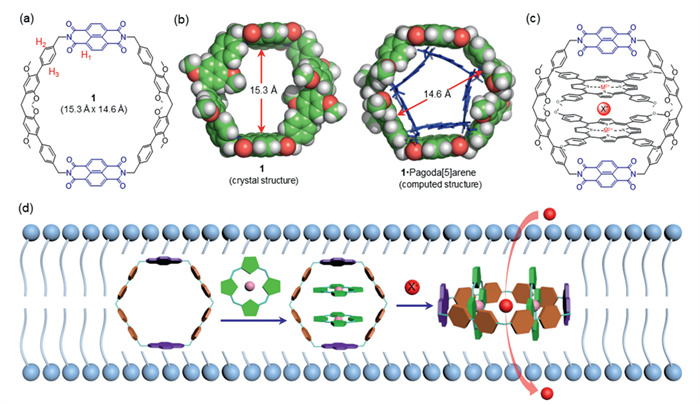
Recently we reported a naphthalene diimide-based giant macrocycle 1, possessing a giant hexagon-shaped tubular cavity of up to 15.3 and 14.6 Å when fully stretched (Fig. 1a) [60]. This giant cavity demonstrates an adaptive feature in response to the guest molecule pagoda[5]arene [61], exhibiting a smaller cavity in the guest's absence that becomes much larger in its presence (Fig. 1b). Inspired by these early results, we hypothesized that the adaptive giant cavity in 1 might be capable of binding electron-rich porphyrins (G1) or metalloporphyrins (Gns, n = 2-5).
Figure 1
Figure 1.
(a) Structure of host 1. (b) Crystal and computed structures of 1 and complex 1·pagoda[5]arene [60], illustrating an adaptive nature of the interior cavity. (c) A possibly formed 1:2 sandwich supramolecular structure of 1 with an anion-bound dimeric metalloporphyrin. (d) Proposed self-assembly process for forming a supramolecular ensemble for facilitating transmembrane anion transport.
Indeed, through our current continued investigation of 1-mediated host-guest chemistry, we demonstrate here that 1 can bind two Gn molecules in its giant cavity, forming a sandwiched 1:2 host-guest complex 1·(Gn)2 (Fig. 1c). And to our best knowledge, this is the first example of cavity-containing hosts that can bind two porphyrin molecules in its adaptive cavity. Further, we show that such a dimeric Co2+-porphyrin (G3)2 geometrically confined in 1 readily promotes far more efficient anion transports than its free monomeric counterpart G3 by up to 35 folds through a dynamic metal-anion bond (Fig. 1d).
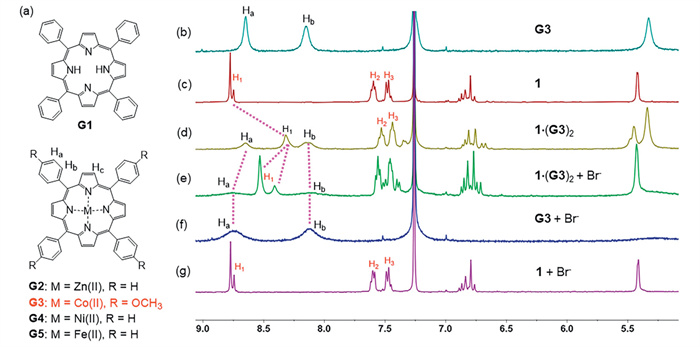
Commercially available G1-G5 were selected to investigate their binding properties with host 1. 1H NMR experiments were first carried out to evaluate the host-guest complexation in CDCl3. As shown in Figs. 2a-c, mixing 1 and G3 at 1:2 molar ratio generated one set of proton signals distinctively different from those of free host and free guest, suggesting not only the formation of a new complex but also the association and dissociation between 1 and G3 to be a fast-exchange process. Specifically, the H1 signal in 1 shifts up field largely by 0.46 ppm, which indicated that 1 experienced a shielded magnetic environment provided by G3. Together with upfield changes in the chemical shift for protons H2 and H3 and those from 3.5–4.0 ppm (Fig. S1 in Supporting information) in 1, we can conclude that the bound G3 molecules largely reside in the cavity of 1, likely forming a sandwich supramolecular structure 1·(G3)2. Similarly, 1 is also found to be capable of binding guest molecules of G1, G2, G4 and G5 at 1:2 molar ratio, possibly producing complexes 1·(Gn)2 (Figs. S2-S5 in Supporting information). Additionally, UV-vis and fluorescence experiments were also conducted to investigate the complexation process between 1 and Gn. As shown in Fig. S34 and S35 (Supporting information), the ultraviolet absorption and fluorescence emission intensity of Gn changed dramatically after the addition of 0.5 equiv. of 1, which further confirmed the formation of complexes 1·(Gn)2.
Figure 2
Figure 2.
Structures of Gns (a) and partial 1H NMR spectra (400 MHz, CDCl3, 298 K) of (b) G3, (c) 1, (d)1·(G3)2, (e) 1·(G3)2 + 10 equiv. of Br−, (f) G3 + 10 equiv. of Br− and (g) 1 + 10 equiv. of Br−. [1] = [1·(G3)2] = 1.0 mmol/L and [G3] = 2.0 mmol/L.
To quantitatively measure the association constants (Ka) between 1 and Gns (n = 1-5), 1H NMR titrations were conducted by monitoring changes in chemical shift of H1 in 1. The mole-ratio plot confirms all binding stoichiometries between 1 and Gns to be 1:2 (Figs. S6-S25 in Supporting information). Accordingly, Ka values were calculated for the 1:2 complexes 1·(Gn)2 using the BindFit software. As summarized in Table 1, while we are not exactly sure why G3 demonstrates a considerable allosteric binding cooperativity value of 1.37 with Ka1 = (4.78 ± 0.15) × 102 L/mol and Ka2 = (1.63 ± 0.23) × 102 L/mol, other non-G3 guests however show negligible cooperativity, with the first Gn bound more tightly than the second Gn by 23-334 folds. Moreover, UV-vis spectroscopy Job plot experiments were also performed to determine the stoichiometry of the complex, and the results indicate the formation of a 1:2 complex between 1 and Gn (Fig. S32 in Supporting information), which are consistent with those obtained from NMR molar ratio analysis.
Table 1
Table 1.
Association constants (Ka) and cooperativity factors (α) for 1:2 complexes formed between 1 and Gns in CDCl3 at 298 K.
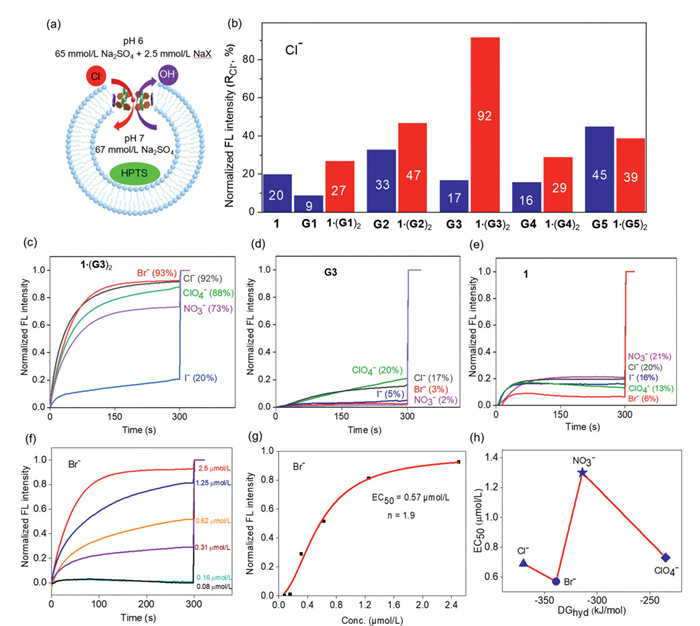
Prompted by the high likelihood that the formed sandwich structures 1·(Gn)2 might facilitate cross-membrane anion transport via dynamic metal-ligand interaction, we conducted the pH-sensitive HPTS assay, having the intravesicular region filled with 0.1 mmol/L HPTS and 67 mmol/L Na2SO4 at pH 7.0 and the extravesicular region with 65 mmol/L Na2SO4 and 2.5 mmol/L NaX (X− = Cl−, Br−, I−, NO3− and ClO4−) at pH 6.0. If 1·(Gn)2 does not transport or transports cations not as well as the anions, the transporter-mediated influx of anions will have to be accompanied by the influx of H+ or efflux of OH−, resulting in an increase in intravesicular pH and the fluorescence intensity of the HPTS dye (Fig. 3a). Using this assay and as illustrated in Fig. 3b, among all the tested complexes 1·(Gn)2 at 2.5 µmol/L, only 1·(G3)2 displays a fractional ion transport activity value (RCl−) of 92%, which is much larger than the combined value of 37% (20% from 1 at 2.5 µmol/L and 17% from G3 at 5.0 µmol/L). Coincidentally yet intriguingly, 1·(G3)2 is the only complex whereas 1 exhibits a positive cooperativity in binding two molecules of G3 (Table 1). After considering the transport activities of 1 and G3 as conservatively estimated in Table S1 (Supporting information), the chloride transport activity of 1·(G3)2 at 2.5 µmol/L is at least 92%, which is 5.4 times that of G3 at 5.0 µmol/L.
Figure 3
Figure 3.
(a) Schematic illustration of the HPTS assay for measuring the Cl− transport activity, applying the pH-sensitive HPTS dye trapped inside LUV under a pH gradient of 7 to 6. (b) Anion transport activities (RCl−) of 1, Gn and 1·(Gn)2; RCl− = (ICl− - I0)/(ITriton - I0). (c–e) Present anion transport activities for Cl−, Br−, I−, NO3− and ClO4− by 1·(G3)2, G3 and 1. (f) and (g) Illustrate EC50 value determination for Br− for 1·(G3)2. (h) EC50 values vs. hydration energies for 1·(G3)2-mediated anion transport. HPTS = 8-hydroxypyrene-1, 3, 6-trisulfonic acid; [1] = [1·(G3)2] = 2.5 µmol/L and [Gn] = 5.0 µmol/L.
Applying the same HPTS assay in Fig. 3a after replacing 65 mmol/L Na2SO4 + 2.5 mmol/L NaX with 67 mmol/L Na2SO4 at pH 8.0, we found that 1·(G3)2 at 2.5 µmol/L elicits no detectable ion transport activity (Fig. S27 in Supporting information). Substituting Na2SO4 with K2SO4 in both intra- and extravesicular regions leads to the same observation. These findings confirm the inability of 1·(G3)2 to transport both Na+ and K+ ions.
Furthermore, enhanced ion transport activities arising from the confined dimeric G3 are also seen when anions such as Br−, NO3− and ClO4− are examined (Figs. 3c-e). Backed by the same method for conservatively estimating transport activity (Table S2 in Supporting information), the anion-transporting capacity of 1·(G3)2 increases by 30 folds for Br−, 35 folds for NO3− and 3.4 folds for ClO4− with respect to those of G3 (Fig. 3cvs.3d).
Using the well-established Hill analysis, the EC50 value at which 50% ion transport activity is reached was determined to be 0.69, 0.57, 1.30 and 0.74 µmol/L for Cl−, Br−, NO3− and ClO4−, respectively (Figs. 3f-h and Fig. S28 in Supporting information).
To evaluate whether the introduction of 1·(G3)2 maintains membrane integrity, we conducted membrane leakage assays. As shown in Fig. S33 (Supporting information), it was found that membrane-lytic melittin results in efflux of 58% and 99% CF dye from LUVs at 5 and 25 nmol/L, respectively, but incorporation of 1·(G3)2 at a concentration as high as 2.5 µmol/L produces an only negligible CF efflux of 3%. These comparative studies clearly support well-maintained membrane integrity in the presence of 1·(G3)2 at high concentrations.
Consistent with the above anion transport studies, 1H NMR titrations verify the ability of 1·(G3)2 to bind various anions. Specifically, addition of 10 equiv. Br− ion to the solution of 1·(G3)2 in CDCl3 results in significant downfield changes in the chemical shift of Ha and H1, suggesting the effective binding of Br− anion by 1·(G3)2. The fact that Br− exerts considerable impact on Ha from G3 (Fig. 2bvs.2f) but no influence on H1 from 1 (Fig. 2cvs.2g) confirms G3 from 1·(G3)2 to be responsible for the 1·(G3)2-mediated binding of Br− anions. The additional fact that Br− makes no difference in chemical shift but does make the shape and height different for both Ha and Hb from G3 and 1·(G3)2 (Fig. 2evs.2f) suggests Br− to interact mainly with G3 from 1·(G3)2. Further investigations show that 1·(G3)2 can also bind Cl−, NO3− and ClO4− (Figs. S29-S31 in Supporting information).
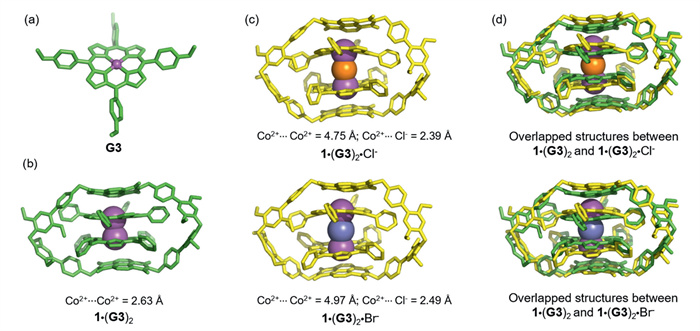
To elucidate the structural basis for the anion transport activity of complex 1·(G3)2, we sought to characterize its solid-state structure. Despite repeated attempts, we were unable to obtain single crystals of the complex. Instead, crystallization invariably resulted in the separation of pure host 1 or guest G3 (CCDC No. 2492337, Fig. 4a). With a stoichiometry 1:2 molar ratio inferred from the solution binding profile, we applied M06-2X/6-31G(d) to optimize complexes of 1·(G3)2 with and without Cl− or Br− (Figs. 4b-d). The computed structures reveal the formation of a Co2+···Co2+ bond of 2.63 Å inside the macrocycle-confirmed dimeric metalloporphyrin (Fig. 4b). This results in a tightly packed complex 1·(G3)2, seemingly leaving no entrance space for anions. Nevertheless, the presence of Cl− and Br− appears to break the Co2+···Co2+ bond, increasing the Co2+···Co2+ distances to 4.75 Å and 4.97 Å (Fig. 4c), respectively. Together with the overlapped structures shown in Fig. 4d, these computational findings suggest a highly dynamic nature of the cage structure and its associated complexes as well as dynamic metal-anion interactions, enabling the dynamic formation of the Co2+···Co2+ and Co2+-anion bonds and their subsequent breaking for the anion to bind and release when crossing the membrane as sketched in Fig. 1d.
Figure 4
Figure 4.
(a) Crystal structure of G3. (b-d) Describe the computationally optimized structures of 1·(G3)2, 1·(G3)2·Cl− and 1·(G3)2·Br− at the level of M06-2X/6-31G(d) in the gas phase as well as their overlapped structures.
To summarize, we have successfully demonstrated a previously unexplored strategy toward construction of an artificial anion-transporting system. This was achieved by using a giant macrocycle to bind and constrain two Co2+-porphyrin complexes in its large adaptive tubular cavity while leaving sufficiently large, confined space for anions to bind and release through dynamic metal-anion interactions. This strategy effectively converts an uncompetitive transporter Co2+-porphyrin into a highly efficient anion-transporting, sandwiched host-guest complex, displaying good EC50 values of 0.57–1.30 µmol/L for Cl−, Br−, ClO4− and NO3− and activity enhancements by up to 35 folds over monomeric Co2+-porphyrin. This geometric confinement-based approach might instigate others or find new inspiring uses in designing diverse types of artificial transmembrane transporter systems, possibly benefiting multidisciplinary applications in chemistry, materials sciences, biology and medicines.
Declaration of competing interest
The authors declare that they have no known competing financialinterestsor personal relationships that could have appeared to influence the work reported in this paper.
This work was supported by the National Natural Science Foundation of China (Nos. 22501049, 21602055, 22271049 and 22371048), Natural Science Foundation of Hunan Province (No. 2023JJ50414), Natural Science Foundation of Fujian Province (No. 2025J08021) and a start-up grant from Fuzhou University.
Supplementary materials
Supplementary material associated with this article can be found, in the online version, at doi:10.1016/j.cclet.2025.112355.
Figure 1
(a) Structure of host 1. (b) Crystal and computed structures of 1 and complex 1·pagoda[5]arene [60], illustrating an adaptive nature of the interior cavity. (c) A possibly formed 1:2 sandwich supramolecular structure of 1 with an anion-bound dimeric metalloporphyrin. (d) Proposed self-assembly process for forming a supramolecular ensemble for facilitating transmembrane anion transport.
Figure 3
(a) Schematic illustration of the HPTS assay for measuring the Cl− transport activity, applying the pH-sensitive HPTS dye trapped inside LUV under a pH gradient of 7 to 6. (b) Anion transport activities (RCl−) of 1, Gn and 1·(Gn)2; RCl− = (ICl− - I0)/(ITriton - I0). (c–e) Present anion transport activities for Cl−, Br−, I−, NO3− and ClO4− by 1·(G3)2, G3 and 1. (f) and (g) Illustrate EC50 value determination for Br− for 1·(G3)2. (h) EC50 values vs. hydration energies for 1·(G3)2-mediated anion transport. HPTS = 8-hydroxypyrene-1, 3, 6-trisulfonic acid; [1] = [1·(G3)2] = 2.5 µmol/L and [Gn] = 5.0 µmol/L.
Figure 4
(a) Crystal structure of G3. (b-d) Describe the computationally optimized structures of 1·(G3)2, 1·(G3)2·Cl− and 1·(G3)2·Br− at the level of M06-2X/6-31G(d) in the gas phase as well as their overlapped structures.


 DownLoad:


 下载:
下载:


 下载:
下载:

