Key Laboratory of Applied Surface and Colloid Chemistry, Ministry of Education, School of Chemistry and Chemical Engineering, Shaanxi Normal University, Xi’an 710119, China
Received Date:
17 July 2025 Accepted Date:
11 September 2025 Revised Date:
06 September 2025 Available Online:
15 November 2026
Abstract:
The electrocatalytic oxygen reduction reaction (ORR) holds significant importance in new energy conversion and storage technologies. Improving the activity of the ORR is vital for the practical applications of these technologies. Herein, we report on the construction of a dinuclear Co corrole complex 1 featuring a bimetallic active center and its electrocatalytic ORR features in acidic, neutral, and alkaline aqueous solutions. Experimental studies demonstrate that Co corrole 1 exhibits excellent electrocatalytic ORR activity for the four-electron reduction of O2 to water. In a 0.1 mol/L KOH solution, 1 achieves a half-wave potential (E1/2) of 0.88 V versus RHE, significantly outperforming its mononuclear analogue Co corrole 2 (0.75 V versus RHE). Importantly, complex 1 also exhibits large anodic shifts of 290 mV (in pH 7.0 phosphate buffer) and 150 mV (in 0.5 mol/L H2SO4) for the half-wave potential as compared to its mononuclear analogue 2. Moreover, the number of electrons transferred during the electrocatalytic ORR with dinuclear complex 1 is up to 3.86. These findings demonstrated that dinuclear Co corrole sites significantly facilitate the four-electron ORR. Therefore, this work is significant to present dinuclear Co corrole 1 as a highly active and selective electrocatalyst for the four-electron ORR and to demonstrate the crucial synergistic effect of well-designed bimetallic active sites for efficient electrocatalytic ORR.
Electrocatalytic oxygen reduction reaction (ORR), serves as a pivotal reaction involved in many energy conversion and storage technologies, such as fuel cells and metal-air batteries [1-6]. O2 can be reduced by four electrons to generate H2O or by two electrons to produce H2O2 [7-9]. From an energy conversion point of view, the four-electron (4e−) reduction of O2 is more favored [10-12]. Nevertheless, the transfer of multiple electrons and multiple protons during the ORR leads to its sluggish kinetics nature [10,11]. As a result, highly active and selective ORR electrocatalysts are required. Pt and Pt-based alloys are highly efficient for the four-electron ORR, but the low earth abundance and the very high cost of this noble metal significantly limit the wide application of Pt-based catalysts [13-16]. Therefore, the development of efficient ORR electrocatalysts based on earth-abundant metal elements has attracted increasing interest in the past decade [17-19]. Extensive studies confirm the ORR efficiency of many first-row transition metal complexes, such as those of Mn [20-22], Fe [23-26], Co [27-29], Ni [30-32], and Cu [33-36]. From these studies, metal complexes of macrocyclic ligands, which feature the M-N4 coordination environment, have emerged as promising candidates. By studying these metal complexes as ORR catalysts, fundamental knowledge regarding structure-function relationships is elucidated, enabling the rational design of efficient molecular electrocatalysts [19,37-40]. However, despite these achievements, developing molecular electrocatalysts that simultaneously deliver high activity, selectivity, and durability for the 4H+/4e− ORR remains an ongoing challenge [10,11,17,25].
In nature, the heme a3-CuB dinuclear site found in cytochrome c oxidases (CcOs) can efficiently catalyze the 4H+/4e− reduction of O2 to H2O under mild conditions [41-43]. This distinctive catalytic center of CcO achieves complete O2-to-H2O conversion through synergistic interactions between its FeⅡ porphyrin unit and a close CuⅠ ion [44,45]. Although extracting this native cofactor while preserving its exceptional activity remains challenging, significant efforts have focused on synthesizing structural mimics of this dinuclear motif [46-48]. Dinuclear catalysts leverage their unique electronic configurations and spatial architectures to enhance ORR performance to simultaneously boost electrocatalytic activity and the four-electron selectivity [49-51]. For example, due to the difficulty to mediate heterolytic O—O bond cleavage at single Co site to generate high-energy terminal Co-oxo intermediate species [10], mononuclear Co complexes in general catalyze the two-electron reduction of O2 and are inefficient to catalyze the four-electron reduction of O2 [4,52]. However, dinuclear Co complexes can realize selective 4H+/4e− ORR. It is proposed that peroxo-bridged dinuclear Co intermediates are formed during the ORR, which can undergo homolytic O—O bond cleavage to achieve the 4H+/4e− ORR [4,10]. With this consideration, a series of Co porphyrin-based dinuclear complexes were designed and synthesized by Collman [53,54], Fukuzumi [55,56], Kadish [57,58], Nocera [59,60], and Cao [61,62], which showed significantly improved activity and selectivity for electrocatalytic 4H+/4e− ORR as compared to their mononuclear counterparts. From these works, it is suggested that the optimal separation between bimetallic centers lies in the range of 4–7 Å [56]. However, currently reported dinuclear molecules typically employ rigid linkers to connect the two metal centers, making it difficult to achieve flexible distance modulation to accommodate the structural changes occurring during O2 activation. Therefore, designing and developing ligands to bring two metal centers into a molecular architecture, which has balanced structural rigidity and flexibility, is required [10].
Recently, metal corroles, which are also macrocyclic complexes with structural similarities as metal porphyrins, have attracted rapidly increasing interest as electrocatalysts for the ORR [63-66]. As compared to dianionic porphyrin ligands, trianionic corrole ligands are more effective to stabilize high-valent metal species, which are key intermediates involved in the ORR process [52,67]. On the other hand, by stabilizing high-valent metal species, metal corroles typically have stronger reducing powers than metal porphyrins, making low-valent metal corroles more effective to bind and activate O2 [68,69]. These features enable metal corroles to be generally more active and selective for the ORR electrocatalysis [52,66]. However, despite these benefits of using metal corroles as ORR electrocatalysts, few reports on dinuclear metal corroles for electrocatalytic ORR are known in literature. Consequently, the design and synthesis of dinuclear metal corroles with suitable intermetallic distances is anticipated to meet the demand for developing ORR catalysts with high activity and selectivity.
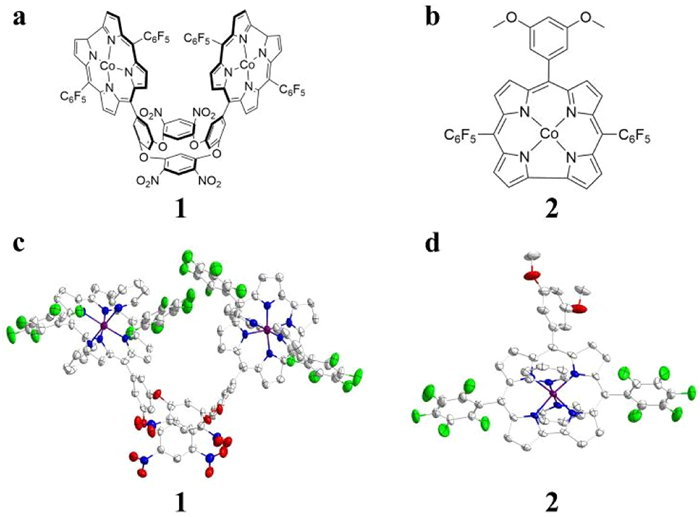
Herein, we report on the design and synthesis of a dinuclear CoⅢ corroles (Fig. 1a), in which the two Co corrole units are linked by a flexible oxacalix[4]arene spacer, along with the characterization of its electrocatalytic ORR properties. We show that under acidic, neutral and alkaline aqueous conditions, dinuclear complex 1 is more active and selective for electrocatalytic 4H+/4e− ORR than its mononuclear CoⅢ corroles analogue 2 (Fig. 1b). Importantly, complex 1 exhibits markedly superior electrocatalytic 4H+/4e− ORR activity and selectivity compared to dinuclear Co porphyrins previously reported [56-61]. This performance enhancement of 1 is proposed to be a result of the oxacalix[4]arene-bridged architecture, which has a well-balanced structural rigidity and flexibility to enable effective and cooperative bimetallic catalysis for the ORR [70,71]. Therefore, this work is significant to present a new dinuclear Co corrole 1 as an active and selective electrocatalyst for the four-electron ORR and to showcase the benefits of using dinuclear systems with balanced structural rigidity and flexibility to mediate ORR.
Figure 1
Figure 1.
Molecular structures of Co corroles (a) 1 and (b) 2. Thermal ellipsoid plots (50% probability) of the X-ray structure of Co corroles (c) 1 and (d) 2. Color code: carbon, grey; fluorine, green; nitrogen, blue; oxygen, red; cobalt, purple. Hydrogen atoms and solvent molecules are omitted for clarity.
CoⅢ corroles complexes 1 and 2 were synthesized following the procedures outlined in Schemes S1 and S2 (Supporting information), respectively. The synthetic details and characterization data are described in the Supporting Information (Figs. S1-S8 in Supporting information). The identity and purity of complexes 1 and 2 were confirmed by single-crystal X-ray crystallography (Figs. 1c and d), 1H NMR spectroscopy (Figs. S4 and S6), and high-resolution mass spectrometry (HRMS, Figs. S5 and S7). High-quality single crystals of complex 1 were grown by slow ether diffusion into a pyridine and dimethylformamide mixture solution of 1. High-quality single crystals of complex 2 suitable for X-ray diffraction studies were obtained via slow evaporation of a mixture solution containing pyridine, hexane, methanol, and dichloromethane. Crystallographic parameters of complexes 1 and 2 are provided in the Supporting Information (Table S1 in Supporting information). As depicted in Fig. 1c, each Co center of 1 exhibits a six-coordinated octahedral geometry. Each Co ion is coordinated by the corrole macrocycle via four equatorial Co—N bonds, while the two axial sites of Co are occupied by pyridine ligands. Bond valence sum and charge balance calculations suggested the CoⅢ oxidation state for both Co ions in complex 1. This result is consistent with CoⅢ corroles reported previously [66]. Structural analysis revealed that the CoⅢ center in complex 2 adopts a coordination environment nearly identical to that presented in complex 1 (Fig. 1d). The UV–vis spectrum of complex 1 exhibited two Soret bands (416 and 436 nm) and two Q-band peaks (586 and 614 nm) (Fig. S8). Furthermore, complex 2 displayed a nearly identical UV–vis spectrum. These spectral similarities indicate that the CoⅢ ions in complexes 1 and 2 share almost identical electronic structure. Note that single crystals of complexes 1 and 2 were used in subsequent electrochemical studies.
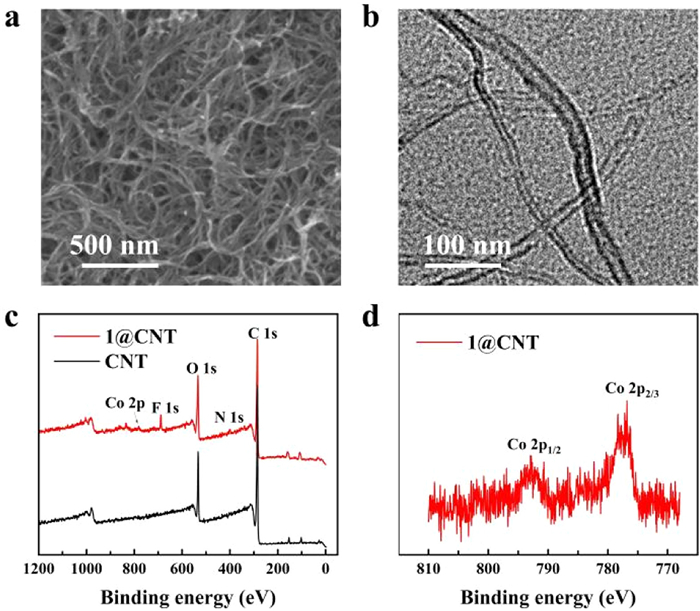
The electrocatalytic ORR performance of CoⅢ corroless 1 and 2 were examined in aqueous solutions of pH 0, 7, and 13. To enhance conductivity during electrocatalysis, complexes 1 and 2 were each loaded onto carbon nanotubes (CNTs) via physical sonication-assisted dispersion. Morphological characterization of the resulted hybrids 1@CNT and 2@CNT, conducted via scanning electron microscopy (SEM, Fig. 2a) and transmission electron microscopy (TEM, Fig. 2b), revealed no aggregation of molecules of these complexes. X-ray photoelectron spectroscopy (XPS) analysis further confirmed the successful loading of CoⅢ corroles complexes on CNTs. The XPS spectrum of 1@CNT (Fig. 2c) displayed weak but discernible Co signals, with Co 2p3/2 and Co 2p1/2 binding energies observed at 780.3 eV and 795.5 eV, respectively (Fig. 2d). These values are in good agreements with the characteristic electronic structure of CoⅢ. Comparable spectral features were also observed with 2@CNT (Fig. S9 in Supporting information). These results indicated that both CoⅢ corroless 1 and 2 maintain their molecular structures after loading on CNTs.
Figure 2
Figure 2.
(a) SEM and (b) TEM images of 1@CNT. (c) Full XPS spectra of 1@CNT and unmodified CNTs. (d) XPS spectra of 1@CNT in the Co 2p region.
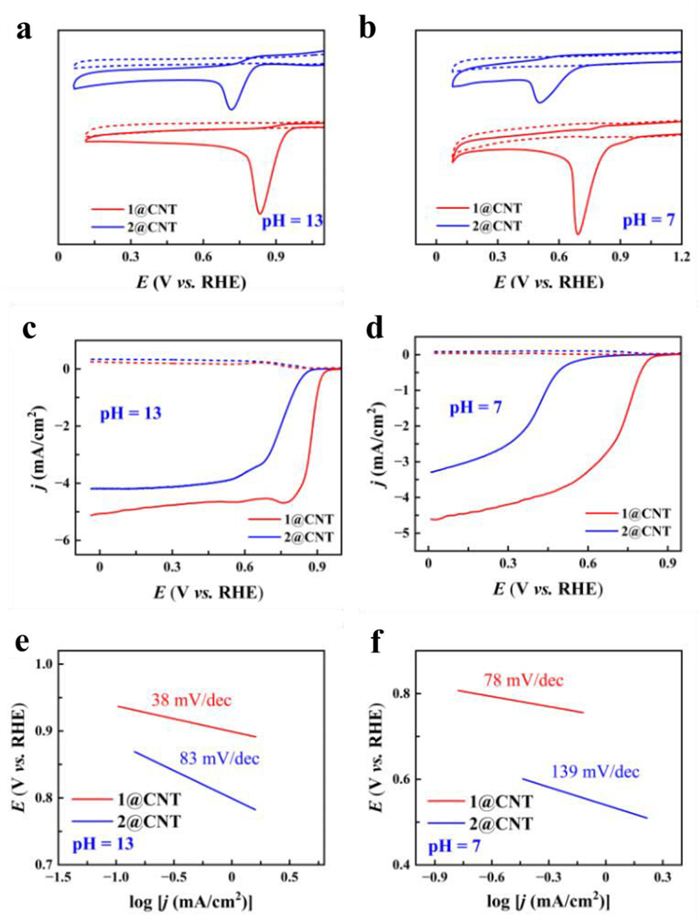
The electrocatalytic O2 reduction behaviours of 1@CNT and 2@CNT were first evaluated in 0.1 mol/L KOH aqueous solutions. As shown in Fig. 3a, the cyclic voltammetry (CV) of a glassy carbon (GC) electrode loaded with 1@CNT displayed a distinct catalytic wave with the peak at 0.85 V versus the reversible hydrogen electrode (RHE) under an O2-saturated solution. No such catalytic wave was observed under N2. This result indicated that 1@CNT is active for the electrocatalytic ORR in alkaline solutions. Similarly, 2@CNT displayed electrocatalytic ORR activity with a peak at 0.72 V versus RHE. Additionally, CV measurements of 1@CNT and 2@CNT were conducted in neutral phosphate buffer solutions (pH 7) and in 0.5 mol/L H2SO4 aqueous solutions. As shown in Fig. 3b, in pH 7 phosphate buffer solutions, both 1@CNT and 2@CNT exhibited catalytic ORR currents, with peak potentials at 0.68 V and 0.44 V versus RHE, respectively. In acidic 0.5 mol/L H2SO4 electrolytes, electrocatalytic ORR with the peak potential occurred at 0.58 V versus RHE for 1@CNT and 0.49 V versus RHE for 2@CNT was also observed (Fig. S10 in Supporting information). In all these measurements under acidic, neutral, and alkaline conditions, 1@CNT displays much higher activity than 2@CNT in terms of anodically shifted ORR peak potentials and also significantly larger (i.e., three folds) electrocatalytic current densities. These results indicate that the dual Co sites in 1 are intrinsically more efficient than the single Co site in 2 for ORR electrocatalysis. Moreover, control experiments were performed to evaluate the ORR activity of unmodified CNTs and non-supported complexes 1 and 2 under acidic, neutral and alkaline conditions (Figs. S11-S19 in Supporting information), showing that unmodified CNTs and non-supported complexes exhibit poor electrocatalytic ORR performance.
Figure 3
Figure 3.
CVs of GC electrodes loaded with 1@CNT and 2@CNT under O2 and N2 in (a) 0.1 mol/L KOH aqueous solutions and (b) neutral phosphate buffer solutions. RRDE data with 1@CNT and 2@CNT in (c) 0.1 mol/L KOH aqueous solutions and (d) neutral phosphate buffer solutions. Tafel plots for 1@CNT and 2@CNT in (e) 0.1 mol/L KOH aqueous solutions and (f) neutral phosphate buffer solutions.
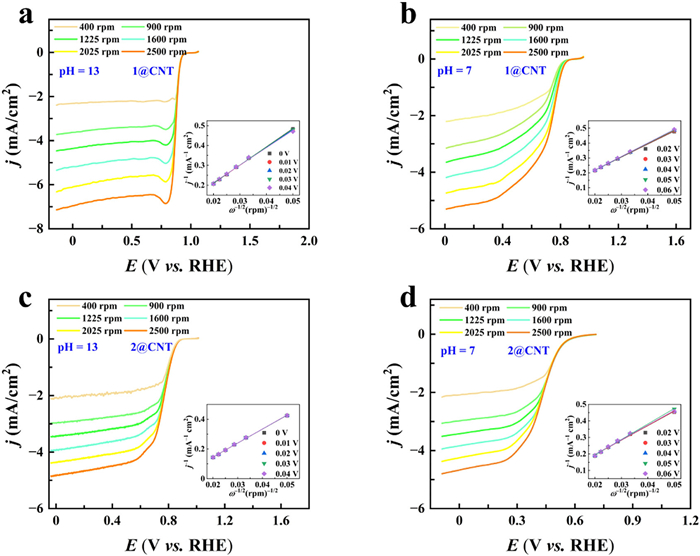
The number (n) of electrons transferred per O2 molecule during the ORR was quantified by using rotating disk electrode (RDE) and rotating ring-disk electrode (RRDE) measurements. In 0.1 mol/L KOH aqueous solutions, the linear sweep voltammetry (LSV) of 1@CNT displayed a pronounced electrocatalytic ORR current, with a half-wave potential (E1/2) of 0.88 V versus RHE at a rotation speed of 1600 rpm (Fig. 3c). The LSV of 2@CNT also showed an electrocatalytic ORR current with E1/2 = 0.73 V versus RHE. The activity trends observed from RRDE measurements is consistent with the results observed from the above-mentioned CV studies, confirming the superior ORR activity of 1@CNT as compared to 2@CNT. Moreover, 1@CNT exhibited a lower ORR Tafel slope (38 mV/dec) than 2@CNT (83 mV/dec) (Fig. 3e), revealing enhanced electrocatalytic kinetics during the ORR. In RRDE measurements, the n value was calculated to be 3.52 for 1@CNT and 3.40 for 2@CNT (Fig. S22 in Supporting information). The n values derived from Koutecky-Levich (K-L) plots in RDE experiments was quantified to be 3.58 for 1@CNT (Fig. 4a) versus 3.50 for 2@CNT (Fig. 4c). In neutral buffer solutions (pH 7), the ORR half-wave potentials measured are 0.73 V versus RHE for 1@CNT versus 0.44 V versus RHE for 2@CNT (Fig. 3d), while the ORR Tafel slopes are 78 mV per dec for 1@CNT and 139 mV/dec for 2@CNT (Fig. 3f). RRDE measurements yielded n = 3.86 for 1@CNT and 3.61 for 2@CNT (Fig. S23 in Supporting information). K-L analysis gave similar values of n = 3.65 for 1@CNT and 3.53 for 2@CNT (Figs. 4b and d, respectively). Moreover, similar activity trends were observed in acidic solutions. In 0.5 mol/L H2SO4, 1@CNT exhibited an ORR half-wave potential of E1/2 = 0.66 V versus RHE, while 2@CNT exhibited an ORR half-wave potential of E1/2 = 0.51 V versus RHE (Fig. S20 in Supporting information). The corresponding Tafel slopes are 126 mV/dec for 1@CNT and 166 mV/dec for 2@CNT (Fig. S21 in Supporting information). In RRDE measurements, the n values were 3.79 for 1@CNT and 3.40 for 2@CNT (Fig. S24 in Supporting information), and K-L analysis also gave similar values of n = 3.67 for 1@CNT and 3.30 for 2@CNT (Figs. S25-S28 in Supporting information). From these results, we can conclude that dinuclear Co corrole 1 is more active and selective than its mononuclear analogue 2 for electrocatalytic O2 reduction to give H2O under acidic, neutral, and alkaline solutions. The turnover frequency (TOF) values of 1@CNT are consistently larger than those of 2@CNT under all acidic, neutral and alkaline conditions (Table S2 in Supporting information). This result further demonstrated that dinuclear Co corrole 1 exhibited superior ORR activity compared to mononuclear analogue 2. It is noteworthy that, under identical conditions, dinuclear Co corrole 1 exhibits superior ORR activity compared to most mononuclear and dinuclear molecular catalysts, as well as material-based catalysts, with the exception of Pt-based systems (Table S3 in Supporting information). In order to achieve insights into the reaction mechanism during ORR process, in situ Raman spectroscopy was conducted to study the ORR with 1@CNT and 2@CNT in pH 7 phosphate buffer solutions. During in situ Raman studies, two distinct characteristic Raman signals were observed at 1275 and 1390 cm−1 with 1@CNT (Fig. S29 in Supporting information), which could be assigned to Co—O—O—Co and Co-superoxo species, respectively [72,73]. For 2@CNT, only the Co-superoxo signal at 1395 cm−1 was detected (Fig. S30 in Supporting information). These results suggest that, compared to mononuclear analogue 2, dinuclear complex 1 can form bridging peroxo species through the cooperation between the two Co sites.
Figure 4
Figure 4.
RDE data of 1 in (a) O2-saturated 0.1 mol/L KOH and (b) neutral aqueous solutions at different rotation speeds. RDE data of 2 in (c) O2-saturated 0.1 mol/L KOH and (d) neutral aqueous solutions at different rotation speeds. Inset: corresponding K-L plots.
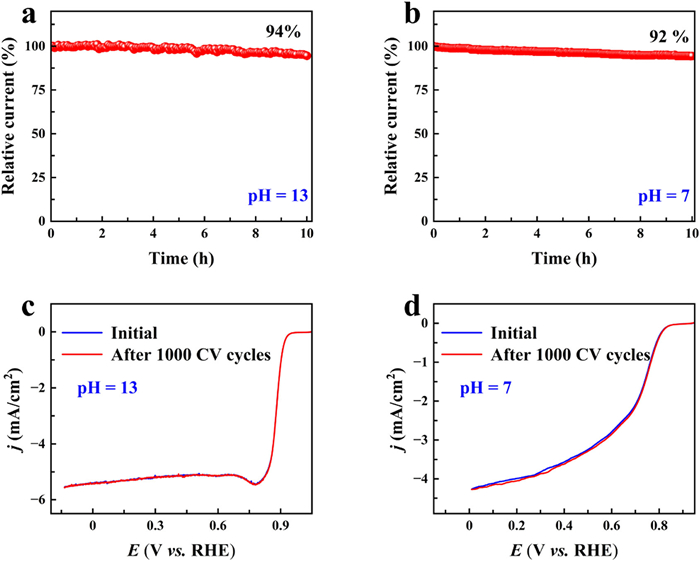
The durability of 1@CNT and 2@CNT under electrolytic ORR conditions was evaluated. Under chronoamperometric testing at 0.67 V versus RHE in O2-saturated 0.1 mol/L KOH aqueous solutions, 1@CNT exhibited 6% current decay over 10 h (Fig. 5a), while 2@CNT showed 15% degradation under identical conditions (Fig. S31 in Supporting information). In neutral solutions, 1@CNT and 2@CNT displayed current decays of 8% (Fig. 5b) and 16% (Fig. S32 in Supporting information), respectively, across 10-h electrolysis. In 0.5 mol/L H2SO4 aqueous solutions, 1@CNT maintained 86% of its initial current (Fig. S33 in Supporting information), while 2@CNT maintained 81% of its initial current (Fig. S34 in Supporting information). Post-stability CV (1000 cycles in 0.1 mol/L KOH solutions) revealed negligible activity loss for 1@CNT, showing nearly overlapping between the initial and post-cycling LSVs (Fig. 5c). Similar stability results were observed for 1@CNT in neutral (Fig. 5d) and acidic media (Fig. S35 in Supporting information). Furthermore, we conducted XPS tests on complex 1 after electrolysis and compared it with the XPS results before electrolysis. No significant differences were observed, further demonstrating the excellent electrochemical stability of 1 during electrocatalytic ORR (Figs. S36-S38 in Supporting information). These results collectively establish 1@CNT and 2@CNT as durable ORR molecular electrocatalysts operable across acidic, neutral, and alkaline environments.
Figure 5
Figure 5.
Controlled-potential electrolysis of GC electrodes loaded with 1@CNT (a) in 0.1 mol/L KOH aqueous solutions at 0.67 V versus RHE and (b) in neutral aqueous solutions at 0.40 V versus RHE. LSVs using GC disk electrodes loaded with 1@CNT before and after 1000 CV cycles (c) in 0.1 mol/L KOH solution and (d) in neutral solution.
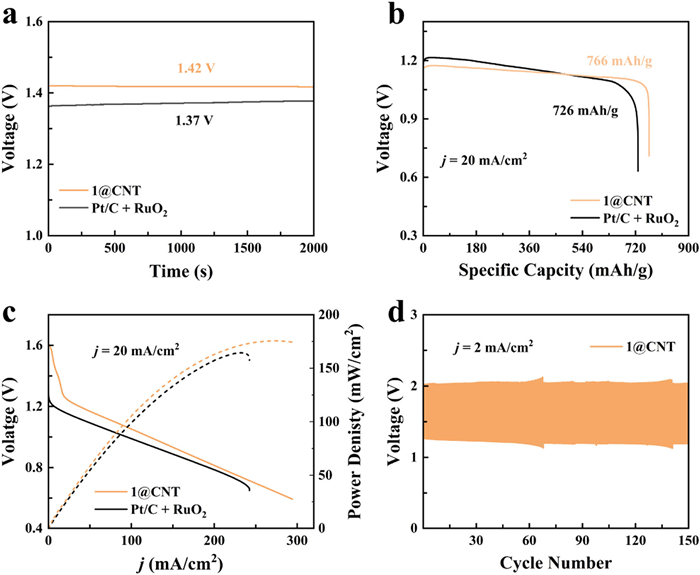
Due to high ORR activity, we used 1 as the air electrode catalyst to assemble Zn-air batteries. The battery assembled with 1@CNT shows an open-circuit voltage of 1.42 V, while it is 1.37 V for the battery assembled with Pt/C + RuO2 (Fig. 6a). The specific capacity of the battery with 1@CNT is 766 mAh/g, which is larger than that of a Pt/C + RuO2-based battery (726 mAh/g) (Fig. 6b). The battery peak power density is 175 mW/cm2 with 1@CNT, while it is 163 mW/cm2 with Pt/C + RuO2 (Fig. 6c). Moreover, the battery with 1@CNT showed high durability in 150 cycling tests (Fig. 6d).
Figure 6
Figure 6.
(a) Open-circuit plot, (b) discharge capacity, and (c) charge-discharge polarization and corresponding peak power density of batteries assembled with 1@CNT and Pt/C + RuO2. (d) The 150 cycling test of the battery with 1@CNT at 2 mA/cm2.
In conclusion, we report on the design, synthesis as well as ORR electrocatalytic features of a dinuclear Co corrole 1. By connecting two Co corrole units through an oxacalix[4]arene spacer, we made dinuclear Co corrole 1. We showed that 1 exhibited significantly boosted four-electron ORR activity and selectivity compared to its mononuclear Co corrole analogue 2 under all acidic, neutral and alkaline conditions. This superiority is attributed to the dinuclear Co active center in 1. We propose that during ORR electrocatalysis, the flexible oxacalix[4]arene spacer enable the two Co corrole units to approach each other, forming a clamshell-like cavity to be able to effectively capture O2. The proximity of the two Co sites facilitates the synergistic activation of O2 and promotes following O—O bond cleavage. This work not only elucidates the critical role of dinuclear metal centers in enhancing ORR activity but also provides a novel strategy for designing highly active and selective ORR electrocatalysts. Furthermore, leveraging flexible bridging frameworks to enable cooperative interactions between dual metal sites is shown to be a valuable molecular design strategy, which can be extended to the design and development of electrocatalysts for the activation of other small molecules.
CRediT authorship contribution statement
Haowen He: Formal analysis, Data curation. Qian Zhao: Formal analysis, Data curation. Zhimeng Wang: Data curation. Lihuan Yang: Data curation. Yimei Gao: Data curation. Haitao Lei: Writing – review & editing, Writing – original draft, Funding acquisition. Rui Cao: Writing – review & editing, Writing – original draft, Supervision, Funding acquisition.
Declaration of competing interest
The authors declare that they have no known competing financial interests or personal relationships that could have appeared to influence the work reported in this paper.
Acknowledgments
We are grateful for the finical support from National Natural Science Foundation of China (Nos. 22371177, 22325202, 22171176 and 22361142751), Key Research and Development Program of Shaanxi (No. 2023-YBGY-296), and Fundamental Research Funds for the Central Universities (Nos. GK202403004 and GK202306001).
Supplementary materials
Supplementary material associated with this article can be found, in the online version, at doi:10.1016/j.cclet.2025.111832.
[1]
K.E. Dalle, J. Warnan, J.J. Leung, et al., Chem. Rev. 119 (2019) 2752–2875. doi: 10.1021/acs.chemrev.8b00392
X. Li, X.P. Zhang, M. Guo, et al., J. Am. Chem. Soc. 143 (2021) 14613–14621. doi: 10.1021/jacs.1c05204
[69]
B. Mondal, S. Chattopadhyay, S. Dey, et al., J. Am. Chem. Soc. 142 (2020) 21040–21049. doi: 10.1021/jacs.0c08654
[70]
E. Hao, F.R. Fronczek, M.G.H. Vicente, J. Org. Chem. 71 (2006) 1233–1236. doi: 10.1021/jo051964h
[71]
D. Jokic, Z. Asfari, J. Weiss, Org. Lett. 4 (2002) 2129–2132. doi: 10.1021/ol0258583
[72]
Z. You, B. Wang, Z. Zhao, et al., Adv. Mater. 35 (2022) 2209129. doi: 10.1002/adma.202209129
[73]
Z. Li, W. Cui, Q. Wu, et al., J. Phys. Chem. C 128 (2024) 20974–20982. doi: 10.1021/acs.jpcc.4c05906
Figure 1
Molecular structures of Co corroles (a) 1 and (b) 2. Thermal ellipsoid plots (50% probability) of the X-ray structure of Co corroles (c) 1 and (d) 2. Color code: carbon, grey; fluorine, green; nitrogen, blue; oxygen, red; cobalt, purple. Hydrogen atoms and solvent molecules are omitted for clarity.
Figure 3
CVs of GC electrodes loaded with 1@CNT and 2@CNT under O2 and N2 in (a) 0.1 mol/L KOH aqueous solutions and (b) neutral phosphate buffer solutions. RRDE data with 1@CNT and 2@CNT in (c) 0.1 mol/L KOH aqueous solutions and (d) neutral phosphate buffer solutions. Tafel plots for 1@CNT and 2@CNT in (e) 0.1 mol/L KOH aqueous solutions and (f) neutral phosphate buffer solutions.
Figure 4
RDE data of 1 in (a) O2-saturated 0.1 mol/L KOH and (b) neutral aqueous solutions at different rotation speeds. RDE data of 2 in (c) O2-saturated 0.1 mol/L KOH and (d) neutral aqueous solutions at different rotation speeds. Inset: corresponding K-L plots.
Figure 5
Controlled-potential electrolysis of GC electrodes loaded with 1@CNT (a) in 0.1 mol/L KOH aqueous solutions at 0.67 V versus RHE and (b) in neutral aqueous solutions at 0.40 V versus RHE. LSVs using GC disk electrodes loaded with 1@CNT before and after 1000 CV cycles (c) in 0.1 mol/L KOH solution and (d) in neutral solution.
Figure 6
(a) Open-circuit plot, (b) discharge capacity, and (c) charge-discharge polarization and corresponding peak power density of batteries assembled with 1@CNT and Pt/C + RuO2. (d) The 150 cycling test of the battery with 1@CNT at 2 mA/cm2.


 DownLoad:

 下载:


 下载:

