State Environmental Protection Key Laboratory of Integrated Surface Water-Groundwater Pollution Control, School of Environmental Science and Engineering, Southern University of Science and Technology, Shenzhen 518055, China
b.
Department of Environmental Sciences, Macquarie University, Sydney, NSW 2109, Australia
c.
College of Environmental Science and Engineering, Dalian Maritime University, Dalian 116026, China
d.
Department of Molecular Sciences, Macquarie University, Sydney, NSW 2109, Australia
e.
Department of Chemical Engineering, University of Missouri, Columbia, MO 65211, United States
* Corresponding author at: State Environmental Protection Key Laboratory of Integrated Surface Water-Groundwater Pollution Control
School of Environmental Science and Engineering
Southern University of Science and Technology
Shenzhen 518055
China. E-mail address:shuaifei.zhao@mq.edu.au (S. Zhao). 1 These authors contributed equally to this work.
Received Date:
04 May 2019 Accepted Date:
28 May 2019 Revised Date:
22 May 2019 Available Online:
01 March 2020
Abstract:
In this work, we adopt a new tobramycin (TOB)-dopamine coating system to endow thin film composite membranes with excellent antifouling and antimicrobial properties. Combining the hydrophilic and antibiofouling properties of both TOB and polydopamine, the TOB-dopamine modified membrane exhibits improved antifouling and antimicrobial properties compared with the conventional dopamine modified and unmodified membranes. The TOB-dopamine system has two advantages over the conventional modification with dopamine and tris buffer solution. First, TOB-dopamine modification is more efficient than the conventional dopamine modification due to the accelerating effect of TOB on dopamine polymerization. Second, the TOB-dopamine modified membranes exhibit better hydrophilicity, and enhanced antifouling and antimicrobial properties than the conventional dopamine modified membrane. Beyond engineering membranes, the proposed TOB-dopamine system can also be extended for wider surface hydrophilic and antimicrobial modifications.
Membrane separation has been considered as the new generation advanced water purification technology due to its high efficiency and flexibility, and reduced membrane and operating costs [1, 2]. Numerous membranes and membrane processes have been widely used for various water treatment applications, such as desalination and wastewater treatment. The thin film composite (TFC) membrane with a polyamide selective layer and a porous support layer is generally designed for nanofiltration (NF) [3], reverse osmosis (RO) [4] and forward osmosis (FO) [5-7]. These membrane processes are typically employed for advanced water treatment due to the excellent separation performance (i.e., high permeability and selectivity) of the TFC membrane. However, TFC membranes still face the critical challenge of membrane fouling, particularly biofouling [8-10]. Developing membranes with stronger fouling resistance is the fundamental strategy to mitigate fouling and thus minimize its adverse impacts [8, 11]. Many nanomaterials, such as silver [12, 13], carbon nanotubes [14], graphene oxide [15], activated carbon [16], nanodiamonds [17] and polypyrrole [18], have been incorporated into the selective layer, the support layer, or onto the surface of TFC membranes. These nanomaterials can enhance membrane hydrophilicity and/or endow the membrane with biocidal properties, thereby reducing membrane fouling. However, nanoparticle incorporated mem-branes may face the problem of nanoparticle leaching in the long-term operation, particularly when the nanoparticles and the membrane bulk materials have poor compatibility [19].
As a bioinspired polymer with similar chemistry to the adhesive proteins of mussels, dopamine has been a versatile agent for various membrane coating and modification applications [20, 21]. During coating, dopamine self-polymerizes into polydopamine (PDA) in a weak alkaline solution with the presence of oxygen where tris is normally used as the buffer solution [12, 21-23]. PDA is highly hydrophilic due to the catechol, quinone and amine groups in its structure, and highly adhesive to almost all types of substrates via covalent bonding, hydrogen bonding, and electro-static and hydrophobic interactions [21, 24]. On one hand, PDA can act as a platform to improve the interfacial interactions between nanomaterials and surfaces for developing antifouling membranes [25, 26]. On the other hand, PDA can be used directly on the membrane surface [22, 27, 28] or during interfacial polymerization [7, 29, 30] for enhancing membrane fouling resistance.
As a potent antibiotic with a broad antibacterial spectrum [31], tobramycin (TOB) could be an effective chemical for engineering antibiofouling TFC membranes. Similar to PDA, TOB is also highly hydrophilic due to the hydroxyl and amino groups in its structure (Fig. 1a). Additionally, the functional groups of TOB and the tris typically used for dopamine polymerization are almost the same (Fig. S1 in Supporting information). Considering the excellent hydrophilic and antibiofouling properties of PDA and TOB as well as the almost identical functional groups of TOB and the tris, the TOB-dopamine system could be a promising combination in developing antifouling and antimicrobial membranes.
Figure 1
Figure 1.
(a) Schematic illustration of the reaction mechanism between tobramycin (TOB) and dopamine. The circled amino group is the most likely reaction site in TOB due to its lowest required energy for reaction. The circled three sites in dopamine can react with TOB. (b) Time dependent absorbance of different dopamine solutions at 400 nm. The colors of the UV cells after 50-min polymerization suggest the accelerating effect of TOB on the polymerization of dopamine.
In this study, we demonstrate a new efficient TOB-dopamine coating system for engineering antifouling and antimicrobial TFC membranes by surface modification. UV–vis absorbance of the coating solution was performed to confirm the accelerating effect of TOB on dopamine polymerization (Fig. 1b). The surface morphology, roughness and hydrophilicity of the modified membrane were evaluated. Organic fouling resistance of the membranes was investigated by a dead-end filtration cell (Fig. S2 in Supporting information). The static adhesion method with E. coli was used to study the antimicrobial/antibiofouling performance of the modified membrane. The proposed TOB-dopamine system can be extended to various surfaces for hydrophilic and antimicrobial modifications.
For membrane modification, we prepared four coating solutions, including dopamine (2 g/L) in a buffer solution, dopamine (2 g/L) and TOB (2 g/L) in a buffer solution, dopamine (2 g/L) and TOB (2 g/L) in water (without the butter solution), and dopamine (2 g/L) and TOB (4 g/L) in water. The modified membranes with these four solutions were labeled as M1, M2*, M2 and M3, respectively. The unmodified virgin membrane was marked as M0. During the polymerization of dopamine in four different coating solutions, we observed two interesting phenomena. First, TOB accelerated the polymerization rate since the color of the solution containing TOB changed within a shorter time period (Fig. S3 in Supporting information). Second, dopamine polymerization occurred in the presence of TOB, even without the tris buffer solution. Namely, the membrane properties of M2* and M2 were the same, which was confirmed by SEM, FTIR, water contact angle and filtration measurements. Therefore, we selected M2 only in the following study.
Fig. 1b and Fig. S4 (Supporting information) further demon-strate the accelerating effect of TOB on dopamine polymerization. The dopamine solutions containing TOB in both water and tris buffer solution had higher absorbance (darker color) than the dopamine solution in tris buffer, suggesting that introducing TOB in dopamine can accelerate the polymerization reaction and thus reduce the coating time. On the other hand, the TOB-dopamine systems with water and tris buffers solution showed very similar absorbance tendencies, indicating that the tris buffer solution can be avoided in the presence of TOB. Therefore, our TOB-dopamine system is more efficient than the conventional dopamine-tris system in surface modification. The amine groups of TOB (Fig. 1a and Fig. S1) plays an important in accelerating dopamine polymerization through Michael addition or a Schiff base reaction between amine and catechol [32].
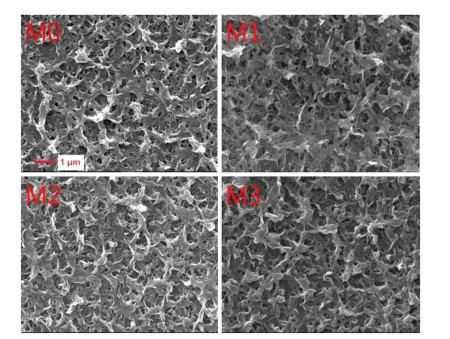
Fig. 2 shows that all the TFC membranes had similar uniform "leaf-like" structures on the surfaces [33]. Little difference was observed for the virgin and modified membranes, suggesting the excellent compatibility between the membrane surface and the TOB-dopamine system. Looking carefully, there were some small particles on the surface of M3. This may be caused by the higher TOB concentration (4 g/L) for M3 that resulted in more intensive dopamine polymerization, compared with the lower TOB concen-tration (2 g/L) for M2. To confirm this, we further increased the TOB concentration to 8 g/L in the TOB-dopamine system, and obvious PDA aggregation was observed (Fig. S5 in Supporting information)[34]. In membrane modification, aggregation is not desirable as it may increase the transfer resistance and destroy the uniformity of the structure. FTIR data (Fig. S6 in Supporting information) show that the virgin and modified membranes had little difference in surface chemistry since the functional groups in PDA and TOB are almost the same as those of the TFC membrane, further suggesting the excellent compatibility of the TOB-dopamine system with the TFC membrane.
Figure 2
Figure 2.
SEM images of the virgin and modified membrane surfaces, showing the loosely crosslinked structures for the active layers of the TFC NF membranes. M0 was the unmodified membrane; M1, M2 and M3 were the membranes modified with different solutions: 2 g/L dopamine in the tris buffer, 2 g/L dopamine and 2 g/L TOB in water, and 2 g/L dopamine and 4 g/L TOB in water, respectively.
The water contact angle of the virgin membrane (M0) was 51°, indicating the hydrophilic surface. Conventional PDA modification significantly reduced the water contact angle to 31° (Fig. 3a). The membranes modified by the TOB-dopamine system displayed the best hydrophilicity, with water contact angles of 25° and 20° for M2 and M3, respectively, representing a reduction of more than 50% compared with that of the unmodified membrane (M0). All the modified membranes showed higher surface roughness after modification (Fig. 3b), which can still cause enhanced antifouling properties [15, 35, 36]. The modified membranes displayed slightly decreased water permeability and increased salt rejection (Table S2 in Supporting information), which can be further optimized to achieve better permeability and selectivity.
Figure 3
Figure 3.
(a) Water contact angles of the virgin and modified membranes. Each measurement was repeated at least 10 times. (b) Surface roughness of the membranes. Each measurement was repeated four times. (c) Water flux decline as a function of time during the filtration of 0.5 g/L BSA solution. The initial water fluxes for M0, M1, M2 and M3 were: 32.0, 24.8, 24.8 and 22.2 L·m -2 h-1, respectively.
Fig. 3c shows that the modified membranes had much less flux declines than the virgin membrane during BSA filtration. The TOB-dopamine modified membranes (M2 and M3) had less flux decline than the conventional tris-dopamine modified membrane (M1). These results demonstrate the excellent organic fouling resistance of the TOB-dopamine modified membrane. The enhanced organic fouling resistance is most likely caused by the improved surface hydrophilicity of the membrane due to the same change trends in water contact angle (Fig. 3a) and flux decline (Fig. 3c).
The antibiofouling properties of the virgin and modified membranes were also evaluated via testing the adhesion of E. coli to membranes by incubating the membranes with bacteria in liquid LB medium for 4 and 24 h. The bacteria concentrations were maintained at similar values for all membranes (Table S1 in Supporting information). Fig. 4 shows that the antibiofouling properties of the membranes are in the order: TOB-dopamine modified > TOB-free dopamine modified > virgin. After 4-h incu-bation, no bacteria were attached on the TOB modified membranes (M2 and M3) and few bacteria were attached to the TOB-free PDA membrane, suggesting that TOB has enhanced the antibacterial properties of the membrane and prevented the bacterial attach-ment within the initial 4-h incubation. After 24 h, bacterial attachment was observed on the TOB-free PDA membranes, but, to a lower degree, compared with that on the virgin membrane. TOB and PDA have similar functional groups in their chemical structures and thus similar biocidal mechanisms, such as the protonated amine groups [34]. The virgin membrane was heavily colonized by bacteria after 24-h incubation (Fig. 3b).
Figure 4
Figure 4.
Confocal laser scanning microscopy (CLSM) images of E.coli on the virgin and modified membranes after 4-h (left) and 24-h (right) cultivation. The black background represents the membrane surface and the live bacteria are shown in green.
It is anticipated that TOB has better stability than inorganic nanoparticles (e.g., silver and copper) in developing antibiofouling membranes due to the excellent compatibility between TOB and the membrane. In the future, the long-term stability of TOB on the membrane surface and the optimisation of the TOB-dopamine system should be carried out.
In summary, we have demonstrated a new efficient TOB-dopamine system for developing antifouling and antimicrobial TFC membranes. Our TOB-dopamine system has two advantages over the conventional modification with dopamine and tris buffer solution. First, TOB-dopamine modification is more efficient than the conventional dopamine modification due to the accelerating effect of TOB on dopamine polymerization. Second, the TOB-dopamine treated membranes exhibit better hydrophilicity, antifouling and antimicrobial properties than the conventional dopamine modified membrane. Beyond engineering membranes, the proposed TOB-dopamine system can be extended for wider surface hydrophilic and antimicrobial modifications.
Acknowledgments
Shuaifei Zhao acknowledges the financial support from Guangdong Provincial Key Laboratory of Soil and Groundwater Pollution Control (No. 2017B030301012), and State Environmental Protection Key Laboratory of Integrated Surface Water-Groundwater Pollution Control. Maryam Golestani is grateful for the scholarship from Macquarie University.
Figure 1
(a) Schematic illustration of the reaction mechanism between tobramycin (TOB) and dopamine. The circled amino group is the most likely reaction site in TOB due to its lowest required energy for reaction. The circled three sites in dopamine can react with TOB. (b) Time dependent absorbance of different dopamine solutions at 400 nm. The colors of the UV cells after 50-min polymerization suggest the accelerating effect of TOB on the polymerization of dopamine.
Figure 2
SEM images of the virgin and modified membrane surfaces, showing the loosely crosslinked structures for the active layers of the TFC NF membranes. M0 was the unmodified membrane; M1, M2 and M3 were the membranes modified with different solutions: 2 g/L dopamine in the tris buffer, 2 g/L dopamine and 2 g/L TOB in water, and 2 g/L dopamine and 4 g/L TOB in water, respectively.
Figure 3
(a) Water contact angles of the virgin and modified membranes. Each measurement was repeated at least 10 times. (b) Surface roughness of the membranes. Each measurement was repeated four times. (c) Water flux decline as a function of time during the filtration of 0.5 g/L BSA solution. The initial water fluxes for M0, M1, M2 and M3 were: 32.0, 24.8, 24.8 and 22.2 L·m -2 h-1, respectively.
Figure 4
Confocal laser scanning microscopy (CLSM) images of E.coli on the virgin and modified membranes after 4-h (left) and 24-h (right) cultivation. The black background represents the membrane surface and the live bacteria are shown in green.


 DownLoad:


 下载:
下载:


 下载:
下载:

