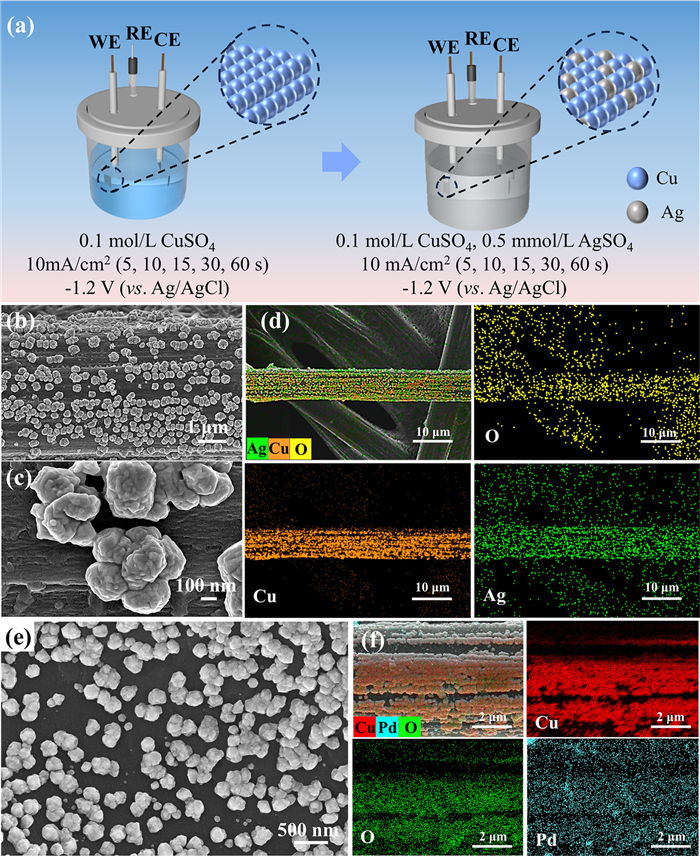
Figure 1.
(a) Schematic diagram of electrodeposition synthesis method. (b, c) SEM and (d) EDX mapping of CuAg-10. (e) SEM and (f) EDX mapping of CuPd-10. SEM: scanning electron microscopy; EDX: energy dispersive X-ray.

Selective regulation of CO2 electroreduction via tandem reactions over copper-based bimetallic catalysts
Tian Wang , Xiaohui Ma , Xihong Liu , Abdelkader Labidi , Dongjin Wan


Electrochemical CO2 reduction (ECO2R) offered a promising method for achieving a carbon-neutral society by converting CO2 into chemical fuels with high energy density [1–3]. The products include C1 compounds, such as methane, carbon monoxide, and formic acid, as well as more valuable C2+ products like ethylene, acetic acid, and ethanol [4–6]. Among them, methane (CH4) and ethylene (C2H4) were particularly attractive due to their high energy density and economic value [7–10]. Copper (Cu)-based catalysts were among the most studied materials for generating CH4 and C2H4 valuable chemicals [11,12]. However, achieving high selectivity for both products remained challenging. This difficulty arose because, under typical ECO2R cathodic potentials, Cu2+ species in catalysts were inevitably reduced to Cu0 or Cu1+ sites. These sites exhibited weak adsorption of *CO intermediate, whose thermodynamics favored dimerization and led to the formation of C2+ products [13–16]. This created a fundamental conflict, as theoretical studies reported by Peterson and Nørskov had predicted that robust CH4 generation required strong adsorption of *CO intermediates [17], conversely suppressed C—C coupling necessary for C2+ formation.
In recent years, tuning the local microenvironment of Cu-based electrocatalysts through the incorporation of metal oxides or noble metal atoms demonstrated significant efficacy in steering the adsorption and conversion pathways of CO2 into useful products [11,18–21]. The integration of bimetallic sites within these electrodes further altered the reaction mechanisms and enhanced their catalytic performance. For instance, Guo et al. found that lanthanum (La)-doped Cu-based electrocatalysts could lower the energy barrier for the *CHO → *OCCHO pathway, thereby promoting C2H4 formation, and for the *CHO → *CH2O step, thus enhancing CH4 production [22]. In another study, Yin et al. reported that Cr@CuS and Ni@CuS catalysts could selectively regulate the *CO reaction pathway, enabling efficient CO2 reduction to CH4 and C2H4, respectively [23]. Despite these advances, the stabilization of multiple copper valence states (Cu0, Cu+, and Cu2+) under operating conditions remained a significant challenge.
To address this challenge, we developed an ultrafast electrodeposition technology for fabricating Cu-M (M = Ag, Pd) bimetallic tandem electrodes. By varying deposition time, applied voltage, and electrolyte effect, the performance of ECO2R was systematically investigated to identify the optimal efficiency of catalysts. Comprehensive morphological and microstructural characterizations were conducted using a suite of electrochemical techniques to evaluate the performance of all electrodes under optimized conditions. Furthermore, density functional theory (DFT) calculations were employed to elucidate how the co-deposition of different metals influenced the catalytic mechanism and product distribution, thereby revealing the reaction pathways for the formation of the target valuable products.
Scanning electron microscopy (SEM) was employed to analyze the microstructures of the CuAg-t (t = 5, 10, 15, 20, 30, 60 s) electrodes under different deposition times (Fig. 1a). Compared with CuAg-5, the CuAg-10 exhibited uniformly distributed popcorn-like particles with diameters of approximately 200–300 nm (Figs. 1b and c). However, these particles were notably smaller than the smooth spherical particles (∼600 nm) observed on the ED-Cu electrode (Fig. S1 in Supporting information). With prolonged deposition time, the popcorn-like particles underwent significant agglomeration and developed an irregular morphology (Fig. S2 in Supporting information). Additionally, the energy-dispersive X-ray (EDX) spectroscopy mapping confirmed that Cu, Ag, and O were uniformly distributed on the CuAg-10 (Fig. 1d), indicating the successful fabrication of the CuAg electrode. Meanwhile, SEM-EDX analysis indicated that the content of Cu was nearly seven times that of Ag (Table S1 in Supporting information), which suggested that Cu exhibited superior deposition characteristics compared to Ag. Similarly, a series of CuPd electrodes were prepared (Fig. S3 in Supporting information), among them, CuPd-10 electrode displayed only regular block-like structures (Fig. 1e, Fig. S4 in Supporting information) and the EDX mappings confirmed the presence of Cu, Pd, and O (Fig. 1f). However, the Pd content in CuPd-10 was only 4.2 wt% (Table S2 in Supporting information), which was lower than that of Ag (18.6 wt%) in the CuAg-10 electrode. This discrepancy could be attributed to the smaller atomic radius of Pd compared to that of Ag, a factor that might have facilitated higher mobility and a greater tendency for Pd to aggregate within the electrolyte [24].
To further proved above hypothesis, the concentration of Ag2SO4 and PdSO4 in the electrolyte was increased from 0.5 mmol/L to 1 mmol/L, we found that the popcorn-like morphology of CuAg-10 disappeared and was replaced by irregularly sized large particles (Fig. S5a in Supporting information), whereas CuPd-10 exhibited only minor changes (Fig. S5b in Supporting information). In addition, a series of CuAgPd electrodes were fabricated under identical conditions (Fig. S6 in Supporting information). SEM and EDX mapping revealed that only the CuAgPd-15 electrode exhibited a well-defined popcorn-like morphology, along with a homogeneous distribution of Cu, Ag, Pd, and O on its surface (Fig. S7 in Supporting information). Furthermore, the content of Ag was nearly seven times higher than that of Pd (Table S3 in Supporting information), demonstrating that Ag atoms played a more dominant role in morphology regulation. Therefore, it could be preliminarily concluded that the relative ease of electrodeposition for the three metals followed the order: Cu > Ag > Pd.
The X-ray diffraction (XRD) patterns of the ED-Cu, CuAg-10, CuPd-10, and CuAgPd-15 depicted characteristic diffraction peaks at 2θ = 43.3°, which could be attributed to the (111) plane of Cu phase (JCPDS No. 99–0034) (Fig. S8 in Supporting information). Moreover, the similar XRD patterns of CuAg and CuPd electrodes at different deposition times are presented in Figs. 2a and b. No diffraction peaks corresponding to the crystal planes of Ag (JCPDS No. 87–0717) or Pd (JCPDS No. 88–2335) were observed, indicating the uniform distribution of Ag and Pd on the Cu atoms [25,26]. The diffraction intensity of the (111) plane in the CuAg electrodes gradually increased with longer deposition time, and the (200) plane emerged after 30 s (Fig. S9a in Supporting information), whereas the (220) plane was not observed at any deposition time. In contrast, the (200) plane was present in the CuPd-5 electrode, and the (220) plane appeared after 60 s (Fig. S9b in Supporting information). These observations suggested that Pd facilitated the Cu phase transformation more effectively than Ag [27,28].
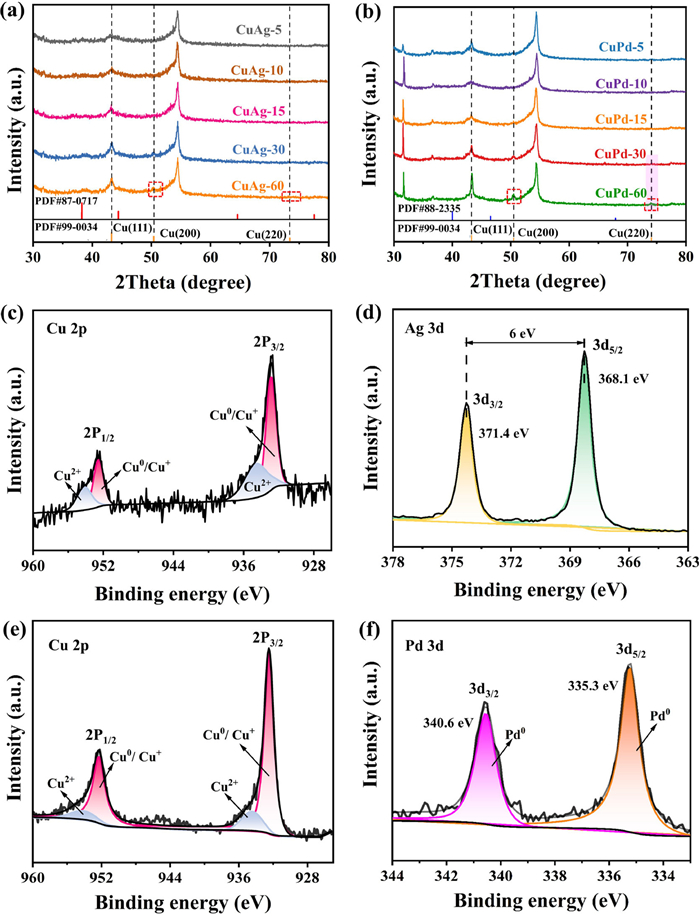
In addition, the surface atomic composition and electronic structures of the samples were characterized by X-ray photoelectron spectroscopy (XPS). The survey spectrum of CuAg-10 confirmed the presence of Cu and Ag atoms (Fig. S10 in Supporting information). The high-resolution Cu 2p spectrum revealed the coexistence of multivalent Cu species (Cu0/Cu+/Cu2+) (Fig. 2c) and exhibited a positive shift to higher binding energy compared with that of the ED-Cu electrode (Figs. S11a and b in Supporting information). For the Ag 3d spectrum of CuAg-10 (Fig. 2d), the peaks appeared at 374.1 (Ag 3d3/2) and 368.1 eV (Ag 3d5/2) confirmed the presence of metallic Ag0 [29–31]. Similarly, the XPS survey spectrum of CuPd-10 demonstrated the existence of distinct Pd 3d signals (Fig. S12 in Supporting information). The high-resolution Cu 2p spectrum of CuPd-10 shows a less positive shift than that of ED-Cu (Fig. 2e), which could be attributed to weaker electron transfer from Cu to Pd atoms. As shown in Fig. 2f, the high-resolution Pd 3d spectrum of CuPd-10 was fitted with peaks at 340.6 and 335.3 eV, corresponding to the metallic Pd0 state [29,30,32]. Furthermore, the XPS data for CuAgPd-15 were obtained. The Cu 2P spectrum shift toward higher binding energy (Fig. S13a in Supporting information), suggesting electron transfer from Cu to Ag and/or Pd atoms (Fig. S13b in Supporting information). The Ag 3d spectrum confirmed the existence of metallic Ag0 (Fig. S13c in Supporting information), while the Pd 3d peaks were observed at 342.9/337.8 eV and 341.0/335.7 eV, corresponding to Pd 3d3/2 and Pd 3d5/2 for oxidized Pd2+ and metallic Pd0, respectively (Fig. S13d in Supporting information) [33,34]. We summarized all observed peak shifts in Table S4 (Supporting information), which indicated that Ag and Pd were present in the form of single atoms or small nanoclusters in CuAg-10 and CuPd-10, respectively.
Faradaic efficiency (FE) is a critical performance metric for assessing ECO2R systems. In the H-cell (Fig. 3a and Fig. S14 in Supporting information), the electroreduction of CO2 to CH4 or C2H4 proceeded on CuAg and CuPd catalysts via pathways involving different numbers of electron transfer steps (Fig. 3b). Among all the tested electrodes, CuAg-10 achieved the highest FECH4 of 86.12%. However, as the deposition time increased, the FECH4 gradually decreased, reaching 74.46% for CuAg-60 (Fig. 3c). Meanwhile, the CuPd-10 exhibited the highest FEC2H4 of 67.10% (Fig. 3d). In contrast, CuAgPd-15 exhibited the highest FECH4 at 52.05%, while CuAgPd-60 achieved the highest FEC2H4 of 26.59% (Fig. S15 in Supporting information), both values were significantly lower than those obtained for CuAg-10 and CuPd-10 (Fig. S16 in Supporting information). These results demonstrated that the CuAg-10 electrode favored CH4 production, whereas the CuPd-10 electrode promoted C2H4 generation. Furthermore, experiments with varying concentrations of AgSO4 and PdSO4 precursor solutions revealed that excessive deposition of Ag and Pd atoms inhibited the formation of CH4 and C2H4 (Fig. S17 in Supporting information). These phenomena could be attributed to the distinct roles of Ag and Pd atoms in modulating the catalytic microenvironment of the Cu-base electrode.
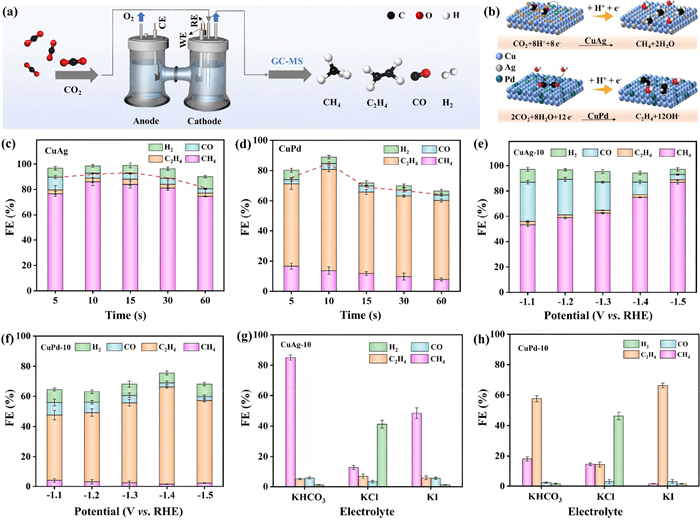
Notably, we investigated the effect of applied potential on the ECO2R reaction performance by testing potentials from −1.1 V to −1.5 V vs. reversible hydrogen electrode (RHE). As shown in Fig. 3e, the CuAg-10 electrode achieved FECH4 of 86.93% at −1.5 V vs. RHE, meanwhile, the CuPd-10 electrode exhibited a maximum FEC2H4 of 64.7% at −1.4 V vs. RHE (Fig. 3f). In contrast, the CuAgPd-15 electrode showed a FECH4 of 50.25% at −1.4 V vs. RHE (lower than that of CuAg-10) whereas its maximum FEC2H4 was 12.9% at −1.3 V vs. RHE (lower than that of CuPd-10) (Fig. S18 in Supporting information). The overall performance of CuAgPd-15 was compared to that of the ED-Cu electrode across the tested voltage range (Fig. S19 in Supporting information), further indicating the distinct promotional effects of Ag and Pd atoms on the formation of CH4 and C2H4, respectively.
Given the effect of electrolyte on the ECO2R performance, various electrodes were evaluated in KHCO3, KCl, and KI. As illustrated in Fig. 3g, the FECH4 of CuAg-10 in 0.1 mol/L KHCO3 reached a maximum of 85.10%, which was significantly higher than the values of 33.92% and 48.39% observed in 0.1 mol/L KCl and KI, respectively. Meanwhile, the substantially higher FEH2 indicated that KCl was unsuitable as an electrolyte for CO2 electroreduction. Furthermore, although CuPd-10 exhibited a FECH4 of only 17.07% in 0.1 mol/L KHCO3, it achieved a much higher FEC2H4 of 65.4% in 0.1 mol/L KI (Fig. 3h). The FECH4 and FEC2H4 values for the CuAgPd-15 electrode were measured at 51.25% and 11.55% in 0.1 mol/L KHCO3, 9.52% and 37.55% in 0.1 mol/L KI, respectively (Fig. S20 in Supporting information), placing its performance between the optimal results of CuAg-10 and CuPd-10. These results suggested that Ag atoms promoted CH4 production in 0.1 mol/L KHCO3, whereas Pd atoms favored C2H4 formation in 0.1 mol/L KI. Moreover, the catalytic performance of CuAg-10 and CuPd-10 surpassed that of most previously reported Cu-based catalysts, as summarized in Table S5 (Supporting information).
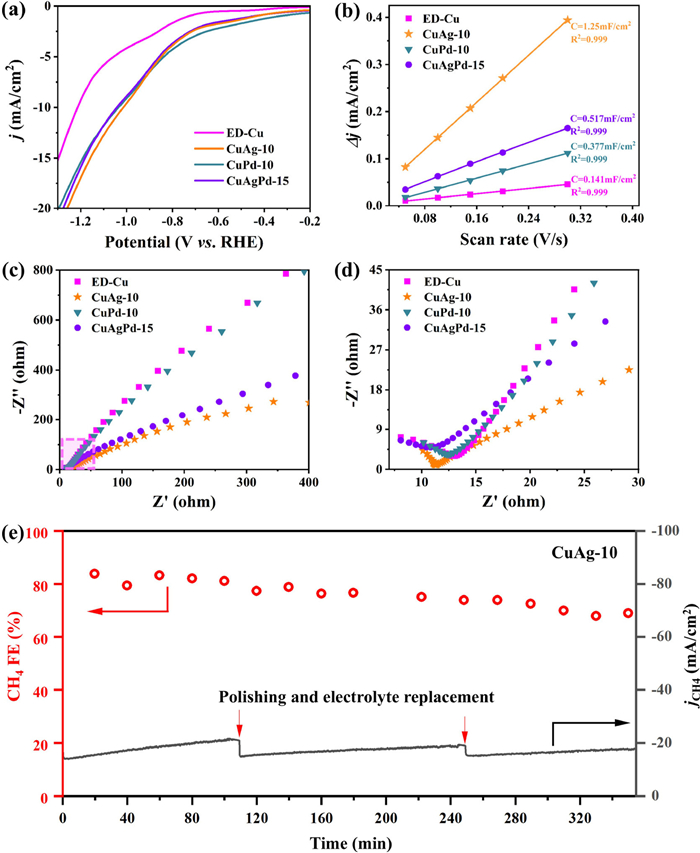
The electrochemical performance of the ED-Cu, CuAg-10, CuPd-10, and CuAgPd-15 electrodes was further evaluated. Linear sweep voltammetry (LSV) was conducted in a 0.1 mol/L KHCO3 solution using a H-type electrolytic cell, with the potential scanned from −0.2 V to −1.4 V vs. RHE (Fig. 4a). The CuAg-10, CuPd-10 and CuAgPd-15 electrodes all exhibited more positive onset potentials and higher current densities compared to ED-Cu, indicating that the introduction of Ag and Pd atoms significantly enhanced the catalytic activity of the Cu substrate [19,35–38]. The electrochemical active surface area (ECSA), a key parameter for normalizing surface-related catalytic activity, is proportional to the double-layer capacitance (Cdl) [39,40]. The calculated Cdl values are 0.141, 1.25, 0.377, and 0.517 mF/cm2 for ED-Cu, CuAg-10, CuPd-10, and CuAgPd-15, respectively (Fig. 4b), demonstrating that CuAg-10 possessed the largest number of accessible active sites [41]. Additionally, electrochemical impedance spectroscopy (EIS) was employed to analyze charge transfer kinetics. As shown in Fig. 4c, the slopes of the EIS curves for ED-Cu, CuPd-10, and CuAg-10 were comparable, with CuAg-10 exhibiting a profile more similar to those of CuPd-10 and CuAgPd-15. A magnified view of the high-frequency region revealed that CuAg-10, CuPd-10, and CuAgPd-15 had smaller Nyquist radii than ED-Cu (Fig. 4d), indicating lower charge transfer resistance [42,43]. These findings collectively confirmed that incorporating Ag or Pd atoms enhanced the electrochemical performance of the Cu-based electrodes by improving reaction kinetics and facilitating charge transfer during ECO2R. Moreover, the long-term stability of CuAg-10 was evaluated at −1.5 V vs. RHE (Fig. 4e). No significant current decay or decrease in FECH4 was observed over 21,600 s, demonstrating the excellent operational durability. The slight current increase may be attributed to the gradual activation of catalytic sites [44]. Meanwhile, CuPd-10 exhibited a consistent performance in FEC2H4, demonstrating the excellent stability of this Cu-based bimetallic electrode (Fig. S21 in Supporting information). In addition, inductively coupled plasma mass spectrometry (ICP-MS) analysis of the catholyte after the stability test detected only negligible leaching of Cu and Ag (Table S6 in Supporting information), further confirming the structural and chemical stability of the CuAg-10 electrode.
To explore the reaction mechanisms and product correlations of the ED-Cu, CuAg, CuPd and CuAgPd electrodes in ECO2R reaction, referring to the XRD and XPS results in Fig. 2, three different theoretical models were established in this work using DFT calculations (Fig. S22 in Supporting information). Two main reaction pathways for CO2RR-to-CH4 have been reported [45]: *CO → *CHO → *CH2O → *CH3O → CH4 and *CO → *COH → *C → *CH → *CH2 → *CH3 → CH4. However, Guo et al. pointed out that for Cu-based electro-catalysts, the Gibbs free energy change (ΔG) for *CO → *CHO was significantly lower than that of *CO → *COH [22]. Therefore, the possibility of CH4 generation via the latter pathway was ruled out in this study. As illustrated in Fig. S23 (Supporting information), the CuAg exhibited the lowest ΔG value (0.26 eV) among the studied systems, indicating that the incorporation of Ag atoms into the Cu substrate promoted the formation of the *CHO intermediate. Subsequently, as shown in Figs. 5a−c, the adsorption energy for the *CHO → *CH2O step on CuAg (−0.83 eV) was more negative than those on CuPd (−0.14 eV) and CuAgPd (−0.04 eV), suggesting that the CuAg electrode facilitated the generation of reaction intermediates that were conductive for CH4 production.
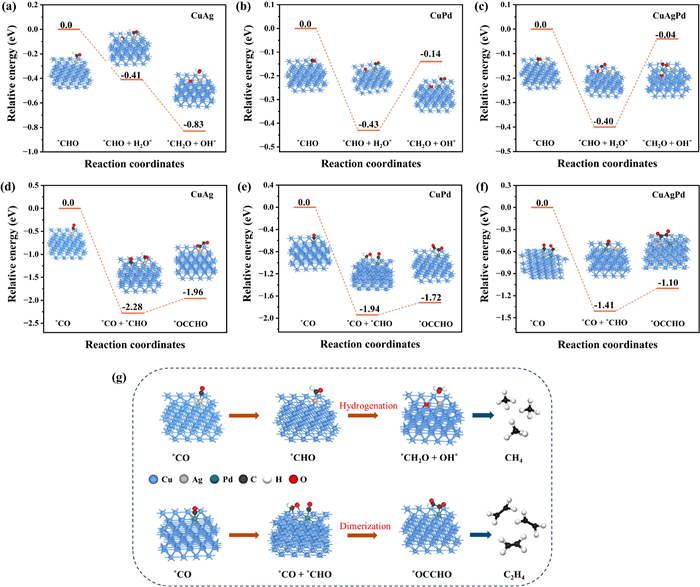
Furthermore, the pathway for C—C coupling during the electroreduction of CO2 to C2H4 was investigated. The formation paths of C2H4 on CuAg, CuPd and CuAgPd surfaces were examined by comparing two coupling mechanisms: *CO-*CO and *CO-*CHO [46]. As shown in Figs. 5d−f, the adsorption energy of *CO-*CHO coupling on CuAg, CuPd and CuAgPd were −2.28, −1.94 and −1.41 eV respectively, all of which were lower than the minimum adsorption energy for *CO-*CO coupling (−1.13 eV) (Fig. S24 in Supporting information). These findings indicated that the *CO-*CHO pathway was the dominant step compared to the two C—C coupling routes. Further analysis of the *CHO → *OCCHO step revealed that the asymmetric coupling of *CO and *CHO at the Pd site in CuPd, which required the lowest energy (0.22 eV), compared to those of CuAg (0.32 eV) and CuAgPd (0.31 eV). This result aligned well with the experimental observations, suggesting that the CuPd electrode could facilitate the formation of key intermediates for C2H4 production. Based on the combined experimental and theoretical investigations, a plausible reaction mechanism was proposed in Fig. 5g. It illustrates a reduction in the energy barriers for the hydrogenation (*CHO → *CH2O) and dimerization (*CHO → *OCCHO) steps could enhance the selectivity toward CH4 and C2H4 in the ECO2R process. Finally, the detailed reaction pathways of ECO2R over the CuAg and CuPd electrodes were illustrated in Fig. S25 (Supporting information).
In summary, this study employed an ultrafast electrodeposition technique to fabricate Cu-based bimetallic electrodes for efficient ECO2R. The effects of deposition time, applied voltage, and electrolyte composition on the product distribution of ECO2R were systematically investigated at a current density of 10 mA/cm2. These results demonstrated that the CuAg-10 and CuPd-10 electrodes exhibited excellent catalytic performance in CO2 electroreduction. Furthermore, the performance of the CuAgPd-15 electrode indicated that the tandem reaction involving three distinct metal atoms did not lead to an enhanced catalytic activity. DFT calculations revealed that the ECO2R pathway for CH4 formation on the CuAg electrode proceeded via the following sequence: *CO → *CHO → *CH2O, whereas the pathway for C2H4 formation on the CuPd electrode followed *CO → *CHO → *OCCHO. It is further determined that on the Cu (111) plane, Ag atoms promoted the hydrogenation of *CHO intermediates, whereas Pd atoms on the Cu (220) plane facilitated the asymmetric dimerization of *CHO and *CO, thereby enhancing C—C coupling and favoring C2H4 generation. These findings provide insights for the atomic-scale optimization of bimetallic active sites and present a promising strategy for designing efficient electrodes for ECO2R under mild conditions.
Tian Wang: Writing – original draft, Project administration, Funding acquisition, Formal analysis, Data curation, Conceptualization. Xiaohui Ma: Software, Resources, Methodology. Xihong Liu: Investigation, Formal analysis. Abdelkader Labidi: Visualization, Validation, Supervision. Dongjin Wan: Writing – review & editing, Visualization, Supervision.
The authors declare that they have no known competing financial interests or personal relationships that could have appeared to influence the work reported in this paper.
This study was supported by the Key Scientific Research Projects of Higher Education Institutions in Henan Province (No. 26A610002), the High-level Talent Research Launch Fund of Henan University of Technology (No. 2024BS050), the Distinguished Young Scholars Natural Science Foundation Project of Henan Province (No. 252300421008) and National Natural Science Foundation of China (No. 52370165), the High-level Talent Research Launch Fund of Henan University of Technology (No. 2023BS003). We thank the discussion with Prof. Fei Xu from Environment Research Institute of Shandong University for the DFT computations in this work.
Supplementary material associated with this article can be found, in the online version, at doi:
Y. Xue, X.M. Lv, C. Yang, et al., Chem. Sci. 16 (2025) 13944–13950. doi: 10.1039/d5sc02562a
E. Aramendia, P.E. Brockway, P.G. Taylor, J.B. Norman, Energy 290 (2024) 130112. doi: 10.1016/j.energy.2023.130112
B.K. Mignone, L. Clarke, J.A. Edmonds, et al., Nat. Commun. 15 (2024) 3938. doi: 10.1038/s41467-024-47059-0
Y.H. Yao, T. Shi, W.X. Chen, et al., Nat. Commun. 15 (2024) 1257. doi: 10.1038/s41467-024-45704-2
G.M. Tomboc, S. Choi, T. Kwon, Y.J. Hwang, K. Lee, Adv. Mater. 32 (2020) e1908398. doi: 10.1002/adma.201908398
J. Zhou, B.L. He, P. Huang, et al., Angew. Chem. Int. Ed. 64 (2025) e202418459. doi: 10.1002/anie.202418459
Q. Fang, Z. Zhang, X. Yang, et al., Chem. Eng. J. 515 (2025) 163293. doi: 10.1016/j.cej.2025.163293
Q. Gao, X. Jiang, Z.H. Wang, et al., Fuel 389 (2025) 134631. doi: 10.1016/j.fuel.2025.134631
R.Z. Ma, S.Q. Bu, Renew. Sust. Energ. Rev. 212 (2025) 115329. doi: 10.1016/j.rser.2025.115329
A.R. Woldu, Z.L. Huang, P.X. Zhao, L.S. Hu, D. Astruc, Coord. Chem. Rev. 454 (2022) 214340. doi: 10.1016/j.ccr.2021.214340
J.L. Wang, H.Y. Tan, Y.P. Zhu, H. Chu, H.M. Chen, Angew. Chem. Int. Ed. 60 (2021) 17254–17267. doi: 10.1002/anie.202017181
H.N. Zhou, L.Y. Li, H.B. Mo, et al., Chin. Chem. Lett. 36 (2025) 111269. doi: 10.1016/j.cclet.2025.111269
Y. Gwon, S.Y. Hwang, S.Y. Kim, et al., Mater. Today Energy 49 (2025) 101831. doi: 10.1016/j.mtener.2025.101831
H. Mac, K. Neubauer, T.H. Vuong, M. Parlinska-Wojtanb, A.M. Abdel-Mageed, J. Mater. Chem. A 13 (2025) 30929–30936. doi: 10.1039/d5ta02862k
S.Y. Nie, L. Wu, Q.D. Liu, X. Wang, J. Am. Chem. Soc. 146 (2024) 29364–29372. doi: 10.1021/jacs.4c07711
M. van der Veer, N. Daems, P. Cool, T. Breugelmans, Green Chem. 27 (2025) 6039–6055. doi: 10.1039/D4GC06164K
A.A. Peterson, J.K. Nørskov, J. Phys. Chem. Lett. 3 (2012) 251–258. doi: 10.1021/jz201461p
J. Santatiwongchai, K. Faungnawakij, P. Hirunsit, ACS Catal. 11 (2021) 9688–9701. doi: 10.1021/acscatal.1c01486
Y.X. Zhou, Y.B. Yao, R. Zhao, et al., Angew. Chem. Int. Ed. 61 (2022) e202205832. doi: 10.1002/anie.202205832
Z.X. Li, X.F. Qiu, P.Q. Liao, Chin. Chem. Lett. 36 (2025) 110473. doi: 10.1016/j.cclet.2024.110473
Y.D. Mao, B.Y. Li, S.L. Ma, et al., Chin. Chem. Lett. 37 (2026) 111675. doi: 10.1016/j.cclet.2025.111675
Z.Y. Guo, H.W. Zhu, Z.J. Yan, et al., App. Catal. B: Environ. 364 (2025) 124839. doi: 10.1016/j.apcatb.2024.124839
L.Y. Yin, X. Zhang, Y.J. Yang, et al., Appl. Surf. Sci. 709 (2025) 163824. doi: 10.1016/j.apsusc.2025.163824
M. Karatok, Appl. Surf. Sci. 698 (2025) 163013. doi: 10.1016/j.apsusc.2025.163013
N. Han, M.Z. Sun, Y. Zhou, et al., Adv. Mater. 33 (2021) e2005821. doi: 10.1002/adma.202005821
L.A. Lumper, J. Fecher, A. Stark, V. Maier-Kiener, Adv. Eng. Mater. 26 (2024) 2400255. doi: 10.1002/adem.202400255
X.L. Chen, S.W. Fu, H. Zhang, et al., ACS Appl. Mater. Interfaces 16 (2024) 47486–47503. doi: 10.1021/acsami.4c07982
D.C. Han, Z.Y. Luo, Y. Li, et al., Appl. Surf. Sci. 529 (2020) 147117. doi: 10.1016/j.apsusc.2020.147117
N. Benipal, J. Qi, Q. Liu, W.Z. Li, Appl. Catal. B: Environ. 210 (2017) 121–130. doi: 10.1016/j.apcatb.2017.02.082
P. Veerakumar, A. Sangili, S.M. Chen, et al., Chem. Eng. J. 489 (2024) 151127. doi: 10.1016/j.cej.2024.151127
R.T. Xue, P. Ge, J. Xie, et al., Small 19 (2023) 2207234. doi: 10.1002/smll.202207234
H. Xu, P.P. Song, B. Yan, et al., J. Electroanal. Chem. 814 (2018) 31–37. doi: 10.1016/j.jelechem.2018.02.034
X. Wang, Q.N. Wang, M. Yuan, et al., Chem. Eng. J. 515 (2025) 163482. doi: 10.1016/j.cej.2025.163482
H.Y. Zhang, F.Y. Zhang, H.C. Di, et al., Sep. Purif. Technol. 368 (2025) 132951. doi: 10.1016/j.seppur.2025.132951
D. Bagchi, M. Riyaz, N. Dutta, et al., Adv. Energy Mater. 14 (2024) 2402237. doi: 10.1002/aenm.202402237
B. Talukdar, C.C. Chang, H.Y. Chen, et al., Mater. Chem. Phys. 344 (2025) 131191. doi: 10.1016/j.matchemphys.2025.131191
Y.Q. Zhu, K.Y. Wen, X.Q. Wan, G.G. Dong, J.F. Niu, Chin. Chem. Lett. 36 (2025) 110399. doi: 10.1016/j.cclet.2024.110399
M. Zhu, J.Q. Chen, T. Zhang, et al., J. Colloid Interf. Sci. 701 (2026) 138788. doi: 10.1016/j.jcis.2025.138788
J.D. Chen, H.Y. Wang, Y.T. Gong, Y. Wang, J. Mater. Chem. A 7 (2019) 11038–11043. doi: 10.1039/c9ta02680k
B. Li, J.D. Chen, L.H. Wang, et al., Appl. Catal. B: Environ. Energy 363 (2025) 124784. doi: 10.1016/j.apcatb.2024.124784
Q. Li, Y.H. Ding, T. Wang, et al., Chem. Eng. J. 512 (2025) 162594. doi: 10.1016/j.cej.2025.162594
T. Zhou, B.R. Xu, R.R. Niu, et al., Chem. Eng. Sci. 313 (2025) 121744. doi: 10.1016/j.ces.2025.121744
A.C. Lazanas, M.I. Prodromidis, ACS Meas. Sci. Au 3 (2023) 162–193. doi: 10.1021/acsmeasuresciau.2c00070
Q. Zhang, Q.Y. Ren, R.H. Cui, L.F. Zhang, L.L. Luo, ACS Catal. 15 (2025) 6702–6710. doi: 10.1021/acscatal.4c06627
Q.K. Fan, X. Zhang, X.H. Ge, et al., Adv. Energy Mater. 11 (2021) 2101424. doi: 10.1002/aenm.202101424
Y.X. Liang, J.K. Zhao, Y. Yang, et al., Nat. Commun. 14 (2023) 474. doi: 10.1038/s41467-023-35993-4

Figure 1 (a) Schematic diagram of electrodeposition synthesis method. (b, c) SEM and (d) EDX mapping of CuAg-10. (e) SEM and (f) EDX mapping of CuPd-10. SEM: scanning electron microscopy; EDX: energy dispersive X-ray.

Figure 2 XRD patterns of (a) CuAg and (b) CuPd electrodes at different deposition times. The high-resolution XPS spectra of (c, e) Cu 2p, (d) Ag 3d, and (f) Pd 3d for CuAg-10 and CuPd-10, respectively.

Figure 3 (a) The schematic diagram of the ECO2R production of CH4, C2H4, CO, and H2. (b) The reaction equation of valuable products generation over CuAg and CuPd. The ECO2RR performance by (c) CuAg and (d) CuPd at different deposition times. The Faraday efficiency of CH4, C2H4, CO, and H2 produced by CuAg-10 and CuPd-10 at different (e, f) voltage, and (g, h) electrolyte.

Figure 4 (a) LSV curves, (b) Cdl, (c, d) EIS of ED-Cu, CuAg-10, CuPd-10 and CuAgPd-15. (e) Long-term stability of CuAg-10 electrode in CO2-saturated KHCO3 (0.1 mol/L) electrolyte at −1.5 V vs. Ag/AgCl. LSV: linear sweep voltammetry; EIS: electrochemical impedance spectroscopy.

Figure 5 Gibbs free energy diagrams for (a–c) the hydrogenation of *CHO to *CH2O, (d–f) the dimerization of *CHO to *OCCHO on CuAg, CuPd, and CuAgPd surfaces. (g) Proposed reaction mechanisms, illustrating CO2 hydrogenation to CH4 products on CuAg (top) and CO2 dimerization to C2H4 on CuPd (bottom). Atoms are colored as follows: Cu, blue; Ag, gray; Pd, cyan; O, red; C, black; and H, white.

 扫一扫看文章


扫一扫关注我们
 DownLoad:
 下载:
 下载: