Received Date:
24 August 2025 Accepted Date:
30 December 2025 Revised Date:
08 December 2025 Available Online:
15 August 2026
Abstract:
Sulfur is a key element in global biogeochemical cycles, participating in the energy exchange among the terrestrial, marine, and atmospheric systems. In the early days, the natural sulfur cycle maintained an input-output balance. However, the rapid expansion of industrial activities has disrupted this equilibrium by altering sulfur species conversion pathways and flux distributions. This has led us to have to explore new sulfur balance states to reduce the impact on the ecological environment. So far, researchers have conducted a series of studies on the modern sulfur cycle, but these findings have not yet been systematically organized. This review systematically examines the sulfur cycle from integrated natural and anthropogenic perspectives. Among them, the natural sulfur cycle encompasses the terrestrial, marine and atmospheric systems of the Earth, focusing on sulfur species, transformation and circulation flux. Furthermore, the investigation of the industrial metabolic process of sulfur has revealed that human activities have disrupted the balance of the Earth’s sulfur cycle, leading to resource depletion and environmental degradation. To mitigate these effects, advancing intra-industrial sulfur recycling strategies is critical for reducing primary resource consumption and waste emissions. This review provided a foundational framework for achieving sustainable sulfur utilization and restoring global sulfur balance.
Sulfur, the fifth most abundant element on the earth [1], is one of the key elements connecting atmosphere, hydrosphere, and lithosphere. Sulfur has high chemical reactivity, with its valence ranging from −2 to +6, forming a variety of sulfur-containing compounds such as hydrogen sulfide (H2S), sulfur dioxide (SO2), sulfate (SO42−), and thiosulfate (S2O32−) [2]. These sulfur-containing species undergo a series of complex chemical transformations in both aerobic and anaerobic environments, covering sulfur mineralization in terrestrial systems, sulfur oxidation-reduction processes involving aquatic organisms, and the migration of sulfur compounds in the atmosphere. The natural sulfur cycle plays a crucial role in maintaining ecosystem balance, regulating climate, supporting biodiversity, and influencing global element cycling.
Meanwhile, sulfur holds an irreplaceable core position in the modern industrial system. As one of the few non-metallic elements that can be extracted and utilized on a large scale through industrialization, the utilization of sulfur resources directly determines the level of multiple basic industrial sectors. With the acceleration of industrialization, human demand for sulfur has sharply increased. In 2024, global sulfur production reached 85 million tons (according to data from the United States Geological Survey) [3], mainly relying on the extraction of mineral resources and industrial transformation processes. However, the interference of human industrial activities on the sulfur cycle may bring about serious environmental and ecological crises. Therefore, understanding and protecting the natural balance of the sulfur cycle is of vital importance for achieving sustainable development.
At present, the research on sulfur cycling mainly focuses on two aspects. One is the study of natural transformation processes, which revolves around sulfur transformation in soil, marine and atmosphere [4,5], especially the influence of biological and non-biological factors on natural sulfur transformation. The other is the sulfur transformation in industrial metabolic processes, mainly focusing on the changes of sulfur throughout the entire life cycle of the “source-processing-consumption-environmental emission” process. In fact, there exists a significant coupling relationship between the natural transformation process of sulfur in the geochemical cycle and the industrial metabolic process. Take sulfur in coal as an example, the combustion of industrial coal releases sulfur in various forms such as H2S, SO2, and thiols [6]. Before the 1970s, these emissions were not controlled by humans, resulting in acid fog and acid rain in many areas and a rise in global temperatures. After the 1980s, people began to pay attention to these environmental issues and attempted to recover sulfur from flue gas through desulfurization, with approximately 98 wt% of sulfur being oxidized and recycled for the production of sulfuric acid (H2SO4) [7]. This desulfurization process reduced 94% of SO2 emissions in coal combustion flue gas, and the environmental problems such as acid fog and acid rain were alleviated [8]. Undoubtedly, the resource utilization in process industries has disrupted the balance of the natural sulfur cycle [9]. These changes in the sulfur fluxes between terrestrial, marine, and atmospheric caused by human activities have had serious impacts on ecological balance, climate change, biodiversity and global element cycling.
Therefore, this review integrates the natural transformation process of sulfur and the industrial metabolic process, systematically examining the geochemical cycle of sulfur. Firstly, we analyzed the natural sulfur cycle across terrestrial, marine, and atmospheric ecosystems, focusing on key sulfur species and their biochemical fluxes. Then, we evaluated industrial metabolism of sulfur, particularly how anthropogenic contaminants disrupt the global sulfur cycle. By bridging natural and industrial sulfur processes, this work will provide a comprehensive perspective for the sustainable utilization of sulfur resources.
2.
Sulfur resources in nature
Sulfur is widely distributed in nature, primarily in the forms of elemental sulfur minerals, metal sulfide minerals, and sulfate minerals. Additionally, a small amount of sulfur is present in natural gas, petroleum, coal, bituminous sand, and oil shale [10,11]. According to the Mineral Commodity Summaries 2025 published by the U.S. Geological Survey [3], the world has approximately 5000 Mt S of usable sulfur, including sulfur deposits in evaporite and volcanic sediments, natural gas, oil, tar sands and metal sulfides. Meanwhile, the relatively difficult-to-utilize sulfur resources in coal, oil shale, and organic-rich shale are about 6 × 10⁵ Mt S [10,11]. Furthermore, sulfide resources in deep-sea and polar geological structures have been discovered, such as potential submarine massive sulfide deposits in the Southwest Indian Ocean Ridge [12,13]. These discoveries further expand the global known sulfur reserves.
Natural sulfur ore is a non-metallic mineral, which is the earliest sulfur resource used in mining. It can form in various environmental conditions. Even in environments without light or lacking external oxidants, it can form large-scale natural sulfur deposits [14]. In a system with oxygen supply, sulfide is mainly oxidized to native sulfur by oxidation of sulfur-oxidizing bacteria. The global proven reserves of natural sulfur are 1500 Mt S, which are mainly distributed in the United States, Mexico, Poland, Iraq, Japan and Italy. Metal sulfide minerals are another important sulfur resource in nature, among which pyrite and non-ferrous metal sulfide ores are the primary minerals. Their global reserves are approximately 1300 Mt S and 12,510 Mt S, respectively [15,16]. These sulfur resources are mainly distributed in Canada, Russia, and China, etc., making these countries as major sulfur resource holders. Sulfates are often found in association with metal sulfide ores. Among various sulfates, only gypsum is considered as a potential source of sulfur. Gypsum and anhydrite are distributed worldwide, with combined reserves of 1.5 × 10⁵ Mt S in the United States and Europe alone. In addition, some of the sulfur resources come from energy minerals such as natural gas and petroleum. Natural gas contains large amounts of sulfur-containing gases such as H2S and SO2. The global reserves of acid gas fields rich in SO2 and H2S are more than 2.6 × 10¹⁵ m3, accounting for about 40% of the world’s total natural gas reserves. Most of the acid gas reservoirs rich in H2S are located in the Middle East, the Caspian Sea and parts of China [17]. Petroleum is another important source of sulfur resources in the world. According to data from the U.S. Energy Information Administration (EIA), the global proven oil reserves exceeded 1.7 trillion barrels (as of 2023), most of which are located in the Middle East and the Americas [17].
3.
Natural cycles of sulfur on Earth’s surface
The natural sulfur cycle encompasses the transformation and migration processes occurring in the terrestrial, marine, and atmospheric systems. Sulfur undergoes various physical state conversions (liquid, solid, and gaseous) among the systems, maintaining the dynamic balance of sulfur content among the Earth’s spheres. Understanding this cycle establishes a crucial baseline for evaluating the effects of human activities.
3.1
Sulfur cycle in terrestrial system
The terrestrial system is one of the important sources of natural sulfur release. The identified sulfur sources exist in the crust, volcanoes, soils, plants, and wetlands, etc. [18]. Sulfur species in terrestrial system can be divided into S2−, SH−, S0, SO32−, SO42−, S2O32−, thioether and other forms [19]. The mutual transformation among these species is complex. The sulfur in the terrestrial environment not only interacts and transforms internally within the system, but also exchanges with the marine and atmospheric systems, promoting the dynamic sulfur balance among different ecosystems. Therefore, this will be discussed from two aspects: the internal sulfur cycle within the terrestrial system and the external cycle with other systems.
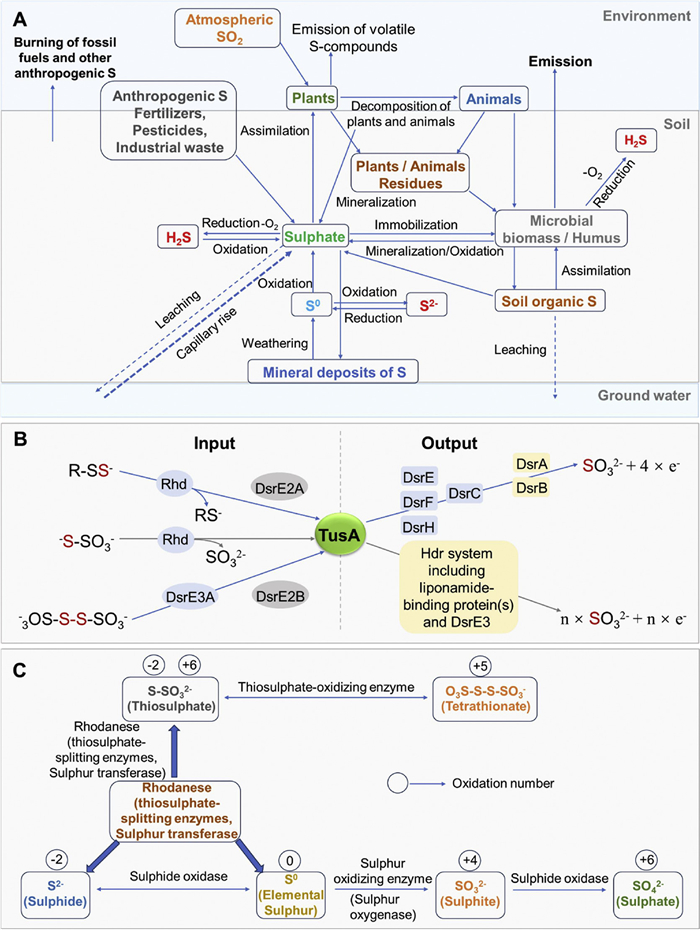
Among them, the sulfur chemical transformation of terrestrial internal circulation is mainly based on redox reactions (Fig. 1A) [20]. Sulfate (SO42−) is a relatively stable form of sulfur among the many sulfur species. Under oxygen-enriched conditions of soil, both organic sulfur and S2O32− can be converted back to SO42− (Eqs. 1–3) [20-22]. Meantime, S° can be oxidized to SO42− by Fe3+ (Eqs. 4 and 5) [23]. In the strong oxidizing environment (e.g., O2, Fe3+, NO3−) or organic matter of agricultural soil, FeS2 could be oxidized to SO42− (Eqs. 6–8) [23,24]. Even some organic sulfur can be directly converted into SO42− (Figs. 1B and C) [20,25]. The SO32− can be easily oxidized to SO42− in an acidic condition [20]. In addition, H2SO4 can be converted to SO42− in the presence of metal salts [4]. However, under different environmental conditions, SO42− can still be converted into other sulfur species [26]. For example, in the presence of organic matter (e.g., CH2O, CH4) in wetlands and paddy soils, SO42− can be reduced to S2−, HS− or H2S by microorganisms (Eqs. 9–11) [23,27,28]. SO42− can also be reduced by NH4+ to HS− in the soil surface layer (Eqs. 12 and 13) [28]. SO42− could be reduced to FeS2 by Fe2O3 and organic matter under oxygen-enriched conditions (Eq. 14) [23], and reduced to S0 and H2S by microorganisms under hypoxic or anoxic conditions [29]. In fact, the complexity of the entire conversion process is not limited to this. Conversions also occur between sulfur species other than sulfates. The sulfide (S2−) can be converted to HS− under weak acid conditions of wetlands and paddy soils, and further converted to H2S under strong acid conditions (Eq. 15) [28]. Excessive S2O32− in plants can also be converted into H2S through sulfide reductase [30], and then released into the air [31]. H2S could be further oxidized to SO2 by oxygen in the lower atmosphere [4]. Moreover, HS−, S2−, S0 can combine with metal ions to form metal sulfides (Eqs. 16–18) [28]. These metal sulfides, in turn, can be oxidized by O2 to elemental sulfur (Eq. 19) [23]. FeS2 can also be oxidized to organic sulfur (e.g., mercaptan) by microbial oxidation in the salt marsh system (Eq. 20) [32].
Figure 1.
Sulfur cycle transformation relationship in terrestrial system. (A) Processes of sulfur oxidation, reduction, mineralization, immobilization and assimilation in soil. Reproduced with permission [20]. Copyright 2023, Elsevier. (B) Major pathways of organic sulfur oxidation to inorganic sulfur by sulfur-oxidizing bacteria. Reproduced with permission [25]. Copyright 2015, John Wiley and Sons. (C) Oxidation conversions of different sulphur forms. Reproduced with permission [20]. Copyright 2023, Elsevier.
However, the sulfur in the terrestrial system undergoes large-scale external circulation with other systems, mainly involving the following processes. Rock weathering release SO42− into rivers and oceans by acidic solutions [33], promoting the terrestrial-ocean transfer of sulfur. Subduction zones regulate the deep and surface circulation of sulfur, with most of it entering the mantle via subducting slabs and only 6.3% reaching the wedge of the mantle. Volcanic activity exports a large amount of S0, SO2, H2S, sulfate and carbonyl sulfide (COS) into atmosphere and marine [34,35]. Additionally, SO2 released by biological processes is converted to H2SO4 by the action of ultraviolet light and water [4]. H2S and S2O32− in the presence of Thiobacillus and other colorless sulfur bacteria can also be oxidized to H2SO4 by O2 [21]. Afterwards, sulfur in the atmosphere returns to terrestrial in the form of acid rain.
The above mainly refers to the chemical transformation of the terrestrial sulfur cycle. The migration behavior of sulfur is mainly based on physical dissolution, release, absorption, and deposition. When sulfur (e.g., organic sulfur and sulfate) from organisms enters the soil, it transitions between dissolved, deposited, and adsorbed states [18], thereby participating in internal terrestrial cycling. Atmospheric deposition serves as the major pathway for sulfur input into terrestrial systems [20], accounting for over 60% of total sulfur influx. Species such as SO2 and SO42− are deposited from the atmosphere onto land [36]. Once on land, these compounds may enter rivers directly or be absorbed by plant roots. Meanwhile, wetlands and soils emit volatile sulfur compound into the atmosphere, including dimethyl sulfide (DMS), COS, CS2, and H2S [5]. Some sulfide and sulfate are also transported to marine systems via surface runoff and rivers. Eventually, marine sulfate deposits as sediments on the seafloor, which may later be reintroduced into terrestrial systems.
3.2
Sulfur cycle in marine system
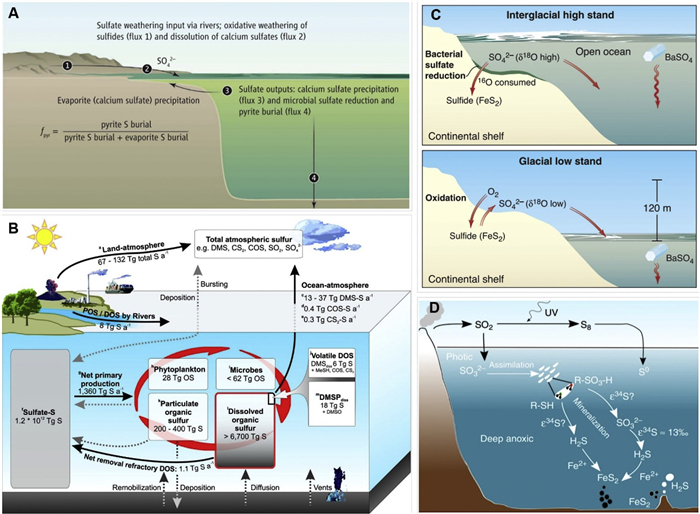
Marine system contains large amounts of dissolved sulfates and sedimentary minerals (e.g., gypsum and pyrite). Therefore, many important chemical processes, such as sulfate reduction and pyrite formation, occur in the marine (Fig. 2A) [37]. Similar to terrestrial system, sulfur in the marine system exists in multiple-oxidation states and undergoes internal circulation, while also exchanging with other systems externally (Fig. 2B) [38,39]. Large amount of dissolved organic sulfur compounds plays a key role in the marine sulfur cycle [39]. DMS is the most abundant volatile sulfur in the ocean [40]. It is mainly produced by the oxidation of the phytoplankton sulfur metabolite dimethylmercaptopropionic acid (DMSP) (Eq. 21) [38]. Additionally, marine organisms can absorb sulfates through photosynthesis or food chain and convert them into organic sulfur compounds such as thiols and DMS [41]. In contrast, the organic sulfur is oxidized back to high-valence sulfates in aerobic soil (Eq. 1) [22]. With the death and decomposition of marine organisms, organic sulfur compounds can be oxidized by microorganisms into inorganic sulfur compounds such as SO42−, H2S, and S2O32− [42]. Seafloor hydrothermal eruptions release inorganic sulfur such as H2S and SO42− into the ocean [4], among which H2S and sulfides can be oxidized to SO42− by other microorganisms or absorbed by other living species in the ocean (e.g., Eqs. 22 and 23) [43,44]. On the contrary, SO42− would be reduced back to sulfide by prokaryotes (reducing bacteria) (e.g., Eq. 24) [45]. In the presence of iron, these sulfides react with iron to form sedimentary pyrite (FeS2) (e.g., Eq. 25) (Fig. 2C) [46]. Sulfides in marine sediments can also be decomposed by reducing bacteria to produce H2S into the ocean [47]. Furthermore, under the action of sulfate reducing bacteria in marine sediments, S2O32− produced by sulfide oxidation can simultaneously (ⅰ) be reduced to HS−, (ⅱ) be oxidized to SO42−, or (ⅲ) undergo a disproportionation reaction to form HS− and SO42− (e.g., Eqs. 26–28) [48]. In addition to the internal cycle, the chemical transformation of sulfur also occurs between marine and terrestrial systems (Fig. 2D) [49]. The main pathways include two: One is that sulfate-reducing bacteria can use organic sulfur compounds and H2S to reduce SO42− to sulfides (such as FeS2) and deposit on the seabed [50]. The other is that SO42− released by rock weathering could enter the ocean [33].
Figure 2
Figure 2.
Sulfur cycle transformation relationship in marine system. (A) Dissolution of evaporite minerals and oxidative weathering of pyrite as major sources of sulfur input to the marine. Reproduced with permission [37]. Copyright 2012, The American Association for the Advancement of Science. (B) Simplified marine organic sulfur cycle. Reproduced with permission [39]. Copyright 2016, The American Association for the Advancement of Science. (C) The process of sulfate being reduced to sulfide by bacterial sulfate. Reproduced with permission [46]. Copyright 2004, The American Association for the Advancement of Science. (D) Schematic diagram of the transformation process of sulfur species between the marine and atmosphere. Reproduced with permission [49]. Copyright 2019, The Author(s).
The physical migration of sulfur in the marine system is mainly dominated by sedimentation, surface runoff, degassing and evaporation. SO2 and sulfate in the atmosphere enter the marine through deposition. Sulfur in terrestrial can enter the marine through surface runoff in the form of sulfate, sulfide, etc. [33,51]. On the contrary, the ocean degassing releases sulfur-containing gases such as SO2, H2S, and DMS back to the atmosphere [40]. In addition, SO42− in seawater will also enter the atmosphere through sea breeze evaporation. These migration processes are the main pathways of sulfur input and output to the marine system.
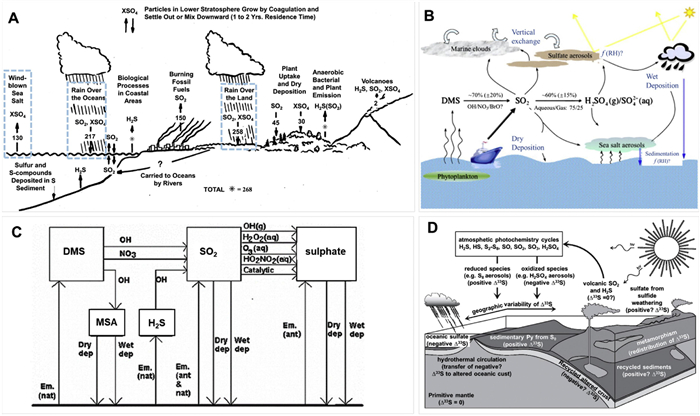
Sulfur-containing gases in the atmosphere play a crucial role in the global sulfur cycle, typically regarded as the main carrier for the transport of sulfur from various sources to the land surface and the ocean (Fig. 3A) [4,41]. Therefore, the exchange interfaces between different systems are the main scenarios for sulfur cycle changes. For instance, in the lower atmosphere at low altitudes, the oxidation of organic sulfur and inorganic sulfur often occurs at the marine surface (Fig. 3B) [52]. A small amount of organic sulfur (e.g., CS2) in the air could be oxidized to COS and HS− by alkaline substance (Eq. 29) [53]. HS− could further combine with oxygen, hydrogen peroxide or water molecules in the troposphere to form SO2 and H2S (Eqs. 30–32) [53]. Among them, H2S can be oxidized to form SO2. The generated SO2 can form sulfate aerogels by homogeneous oxidation in the gas phase or heterogeneous oxidation on moist surfaces of clouds, fog, plants and soil (Eqs. 33–35) [4,41,44]. Sulfites at the water-air interface will further form sulfate aerogels under strong oxidation (Eq. 36) [54]. In addition, SO2 can be reduced to H2S by bacteria and further oxidized to SO42− in the air (Fig. 3C) [43,55]. Sulfates and other sulfur compounds (e.g., methanesulfonic acid) in the atmosphere are mainly derived from the oxidation of marine boundary layer DMS. The oxidation of DMS and subsequent formation of other sulfur species such as sulfuric acid and methanesulfonic acid (MSA: CH3SO3H) are critical to the formation and evolution of gassol and clouds in the marine boundary layer. Meanwhile, these sulfur compounds can also be cyclically reduced to release SO2 or H2S between clouds, fog and dry atmosphere again [56,57]. In contrast, the concentration of DMS in the near-surface region exhibits high temporal and spatial variability, and thus has received less research attention. Additionally, organic sulfur esters (OSs) are a common component of atmospheric aerosol particles [58]. Due to the small size effect and surface activity of these aerosol particles, they have a significant impact on the environment [59]. OSs account for ∼30% of the total organic aerosol [60]. OSs are generally considered to be formed in the reaction of active organic compounds with acidic sulfate aerosols (Eq. 37) [61]. Mineral-mediated photochemical pathways can also form OSs. For example, natural titanium-bearing minerals and road dust can catalyze the formation of hydroxyacetone sulfate and Oss [62].
Figure 3
Figure 3.
Sulfur cycle transformation relationship in atmospheric system. (A) Sources and sinks of atmospheric sulfur compounds (units are 106 tons calculated as sulfate per year). Reproduced with permission [4]. Copyright 1972, The American Association for the Advancement of Science. (B) Important processes affecting the sulfur cycle in the marine atmospheric boundary layer. Reproduced with permission [52]. Copyright 2009, Elsevier. (C) The key transformation process of sulfur species in atmospheric system. Reproduced with permission [55]. Copyright 2004, John Wiley and Sons. (D) Migration process of sulfur species between the atmospheric system and other systems. Reproduced with permission [63]. Copyright 2003, Elsevier.
Between the atmospheric system and the external system, there is a large-scale physical transfer. For instance, marine plants (including seaweeds, cyanobacteria, and salt marsh plants) release sulfur-containing gases such as sulfur oxides, H2S, DMS (Fig. 3D) [36,63]. Among them, DMS is the main sulfur compound entering the atmosphere from terrestrial and aquatic environments [15,16]. Additionally, sulfate formed by evaporation from sea winds is released into the atmosphere [4]. At the same time, large amounts of H2S, SO2, S0 and COS emitted by the volcanic eruption and plants from wetlands and soils also enter the atmosphere [31,32,64]. These are main pathways for sulfur input from external system. The sulfur output process of atmospheric system mainly involves the deposition of SO2 and sulfate into the marine and terrestrial through rainwater deposition. SO2 and SO42− also enter the terrestrial system through plant absorption and dry deposition [20,22,24]. Similarly, SO2 and SO42− in the atmosphere are also absorbed by seawater or marine organisms [18].
3.4
Sulfur geochemical cycle model in Earth’s surface natural environment
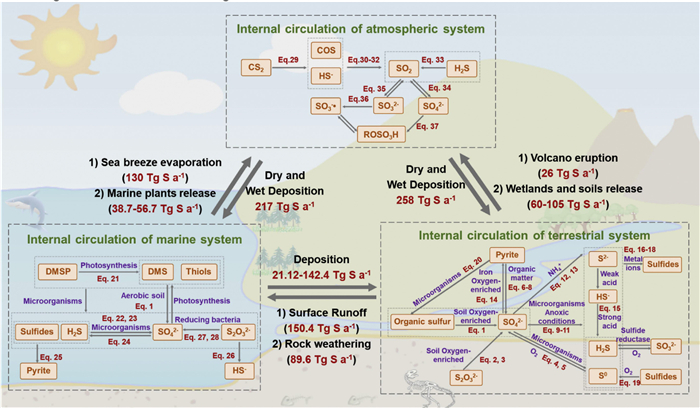
According to Ksionzek and Malin’s description of the cyclic transformation of sulfur in the marine system through flux, the sulfur transformation in terrestrial system can be quantitatively represented by the input and output fluxes. These fluxes can be calculated based on experimental tests and predictive model simulations [39,65]. The detailed transformation relationships and fluxes are shown in Fig. 4. The sulfur output fluxes in the terrestrial system mainly include the following aspects. First, rock weathering releases sulfur-containing compounds to the marine with a flux of about 89.6 Tg S a−1 [33]. Second, volcanic eruptions release sulfur-containing compounds into the atmosphere, with an output flux of approximately 26 Tg S a−1 [66-69]. Third, the output flux of sulfur-containing gases released in wetlands and soils is approximately 60–105 Tg S a−1 [64]. Fourth, the flux exported by surface runoff, with a flux of about 150.4 Tg S a−1 [33]. These four pathways collectively constitute the output flux of sulfur cycling in the terrestrial system. In contrast, the flux of sulfur that enters the terrestrial system through sedimentation from the atmosphere is approximately 258 Tg S a−1 [4], and the flux that enters the terrestrial system through sedimentation from the marine is 21.12–142.4 Tg S a−1 [70]. Based on the above input and output fluxes, the total input flux that the terrestrial system receives from the marine and atmosphere system is approximately 279.12–400.4 Tg S a−1, while the total output flux from the terrestrial system is approximately 326–371 Tg S a−1. Therefore, the sulfur cycle can maintain a relative balance in natural terrestrial system, although there is a slight deviation of 29.4–91.88 Tg S a−1 between the output and input fluxes.
Figure 4
Figure 4.
Sulfur cycle transformation model in Earth’s surface natural systems, including the conversion flux and balance of sulfur in terrestrial system, marine system, and atmosphere system.
The output and input fluxes of sulfur between the marine and other systems were analyzed to describe the sulfur cycling balance in the marine. Sulfur output from marine to terrestrial mainly includes the deposition of submarine sulfur deposits with a flux of 21.12–142.4 Tg S a−1 [70]. The output flux of oceanic to atmosphere includes degassing back of 38.7–56.7 Tg S a−1 and the sea breeze evaporation of 130 Tg S a−1 [4,71]. The external system input fluxes include the flux of sulfur-containing compounds (such as SO2 and SO42−) sinking into the marine from the atmosphere, with the input flux of about 217 Tg S a−1 [4]. At the same time, the input flux from terrestrial to marine through surface runoff is approximately 150.4 Tg S a−1 [33]. Another input pathway is the rock weathering release, with an input flux of about 89.6 Tg S a−1 [33]. To sum up, the total input fluxes in marine from terrestrial and atmosphere systems are about 457 Tg S a−1, while the total output fluxes are 189.82–329.1 Tg S a−1. The input flux is higher than the output flux, with the deviation range between 127.9–267.18 Tg S a−1. Hence, ocean is likely to play a role as the main reservoir of sulfur on earth [72].
The sulfur input fluxes to the atmospheric system include the following components. Firstly, S0 and COS released by volcanic eruptions enter the atmosphere [7,8,31,32]. Although there are considerable differences in the contribution of volcanoes to total atmospheric sulfur, related studies have shown that the global volcanic sulfur flux is not lower than 10 Tg S a−1 [73-75]. The average sulfur flux is 26 Tg S a−1 [4]. Secondly, the input fluxes of sulfur oxides, H2S, organic sulfur and other gases released by marine plants are 38.7–56.7 Tg S a−1 [15,16]. Thirdly, the input flux of sulfur-containing gases released in wetlands and soils is about 60–105 Tg S a−1 [64]. Finally, amount of sulfur released into the atmosphere by sea breeze evaporation is about 130 Tg S a−1 [4]. Nevertheless, the output fluxes are mainly dominated by atmospheric deposition. The sulfur fluxes deposited to terrestrial and marine are 217 Tg S a−1 and 258 Tg S a−1, respectively. In summary, the total input fluxes in atmosphere from terrestrial and marine systems are about 254.7–317.7 Tg S a−1, while the total output fluxes in atmosphere system are about 475 Tg S a−1. The input flux is less than the output flux with the deviation range between 157.3–220.3 Tg S a−1.
As mentioned above, the sulfur cycle within Earth’s surface ecosystems is a dynamic interplay among the terrestrial, marine, and atmospheric systems. Sulfur transformations in terrestrial and marine environments involve multiple valence changes and complex processes, whereas atmospheric sulfur species are relatively simple and undergo more straightforward reactions [76]. Although the sulfur flux from terrestrial to marine (mainly through runoff) exceeds direct marine-to-terrestrial output, the input flux from atmosphere to marine (via precipitation) is smaller than the evaporative output from marine to atmosphere. Overall, the fluxes between terrestrial, marine, and atmospheric systems remain largely balanced. The steady state of the global sulfur cycle, with a total flux ranging from 990.82 Tg S a−1 to 1175.1 Tg S a−1, depends on the coordination of microbial redox reactions, plant assimilation, and abiotic processes such as weathering and precipitation. This self-regulating mechanism is essential for maintaining cycle stability. The significant increase in anthropogenic sulfur emissions may initially disrupt the terrestrial ecological balance, and ultimately undermine the stability of the global sulfur cycle through systematic interconnections.
4.
Industry flow of sulfur products
After the onset of industrial civilization, sulfur was elevated to a significant position as an indispensable product. After extracted from natural minerals, sulfur mainly flow to chemical industry, non-ferrous smelting and pyrite acid industry. Sulfur in these industrial processes would go through complex chemical conversions and become sulfur products of sulfuric acid, sulfur and organic sulfur [3]. According to the latest data survey of the US Geological Survey, the world sulfur resource production in 2024 is about 85 Mt S [3]. As we mentioned above, the industrial metabolic process of sulfur in humans has disrupted the balance of the sulfur cycle in the terrestrial system, directly affecting the balance of the global sulfur cycle. Obviously, the industrial metabolic process of sulfur has significantly altered the transformation and circulation pathways of sulfur species.
Among them, sulfuric acid is the most important sulfur product in the industrial metabolism and an important industrial raw material. It is mainly used in fertilizer, pigment, non-ferrous metal smelting, petrochemical and other industries, among which the acid used for chemical fertilizer accounts for 50% of the whole sulfuric acid consumption [77]. There are many methods for sulfuric acid production, including the reaction of oxidized sulfur with water, the recondensation of sulfur vapor produced by roasting of pyrite, and the direct reaction of H2S with water. The production of sulfuric acid is around 68 Mt S a−1, among which the roasters and smelters of copper, lead, molybdenum and zinc account for 7% of the total production [78]. Many by-products and wastes would be produced during the production of sulfuric acid. Most of these substances remain in the environment without further resource recovery, which greatly reduces the utilization rate of sulfur resources. For example, a large amount of sulfur is lost by being transferred to phosphogypsum in the production of phosphate fertilizer [79]. Most of the unused phosphogypsum is piled up in the open air, which not only occupies land, but also has a great impact on the surrounding environment [80].
Elemental sulfur is a significant industrial product widely used in chemicals, metallurgy, dyes, and sulfuric acid production [81]. Materials derived from elemental sulfur, such as sulfur quantum dots and various nano-sulfur functional materials, play important roles in energy storage and conversion, optical and electrochemical sensing, and imaging [82-84]. Currently, global sulfur supply primarily comes from four sources: (1) Oil and natural gas; (2) metal sulfide deposits; (3) coal and organic-rich shale; and (4) pyrite and native sulfur ores [85]. Annual sulfur production is approximately 66 Mt S, with about 93% of recovered elemental sulfur originating from refineries, smelters, and coking plants [78]. However, the recovery process generates polymetallic waste residues, whose accumulation not only wastes metal resources but also causes environmental pollution.
Furthermore, organic sulfur, with the main species of methyl mercaptan, ethyl mercaptan, dimethyl sulfide, and thiourea, is also a significant main raw material for feed, pesticide, medicine and other industries. The application value of these organic sulfur products is usually several times or even dozens of times that of sulfur products [56,86]. However, there are still many problems in the large-scale production and application of organic sulfur products, such as low production technology level and most of the raw materials and products used are toxic and dangerous.
5.
Geochemical cycles of sulfur under the human industrial activities
To clarify the specific impact of the industrial metabolic process of sulfur by humans on the natural sulfur cycle on the Earth’s surface, we have summarized the influence of the industrial sulfur cycle and the geochemical sulfur cycle under the influence of human activities on the global sulfur cycle balance and the resulting environmental problems.
5.1
Industrial cycle of sulfur
5.1.1
The generation of sulfur-containing waste
The industrial production of sulfur generates substantial amounts of sulfur-containing waste, leading to significant environmental pollution. Understanding the sources, transformation processes, and outputs of these wastes is essential for assessing anthropogenic impacts on the sulfur biogeochemical cycle and implementing effective pollution control strategies [57,87]. Sulfur-containing wastes from industrial metabolism can be categorized into three types: Waste gas, waste liquid, and solid waste. Sulfur-containing gases consist primarily of SO2 and H2S, originating from industrial activities such as fertilizer production, coal coking, petroleum refining, as well as from biological decay and natural degradation of waste [88]. Additionally, SO2 is emitted from the combustion of sulfur-containing fuels (e.g., coal and oil), smelting of sulfur-rich ores (particularly non-ferrous metals), and chemical manufacturing, oil refining, and sulfuric acid production. Based on SO2 emission data from 1990 to 2015, Aas et al. predicted by the model that global sulfur dioxide emissions decreased by 55 Tg S, of which the SO2 emission in 2015 was still above 100 Tg S [74]. H2S, a harmful pollutant, is mainly produced during natural gas processing, refining, petrochemical operations, and domestic waste treatment [75]. Sulfur-containing waste liquids include spent sulfuric acid, sulfide-rich wastewater, and sulfate-laden effluent. Spent sulfuric acid arises from titanium dioxide production, metal pickling, dye manufacturing, and nitrification processes. For instance, sulfuric acid is used to extract metals like copper, zinc, and nickel from ores, resulting in significant acid waste, with annual production estimated at 8.2–16.3 Mt S [77]. High-sulfate wastewater is generated in industries such as electroplating, pulp and paper, and dye production. Typical sulfur-containing solid wastes comprise industrial gypsum and sulfur slag. Industrial gypsum consists mainly of CaSO4·2H2O (60%–80%), along with impurities such as Fe(OH)3, FeSO4, Al(OH)3, and oxides of magnesium, potassium, phosphorus, and titanium [89]. By source, it includes more than ten types, such as desulfurization gypsum, phosphogypsum, and titanium gypsum. Desulfurization and phosphogypsum account for about 85% of total industrial by-product gypsum, with the power and heat supply sector being the largest producer. Sulfur slag is generated during industrial processes involving reactions of sulfur or its compounds, such as in chemical smelting, oil and gas processing, and non-ferrous metallurgy [90]. Elemental sulfur constitutes 50%–80% of sulfur slag, which also contains recoverable metals like Zn, Pb, Ag, Fe, and Si [91]. Thus, the accumulation of sulfur-containing wastes not represents a loss of valuable resources but also contributes to soil, atmospheric, and water pollution.
5.1.2
Industrial cycle model of sulfur
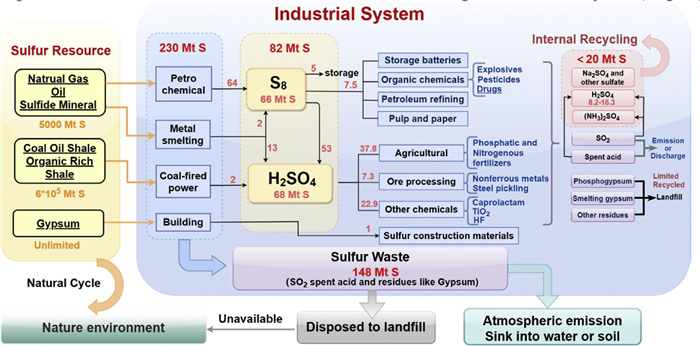
According to the analysis of the material flow of sulfur, industrial activities have made great changes in the form of sulfur, such as decreasing the content of natural sulfide ores and increasing the secondary generation of calcium sulfate. Therefore, industrial activities may affect the circulation flux of sulfur. In previous works, the inflow or outflow of sulfur in industrial systems is always tracked according to the world’s annual resource consumption and the assumed world average sulfur content [92]. To improve the estimation of sulfur flow, a cyclic evaluation method based on comprehensive analysis method is proposed. Then, a sulfur industrial cycle model is constructed to evaluate the impact of human industrial activities on the sulfur geochemical cycle (Fig. 5).
Figure 5
Figure 5.
Sulfur flows within industrial systems: from resources to end uses. The data in this figure are converted into million tons of sulfur per year (Mt S a−1, where a−1 denotes “per annum”) to ensure a balance between the input and output.
The industrial sulfur cycle involves the extraction of sulfur from natural resources, its circulation through industrial processes, and the management of sulfur-containing waste. Extractable sulfur reserves primarily exist in natural gas, oil, sulfur ores, and coal, with total reserves in natural gas, oil, and sulfur ores estimated at 5000 Mt S. Other natural sulfur resources exceed 6 × 10⁵ Mt S, while gypsum deposits are virtually inexhaustible [3]. The cycle encompasses the entire industrial life of sulfur, spanning from raw material processing to product formation and waste generation. Sulfur enters industrial systems mainly via sulfide minerals and fossil fuels. After extraction, it is channeled primarily into three sectors: petrochemicals, coal-fired power generation, and metal smelting. Approximately 35% of sulfur is converted into commercial products such as elemental sulfur and sulfuric acid, while the remaining 65% is treated or discharged as SO2 or gypsum. The total production of sulfur products at around 82 Mt S includes approximately 66 Mt S of elemental sulfur and 16 Mt S of sulfuric acid. Alongside this, sulfur-containing waste generation amounted to approximately 148 Mt S, resulting in a total sulfur flux into industrial systems of around 230 Mt S. Over 95% of elemental sulfur supply originates from SO2 emissions during fossil fuel combustion. However, more than 80% of elemental sulfur is subsequently converted to sulfuric acid, consuming nearly 52 Mt S. Thus, although elemental sulfur production is four times that of sulfuric acid, nearly 90% of all sulfur products are ultimately consumed as sulfuric acid. Major end-uses include agricultural chemicals, especially phosphate fertilizers, which account for 37.8 Mt S (47.2% of total sulfur products), and non-ferrous metal processing, which consumes 6.8 Mt S. Another 22.9 Mt S is used in producing chemicals such as caprolactam, titanium dioxide, and hydrofluoric acid. Sulfur-containing waste exiting the industrial system takes various forms, including SO2, spent acid, waste gypsum, and other residues. Sulfur dioxide was commonly recovered into sodium sulfate, ammonium sulfate, or other sulfates, with about 8.2–16.3 Mt S of sulfuric acid re-entering the industrial system [77]. However, most waste gypsum and residues were landfilled or stored in the environment, making it difficult to re-engaging in the sulfur cycle.
In summary, industrial activities changed the earth’s surface sulfur cycle. Firstly, industrial activities reduce the reserves of natural sulfur resources. This primarily depends on the quantity of sulfur resources entering the industrial system, approximately 230 Mt S. Secondly, the sulfur-containing waste that generated after the industrial cycle are re-engaged in the natural sulfur cycle. For example, SO2 and other sulfur oxides mainly enter the atmospheric system, of which the emission of SO2 alone is above 100 Tg S. However, considering the recovery of SO2 back to industrial systems, the actual amount of SO2 entering the atmosphere may be less than 100 Tg S. For the non-degradable sulfur-containing wastes (such as waste gypsum) formed after the industrial cycle, most of them are piled up in the environment and cannot participate in the natural sulfur cycle again. In short, the sulfur flux from nature to industry is much higher than the sulfur flux back to the environment, which impacts the balance of sulfur geochemical a lot.
5.2
Geochemical cycle model of sulfur under human industrial activities
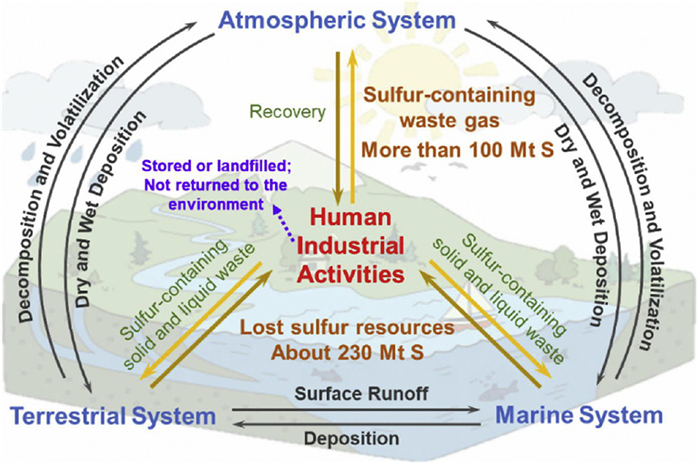
Sulfur cycle is an evolving dynamic process in the earth’s system. Under natural conditions, sulfur forms a relatively stable cycle through plant assimilation and microbial mineralization in terrestrial system, atmospheric deposition and oxidation, and oxidation-reduction of marine organisms. However, due to the development of human industrial activities, industrial metabolism, as a new uncontrollable factor, has greatly affected the geochemical cycle of sulfur (Fig. 6). On the one hand, human industrial activities increase the sulfur cycle conversion fluxes. Most anthropogenic sulfur emissions are produced in the form of SO2 with an amount of ∼100 Tg S, which means industrial metabolism increases the input flux of sulfur in atmospheric system by roughly 100 Tg S. This not only increases the concentration of atmospheric sulfur, but also accelerates the circulation rate of sulfur between the atmosphere, terrestrial and marine systems. On the other hand, human industrial activities also reduce the conversion fluxes of natural sulfur cycle. In the industrial process, the internal industrial cycle consumes a part of the sulfur mineral resources, which reduces the conversion fluxes of terrestrial system for about 230 Mt S. This slows down the sulfur cycle process of terrestrial system to a certain extent. Additionally, the process of mineral smelting and processing also produces sulfur-containing waste, most of which stockpiles in environment and fails to re-participate in the sulfur cycle. This also causes sulfur loss in the global sulfur cycle process. Overall, due to the influence of industrial metabolism, the natural conversion flux of sulfur has decreased, but the overall conversion flux of sulfur has increased. The balance of the original natural sulfur cycle on the Earth’s surface has been disrupted.
Figure 6
Figure 6.
The sulfur cycle model under the influence of human activities.
5.3
Environmental problems and economic benefits issues caused by sulfur cycle changes
5.3.1
Environmental problems
Changes in the global sulfur cycle cause various environmental effects across terrestrial, marine, and atmospheric systems. In the atmosphere, SO2 and NOx undergo photochemical reactions under strong light and oxidants (e.g., O3), forming fine aerosols and haze that impair regional air quality and visibility [93]. Increased atmospheric SO2 and NOx also react with water vapor to produce sulfuric and nitric acids, leading to acid rain. This acidification degrades soil and water quality, adversely affecting terrestrial and marine ecosystems, reducing crop yields, and damaging forests [94]. Sulfate aerosols are key agents in marine cloud formation, which holds major climatic implications. Thus, anthropogenic sulfate emissions can significantly influence climate patterns [73]. Elevated SO2 levels contribute to the formation of methane sulfonic acid (MSA), a greenhouse gas that absorbs infrared radiation and may intensify global warming. Conversely, SO2-derived aerosols can reflect solar radiation, exerting a cooling effect. Hence, the net impact of SO2 on climate remains complex [63,95]. Climate warming also expands marine oxygen-deficient zones, which may alter global cycles of carbon, sulfur, nitrogen [96]. Furthermore, excess SO2 emissions enhance tropospheric ozone consumption, modify polar atmospheric chemistry and circulation, and influence polar climates [97].
Alterations in the sulfur cycle also interact with other elemental cycles. Sulfate and nitrate reductions often occur simultaneously, indicating a close linkage between sulfur and nitrogen cycles. For instance, sulfate reduction can supply ammonium to bacteria, which may eventually be converted into nitrogen [98]. Using molecular techniques and process rate measurements, Canfield et al. [99] demonstrated that both sulfate reduction and sulfide oxidation contribute to energy flux and elemental cycling in the anaerobic waters off northern Chile. However, these processes are often overlooked because sulfide produced from sulfate reduction is rapidly reoxidized to sulfate. This cryptic sulfur cycle is interconnected with anaerobic ammonium oxidation and other nitrogen cycle processes.
5.3.2
Economic benefits issues
Apart from environmental effects, the disruption of the global sulfur cycle has also had significant economic impacts. In terms of negative economic effects, the improper disposal of sulfur-containing waste leads to severe resource waste and high treatment costs. It is estimated that the global stockpile of phosphogypsum has exceeded 6 billion tons, occupying approximately 30,000 square kilometers of land. If calculated based on the current price of sulfur resources at $81 per ton [3], it amounts to over $13 billion in resource losses annually. Additionally, controlling sulfur dioxide emissions requires significant financial investments, particularly in industrial and energy sectors, where pollution control technologies like flue-gas desulfurization demand extensive capital [100]. Furthermore, sulfur pollution-induced environmental degradation (e.g., acid deposition) reduces agricultural and forestry productivity, causing economic losses [101,102]. Conversely, the optimized management of the sulfur cycle also holds considerable economic opportunities. Enhanced recovery of industrial sulfur by-products can reduce waste and create economic value. For example, thermal treatment of arsenic sulfide slag fixes arsenic in scorodite while recovering sulfur [103]. In agricultural systems, optimization of sulfur utilization through precision application techniques could potentially increase crop productivity while reducing fertilizer input requirements [104,105].
However, the current management model of sulfur resources has a significant imbalance in benefits. On one hand, the costs of pollution control and ecological restoration remain high; on the other hand, the potential benefits of recycling and efficient management have not been fully realized. This disparity underscores the necessity of transitioning toward a circular economy framework, where waste is minimized, and sulfur resources are systematically recovered and reused. Such a shift could mitigate economic losses while unlocking new value from previously wasted materials.
6.
Summary and outlooks
Collectively, this review summarizes the impact of industrial activities on the Earth’s surface sulfur cycle from two aspects of natural sulfur cycle and industrial sulfur cycle. The natural sulfur cycle without the impact of human activities was a dynamic equilibrium process covering the terrestrial, marine, and atmospheric systems on earth. Sulfur in these systems not only self-circulation internally, but also exchange with each other through chemical transformation and physical migration. The balance of input and output fluxes between different nature systems maintains a constant sulfur content on earth. However, contemporary industrial operations have disrupted this delicate balance through two distinct yet interconnected processes. First, the intensification of sulfur fluxes occurs through combustion-derived SO2 emissions, which increase atmospheric sulfur inputs by approximately 1 million tons annually while accelerating cross-media transport. Second, the fragmentation of natural cycles results from extensive resource extraction (consuming 230 Mt S annually) coupled with the accumulation of persistent industrial byproducts such as phosphogypsum. Crucially, the net loss of sulfur flux mainly originated from sulfur losses during industrial activities and un-supplemented sulfur waste that did not return to nature, resulting in an unsustainable depletion in the natural sulfur reservoir. At the same time, changes in the balance of the sulfur cycle can have adverse effects on the environment and economic benefits, such as changing the chemical composition of atmosphere and affecting the global cycle of other elements (carbon, nitrogen, etc.). By conducting a quantitative assessment of this impact, new perspectives are provided for understanding the evolution of human element cycle, and a scientific foundation is laid for the sustainable management of sulfur resources.
To mitigate anthropogenic disturbances to the global sulfur cycle, we outline three critical research and implementation priorities. (1) More precise analysis techniques towards sulfur species should be further developed, to accurately assessed global sulfur transformation from the micro-level (such as isotope labelling techniques) to the macro-level (such as global sulfur emission monitoring). This includes the use of advanced mass spectrometry and remote sensing technology to track the source, transformation and destination of sulfur in the earth system. (2) Integrate interdisciplinary research such as geology, chemistry, and biology to promote a comprehensive grasp of the factors affecting the sulfur cycle. This may include studying the biogeochemical cycle of sulfur in different environments and the interaction of sulfur with other elements (such as carbon and nitrogen) cycles. Interdisciplinary cooperation will help to reveal the role of the sulfur cycle in global change and its impact on ecosystems. (3) Industrial transformation is imperative to address the environmental challenges posed by sulfur-containing wastes. To achieve sustainable sulfur resource utilization, industries must adopt cleaner production technologies and enhance sulfur conversion efficiency, thereby establishing closed-loop sulfur cycles. Concurrently, innovative approaches are needed for safer and more effective sulfur pollutant management, including: microbial sulfide metabolism for bioremediation, nanotechnology for pollution extraction from water/soil matrices, and value-added waste conversion (e.g., transforming phosphogypsum into construction materials). These strategies collectively enable both pollution mitigation and resource recovery. In summary, the sustainable development between sulfur cycle and human activities is essential for maintaining ecological balance on earth.
Declaration of competing interest
The authors declare that they have no known competing financial interests or personal relationships that could have appeared to influence the work reported in this paper.
This work was funded by the National Natural Science Foundation of China (Nos. 22222612, 22476216, 22336006), and the National Key Research and Development Program of China (No. 2022YFC3901104).
[1]
J.W. Morgan, E. Anders, Proc. Natl. Acad. Sci. U. S. A. 77 (1980) 6973–6977. doi: 10.1073/pnas.77.12.6973
U.S. Energy Information Administration (EIA), International Energy Statistics: Petroleum and Other Liquids, Statistical Report, U.S. Energy Information Administration, Washington, DC, 2023.
[18]
J. Eriksen, Chapter 2 soil sulfur cycling in temperate agricultural systems, in: D.L. Sparks (Ed.), Advances in Agronomy, Academic Press, New York, 2009, pp. 55–89.
[19]
L.O. Fuentes-Lara, J. Medrano-Macías, F. Pérez-Labrada, et al., Molecules 24 (2019) 2282. doi: 10.3390/molecules24122282
[20]
S. Chaudhary, S.S. Sindhu, R. Dhanker, et al., Microbiol. Res. 271 (2023) 127340. doi: 10.1016/j.micres.2023.127340
N.S. Bolan, M.J. Hedley, Role of carbon, nitrogen, and sulfur cycles in soil acidification, in: Z. Rengel (Ed.), Handbook of Soil Acidity, CRC Press, Boca Raton, 2003, pp. 29–56.
M. Maslin, L. Van Heerde, S. Day, Geogr. J. 188 (2022) 498–505. doi: 10.1111/geoj.12475
[78]
L.E. Apodaca, Sulfur [ADVANCE RELEASE], in: National Minerals Information Center (Ed.), 2018 Minerals Yearbook, U.S. Geological Survey, Washington, DC, 2018 pp. 74.1-74.13.
[79]
M. Essakhraoui, A. Nyassi, A. Boukhair, et al., Appl. Sci. 13 (2023) 8879. doi: 10.3390/app13158879
S. Jain, D. Ramesh, D. Bhattacharya, Appl. Soft Comput. 112 (2021) 107772. doi: 10.1016/j.asoc.2021.107772
[105]
A. Ali, M.U. Hassan, H.P. Kaul, J. Agron. Crop Sci. 210 (2024) e12732. doi: 10.1111/jac.12732
Figure 1
Sulfur cycle transformation relationship in terrestrial system. (A) Processes of sulfur oxidation, reduction, mineralization, immobilization and assimilation in soil. Reproduced with permission [20]. Copyright 2023, Elsevier. (B) Major pathways of organic sulfur oxidation to inorganic sulfur by sulfur-oxidizing bacteria. Reproduced with permission [25]. Copyright 2015, John Wiley and Sons. (C) Oxidation conversions of different sulphur forms. Reproduced with permission [20]. Copyright 2023, Elsevier.
Figure 2
Sulfur cycle transformation relationship in marine system. (A) Dissolution of evaporite minerals and oxidative weathering of pyrite as major sources of sulfur input to the marine. Reproduced with permission [37]. Copyright 2012, The American Association for the Advancement of Science. (B) Simplified marine organic sulfur cycle. Reproduced with permission [39]. Copyright 2016, The American Association for the Advancement of Science. (C) The process of sulfate being reduced to sulfide by bacterial sulfate. Reproduced with permission [46]. Copyright 2004, The American Association for the Advancement of Science. (D) Schematic diagram of the transformation process of sulfur species between the marine and atmosphere. Reproduced with permission [49]. Copyright 2019, The Author(s).
Figure 3
Sulfur cycle transformation relationship in atmospheric system. (A) Sources and sinks of atmospheric sulfur compounds (units are 106 tons calculated as sulfate per year). Reproduced with permission [4]. Copyright 1972, The American Association for the Advancement of Science. (B) Important processes affecting the sulfur cycle in the marine atmospheric boundary layer. Reproduced with permission [52]. Copyright 2009, Elsevier. (C) The key transformation process of sulfur species in atmospheric system. Reproduced with permission [55]. Copyright 2004, John Wiley and Sons. (D) Migration process of sulfur species between the atmospheric system and other systems. Reproduced with permission [63]. Copyright 2003, Elsevier.
Figure 4
Sulfur cycle transformation model in Earth’s surface natural systems, including the conversion flux and balance of sulfur in terrestrial system, marine system, and atmosphere system.
Figure 5
Sulfur flows within industrial systems: from resources to end uses. The data in this figure are converted into million tons of sulfur per year (Mt S a−1, where a−1 denotes “per annum”) to ensure a balance between the input and output.


 DownLoad:

 下载:
下载:


 下载:
下载:

