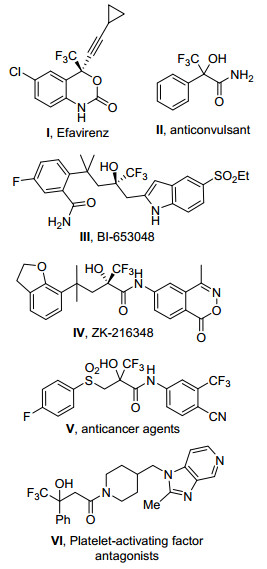
Figure 1.
Biologically active compounds featuring trifluoromethyl-substituted tertiary alcohol motif.

Catalytic Nucleophilic Addition of 3, 5-Dialkyl-4-nitroisoxazoles to Trifluoromethyl Ketones on Water
Jingjing Wang , Feng Li , Yan Xu , Juan Wang , Ziyan Wu , Chengyu Yang , Lantao Liu


The synthesis of trifluoromethyl compounds has attracted much attention over the past decades due to the dramatic effect on their physical, chemical and biological properties presented by introduction of trifluoromethyl group into organic compounds.[1, 2] Particularly, some trifluoromethyl- substituted tertiary alcohols are important pharmaceuticals and agrochemicals, such as the critical anti-HIV drug (Efavirenz, Ⅰ), [3] anticonvulsant Ⅱ, [4] glucocorticoid agonist (BI-653048, Ⅲ), [5] selective glucocorticoid receptor agonist (ZK-216348, Ⅳ), [6] anticancer agents Ⅴ, [7] the platelet-activating factor antagonists Ⅵ[8] (Figure 1). Accordingly, the creation of bearing trifluoromethyl-sub- stituted tertiary alcohols from readily available starting substrates under mild reaction conditions is of great synthetic and industrial interest.
Trifluoromethyl ketones have been utilized as versatile reagents in a wide range of organic reactions.[9] In recent years, catalytic nucleophilic additions to trifluoromethyl ketones is an attractive way to synthesize trifluoromethyl-substituted tertiary alcohols.[10] However, almost of these reactions were carried out in organic solvents. To the best of our knowledge, only the limited examples were employed water as solvent. For example, in 2009, Bandini and co-workers[11] reported the guanidine-catalyzed Friedel-Crafts-type alkylation of indoles with fluoromethyl ketones in the presence of water. During the progress of our work, Zhang and Fan et al.[12] reported an “on water” promoted direct vinylogous addition of 3, 5-dimethyl-4- nitroisoxazole to aldehydes and trifluoromethyl ketones, but just a few examples for trifluoromethyl ketones. Recently, Michalak and co-workers[13] reported NHC-copper (Ⅰ) halide-catalyzed addition of terminal alkynes with trifluoromethyl ketones on water to provide trifluoromethyl-substituted propargylic tertiary alcohols.
Water is abundant, nontoxic, nonflammable, and environmentally friend, which could be regarded as the solvent of Nature.[14] In addition, water has unique and unusual physical and chemical properties, which can intentionally influence the selectivity and reactivity of chemicals, and even allows to realize reactivities that can not be achieved in conventional organic solvents.[15] The use of water as solvent for organic synthesis is regarded as an important subject in green chemistry.[16] In recent years, many organic reactions have been carried out under “on water” conditions.[17] Considering, our research group is always engaged in green chemistry and organofluorine chemistry.[18] Herein, we would like to report preparation of trifluoromethyl tertiary alcohols in high yields via the triethylamine catalyzed nucleophilic addition reactions between 3, 5-dialkyl-4-nitroisoxazoles and trifluoromethyl ketones on water under mild conditions.
2, 2, 2-Trifluoroacetophenone (1a) and 3, 5-dimethyl-4- nitroisoxazole (2a) were chosen as the model substrates to optimize the reaction conditions at room temperature. The results are summarized in Table 1. Initially, when Et3N was used as catalyst, solvent effect was investigated (Table 1, Entries 1~6). The reaction did not proceed in CH2Cl2 and toluene (Entries 1~2). The use of tetrahydrofuran (THF) afforded only a small amount of 3a (Entry 3). Using CH3CN or N, N-dimethylsulfoxide (DMF) as the solvent, 3a was obtained in 75% and 87% yields, respectively (Entries 4 and 5). To our delight, the desired product 3a was obtained in 93% yield when H2O was used as the solvent (Entry 6). Through a process of solvent optimization, H2O was identified as the optimal solvent.
 下载:
导出CSV
下载:
导出CSV
 |
|||
| Entry | Catalyst | Solvent | Yieldb/% |
| 1 | Et3N | CH2Cl2 | — |
| 2 | Et3N | Toluene | — |
| 3 | Et3N | THF | 28 |
| 4 | Et3N | CH3CN | 75 |
| 5 | Et3N | DMF | 87 |
| 6 | Et3N | H2O | 93 |
| 7 | DABCO | H2O | 93 |
| 8 | DMAP | H2O | 91 |
| 9 | DBU | H2O | 90 |
| 10 | NaOH | H2O | — |
| 11c | Et3N | H2O | 84 |
| a Reaction conditions: 1a (0.3 mmol), 2a (0.2 mmol), catalyst (20 mol%), solvent (1.0 mL).b Isolated yield. c 10 mol% catalyst was used. | |||
Subsequently, we examined the influence of different bases on the reaction yield in water (Table 1, Entries 7~10). 1, 4-Diazabicyclo[2.2.2]octane (DABCO) gave the desired product 3a in 93% yield (Entry 7). Although DABCO and Et3N had the same yield, DABCO was more expensive than Et3N. 4-Dimethylaminopyridine (DMAP) and 1, 8-diazabicyclo[5.4.0]undec-7-ene (DBU) catalyzed the reaction to give the desired products in 91% and 90% yields, respectively (Entries 8 and 9). In addition, no product was detected when the inorganic base NaOH was used as the catalyst (Entry 10). We found that the product 3a will be broken down into the compounds 1a and 2a in aqueous NaOH. When the catalyst loading of Et3N was reduced to 10 mol%, the desired product 3a was obtained in 84% yield (Entry 11). Therefore, Et3N (20 mol%) as the catalyst and H2O as the solvent were the optimal condition for the current transformation.
With the optimized conditions to hand, we subsequently turned our focus to explore the substrate generality of this strategy. The results are summarized in Table 2. To our delight, this well-established approach could be utilized for a wide variety of trifluoromethyl ketones bearing either electron-donating or electron-withdrawing groups. The reaction of 2, 2, 2-trifluoroacetophenone (1a) with 3, 5-dimethyl- 4-nitroisoxazole (2a) proceeded smoothly to give the corresponding product 3a in 93% yield. 2, 2, 2-Trifluoro-1-(p-tolyl)ethanone and 1-(4-(tert-butyl)phenyl)- 2, 2, 2-trifluoroethanone reacted smoothly with 2a to give the desired products 3b and 3c in 86% and 78% yields, respectively. Trifluoromethyl ketones bearing a methoxy group at the para-, meta- or ortho-positions of the phenyl ring also showed good reactivity with 2a, giving the desired product 3d~3f in 75%~87% yields. In addition, 1-(3, 5-dimethyl- phenyl)-2, 2, 2-trifluoroethanone reacted with 2a to give the desired product 3g in 71% yield. 2, 2, 2-trifluoro-1-(naph- thalen-2-yl)-ethanone was also applicable, affording the desired product 3h in 83% yield. Trifluoromethyl ketones bearing an electron-withdrawing group such as F, Cl, Br or Ph at the 4 position on the phenyl ring, reacted with 2a to give the desired products 3i, 3j, 3k or 3l in 81%~99% yields. When 2, 2, 2-trifluoroacetophenone reacted with 5-methyl-4-nitro-3-phenylisoxazole under the same reaction condition, the desired product 3m was obtained in 84% yield. Notably, the heterocyclic trifluoromethyl ketones such as thienyl, furyl, pyridyl, quinolinyl, and indolyl group were also tolerated, and the desired products 3n~3r were obtained in 80%~95% yields. Fortunately, the aliphatic trifluoromethyl ketones were also suitable for this transformation. When starting from methyl and benzyl ketones, the corresponding products 3s and 3t were obtained in 66% and 81% yields, respectively.
下载:
导出CSV
 |
 |
| a Reaction conditions: 1 (0.3 mmol), 2a or 2b (0.2 mmol), Et3N (20 mol%), H2O (1.0 mL), r.t., 24 h. b Isolated yield. c The values in brackets were yield under neat conditions. |
We also tested the possibility of applying 3, 5-diethyl- 4-nitroisoxazole (2c) as the vinylogous Henry donor in this reaction (Table 3). Considering the different reactivity between 3, 5-diethyl- and 3, 5-dimethyl-4-nitroisoxazole, we first examined the influence of the catalyst loading on the reaction yield and diastereoselectivity. Finally, Et3N (30 mol%) proved to be more suitable for this reaction. The reaction of 2, 2, 2-trifluoroacetophenone (1a) with 3, 5-di- ethyl-4-nitroisoxazole (2c) proceeded smoothly to give the corresponding product 4a in 71% yield with high diastereoselectivity (94:6). 2, 2, 2-Trifluoro-1-(4-fluorophenyl)- ethanone, 1-(4-chlorophenyl)-2, 2, 2-trifluoroethanone and 1-(4-bromophenyl)-2, 2, 2-trifluoroethanone led to their desired products 4b~4d in 79%~82% yields with high to excellent diastereoselectivities (95:5~99:1). When 2, 2, 2-trifluoro-1-(naphthalen-2-yl)ethanone reacted with 3, 5-diethyl-4-nitroisoxazole (2c), the desired product 4e was obtained in 83% yield and in excellent diastereoselectivity (99:1).
下载:
导出CSV
 |
 |
| a Reaction conditions: 1 (0.3 mmol), 2c (0.2 mmol), Et3N (30 mol%), H2O (1.0 mL), r.t., 24 h. b Isolated yield. c The value in brackets were yield and dr under neat conditions. d The dr value was determined by 19F NMR analysis of the corresponding products. |
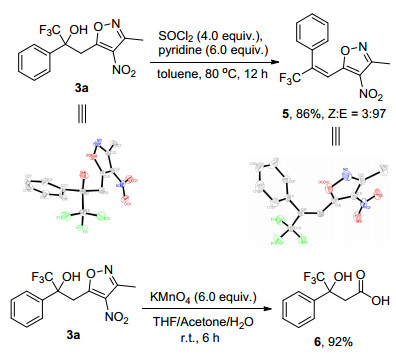
To demonstrate the synthetic utility of the current reaction, we devoted our efforts to explore some additional transformations of the nucleophilic addition products. As shown in Scheme 1, the dehydration of the product 3a proceeded well with SOCl2 and pyridine, affording (E)-3-methyl-4-nitro-5-(3, 3, 3-trifluoro-2-phenylprop-1-en-1-yl)isoxazole (5) in 86% yield (Z:E=3:97). On the other hand, the product 3a can be oxidized using KMnO4, THF, acetone and H2O to give 4, 4, 4-trifluoro-3-hydroxy-3- phenylbutanoic acid (6) in 92% yield. The configuration of the compounds 3a and 5 were unambiguously confirmed by X-ray crystallographic analysis.[19]
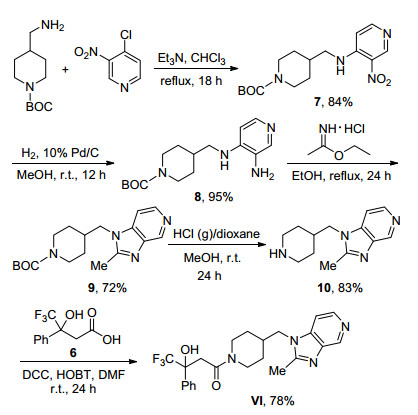
Based on the previous research work[8], we conducted for the synthesis of the potent, orally active platelet-activating factor antagonists Ⅵ. As shown in Scheme 2, the alkylation of commercially available N-Boc-4-ami- nomethylpiperidine with 4-chloro-3-nitropyridine to afford nitropyridine 7 in 84% yield. The product 7 was hydrogenated by 10% Pd/C to give diamine 8 in 95% yield, which was cyclized to generate the imidazopyridine 9 in 72% yield using ethyl acetimidate hydrochloride. Deprotection of the product 9 with saturated HCl (g)/dioxane solution to provide the amine 10 in 83% yield. The platelet-activating factor antagonists Ⅵ was obtained in 78% yield by reacting the amine 10 with the carboxylic acid 6 via DCC coupling in the presence of 1-hydroxybenzotriazole (HOBT).
In conclusion, we have described a novel variant of the nucleophilic addition reaction in which a new bond between 3, 5-dimethyl-4-nitroisoxazole and trifluoromethyl ketones was formed. This reaction worked under the catalysis of a simple and inexpensive triethylamine and gave the desired products in 66%~99% yields. In addition, 3, 5-diethyl-4- nitroisoxazole was also tested, and the desired products were obtained in 71%~83% yields with excellent diastereoselectivities. Some additional transformations, such as dehydration and oxidation of the nucleophilic addition products were explored. Application of this novel concept to the synthesis of naturally occurring compounds is in progress.
1H NMR, 13C NMR, and 19F NMR were recorded on a Bruker 400 MHz (1H NMR), 100 MHz (13C NMR), as well as 376 MHz (19F NMR). Chemical shifts were reported from the solvent resonance as the internal standard (CDCl3: 7.26, 77.0). IR spectra were recorded on an AVATAR 360 FT-IR spectrometer. X-ray structural analysis was conducted on an XtaLAB mini (600 W, SHINE, CCD, 75 mn, 0.1 electorns/pixel/sec). The high resolution ESI-MS spectra were obtained on a Bruker APEX Ⅳ Fourier transformmass spectrometer.
All commercially available reagents and solvent were used without further purification. Analytical thin layer chromatography was performed on 0.25 mm of silica gel plates. Silica gel (200~300 mesh) was used for flash chromatography. Trifluoromethyl ketones[20] and 3, 5-di- methyl-4-nitroisoxazole[21] were prepared according to literatures.
To a solution of 3, 5-dimethyl-4-nitroisoxazole (0.2 mmol), trifluoromethyl ketone (0.3 mmol) and H2O (1.0 mL) was added NEt3 (20 mol%). The mixture was stirred for 24 h at room temperature. After diluted with ethyl acetate, the organic phase was separated and dried over anhydrous MgSO4, followed by purification with flash chromatography on silica gel, eluting with ethyl acetate/petroleum ether (V:V=1:5), to afford the corresponding alcohol.
1, 1, 1-Trifluoro-3-(3-methyl-4-nitroisoxazol-5-yl)-2-phe-nylpropan-2-ol (3a):[12] white solid, 93% yield. m.p. 107~109 ℃ (Lit.[12] m.p. 112.9~113.1 ℃); 1H NMR (400 MHz, CDCl3) δ: 2.48 (s, 3H), 3.56 (s, 1H), 4.09 (dd, J=18.0, 14.8 Hz, 2H), 7.37~7.40 (m, 3H), 7.55~7.57 (m, 2H); 13C NMR (100 MHz, CDCl3) δ: 168.1, 155.4, 134.3, 132.1, 129.4, 128.5, 125.9, 124.6 (q, JC-F=284.4 Hz), 77.0 (q, JC-F=29.1 Hz), 33.9, 11.4; 19F NMR (376 MHz, CDCl3) δ: -79.90 (s, 3F); IR (KBr) ν: 2923, 2851, 1607, 1524, 1450, 1419, 1380, 1364, 1266, 1156, 1076, 1004, 830, 723, 698 cm-1.
1, 1, 1-Trifluoro-3-(3-methyl-4-nitroisoxazol-5-yl)-2-(p- tolyl)propan-2-ol (3b):[12] white solid, 86% yield. m.p. 114~115 ℃ (Lit.[12] m.p. 117.7~118.4 ℃); 1H NMR (400 MHz, CDCl3) δ: 2.34 (s, 3H), 2.48 (s, 3H), 3.49 (s, 1H), 4.07 (s, 2H), 7.18 (d, J=8.0 Hz, 2H), 7.42 (d, J=7.6 Hz, 2H); 13C NMR (100 MHz, CDCl3) δ: 168.3, 155.4, 139.3, 132.0, 131.3, 129.2, 125.8, 124.6 (q, JC-F=284.4 Hz), 77.1 (q, JC-F=29.0 Hz), 33.8, 21.0, 11.5; 19F NMR (376 MHz, CDCl3) δ: -80.10 (s, 3F); IR (KBr) ν: 2967, 2925, 1608, 1572, 1520, 1417, 1377, 1363, 1265, 1012, 831 cm-1.
2-(4-(tert-Butyl)phenyl)-1, 1, 1-trifluoro-3-(3-methyl-4-nitroisoxazol-5-yl)propan-2-ol (3c): white solid, 78% yield. m.p. 103~104 ℃; 1H NMR (400 MHz, CDCl3) δ: 1.30 (s, 9H), 2.48 (s, 3H), 3.53 (s, 1H), 4.08 (s, 2H), 7.39 (d, J=8.0 Hz, 2H), 7.46 (d, J=7.6 Hz, 2H); 13C NMR (100 MHz, CDCl3) δ: 168.3, 155.4, 152.4, 132.0, 131.4, 125.6, 125.5, 124.6 (q, JC-F=284.4 Hz), 113.9, 77.0 (q, JC-F=29.1 Hz), 34.5, 33.8, 31.1, 11.5; 19F NMR (376 MHz, CDCl3) δ: -79.88 (s, 3F); IR (KBr) ν: 2965, 2911, 2871, 1609, 1525, 1418, 1380, 1365, 1267, 1161, 1109, 830 cm-1; HRMS (ESI) calcd for C17H20F3N2O4 [M+H]+ 373.1370, found 373.1371.
1, 1, 1-Trifluoro-2-(4-methoxyphenyl)-3-(3-methyl-4-ni-troisoxazol-5-yl)propan-2-ol (3d):[12] white solid, 82% yield. m.p. 113~115 ℃ (Lit.[12] m.p. 122.5~123.8 ℃); 1H NMR (400 MHz, CDCl3) δ: 2.48 (s, 3H), 3.52 (s, 1H), 3.80 (s, 3H), 4.06 (s, 2H), 6.89 (d, J=8.8 Hz, 2H), 7.46 (d, J=8.4 Hz, 2H); 13C NMR (100 MHz, CDCl3) δ: 168.3, 160.2, 155.4, 132.1, 127.4, 126.2, 124.6 (q, JC-F=284.4 Hz), 113.9, 76.9 (q, JC-F=29.2 Hz), 55.2, 33.8, 11.5; 19F NMR (376 MHz, CDCl3) δ: -80.32 (s, 3F); IR (KBr) ν: 2958, 2920, 1607, 1563, 1515, 1419, 1380, 1364, 1254, 1150, 1033, 829, 618 cm-1.
1, 1, 1-Trifluoro-2-(3-methoxyphenyl)-3-(3-methyl-4-ni- troisoxazol-5-yl)propan-2-ol (3e): white solid, 87% yield. m.p. 78~79 ℃; 1H NMR (400 MHz, CDCl3) δ: 2.48 (s, 3H), 3.63 (s, 1H), 3.79 (s, 3H), 4.07 (s, 2H), 6.90 (d, J=7.2 Hz, 1H), 7.10~7.12 (m, 2H), 7.29 (t, J=8.8 Hz, 1H); 13C NMR (100 MHz, CDCl3) δ: 168.1, 159.6, 155.4, 135.9, 132.0, 129.6, 124.5 (q, JC-F=284.5 Hz), 118.1, 114.6, 112.1, 77.0 (q, JC-F=29.0 Hz), 55.2, 33.9, 11.5; 19F NMR (376 MHz, CDCl3) δ: -79.81 (s, 3F); IR (KBr) ν: 2940, 2840, 1607, 1525, 1493, 1418, 1380, 1365, 1264, 1157, 1043, 829, 784, 732 cm-1; HRMS (ESI) calcd for C14H14F3N2O5 [M+H]+ 347.0849, found 347.0852.
1, 1, 1-Trifluoro-2-(2-methoxyphenyl)-3-(3-methyl-4-ni- troisoxazol-5-yl)propan-2-ol (3f): white solid, 75% yield. m.p. 58~60 ℃; 1H NMR (400 MHz, CDCl3) δ: 2.48 (s, 3H), 3.91 (s, 3H), 4.00 (d, J=15.2 Hz, 1H), 4.32 (d, J=15.2 Hz, 1H), 6.18 (s, 1H), 6.97~7.02 (m, 2H), 7.34~7.40 (m, 2H); 13C NMR (100 MHz, CDCl3) δ: 168.9, 157.8, 155.2, 131.9, 130.9, 128.8, 124.8 (q, JC-F=285.9 Hz), 121.9, 121.5, 78.4 (q, JC-F=29.4 Hz), 56.2, 32.7, 11.5; 19F NMR (376 MHz, CDCl3) δ: -80.49 (s, 3F); IR (KBr) ν: 2918, 2848, 1601, 1520, 1490, 1434, 1417, 1378, 1241, 1149, 1019, 828, 754 cm-1; HRMS (ESI) calcd for C14H14F3N2O5 [M+H]+ 347.0849, found 347.0851.
2-(3, 5-Dimethylphenyl)-1, 1, 1-trifluoro-3-(3-methyl-4- nitroisoxazol-5-yl)propan-2-ol (3g): white solid, 71% yield. m.p. 40~41 ℃; 1H NMR (400 MHz, CDCl3) δ: 2.31 (s, 6H), 2.49 (s, 3H), 3.57 (s, 1H), 4.07 (s, 2H), 6.99 (s, 1H), 7.13 (s, 2H); 13C NMR (100 MHz, CDCl3) δ: 168.3, 155.4, 138.1, 134.3, 132.0, 131.0, 124.6 (q, JC-F=284.2 Hz), 123.6, 77.1 (q, JC-F=28.9 Hz), 33.9, 21.3, 11.5; 19F NMR (376 MHz, CDCl3) δ: -79.80 (s, 3F); IR (KBr) ν: 2922, 2851, 1609, 1525, 1418, 1379, 1364, 1262, 1188, 1157, 1039, 853, 830, 734 cm-1; HRMS (ESI) calcd for C15H16F3N2O4 [M+H]+ 345.1057, found 345.1058.
1, 1, 1-Trifluoro-3-(3-methyl-4-nitroisoxazol-5-yl)-2-(naphthalen-2-yl)propan-2-ol (3h): white solid, 83% yield. m.p. 84~85 ℃; 1H NMR (400 MHz, CDCl3) δ: 2.45 (s, 3H), 3.65 (s, 1H), 4.20 (dd, J=21.6, 14.8 Hz, 2H), 7.52 (s, 2H), 7.64 (d, J=7.6 Hz, 1H), 7.86~7.88 (m, 3H), 8.07 (s, 1H); 13C NMR (100 MHz, CDCl3) δ: 168.1, 155.4, 133.3, 132.6, 132.1, 131.6, 128.5, 128.4, 127.5, 127.1, 126.6, 126.2, 124.6 (q, JC-F=284.5 Hz), 122.8, 77.3 (q, JC-F=29.1 Hz), 33.8, 11.4; 19F NMR (376 MHz, CDCl3) δ: -79.72 (s, 3F); IR (KBr) ν: 2925, 2860, 1608, 1524, 1418, 1379, 1364, 1267, 1188, 1158, 1019, 829, 750 cm-1; HRMS (ESI) calcd for C17H14F3N2O4 [M+H]+ 367.0900, found 367.0903.
1, 1, 1-Trifluoro-2-(4-fluorophenyl)-3-(3-methyl-4-nitrois-oxazol-5-yl)propan-2-ol (3i):[12] white solid, 99% yield. m.p. 85~86 ℃ (Lit.[12] mp 87.5~88.6 ℃); 1H NMR (400 MHz, CDCl3) δ: 2.49 (s, 3H), 3.61 (s, 1H), 4.07 (dd, J=37.6, 14.8 Hz, 2H), 7.07 (t, J=8.4 Hz, 2H), 7.55 (dd, J=8.4, 5.2 Hz, 2H); 13C NMR (100 MHz, CDCl3) δ: 167.8, 163.2 (d, JC-F=247.9 Hz), 155.5, 132.1, 130.0 (d, JC-F=3.1 Hz), 128.2 (d, JC-F=9.0 Hz), 124.5 (q, JC-F=284.6 Hz), 115.6 (d, JC-F=21.6 Hz), 76.8 (q, JC-F=29.4 Hz), 33.8, 11.4; 19F NMR (376 MHz, CDCl3) δ: -80.23 (s, 3F), -111.93 (s, 1F); IR (KBr) ν: 1608, 1513, 1419, 1381, 1365, 1267, 1238, 1160, 1095, 1006, 830, 738 cm-1.
2-(4-Chlorophenyl)-1, 1, 1-trifluoro-3-(3-methyl-4-nitrois-oxazol-5-yl)propan-2-ol (3j):[12] white solid, 97% yield. m.p. 123~124 ℃ (Lit.[12] mp 129.0~130.2 ℃); 1H NMR (400 MHz, CDCl3) δ: 2.50 (s, 3H), 3.62 (s, 1H), 4.07 (dd, J=45.2, 14.8 Hz, 2H), 7.37 (d, J=8.8 Hz, 2H), 7.50 (d, J=8.4 Hz, 2H); 13C NMR (100 MHz, CDCl3) δ: 167.7, 155.5, 135.7, 132.7, 132.2, 128.8, 127.6, 124.4 (q, JC-F=284.4 Hz), 76.8 (q, JC-F=29.6 Hz), 33.7, 11.5; 19F NMR (376 MHz, CDCl3) δ: -80.14 (s, 3F); IR (KBr) ν: 1608, 1514, 1419, 1380, 1365, 1267, 1162, 1095, 1005, 831, 738 cm-1.
2-(4-Bromophenyl)-1, 1, 1-trifluoro-3-(3-methyl-4-nitrois- oxazol-5-yl)propan-2-ol (3k):[12] white solid, 94% yield. m.p. 125~126 ℃ (Lit.[12] m.p. 123.3~125.1 ℃); 1H NMR (400 MHz, CDCl3) δ: 2.50 (s, 3H), 3.59 (s, 1H), 4.07 (dd, J=62.4, 14.8 Hz, 2H), 7.44 (d, J=8.4 Hz, 2H), 7.53 (d, J=8.8 Hz, 2H); 13C NMR (100 MHz, CDCl3) δ: 167.7, 155.6, 133.3, 132.2, 131.7, 127.8, 124.3 (q, JC-F=284.5 Hz), 124.0, 76.8 (q, JC-F=29.3 Hz), 33.6, 11.5; 19F NMR (376 MHz, CDCl3) δ: -80.15 (s, 3F); IR (KBr) ν: 2920, 1608, 1525, 1490, 1419, 1380, 1364, 1264, 1160, 1100, 1009, 829, 735 cm-1.
2-([1, 1'-Biphenyl]-4-yl)-1, 1, 1-trifluoro-3-(3-methyl-4-nitroisoxaz ol-5-yl)propan-2-ol (3l): white solid, 81% yield. m.p. 108~109 ℃; 1H NMR (400 MHz, CDCl3) δ: 2.49 (s, 3H), 3.68 (s, 1H), 4.13 (s, 2H), 7.38 (d, J=7.2 Hz, 1H), 7.45 (t, J=7.6 Hz, 2H), 7.58~7.62 (m, 6H); 13C NMR (100 MHz, CDCl3) δ: 168.1, 155.5, 142.1, 139.8, 133.2, 132.1, 128.8, 127.7, 127.1, 127.0, 126.4, 124.6 (q, JC-F=284.5 Hz), 77.1 (q, JC-F=29.1 Hz), 33.8, 11.5; 19F NMR (376 MHz, CDCl3) δ: -79.88 (s, 3F); IR (KBr) ν: 2925, 1608, 1523, 1488, 1418, 1379, 1364, 1262, 1158, 1099, 1007, 829, 765, 738, 697 cm-1; HRMS (ESI) calcd for C19H16F3N2O4 [M+H]+ 393.1057, found 393.1054.
1, 1, 1-Trifluoro-3-(4-nitro-3-phenylisoxazol-5-yl)-2- phenylpropa n-2-ol (3m): white solid, 84% yield. m.p. 78~80 ℃; 1H NMR (400 MHz, CDCl3) δ: 3.63 (s, 1H), 4.13 (s, 2H), 7.40~7.42 (m, 3H), 7.44~7.48 (m, 2H), 7.51~7.53 (m, 3H), 7.59 (d, J=3.2 Hz, 2H); 13C NMR (100 MHz, CDCl3) δ: 168.6, 157.4, 134.3, 131.5, 130.9, 129.4, 129.1, 128.6, 128.5, 125.9, 125.1, 124.6 (q, JC-F=284.4 Hz), 77.1 (q, JC-F=29.1 Hz), 34.0; 19F NMR (376 MHz, CDCl3) δ: -79.71 (s, 3F); IR (KBr) ν: 2964, 2922, 2848, 1598, 1577, 1527, 1449, 1414, 1366, 1265, 1170, 1075, 1009, 829, 765, 696 cm-1; HRMS (ESI) calcd for C18H14F3N2O4 [M+H]+ 379.0900, found 379.0899.
1, 1, 1-Trifluoro-3-(3-methyl-4-nitroisoxazol-5-yl)-2-(thiophen-2-yl)propan-2-ol (3n): white solid, 80% yield. m.p. 107~108 ℃; 1H NMR (400 MHz, CDCl3) δ: 2.51 (s, 3H), 3.82 (s, 1H), 4.05 (dd, J=41.6, 14.4 Hz, 2H), 7.03 (s, 1H), 7.18 (s, 1H), 7.34 (d, J=4.0 Hz, 1H); 13C NMR (100 MHz, CDCl3) δ: 167.5, 155.5, 138.1, 132.2, 127.4, 127.1, 126.2, 124.0 (q, JC-F=284.3 Hz), 76.7 (q, JC-F=30.6 Hz), 34.8, 11.5; 19F NMR (376 MHz, CDCl3) δ: -81.07 (s, 3F); IR (KBr) ν: 2958, 1608, 1566, 1522, 1420, 1380, 1365, 1271, 1156, 1108, 991, 877, 829, 708, 618 cm-1; HRMS (ESI) calcd for C11H10F3N2O4S [M+H]+ 323.0308, found 323.0306.
1, 1, 1-Trifluoro-2-(furan-2-yl)-3-(3-methyl-4-nitroisoxa-zol-5-yl)propan-2-ol (3o): white solid, 83% yield. m.p. 96~97 ℃; 1H NMR (400 MHz, CDCl3) δ: 2.51 (s, 3H), 3.65 (s, 1H), 4.05 (s, 2H), 6.40 (d, J=0.8 Hz, 1H), 6.49 (s, 1H), 7.45 (s, 1H); 13C NMR (100 MHz, CDCl3) δ: 167.6, 147.2, 143.8, 132.1, 123.6 (q, JC-F=284.7 Hz), 111.0, 110.0, 74.5 (q, JC-F=30.9 Hz), 31.8, 11.4; 19F NMR (376 MHz, CDCl3) δ: -80.71 (s, 3F); IR (KBr) ν: 3439, 2955, 1616, 1566, 1527, 1421, 1381, 1265, 1159, 1015, 831, 748, 620 cm-1; HRMS (ESI) calcd for C11H10F3N2O5 [M+H]+ 307.0536, found 307.0539.
1, 1, 1-Trifluoro-3-(3-methyl-4-nitroisoxazol-5-yl)-2-(pyridin-2-yl)propan-2-ol (3p): sticky oil, 92% yield. 1H NMR (400 MHz, CDCl3) δ: 2.44 (s, 3H), 4.01 (d, J=14.8 Hz, 1H), 4.24 (d, J=14.4 Hz, 1H), 6.58 (s, 1H), 7.41 (s, 2H), 7.67 (d, J=6.0 Hz, 1H), 7.86 (s, 1H), 8.55 (s, 1H); 13C NMR (100 MHz, CDCl3) δ: 167.7, 155.2, 151.5, 147.6, 137.9, 131.8, 124.7, 124.3 (q, JC-F=284.4 Hz), 121.4, 75.5 (q, JC-F=29.3 Hz), 32.3, 11.4; 19F NMR (376 MHz, CDCl3) δ: -79.71 (s, 3F); IR (KBr) ν: 3431, 2958, 2925, 1611, 1525, 1420, 1380, 1274, 1153, 828, 751, 618 cm-1; HRMS (ESI) calcd for C12H11F3N3O4 [M+H]+ 318.0696, found 318.0701.
1, 1, 1-Trifluoro-3-(3-methyl-4-nitroisoxazol-5-yl)-2-(qui-nolin-2-yl)propan-2-ol (3q): white solid, 89% yield. m.p. 63~64 ℃; 1H NMR (400 MHz, CDCl3) δ: 2.40 (s, 3H), 4.14 (d, J=14.4 Hz, 1H), 4.34 (d, J=14.4 Hz, 1H), 6.93 (s, 1H), 7.64 (t, J=6.4 Hz, 1H), 7.72~7.84 (m, 2H), 7.90 (d, J=6.8 Hz, 1H), 8.07 (d, J=7.6 Hz, 1H), 8.34 (d, J=7.2 Hz, 1H); 13C NMR (100 MHz, CDCl3) δ: 167.7, 155.2, 151.5, 145.4, 138.5, 131.8, 130.7, 128.8, 128.1, 128.0, 127.6, 124.4 (q, JC-F=284.8 Hz), 117.8, 75.9 (q, JC-F=29.3 Hz), 32.0, 11.4; 19F NMR (376 MHz, CDCl3) δ: -78.97 (s, 3F); IR (KBr) ν: 3280, 3068, 2958, 1611, 1525, 1418, 1379, 1272, 1151, 1064, 986, 829, 758, 627 cm-1; HRMS (ESI) calcd for C16H13F3N3O4 [M+H]+ 368.0853, found 368.0858.
1, 1, 1-Trifluoro-3-(3-methyl-4-nitroisoxazol-5-yl)-2-(1-tosyl-1H-indol-3-yl)propan-2-ol (3r): white solid, 95% yield. m.p. 120~121 ℃; 1H NMR (400 MHz, CDCl3) δ: 2.34 (s, 3H), 2.46 (s, 3H), 3.83 (s, 1H), 4.06 (d, J=14.4 Hz, 1H), 4.21 (d, J=14.4 Hz, 1H), 7.15~7.40 (m, 4H), 7.62~7.79 (m, 3H), 7.81 (s, 1H), 7.92 (d, J=7.6 Hz, 1H); 13C NMR (100 MHz, CDCl3) δ: 167.7, 155.5, 145.3, 135.0, 134.5, 132.3, 130.0, 127.7, 126.9, 126.0, 125.1, 123.6, 123.5 (q, JC-F=284.1 Hz), 121.6, 116.2, 113.5, 76.1 (q, JC-F=30.9 Hz), 32.8, 21.5, 11.4; 19F NMR (376 MHz, CDCl3) δ: -80.40 (s, 3F); IR (KBr) ν: 3451, 2964, 2928, 1608, 1562, 1525, 1448, 1378, 1267, 1174, 1124, 1021, 810, 751, 679, 618 cm-1; HRMS (ESI) calcd for C22H19- F3N3O6S [M+H]+ 510.0941, found 510.0938.
1, 1, 1-Trifluoro-2-methyl-3-(3-methyl-4-nitroisoxazol-5-yl)propan-2-ol (3s): colorless liquid, 66% yield. 1H NMR (400 MHz, CDCl3) δ: 1.42 (s, 3H), 2.57 (s, 3H), 3.04 (s, 3H), 3.45 (d, J=14.0 Hz, 1H), 3.80 (d, J=14.0 Hz, 1H); 13C NMR (100 MHz, CDCl3) δ: 168.6, 155.8, 132.1, 125.2 (q, JC-F=283.6 Hz), 73.9 (q, JC-F=29.3 Hz), 32.8, 20.4, 11.5; 19F NMR (376 MHz, CDCl3) δ: -83.57 (s, 3F); IR (KBr) ν: 3431, 3000, 2955, 1610, 1527, 1421, 1381, 1367, 1286, 1163, 1103, 830, 618 cm-1; HRMS (ESI) calcd for C8H10F3N2O4 [M+H]+ 255.0587, found 255.0592.
2-Benzyl-1, 1, 1-trifluoro-3-(3-methyl-4-nitroisoxazol-5-yl)propan-2-ol (3t): colorless liquid, 81% yield. 1H NMR (400 MHz, CDCl3) δ: 2.52 (s, 3H), 3.01 (d, J=14.0 Hz, 1H), 3.08 (s, 1H), 3.26 (d, J=14.0 Hz, 1H), 3.53 (d, J=14.8 Hz, 1H), 3.67 (d, J=14.8 Hz, 1H), 7.26~7.40 (m, 5H); 13C NMR (100 MHz, CDCl3) δ: 168.7, 155.6, 132.8, 131.7, 130.7, 128.7, 127.8, 125.0 (q, JC-F=284.8 Hz), 76.0 (q, JC-F=27.6 Hz), 40.1, 31.3, 11.5; 19F NMR (376 MHz, CDCl3) δ: -79.92 (s, 3F); IR (KBr) ν: 3443, 2955, 2922, 1608, 1562, 1525, 1421, 1382, 1148, 1114, 828, 703, 618 cm-1; HRMS (ESI) calcd for C14H14F3N2O4 [M+H]+ 331.0900, found 331.0902.
To a solution of 3, 5-diethyl-4-nitroisoxazole (0.2 mmol), trifluoromethyl ketone (0.3 mmol) and H2O (1.0 mL) was added NEt3 (30 mol%). The mixture was stirred for 24 h at room temperature. After diluted with ethyl acetate, the organic phase was separated and dried over anhydrous MgSO4, followed by purification with flash chromatography on silica gel, eluting with ethyl acetate/petroleum ether (V:V=1:5), to afford the corresponding alcohol.
3-(3-Ethyl-4-nitroisoxazol-5-yl)-1, 1, 1-trifluoro-2-phenyl- butan-2-ol (4a):[12] white solid, 71% yield, dr=94:6. m.p. 119~121 ℃ (Lit.[12] m.p. 123.3~125.1 ℃); 1H NMR (400 MHz, CDCl3) δ: 1.19 (d, J=6.0 Hz, 3H), 1.36 (s, 3H), 3.06 (d, J=6.4 Hz, 2H), 3.52 (s, 1H), 4.87 (d, J=6.4 Hz, 1H), 7.45~7.47 (m, 3H), 7.68 (d, J=4.4 Hz, 2H); 13C NMR (100 MHz, CDCl3) δ: 173.4, 160.2, 134.6, 129.5, 129.1, 128.7, 125.9, 124.9 (q, JC-F=285.5 Hz), 79.4 (q, JC-F=27.7 Hz), 37.3, 19.8, 13.2, 11.0; 19F NMR (376 MHz, CDCl3) δ: -76.73 (s, 3F), -73.99; IR (KBr) ν: 3420, 2979, 2939, 1599, 1514, 1449, 1355, 1301, 1203, 1149, 1070, 1017, 924, 829, 771, 717, 699 cm-1.
3-(3-Ethyl-4-nitroisoxazol-5-yl)-1, 1, 1-trifluoro-2-(4-fluorophenyl) butan-2-ol (4b): white solid, 80% yield, dr=95:5. m.p. 98~100 ℃; 1H NMR (400 MHz, CDCl3) δ: 1.19 (d, J=7.2 Hz, 3H), 1.36 (t, J=7.2 Hz, 3H), 3.05 (dd, J=14.0, 6.8 Hz, 2H), 3.59 (s, 1H), 4.83 (dd, J=13.6, 6.8 Hz, 1H), 7.15 (t, J=8.4 Hz, 2H), 7.65 (t, J=4.4 Hz, 2H); 13C NMR (100 MHz, CDCl3) δ: 173.1, 163.1 (d, JC-F=247.4 Hz), 160.2, 130.4 (d, JC-F=3.1 Hz), 129.5, 128.0 (d, JC-F=8.6 Hz), 124.8 (q, JC-F=285.2 Hz), 115.7 (d, JC-F=21.5 Hz), 79.2 (q, JC-F=28.0 Hz), 37.3, 19.8, 13.2, 11.0; 19F NMR (376 MHz, CDCl3) δ: -76.95 (s, 3F), -74.32, -112.45 (s, 1F), -112.07; IR (KBr) ν: 3446, 2978, 2943, 1599, 1509, 1431, 1367, 1262, 1205, 1156, 1016, 921, 830 cm-1; HRMS (ESI) calcd for C15H15F4N2O4 [M+H]+ 363.0962, found 363.0960.
2-(4-Chlorophenyl)-3-(3-ethyl-4-nitroisoxazol-5-yl)-1, 1, 1-trifluor obutan-2-ol (4c): white solid, 82% yield, dr=99:1. m.p. 142~143 ℃; 1H NMR (400 MHz, CDCl3) δ: 1.20 (d, J=6.8 Hz, 3H), 1.36 (t, J=6.8 Hz, 3H), 3.06 (d, J=6.8 Hz, 2H), 3.52 (s, 1H), 4.82 (d, J=6.8 Hz, 1H), 7.45 (d, J=8.0 Hz, 2H), 7.61 (d, J=7.6 Hz, 2H); 13C NMR (100 MHz, CDCl3) δ: 173.0, 160.2, 135.4, 133.1, 129.5, 128.9, 127.5, 124.7 (q, JC-F=285.5 Hz), 79.2 (q, JC-F=27.9 Hz), 37.2, 19.8, 13.2, 11.0; 19F NMR (376 MHz, CDCl3) δ: -76.85 (s, 3F); IR (KBr) ν: 2986, 2946, 1601, 1519, 1490, 1380, 1264, 1184, 1173, 1093, 1012, 923, 828, 729 cm-1; HRMS (ESI) calcd for C15H15ClF3N2O4 [M+H]+ 379.0667, found 379.0667.
2-(4-Bromophenyl)-3-(3-ethyl-4-nitroisoxazol-5-yl)-1, 1, 1-trifluorobutan-2-ol (4d): white solid, 79% yield, dr=99:1. m.p. 125~127 ℃; 1H NMR (400 MHz, CDCl3) δ: 1.20 (d, J=5.6 Hz, 3H), 1.36 (t, J=6.4 Hz, 3H), 3.06 (d, J=6.4 Hz, 2H), 3.52 (s, 1H), 4.81 (d, J=6.0 Hz, 1H), 7.57 (d, J=16.0 Hz, 4H); 13C NMR (100 MHz, CDCl3) δ: 173.0, 160.3, 133.7, 131.9, 129.6, 127.8, 124.6 (q, JC-F=285.4 Hz), 123.7, 79.3 (q, JC-F=28.1 Hz), 37.2, 19.8, 13.3, 11.0; 19F NMR (376 MHz, CDCl3) δ: -76.82 (s, 3F); IR (KBr) ν: 3419, 2987, 2946, 1599, 1517, 1489, 1380, 1257, 1167, 1009, 918, 832, 816, 728 cm-1; HRMS (ESI) calcd for C15H15BrF3N2O4 [M+H]+ 423.0162, found 423.0157.
3-(3-Ethyl-4-nitroisoxazol-5-yl)-1, 1, 1-trifluoro-2-(naph-thalen-2-yl)butan-2-ol (4e): white solid, 83% yield, dr=99:1. m.p. 122~123 ℃; 1H NMR (400 MHz, CDCl3) δ: 1.22 (d, J=7.2 Hz, 3H), 1.39 (t, J=7.2 Hz, 3H), 3.09 (dd, J=12.8, 6.8 Hz, 2H), 3.61 (s, 1H), 5.00 (dd, J=14.0, 6.8 Hz, 1H), 7.57 (dd, J=5.6, 2.8 Hz, 2H), 7.72 (d, J=8.0 Hz, 1H), 7.88~7.91 (m, 1H), 7.94~7.96 (m, 2H), 8.23 (s, 1H); 13C NMR (100 MHz, CDCl3) δ: 173.4, 160.2, 133.2, 132.8, 131.9, 129.6, 128.6, 128.5, 127.5, 127.0, 126.6, 126.2, 125.0 (q, JC-F=285.6 Hz), 122.6, 79.7 (q, JC-F=27.8 Hz), 37.2, 19.8, 13.3, 11.0; 19F NMR (376 MHz, CDCl3) δ: -76.43 (s, 3F), -73.85; IR (KBr) ν: 3446, 2990, 2943, 2881, 1601, 1521, 1363, 1262, 1188, 1152, 979, 817, 750 cm-1; HRMS (ESI) calcd for C19H19F3N2O4 [M+H]+ 395.1213, found 395.1212.
To a solution of 3a in toluene (0.25 mol•L-1) were successively added SOCl2 (4.0 equiv.) and pyridine (6.0 equiv.) at room temperature. The mixture was stirred at 80 ℃ for 12 h and then diluted with ethyl acetate. After washing with water and brine, the organic phase was separated and dried over anhydrous MgSO4. The solvent was removed under vacuum and the residue was purified with flash chromatography on silica gel, eluting with ethyl acetate/petroleum ether (V:V=1:20), to afford (E)-3-methyl-4-nitro-5- (3, 3, 3-trifluoro-2-phenyl-prop-1-en-1-yl)-isoxazole (5), [22] pale yellow solid, 86% yield. Z:E=3:97, m.p. 49~51 ℃; 1H NMR (400 MHz, CDCl3) δ: 2.52 (s, 3H), 7.30 (d, J=6.8 Hz, 2H), 7.41~7.48 (m, 3H), 7.72 (s, 1H); 13C NMR (100 MHz, CDCl3) δ: 163.8, 155.5, 142.5 (q, JC-F=31.5 Hz), 131.3, 130.5, 130.0, 128.7, 128.6, 122.3 (q, JC-F=273.4 Hz), 116.0 (q, JC-F=6.4 Hz), 11.4; 19F NMR (376 MHz, CDCl3) δ: -67.14 (s, 3F); IR (KBr) ν: 2967, 2922, 1659, 1578, 1520, 1416, 1379, 1359, 1266, 1171, 1131, 962, 828, 720, 696 cm-1; HRMS (ESI) calcd for C13H10F3N2O3 [M+H]+ 299.0638, found 299.0638.
To a solution of 3a (0.3 mmol) in THF (3.0 mL) was added dropwise a solution of KMnO4 (6.0 equiv.) in H2O:Acetone (V:V=3.5:1). The reaction mixture was stirred for 6 h at room temperature and then a saturated Na2SO3 solution (30 mL) was added to destroy the excess of KMnO4. The mixture was then acidified with 6 mol•L-1 HCl until pH=3. At this point it was noted that the solution became clear. The mixture was then extracted with EtOAc (3×10 mL). The combined organic phases were dried over anhydrous MgSO4, and evaporated. The residue was purified with flash chromatography on silica gel, [23] eluting with ethyl acetate/petroleum ether (V:V=1:1), to afford 4, 4, 4-trifluoro-3-hydroxy-3-phenylbutanoic acid (6), [24] white solid, 92% yield. m.p. 130~131 ℃ (Lit.[24] m.p. 133~134 ℃); 1H NMR (400 MHz, CD3OD) δ: 3.10 (d, J=16.0 Hz, 1H), 3.27 (d, J=16.0 Hz, 1H), 4.99 (s, 2H), 7.36~7.38 (m, 3H), 7.62 (d, J=6.0 Hz, 2H); 13C NMR (100 MHz, CD3OD) δ: 173.4, 138.8, 129.6, 129.2, 127.9, 126.6 (q, JC-F=283.2 Hz), 76.5 (q, JC-F=28.3 Hz), 39.6; 19F NMR (376 MHz, CD3OD) δ: -81.83 (s, 3F); IR (KBr) ν: 3446, 2931, 1689, 1652, 1549, 1445, 1406, 1306, 1243, 1172, 703 cm-1.
To a cooled solution (0 ℃) of 9 (165.3 mg, 0.5 mmol) in MeOH (5 mL) was added dropwise saturated HCl (g)/di- oxane solution (5 mL). After the addition was completed, the cooling bath was removed and the mixture was stirred at room temperature for 24 h. It was then evaporated and the residue partitioned between cooled 2 mol•L-1 NaOH solution and CH2Cl2. The aqueous phase was reextracted twice with CH2Cl2, and the combined organic extracts were dried (Na2SO4) and evaporated to give 95.6 mg 2-methyl-1- (piperidin-4-yl-methyl)-1H-imidazo[4, 5-c]pyridine (10), [8] earthy yellow solid, 83% yield. m.p. 129~130 ℃ (Lit.[8] m.p. 128~129 ℃); 1H NMR (400 MHz, CDCl3) δ: 1.15~1.30 (m, 2H), 1.52 (d, J=9.6 Hz, 2H), 1.84~1.99 (m, 2H), 2.48 (t, J=10.0 Hz, 2H), 2.58 (s, 3H), 3.04 (d, J=10.0 Hz, 2H), 3.92 (d, J=4.8 Hz, 2H), 7.18 (s, 1H), 8.33 (s, 1H), 8.93 (s, 1H); 13C NMR (100 MHz, CDCl3) δ: 153.3, 141.7, 141.5, 140.2, 139.5, 104.9, 49.9, 45.9, 37.1, 31.0, 14.1.
To a cooled solution (0 ℃) of 6 (70.3 mg, 0.3 mmol), 10 (69.1 mg, 0.3 mmol), and HOBT (40.6 mg, 0.3 mmol) in DMF (5 mL) was added DCC (61.9 mg, 0.3 mmol). After the reaction mixture was stirred at room temperature for 24 h, the solid material was separated and the filtrate concentrated. The residue was partitioned between NaHCO3 solution and CH2Cl2. The organic phase was dried over anhydrous MgSO4 and concentrated. The residue was purified by chromatography on silica gel [V(CH2Cl2):V(Me-OH)=5%] to afford 104.5 mg 4, 4, 4-trifluoro-3-hydroxy- 1-(4-((2-methyl-1H-imidazo[4, 5-c]pyridin-1-yl)methyl)pi-peridin-1-yl)-3-phenylbutan-1-one (Ⅵ), [8] white solid, 78% yield. m.p. 208~210 ℃ (Lit.[8] m.p. 210~211 ℃); 1H NMR (400 MHz, CD3OD) δ: 1.61~1.78 (m, 2H), 1.79~1.82 (m, 2H), 2.30~2.48 (m, 1H), 2.61 (d, J=6.0 Hz, 2H), 2.79 (s, 2H), 2.93 (s, 3H), 3.25 (s, 2H), 3.36 (s, 1H), 4.04 (d, J=5.2 Hz, 1H), 4.12 (d, J=5.2 Hz, 1H), 7.21~7.35 (m, 3H), 7.50~7.60 (m, 3H), 8.26 (s, 1H), 8.74 (s, 1H); 13C NMR (100 MHz, CDCl3) δ: 168.7, 153.0, 142.0, 141.8, 140.1, 138.1, 128.6, 128.3, 126.2, 126.0, 124.8 (q, JC-F=268.8 Hz), 104.6, 75.7 (q, JC-F=28.4 Hz), 49.0, 45.5, 41.4, 36.9, 33.9, 30.4, 24.9, 14.1; 19F NMR (376 MHz, CD3OD) δ: -81.27 (s, 3F).
Supporting Information IR, X-ray structural analysis and NMR spectra of materials and products. The Supporting Information is available free of charge via the Internet at http://sioc-journal.cn/.
(a) Welch, J. T. ; Eswarakrishman, S. Fluorine in Bioorganic Chemistry, Wiley, New York, 1991.
(b) Filler, R. ; Kobayashi, Y. ; Yagupolskii, L. M. Organofluorine Compounds in Medicinal Chemistry and Biomedical Applications, Elsevier, Amsterdam, 1993.
(c) Banks, R. E. ; Smart, B. E. ; Tatlow, C. J. Organofluorine Chemistry: Principles and Comercial Applications, Springer, New York, 1994.
(d) Hiyama, T. ; Kanie, K. ; Kusumoto, T. ; Morizawa, Y. ; Shimizu, M. Organofluorine Compounds: Chemistry and Applications, Springer-Verlag, Berlin, 2000.
(e) Kirsch, P. Modern Fluoroorganic Chemistry, Wiley-VCH, Weinheim, 2005.
(f) Uneyama, K. Organofluorine Chemistry, Blackwell, Oxford, 2007.
(g) Ojima, I. Fluorine in Medicinal Chemistry and Chemical Biology, Wiley-Blackwell, Chichester, 2009.
(a) Kirk, K. L. J. Fluorine Chem. 2006, 127, 1013.
(b) Mîller, K. ; Faeh, C. ; Diederich, F. Science 2007, 317, 1881.
(c) Purser, S. ; Moore, P. R. ; Swallow, S. ; Gouverneur, V. Chem. Soc. Rev. 2008, 37, 320.
(d) Hagmann, W. K. J. Med. Chem. 2008, 51, 4359.
(e) Berger, R. ; Resnati, G. ; Metrangolo, P. ; Weber, E. ; Hulliger, J. Chem. Soc. Rev. 2011, 40, 3496.
(f) Ojima, I. J. Org. Chem. 2013, 78, 6358.
(g) Fujiwara, T. ; O_Hagan, D. J. Fluorine Chem. 2014, 167, 16.
(h) Wang, J. ; Sánchez-Roselló, M. ; Aceñ a, J. L. ; Pozo, C. ; Sorochinsky, A. E. ; Fustero, S. ; Soloshonok, V. A. ; Liu, H. Chem. Rev. 2014, 114, 2432.
(i) Gillis, E. P. ; Eastman, K. J. ; Hill, M. D. ; Donnelly, D. J. ; Meanwell, N. A. J. Med. Chem. 2015, 58, 8315.
(a) Pierce, M. E. ; Rodney, L. P. J. ; Radesca, L. A. ; Lo, Y. S. ; Silverman, S. ; Moore, J. R. ; Islam, Q. ; Choudhury, A. ; Fortunak, J. M. D. ; Nguyen, D. ; Luo, C. ; Morgan, S. J. ; Davis, W. P. ; Confalone, P. N. ; Chen, C. -Y. ; Tillyer, R. D. ; Frey, L. ; Tan, L. ; Xu, F. ; Zhao, D. ; Thompson, A. S. ; Corley, E. G. ; Grabowski, E. J. J. ; Reamer, R. ; Reider, P. J. J. Org. Chem. 1998, 63, 8536.
(b) Corbett, J. W. ; Ko, S. S. ; Rodgers, J. D. ; Gearhart, L. A. ; Magnus, N. A. ; Bacheler, L. T. ; Diamond, S. ; Jeffrey, S. ; Klabe, R. M. ; Cordova, B. C. ; Garber, S. ; Logue, K. ; Trainor, G. L. ; Anderson, P. S. ; Erickson-Viitanen, S. K. J. Med. Chem. 2000, 43, 2019.
Schenck, H. A.; Lenkowski, P. W.; Choudhury-Mukherjee, I.; Ko, S.-H.; Stables, J. P.; Patel, M. K.; Brown, M. L. Bioorg. Med. Chem. 2004, 12, 979. doi: 10.1016/j.bmc.2003.12.011
Fandrick, D. R.; Reeves, J. T.; Bakonyi, J. M.; Nyalapatla, P. R.; Tan, Z.; Niemeier, O.; Akalay, D.; Fandrick, K. R.; Wohlleben, W.; Ollenberger, S.; Song, J. J.; Sun, X.; Qu, B.; Haddad, N.; Sanyal, S.; Shen, S.; Ma, S.; Byrne, D.; Chitroda, A.; Fuchs, V.; Narayanan, B. A.; Grinberg, N.; Lee, H.; Yee, N.; Brenner, M.; Senanayake, C. H. J. Org. Chem. 2013, 78, 3592. doi: 10.1021/jo400080y
(a) Betageri, R. ; Zhang, Y. ; Zindell, R. M. ; Kuzmich, D. ; Kirrane, T. M. ; Bentzien, J. ; Cardozo, M. ; Capolino, A. J. ; Fadra, T. N. ; Nelson, R. M. ; Paw, Z. ; Shih, D. -T. ; Shih, C. -K. ; Zuvela-Jelaska, L. ; Nebozny, G. ; Thomson, D. Bioorg. Med. Chem. Lett. 2005, 15, 4761.
(b) Barker, M. ; Clackers, M. ; Copley, R. ; Demaine, D. A. ; Humphreys, D. ; Inglis, G. G. A. ; Johnston, M. J. ; Jones, H. T. ; Haase, M. V. ; House, D. ; Loiseau, R. ; Nisbet, L. ; Pacquet, F. ; Skone, P. A. ; Shanahan, S. E. ; Tape, D. ; Vinader, V. M. ; Washington, M. ; Uings, I. ; Upton, R. ; McLay, I. M. ; Macdonald, S. J. F. J. Med. Chem. 2006, 49, 4216.
(a) Sani, M. ; Viani, F. ; Binda, M. ; Zaffaroni, N. ; Zanda, M. Lett. Org. Chem. 2005, 2, 447.
(b) Betageri, R. ; Gilmore, T. ; Kuzmich, D. ; Kirrane, T. M. ; Bentzien, J. ; Wiedenmayer, D. ; Bekkali, Y. ; Regan, J. ; Berry, A. ; Latli, B. ; Kukulka, A. J. ; Fedra, T. N. ; Nelson, R. N. ; Goldrick, S. ; Zuvela-Jelaska, L. ; Souza, D. ; Pelletier, J. ; Dinallo, R. ; Panzenbeck, M. ; Torcellini, C. ; Lee, H. ; Pack, E. ; Harcken, C. ; Nabozny, G. ; Thomson, D. S. Bioorg. Med. Chem. Lett. 2011, 21, 6842.
Carceller, E.; Merlos, M.; Giral, M.; Balsa, D.; Garcıía-Rafanell, J.; Forn, J. J. Med. Chem. 1996, 39, 487. doi: 10.1021/jm950555i
For reviews, see: (a) Nie, J. ; Guo, H. -C. ; Cahard, D. ; Ma, J. -A. Chem. Rev. 2011, 111, 455.
(b) Kelly, C. B. ; Mercadante, M. A. ; Leadbeater, N. E. Chem. Commun. 2013, 49, 11133.
For selected examples: (a) Hara, N. ; Tamura, R. ; Funahashi, Y. ; Nakamura, S. Org. Lett. 2011, 13, 1662.
(b) Zhang, G. -W. ; Meng, W. ; Ma, H. ; Nie, J. ; Zhang, W. -Q. ; Ma, J. -A. Angew. Chem., Int. Ed. 2011, 50, 3538.
(c) Cui, H. -F. ; Wang, L. ; Yang, L. -J. ; Nie, J. ; Zheng, Y. ; Ma, J. -A. Tetrahedron 2011, 67, 8470.
(d) Li, X. -J. ; Xiong, H. -Y. ; Hua, M. -Q. ; Nie, J. ; Zheng, Y. ; Ma, J. -A. Tetrahedron Lett. 2012, 53, 2117.
(e) Zheng, Y. ; Xiong, H. -Y. ; Nie, J. ; Hua, M. -Q. ; Ma, J. -A. Chem. Commun. 2012, 48, 4308.
(f) Luo, R. ; Li, K. ; Hu, Y. ; Tang, W. Adv. Synth. Catal. 2013, 355, 1297.
(g) Zong, H. ; Huang, H. ; Bian, G. ; Song, L. J. Org. Chem. 2014, 79, 11768.
(h) Wang, L. ; Liu, N. ; Dai, B. ; Ma, X. ; Shi, L. RSC Adv. 2015, 5, 10089.
(i) Jamal, Z. ; Teo, Y. -C. RSC Adv. 2015, 5, 26949.
(j) Zhang, D. ; Tanaka, F. Adv. Synth. Catal. 2015, 357, 3458.
(k) Tao, R. ; Yin, X. -J. ; Wang, K. -H. ; Niu, Y. -Z. ; Wang, Y. -L. ; Huang, D. -F. ; Su, Y. -P. ; Wang, J. -X. ; Hu, Y. -L. ; Fu, Y. ; Du, Z. -Y. Chin. Chem. Lett. 2015, 26, 1046.
(l) Jing, Z. ; Bai, X. ; Chen, W. ; Zhang, G. ; Zhu, B. ; Jiang, Z. Org. Lett. 2016, 18, 260.
(m) Lutete, L. M. ; Miyamoto, T. ; Ikemoto, T. Tetrahedron Lett. 2016, 57, 1220.
(n) Cook, A. M. ; Wolf, C. Angew. Chem., Int. Ed. 2016, 55, 2929.
(o) Lee, K. ; Silverio, D. L. ; Torker, S. ; Robbins, D. W. ; Haeffner, F. ; Mei, F. W. ; Hoveyda, A. H. Nat. Chem. 2016, 8, 768.
(p) Matador, E. ; Monge, D. ; Fernández, R. ; Lassaletta, J. M. Green Chem. 2016, 18, 4042.
(q) Mszar, N. W. ; Mikus, M. S. ; Torker, S. ; Haeffner, F. ; Hoveyda, A. H. Angew. Chem., Int. Ed. 2017, 56, 8736.
(r) Noda, H. ; Amemiya, F. ; Weidner, K. ; Kumagai, N. ; Shibasaki, M. Chem. Sci. 2017, 8, 3260.
(s) Bai, X. ; Zeng, G. ; Shao, T. ; Jiang, Z. Angew. Chem., Int. Ed. 2017, 56, 3684.
(t) Zheng, Y. ; Tan, Y. ; Harms, K. ; Marsch, M. ; Riedel, R. ; Zhang, L. ; Meggers, E. J. Am. Chem. Soc. 2017, 139, 4322.
Bandini, M.; Sinisi, R. Org. Lett. 2009, 11, 2093. doi: 10.1021/ol9005079
Zhang, Y.; Wei, B.-W.; Zou, L.-N.; Kang, M.-L.; Luo, H.-Q.; Fan, X.-L. Tetrahedron 2016, 72, 2472. doi: 10.1016/j.tet.2016.03.072
Czerwinski, P.; Molga, E.; Cavallo, L.; Poater, A.; Michalak, M. Chem. Eur. J. 2016, 22, 8089. doi: 10.1002/chem.201601581
(a) Grieco, P. A. Organic Synthesis in Water, Blackie, London, 1998.
(b) Lindstrom, U. M. Organic Reactions in Water: Principles, Strategies and Applications, Blackwell, Oxford, U. K., 2007.
(c) Li, C. -J. ; Chan, T. -H. Comprehensive Organic Reactions in Aqueous Media, Wiley, New York, 2007.
For selected reviews: (a) Lindstrom, U. M. Chem. Rev. 2002, 102, 2751.
(b) Head-Gordon, T. ; Hura, G. Chem. Rev. 2002, 102, 2651.
(c) Hayashi, Y. Angew. Chem., Int. Ed. 2006, 45, 8103.
(d) Mase, N. ; Barbas Ⅲ, C. F. Org. Biomol. Chem. 2010, 8, 4043.
For selected reviews: (a) Li, C. -J. Chem. Rev. 2005, 105, 3095.
(b) Li, C. -J. ; Chen, L. Chem. Soc. Rev. 2006, 35, 68.
(c) Chanda, A. ; Fokin, V. V. Chem. Rev. 2009, 109, 725.
(d) Butler, R. N. ; Coyne, A. G. Chem. Rev. 2010, 110, 6302.
(e) Simon, M. -O. ; Li, C. -J. Chem. Soc. Rev. 2012, 41, 1415.
(f) Gawande, M. B. ; Bonifacio, V. D. B. ; Luque, R. ; Branco, P. S. ; Varma, R. S. Chem. Soc. Rev. 2013, 42, 5522.
(g) Levin, E. ; Ivry, E. ; Diesendruck, C. E. ; Lemcoff, N. G. Chem. Rev. 2015, 115, 4607.
(h) Butler, R. N. ; Coyne, A. G. Org. Biomol. Chem. 2016, 14, 9945.
For selected examples: (a) Phippen, C. B. W. ; Beattie, J. K. ; McErlean, C. S. P. Chem. Commun. 2010, 46, 8234.
(b) Fu, X. -P. ; Liu, L. ; Wang, D. ; Chen, Y. -J. ; Li, C. -J. Green. Chem. 2011, 13, 549.
(c) Sakakura, A. ; Koshikari, Y. ; Akakura, M. ; Ishihara, K. Org. Lett. 2011, 14, 30.
(d) Paladhi, S. ; Chauhan, A. ; Dhara, K. ; Tiwari, A. K. ; Dash, J. Green. Chem. 2012, 14, 2990.
(e) Islam, S. ; Larrosa, I. Chem. Eur. J. 2013, 19, 15093.
(f) Sengoden, M. ; Punniyamurthy, T. Angew. Chem. Int. Ed. 2013, 52, 572.
(g) Paladhi, S. ; Bhati, M. ; Panda, D. ; Dash, J. J. Org. Chem. 2014, 79, 1473.
(h) Thakur, P. B. ; Meshram, H. M. RSC Adv. 2014, 4, 5343.
(i) Thakur, P. B. ; Meshram, H. M. RSC Adv. 2014, 4, 6019.
(j) Yu, J. -S. ; Liu, Y. -L. ; Tang, J. ; Wang, X. ; Zhou, J. Angew. Chem. Int. Ed. 2014, 53, 9512.
(k) Yang, F. ; Klumphu, P. ; Liang, Y. -M. ; Lipshutz, B. H. Chem. Commun. 2014, 50, 936.
(l) Zhang, F. -Z. ; Tian, Y. ; Li, G. -X. ; Qu, J. J. Org. Chem. 2015, 80, 1107.
(m) SaiPrathima, P. ; Srinivas, K. ; Mohan Rao, M. Green. Chem. 2015, 17, 2339.
(n) Bhattacharjya, A. ; Klumphu, P. ; Lipshutz, B. H. Nat. Commun. 2015, 6, 7401.
(o) Cho, B. S. ; Chung, Y. K. Chem. Commun. 2015, 51, 14543.
(p) Xiao, J. ; Wen, H. ; Wang, L. ; Xu, L. ; Hao, Z. ; Shao, C. -L. ; Wang, C. -Y. Green Chem. 2016, 18, 1032.
(q) Zhang, Y. ; Wei, B. -W. ; Lin, H. ; Zhang, L. ; Liu, J. -X. ; Luo, H. -Q. ; Fan, X. -L. Green Chem. 2015, 17, 3266.
(r) Ren, N. ; Nie, J. ; Ma, J. -A. Green Chem. 2016, 18, 6609.
(a) Wang, J. ; Kong, W. -G. ; Li, F. ; Liu, J. ; Shen, Q. ; Liu, L. ; Zhao, W. -X. Org. Biomol. Chem. 2015, 13, 5399.
(b) Li, F. ; Wang, J. ; Xu, M. ; Zhao, X. ; Zhou, X. ; Zhao, W. -X. ; Liu, L. Org. Biomol. Chem. 2016, 14, 3981.
(c) Wang, J. ; Li, F. ; Shen, Q. ; Pei, W. ; Zhao, W. -X. ; Liu, L. Synthesis 2016, 48, 441.
(d) Wang, J. ; Li, F. ; Xie, H. ; Xu, M. ; Zhao, X. ; Liu, L. ; Zhao, W. -X. Appl. Organomet. Chem. 2017, 31, e3545.
CCDC 1558716(3a) and CCDC 1559048(5) contains the supplementary crystallographic data for this paper. These data can be obtained free of charge from The Cambridge Crystallographic Data Center via www.ccdc.cam.ac.uk/data_request/cif.
(a) Creary, X. J. Org. Chem. 1987, 52, 5026.
(b) Chong, J. M. ; Mar, E. K. J. Org. Chem. 1991, 56, 893.
(c) Prakash, G. K. S. ; Panja, C. ; Vaghoo, H. ; Surampudi, V. ; Kultyshev, R. ; Mandal, M. ; Rasul, G. ; Mathew, T. ; Olah, G. A. J. Org. Chem. 2006, 71, 6806.
(d) Cheng, H. ; Pei, Y. ; Leng, F. ; Li, J. ; Liang, A. ; Zou, D. ; Wu, Y. ; Wu, Y. Tetrahedron Lett. 2013, 54, 4483.
(a) Adamo, M. F. A. ; Duffy, E. F. Org. Lett. 2006, 8, 5157.
(b) Adamo, M. F. A. ; Suresh, S. Tetrahedron 2009, 65, 990.
(c) Zhang, J. ; Liu, X. ; Ma, X. ; Wang, R. Chem. Commun. 2013, 49, 9329.
Gao, J.-R.; Wu, H.; Xiang, B.; Yu, W.-B.; Han, L.; Jia, Y.-X. J. Am. Chem. Soc. 2013, 135, 2983. doi: 10.1021/ja400650m
Fiandra, C. D.; Piras, L.; Fini, F.; Disetti, P.; Moccia, M.; Adamo, M. F. A. Chem. Commun. 2012, 48, 3863. doi: 10.1039/c2cc30401e
McBee, E. T.; Kim, Y. S.; Braendlin, H. P. J. Am. Chem. Soc. 1962, 84, 3154. doi: 10.1021/ja00875a023

Figure 1 Biologically active compounds featuring trifluoromethyl-substituted tertiary alcohol motif.
Table 1. Screening of reaction conditionsa
|
|||
| Entry | Catalyst | Solvent | Yieldb/% |
| 1 | Et3N | CH2Cl2 | — |
| 2 | Et3N | Toluene | — |
| 3 | Et3N | THF | 28 |
| 4 | Et3N | CH3CN | 75 |
| 5 | Et3N | DMF | 87 |
| 6 | Et3N | H2O | 93 |
| 7 | DABCO | H2O | 93 |
| 8 | DMAP | H2O | 91 |
| 9 | DBU | H2O | 90 |
| 10 | NaOH | H2O | — |
| 11c | Et3N | H2O | 84 |
| a Reaction conditions: 1a (0.3 mmol), 2a (0.2 mmol), catalyst (20 mol%), solvent (1.0 mL).b Isolated yield. c 10 mol% catalyst was used. | |||
 下载: 导出CSV
Table 2. Direct nucleophilic addition of 3, 5-dimethyl-4-nitroisoxazole to trifluoromethyl ketonesa, b, b
|
|
| a Reaction conditions: 1 (0.3 mmol), 2a or 2b (0.2 mmol), Et3N (20 mol%), H2O (1.0 mL), r.t., 24 h. b Isolated yield. c The values in brackets were yield under neat conditions. |
下载: 导出CSV
Table 3. Direct diastereoselctive nucleophilic addition of 3, 5-diethyl-4-nitroisoxazole to trifluoromethyl ketonesa, b, b, d
|
|
| a Reaction conditions: 1 (0.3 mmol), 2c (0.2 mmol), Et3N (30 mol%), H2O (1.0 mL), r.t., 24 h. b Isolated yield. c The value in brackets were yield and dr under neat conditions. d The dr value was determined by 19F NMR analysis of the corresponding products. |
下载: 导出CSV

 扫一扫看文章


扫一扫关注我们


 下载:
下载: