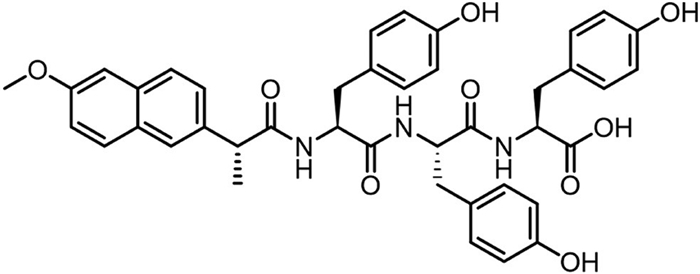
Scheme 1.
Chemical structure of Npx-YYY.

A dissipative hydrogel formed by peptide-carbon dioxide interaction
Lihua Mo , Hang Wu , Yu Zhang , Tengyan Xu , Yuanzhi Zhong , Zhimou Yang


Hydrogels have found widespread applications in diverse fields, ranging from biomedicine to analytical science and catalysis [1–13]. A variety of hydrogelators have been developed to construct three-dimensional networks capable of forming functional hydrogels, including polymers [14–16], inorganic materials [17–19], and biologically active molecules [20–22]. Among them, synthetic short peptides stand out because they are biocompatible, bioactive, and sequence-defined, while also exhibiting responsiveness to external stimuli [23]. Consequently, peptide-based hydrogels are regarded as promising next-generation smart materials.
Typically, the self-assembly of short peptides into hydrogels is triggered by chemical or biological stimuli, such as reactive oxygen species (ROS), enzymes, and proteins [5,6,24–28]. These stimuli usually originate from biological microenvironments that exist in the liquid or solid phase. In contrast, gaseous molecules also play essential roles in sustaining life, as all organisms on Earth live within an atmospheric environment. Notably, gases such as O2, N2, CO2, CO, and NO are effective hydrogen-bond acceptors [11] and could potentially serve as triggers for peptide self-assembly and hydrogel formation. Since peptides and proteins are central to biological responses to changes in gaseous environments, exploring gas-responsive peptide systems offers a fascinating opportunity to link molecular assembly with environmental cues [29]. Here, we report CO2-responsive tripeptides that undergo self-assembly to form hydrogels.
Pioneering studies have shown that CO2 can form hydrogen bonds with carboxylic acids, amines, and phenolic groups [30]. Based on this principle, we designed and synthesized a tyrosine-based self-assembling peptide, Npx-YYY (Scheme 1), in which the tyrosine residue is expected to interact with CO2 through a PhO–H···O=C=O hydrogen bond. The peptide was synthesized via standard solid-phase peptide synthesis and purified using high-performance liquid chromatography (HPLC) (Figs. S1–S4 in Supporting information).
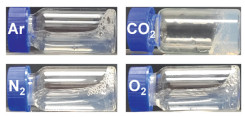
We next examined the gelation behavior of Npx-YYY under different gaseous environments. As shown in Fig. 1, the peptide formed a viscous solution in water (pH 7.2–7.4, adjusted with NaOH) even at a high concentration of 10 mg/mL under an Ar atmosphere. Remarkably, bubbling CO2 through the solution for 5 min induced a rapid transition to an opaque hydrogel. In contrast, no gelation occurred under O2 or N2 atmospheres. These results clearly demonstrate that hydrogel formation is selectively triggered by CO2–peptide interactions (Figs. S5 and S6 in Supporting information). The pKa of phenol is ~10.5, while the pKa of -COOH is ~2.2. Therefore, in the solution pH of 7.2–7.4, no proton attaches to -COOH, and the mainly existence form is -COO−. The pKa of water-containing total CO2 (including H2CO3 + CO2) is ~6.3, thus failing to react with -COO− to form -COOH according to the acid-base theory. The information suggested that the main functional group to interact with CO2 for hydrogels formation was phenol. As shown in Figs. S7–S11 (Supporting information), Npx-GYY could also form a hydrogel under the CO2 atmosphere, but the Npx-YGY and Npx-YYG could not form hydrogels under the CO2 atmosphere. Deletion of one tyrosine (Y) from Npx-YYY resulted in Npx-YY, which could also form a hydrogel. However, further deletion of Y led to the Npx-Y that could not form a hydrogel under the CO2 atmosphere (Figs. S12–S15 in Supporting information). These observations highlighted the importance of both aromatic and the phenol-CO2 interactions for the formation of hydrogels. Solvents gelatin experiments showed that no organogel formation of Npx-YYY in organic solvents including DMSO, MeOH, EtOH, and acetonitrile in the presence of CO2, which meant that the aromatic interaction also played a role for the hydrogel formation (Fig. S16 in Supporting information). The addition of HCl leaded to a partial hydrogel formation (Fig. S17 in Supporting information). Due to the low pKa of HCl (pKa = −7), HCl reacts with -COO− to form -COOH according to the acid-base theory, which will increase the gelation ability of Npx-YYY and thus forming a partial hydrogel. However, the HCl also shift the equilibrium between CO2 and H2O, and leads to the decrease in concentration of dissolving CO2, thus interfering the phenol-CO2 interaction. These observations highlighted the advantages of CO2 to form a bulky hydrogel.
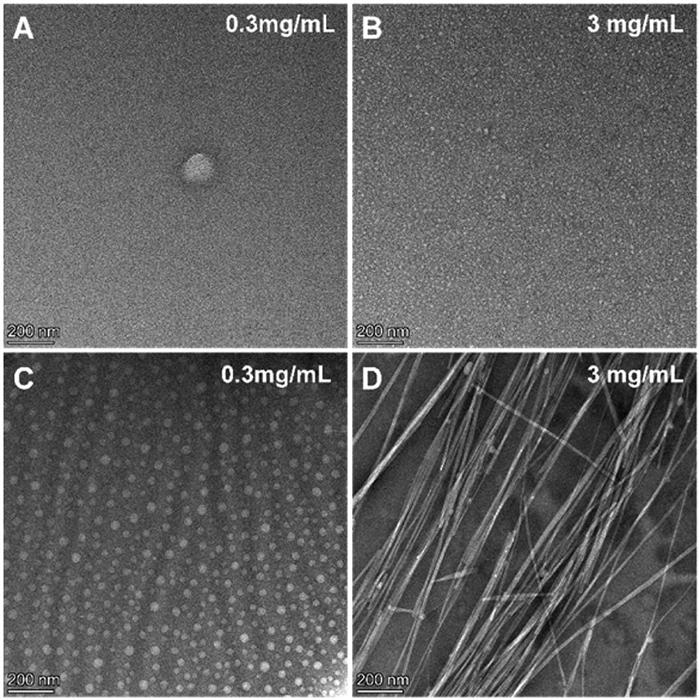
Concentration-dependent gelation experiments conducted under CO2 revealed a critical gelation concentration (CGC) of approximately 3 mg/mL in Npx-YYY aqueous solution (Fig. S18 in Supporting information). Transmission electron microscopy (TEM) images of the Npx-YYY aqueous solution under an Ar atmosphere revealed the formation of nanoparticles with an average diameter of 13 ± 4 nm at a concentration of 3 mg/mL, whereas no well-defined nanostructures were observed at 0.3 mg/mL (Figs. 2A and B). In contrast, when exposed to a CO2 atmosphere, Npx-YYY self-assembled into nanoparticles with an average diameter of 26 ± 4 nm at 0.3 mg/mL, which further organized into entangled nanofibers with an average diameter of 19 ± 5 nm at 3 mg/mL (Figs. 2C and D). These intertwined nanofibers represent the fundamental structural framework responsible for hydrogel formation under CO2 conditions [31].
To further investigate the self-assembly behavior, the critical aggregation concentration (CAC) of Npx-YYY was determined under different gaseous environments. As shown in Fig. S19 (Supporting information), the CAC in the Ar atmosphere was 34 μmol/L, whereas that in the CO2 atmosphere decreased markedly to 12 μmol/L (Fig. S20 in Supporting information). This substantial reduction indicates that CO2 enhances the self-assembly propensity of Npx-YYY, consistent with the proposed peptide–CO2 interaction driving the formation of the CO2-responsive hydrogel.
To verify the proposed peptide–CO2 interaction responsible for the enhanced self-assembly of Npx-YYY and its subsequent hydrogelation, we performed 13C nuclear magnetic resonance (13C NMR) spectroscopy under different gaseous environments. As shown in Fig. 3, no 13C NMR signal corresponding to CO2 (124.5 ppm) was detected in the sample maintained under an Ar atmosphere. In contrast, upon bubbling CO2 into the peptide solution for 2 min, a distinct resonance appeared at 124.5 ppm, characteristic of dissolved CO2. The intensity of this signal was significantly higher than that observed in pure water, indicating an increased CO2 concentration in the peptide solution, consistent with specific peptide–CO2 interactions.
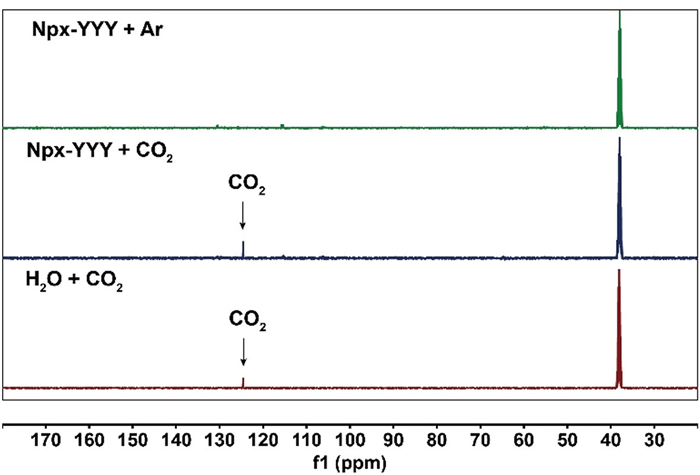
Furthermore, no appreciable 13C NMR signals were observed at ~161 or ~167 ppm, which correspond to HCO3− and CO32−, respectively. This absence likely results from their extremely low concentrations in aqueous solution under 1 atm CO2 (approximately 33 mmol/L for CO2, 0.01 mmol/L for HCO3−, and 10−8 mmol/L for CO32−) [32]. These findings collectively support the conclusion that CO2 interacts directly and reversibly with Npx-YYY, facilitating its self-assembly into hydrogels.
Interestingly, the hydrogel formed through peptide–CO2 interactions exhibited a dissipative nature, suggesting its potential utility for reversible CO2 capture and release. As shown in Fig. 4A, simple exposure of the hydrogel to air led to its gradual disassembly, ultimately reverting to a viscous solution within 3 h. Moreover, the ultraviolet–visible (UV–vis) spectrum of the peptide solution in a CO2 atmosphere displayed a 2 nm red shift compared with that in an Ar atmosphere (Fig. S21 in Supporting information), further supporting the altered electronic environment caused by CO2 binding.
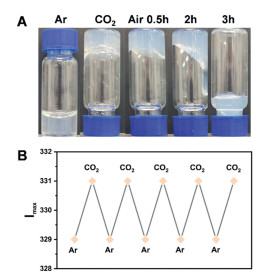
To evaluate the reversibility of this process, a cyclic CO2 capture–release experiment was performed by alternately bubbling CO2 and Ar gases through the system. As shown in Fig. 4B, the hydrogelation–dissolution process was fully reversible and could be repeated for at least seven cycles, confirming the reversible peptide–CO2 interaction responsible for the dynamic assembly behavior.
In summary, we have demonstrated the first example of a dissipative hydrogel driven by peptide–CO2 interactions. The tyrosine-based self-assembling peptide (Npx-YYY) forms multiple hydrogen bonds with CO2 molecules, thereby promoting hydrogel formation. Owing to the reversible nature of the peptide–CO2 interaction, the absorbed gas is gradually released from the hydrogel, resulting in a gel–sol phase transition. This gas-responsive hydrogel system represents a new class of dynamic self-assembling materials with potential applications in catalysis, sensing, drug delivery, and controllable CO2 capture and release.
Lihua Mo: Writing – original draft, Visualization, Validation, Methodology, Formal analysis, Data curation, Conceptualization. Hang Wu: Validation, Investigation, Data curation. Yu Zhang: Validation, Investigation, Data curation. Tengyan Xu: Supervision, Methodology, Conceptualization. Yuanzhi Zhong: Writing – original draft, Visualization, Validation, Methodology, Investigation, Formal analysis, Data curation, Conceptualization. Zhimou Yang: Writing – review & editing, Supervision, Resources, Project administration, Methodology, Funding acquisition, Data curation, Conceptualization.
The authors declare that they have no known competing financial interests or personal relationships that could have appeared to influence the work reported in this paper.
This work was supported by National Natural Science Foundation of China (No. 32230055).
Supplementary material associated with this article can be found, in the online version, at doi:
Q. Jiang, W. Zhan, X. Liu, et al., Nat. Commun. 14 (2023) 3935. doi: 10.1038/s41467-023-39658-0
G. Gao, Y.W. Jiang, W. Zhan, et al., J. Am. Chem. Soc. 144 (2022) 11897–11910. doi: 10.1021/jacs.2c05743
H. Wang, Z. Feng, B. Xu, J. Am. Chem. Soc. 141 (2019) 7271–7274. doi: 10.1021/jacs.9b03346
Y. Gao, J. Shi, D. Yuan, et al., Nat. Commun. 3 (2012) 1033. doi: 10.1038/ncomms2040
F. Wang, H. Su, D. Xu, et al., Nat. Biomed. Eng. 4 (2020) 1090–1101. doi: 10.1038/s41551-020-0597-7
M. Ikeda, T. Tanida, T. Yoshii, et al., Nat. Chem. 6 (2014) 511–518. doi: 10.1038/nchem.1937
J. Yang, P. Wang, Y. Zhang, et al., Cell Stem Cell. 32 (2025) 121–136 e126. doi: 10.1016/j.stem.2024.09.016
B. Xue, Z. Xu, L. Li, et al., Nat. Commun. 16 (2025) 3633. doi: 10.1038/s41467-025-59016-6
Q. Wang, J.L. Mynar, M. Yoshida, et al., Nature 463 (2010) 339–343. doi: 10.1038/nature08693
Q. Wu, Z. He, X. Wang, et al., Nat. Commun. 10 (2019) 240. doi: 10.1038/s41467-018-08234-2
Y. Zhong, L. Mo, Y. Yi, et al., Angew. Chem. Int. Ed. 65 (2026) e15617. doi: 10.26434/chemrxiv-2025-p3sgc
D. Ye, A.J. Shuhendler, L. Cui, et al., Nat. Chem. 6 (2014) 519–526. doi: 10.1038/nchem.1920
L. Cui, S. Vivona, B.R. Smith, et al., J. Am. Chem. Soc 142 (2020) 15575–15584. doi: 10.1021/jacs.0c07594
R.R. Weber, R. Hein, A. Ryabchun, et al., Nat. Commun. 16 (2025) 9106. doi: 10.1038/s41467-025-64123-5
Y. Wang, H. Zhang, Y. Zhao, et al., Chin. Chem. Lett. 37 (2026) 111483. doi: 10.1016/j.cclet.2025.111483
X. Li, X. Ding, J. Zhou, et al., Chin. Chem. Lett. 35 (2024) 109158. doi: 10.1016/j.cclet.2023.109158
K. Sano, N. Igarashi, Y. Ebina, et al., Nat. Commun. 11 (2020) 6026. doi: 10.1038/s41467-020-19905-4
B. Xu, H. Zhang, X. Feng, et al., Chin. Chem. Lett. 37 (2026) 111880. doi: 10.1016/j.cclet.2025.111880
N. Gao, Y. Zhang, Z. Yang, et al., Chin. Chem. Lett. 35 (2024) 108820. doi: 10.1016/j.cclet.2023.108820
S. Bianco, M. Hasan, A. Ahmad, et al., Nature 631 (2024) 544–548. doi: 10.1038/s41586-024-07580-0
J. Song, M. Lee, T. Kim, et al., Nat. Commun. 9 (2018) 4331. doi: 10.1038/s41467-018-06864-0
H. Shen, Y. Qiao, C. Zhang, et al., Chin. Chem. Lett. 35 (2024) 110283. doi: 10.1016/j.cclet.2024.110283
J. Guo, F. Wang, Y. Huang, et al., Nat. Nanotechnol. 18 (2023) 1094–1104. doi: 10.1038/s41565-023-01401-7
H. He, W. Tan, J. Guo, et al., Chem. Rev. 120 (2020) 9994–10078. doi: 10.1021/acs.chemrev.0c00306
D.J. Smith, G.A. Brat, S.H. Medina, et al., Nat. Nanotechnol. 11 (2016) 95–102. doi: 10.1038/nnano.2015.238
Z. Luo, Q. Wu, C. Yang, et al., Adv. Mater. 29 (2017) 1601776. doi: 10.1002/adma.201601776
Y. Ding, D. Zheng, L. Xie, et al., J. Am. Chem. Soc. 145 (2023) 4366–4371. doi: 10.1021/jacs.2c11823
P. Majumder, A. Singh, Z. Wang, et al., Nat. Nanotechnol. 16 (2021) 1251–1259. doi: 10.1038/s41565-021-00961-w
P. Norouzitallab, K. Baruah, D. Vanrompay, et al., Sci. Total Env. 647 (2019) 1281–1293. doi: 10.1016/j.scitotenv.2018.08.063
M. George, R.G. Weiss, Acc. Chem. Res. 39 (2006) 489–497. doi: 10.1021/ar0500923
R.G. Weiss, J. Am. Chem. Soc. 136 (2014) 7519–7530. doi: 10.1021/ja503363v
S. Mohammadi, W.K. Jones, P. Jaeger, et al., Discov. Appl. Sci. 7 (2025) 984. doi: 10.1007/s42452-025-07557-2

Figure 1 Optical images of water solutions of Npx-YYY (10 mg/mL, pH 7.2–7.4, adjusted by NaOH) in different gas atmospheres.

Figure 3 13C NMR spectra of Npx-YYY in different atmosphere. After gas bubbling for two minutes, 0.1 mL of DMSO-d6 was added to the 0.4 mL of H2O or the Npx-YYY aqueous solution (0.4 wt%).

 扫一扫看文章


扫一扫关注我们
 DownLoad:

 下载:


 下载: