
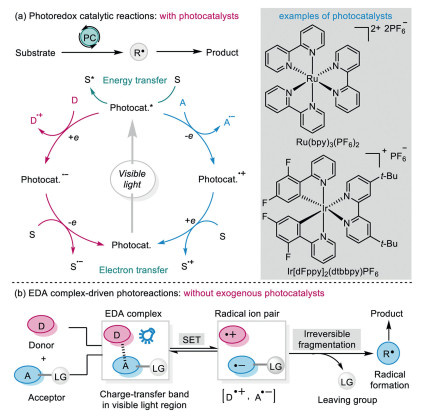
Scheme 1.
Visible-light-driven radical transformations.


Visible-light photoredox reactions have attracted significant attention in recent years and have emerged as a powerful synthetic methodology for the activation, cleavage, and formation of chemical bonds, playing a crucial role in modern organic synthesis [1-6]. However, since most organic substrates do not absorb visible light, photoredox catalysis relies on the use of exogenous photocatalysts to harvest the energy of visible light and convert it into chemical energy, enabling substrate activation via energy transfer or electron transfer processes to generate reactive radical species (Scheme 1a) [2,7]. Currently developed photocatalysts are primarily polypyridyl complexes of precious metals (e.g., Ir(Ⅲ), Ru(Ⅱ)) or organic dyes with extended π-conjugated systems [8-11]. These photocatalysts often suffer from high costs, laborious synthesis, or photodegradation, which limits their synthetic utility in photocatalytic applications to some extent.
Distinct from visible-light-catalyzed photoredox reactions, electron-rich donor molecules (A donor, D) and electron-deficient acceptor molecules (An acceptor, A) can engage in direct interaction to form a ground-state electron donor-acceptor (EDA) complex. Visible light excitation of the EDA complexes triggers single electron transfer (SET) from the electron donor to the electron acceptor, resulting in the formation of radical ion pairs (D•+ and A•-), which subsequently undergo irreversible fragmentation to generate reactive radical species. This approach facilitates visible-light-driven chemical transformations without the requirement for exogenous photocatalysts (Scheme 1b) [11-26].
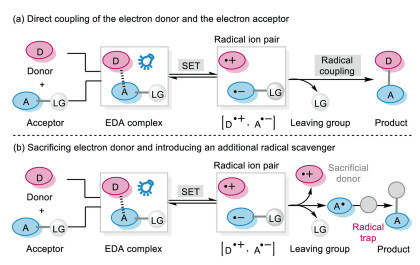
Nevertheless, most radical reactions with EDA complexes are currently stoichiometric, necessitating stoichiometric amounts of electron donors and electron acceptors to form the resulting EDA complexes. Radical reactions involving stoichiometric EDA complexes primarily proceed via two distinct strategies. One strategy entails the direct interaction of the electron donor and the electron acceptor through a radical pathway to afford the corresponding coupling products (Scheme 2a) [27-45]. This approach requires the electron donor to possess radical-trapping capability, imposing stringent demands on substrates and thereby constraining the diversity of reaction substrates. To circumvent this limitation, organic chemists have proposed an alternative strategy: Sacrificing electron donor and introducing an additional radical scavenger to capture the radicals, thereby affording new compounds without the electron donor structural fragments (Scheme 2b) [46-53]. Although the diversity of products can be broadened by this method, the sacrifice and waste of stoichiometric electron donors are incurred, resulting in low atom economy.
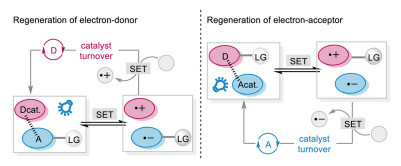
In comparison to stoichiometric EDA reactions, catalytic EDA strategies not only enable the generation of radical species at relatively low concentrations to suppress undesired side reactions but also circumvent stoichiometric reagent waste, improve atom economy, and reduce waste formation, all of which align perfectly with the principles of green chemistry. Therefore, the development of catalytic EDA strategies to achieve the catalytic cycle of electron donors or electron acceptors, improve the atom economy, and enhance the synthetic application potential of EDA reactions has aroused great interest among synthetic organic chemists [15,18].
This review intends to highlight current advancements in the photochemistry of catalytic EDA complexes and will be organized into two core categories: Examples of EDA catalysis with electron-donor as catalyst and examples with electron-acceptor as catalyst (Scheme 3). Notably, recent progress has further been made in the utilization of catalytically generated intermediates for EDA complex formation, such as enamine- or iminium ion-based intermediates produced in organocatalytic processes or N-heterocyclic carbene-derived intermediates [54-63]. However, these examples will not be discussed in this review.
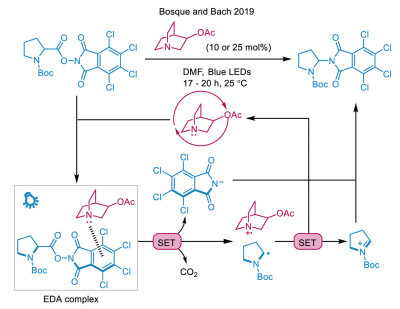
As commonly known, amines are excellent electron donors due to the electron-donating lone pair of electrons on their nitrogen atoms. In 2019, Bosque and Bach reported a decarboxylative amination reaction catalyzed by 3-acetoxyquinuclidine (q-OAc) functioning as a catalytic electron donor under visible-light irradiation (Scheme 4) [64]. Catalytic amounts of q-OAc formed a catalytic EDA complex with electron-deficient redox-active esters. Under visible light induction, the EDA complex underwent charge transfer and decarboxylation to generate tetrachlorophthalimide anion, α-amino radical and q-OAc•+. Subsequently, q-OAc•+ engaged in a single-electron transfer process with the α-amino radical, resulting in the formation of an iminium ion and regeneration of q-OAc, thereby completing the catalytic cycle of the electron donor. The generated iminium ion was subsequently captured by the tetrachlorophthalimide anion, leading to the formation of the decarboxylated amination product. This reaction utilized the structurally rigid q-OAc as an electron donor, which effectively suppressed the subsequent deprotonation of the amino radical cation formed through the single-electron transfer of tertiary amines, thereby preventing the formation of iminium cations and catalyst deactivation. Furthermore, owing to its rigid structure resembling that of q-OAc, DABCO was also used as a catalytic electron donor in EDA strategies. In 2024, Zhu’s group reported a visible-light-induced organophotocatalytic pathway for the cyanoalkylation of azauracils using inexpensive and readily available DABCO as a catalytic electron donor to form an EDA complex with cycloketone oxime esters [65].
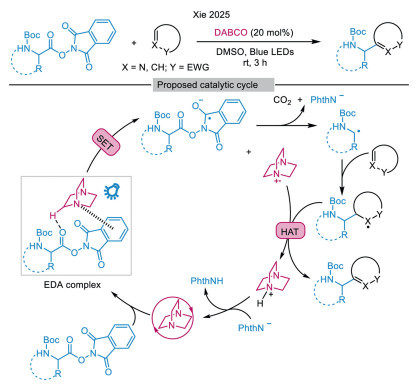
In 2025, Xie’s group reported a catalytic EDA complex mediated decarboxylative α-amino alkylation of heterocyclic compounds, using readily available DABCO as a catalytic electron donor (Scheme 5) [66]. Mechanistic studies and DFT calculations revealed that α-amino alkylation proceeds via a transiently assembled photoactive EDA complex between α-amino acid esters and DABCO through n-π stacking and H-bonding. Upon irradiation, the EDA complex occurred SET and irreversible fragmentation to generate radical cation DABCO+• and α-amino alkyl radical. Then, α-amino alkyl radical added to the C═X bond of heterocyclic compounds, forming radical intermediate. Finally, electrophilic DABCO+• abstracted a hydrogen atom from the hydridic C(sp3)–H bond of radical intermediate to afford the desired product and DABCO–H+, which was deprotonated by the phthalimide anion, regenerating DABCO and completing the catalytic cycle.
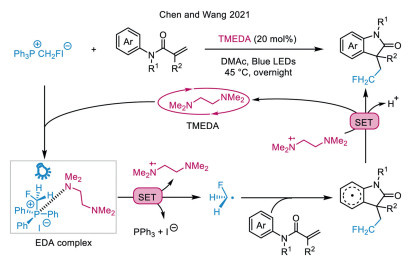
Subsequently, the range of catalytic electron donors was further expanded to acyclic trialkylamines. For example, in 2021, Chen and Wang’s group used catalytic TMEDA as an electron donor to form a catalytic EDA complex with phosphonium iodide salts (Scheme 6) [67]. Under visible light induction, charge transfer and C–P bond cleavage occurred, generating TMEDA radical cations and fluoroalkyl radicals. The fluoroalkyl radicals underwent radical addition to the alkene, followed by intramolecular radical addition to the aromatic ring, resulting in the formation of aryl radicals. The aryl radicals engaged in SET with TMEDA radical cations to regenerate the catalytic electron donor, and delivered the fluoroalkylated products after deprotonation.
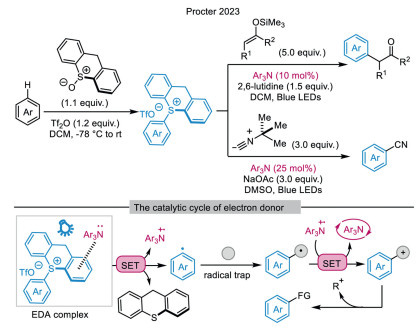
In addition to trialkylamines, triarylamines were among the most extensively studied electron donors for their versatility, the feasibility of modulating their electronic properties via structural modification of aromatic substituents, and the relative stability of their corresponding radical cations. In 2023, Procter’s group accomplished a site-selective alkylation and cyanation of aryl C–H bonds under visible-light-driven EDA catalysis by using triarylamine as catalytic electron donor (Scheme 7) [68]. This reaction proceeded directly from native unfunctionalized arenes, with in situ formation of aryl sulfonium salts that subsequently formed an EDA complex with catalytic triarylamines. This system facilitated the generation of aryl radicals and triarylamine radical cations under visible light induction. Aryl radical was then trapped by enol silyl ether or isocyanide to get a new radical, which underwent SET with triarylamine radical cation regenerated the catalytic electron donor triaryl amine. This strategy eliminated the need for pre-activation of aryl compounds, offered a straightforward operational procedure, and demonstrated excellent step economy, thereby presenting a novel approach for the activation of aryl C–H bonds.
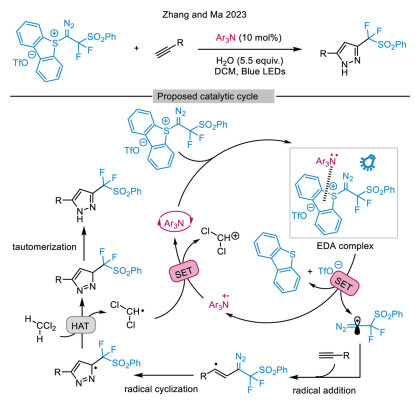
In the same year, an α-diazodifluoroethane sulfonium reagent was developed by Zhang and co-workers to undergo [3 + 2] radical cyclization with unactivated alkynes to give the corresponding 3-difluoromethyl pyrazoles under blue light irradiation conditions (Scheme 8) [69]. Key to the success of this transformation lied in the formation of a catalytic EDA complex between an electron-deficient α-diazo sulfonium salt and a catalytic electron-rich triarylamine. In this strategy, the catalytic EDA complex underwent charge transfer to generate difluorodiazomethyl radical and triarylamine radical cation species irreversibly. Subsequent difluorodiazomethyl radical addition to alkynes gave thermodynamically favored radical intermediate, which underwent fast intramolecular cyclization to yield pyrazolyl radical. Then, a hydrogen-atom transfer (HAT) from dichloromethane and tautomerization released the 3-difluoromethyl pyrazoles. Finally, triarylamine radical cation could oxidize the dichloromethyl radical and regenerated the amine catalyst to enter the next catalytic cycle.
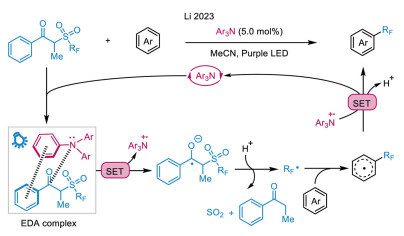
In 2023, Li’s group reported a discovery of catalytic EDA complex between triarylamines and α-perfluorosulfonylpropiophenone reagents that enabled the C–H perfluoroalkylation of arenes and heteroarenes under visible light irradiation (Scheme 9) [70]. In this reaction, the catalytic EDA complex underwent a charge transfer to generate triphenylaminium radical cation and perfluoroalkyl radical. The perfluoroalkyl radical added to (hetero)aryl to form (hetero)aryl radical, which then underwent SET with the triphenylaminium radical cation and deprotonation to obtain the target compound, while regenerating the catalytic electron donor to complete the catalytic cycle.
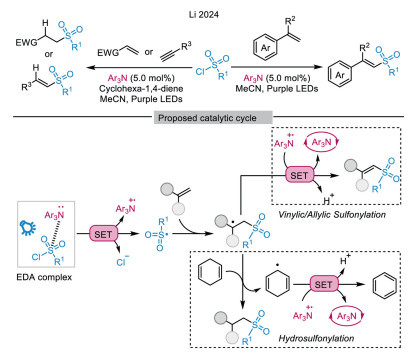
In 2024, Li’s group further demonstrated the utility of triarylamines as catalytic electron donors to achieve sulfonylation of alkenes under redox-neutral conditions and hydrosulfonylation of alkenes or alkynes under net-reductive conditions (Scheme 10) [71]. This strategy employed triarylamines as catalytic electron donors to generate EDA complexes with inexpensive and readily available sulfonyl chlorides. Upon visible light irradiation, sulfonyl radicals were generated and participated in the sulfonylation of alkenes or alkynes. The methodology featured a straightforward operational procedure and offered high atom efficiency.
In 2025, Li and co-workers also used triarylamine as a catalytic donor to form an EDA complex with sulfonyl chloride, achieving the sulfonylation/cyclization of biaryl vinyl ethers under visible light irradiation [72]. Applying this operationally simple and visible-light-mediated general platform, 6H-benzo[c]chromene and 6H-benzo[c]thiochromene scaffolds could be easily constructed.
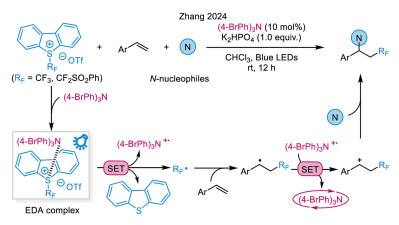
In the aforementioned reaction, the triarylamine radical cation facilitated the regeneration of the catalytic electron donor via SET with the radical species, concomitantly oxidizing the radical to a cationic state. Building on this reaction mechanism, Zhang and co-workers employed triarylamine as a catalytic electron donor, S-fluoromethyldiaryl sulfonium salt as a radical precursor, and N-nucleophile as a cation trapping agent to realize a three-component coupling reaction involving alkenes, S-fluoromethyldiaryl sulfonium salts, and N-nucleophiles via a catalytic EDA strategy (Scheme 11) [73]. This methodology provided a novel and efficient approach for the visible-light-mediated trifluoromethyl amination of alkenes.
In 2025, Ma and co-workers expanded the nucleophile scope to chalcogen nucleophiles, enabling a three-component chalcogen-trifluoromethylation of alkenes under blue light irradiation without the need for transition metal catalyst. This reaction was broadly applicable to oxy, thio, and seleno nucleophiles, facilitating modular access to a diverse array of β-trifluoromethyl alcohols, ethers, thioethers, thiocyanates, and selenocyanates with good yields and predictable regioselectivities [74].
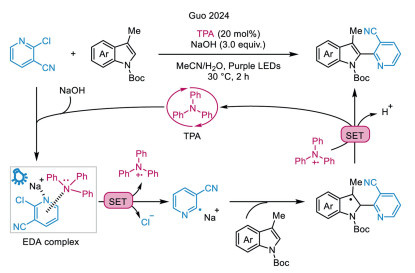
In 2024, Guo’s group employed triarylamines as catalytic electron donor to generate EDA complexes with electron-deficient pyridine halides, thereby enabling the C2-heteroarylation of indole compounds under visible light irradiation (Scheme 12) [75]. The triaryl radical cation, generated through charge transfer within the catalytic EDA complex, underwent a SET process with the alkyl radical formed via the addition of the pyridine radical to the indole substrate. This process facilitated the regeneration of the catalytic triarylamine, thus completing catalytic cycle of the reaction.
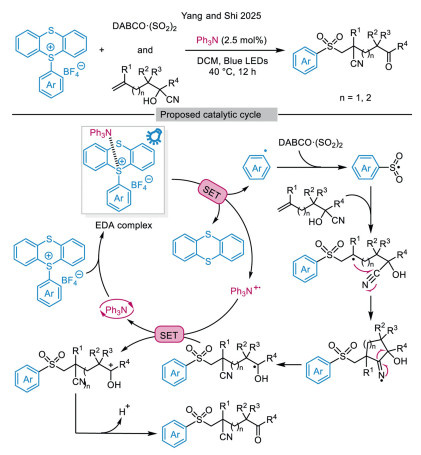
In 2025, Yang’s group disclosed a simple and efficient catalytic EDA strategy by utilizing triarylamine as catalytic electron donor for the synthesis of β-cyanosulfones. This strategy realized a three-component alkene difunctionalization of aryl thianthrenium salts, DABCO·(SO2)2, and cyanohydrins via intramolecular 1,4-cyano migration (Scheme 13) [76]. In this reaction, triphenylamine combined with electron-poor aryl thianthrenium salt to form the EDA complex, which generated aryl radical, triphenylamine radical cation, and thianthrene. Then, the aryl radical was intercepted by DABCO·(SO2)2 to deliver sulfonyl radical, which reacted with cyanohydrins to afford the alkyl radical. The effective intramolecular interception of alkyl radical by the cyanohydrin species via a five-membered ring cyclization yielded the cyclic iminium radical. The homolysis of cyclic iminium radical enabled 1,4-cyano migration and generated a more stable hydroxyalkyl radical, which then underwent a SET process with triphenylamine radical cation to give the carbon cation intermediate, along with the regeneration of triphenylamine to complete the catalysis cycle. Finally, carbon cation intermediate underwent deprotonation to obtain target product. In the same year, Yu’s group employed a similar strategy to generate sulfonyl radicals, achieving a sulfonylation-cyclization cascade reaction of 1-(2-(arylethynyl)benzoyl)indoles [77].
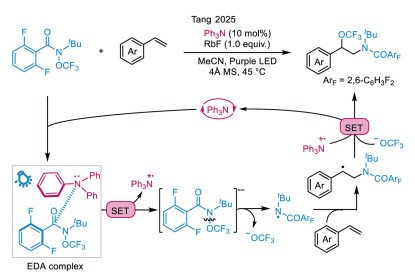
In the same year, Tang’s group employed triarylamines as catalytic electron donor to generate EDA complexes with N–OCF3 reagent, thereby enabling the amidotrifluoromethoxylation of styrenes under visible light irradiation (Scheme 14) [78]. In this strategy, N–OCF3 reagent served as a bifunctional reagent to provide both amidyl radical and trifluoromethoxy anion. This method manifested exceptional functional group compatibility and was successfully applied to the late-stage modification of complex bioactive molecules.
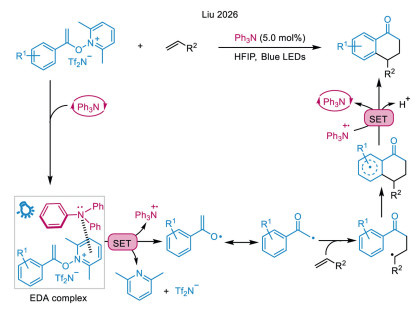
In 2026, Liu’s group developed a formal [4 + 2] cycloaddition using Ph3N as a catalytic electron donor for EDA complex formation with pyridinium-masked enols (Scheme 15) [79]. Upon blue-light irradiation, a nonbonded electron from Ph3N was transferred to the pyridinium moiety, resulting in the generation of 2,6-lutidine and α-carbonyl radical. Subsequently, the α-carbonyl radical added to the olefin to form the γ-carbonyl radical. Then, the radical cyclization step preferentially provided a new radical intermediate, which underwent SET with Ph3N•+ to regenerate Ph3N, followed by deprotonation to provide the desired product. This work not only expanded the application of Ph3N in EDA catalysis, but also enriched the arsenal of EDA complexes.
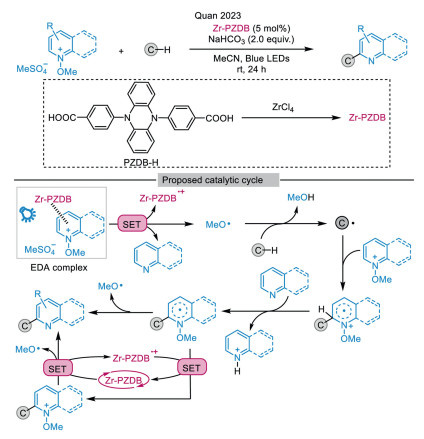
Interestingly, triphenylamine-based electron donors could be applied not only in homogeneous catalytic EDA strategies but also in heterogeneous ones. In 2023, Quan’s group embedded dihydrophenazine into Zr-doped metal-organic framework materials (MOF) to synthesize a heterogeneous catalyst Zr-PZDB. They achieved Minisci reactions between heterocycles and a series of C–H coupling reagents (such as ethers, alcohols, alkanes, amides, and aldehydes) under visible light induction (Scheme 16) [80]. Zr-PZDB was used as catalytic electron donor to form catalytic EDA complex with alkoxy pyridinium salts. This research not only highlighted the potential of MOF engineering to address the limitations of organic catalysis, but also paved an innovative avenue to develop the green and sustainable MOF-based EDA photochemistry.
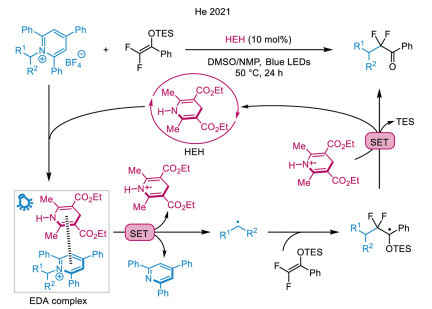
Further studies had demonstrated that, besides tertiary amines, secondary amines and pyridine derivatives could also act as catalytic electron donors. In 2021, He’s group described a novel visible-light-mediated deaminative difluoroalkylation reaction of Katritzky salts derived from primary amines with difluoroenoxytriethylsilane for the synthesis of the difluoroketone motifs, where Hantzsch ester was utilized as a catalytic electron donor (Scheme 17) [81]. Initially, the catalytic EDA complex was generated by the interaction between Hantzsch esters and Katritzky salts, up irradiation with blue LEDs generated alkyl radical via a photo-induced SET process. Subsequent regioselective addition of alkyl radical to alkene afforded another carbon-centered radical intermediate, which underwent SET with cationic Hantzsch ester followed by desilylation afforded the corresponding difluoroalkylated products and regenerated the catalytic electron donor Hantzsch ester.
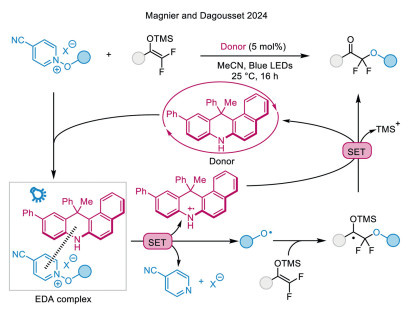
In 2024, Magnier’s group reported a catalytic protocol where electron-rich secondary amines and electron-deficient alkoxy pyridinium salts form catalytic EDA complexes (Scheme 18) [82]. Under visible light induction, these EDA complexes generated amino radical cations and alkoxyl radicals via charge transfer. The alkoxyl radicals added to difluorinated silyl enol ethers, forming carbon-centered radicals, which then underwent SET with amino radical cations to regenerate the catalytic electron donor and release the carbocation species. Finally, removing the silicon cation completed the alkoxylation of difluorinated silyl enol ethers, enabling the synthesis of gem‑difluorinated alkoxy ketones.
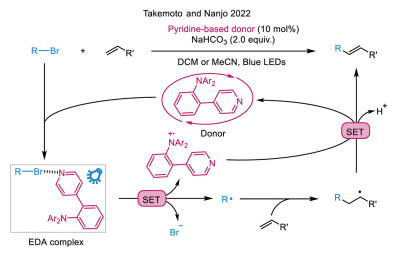
In 2022, Takemoto and co-workers proposed a Heck reaction of alkenes with alkyl bromides under visible light induction, wherein pyridine derivative served as catalytic electron donor (Scheme 19) [83]. A catalytic amount of EDA complex was formed by interaction of pyridine derivatives with alkyl bromides. Under visible light induction, a charge transfer event happened to generate alkyl radicals and pyridinium radical cations. The alkyl radicals added to alkenes, and then underwent a SET with the pyridinium radical cations to regenerate the catalytic electron donor. The Heck reaction product was ultimately formed after deprotonation. In 2023, Rovis’s group utilized pyridine as catalytic electron donor to form a catalytic EDA complex with α-bromoamides. Upon visible-light irradiation, a formal [3 + 2] reaction between α-bromoamides and unactivated alkenes was achieved, resulting in an efficient synthesis of structurally diverse γ-lactam compounds [84].
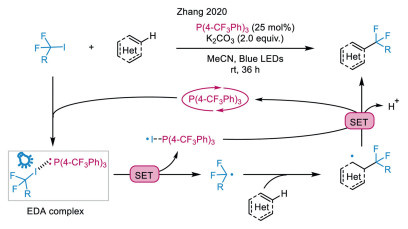
Catalytic EDA strategies using amines as electron donors have been widely developed. As an element of the same main group as nitrogen, phosphorus exhibits similar electronic properties to nitrogen. Consequently, EDA strategies with organophosphines as catalytic electron donors have also attracted the attention of organic chemists. In 2020, Zhang’s group described a mild and efficient strategy for direct gem‑difluoromethylation of unactivated arenes and heteroarenes using triaryl phosphine as catalytic electron donor and difluoroalkyl iodide as electron acceptor (Scheme 20) [85]. A broad range of substrates and diverse iododifluoroalkanes were well tolerated, facilitating the synthesis of highly valued gem‑difluoroalkanes. The catalytic triaryl phosphine was regenerated through SET process between the triaryl phosphine iodide radical and the difluoromethyl alkyl-substituted aryl radical or heteroaryl radical.
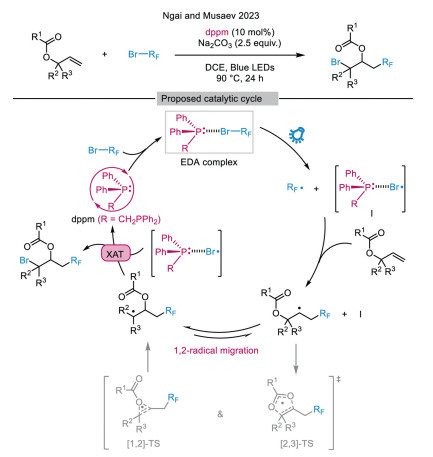
In 2023, Ngai and co-workers reported the first visible-light-induced phosphine-catalyzed 1,3-carbobromination of allyl carboxylates, affording a range of valuable substituted isopropyl carboxylates (Scheme 21) [86]. In this reaction, a catalytic EDA complex was formed between an organic phosphine and a polyfluoroalkyl bromide. Photoexcitation of EDA complex generated bromophosphine radical species and difluoroalkyl radical. Subsequent radical addition of difluoroalkyl radical to allyl benzoate afforded the secondary alkyl radical. The secondary alkyl radical underwent concerted [1,2]- or [2,3]-ester migration via three- or five-membered ring transition state, forming the more stable tertiary alkyl radical intermediate. Finally, Br-atom transfer from bromophosphine radical species to tertiary alkyl radical intermediate delivered the desired product and regenerated catalytic electron donor, closing the catalytic cycle.
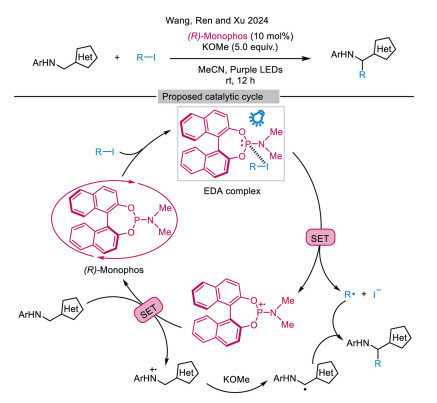
In 2024, Wang’s group disclosed a C(sp3)–H alkylation of heterobenzylic amines under visible light irradiation, involving an EDA complex formed upon association of alkyl iodide and organophosphine in catalytic amounts (Scheme 22) [87]. In this reaction, a catalytic EDA complex underwent charge transfer upon visible-light irradiation, resulting in the generation of alkyl radical and phosphonium radical cation. Then, a charge transfer between heterobenzylic amine and phosphonium radical cation obtained heterobenzylic amine radical cation, while regeneration of organophosphine to complete the catalytic cycle. The heterobenzylic amine radical cation was deprotonated under basic conditions to provide the stable benzyl radical. Finally, radical–radical cross-coupling between alkyl radical and benzyl radical provided the alkylated product.
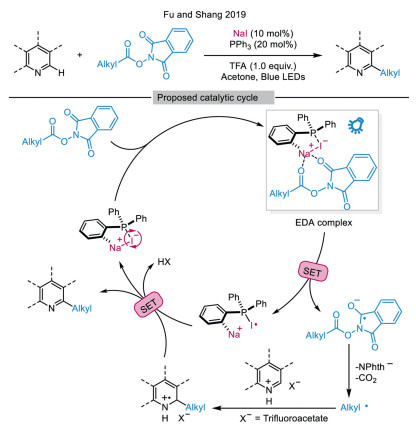
In addition to reagents with lone pairs of electrons that can form EDA complexes with electron-deficient substrates, negatively charged iodide ions can also act as catalytic electron donors to form EDA complexes with electron acceptors. In 2019, Fu and Shang’s group found that a combination of catalytic triphenylphosphine and sodium iodide under visible-light irradiation can catalyze the Minisci-type alkylation of N-heterocycles by decarboxylative coupling with redox-active esters in the absence of photocatalyst (Scheme 23) [88]. The catalytic cycle of iodide ions was accomplished through SET between the iodine radical and the pyridine radical cation. The iodine radical was generated via charge transfer within the catalytic EDA complex under visible light irradiation, while the pyridine radical cation was formed by the addition of an alkyl radical to a pyridinium salt. Triphenylphosphine was crucial to facilitate the intermolecular charge transfer and stabilize the iodine radical in this reaction. After that, the same group reported a photocatalytic decarboxylative alkenylation of N-(acyloxy)phthalimide derived from α-amino and α‑hydroxy acids with 1,1-diarylethene, and with cinnamic acid derivatives through double decarboxylation to synthesize compounds containing allylic amine and allylic ether structures, using catalytic sodium iodide and triphenylphosphine as redox catalyst [89].
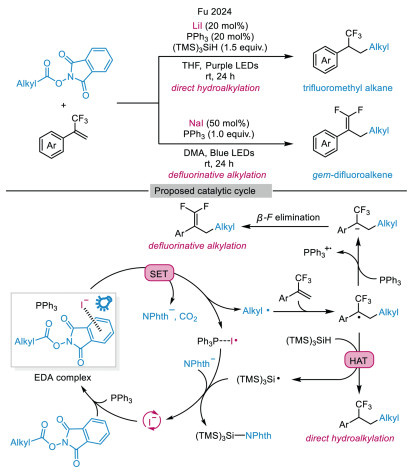
Building upon the aforementioned research, in 2024, Fu and co-workers reported a general photoinduced reductive alkylation via an EDA complex strategy to enable divergent decarboxylative hydroalkylation and reductive decarboxylative defluorinative alkylation between α-CF3-styrenes with N-hydroxyphthalimide esters (Scheme 24) [90]. These processes were driven by the photoactivity of catalytic EDA complexes assembled from catalytic iodide salts with redox-active esters. This protocol allowed the simple and efficient preparation of various trifluoromethyl alkanes and gem‑difluoroalkenes. In addition, in 2021, Fu group applied a similar strategy to achieve the decarboxylative alkylation of α-amino redox-active esters with enamides. They also extended the scope of radical precursors to Katritzky salts derived from amino acids, enabling the deaminative alkylation of amino acid derivatives with enamides [91].
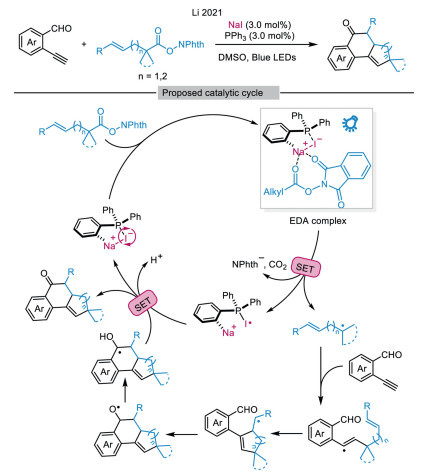
In 2021, Li’s group developed a practical and eco-friendly strategy for the radical-mediated decarboxylative [3 + 2] and [4 + 2] annulation of enynals and γ,σ-unsaturated N-(acyloxy)phthalimides through the photoactivation of a catalytic EDA complex (Scheme 25) [92]. In this reaction, catalytic iodide ion served as electron donor to form a catalytic EDA complex with redox-active ester. Visible light irradiation induced charge transfer, leading to the generation of alkyl radical and iodine radical. The alkyl radical added to alkynes to generate a new vinyl radical intermediate, followed by the 5-exo-trig annulation to give an unstable alkyl radical intermediate. Subsequently, the addition of unstable alkyl radical intermediate to the aldehyde via annulation would afford the alkoxy radical intermediate, which would undergo a 1,2-H atom shift to deliver the hydroxyalkyl radical intermediate. Then, hydroxyalkyl radical intermediate was oxidized by iodine radical to form the cation intermediate, which underwent deprotonation to provide the fused ketones, accompanied by the regeneration of catalytic iodide anion.
Building on Fu and Shang’s seminal contribution in 2019, numerous reports have demonstrated that iodide salts can serve as electron donor catalysts for EDA complex photochemistry, even in the absence of PPh3. In 2021, Shang’s group reported the visible-light-mediated α-alkylation of N-aryl glycine derivatives using iodide anion as a catalytic electron donor to form catalytic EDA complex with alkyl redox-active ester (Scheme 26) [93]. In this reaction, a catalytic EDA complex underwent charge transfer in amide solvent to generate iodine radical intermediate and carboxylate radical. Carboxylate radical underwent decarboxylation to generate alkyl radical. Simultaneously, the iodine radical intermediate acted as an oxidative species to oxidize glycinate through SET to generate nitrogen radical cation followed by deprotonation by phthalimide anion to deliver a persistent α-carbonyl radical. Finally, radical cross-coupling of alkyl radical with α-carbonyl radical produced α-alkylated glycinate.
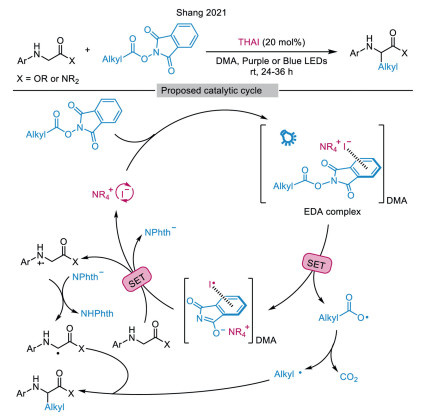
In this year, the same group employed a comparable strategy to achieve photocatalytic decarboxylative alkylation reaction of silyl enol ethers and enamides with alkyl redox-active esters, leading to the synthesis of a series of N-acyl imines and ketones [94]. In 2025, Rao’s group established iodide ion-catalyzed decarboxylative C—H alkylation of azauracils with alkyl redox-active esters, enabled by visible light activation of catalytic EDA complexes. This reaction featured a simple operational procedure, broad substrate scope, and excellent functional group compatibility [95].
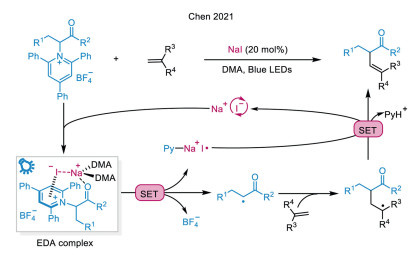
In 2021, Chen’s group reported a photoinduced deaminative alkenylation of Katritzky salts with alkenes using iodide anion as catalytic electron donor, enabling the synthesis of a wide variety of β,γ-unsaturated esters (Scheme 27) [96]. In this reaction, catalytic iodide anions and Katritzky salts formed catalytic EDA complexes in amide solvent. Under visible light induction, charge transfer occurred to generate secondary alkyl radicals and iodine radicals. The secondary alkyl radicals added to alkenes to form tertiary alkyl radicals, which then underwent SET with iodine radical species followed by deprotonation, thereby regenerating iodide anions and affording β,γ-unsaturated esters.
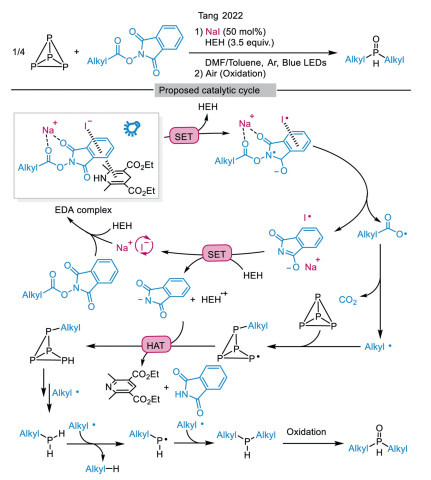
In 2022, Tang’s group developed an efficient photoinduced selective alkylation of P4 using NaI as a catalytic electron donor to form an EDA complex with aliphatic carboxylic acid derivative and Hantzsch ester (HEH), thus providing dialkylphosphine derivatives under mild conditions. Subsequently, dialkylphosphine derivatives could be oxidized to the corresponding dialkylphosphine oxides (Scheme 28) [97]. In this reaction, iodide anion was regenerated through SET between the iodine radical and Hantzsch ester. This step-economic approach could install various alkyl substituents bearing broad functional groups at phosphorus directly using P4 as the P-atom source, thereby avoiding the traditional chlorination stage.
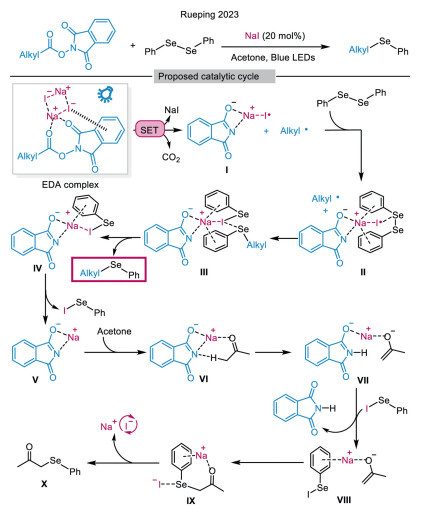
In 2023, Rueping’s group disclosed a visible-light-induced decarboxylative coupling reaction between alkyl redox-active esters and diselenides, synthesizing a series of organoselenium compounds (Scheme 29) [98]. This strategy employed catalytic amounts of iodide anions as electron donors to form catalytic EDA complexes with alkyl redox-active esters. Upon visible light irradiation, catalytic EDA complexes underwent charge transfer, leading to the generation of alkyl radicals and iodine radical species Ⅰ. The iodine radical species Ⅰ interacted with diselenides through non-covalent interaction to form the diselenide iodine radical species Ⅱ. The alkyl radicals were subsequently captured by diselenide iodine radical species Ⅱ to generate alkyl selenide compounds, iodinated selenide compounds, and sodium phthalimide salts Ⅴ through transition state Ⅲ. The sodium phthalimide salts Ⅴ abstracted a hydrogen atom from acetone through hydrogen bonding interaction, followed by an exchange reaction with the iodoselenide compounds to yield phthalimides and enol silyl salts Ⅷ. Subsequently, enol tautomerization took place, accompanied by the formation of C–Se bond and the cleavage of Se–X bond, resulting in formation of by-product X and regeneration of catalytic iodide ion, thereby completing the catalytic cycle.
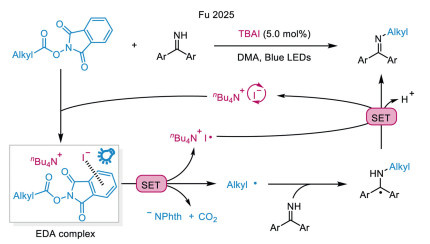
In 2025, Fu’s group reported a photoinduced decarboxylative amination of alkyl NHPI esters with benzophenone imines without the need for transition-metal catalysts or photocatalysts (Scheme 30) [99]. In this reaction, catalytic iodide anions and alkyl NHPI esters formed catalytic EDA complexes. Under visible light induction, SET and irreversible fragmentation occurred to generate alkyl radicals and iodine radicals. The alkyl radicals added to imines to form α-amino alkyl radicals, which then underwent SET with iodine radical species followed by deprotonation, thereby regenerating iodide anions and affording the protected amines.
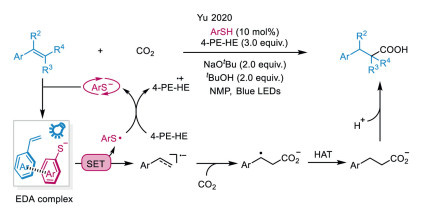
Given their electron-rich property, sulfide ions are also commonly utilized as catalytic electron donors to engage in EDA complex formation. In 2020, Yu’s group discovered the first anti-Markovnikov selective hydrocarboxylation of acrylates and styrenes with CO2 under visible-light-driven photocatalyst-free and transition-metal-free conditions, enabled by a novel catalytic EDA strategy between thiolate and acrylate/styrene (Scheme 31) [100]. The authors proposed a plausible mechanism for this reaction as follows: Under alkaline conditions, aryl thiol underwent deprotonation to generate aryl thioanion. The catalytic amounts of electron-donating aryl thioanion subsequently formed catalytic EDA complex with styrene. Irradiation of the catalytic EDA complex might generate styrene radical anion and aryl thiol radical. The styrene radical anion captured CO2 and then underwent hydrogen atom transfer, followed by protonation to obtain the carboxylic acids. In this reaction, the catalytic regeneration of the aryl thioanion was accomplished through SET between the aryl thiol radical and the reducing agent Hantzsch ester.
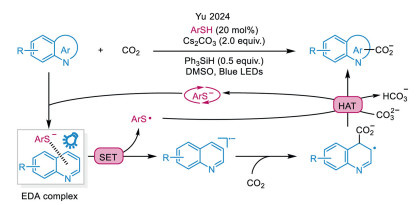
Based on this work, in 2024, Yu’s group reported a photocatalytic C(sp2)–H bond carboxylation of azines with CO2, resulting in the synthesis of structurally diverse N-heteroaromatic carboxylic acids with excellent regioselectivity, which was enabled by the formation of an EDA complex between catalytic thiolate and azine (Scheme 32) [101]. In this reaction, the catalytic regeneration of aryl thiol was accomplished via hydrogen atom abstraction from N-heteroaromatic radical intermediate by aryl thiol radical.
In 2025, the same group developed a visible-light-driven thiolate-catalyzed sequential carboxylation/intramolecular arylation of N-aryl acrylamides with CO2, providing a straightforward route to construct oxindole-3-acetic acid derivatives with good efficiency [102]. Mechanistic studies identified the formation of catalytic EDA complexes between catalytic thiolates and alkenes as a key step in the reaction mechanism. In the same year, Sun’s group achieved the synthesis of oxindole-3-acetic acid derivatives using a similar strategy [103].
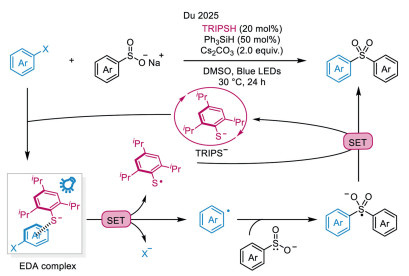
In the same year, Du’s group employed the thiophenolate anion as a catalytic electron donor to enable the sulfonylation of aryl halides, using cost-effective sulfinates as radical acceptors and affording a wide array of aromatic sulfones (Scheme 33) [104]. This transformation was initiated by the deprotonation of TRIPSH with Cs2CO3, generating an electron-rich thiophenolate anion. This anion subsequently engaged with an aryl halide to form a photoactive EDA complex. Upon irradiation with blue light, a SET was triggered from the thiophenolate anion to the aryl halide, resulting in the formation of a thiol radical and an aryl radical. The sulfinate then served as a radical acceptor, coupling with the aryl radical to yield a sulfone radical anion. Finally, this intermediate facilitated an electron back-transfer to the thiol radical, affording the sulfonylation product and regenerating the catalytic electron donor, thus completing the catalytic cycle.
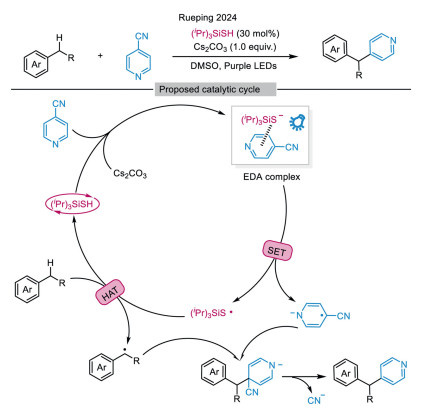
In 2024, Rueping’s group accomplished the heteroarylation of benzylic C(sp3)–H bonds via a catalytic EDA strategy employing catalytic amounts of triisopropylsilanethiol (iPr3SiSH) as electron donor (Scheme 34) [105]. First, iPr3SiSH was deprotonated by Cs2CO3 to generate electron-rich thiolate anion. Then, the generated thiolate anion interacted with 4-cyanopyridine, forming a photoactive EDA complex. This EDA complex underwent a light-induced SET process to generate pyridine radical anion and the corresponding thiol radical. The thiol radical abstracted the hydrogen atom of benzylic C—H bond, delivering benzylic radical and regenerating iPr3SiSH catalyst. Radical-radical cross-coupling of pyridine radical anion and benzylic radical formed the pyridine anion intermediate, which eliminated a cyanide anion to give the desired product.
In addition, Huang’s group reported a visible-light-induced selective mono-(deutero)hydrodechlorination of various trichloroacetyl esters and amides for the incorporation of gem‑dichloromethyl moieties. In this reaction, alkyl thiol served as a catalytic electron donor, forming a catalytic EDA complex with trichloroacetyl ester or amide under base conditions [106].
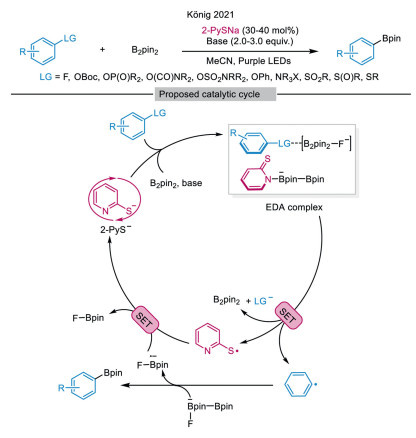
Apart from thiols, the use of sulfide salts as catalytic electron donors in the EDA strategy has also been developed. In 2021, König’s group introduced a novel photocatalytic strategy for the activation of inert substituted arenes (Caryl–F, Caryl–N, Caryl–O, Caryl–S) for aryl borylation by using thiolate as electron-donor catalyst (Scheme 35) [107]. The reaction sequence was initiated by a photo-induced electron-transfer process between [F-B2pin2]– activated substrate and 2-PySNa/B2pin2 adduct to afford thiyl radical and phenyl radical. Phenyl radical reacted with a sp3–sp2 diboron species [F–B2pin2]– to give the desired borylation product and boryl radical anion [F–Bpin]•-. Finally, the thiyl radical was reduced by boryl radical anion [F–Bpin]•- to regenerate thiolate, closing the catalytic cycle.
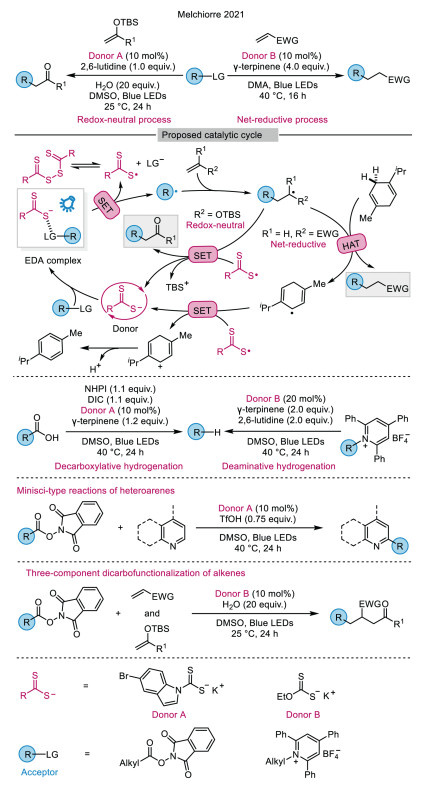
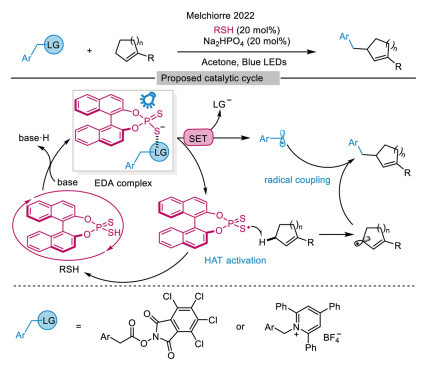
In the same year, Melchiorre’s group reported a visible-light-induced Giese addition of alkenes with alkyl radicals and the alkylation of silyl enol ethers, employing catalytic amounts of dithiocarboxylate salts as electron donors. Catalytic dithiocarboxylic acid anion formed a catalytic EDA complex with redox active ester or pyridinium salt, which underwent charge transfer under visible light induction to generate alkyl radical and sulfur radical. Subsequently, alkyl radical added to alkene to form new carbon radical. Under net-reductive conditions, the new carbon radical abstracted hydrogen atom from hydrogen atom donor, such as 1,4-cyclohexadiene derivatives, leading to the formation of Giese addition product and 1,4-cyclohexadiene radical. The 1,4-cyclohexadiene radical underwent SET with sulfur radical to regenerate catalytic electron donor. Under redox-neutral conditions, the new carbon radical directly underwent SET with sulfur radical to regenerate the catalytic electron donor, while obtaining α-alkylation ketone after desilylation. Furthermore, this catalytic system demonstrated applicability in decarboxylative hydrogenation, deaminative hydrogenation, Minisci-type reactions of heteroarenes, and three-component dicarbofunctionalization of alkenes (Scheme 36) [108].
Subsequently, the same group developed a radical-based organocatalytic method for the direct benzylation of allylic C—H bonds, using dithiophosphoric acid as catalytic electron donor (Scheme 37) [109]. Under alkaline conditions, deprotonated dithiophosphoric acid formed a catalytic EDA complex with benzyl redox-active ester or pyridinium salt. Excitation with visible light induced an intramolecular SET, leading to a benzyl radical and a thiyl radical. The thiyl radical then served as a hydrogen atom abstractor to activate the allylic substrate via a HAT mechanism, forming an allylic radical and regenerating catalytic dithiophosphoric acid. Finally, coupling of allylic radical with benzyl radical afforded the benzylation products. In addition, this strategy was also applicable to three-component radical cascade reaction, enabling efficient alkyl allylation of alkenes. It featured a broad substrate scope, excellent functional group tolerance, and good compatibility with various complex biological molecules.
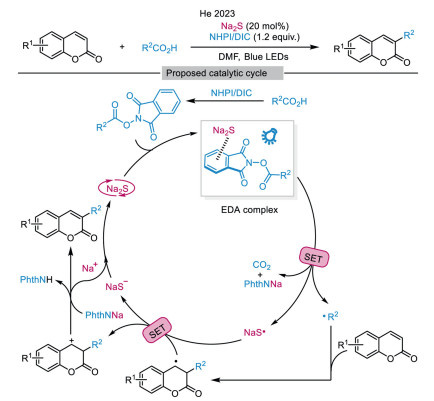
In 2023, He’s group developed a facile and practical EDA strategy for constructing various 3-alkylated coumarins from easily available coumarins and naturally abundant carboxylic acids under visible light induction, employing catalytic Na2S as the electron donor (Scheme 38) [110]. In this reaction, a catalytic EDA complex was formed between the in situ generated NHPI ester and the sulfide salt (Na2S). With the irradiation of visible light, the EDA complex was activated to induce a SET to generate an alkyl radical, a sulfur radical, a phthalimide salt (PhthNNa), and CO2. The alkyl radical subsequently attacked the C3-position of coumarin to form the benzyl radical intermediate, which was oxidized by the sulfur radical to generate a carbocation intermediate via a second SET process. Ultimately, the desired product was produced through the deprotonation of carbocation intermediate with the assistance of the PhthNNa. Concurrently, the catalytic recycle ended up with the regeneration of Na2S.
In the same year, He’s group established a visible-light-promoted decarboxylative alkylation of quinoxalin-2(1H)-ones with N-hydroxyphthalimide esters (NHPI esters) as both the electron acceptor and the alkyl radical precursor, using Na2S as the catalytic electron donor [111]. What is more, Wang’s group reported a catalytic EDA strategy employing Li2S as an electron donor for the decarboxylative coupling of alkyl redox-active esters with 2-isocyanato-1,1′-biphenyl compounds, leading to the efficient synthesis of structurally diverse heterocyclic compounds [112].
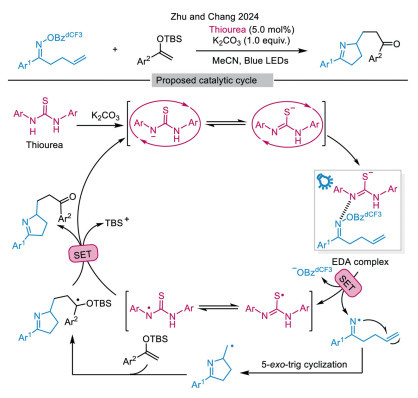
Furthermore, thiourea can be deprotonated under basic conditions to generate an electron-donating thiourea anion, thereby enabling its use as a catalytic electron donor. In 2024, Zhu and co-workers reported an innovative EDA-complex catalysis strategy for the coupling reaction of oxime esters with silyl enol ethers, utilizing thiourea as a pre-catalyst (Scheme 39) [113]. First, catalytic thiourea was converted to thiourea anions in the aid of K2CO3. The negative charge in thiourea anions was shared by both the nitrogen and sulfur atoms in corresponding resonance structures, respectively. A catalytic EDA-complex was generated by combining thiourea anionic and oxime ester. The EDA-complex underwent a SET to generate thiouronyl radical and iminyl radical under blue LED irradiation. Subsequently, iminyl radical underwent a radical type 5-exo-trig cyclization to form alkyl radical, which then attacked silyl enol ether to generate benzyl radical. Finally, SET between thiouronyl radical and benzyl radical regenerated catalytic thiourea anions and afforded pyrroline products by subsequent desilylation.
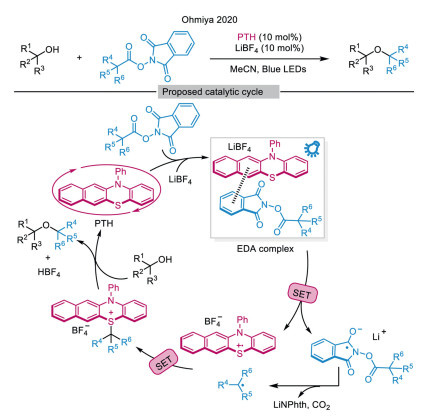
Further investigation into sulfur-containing compounds has revealed that thioethers can also serve as catalytic electron donors in the formation of EDA complexes with redox-active esters. In 2020, Ohmiya’s group reported a visible-light-mediated organosulfide catalysis that enabled the decarboxylative coupling between simple aliphatic alcohol and tertiary or secondary alkyl carboxylic acid-derived redox active esters to produce a C(sp3)-O-C(sp3) fragment (Scheme 40) [114]. The author proposed the mechanism of this reaction as follows: catalytic electron donor N-Ar-phenothiazine (PTH) formed a catalytic EDA complex with alkyl redox active ester, which underwent charge transfer and irreversible cleavage under visible light induction to generate thiyl radical cation and alkyl radical. Single electron oxidation of alkyl radical by thiyl radical cation afforded an alkylsulfonium intermediate. Finally, alcohol nucleophile reacted with alkylsulfonium to give dialkyl ether and recycle organosulfide catalyst.
In 2021, Ohmiya’s group expanded the scope of nucleophiles to azoles and successfully achieved the decarboxylative N-alkylation of azoles [115]. Furthermore, this research group extended the application of the strategy to a three-component coupling of heteroatom nucleophiles, alkenes, and aliphatic redox-active esters for vicinal difunctionalization of alkenes. A wide range of heteroatom nucleophiles including alcohols, water, carboxylic acids, amides, and halogens can be used for this transformation [116].
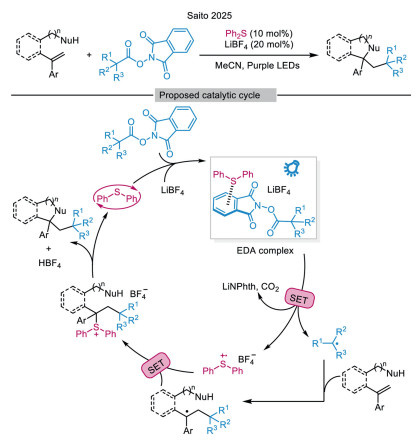
In 2025, Saito’s group developed a general platform using a catalytic EDA system, which combined inexpensive and readily available sulfides and NHPI esters (Scheme 41). This general platform facilitated various redox-neutral and net-reductive reactions, including intramolecular cyclization and hydroalkylation of alkenes with NHPI esters, hydrodecarboxylation of NHPI esters, and C–H imidation of arenes or heteroarenes with NHPI esters, through simple operations [117]. Taking intramolecular cyclization as a representative example, the regeneration of the catalytic diaryl sulfide was accomplished via SET between diaryl sulfonium radical cation and benzyl radical generated through alkyl radical addition to the alkene, and following intramolecular nucleophilic capture process.
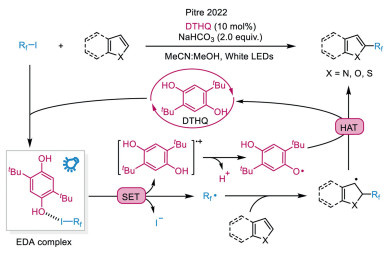
Recent research advances have revealed that it is an efficient method to synthesize perfluoroalkylated compounds via halogen bond-mediated EDA complex formation, where phenols act as catalytic electron donors and the σ* orbitals of perfluoroalkyl halides serve as electron acceptors. In 2022, Pitre’s group utilized a substituted hydroquinone (DTHQ) as catalytic electron donor to form catalytic EDA complex with perfluoroalkyl iodide, achieving perfluoroalkylation of aromatics and heteroaromatics under visible light induction (Scheme 42) [118]. Initially, the catalytic EDA complex was excited by the white LEDs irradiation, generating a perfluoroalkyl radical and a DTHQ•+, which was subsequently deprotonated to form phenoxy radical. The perfluoroalkyl radical added to the electron-rich (hetero)arene to give cycloalkyl radical intermediate, which underwent a HAT reaction with phenoxy radical to yield the perfluoroalkylated (hetero)arene and regenerate catalytic DTHQ, completing the crucial catalyst turnover step.
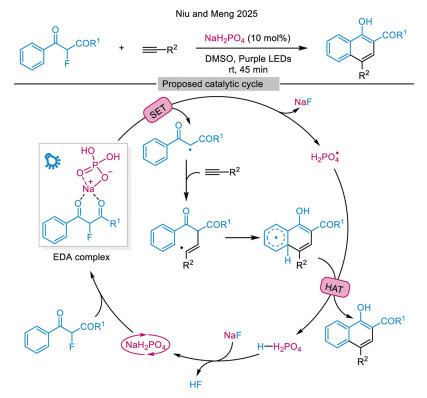
With the deepening exploration of catalytic EDA complexes, Phosphoric acid ion has been identified as viable catalytic electron donors. In 2025, Niu and co-workers accomplished the defluorinative cycloaddition reaction of fluorinated β-ketoesters with terminal alkynes under visible light irradiation, leading to the synthesis of α-naphthols with structural diversity (Scheme 43) [119]. This reaction utilized catalytic NaH2PO4 as the electron donor, forming a catalytic EDA complex with β-ketoester. Under photoexcitation, the complex generated a phosphoric acid radical and an alkyl radical, while releasing NaF. The alkyl radical added to the alkyne to yield a vinyl radical, which then underwent a radical addition with the benzene ring to form an aryl radical intermediate. Subsequently, the phosphoric acid radical quickly underwent a HAT process with the aryl radical intermediate, producing phosphoric acid and α-naphthol. The phosphoric acid then exchanged a proton with NaF to regenerate catalytic NaH2PO4.
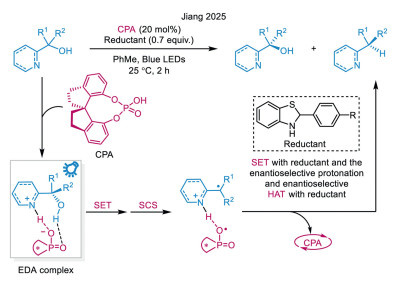
In the same year, Jiang’s group realized thermodynamically driven enantiofacial differentiation of racemic substrates via the formation of EDA complexes with chiral catalysts, thereby achieving a highly efficient kinetic resolution (Scheme 44) [120]. By employing a chiral phosphoric acid (CPA) catalyst, various racemic aza-arene-based tertiary alcohols were efficiently converted into the corresponding enantioenriched tertiary carbon derivatives with high stereoselectivity. Initially, H-bonding interactions between the aza-arene-based tertiary alcohol and the CPA formed an EDA complex. Due to the thermodynamic differences in the interaction between the CPA and the two enantiomers of the substrate, the preferred EDA complex was more prone to undergo intermolecular SET, leading to reduction of the substrate. Following a spin center shift (SCS) event, the departure of the hydroxyl anion generated a tertiary carbon radical that could undergo either cascade SET and enantioselective protonation or direct enantioselective HAT to form chiral tertiary carbon-centered products.
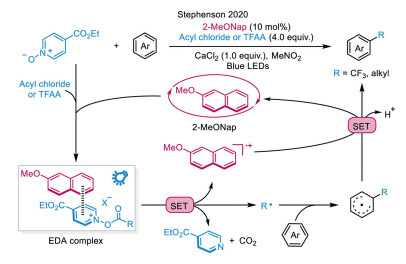
Building on the identification of electron lone pair-containing or negatively charged reagents as catalytic electron donors, electron-rich aromatics have also been explored to form catalytic EDA complexes with electron-deficient substrates via noncovalent π-π interactions. In 2020, Stephenson’s group demonstrated a photochemical protocol that leveraged an EDA complex as a catalytic intermediate to promote the C—H trifluoromethylation and alkylation of (hetero)arenes (Scheme 45) [121]. The catalytic reaction was enabled by the formation of EDA complex between ethyl N-(acyloxy)pyridinium-4-carboxylate salt and electron-rich 2-methoxynaphthalene as catalytic donor. Photoexcitation of the EDA complex induced an electron transfer event that produced 2-methoxynaphthalene radical cation and reactive alkyl radical intermediate. The alkyl radical was efficiently trapped by arenes followed by oxidation and deprotonation to afford the desired C—H trifluoromethylation products and regenerated 2-methoxynaphthalene to turn over the catalytic cycle.
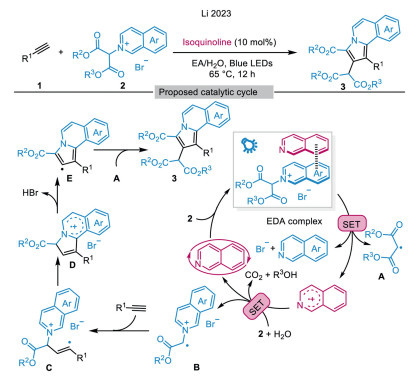
In 2023, Li’s group developed a visible light-induced alkylative [3 + 2] annulation of terminal alkynes with isoquinolinium bromides for the synthesis of highly functionalized pyrrolo[2,1-α]isoquinolines (Scheme 46) [122]. This reaction was driven by the photochemical activity of EDA complexes that consist of catalytic electron-donor isoquinolines and electron-acceptor isoquinolinium bromides. Visible-light irradiation of the EDA complex induced electron transfer and generated the isoquinoline radical cation and alkyl radical A. SET and decarboxylation of the isoquinolinium bromide 2 with the isoquinoline radical cation regenerated catalytic isoquinoline and afforded alkyl radical cation intermediate B. Alkyl radical cation intermediate B subsequently underwent reaction across the C≡C bond of alkyne, cyclization and SET isomerization cascades, to deliver the pyrroloisoquinoline radical intermediate E. Radical coupling between the pyrroloisoquinoline radical intermediate E and the alkyl radical A afforded the desired product.
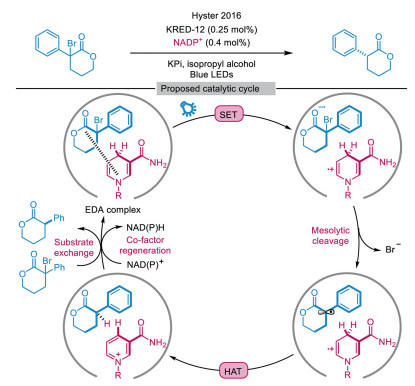
Compared with traditional synthetic methods, the photoenzymatic catalysis demonstrates remarkable advantages in reaction efficiency and selectivity, earning significant attention from chemists and being widely applied in asymmetric radical reactions [15,18,123-125]. In pioneering work by Hyster and co-workers in 2016, they reported a synergistic catalytic system involving visible light and nicotinamide-dependent ketoreductase (KRED) for the enantioselective radical dehalogenation of α-bromolactones (Scheme 47) [126]. Irradiation of the catalytic EDA complex, which comprised racemic α-bromolactone and the nicotinamide residue from NAD(P)H within the active site of the KRED enzyme, effected an electron transfer to form a radical ion pair, followed by mesolytic cleavage of the C-Br bond to generate a prochiral lactone radical intermediate. Then, a conformational change within the enzyme’s active site enabled an enantioselective HAT to the lactone radical intermediate to yield dehalogenated product. Finally, unreacted substrate replaced the product in the enzyme pocket while the catalyst turnover was facilitated by the reduction of NAD(P)+ with either isopropyl alcohol or glucose dehydrogenase.
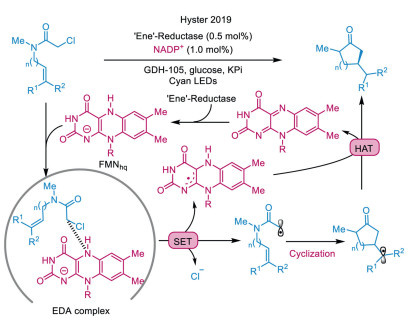
Subsequently, the same group utilized flavin hydroquinone FMNhq cofactor as a catalytic donor to form a catalytic EDA complex with α-chloroamide, leading to the generation of α-acylalkyl radical and flavin radical under visible light irradiation (Scheme 48) [127]. The α-acylalkyl radical underwent intramolecular cyclization to generate a tertiary alkyl radical, which subsequently participated in a hydrogen atom transfer with the flavin radical, affording enantiomerically enriched lactam product and concomitantly regenerating the catalytic flavin cofactor. The flavin cofactor was reduced to flavin hydroquinone FMNhq by the ene-reductase (ERED) and participated in the next catalytic cycle.
On the basis of the previous work, in 2020, Hyster’s group employed a photoenzymatic catalysis to achieve an intramolecular enantioselective radical cyclization of unactivated alkyl iodides, divergently synthesizing esters, amides, and lactones [128]. In addition, this group expanded the substrate scope to α-chloroamides containing oxime ether structures, thereby enabling intramolecular enantioselective radical cyclization and facilitating the synthesis of structurally diverse chiral α-tertiary amine products [129].
In 2020, Zhao’s group achieved an intermolecular enantioselective reductive Heck reaction of α-halo carbonyl compounds with alkenes by using a similar photoenzymatic catalysis, extending the photoenzymatic catalysis to two-component reaction [130]. Almost simultaneously, the Hyster’s group applied this strategy to the intermolecular reaction of α-chloroamides with alkenes, achieving enantioselective hydroalkylation of alkenes and synthesizing a series of γ-stereogenic amides [131].
Although recent advances have significantly expanded the toolbox of catalytic electron donors, challenges remain in catalytic EDA design. A key limitation is that the turnover of electron donor catalysts depends on the efficient SET process of reaction intermediates, constraining the substrate scope and reaction generality. Recently, merging transition metal catalysis with photoredox catalysis has provided new approaches to developing diverse previously inaccessible radical-mediated cross-coupling reactions [132]. According to the synergistic catalysis concept, combining EDA catalysis with metal catalysis may provide a new catalytic EDA paradigm, where donor catalyst turnover is achievable via SET reduction of the donor radical cation by transition metal intermediates. The radicals generated from the precursor EDA complex can participate in transition metal-catalyzed radical coupling processes. This dual catalytic system significantly enhances the flexibility and efficiency of the catalyst turnover, as the key SET step in catalyst recycling is decoupled from the substrate. Recent investigations have established the feasibility of this dual catalysis approach.
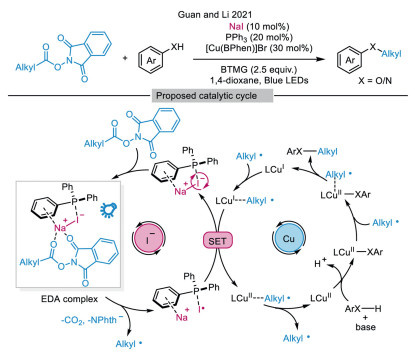
In 2021, Guan’s group reported a catalytic EDA/copper cooperative catalytic system to achieve C(sp3)-O/N cross-couplings of alkyl NHPI esters with phenols/secondary amines (Scheme 49) [133]. The calculated results clearly disclosed that the radical mechanism merging the catalytic EDA cycle and low-valent CuⅠ/CuⅡ/CuⅠ cycle was a promising way for the target C(sp3)-O and C(sp3)-N cross-couplings. The catalytic cycle initially underwent key photoexcited radical decarboxylation of the EDA complex formed from catalytic NaI/PPh3 and alkyl NHPI ester, which generated the activated PPh3-I• species and nucleophilic sp3-carbon-centered alkyl radical, respectively. The resultant alkyl radical was directly captured by the CuⅠ catalyst to afford the doublet CuⅠ···alkyl• intermediate, and the subsequent intermolecular SET process with PPh3-I• species immediately occured to afford the resting-state CuⅡ···alkyl• intermediate and regenerate catalytic NaI/PPh3. Next, the stepwise base-mediated proton transfer accompanied by the radical recombination process provided the triplet CuⅡ···alkyl• phenoxy/amino intermediate. Finally, a rate-determining reductive elimination occured to afford the cross-coupling product and regenerate CuⅠ catalyst.
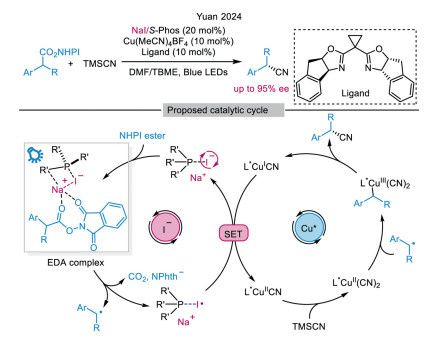
In 2024, Yuan’s group developed a catalytic EDA/copper cooperative strategy to achieve enantioselective decarboxylative cyanation of alkyl redox-active esters, enabling the synthesis of structurally diverse chiral alkyl nitriles (Scheme 50) [134]. The author proposed a plausible catalytic cycle as follows: Firstly, the assembly of R3P and NaI with the NHPI ester to form a catalytic EDA complex, which could be excited by the visible light irradiation to initiate a charge transfer to get an alkyl radical and R3P stabilized iodine radical. R3P stabilized iodine radical underwent a SET with CuⅠ, resulting in the regeneration of the catalytic electron donor and the formation of a CuⅡ species. The CuⅡ species experienced ligand exchange with TMSCN, followed by capture of the alkyl radical to form a CuⅢ intermediate, which subsequently underwent reductive elimination to afford the chiral alkyl nitrile and regenerate the CuⅠ catalyst. This reaction proceeded through a catalytic cycle involving the CuⅠ/CuⅡ/CuⅢ.
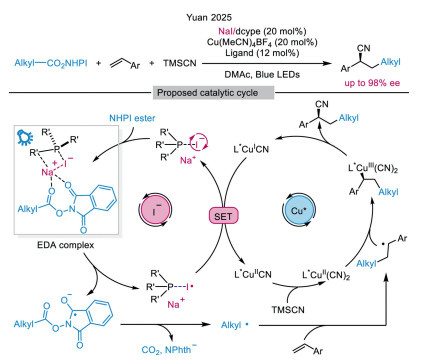
Building upon this work, the same group further developed a catalytic EDA/copper-mediated three-component asymmetric carbo-cyanation reaction of alkenes via a radical relay pathway (Scheme 51) [135]. This reaction utilized a catalytic amount of NaI/R3P to form an EDA complex with a redox-active ester, which underwent charge transfer to generate alkyl radical and iodine radical under visible light induction. This reaction leveraged the effective single-electron transfer between iodine radical and copper catalyst to achieve the catalytic cycle of CuⅠ/CuⅡ/CuⅢ, while efficiently regenerating the catalytic electron donor. This dual EDA/Cu catalytic platform eliminated the need for photocatalyst in decarboxylative radical cyanation and facilitated the regeneration of the catalytic electron donor decoupled from reactive intermediates.
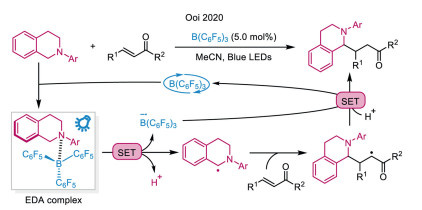
While EDA strategies with electron donors as catalysts have advanced rapidly, the development of EDA reactions utilizing electron acceptors as catalysts is still comparatively sluggish. In 2020, Ooi’s pioneering work demonstrated that the Boron Lewis acid could be utilized as an acceptor catalyst in EDA complex mediated photoreactions. They used tris(pentafluorophenyl)borane (B(C6F5)3) as catalytic electron acceptor to form catalytic EDA complexe with N-Ar tetrahydroisoquinoline, achieving the aminoalkylation of α,β-unsaturated ketones under visible light irradiation (Scheme 52) [136]. In the reaction, the B(C6F5)3•- radical anion, generated by the charge transfer of the catalytic EDA complex, underwent a SET process with the α-carbonyl radical to regenerate the electron acceptor catalyst. The α-carbonyl radical was formed by the addition of aminoalkyl radical to α,β-unsaturated ketone.
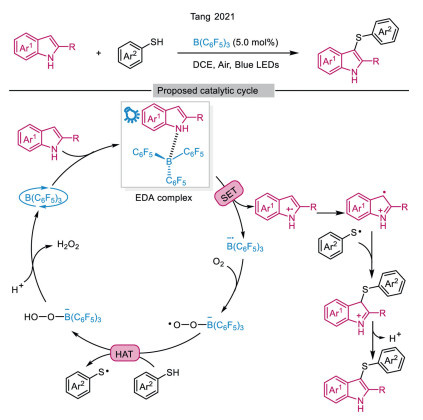
In 2021, Tang’s group reported an efficient B(C6F5)3-catalyzed aerobic oxidative C-S cross coupling reaction of thiophenols with indoles, affording a wide range of diaryl sulfides in good yields (Scheme 53) [137]. This protocol demonstrated a novel reaction model utilizing B(C6F5)3 as a catalytic electron acceptor to form a catalytic EDA complex with indole. Upon irradiation by visible light, a SET process occurred in the EDA complex, generating a radical ion pair. The B(C6F5)3•- radical anion was oxidized by O2 to yield B(C6F5)3O2•-, which abstracted a hydrogen atom from the aryl thiol to deliver B(C6F5)3O2H- anion and sulfur radical. Protonation of B(C6F5)3O2H- anion turned over the B(C6F5)3 catalyst, releasing hydrogen peroxide. The cross-coupling of sulfur radical and the indole radical cation followed by proton release led to the formation of C–S bond cross-coupling product.
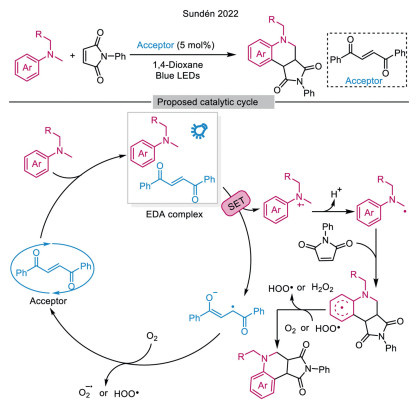
Moreover, electron-deficient species such as electron-deficient alkenes can function as catalytic electron acceptors to form catalytic EDA complexes with substrates. For example, in 2022, Sundén’s group disclosed a catalytic EDA strategy for the visible light-induced aerobic oxidative annulation reaction between N-phenyl maleimide and N,N-substituted dialkyl anilines, leading to the synthesis of a series of tetrahydroquinoline derivatives (Scheme 54) [138]. The key photoactive EDA complex was formed in situ between dialkylated aniline as donor and electron-deficient 1,2-dibenzoylethylene as a catalytic acceptor. The catalytic acceptor was regenerated through the aerobic oxidation of the radical anion generated by the charge transfer of the catalytic EDA complex.
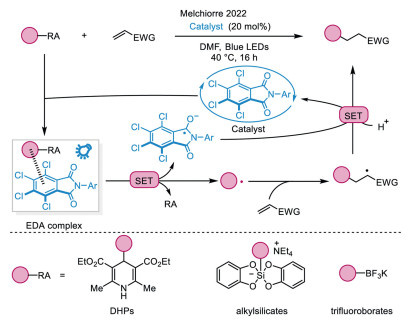
With the further exploration of EDA reactions involving electron acceptors as catalysts, electron-deficient arenes have been identified as high-efficiency electron acceptor catalysts, which can interact with various electron-rich radical precursors to generate photoactive EDA complexes. In 2022, Melchiorre and co-workers reported that electron-poor tetrachlorophthalimides could act as effective organocatalytic acceptors to trigger the formation of EDA complexes with a variety of electron-rich radical precursors, enabling the hydroalkylation of electron-deficient alkenes under visible-light irradiation (Scheme 55) [139]. The key to this reaction lay in the regeneration of the catalytic electron acceptor via SET between the radical anion, generated through charge transfer within the EDA complex, and the electrophilic radical formed upon capture of alkyl radical by electron-deficient alkene, thereby completing the catalytic cycle.
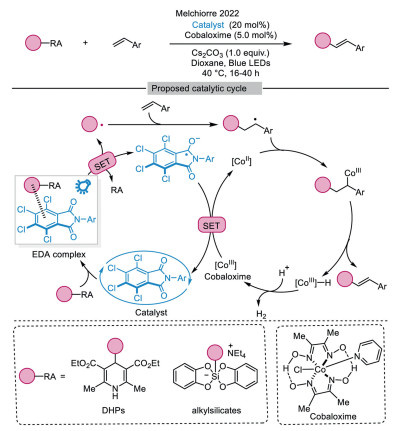
Building on the aforementioned foundation, the authors further developed a dual catalytic system combining catalytic EDA strategy with cobalt catalysis, achieving the Heck-type cross-coupling reaction of alkenes (Scheme 56) [139]. The photoactivity of the catalytic EDA complex, formed by association of the acceptor catalyst with the electron-rich radical precursor, would lead to the alkyl radical and the catalyst radical anion. Subsequent addition of alkyl radical to styrene would furnish a stable benzylic radical intermediate. At this juncture, the EDA catalytic cycle would intersect the cobaloxime cycle: The catalyst radical anion would undergo SET oxidation from the [CoⅢ] catalyst to afford the [CoⅡ] species while turning over the EDA acceptor catalyst. The cobalt-based catalytic cycle would continue with the [CoⅡ] species intercepting the benzylic radical to form the [CoⅢ] intermediate, which was known to undergo facile β-hydride eliminations. This step would deliver the alkene product and the [CoⅢ]-H species, which would release H2 and regenerate the [CoⅢ] catalyst upon reaction with protic sources.
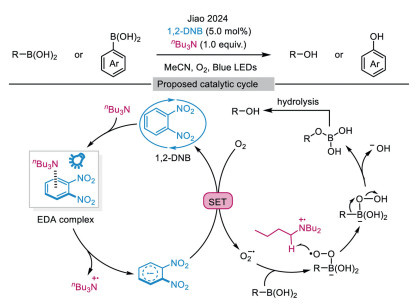
In 2024, Jiao’s group developed a visible-light mediated oxidative EDA protocol, which was successfully applied in the aerobic oxygenation of boronic acids through dioxygen activation (Scheme 57) [140]. This strategy entailed the formation of a catalytic EDA complex through the interaction of electron-deficient 1,2-dinitrobenzene as catalytic electron acceptor with tri-n-butylamine as electron donor. Under excitation by visible light, a SET process took place to form 1,2-dinitrobenzene radical anion and cationic amine radical intermediate. Subsequently, the dioxygen molecule captured the electron from the 1,2-dinitrobenzene radical anion, generating a superoxide radical anion. Simultaneously, the catalytic acceptor was regenerated, completing the catalytic cycle. The superoxide anion radical was then trapped by boronic acid, forming a peroxide radical intermediate, which underwent HAT with the cationic amine radical intermediate to form the peroxyl alcohol species. Subsequently, the rearrangement of the peroxyl alcohol species occurred to produce the oxygenated boronic acid, which was further hydrolyzed to yield the alcohol.
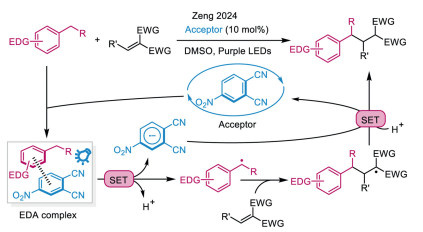
In the same year, Zeng’s group utilized 4-nitrophthalonitrile as a catalytic electron acceptor to facilitate an efficient π-π stacking with electron-rich arenes to form EDA complex (Scheme 58). This catalytic EDA strategy can be efficiently applied in the benzylic C—H bond photoactivation [141]. Upon irradiation under 390 nm LEDs, the EDA complex triggered SET led to 4-nitrophthalonitrile radical anion and 4-methylanisole radical cation. The later one then underwent facile deprotonation, resulting in the formation of benzylic radical intermediate. The subsequent radical addition of benzylic radical to the electron-deficient alkene afforded the alkyl radical. This alkyl radical then interacted with 4-nitrophthalonitrile radical anion to regenerate the electron-acceptor catalyst, while protonation furnished the final coupling product.
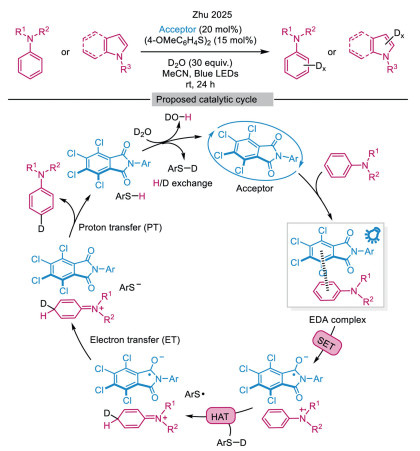
In 2025, Zhu’s group developed a transition metal-free photocatalytic protocol for selective C(sp2)–H/D exchange of electron-rich arenes and heterocycles (Scheme 59) [142]. Mechanistic studies revealed that the EDA complex formed between the electron-deficient tetrachlorophthalimide and the arene substrate played a critical role in promoting photoinduced electron transfer and the selective deuteration of C(sp2)–H bonds. The reaction was initiated by photoinduced SET within the EDA complex, generating a tetrachlorophthalimide radical anion and an anilinium radical cation. D-atom transfer from the ArSD to the anilinium radical cation occurred selectively at the ortho- and para-positions, affording the corresponding aminium cation. The resulting thiyl radical was reduced by tetrachlorophthalimide radical anion, and subsequent deprotonation of aminium cation delivered the D-labeled product while regenerating both the tetrachlorophthalimide and the thiol HAT catalyst. The final H+/D+ exchange between ArSH and excess D2O regenerated the deuterated thiol catalyst (ArSD). This protocol demonstrated the potential of leveraging EDA complexes for radical-based C(sp2)–H derivatization and enabled efficient hydrogen isotope exchange across a diverse range of anilines, pyrroles, and indoles.
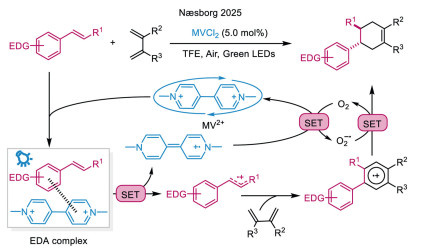
In 2025, Næsborg’s group presented a visible light-induced radical [4 + 2] cycloaddition between aryl ethylenes and conjugated dienes by employing electron-deficient methyl viologen as catalytic electron acceptor to generate EDA complexes with electron-rich aryl ethylenes, enabling the synthesis of cyclohexene derivatives with oxygen as the terminal oxidant (Scheme 60) [143].
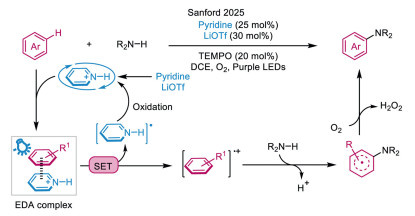
In 2025, Sanford’s group described a photocatalytic C(sp2)–H amination of electron-rich arenes with azoles via a catalytic EDA pathway (Scheme 61) [144]. The catalytic electron acceptor in this system was proposed to be a pyridin-1-ium salt generated in situ from the combination of pyridine and LiOTf. Firstly, the in-situ generated a pyridin-1-ium salt and electron-rich arene formed a catalytic EDA complex, which underwent light-induced SET to release an arene radical cation along with a reduced pyridyl radical. The arene radical cation reacted with azoles to generate a radical intermediate, which was rearomatized by O2 to afford the desired product. In parallel, the reaction of the pyridyl radical with an oxidant (likely O2, TEMPO, or the H2O2 formed in the radical cation pathway) regenerated the pyridin-1-ium catalyst.
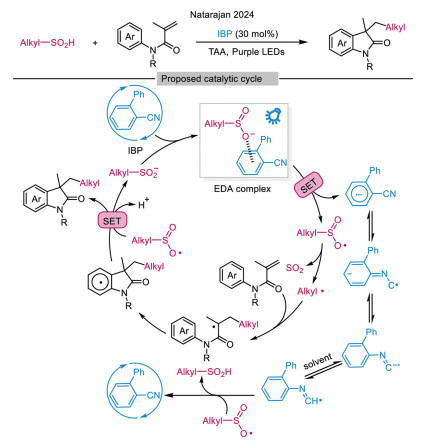
Furthermore, Natarajan’s group employed electron-deficient 2-isocyano-1,10-biphenyl as a catalytic electron acceptor to generate a catalytic EDA complex with alkylsulfinate. Under visible-light irradiation, this system enabled a radical addition/cyclization cascade reaction of N-arylacrylamides, leading to the synthesis of structurally diverse 3,3-dialkylindolin-2-one derivatives (Scheme 62) [145].
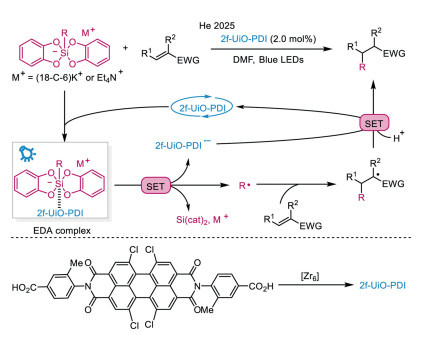
In 2025, He’s group embedded perylene diimide into Zr-doped metal-organic framework materials (MOFs) to synthesize heterogeneous catalyst (2f-UiO-PDI). Using a catalytic amount of 2f-UiO-PDI as an electron acceptor to form a catalytic EDA complex with alkyl silicate, furnishing the hydroalkylation of alkene under visible light induction (Scheme 63) [146]. This heterogeneous photocatalysis substantially improved the catalyst turnover numbers in comparison to previous homogeneous photocatalytic systems and demonstrated outstanding catalyst recyclability. These research findings paved the way for the advancement of various efficient and practical organic transformations using framework-supported organocatalysts.
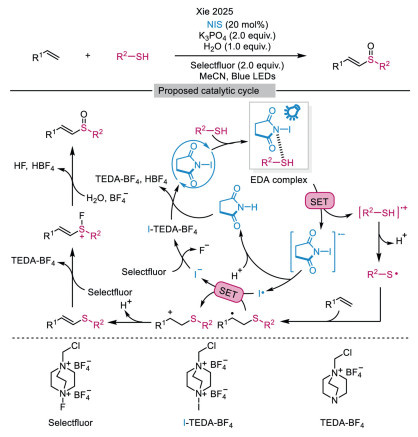
Recently, as the range of electron acceptor catalysts continues to expand, N-iodosuccinimide (NIS) can also serve as a catalytic electron acceptor to participate in EDA reactions. In 2025, Xie’s group reported a novel catalytic EDA pathway for C(sp2)–H sulfoxidation using NIS as a catalytic electron acceptor and thiophenol as an electron donor (Scheme 64) [147]. Upon visible-light irradiation, a SET occured within the EDA complex, generating the NIS radical anion and the thiol radical cation. The NIS radical anion and the thiol radical cation underwent proton exchange to form iodine radical, sulfur radical and succinimide. Sulfur radical then rapidly added to alkene to generate the alkyl radical. This alkyl radical was oxidized to carbocation by the iodine radical; simultaneously, the iodine radical was reduced to an iodide anion. Subsequently, carbocation underwent elimination in the presence of a base, leading to the formation of trans-configured sulfur-substituted alkene. The sulfur-substituted alkene reacted with Selectfluor, producing the fluorinated sulfur cation, which was then converted to the final product in the presence of water. Concurrently, Selectfluor reacted with the iodide anion to generate I-TEDA-BF4 through a nucleophilic reaction mechanism. Following this, succinimide reacted with I-TEDA-BF4 to regenerate catalytic electron acceptor NIS, thus completing the catalytic cycle.
Recent advances in the photochemistry of catalytic EDA complexes have significantly expanded the synthetic toolbox for radical-mediated transformations. This review provides a systematic overview of the development of the catalytic EDA strategy, including radical reactions involving EDA complexes formed from catalytic electron donors or catalytic electron acceptors. As evidenced by current literature, radical reactions involving EDA complexes formed via catalytic electron donors have advanced rapidly. A diverse array of electron donor catalysts has been developed, along with systematic exploration of structurally diverse and compatible electron-acceptor-based radical precursors. In contrast, the development of EDA reactions with catalytic electron acceptors has progressed slowly. To date, only a limited number of electron acceptor catalyst types have been established, and the range of compatible electron-donor-based radical precursors remains relatively narrow. Therefore, further diversification of electron acceptor catalysts to expand the application scope of catalytic EDA strategies will remain a key focus of future research.
Furthermore, another challenge for the catalytic EDA strategy is that the regeneration of electron donors/acceptors in the reaction process is highly dependent on the structural features of reaction intermediates and their redox potentials, placing stringent requirements on the design of reaction routes and the matching of redox potentials among intermediates. While the Yuan’s and Guan’s groups have developed a synergistic catalytic strategy combining catalytic EDA with copper catalysis, in which the incorporation of transition metal copper facilitates the regeneration of catalytic electron donors [133-135], the current catalytic paradigm remains relatively limited in versatility. Accordingly, the exploration of additional classes of transition metal/catalytic EDA synergistic catalysis strategies, which leverage the single-electron redox processes of transition metals to enable the regeneration of electron donors/acceptors, offers significant potential for expanding the diversity and adaptability of catalytic paradigms.
Finally, as photocatalysis advances, the core challenge in synthetic photochemistry is the development of asymmetric transformations. Although catalytic EDA strategies have achieved certain progress in the field of asymmetric synthesis in recent years, relevant reports remain relatively scarce. The primary reason is that the radical intermediates generated upon photoexcitation of the catalytic EDA complex adopt planar configurations, which poses a significant challenge to achieving effective stereocontrol [13]. Herein, we aspire to exploit the robust cross-coupling and bond-constructing capacity of transition metal catalysis. By combining chiral transition metals with radicals to stabilize highly reactive radicals and control the stereoselectivity, we intend to advance efficient and highly selective radical coupling reactions, including asymmetric radical transformations. Consequently, establishing a synergistic catalytic paradigm that merges EDA catalysis with chiral transition metal catalysis or enzyme catalysis holds great research importance, as it leverages the inherent merits of both approaches, fosters the development of asymmetric EDA catalysis, and enhances its synthetic application prospects.
Hongping Zhao: Writing – review & editing, Writing – original draft. Peiwen Liu: Writing – review & editing. Xianzhou Zheng: Writing – review & editing. Weiming Yuan: Writing – review & editing, Writing – original draft, Supervision, Conceptualization.
The authors declare that they have no known competing financial interests or personal relationships that could have appeared to influence the work reported in this paper.
We are grateful to the National Key R&D Program of China (No. 2024YFA1510500) and the National Natural Science Foundation of China (Nos. 22571104, 22201087) for the financial support.
C.K. Prier, D.A. Rankic, D.W. MacMillan, Chem. Rev. 113 (2013) 5322–5363. doi: 10.1021/cr300503r
N.A. Romero, D.A. Nicewicz, Chem. Rev. 116 (2016) 10075–10166. doi: 10.1021/acs.chemrev.6b00057
Y. Chen, L.Q. Lu, D.G. Yu, C.J. Zhu, W.J. Xiao, Sci. China Chem. 62 (2019) 24–57. doi: 10.1007/s11426-018-9399-2
X.Y. Yu, J.R. Chen, W.J. Xiao, Chem. Rev. 121 (2021) 506–561. doi: 10.1021/acs.chemrev.0c00030
Q. Liu, L.Z. Wu, Natl. Sci. Rev. 4 (2017) 359–380. doi: 10.1093/nsr/nwx039
L. Marzo, S.K. Pagire, O. Reiser, B. Konig, Angew. Chem. Int. Ed. 57 (2018) 10034–10072. doi: 10.1002/anie.201709766
L. Buzzetti, G.E.M. Crisenza, P. Melchiorre, Angew. Chem. Int. Ed. 58 (2019) 3730–3747. doi: 10.1002/anie.201809984
S. Angerani, N. Winssinger, Chem. Eur. J. 25 (2019) 6661–6672. doi: 10.1002/chem.201806024
M. Majek, A.J. Wangelin, Acc. Chem. Res. 49 (2016) 2316–2327. doi: 10.1021/acs.accounts.6b00293
M.H. Shaw, J. Twilton, D.W. MacMillan, J. Org. Chem. 81 (2016) 6898–6926. doi: 10.1021/acs.joc.6b01449
L. Zheng, L. Cai, K. Tao, et al., Asian J. Org. Chem. 10 (2021) 711–748. doi: 10.1002/ajoc.202100009
S.V. Rosokha, J.K. Kochi, Acc. Chem. Res. 41 (2008) 641–653. doi: 10.1021/ar700256a
A.K. Wortman, C.R.J. Stephenson, Chem 9 (2023) 2390–2415. doi: 10.1016/j.chempr.2023.06.013
C.G.S. Lima, T.M. Lima, M. Duarte, I.D. Jurberg, M.W. Paixão, ACS Catal.. 6 (2016) 1389–1407. doi: 10.1021/acscatal.5b02386
G.E.M. Crisenza, D. Mazzarella, P. Melchiorre, J. Am. Chem. Soc. 142 (2020) 5461–5476. doi: 10.1021/jacs.0c01416
Y.Q. Yuan, S. Majumder, M.H. Yang, S.R. Guo, Tetrahedron Lett. 61 (2020) 151506–151520. doi: 10.1016/j.tetlet.2019.151506
Y. Sumida, H. Ohmiya, Chem. Soc. Rev. 50 (2021) 6320–6332. doi: 10.1039/d1cs00262g
T. Tasnim, M.J. Ayodele, S.P. Pitre, J. Org. Chem. 87 (2022) 10555–10563. doi: 10.1021/acs.joc.2c01013
G. Hu, Z. Wang, X. Wang, Y. Quan, ChemPhotoChem 7 (2023) e202300041. doi: 10.1002/cptc.202300041
B. Saxena, R.I. Patel, A. Sharma, Adv. Synth. Catal. 365 (2023) 1538–1564. doi: 10.1002/adsc.202300078
L. Dalsen, R.E. Brown, J.A. Rossi-Ashton, D.J. Procter, Angew. Chem. Int. Ed. 62 (2023) e202303104. doi: 10.1002/anie.202303104
P. Barik, S.S. Behera, S.K. Nanda, Asian J. Org. Chem. 13 (2024) e202400089. doi: 10.1002/ajoc.202400089
M. Mondal, S. Ghosh, D. Lai, A. Hajra, ChemSusChem 17 (2024) e202401114. doi: 10.1002/cssc.202401114
D.E. Yerien, S. Barata-Vallejo, A. Postigo, ChemPhotoChem 8 (2024) e202400112. doi: 10.1002/cptc.202400112
M. Shanthi, K. Perumal, V. Hemamalini, R. Dandela, S. Ramesh, Asian J. Org. Chem. 14 (2025) e202400621. doi: 10.1002/ajoc.202400621
S. Wang, L. Wang, J. Cui, et al., Org. Biomol. Chem. 23 (2025) 1794–1808. doi: 10.1039/d4ob01951b
M. Nappi, G. Bergonzini, P. Melchiorre, Angew. Chem. Int. Ed. 53 (2014) 4921–4925. doi: 10.1002/anie.201402008
S.R. Kandukuri, A. Bahamonde, I. Chatterjee, et al., Angew. Chem. Int. Ed. 54 (2015) 1485–1489. doi: 10.1002/anie.201409529
A. Fawcett, J. Pradeilles, Y. Wang, et al., Science 357 (2017) 283–286. doi: 10.1126/science.aan3679
B. Liu, C.H. Lim, G.M. Miyake, J. Am. Chem. Soc. 139 (2017) 13616–13619. doi: 10.1021/jacs.7b07390
L. Marzo, S. Wang, B. König, Org. Lett. 19 (2017) 5976–5979. doi: 10.1021/acs.orglett.7b03001
Y. Wang, J. Wang, G.X. Li, G. He, G. Chen, Org. Lett. 19 (2017) 1442–1445. doi: 10.1021/acs.orglett.7b00375
Q. Guo, M. Wang, H. Liu, R. Wang, Z. Xu, Angew. Chem. Int. Ed. 57 (2018) 4747–4751. doi: 10.1002/anie.201800767
J. Wu, L. He, A. Noble, V.K. Aggarwal, J. Am. Chem. Soc. 140 (2018) 10700–10704. doi: 10.1021/jacs.8b07103
K. Liang, N. Li, Y. Zhang, T. Li, C. Xia, Chem. Sci. 10 (2019) 3049–3053. doi: 10.1039/c8sc05170d
J. Wu, R.M. Bar, L. Guo, A. Noble, V.K. Aggarwal, Angew. Chem. Int. Ed. 58 (2019) 18830–18834. doi: 10.1002/anie.201910051
S. Xie, D. Li, H. Huang, F. Zhang, Y. Chen, J. Am. Chem. Soc. 141 (2019) 16237–16242. doi: 10.1021/jacs.9b09099
H.H. Zhang, S. Yu, Org. Lett. 21 (2019) 3711–3715. doi: 10.1021/acs.orglett.9b01169
C. Wang, R. Qi, H. Xue, et al., Angew. Chem. Int. Ed. 59 (2020) 7461–7466. doi: 10.1002/anie.201914555
M.J. Cabrera-Afonso, A. Granados, G.A. Molander, Angew. Chem. Int. Ed. 61 (2022) e202202706. doi: 10.1002/anie.202202706
A. Granados, M.J. Cabrera-Afonso, M. Escolano, S.O. Badir, G.A. Molander, Chem Catal. 2 (2022) 898–907.
M. Sharique, J. Majhi, R.K. Dhungana, et al., Chem. Sci. 13 (2022) 5701–5706. doi: 10.1039/d2sc01363k
Y.M. Tian, E. Hofmann, W. Silva, et al., Angew. Chem. Int. Ed. 62 (2023) e202218775. doi: 10.1002/anie.202218775
Y. Zhang, Q. Feng, Y. Zheng, et al., Org. Lett. 26 (2024) 1410–1415. doi: 10.1021/acs.orglett.4c00010
S. Wang, P. Xu, Z.T. Liu, et al., ACS Cent. Sci. 11 (2025) 46–56. doi: 10.1021/acscentsci.4c01464
X. Sun, W. Wang, Y. Li, J. Ma, S. Yu, Org. Lett. 18 (2016) 4638–4641. doi: 10.1021/acs.orglett.6b02271
J. Zhang, Y. Li, R. Xu, Y. Chen, Angew. Chem. Int. Ed. 56 (2017) 12619–12623. doi: 10.1002/anie.201707171
Y. Li, J. Zhang, D. Li, Y. Chen, Org. Lett. 20 (2018) 3296–3299. doi: 10.1021/acs.orglett.8b01172
X. Tang, A. Studer, Angew. Chem. Int. Ed. 57 (2018) 814–817. doi: 10.1002/anie.201710397
Y. Liu, X.L. Chen, K. Sun, et al., Org. Lett. 21 (2019) 4019–4024. doi: 10.1021/acs.orglett.9b01175
J. Wu, P.S. Grant, X. Li, A. Noble, V.K. Aggarwal, Angew. Chem. Int. Ed. 58 (2019) 5697–5701. doi: 10.1002/anie.201814452
M. Wang, C. Wang, Y. Huo, et al., Nat. Commun. 12 (2021) 6873–6881. doi: 10.1038/s41467-021-27086-x
H. Xu, X. Li, Y. Dong, et al., Org. Lett. 25 (2023) 3784–3789. doi: 10.1021/acs.orglett.3c01303
E. Arceo, I.D. Jurberg, A. Álvarez-Fernández, P. Melchiorre, Nat. Chem. 5 (2013) 750–756. doi: 10.1038/nchem.1727
E. Arceo, A. Bahamonde, G. Bergonzini, P. Melchiorre, Chem. Sci. 5 (2014) 2438–2442. doi: 10.1039/c4sc00315b
Ł. Woźniak, J.J. Murphy, P. Melchiorre, J. Am. Chem. Soc. 137 (2015) 5678–5681. doi: 10.1021/jacs.5b03243
Z.Y. Cao, T. Ghosh, P. Melchiorre, Nat. Commun. 9 (2018) 3274–3283. doi: 10.1038/s41467-018-05375-2
T. Morack, C. Mück-Lichtenfeld, R. Gilmour, Angew. Chem. Int. Ed. 58 (2019) 1208–1212. doi: 10.1002/anie.201809601
S. Jin, X. Sui, G.C. Haug, et al., ACS Catal. 12 (2021) 285–294.
J.Y. Kim, Y.S. Lee, D.H. Ryu, ACS Catal. 11 (2021) 14811–14818. doi: 10.1021/acscatal.1c04835
R.I. Rodriguez, M. Sicignano, J. Alemán, Angew. Chem. Int. Ed. 61 (2022) e202112632. doi: 10.1002/anie.202112632
M. Balletti, T. Wachsmuth, A.D. Sabato, W.C. Hartley, P. Melchiorre, Chem. Sci. 14 (2023) 4923–4927. doi: 10.1039/d3sc01347b
C.E. Adams, C.P. Johnston, Org. Chem. Front. 11 (2024) 3639–3647. doi: 10.1039/d4qo00390j
I. Bosque, T. Bach, ACS Catal. 9 (2019) 9103–9109. doi: 10.1021/acscatal.9b01039
X.L. Huang, D.L. Zhang, Q. Li, et al., Org. Lett. 26 (2024) 3727–3732. doi: 10.1021/acs.orglett.4c00742
Z.Q. Zhu, W.Y. Zhang, Q.Q. Xu, et al., Org. Lett. 27 (2025) 14264–14269. doi: 10.1021/acs.orglett.5c04537
Q. Liu, Y. Lu, H. Sheng, et al., Angew. Chem. Int. Ed. 60 (2021) 25477–25484. doi: 10.1002/anie.202111006
A. Dewanji, L. Dalsen, J.A. Rossi-Ashton, et al., Nat. Chem. 15 (2023) 43–52. doi: 10.1038/s41557-022-01092-y
M.Y. He, X. Tang, H.Y. Wu, et al., Org. Lett. 25 (2023) 9041–9046. doi: 10.1021/acs.orglett.3c03790
D.J. Castillo-Pazos, J.D. Lasso, E. Hamzehpoor, et al., Chem. Sci. 14 (2023) 3470–3481. doi: 10.1039/d2sc07078b
J.D. Lasso, D.J. Castillo-Pazos, J.M. Salgado, et al., J. Am. Chem. Soc. 146 (2024) 2583–2592. doi: 10.1021/jacs.3c11225
J. Jiang, T. Xu, F. Chang, et al., Adv. Synth. Catal. 367 (2025) e70085. doi: 10.1002/adsc.70085
H.Y. Wu, X. Tang, R. Guo, et al., Cell Rep. Phys. Sci. 5 (2024) 102135–102148. doi: 10.1016/j.xcrp.2024.102135
H.Y. Wu, X. Tang, R. Guo, F.G. Zhang, J.A. Ma, Chin. J. Chem. 43 (2025) 2468–2642. doi: 10.1080/01496395.2025.2561192
Y. Tan, M. Pei, K. Yang, et al., Org. Lett. 26 (2024) 8084–8089. doi: 10.1021/acs.orglett.4c02985
S. Ji, X. Li, Y. Wang, et al., Org. Lett. 27 (2025) 7892–7897. doi: 10.1021/acs.orglett.5c02202
L. Guo, J. An, H. Liu, et al., ACS Sustainable Chem. Eng. 13 (2025) 14939–14948. doi: 10.1021/acssuschemeng.5c05040
K. Zhang, M. Zhao, J. Guo, Y.X. Luan, P. Tang, CCS Chem. 8 (2026) 1276–1283. doi: 10.31635/ccschem.025.202506759
J. Li, Z. Ji, H. Wang, et al., Org. Lett. 28 (2026) 553–559. doi: 10.1021/acs.orglett.5c05038
J. Lin, J. Ouyang, T. Liu, et al., Nat. Commun. 14 (2023) 7757–7767. doi: 10.1038/s41467-023-43577-5
Q.P. Huang, Y. Huang, A.J. Wang, et al., Org. Chem. Front. 8 (2021) 4438–4444. doi: 10.1039/d1qo00507c
J. Paut, S. Baldon, E. Anselmi, et al., Adv. Synth. Catal. 366 (2024) 3500–3504. doi: 10.1002/adsc.202400510
N. Kato, T. Nanjo, Y. Takemoto, ACS Catal. 12 (2022) 7843–7849. doi: 10.1021/acscatal.2c02067
S.M. Treacy, D.R. Vaz, S. Noman, C. Tard, T. Rovis, Chem. Sci. 14 (2023) 1569–1574. doi: 10.1039/d2sc05973h
H. Lu, D.Y. Wang, A. Zhang, J. Org. Chem. 85 (2020) 942–951. doi: 10.1021/acs.joc.9b02882
G. Zhao, S. Lim, D.G. Musaev, M.Y. Ngai, J. Am. Chem. Soc. 145 (2023) 8275–8284. doi: 10.1021/jacs.2c11867
Y. Huo, B. Chen, Z. Xu, et al., Org. Chem. Front. 11 (2024) 205–210. doi: 10.1039/d3qo01765f
M.C. Fu, R. Shang, B. Zhao, B. Wang, Y. Fu, Science 363 (2019) 1429–1434. doi: 10.1126/science.aav3200
Y.T. Wang, M.C. Fu, B. Zhao, R. Shang, Y. Fu, Chem. Commun. 56 (2020) 2495–2498. doi: 10.1039/c9cc09654j
J.X. Wang, M.C. Fu, L.Y. Yan, X. Lu, Y. Fu, Adv. Sci. 11 (2024) 2307241–2307250. doi: 10.1002/advs.202307241
J.X. Wang, Y.T. Wang, H. Zhang, M.C. Fu, Org. Chem. Front. 8 (2021) 4466–4472. doi: 10.1039/d1qo00660f
X.J. Liu, S.Y. Zhou, Y. Xiao, et al., Org. Lett. 23 (2021) 7839–7844. doi: 10.1021/acs.orglett.1c02858
G.Z. Wang, M.C. Fu, B. Zhao, R. Shang, Sci. China Chem. 64 (2021) 439–444. doi: 10.1007/s11426-020-9905-1
C. Liu, N. Shen, R. Shang, Org. Chem. Front. 8 (2021) 4166–4170. doi: 10.1039/d1qo00648g
Z.Q. Zhu, W.Y. Zhang, X.L. Huang, et al., J. Org. Chem. 90 (2025) 2842–2847. doi: 10.1021/acs.joc.4c02177
C.S. Zhang, L. Bao, K.Q. Chen, Z.X. Wang, X.Y. Chen, Org. Lett. 23 (2021) 1577–1581. doi: 10.1021/acs.orglett.0c04287
F. Chen, M. Bai, Y. Zhang, et al., Angew. Chem. Int. Ed. 61 (2022) e202210334.
B. Li, L. Yi, B. Maity, et al., ACS Catal. 13 (2023) 15194–15202. doi: 10.1021/acscatal.3c04601
A. Gao, L. Yan, G. Wang, M. Fu, Chin. J. Org. Chem. 45 (2025) 1747–1754. doi: 10.6023/cjoc202407010
H. Huang, J.H. Ye, L. Zhu, et al., CCS Chem. 3 (2021) 1746–1756. doi: 10.31635/ccschem.020.202000374
Y.X. Jiang, L.L. Liao, T.Y. Gao, et al., Nat. Synth. 3 (2024) 394–405. doi: 10.1038/s44160-023-00465-6
Y.Y. Jiang, Z. Chen, Y.X. Jiang, et al., Chin. J. Chem. 43 (2025) 2341–2346. doi: 10.1002/cjoc.70115
P. Cheng, H. Yang, J. Lin, Y. Yao, S. Sun, Org. Lett. 27 (2025) 7685–7690. doi: 10.1021/acs.orglett.5c02427
J. He, H. Shi, J. Wu, et al., Org. Lett. 27 (2025) 11566–11572. doi: 10.1021/acs.orglett.5c03601
K. Almagambetova, K. Murugesan, M. Rueping, ACS Catal. 14 (2024) 12664–12670. doi: 10.1021/acscatal.4c03766
J. Wang, G. Gao, J. Cheng, et al., Green Chem. 26 (2024) 5167–5172. doi: 10.1039/d4gc01173b
S. Wang, H. Wang, B. König, Chem. 7 (2021) 1653–1665. doi: 10.1016/j.chempr.2021.04.016
E.P. Beato, D. Spinnato, W. Zhou, P. Melchiorre, J. Am. Chem. Soc. 143 (2021) 12304–12314. doi: 10.1021/jacs.1c05607
E.L. Saux, M. Zanini, P. Melchiorre, J. Am. Chem. Soc. 144 (2022) 1113–1118. doi: 10.1021/jacs.1c11712
H.Y. Song, M.Y. Liu, J. Huang, et al., J. Org. Chem. 88 (2023) 2288–2295. doi: 10.1021/acs.joc.2c02679
H.Y. Song, Z.T. Zhang, H.Y. Tan, et al., Asian J. Org. Chem. 12 (2023) e202200658. doi: 10.1002/ajoc.202200658
M.T. Liu, D.G. Liu, Z.W. Qin, G.Z. Wang, Asian J. Org. Chem. 11 (2022) e202200335. doi: 10.1002/ajoc.202200335
H. Mao, Y. Zhang, H. Cao, et al., Org. Chem. Front. 11 (2024) 3204–3213. doi: 10.1039/d4qo00424h
S. Shibutani, T. Kodo, M. Takeda, et al., J. Am. Chem. Soc. 142 (2020) 1211–1216. doi: 10.1021/jacs.9b12335
R. Kobayashi, S. Shibutani, K. Nagao, et al., Org. Lett. 23 (2021) 5415–5419. doi: 10.1021/acs.orglett.1c01745
S. Shibutani, K. Nagao, H. Ohmiya, Org. Lett. 23 (2021) 1798–1803. doi: 10.1021/acs.orglett.1c00211
K. Matsukuma, M. Tayu, M. Noji, et al., Adv. Synth. Catal. 367 (2025) e202500196. doi: 10.1002/adsc.202500196
T. Tasnim, C. Ryan, M.L. Christensen, C.J. Fennell, S.P. Pitre, Org. Lett. 24 (2022) 446–450. doi: 10.1021/acs.orglett.1c04139
H.Y. Li, X.L. Yang, R.X. Liu, et al., Org. Lett. 27 (2025) 7336–7341. doi: 10.1021/acs.orglett.5c02026
T. Shao, Z. Li, F. Nie, et al., Nat. Chem. 17 (2025) 1722–1731. doi: 10.1038/s41557-025-01973-y
E.J. McClain, T.M. Monos, M. Mori, J.W. Beatty, C.R.J. Stephenson, ACS Catal. 10 (2020) 12636–12641. doi: 10.1021/acscatal.0c03837
Y.F. Han, Y. Li, X.H. Ouyang, et al., Org. Chem. Front. 10 (2023) 1173–1181. doi: 10.1039/d2qo01754g
U.T. Bornscheuer, G.W. Huisman, R.J. Kazlauskas, et al., Nature 485 (2012) 185–194. doi: 10.1038/nature11117
J.A. Maciá-Agulló, A. Corma, H. Garcia, Chem. Eur. J. 21 (2015) 10940–10959. doi: 10.1002/chem.201406437
L. Schmermund, V. Jurkaš, F.F. Özgen, et al., ACS Catal. 9 (2019) 4115–4144. doi: 10.1021/acscatal.9b00656
M.A. Emmanuel, N.R. Greenberg, D.G. Oblinsky, T.K. Hyster, Nature 540 (2016) 414–417. doi: 10.1038/nature20569
K.F. Biegasiewicz, S.J. Cooper, X. Gao, et al., Science 364 (2019) 1166–1169. doi: 10.1126/science.aaw1143
P.D. Clayman, T.K. Hyster, J. Am. Chem. Soc. 142 (2020) 15673–15677. doi: 10.1021/jacs.0c07918
X. Gao, J.R. Turek-Herman, Y.J. Choi, R.D. Cohen, T.K. Hyster, J. Am. Chem. Soc. 143 (2021) 19643–19647. doi: 10.1021/jacs.1c09828
X. Huang, B. Wang, Y. Wang, et al., Nature 584 (2020) 69–74. doi: 10.1038/s41586-020-2406-6
C.G. Page, S.J. Cooper, J.S. DeHovitz, et al., J. Am. Chem. Soc. 143 (2021) 97–102. doi: 10.1021/jacs.0c11462
A.Y. Chan, I.B. Perry, N.B. Bissonnette, et al., Chem. Rev. 122 (2022) 1485–1542. doi: 10.1021/acs.chemrev.1c00383
R.H. Li, Y.L. Zhao, Q.K. Shang, et al., ACS Catal. 11 (2021) 6633–6642. doi: 10.1021/acscatal.1c01222
H. Zhao, X. Xi, T. Wu, et al., Sci. China Chem. 67 (2024) 3019–3028. doi: 10.1007/s11426-024-2123-0
H. Zhao, W. Yuan, Chin. Chem. Lett. 36 (2025) 110894. doi: 10.1016/j.cclet.2025.110894
Y. Aramaki, N. Imaizumi, M. Hotta, J. Kumagai, T. Ooi, Chem. Sci. 11 (2020) 4305–4311. doi: 10.1039/d0sc01159b
W. Yuan, J. Huang, X. Xu, L. Wang, X.Y. Tang, Org. Lett. 23 (2021) 7139–7143. doi: 10.1021/acs.orglett.1c02553
A. Runemark, H. Sundén, J. Org. Chem. 87 (2022) 1457–1469. doi: 10.1021/acs.joc.1c02776
W. Zhou, S. Wu, P. Melchiorre, J. Am. Chem. Soc. 144 (2022) 8914–8919. doi: 10.1021/jacs.2c03546
J. Wei, J. Meng, C. Zhang, Y. Liu, N. Jiao, Nat. Commun. 15 (2024) 1886–1893. doi: 10.1038/s41467-024-45866-z
T. Xue, C. Ma, L. Liu, et al., Nat. Commun. 15 (2024) 1455–1464. doi: 10.1038/s41467-024-45686-1
R.Y. Way, X. Guo, Y. Tang, J.B. Shirah, Q. Zhu, J. Am. Chem. Soc. 147 (2025) 47179–47186. doi: 10.1021/jacs.5c14203
R. Jeyaseelan, W. Liu, J. Zumbusch, L. Næsborg, Green Chem. 27 (2025) 1969–1973. doi: 10.1039/d4gc05481d
D.S. Brandes, M.R. Lasky, A.D. Lisboa, et al., Org. Lett. 27 (2025) 10011–10015. doi: 10.1021/acs.orglett.5c03040
P. Natarajan, Partigya, Meena, New J. Chem. 48 (2024) 17097–17105. doi: 10.1039/d4nj03602f
X. Wu, M. Cui, K. Wu, et al., J. Am. Chem. Soc. 147 (2025) 8350–8360. doi: 10.1021/jacs.4c16021
W. Huang, X. Yang, W. Qi, et al., Green Chem. 27 (2025) 14540–14546. doi: 10.1039/d5gc03110a

Scheme 5 Decarboxylative α-amino alkylation of heterocyclic compounds catalyzed by DABCO as an electron donor.

Scheme 6 Visible-light-induced selective photolysis of phosphonium iodide salts for monofluoromethylations.

Scheme 7 Site-selective alkylation and cyanation of aryl C–H bonds using triarylamine as catalytic electron donor.

Scheme 8 Catalytic triarylamine as an electron donor enabled the radical cyclization of α-diazodifluoroethyl sulfonium salt with unactivated alkynes.

Scheme 9 Triarylamine as a catalytic electron donor enabled the C–H perfluoroalkylation of arenes and heteroarenes.

Scheme 10 A general platform for visible light sulfonylation reactions enabled by catalytic triarylamine EDA complexes.

Scheme 12 Triarylamine as a catalytic electron donor enabled the C2-heteroarylation of indoles.

Scheme 13 Triphenylamine-mediated intramolecular remote cyano migration via catalytic EDA complex photoactivation.

Scheme 14 Amidotrifluoromethoxylation of styrenes using triphenylamine as an electron donor.

Scheme 15 Triphenylamine as a catalytic electron donor for photoactivation of pyridinium-masked enols in the formal [4 + 2] cycloaddition with unactivated olefins.

Scheme 16 Minisci reaction of heterocycles using triphenylamine-based heterogeneous catalyst as an electron donor.

Scheme 17 Deaminative alkylation of difluoroenoxysilanes utilizing Hantzsch ester as a catalytic electron donor.

Scheme 18 Secondary amine as a catalytic electron donor for the synthesis of gem‑difluorinated alkoxy ketones.

Scheme 20 Visible light-promoted phosphine-catalyzed difluoroalkylation of arenes and heteroarenes.

Scheme 21 Visible-light-induced phosphine-catalyzed 1,3-carbobromination of allyl carboxylates.

Scheme 22 Visible-light-driven phosphine-catalyzed C(sp3)–H alkylation of heterobenzylic amines.

Scheme 23 Photocatalytic decarboxylative alkylations mediated by sodium iodide/triphenylphosphine.

Scheme 24 Photoinduced iodide salt/triphenylphosphine promoted reductive decarboxylative coupling.

Scheme 25 Photocatalytic decarboxylative [3 + 2] and [4 + 2] annulation by NaI/PPh3 catalysis.

Scheme 26 Visible-light-mediated α-alkylation of N-aryl glycine derivatives using iodide anion as a catalytic electron donor.

Scheme 28 Decarboxylative selective phosphorylation of aliphatic acids using iodide anion as a catalytic electron donor.

Scheme 29 Iodide anion-promoted cross coupling for the synthesis of organoselenium compounds.

Scheme 31 Anti-Markovnikov selective hydrocarboxylation of acrylates and styrenes with CO2 enabled by thiolate as a catalytic electron donor.

Scheme 32 Synthesis of N-heteroaromatic carboxylic acids by thiolate-catalyzed carboxylation of C(sp2)–H bonds using CO2.

Scheme 33 Thiophenolate anion-enabled functionalization of aryl halides via catalytic EDA complex.

Scheme 34 Heteroarylation of benzylic C(sp3)–H bonds employing catalytic triisopropylsilanethiol as an electron donor.

Scheme 35 Photoinduced thiolate catalytic activation of inert Caryl-hetero bonds for radical borylation.

Scheme 36 Catalytic dithiocarboxylate salts as electron donors for the diverse transformations of alkyl radicals.

Scheme 37 Dithiophosphoric acid as a catalytic electron donor for the direct benzylation of allylic C–H bonds.

Scheme 38 Photosynthesis of 3-alkylated coumarins from carboxylic acids catalyzed by a Na2S-based EDA complex.

Scheme 39 Thiourea as a precatalyst for the EDA complex photoactivation platform of oxime esters.

Scheme 41 Catalytic sulfide-based decarboxylative transformations of N-hydroxyphthalimide esters.

Scheme 42 Radical perfluoroalkylation enabled by substituted hydroquinone as a catalytic electron donor.

Scheme 43 Catalytic phosphoric acid salt promotes an EDA complex to achieve defluorinated cycloaddition.

Scheme 44 Leveraging chiral phosphoric acid as a catalytic electron donor for kinetic resolution in catalytic asymmetric photochemical synthesis.

Scheme 45 Catalytic 2-methoxynaphthalene as electron donor for radical trifluoromethylation and alkylation.

Scheme 46 Alkylative [3 + 2] annulation of terminal alkynes with N-alkyl isoquinolin-2-iums by catalytic isoquinoline-based EDA complex.

Scheme 47 Accessing enantioselective radical dehalogenation of α-bromolactones by irradiating nicotinamide-dependent enzymes with light.

Scheme 48 Photoexcitation of flavoenzymes enabled a stereoselective radical cyclization.

Scheme 49 Photocatalytic C(sp3)-O/N cross-couplings by NaI-PPh3/CuBr cooperative catalysis.

Scheme 51 Enantioselective radical carbocyanation of alkenes via catalytic EDA complex with copper catalysis.

Scheme 52 B(C6F5)3 as a catalytic electron acceptor enabled the aminoalkylation of α,β-unsaturated ketones.

Scheme 54 Synthesis of tetrahydroquinolines using electron-deficient 1,2-dibenzoylethylene as a catalytic electron acceptor.

Scheme 55 Tetrachlorophthalimides as catalytic electron acceptors for hydroalkylation of electron-deficient alkenes.

Scheme 56 Dual photochemical EDA complex/cobalt catalytic system for the Heck-type reaction using tetrachlorophthalimides as catalytic electron acceptors.

Scheme 57 Aerobic oxygenation of boronic acids through dioxygen activation using 1,2-dinitrobenzene as a catalytic electron acceptor.

Scheme 58 Catalytic 4-nitrophthalonitrile as an electron acceptor for benzylic C-H bond photoactivation.

Scheme 59 Tetrachlorophthalimide as a catalytic electron acceptor for hydrogen isotope exchange of aromatic C(sp2)–H bonds.

Scheme 60 Catalytic electron-deficient methyl viologen as an electron acceptor for radical [4 + 2] cycloaddition.

Scheme 62 Catalytic electron-deficient 2-isocyano-1,10-biphenyl as an electron acceptor for the synthesis of 3,3-dialkylindolin-2-ones.

Scheme 63 Hydroalkylation of alkenes utilizing perylene diimide metal-organic framework as a catalytic electron acceptor.

 扫一扫看文章


扫一扫关注我们
 DownLoad:

 下载:


 下载: