
Figure 1.
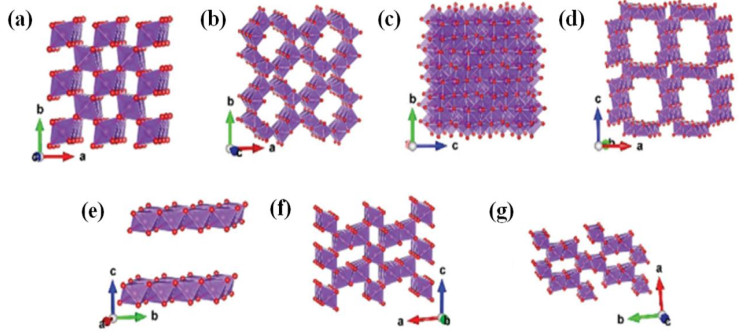
Schematic illustration of the crystal structures of MnO2: (a) β-MnO2; (b) ɑ-MnO2; (c) λ-MnO2; (d) todorokite MnO2; (e) δ-MnO2; (f) γ-MnO2; (g) R-MnO2[10]


Aqueous rechargeable zinc-ion batteries (AZIBs) have been considered as promising alternatives to lithium-ion batteries for electrochemical energy storage. There are two typical overwhelming advantages that make AZIBs stand out among the various electrochemical energy storage systems (organic alkaline ion batteries, e.g., Na+ and K+, and aqueous batteries, e.g., Na+, K+, Mg2+, and Al3+). Firstly, some advantages come from the utilization of aqueous electrolyte. The aqueous electrolytes could deliver 2 orders of magnitude higher ionic conductivities (~ 1 S cm-1) than the non-aqueous electrolytes (~1-10 mS cm-1)[1]. Moreover, aqueous electrolyte reduces the fabrication cost comparing with the usage of organic solvents. In addition, it is an important point that the high operational safety and environmental friendliness derived from aqueous electrolyte endows AZIBs with strong competitiveness. Secondly, zinc metal can directly be used as the anode in the AZIBs, which makes the AZIBs more promising than other aqueous batteries (Al3+, Mg2+, Na+, K+). Zn anode features the low oxidation-reduction potential of Zn2+/Zn (-0.76 V vs. standard 2H+/H2 potential), which can deliver higher energy density[2]. Moreover, the low-cost Zn metal can decrease the manufacturing cost.
To date, various electrode materials have been developed for AZIBs, such as Prussian blue analogues[3], metal oxides (MnO2, Co3O4)[4, 5], vanadium oxides (V2O5·H2O) and their derivatives[6, 7], polyanion compounds[8], organic materials (polyaniline)[9], etc. The energy storage mechanisms in AZIBs are complicated and controversial. So far, there are two main redox reactions in AZIBs: Zn2+ insertion/extraction and the chemical conversion reaction. According to the storage mechanism, different electrolytes are chosen for the AZIBs. The conversion-type cathodes need an alkaline electrolyte, while the insertion-type ones use neutral (or slightly acidic, ZnSO4) electrolytes. In comparison, the insertion-type cathodes that use the neutral electrolytes are more environmentally friendly. In the case of the insertion-type mechanism, many com-pounds with tunnel-type and layered-type structure, such as Prussian blue analogues, and manganese oxide-based and vanadium oxide-based materials, enable the insertion/extraction of Zn2+ ions into/from their hosts due to the small ionic radius of Zn2+ (0.74 Å). Among these insertion-type cathode candidates, manganese oxides are more ideal candidates for Zn-ion storage owing to their intrinsic properties of low cost and environmental friendliness. MnO2 has a variety of complicated crystal structures, however, giving rise to enormous effects on the electrochemical performance of AZIBs in terms of Zn-ion storage.
MnO2 has various crystal structures, including λ-MnO2, δ-MnO2, β-MnO2, ɑ-MnO2, γ-MnO2, and R-type and todorokite MnO2, as shown in Fig. 1. The basic crystal structural unit is the MO6 octahedron, which is composed of six oxygen atoms and one manganese atom. These MnO2 structures are classified into three main types: tunnel-structured (β-MnO2, ɑ-MnO2, γ-MnO2, and todorokite MnO2), layered structured (δ-MnO2), and spinel structured (λ-MnO2). The tunnel size depends on the number of interconnected MnO6 octahedra. β-MnO2 presents [1×1] tunnels along the c-axis, as shown in Fig. 1(a); ɑ-MnO2 shows a large [2×2] tunnel size with four interconnected MnO6 octahedra (Fig. 1(b)); γ-MnO2 grows along the b-axis to form randomly arranged [1×1] and [1×2] hybrid tunnels (Fig. 1(c)); todorokite MnO2 presents larger [3×3] tunnels, as shown in Figure 1(d). δ-MnO2 presents a layered structure with interlayer spacing of ~ 7 Å (Fig. 1(e)).
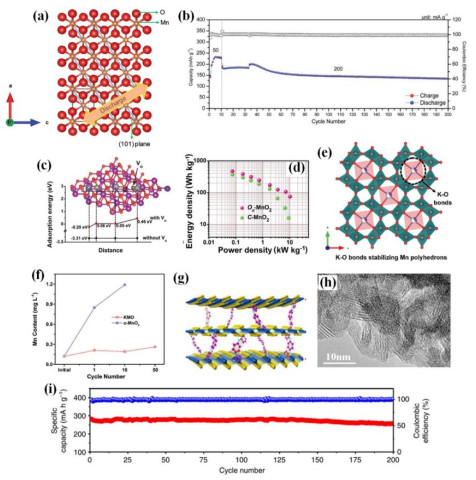
The crystal structure of MnO2 has an enormous effect on the Zn2+ storage performance. Among these MnO2 polymorphs, λ-MnO2, β-MnO2 and todorokite MnO2 are not ideal hosts for Zn2+ insertion owing to their limited three-dimensional (3D) tunnel structures. Although todorokite MnO2 has large tunnels, the tunnels are already occupied by a number of Mn2+ ions, which affects the average oxidation of manganese, resulting in its low theoretical capacity of 99 mAh·g-1[11]. β-MnO2 is intrinsically electrochemically inactive for Zn-ion storage. The electrochemical performances of these structures for Zn2+ storage, however, could be improved by modulating them through the following approaches: 1) exposing the preferred crystal orientation; 2) introducing oxygen defects into the structure; and 3) doping exotic atoms or molecules (K+, polyaniline) into the MnO2 framework to widen the interlayer spacing. Kim et al. were the first to explore the proposal that tunnel-type β-MnO2 nanorods with exposed (101) planes could present excellent Zn2+ storage performance. In contrast to its bulk counterpart which showed no electrochemical reactivity, the β-MnO2 nanorod electrode exhibited a high discharge capacity of 270 mAh·g-1 at the 100 mA·g-1 rate and long cycling stability (75% capacity retention) over 200 cycles (Fig. 2(a, b))[12] because the exposure of these specific planes of the crystal structure promoted facile ionic transport during the electrochemical reaction. Generally, Zn2+ is difficult to intercalate into a MnO2 host due to the strong electrostatic interaction between Zn2+ and the MnO2 lattice. Once Zn2+ is adsorbed onto the MnO2 surface, the strong chemical bonds between Zn and O would hinder the subsequent Zn2+ desorption process and these un-desorbed Zn2+ ions would eventually act as a physical barrier, reducing the available electroche-mically active surface area of MnO2. As a result, the rate capability of MnO2 is not ideal. It was reported that the introduction of oxygen vacancies into MnO2 would be a feasible approach for developing high-performance cathodes for zinc-ion batteries[13]. According to the first principles calculations, the Gibbs free energies of Zn2+ adsorption are close to thermoneutral values (~0.05 eV) for oxygen-deficient MnO2. In comparison, the Gibbs free energy of Zn2+ adsorption onto MnO2 without oxygen vacancies is significantly reduced to about –3.31 eV (Fig. 2(c)). This indicates that Zn2+ adsorption/desorption onto/from oxygen-deficient MnO2 would be more reversible than for MnO2 without oxygen vacancies, enhancing the electrochemical performance of MnO2 cathode. Manganese dissolution, which gives rise to sharp capacity decay, is still a major issue for MnO2 as cathode for aqueous zinc-ion batteries. Liang's group demonstrated that introducing K+ ions into the structure could stabilize the Mn-based cathode[16]. In order to characterize the dissolution of Mn element, inductively coupled plasma-optical emission spectrometry (ICP-OES) analysis was conducted to test the Mn concentration in 2 M ZnSO4 electrolyte. The results showed that the α-MnO2 exhibited fast dissolution of Mn element during cycling and that the level of dissolved Mn in the electrolyte was much higher than that for K0.1MO2 (Fig. 2(f)), suggesting that Mn dissolution is suppressed as the K+ ions are intercalated into the structure and bonded with the MnO6 polyhedra (Fig. 2(e)). Usually, MnO2 hosts suffer from serious structural transformation during cycling processes, leading to significant capacity fading. Huang et al. designed polyaniline-intercalated layered manganese dioxide (PANI-MnO2), which could efficiently eliminate the phase transformation induced by Zn2+-insertion. As a result, it showed excellent cycling performance with high capacity of 280 mAh·g-1 (Fig. 2(i))[16].
In summary, MnO2-based AZIBs have some issues that need to be addressed, including Mn dissolution, phase transformation, and strong electrostatic interaction of Zn2+ with the host lattice, which are restricting the electrochemical performance of MnO2. Their performance is determined by the crystal structure of their materials. Thus, there are some approaches that operate through structural modulation to improve the electrochemical performance of MnO2-based AZIBs: 1) exposing the preferred crystal orientation; 2) introducing oxygen defects into the structure; and 3) doping exotic atoms or molecules (K+, polyaniline) into the MnO2 framework to widen the interlayer spacing. As a result, properties including Zn-ion transport, phase transformation, and electrostatic interaction with Zn2+ could be effectively improved, giving rise to enhanced Zn2+ storage performance (high rate capability, cycling stability, etc.).
Fang, G.; Zhou, J.; Pan, A.; Liang, S. Recent advances in aqueous zinc-ion batteries. ACS Energy Lett. 2018, 3, 2480–2501. doi: 10.1021/acsenergylett.8b01426
Ding, J.; Du, Z.; Gu, L.; Li, B.; Wang, L.; Wang, S.; Gong, Y.; Yang, S. Ultrafast Zn2+ intercalation and deintercalation in vanadium dioxide. Adv. Mater. 2018, 30, 1800762. doi: 10.1002/adma.201800762
Yang, Q.; Mo, F.; Liu, Z.; Ma, L.; Li, X.; Fang, D.; Chen, S.; Zhang, S.; Zhi, C. Activating C-coordinated iron of iron hexacyanoferrate for Zn hybrid-ion batteries with 10000-cycle lifespan and superior rate capability. Adv. Mater. 2019, 31, 1901521.
Mo, F.; Liang, G.; Meng, Q.; Liu, Z.; Li, H.; Fan, J.; Zhi, C. A flexible rechargeable aqueous zinc manganese-dioxide battery working at –20 ℃. Energy Environ. Sci. 2019, 12, 706–715. doi: 10.1039/C8EE02892C
Wang, X.; Wang, F.; Wang, L.; Li, M.; Wang, Y.; Chen, B.; Zhu, Y.; Fu, L.; Zha, L.; Zhang, L.; Wu, Y.; Huang, W. An aqueous rechargeable Zn//Co3O4 battery with high energy density and good cycling behavior. Adv. Mater. 2016, 28, 4904–4911. doi: 10.1002/adma.201505370
Yan, M.; He, P.; Chen, Y.; Wang, S.; Wei, Q.; Zhao, K.; Xu, X.; An, Q.; Shuang, Y.; Shao, Y.; Mueller, K. T.; Mai, L.; Liu, J.; Yang, J. Water-lubricated intercalation in V2O5·nH2O for high-capacity and high-rate aqueous rechargeable zinc batteries. Adv. Mater. 2018, 30, 1703725. doi: 10.1002/adma.201703725
Yang, Y.; Tang, Y.; Fang, G.; Shan, L.; Guo, J.; Zhang, W.; Wang, C.; Wang, L.; Zhou, J.; Liang, S. Li+ intercalated V2O5·nH2O with enlarged layer spacing and fast ion diffusion as an aqueous zinc-ion battery cathode. Energy Environ. Sci. 2018, 11, 3157–3162. doi: 10.1039/C8EE01651H
Wan, F.; Zhang, Y.; Zhang, L.; Liu, D.; Wang, C.; Song, L.; Niu, Z.; Chen, J. Reversible oxygen redox chemistry in aqueous zinc-ion batteries. Angew. Chem. Int. Ed. 2019, 58, 7062–7067. doi: 10.1002/anie.201902679
Shi, H. Y.; Ye, Y. J.; Liu, K.; Song, Y.; Sun, X. A long cycle-life self-doped polyaniline cathode for rechargeable aqueous zinc batteries. Angew. Chem. Int. Ed. 2018, 57, 16359–16363. doi: 10.1002/anie.201808886
Tang, B.; Shan, L.; Liang, S.; Zhou, J. Issues and opportunities facing aqueous zinc-ion batteries. Energy Environ. Sci. 2019, 12, 3288–3304. doi: 10.1039/C9EE02526J
Lee, J.; Ju, J. B.; Cho, W. I.; Cho, B. W.; Oh, S. H. Todorokite-type MnO2 as a zinc-ion intercalating material. Electrochim. Acta 2013, 112, 138–143. doi: 10.1016/j.electacta.2013.08.136
Islam, S.; Alfaruqi, M. H.; Mathew, V.; Song, J.; Kim, S.; Kim, S.; Jo, J.; Baboo, J. P.; Pham, D. T.; Putro, D. Y.; Sun, Y. K.; Kim, J. Facile synthesis and the exploration of the zinc storage mechanism of β-MnO2 nanorods with exposed (101) planes as a novel cathode material for high performance eco-friendly zinc-ion batteries. J. Mater. Chem. A 2017, 5, 23299–23309. doi: 10.1039/C7TA07170A
Xiong, T.; Yu, Z. G.; Wu, H.; Du, Y.; Xie, Q.; Chen, J.; Zhang, Y. W.; Pennycook, S. J.; Lee, W. S. V.; Xue, J. Defect engineering of oxygen-deficient manganese oxide to achieve high-performing aqueous zinc ion battery. Adv. Energy Mater. 2019, 9, 1803815. doi: 10.1002/aenm.201803815
Trócoli, R.; La Mantia, F. An aqueous zinc-ion battery based on copper hexacyanoferrate. ChemSusChem. 2015, 8, 481–485. doi: 10.1002/cssc.201403143
Huang, J.; Wang, Z.; Hou, M.; Dong, X.; Liu, Y.; Wang, Y.; Xia, Y. Polyaniline-intercalated manganese dioxide nanolayers as a high-performance cathode material for an aqueous zinc-ion battery. Nat. Commun. 2018, 9, 2906. doi: 10.1038/s41467-018-04949-4
Fang, G.; Zhu, C.; Chen, M.; Zhou, J.; Tang, B.; Cao, X.; Zheng, X.; Pan, A.; Liang, S. Suppressing manganese dissolution in potassium manganate with rich oxygen defects engaged high-energy-density and durable aqueous zinc-ion battery. Adv. Funct. Mater. 2019, 29, 1808375. doi: 10.1002/adfm.201808375

Figure 1 Schematic illustration of the crystal structures of MnO2: (a) β-MnO2; (b) ɑ-MnO2; (c) λ-MnO2; (d) todorokite MnO2; (e) δ-MnO2; (f) γ-MnO2; (g) R-MnO2[10]

Figure 2 (a) Schematic illustration of (101) lattice planes in the β-MnO2 structure[12]. (b) Cycling performance of the β-MnO2 with (101) planes as cathode in Zn-ion batteries[12]. (c) Calculated adsorption energies for Zn2+ on the surface of perfect σ-MnO2 and that with oxygen vacancies. VO represents oxygen vacancy[13]. (d) Ragone plots of σ-MnO2 with and without VO in Zn-ion batteries[13]. (e) Incorporated K+ ions stabilized Mn polyhedra[14]. (f) Element analysis of dissolved Mn2+ in 2 M ZnSO4 aqueous electrolyte during cycling of K0.1MnO2 and ɑ-MnO2[14]. (g) Expanded structure of polyaniline (PANI)-intercalated MnO2 layers[15]. (h) High resolution transmission electron microscope (TEM) image of PANI-intercalated MnO2 layers[15], and (i) cycling performance of PANI-intercalated MnO2[15]

 扫一扫看文章


扫一扫关注我们
 DownLoad:
 下载:
下载:
 下载:
下载: