
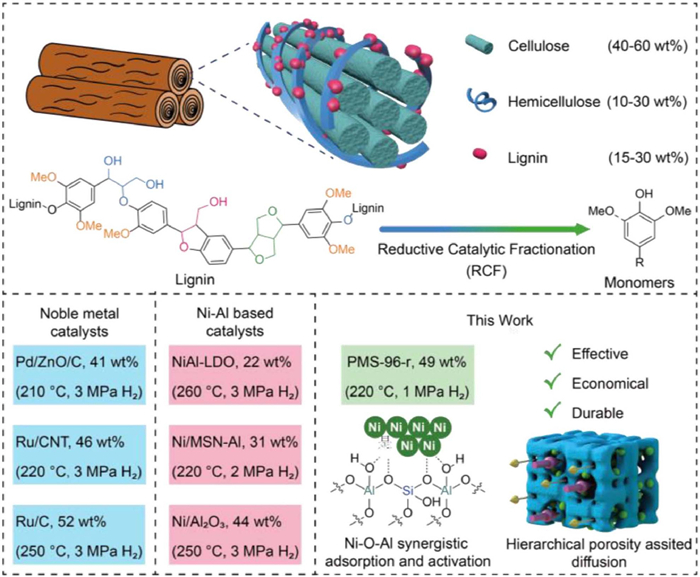
Figure 1.
Schematic overview of RCF of lignocellulose with PMS-96-r and comparable catalysts.


Lignocellulose, composed of lignin (15%−30%), cellulose (40%−60%) and hemicellulose (10%−30%), is a promising renewable resource for producing valuable chemicals, offering a sustainable alternative to fossil fuels [1–5]. While most biorefinery efforts have focused on converting cellulose and hemicellulose into biofuels and biomaterials, lignin has traditionally been used for heat and power generation [6–10]. However, lignin is the second most abundant biopolymer and is predominantly composed of phenylpropanoid units, making it a renewable source of aromatic carbon for diverse fine chemicals [11–13]. Efficient valorization of lignin is thus essential to fully realize the economic potential of lignocellulose. Nevertheless, the complex, cross-linked structure of lignin renders it notoriously recalcitrant [14–19], underscoring the critical need for rationally designed catalytic strategies to enable sustainable lignin upgrading.
Traditional methods for lignin degradation, such as thermochemical treatment (> 450 ℃) or step-wise extraction, suffer from harsh conditions or exhibit low monomer yield (< 30 wt% below 250 ℃), primarily attributed to the high bond energy and the irreversible formation of C–C bonds via electrophilic addition between aromatic rings and lignin side chains under acidic conditions [20–25]. Reductive catalytic fractionation (RCF) approach has emerged as a promising lignin-first strategy for the in-situ depolymerization of wood into lignin oil and processable hydrocarbon pulp by using near-supercritical methanol as solvent, avoiding the use of acidic reagents and the formation of robust C–C bonds, producing monophenols with high yields of 20–55 wt% [26–32]. However, the intrinsic scarcity and resultant high prices of platinum-group metals have accelerated research efforts toward non-noble metal catalysts (e.g., Fe, Co, Ni and Cu) for sustainable RCF implementations [9,33–39]. Among these, Ni-Al bifunctional catalyst system has attracted widespread attention due to its promising catalytic activity and low cost [40–44]. Wang et al. reported the well-dispersed Ni in Al-SBA-15 that catalyzed the organosolv lignin at 280 ℃ and 1 MPa H2 with a 22 wt% yield of monomers [45]. Afterwards, Sels et al. used Ni-Al2O3 catalyst to study the conversion of birch wood, which achieved a 44 wt% yield of monomers at 250 ℃ and 3 MPa H2 [41]. The promotional effect of Al in Ni-catalyzed lignin depolymerization has been investigated from various aspects. Xu et al. revealed that Al-doped silica nanospheres could regulate the defects of the support, leading to uniform dispersion of Ni nanoparticles, rendering a 31 wt% yield of monomers with organosolv lignin at 220 ℃ and 2 MPa H2 [43]. Zhang et al. presented the strong acid sites introduced by Al in NiAl-LDO which facilitated the hydrogenolysis of C–O bonds in lignin, achieving a 22 wt% yield of monomers using pine wood at 260 ℃ and 3 MPa H2 [44]. Despite promising results, the catalytic activity of Ni-Al-based catalysts for lignin depolymerization still lags behind that of noble metals. Challenges such as poor dispersion of active sites remain and the underlying synergistic mechanism between Ni and Al during the RCF process is still unclear.
A promising strategy to effectively enhance the catalytic activity of RCF catalysts involves integrating active sites into porous frameworks while maximizing their accessibility and inhibiting sintering [46,47]. However, the RCF process necessitates large mass transport channels to accommodate lignin solvolysis fragments (1100–1600 Da) [33,48,49], whereas conventional mesoporous supports face inherent hydrothermal instability under such conditions [50,51], creating a critical materials design challenge. In this regard, porous metal silicate (PMS) materials have emerged as promising candidates due to their hydrothermal stability, tunable porosity and dispersed redox-active metal sites, which are introduced via metal-organic templates and enable simultaneous regulation of electronic and mechanical structures [52–56]. Furthermore, the demonstrated ability of micropores to accelerate product diffusion motivates the incorporation of hierarchical porosity into PMS materials, offering an effective strategy to enhance the transport of lignin monomers during the RCF of lignocellulose [57].
It is noteworthy that among various lignocellulose resources, hardwoods like birch (Betula spp.) and poplar (Populus spp.) are widely studied in lignin valorization due to their high β–O–4 linkage content [58–61]. While birch typically achieves higher monomer yields in lab-scale depolymerization [30], poplar was selected for this study due to its higher potential biomass production (4.2 t DM ha–1 yr–1 for poplar vs. 3.3 t DM ha–1 yr–1 for birch) and lower costs, providing a representative yet economically viable substrate for catalytic valorization [33,62]. Herein, we engineered a Ni-Al co-doped hierarchical porous metal silicate catalyst (PMS-96-r) for RCF of poplar sawdust. Under mild conditions (220 ℃, 1 MPa H2), PMS-96-r achieved a 49 wt% lignin monomer yield, which is within the theoretical maximum range (45–54 wt%) for native lignin and outperforms reported Ni-based catalysts (Fig. 1). Systematic investigation of the Ni-Al synergy in PMS-96-r revealed the "adsorption-activation-diffusion" mechanisms: The adsorption of lignin fragments is facilitated by the co-incorporation of Ni and Al in PMS-96-r, combined with the structural integration of aromatic rings and polyol structures that leads to the specific affinity between β–O–4 linkage and PMS-96-r, ensuring the dominant preference of lignin over competing monomeric products. The Ni–O–Al interfacial structure in PMS-96-r plays a pivotal role in electronic engineering: Al doping induces electron-deficient Ni sites, which strengthen methoxy‑group coordination and lower the β–O–4 linkage cleavage energy barrier (from 33.5 kcal/mol to 28.7 kcal/mol). Simultaneously, the hierarchical porosity facilitates diffusional mass transport, and mesopores promote lignin fragment diffusion while micropores accelerate monomer egress, thereby alleviating product inhibition and shifting the equilibrium toward depolymerization. This synergistic electronic modulation with structural engineering strategy establishes a powerful framework for designing high-performance lignin-targeting catalysts.
PMS-96-p (where "p" denotes precursor) was initially synthesized by a sol-gel method using tetraethyl orthosilicate (TEOS) as the silica source, with Ni-gallate and Al-gallate complexes as templates. After that, PMS-96-p was calcined at 500 ℃ in the air to remove the organic template and promote the anchoring of Al on the skeleton of silica to obtain PMS-96-o. The PMS-96-o was further calcined at 500 ℃ in a 10 vol% H2/Ar atmosphere to reduce well-dispersed NiO nanoparticles to Ni nanoparticles and enhance the Ni-Al interaction, thus producing porous metal silicate catalyst (PMS-96-r). The powder X-ray diffraction (PXRD) patterns indicate the presence of NiO in PMS-96-o and the formation of Ni0 in PMS-96-r. No Al-related characteristic peak was observed, suggesting the high dispersion of Al in PMS-96-r at relatively low loading (Fig. 2a). The weight percentages of Ni and Al in PMS-96-r were determined based on inductively coupled plasma mass spectrometry (ICP-MS) analysis (Table S1 in Supporting information).
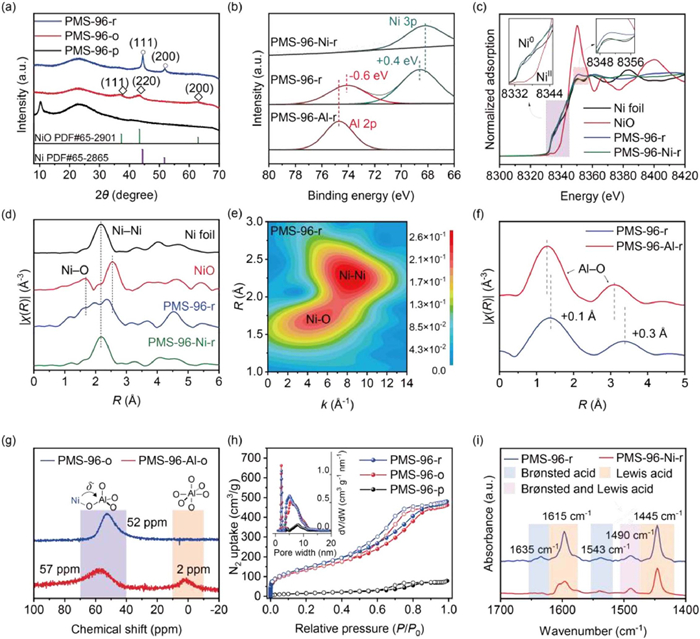
The surface chemical states of PMS-96-o and in-situ-reduced PMS-96-r were studied by X-ray photoelectron spectroscopy (XPS). In PMS-96-o, the peaks located at 855.52 and 872.63 eV were assigned to NiⅡ 2p3/2 and NiⅡ 2p1/2, respectively. In PMS-96-r, new peaks at 852.55 and 869.85 eV, corresponding to Ni0 2p3/2 and Ni0 2p1/2, revealed the partial reduction of NiⅡ and the formation of metallic Ni (Fig. S1 in Supporting information). The coexistence of both oxidation states in PMS-96-r suggested the presence of Ni species with enhanced antireduction capability, which could be attributed to nickel silicate [53–55]. A positive deviation of 0.4 eV in the peak position of Ni 3p was observed in PMS-96-r compared with PMS-96-Ni-r (PMS-96-r without Al), whereas the Al 2p peak shifted negatively by 0.6 eV in PMS-96-r compared with PMS-96-Al-r (PMS-96-r without Ni) (Fig. 2b). These shifts indicate a net charge transfer from Ni to Al species in PMS-96-r [63,64]. To further verify the electronic properties and local coordination environments of Ni and Al species, X-ray absorption spectroscopy (XAS) was implemented to examine the valence states and local arrangements of Ni and Al in PMS-96-r, PMS-96-Ni-r and PMS-96-Al-r. The X-ray absorption near-edge structure (XANES) spectra at Ni K-edge demonstrated the prevailing presence of Ni0 in PMS-96-r and PMS-96-Ni-r (Fig. 2c), and the peak located at 8350 eV showed differences in Ni foil and PMS-96-Ni-r, suggesting that Al doping introduced partial NiⅡ in PMS-96-r. The extended X-ray absorption fine structure (EXAFS) analysis for R space displayed the structural phase in the range of 1.5–3.0 Å in PMS-96-r and PMS-96-Ni-r (Fig. 2d). Compared with those of Ni foil and NiO, the peaks of Ni species in PMS-96-r were shifted to the left, revealing the presence of smaller Al atoms around Ni. The plot of PMS-96-Ni-r was consistent with that of Ni foil, confirming the exclusive presence of Ni0. The wavelet transform (WT) exhibited a better discrimination of the nature of the scattering contributions around Ni atoms (Fig. 2e and Figs. S2-S4 in Supporting information). PMS-96-Ni-r exhibited the intensity maximum at k = 7 Å-1 consistent with Ni foil, while PMS-96-r displayed the combined characteristics of both Ni foil and NiO. Moreover, the Al K-edge EXAFS R space spectra displayed an upshift from PMS-96-Al-r to PMS-96-r (Fig. 2f). Specifically, the Al–O first-shell signal shifted from R = 1.3 Å to 1.4 Å, and the second-shell peak shifted from R = 3.1 Å to 3.4 Å. These shifts were consistent with the Ni K-edge EXAFS result, while the absence of a Ni–Al signal indicated that the interaction of Ni and Al occurred via the Ni–O–Al structure.
To better understand the coordination environments of Al species, nuclear magnetic resonance (NMR) spectra of 27Al with magic-angle spinning (MAS) were collected. PMS-96-Al-o exhibited two types of Al coordination environments at 2 and 57 ppm (Fig. 2g), which are respectively assigned to octahedrally coordinated Al in Al2O3 and tetrahedrally coordinated Al in the silicate framework. In contrast, PMS-96-o displayed only tetrahedrally coordinated Al at 52 ppm [43], indicating that Ni prevented Al aggregation into Al2O3 and induced an upfield shift of framework Al, suggesting that Al replaced Si at the metal-support interface silicate to form of the Ni–O–Al structure. High-resolution transmission electron microscopy (HR-TEM) images confirmed this dispersion-promoting effect, showing uniformly distributed nanoparticles in PMS-96-o and PMS-96-r. Lattice fringes with interplanar spacings of 0.210 and 0.203 nm corresponded to NiO (200) and Ni (111), respectively (Figs. S5 and S6 in Supporting information). Elemental mapping confirmed the uniform dispersion of Ni, Al, Si, and O in both PMS-96-r and PMS-96-o (Fig. S7 in Supporting information). H2-TPR results suggested that the incorporation of Al altered the material's reduction temperature from 406 ℃ to 427 ℃, and a new broad reduction peak emerged at 500–700 ℃ as the Al content increased, indicating enhanced metal-support interaction. The presence of this incompletely reduced Ni species, along with the corresponding Ni2+ signal in XPS, can be attributed to the formation of nickel silicate (Figs. S1 and S8 in Supporting information), which is consistent with literature reports [44,54,55,65]. To gain further structural insight, N2 adsorption-desorption isotherms were obtained. The isotherms for PMS-96-o and PMS-96-r revealed hierarchical porosity with significantly enhanced N2 uptake capacities, corresponding to Brunauer-Emmett-Teller (BET) surface areas of 486 and 530 m2/g, respectively (Fig. 2h and Table S2 in Supporting information).
The NH3 temperature programmed desorption (NH3-TPD) measurements revealed a substantial increase in NH3 adsorption at 110 ℃ and the emergence of a new peak at 465 ℃ in PMS-96-r compared to PMS-96-Ni-r (Fig. S9 in Supporting information), suggesting that the presence of Al not only introduced strong acid sites but also exhibited significant interaction with Ni, as evidenced by the H2-TPR results (Fig. S8 in Supporting information). To confirm the nature of acid sites in PMS-96-r, in-situ pyridine adsorption infrared (Py-IR) spectroscopy was further employed (Fig. 2i and Table S3 in Supporting information). The peaks at 1450, 1576 and 1612 cm–1 were identified as characteristic vibrations of pyridine sorption on Lewis acid sites (L) [66]. The peaks at 1543 and 1637 cm–1 were assigned to the adsorbed pyridine at Brønsted acid sites (B), and the peak at 1489 cm–1 was attributed to the overlap of Brønsted and Lewis acid sites. Compared with PMS-96-Ni-r, PMS-96-r showed a significant increase in L content, and the ratio of L/B showed a negligible decrease with increasing temperature, confirming the stronger Lewis acidity of PMS-96-r (Fig. S10 in Supporting information). The comprehensive characterization results demonstrated the strong synergy between Ni and Al species in PMS-96-r, in which electron transfer from Ni to Al occurs via the Ni–O–Al structure, thus making the catalyst suitable for RCF of lignocellulose.
The synthesized catalysts were initially evaluated using poplar sawdust as the substrate. The composition of products was analyzed by GC–MS (Fig. S11 in Supporting information). Preliminary screening of the elemental ratio and catalyst dosage was conducted in methanol solvent to obtain the optimal catalyst composition (Al: Ni: Si = 1:5:9) and dosage (50 mg) (Figs. S12-S14 in Supporting information). The influence of reaction time, temperature and pressure was investigated to unravel the overall catalytic performance of PMS-96-r. As shown in Figs. 3a and b, a significant increase in both the formation of saturated side chain products and the total monomer yield was observed with the increase of reaction time and temperature, and a monomer yield of 49 wt% was achieved at 220 ℃, 1 MPa H2. Notably, as the temperature rose to 240 ℃, monomer yield showed only a slight increase, while substantial amounts of undesired gaseous products were generated (primarily CO, CO2 and CH4, Tables S4 and S5 in Supporting information). The mass of these gases significantly exceeded the theoretical gas yield from lignin alone, complicating source identification. Furthermore, the system pressure rose sharply to nearly 8 MPa at 240 ℃, posing challenges for practical applications. In comparison, the monomer yield and the selectivity of hydroxylated products rose with the increase of hydrogen pressure, mainly due to the fast hydrogenation of C═C bonds in the intermediates under high hydrogen pressure, thus suppressing the reactivity of γ-hydroxyls [41], achieving a monomer yield of 48 wt% at 200 ℃, 3 MPa H2 (Fig. 3c). A monomer yield of only 20 wt% was achieved under N2 atmosphere, indicating that methanol provided active hydrogen species in the absence of gaseous hydrogen [48]. The post-reacted PMS-96-r catalyst was recovered with a magnet and washed, and subsequently reactivated to evaluate the reusability and stability. The recovered PMS-96-r presented a slight decrease in monomer yield after ten cycles, which could be attributed to inevitable and cumulative catalyst loss during recovery (Fig. 3d). Comparative PXRD and FT-IR spectra revealed no significant structural changes or coke formation in PMS-96-r after ten reaction cycles, and negligible metal leaching was observed according to ICP-MS data (Fig. S15 and Table S1 in Supporting information). A mild condition of 200 ℃, 1 MPa H2 was used to compare the performance of different catalysts (Fig. 3e and Fig. S16 in Supporting information). Compared with the blank catalyst (5 wt% monomer yield), Ni/Al-SBA-15 displayed limited catalytic activity with a marginal improvement to 10 wt% monomer yield. Both PMS-96-Ni-r and PMS-96-Al-r delivered < 20 wt% monomer yield. However, PMS-96-Al-r gave a higher production of hydroxylated products, whereas PMS-96-Ni-r showed more monomers with C═C bonds. This discrepancy might be attributed to the oxophilic nature of aluminum, leading to the coordination of Al with oxygen, which in turn suppressed the hydrogenation of hydroxyls [67]. Notably, PMS-96-r achieved a monomer yield of up to 40 wt%, surpassing that of Ru/C, which exhibited a 35 wt% yield, confirming the crucial role of Ni-Al synergy for catalytic performance. Detailed monomer distributions for all experiments are shown in Table S4 (Supporting information), which were calculated based on Klason lignin content (Table S6 in Supporting information). The performance of PMS-96-r was also benchmarked against various catalysts reported in the literature, demonstrating its superior performance (Table S7 in Supporting information) [30,43,68–71].
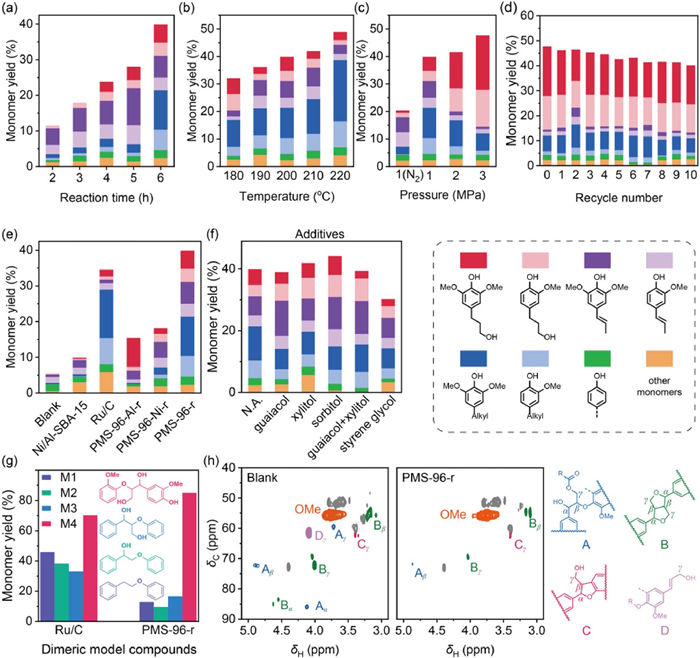
To investigate the competition between products and substrates in RCF, guaiacol was co-introduced with poplar sawdust (Fig. S17 and Table S8 in Supporting information). When catalyzed by Ru/C, guaiacol maintained 70% relative conversion compared to the single-substrate scenario. However, with both PMS-96-r and Ni/Al-SBA-15, the relative conversion of guaiacol dropped below 10%, indicating a significantly lower affinity of these Ni-Al-based catalysts for phenolic monomers than for lignin fragments. Remarkably, PMS-96-r preserved > 97% lignin monomer production in competitive reaction, outperforming Ru/C and Ni/Al-SBA-15 which preserved only 84% and 63% monomer production, respectively (Fig. S17). This result demonstrated the unique capability of PMS-96-r to minimize product inhibition, thereby enhancing lignin depolymerization in RCF processes.
The role of molecular structure in substrate-product competition was elucidated by co-introducing molecules with different functional groups into the PMS-96-r-catalyzed RCF reaction (Fig. 3f). It can be observed that neither guaiacol, polyhydric alcohol nor their mixture exerted any decreasing effect on the RCF of poplar sawdust. In fact, polyhydric alcohol exhibited an enhanced effect due to its protective functionality [8]. However, the incorporation of styrene glycol led to a noticeable decrease in monomer yield, suggesting that the presence of a benzene ring or a polyol structure alone did not substantially reduce the RCF efficiency of PMS-96-r, yet the combination of these features enabled the molecule to compete with lignin fragments in the reaction (Fig. 3f). Depolymerization of β–O–4 model compounds by PMS-96-r and Ru/C were assessed (Fig. 3g and Figs. S18-S22 in Supporting information). The PMS-96-r yielded < 20 wt% monomers for M1-M3 (corresponding to 2-phenylethyl phenyl ether, 2-phenoxy-1-phenylethanol and 2-phenoxy-1-phenylpropane-1,3-diol, respectively), which lack additional functional groups or possess only aliphatic hydroxyls. In contrast, M4 (correspond to guaiacol-based glycerol-β-guaiacyl ether), which features aromatic hydroxyl and methoxy groups, yielded over 80 wt% monomers. In comparison, Ru/C yielded over 30 wt% monomers for M1-M3 but only 70 wt% for M4. These phenomena indicate that aromatic oxygen substitution played a key role in the cleavage of β–O–4, which is consistent with literature results [72], and this effect was amplified by PMS-96-r. The heteronuclear single quantum coherence (HSQC) spectrum of PMS-96-r-catalyzed RCF products showed a marked decrease in the β–O–4 linkages (Aα, Aβ, Aγ) and other oxygen-containing inter-linkages compared to the blank reaction, indicating the efficient depolymerization of lignin (Fig. 3h). This was further confirmed by the matrix-assisted laser desorption/ionization time-of-flight mass spectrometry (MALDI-TOF-MS) analysis, which revealed that PMS-96-r-derived products exhibited lower molecular weights than those from the blank reaction, consistent with the performance of Ru/C (Fig. S23 in Supporting information). Moreover, diverse lignocellulosic feedstocks were further applied in the PMS-96-r catalyzed RCF. Hardwoods including birch, poplar, cedar and oak afforded substantial amounts of monomers, demonstrating substrate versatility, whereas corn stover (herbaceous plant) and pine (softwood) delivered relatively lower monomer production due to their low β–O–4 content (Fig. S24 in Supporting information) [30,68].
To further unravel the exceptional catalytic property of PMS-96-r, the adsorption behavior of lignin fragments and monomer products was investigated. UV–vis absorption spectroscopy was applied to assess the adsorption capacity of PMS-96-r and Ru/C for methanol-soluble lignin and guaiacol. While Ru/C and PMS-96-r showed comparable uptake of methanol-soluble lignin, PMS-96-r adsorbed substantially less guaiacol, confirming that the competitive adsorption on PMS-96-r was dominated by lignin fragments over monomer products (Fig. 4a). Moreover, the exceptional adsorption capacity of PMS-96-r for lignin fragments was attributed not only to the mass transfer channel provided by mesopores but also to the synergy between Ni and Al, as evidenced by the fact that both PMS-96-Ni-r and PMS-96-Al-r exhibited weaker adsorption for methanol-soluble lignin (Figs. S25 and S26 in Supporting information). The adsorption capacities of PMS-96-r and Ru/C were consistent with their catalytic performances, signifying the pivotal role of lignin fragment adsorption on the catalyst in the RCF of lignocellulose.
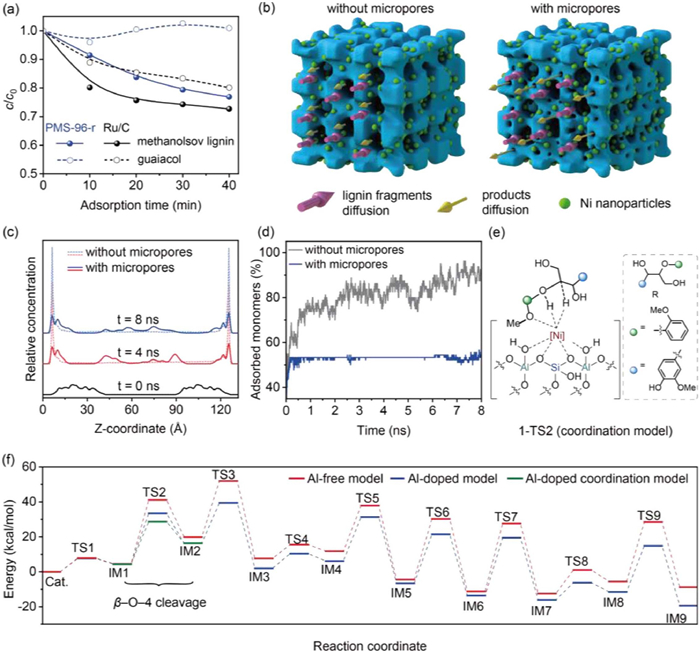
In addition to the apparent adsorption capacity of the catalysts, local mass transfer also plays a critical role in catalytic reactions. Given the enhanced diffusional transport of product molecules induced by microporous zeolites on catalyst surfaces [57], the hierarchical porosity of PMS-96-r was considered to accelerate the escape of monomeric products through micropores after the depolymerization of lignin in mesopores (Fig. 4b). This was subsequently corroborated by molecular dynamics (MD) simulations. Figs. S27 and S28 (Supporting information) depict models containing the Ni surfaces with or without adjacent micropores, along with an intervening free region representing the mesoporous channels. The diffusion of 4-propylguaiacol (PG), which represented the product molecules, was predicted using MD simulations at 200 ℃. It was observed that in the absence of the microporous region, the diffusion of PG was suppressed, leading to a continuous increase in PG concentration on the Ni surfaces. Conversely, PG diffused away from the surface of Ni in the presence of micropores, thus the concentration of PG adsorbed on the Ni surfaces maintained an equilibrium of about 55% (Figs. 4c and d, Figs. S27 and S28). These results suggested that the hierarchical porosity of PMS-96-r led to an efficient transfer of product molecules from the Ni surfaces to the micropores, thereby shifting the reaction equilibrium of lignin depolymerization on the Ni surfaces. In addition, when the surface of the silica exhibited a high content of silanol groups, micropores were predominantly occupied by solvent molecules. Under this circumstance, the promoting effect of the micropores on product diffusion was relatively diminished (Fig. S29 in Supporting information). These results substantiated the experimental observation that PMS-96-r exhibited a low content of silanol groups according to the negligible signal of Si-OH vibration in the ATR-FTIR spectra (Fig. S30 in Supporting information).
To further elucidate the exceptional catalytic property of PMS-96-r and the synergistic effect between Ni and Al, surface models of PMS-96-r and PMS-96-Ni-r were constructed to represent their respective catalytic surface and density functional theory (DFT) calculations were performed to gain a molecular-level understanding of β–O–4 cleavage over PMS-96-r (Figs. 4e and f, Figs. S31 and S32 in Supporting information). The Ni10 cluster was selected as a stable and well-defined model system that accurately represented the dominant (111) facet of Ni nanoparticles [73,74]. The Ni–O–Al structure was represented at the model's cluster-support interface, where Ni and Al were connected through a bridging oxygen atom (Fig. S33 in Supporting information). Previous studies have identified several key reaction pathways, primarily involving β–O–4 hydrogenolysis, β–elimination dehydration and C═C hydrogenation [48,75,76]. Accordingly, a typical route was selected to study the reaction mechanisms, as presented in Figs. S31 and S32. The results showed that the potential energy surface for M4 depolymerization in the presence of Al lay always below that of the Al-free scenario, and the activation barrier for β–O–4 cleavage was further decreased when the interaction between the ortho methoxy group and the Ni surface was taken into account. This result not only confirmed the critical role of Al in PMS-96-r for the depolymerization of lignin fragments but also revealed that, as evidenced by the transition state model 1-TS2 (Fig. 4e), the coordination of the ortho methoxy group resulted in a more thermodynamically favored transition state. This coordination mode was substantiated by the reduced electron density at Ni sites (enhanced via Al doping, as evidenced by the characterization results in Fig. 2), the Lewis acidity of the catalyst that facilitated coordination with electron-rich oxygen in methoxy groups, and depolymerization tests of dimeric compounds, which underscored the critical role of methoxy substitution in β–O–4 cleavage. These findings provide a scientific basis for the excellent RCF performance of PMS-96-r.
In summary, we developed a hierarchical porous Ni-Al silicate catalyst (PMS-96-r) for efficient reductive catalytic fractionation (RCF) of lignocellulose. The silicate framework not only provided a high surface area for the dispersion of Ni and Al but also influenced the catalytic performance through metal-support interactions. This "adsorption-activation-diffusion" in PMS-96-r catalyst achieved 49 wt% lignin monomer yield from poplar sawdust under mild conditions (220 ℃, 1 MPa H2), outperforming non-porous analogs. Micropores and mesopores in PMS-96-r synergistically modulated adsorption-desorption dynamics. MD simulations revealed that mesopores facilitated lignin fragment ingress, while micropores accelerated monomer egress, shifting reaction equilibrium toward depolymerization. The Lewis acid sites of Al and the metallic surface of Ni in PMS-96-r led to the excessively strong adsorption of lignin fragments in comparison to monomers, whereas Ni–O–Al interfaces induced charge transfer from Ni to Al, creating electron-deficient Ni sites that lowered the β–O–4 linkage cleavage barrier. Future efforts should focus on (1) developing scalable and cost-effective synthesis methods for producing the hierarchical Ni-Al silicate catalyst at gram-to-kilogram levels, (2) evaluating its long-term stability, particularly in continuous-flow reactor systems over extended durations, and (3) conducting a comprehensive techno-economic analysis to assess the overall industrial viability of the process. Addressing these aspects will be crucial for realizing the commercial potential of the proposed catalytic system. These findings not only broaden our mechanistic understanding of the RCF of lignocellulose but also provide new perspectives and strategies for the design of lignin depolymerization catalysts.
Bu-Hang Zheng: Writing – review & editing, Writing – original draft, Visualization, Validation, Methodology, Investigation, Formal analysis, Data curation. Ji-Jie Ye: Writing – review & editing, Visualization, Validation, Software, Formal analysis. Hang Wang: Writing – review & editing, Visualization, Validation, Methodology, Funding acquisition, Formal analysis, Data curation. Chuan-De Wu: Writing – review & editing, Writing – original draft, Visualization, Validation, Supervision, Project administration, Funding acquisition, Data curation, Conceptualization.
The authors declare that they have no known competing financial interests or personal relationships that could have appeared to influence the work reported in this paper.
This work was financially supported by the National Key Research and Development Program of China (No. 2021YFA1500404), the National Natural Science Foundation of China (Nos. 22575268, 21525312 and 21872122), and the Fundamental Research Funds for the Central Universities (Nos. 23CX06019A, R20220132).
Supplementary material associated with this article can be found, in the online version, at doi:
E.T.C. Vogt, B.M. Weckhuysen, Nature 629 (2024) 295–306. doi: 10.1038/s41586-024-07322-2
Y. Liao, S.F. Koelewijn, G. Van den Bossche, et al., Science 367 (2020) 1385–1390. doi: 10.1126/science.aau1567
N. Li, K. Yan, T. Rukkijakan, et al., Nature 630 (2024) 381–386. doi: 10.1038/s41586-024-07446-5
S. Yu, L. Chen, Y. Xie, Q. Feng, C. Chen, Prog. Mater. Sci. 148 (2025) 101383. doi: 10.1016/j.pmatsci.2024.101383
G. Zhang, L. Ma, Y. Dong, Y. Fang, X. Kong, Fuel 333 (2023) 126400. doi: 10.1016/j.fuel.2022.126400
M.M. Abu-Omar, K. Barta, G.T. Beckham, et al., Energy Environ. Sci. 14 (2021) 262–292. doi: 10.1039/d0ee02870c
Z. Sun, B. Fridrich, A. de Santi, S. Elangovan, K. Barta, Chem. Rev. 118 (2018) 614–678. doi: 10.1021/acs.chemrev.7b00588
Y.M. Questell-Santiago, M.V. Galkin, K. Barta, J.S. Luterbacher, Nat. Rev. Chem. 4 (2020) 311–330. doi: 10.1038/s41570-020-0187-y
X. Li, R. Ma, X. Gao, et al., Adv. Sci. 11 (2024) 2310202. doi: 10.1002/advs.202310202
L. Ma, G. Zhang, S. Dou, Y. Dong, X. Kong, Int. J. Biol. Macromol. 269 (2024) 132156. doi: 10.1016/j.ijbiomac.2024.132156
M.S. Webber, J. Watson, J. Zhu, et al., Nat. Mater. 23 (2024) 1622–1638. doi: 10.1038/s41563-024-02024-6
L. Ma, G. Zhang, Y. Dong, et al., J. Environ. Chem. Eng. 11 (2023) 110215. doi: 10.1016/j.jece.2023.110215
G. Zhang, L. Ma, Y. Dong, S. Dou, X. Kong, J. Colloid. Interface Sci. 647 (2023) 188–200. doi: 10.1016/j.jcis.2023.05.139
R. Rinaldi, R. Jastrzebski, M.T. Clough, et al., Angew. Chem. Int. Ed. 55 (2016) 8164–8215. doi: 10.1002/anie.201510351
W. Deng, Y. Feng, J. Fu, et al., Green Energy Environ. 8 (2023) 10–114. doi: 10.1016/j.gee.2022.07.003
C. Mondelli, G. Gözaydın, N. Yan, J. Pérez-Ramírez, Chem. Soc. Rev. 49 (2020) 3764–3782. doi: 10.1039/d0cs00130a
D.M. Alonso, S.G. Wettstein, J.A. Dumesic, Chem. Soc. Rev. 41 (2012) 8075–8098. doi: 10.1039/c2cs35188a
C. Li, X. Zhao, A. Wang, G.W. Huber, T. Zhang, Chem. Rev. 115 (2015) 11559–11624. doi: 10.1021/acs.chemrev.5b00155
W. Schutyser, T. Renders, S. Van den Bosch, et al., Chem. Soc. Rev. 47 (2018) 852–908. doi: 10.1039/c7cs00566k
Z. Shen, C. Shi, F. Liu, et al., Adv. Sci. 11 (2024) 2306693. doi: 10.1002/advs.202306693
A.J. Ragauskas, G.T. Beckham, M.J. Biddy, et al., Science 344 (2014) 1246843. doi: 10.1126/science.1246843
C. Zhang, F. Wang, Acc. Chem. Res. 53 (2020) 470–484. doi: 10.1021/acs.accounts.9b00573
Y. Jing, L. Dong, Y. Guo, X. Liu, Y. Wang, ChemSusChem 13 (2020) 4181–4198. doi: 10.1002/cssc.201903174
C. Liu, H. Wang, A.M. Karim, J. Sun, Y. Wang, Chem. Soc. Rev. 43 (2014) 7594–7623. doi: 10.1039/C3CS60414D
L. Yin, M. Feng, T. Li, et al., Chem. Eng. J. 488 (2024) 150811. doi: 10.1016/j.cej.2024.150811
S. Wang, X. Li, R. Ma, G. Song, Acc. Chem. Res. 58 (2025) 529–542. doi: 10.1021/acs.accounts.4c00644
S. Wang, X. Li, C. Fu, H. Li, G. Song, ACS Catal. 14 (2024) 3565–3574. doi: 10.1021/acscatal.3c05461
T. Renders, S. Van den Bosch, T. Vangeel, et al., ACS Sustain. Chem. Eng. 4 (2016) 6894–6904. doi: 10.1021/acssuschemeng.6b01844
L. Chen, L. Pan, A.P. van Muyden, et al., Cell Rep. Phys. Sci. 2 (2021) 100567. doi: 10.1016/j.xcrp.2021.100567
S. Van den Bosch, W. Schutyser, R. Vanholme, et al., Energy Environ. Sci. 8 (2015) 1748–1763. doi: 10.1039/C5EE00204D
W. Jiang, Q. Li, M. Cao, et al., ACS Catal. 15 (2025) 2595–2606. doi: 10.1021/acscatal.4c07113
S. Wang, K. Zhang, H. Li, L.P. Xiao, G. Song, Nat. Commun. 12 (2021) 416. doi: 10.1038/s41467-020-20684-1
J. Zhu, F. Chen, Z. Zhang, et al., ACS Sustain. Chem. Eng. 7 (2019) 12955–12963. doi: 10.1021/acssuschemeng.9b02005
J. He, C. Zhao, J.A. Lercher, J. Am. Chem. Soc. 134 (2012) 20768–20775. doi: 10.1021/ja309915e
R. Ma, W. Hao, X. Ma, Y. Tian, Y. Li, Angew. Chem. Int. Ed. 53 (2014) 7310–7315. doi: 10.1002/anie.201402752
X. Kong, C. Liu, Y. Fan, W. Xu, R. Xiao, ACS Sustain. Chem. Eng. 10 (2022) 495–507. doi: 10.1021/acssuschemeng.1c06830
S. De, J. Zhang, R. Luque, N. Yan, Energy Environ. Sci. 9 (2016) 3314–3347. doi: 10.1039/C6EE02002J
Z.Q. Liu, Y.Y. Yu, Y.J. Liu, et al., ACS Catal. 14 (2024) 2115–2126. doi: 10.1021/acscatal.3c04721
Q. Wang, L.P. Xiao, Y.H. Lv, et al., ACS Catal. 12 (2022) 11899–11909. doi: 10.1021/acscatal.2c02955
X. Wang, R. Rinaldi, Catal. Today 269 (2016) 48–55. doi: 10.1504/IJMIC.2016.074298
S. Van den Bosch, T. Renders, S. Kennis, et al., Green Chem. 19 (2017) 3313–3326. doi: 10.1039/C7GC01324H
X. Lu, H. Guo, J. Chen, et al., ChemSusChem 15 (2022) e202200099. doi: 10.1002/cssc.202200099
X. Si, J. Chen, F. Lu, et al., ACS Sustain. Chem. Eng. 7 (2019) 19034–19041. doi: 10.1021/acssuschemeng.9b04746
X. Yang, F. Geng, Z. Yang, et al., ACS Sustain. Chem. Eng. 12 (2024) 13816–13825. doi: 10.1021/acssuschemeng.4c03808
P. Chen, Q. Zhang, R. Shu, et al., Bioresour. Technol. 226 (2017) 125–131. doi: 10.1016/j.biortech.2016.12.030
C. Zhang, L. Wang, C.D. Wu, Dalton Trans. 52 (2023) 8834–8849. doi: 10.1039/d3dt01020a
M.E. Davis, Nature 417 (2002) 813–821. doi: 10.1038/nature00785
Q. Song, F. Wang, J. Cai, et al., Energy Environ. Sci. 6 (2013) 994. doi: 10.1039/c2ee23741e
S. Qiu, M. Wang, Y. Fang, T. Tan, Sustain. Energ. Fuels 4 (2020) 5588–5594. doi: 10.1039/d0se01118e
H.N. Pham, A.E. Anderson, R.L. Johnson, et al., ACS Catal. 5 (2015) 4546–4555. doi: 10.1021/acscatal.5b00329
B.R. Silveira De Araujo, J.A. Onrubia-Calvo, G. Pétaud, et al., ChemCatChem 15 (2023) e202300071. doi: 10.1002/cctc.202300071
J. Ye, J. Tang, Y.J. Zhao, C.D. Wu, Inorg. Chem. 59 (2020) 767–776. doi: 10.1021/acs.inorgchem.9b03039
Y.Y. Liu, C.D. Wu, Inorg. Chem. 63 (2024) 1166–1174. doi: 10.1021/acs.inorgchem.3c03554
C. Zhang, X.K. Shi, C.D. Wu, Inorg. Chem. 61 (2022) 16786–16793. doi: 10.1021/acs.inorgchem.2c02624
H. Li, G.Z. Chen, C.D. Wu, Dalton Trans. 52 (2023) 17219–17228. doi: 10.1039/d3dt03002d
Z. Liu, C.D. Wu, Appl. Catal. A 685 (2024) 119901. doi: 10.1016/j.apcata.2024.119901
C. Wang, W. Fang, Z. Liu, et al., Nat. Nanotechnol. 17 (2022) 714–720. doi: 10.1038/s41565-022-01154-9
S.S. Wong, R. Shu, J. Zhang, H. Liu, N. Yan, Chem. Soc. Rev. 49 (2020) 5510–5560. doi: 10.1039/d0cs00134a
Y. Li, Y. Yu, Y. Lou, et al., Angew. Chem. Int. Ed. 62 (2023) e202307116. doi: 10.1002/anie.202307116
J. Ma, D. Le, N. Yan, Chem 9 (2023) 2869–2880. doi: 10.1016/j.chempr.2023.05.030
M.Y. Liu, Z.H. Zhang, X.Q. Wang, et al., Green Energy Environ. 10 (2025) 161–172. doi: 10.1117/12.3070788
I. Vande Walle, N. Van Camp, L. Van de Casteele, K. Verheyen, R. Lemeur, Biomass Bioenerg. 31 (2007) 276–283. doi: 10.1016/j.biombioe.2007.01.002
N. Ohtsu, M. Oku, T. Shishido, K. Wagatsuma, Appl. Surf. Sci. 253 (2007) 8713–8717. doi: 10.1016/j.apsusc.2007.04.049
A.N. Mansour, C.A. Melendres, Surf. Sci. Spectra 3 (1994) 271–278. doi: 10.1116/1.1247756
Y.Y. Liu, G.P. Zhan, C.D. Wu, Chem. Commun. 57 (2021) 6185–6188. doi: 10.1039/d1cc01797g
Q. Hou, M. Zhen, L. Liu, et al., Appl. Catal. B 224 (2018) 183–193. doi: 10.1016/j.apcatb.2017.09.049
G. Meng, W. Lan, L. Zhang, et al., J. Am. Chem. Soc. 145 (2023) 12884–12893. doi: 10.1021/jacs.3c04028
S. Su, L.P. Xiao, X. Chen, et al., ChemSusChem 15 (2022) e202200365. doi: 10.1002/cssc.202200365
V. Ranaware, D. Verma, R. Insyani, et al., Green Chem. 21 (2019) 1021–1042. doi: 10.1039/c8gc03623c
X. Dou, W. Li, C. Zhu, X. Jiang, Appl. Catal. B 287 (2021) 119975. doi: 10.1016/j.apcatb.2021.119975
K. Wu, J. Wang, Y. Zhu, et al., Ind. Eng. Chem. Res. 58 (2019) 12602–12610. doi: 10.1021/acs.iecr.9b01807
Z. Liu, H. Li, X. Gao, et al., Nat. Commun. 13 (2022) 4716. doi: 10.1038/s41467-022-32451-5
N.D. Yilmazer, M.F. Fellah, I. Onal, Appl. Surf. Sci. 256 (2010) 5088–5093. doi: 10.1016/j.apsusc.2010.03.067
H. Xu, W. Chu, W. Sun, C. Jiang, Z. Liu, RSC Adv. 6 (2016) 96545–96553. doi: 10.1039/C6RA14009B
Q. Xu, Q. Wang, L.P. Xiao, et al., J. Mater. Chem. A 11 (2023) 23809–23820. doi: 10.1039/d3ta04927b
H. Li, G. Song, ACS Catal. 10 (2020) 12229–12238. doi: 10.1021/acscatal.0c02339

Figure 1 Schematic overview of RCF of lignocellulose with PMS-96-r and comparable catalysts.

Figure 2 Characterization of catalysts. (a) PXRD patterns of PMS-96-r, PMS-96-o and PMS-96-p. (b) Al 2p and Ni 3p XPS spectra of PMS-96-Ni-r, PMS-96-r and PMS-96-Al-r. (c) Normalized Ni K-edge XANES spectra of PMS-96-r, PMS-96-Ni-r, NiO and Ni foil. (d) Fourier transform of k2-weighted EXAFS spectra at Ni K-edge for PMS-96-r, PMS-96-Ni-r, NiO and Ni foil. (e) WT for FT k2-weighted χ(k)-function at the Ni K-edge for PMS-96-r. (f) Fourier transform of Al K-edge k2-weighted EXAFS spectra of PMS-96-r and PMS-96-Al-r. (g) 27Al MAS NMR spectra of PMS-96-Al-o and PMS-96-o. (h) Nitrogen sorption isotherms and pore size distributions (inset) of PMS-96-r, PMS-96-o and PMS-96-p. (i) Py-IR profiles of PMS-96-r and PMS-96-Ni-r.

Figure 3 Catalytic performances. Influences of (a) reaction time, (b) temperature and (c) pressure for the RCF of poplar sawdust with PMS-96-r catalyst. (d) Catalyst activity test of recycled and reactivated PMS-96-r in RCF under 3 MPa H2. (e) Lignin monomer production from poplar over various catalysts. (f) PMS-96-r catalyzed RCF in the presence of different additives. (g) Depolymerization of various dimeric model compounds (the marking colors correspond to the dimeric model compound colors, such as M1 (purple) corresponds to 2-phenylethyl phenyl ether (purple)). (h) 2D HSQC NMR spectra of RCF products obtained without catalyst and with PMS-96-r catalyst. Unless otherwise noted, all reactions were performed under the following conditions: Poplar sawdust (500 mg), catalyst (50 mg), MeOH (10 mL), 200 ℃, 1 MPa H2 and 6 h.

Figure 4 Modelling of the mechanism. (a) Adsorption of methanol-soluble lignin (solid line) and guaiacol (dash line) in methanol on PMS-96-r and Ru/C. (b) Schematic illustration of the diffusion of lignin fragments and products with or without the presentation of micropores. (c) Monomer concentration distributions in MD simulations. (d) Percentage of monomers adsorbed on the Ni surfaces in MD simulations. (e) The transition state structure for β–O–4 cleavage in Al-doped coordination model. (f) Free energy profiles for M4 depolymerization in different models (Al-free, Al-doped and Al-doped coordination models).

 扫一扫看文章


扫一扫关注我们
 DownLoad:
 下载:
 下载: