
Table 1.
Effect of solvent, temperature and molar ratio of n(1a)/n(2a)/n(CuO)/n(I2) on the yield of 3a

I2/CuO-Catalyzed One-Pot Synthesis of 3-(2-Amino-4-thiazolyl) Coumarin Derivatives from 3-Acetylcoumarins and Thiourea
Fang Zhao , Yang Hu , Qiao Li , Shengli Hu


Coumarins play a key role in the medicinal area because of their structural diversity and pharmaceutical properties. Various synthetic coumarin derivatives constitute one of the most widely used groups of anti-human immunodeficiency virus, [1] anti-inflam-matory, [2, 3] antioxidant[4] and anticancer agents.[5~7] Further, 2-aminothiazoles have been employed in the preparation of different important drugs required for the treatment of allergies, hypertension, inflammation, bacterial, and human immunodeficiency virus (HIV) infections.[8~11] Therefore, it is very meaningful to synthesize 2-amino-4-thiazolyl coumarin derivatives in medicinal chemistry area.
Numerous methods were reported for the preparation of 2-amino-4-thiazolyl coumarin derivatives. In general, Hantzsch thiazole synthesis, involving the reaction of 3-(2-bromoacetyl) coumarin and various thioureas, is the most widely used methods.[12~21] In recent years, much attention has been paid to one-pot synthesis, [22~26] which is a strategy to improve the efficiency of a chemical reaction because of avoiding a separation process and purification of the intermediates. The use of molecular iodine in organic synthesis has been known for a long time.[27~29] Recently, Zhu and co-workers[30] developed a I2/CuO-catalyzed tandem cyclization strategy involving the direct use of aromatic methyl ketones and thiourea for one-pot synthesis of substituted 2-aminothiozole. Although 3-acetylcoumarins also belong to methyl ketone, to the best of our knowledge, the direct use of 3-acetylcoumarin and thiourea for one-pot synthesis of 2-amino-4-thiazolyl coumarin has not been reported. Herein, we reported a facile, efficient method for synthesis of 3-(2-amino-4-thiazolyl) coumarins from 3-acetylcoumarins and thioureas.
To explore optimized reaction condition, 3-acetylcoumarin (1a) was first used as the model substrate to react with thiourea in different solvents for the synthesis of desired product 3-(2-aminothiazol-4-yl)coumarin (3a). As shown in Eq. 1 and Table 1, the product 3a was successful obtained in 72%~5% yields using ethanol, methanol, propanol and butanol as solvents under the media of I2/CuO (Table 1, Entries 1~4). However, 3a was not obtained when tertbutanol (t-BuOH), acetonitrile (MeCN), tetrahydrofuran (THF), toluene or dimethylformamide (DMF) was used as solvent (Entries 5~9). It was obvious that EtOH was the optimal solvent in the reaction. Furtherly, the molar ratio of substrate, I2 and CuO was also optimized. When the molar ratio of n(1a)/n(2a)/ n(CuO)/n(I2) was varied from 1.0:1.0:1.0:1.0 to 1.0:1.1:1.1:1.1 (Entries 10~12), the product 3a was afforded in 86%~88% yields in ethanol at reflux. Therefore, n(1a):n(2a):n(I2):n(CuO)=1.0:1.0:1.1:1.1 is the optimal condition. Finally, the effect of reaction temperature on the yield of the product 3a was also examined (Entry 13). The experiment result indicates that 78 ℃ is the optimal temperature.
 下载:
导出CSV
下载:
导出CSV
| Entry | Solvent | t/℃ | n(1a):n(2a):n(CuO):n(I2) | Yielda/% |
| 1 | EtOH | 78 | 1.0:1.0:1.0:1.0 | 85 |
| 2 | MeOH | 65 | 1.0:1.0:1.0:1.0 | 82 |
| 3 | PrOH | 97 | 1.0:1.0:1.0:1.0 | 78 |
| 4 | BuOH | 118 | 1.0:1.0:1.0:1.0 | 72 |
| 5 | t-BuOH | 83 | 1.0:1.0:1.0:1.0 | 0b |
| 6 | MeCN | 82 | 1.0:1.0:1.0:1.0 | 0b |
| 7 | THF | 66 | 1.0:1.0:1.0:1.0 | 0b |
| 8 | Toluene | 111 | 1.0:1.0:1.0:1.0 | 0b |
| 9 | DMF | 90 | 1.0:1.0:1.0:1.0 | 0b |
| 10 | EtOH | 78 | 1.0:1.0:1.1:1.1 | 88 |
| 11 | EtOH | 78 | 1.0:1.0:1.5:1.5 | 86 |
| 12 | EtOH | 78 | 1.0:1.1:1.1:1.1 | 87 |
| 13 | EtOH | 65 | 1.0:1.0:1.1:1.1 | 75 |
| a Isolated yield. b No reaction. | ||||
|
|
(1) |
After the optimization of reaction conditions, the reactions of different acetylcoumarins (1) with thiourea and N-substituted thioureas (Eq. 2) were examined to establish the generality of the present transformation. The results are listed in Table 2. The condensation of different 3-acetylcoumarins including electron-donating groups (such as Me, NEt2) or electron-withdrawing groups (such as OMe, Cl, Br and NO2) on their phenyl ring with thiourea gave the expected products 3-(2-amino-4-thiazolyl) coumarins 3b~3h in good to excellent yields (80%~89%). Furthermore, it was found that the reaction of N-substituted thioureas (such as N-methylthiourea and N-phenylthiourea) and acetylcoumarins could afford the 2-aminothiazole derivatives 3i~3x in 58%~85% yields. The treatment of 1a with thiourea, N-methylthiourea and N-phenylthiourea gave the desired products 3a, 3i and 3q in 88%, 84% and 66% yields, respectively. The slightly lower yields might be attributed to the steric hindrance of N-methylthiourea and N-phenylthiourea.
下载:
导出CSV
| Compd. | R1 | R2 | R3 | R4 | R5 | Yielda/% |
| 3a | H | H | H | H | H | 88 |
| 3b | H | Me | H | H | H | 82 |
| 3c | H | H | H | OMe | H | 89 |
| 3d | H | Cl | H | H | H | 85 |
| 3e | H | Br | H | H | H | 83 |
| 3f | H | NO2 | H | H | H | 81 |
| 3g | H | H | NEt2 | H | H | 80 |
| 3h | Benzo | H | H | H | 82 | |
| 3i | H | H | H | H | Me | 84 |
| 3g | H | Me | H | H | Me | 76 |
| 3k | H | H | H | OMe | Me | 85 |
| 3l | H | Cl | H | H | Me | 82 |
| 3m | H | Br | H | H | Me | 79 |
| 3n | H | NO2 | H | H | Me | 74 |
| 3o | H | H | NEt2 | H | Me | 75 |
| 3p | Benzo | H | H | Me | 77 | |
| 3q | H | H | H | H | Ph | 66 |
| 3r | H | Me | H | H | Ph | 63 |
| 3s | H | H | H | OMe | Ph | 68 |
| 3t | H | Cl | H | H | Ph | 65 |
| 3u | H | Br | H | H | Ph | 62 |
| 3v | H | NO2 | H | H | Ph | 58 |
| 3w | H | H | NEt2 | H | Ph | 60 |
| 3x | Benzo | H | H | Ph | 63 | |
| a Isolated yield. | ||||||
|
|
(2) |
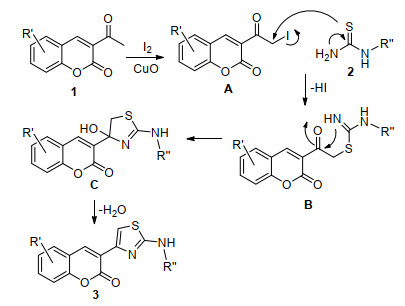
Based on previous report, [30] a proposed mechanism for this reaction is given in Scheme 1. Initially, 3-acetyl-coumarins (1) undergoes the formation of intermediate 3-(2-iodoacetyl)coumarin in the media of I2 and CuO, then, 3-(2-iodoacetyl)coumarins reacted with thiourea giving the corresponding 3-(2-amino-4-thiazolyl) coumarins.
A facile, efficient one-pot synthesis of 3-(2-amino-4-thiazolyl) coumarins from 3-acetylcoumarins and thiourea under the media of I2/CuO in refluxing ethanol was developed. Further application of this methodology for the synthesis of various coumarin-based heterocyclic compounds is under way in our laboratory.
NMR spectra were measured on a VXR 300 instrument. Chemical shifts are reported relative to the internal standard of tetramethylsilane (TMS). IR spectra were obtained as KBr pellet samples on a Nicolet 5700 FTIR spectrometer. Mass spectra were measured on an LCQ Advantage MAX (ESI). The elemental analyses were measured on a Vario EL-III instrument CHNSO elemental analyzer. 3-Acetylcoumarins (1) were synthesized according to literature method.[31] Other reagents were obtained from commercial suppliers and used without further purification.
A mixture of 3-acetylcoumarin (1) (1.0 mmol), iodine (279.2 mg, 1.1 mmol), and CuO (88 mg, 1.1 mmol) in anhydrous ethanol (30 mL) was heated at reflux. After the reaction (1~5 h, monitored by TLC), thiourea (2) (1.0 mmol) was added and the mixture was refluxed for 1 h. After that, the solvent was removed under reduce pressure, and 50 mL of water was added to the residue. The mixture was extracted with EtOAc three times (50 mL×3). The extract was washed with 10% Na2S2O3 and then a small amount of 5% NaOH solution, dried over anhydrous Na2SO4 and concentrated in vacuo. The residue was purified by column chromatography on silica gel using petroleum ether/EtOAc as the eluent to afford the corresponding purified products 3.
3-(2-Aminothiazol-4-yl)-2H-chromen-2-one (3a): Yellow solid; m.p. 224~225 ℃ (lit.[12] 225~227 ℃); 1H NMR (300 MHz, DMSO-d6) δ: 8.51 (s, 1H), 7.83 (d, J=7.4 Hz, 1H), 7.61 (t, J=7.4 Hz, 1H), 7.51 (s, 1H), 7.45~7.35 (m, 2H), 7.15 (br, 2H); 13C NMR (75 MHz, DMSO-d6), δ:167.4, 158.8, 152.2, 143.3, 138.0, 131.4, 128.8, 124.5, 120.5, 119.3, 115.7, 108.6; IR (KBr) νmax: 3388, 1691, 1639, 1531, 1442, 1374, 1091, 751 cm-1; ESI-MS m/z: 244.89 [M+H]+.
3-(2-Aminothiazol-4-yl)-6-methyl-2H-chromen-2-one (3b): Yellow solid, m.p. 235~237 ℃; 1H NMR (300 MHz, CDCl3) δ: 8.39 (s, 1H), 7.70 (s, 1H), 7.18~7.23 (m, 3H), 4.97 (s, 2H, NH2), 2.34 (s, 3H); 13C NMR (75 MHz, CDCl3) δ: 166.2, 151.0, 143.9, 138.8, 134.2, 132.4, 127.9, 120.7, 119.3, 116.5, 116.0, 111.0, 20.8; IR (KBr) νmax: 3395, 1630, 1535, 1378, 1262, 1091, 1024, 805 cm-1; ESIMS m/z: 259.05 [M+H]+. Anal. calcd for C13H10N2O2S: C 60.45, H 3.90, N 10.85; found C 60.32, H 3.79, N 10.71.
3-(2-Aminothiazol-4-yl)-8-methoxy-2H-chromen-2-one (3c): Yellow solid, m.p. 256~258 ℃ (lit.[18] 256~258 ℃); 1H NMR (300 MHz, CDCl3) δ: 8.47 (s, 1H), 7.37~7.51 (m, 1H), 7.30~7.36 (m, 1H), 7.29~7.30 (m, 2H), 7.18 (s, 2H), 3.93 (s, 3H); 13C NMR (75 MHz, CDCl3) δ: 167.4, 158.5, 146.2, 143.2, 138.3, 133.7, 131.6, 124.6, 120.6, 119.9, 113.7, 108.8, 56.0; IR (KBr) νmax: 3452, 2962, 1631, 1391, 1262, 1094, 1026, 804 cm-1; ESI-MS m/z: 274.89 [M+H]+.
3-(2-Aminothiazol-4-yl)-6-chloro-2H-chromen-2-one (3d): Yellow solid, m.p. 204~205 ℃ (lit.[18] 206~208 ℃); 1H NMR (300 MHz, DMSO-d6) δ: 8.45 (s, 1H), 7.98 (d, J=2.4 Hz, 1H), 7.45~7.64 (m, 3H), 7.18 (s, 2H, NH2); 13C NMR (75 MHz, DMSO-d6) δ: 167.9, 158.8, 151.2, 143.5, 137.1, 131.3, 128.9, 128.0, 121.8, 121.2, 118.2, 110.0; IR (KBr) νmax: 3444, 1639, 1372, 1086, 708 cm-1; ESI-MS m/z: 278.84 [M+H]+.
3-(2-Aminothiazol-4-yl)-6-bromo-2H-chromen-2-one (3e): Yellow solid, m.p. 208~209 ℃ (lit.[18] 210~212 ℃); 1H NMR (300 MHz, CDCl3) δ: 8.40 (s, 1H), 7.77~7.79 (s, 1H), 7.67~7.70 (m, 1H), 7.71~7.74 (m, 1H), 7.56~7.59 (m, 1H), 5.08 (s, 2H, NH2); 13C NMR (75 MHz, CDCl3) δ: 166.4, 159.0, 154.1, 151.6, 145.9, 137.1, 133.8, 132.2, 130.3, 118.0, 117.1, 112.0; IR (KBr) νmax: 3422, 1721, 1625, 1541, 1363, 1196, 1094, 823 cm-1; ESI-MS m/z: 323.05 [M+H]+.
3-(2-Aminothiazol-4-yl)-6-nitro-2H-chromen-2-one (3f): Yellow solid, m.p. 181~182 ℃; 1H NMR (300 MHz, DMSO-d6) δ: 8.52 (d, J=2.7 Hz, 1H), 8.18~8.22 (m, 3H), 7.48 (s, 2H), 7.34 (d, J=9.0 Hz, 1H); 13C NMR (75 MHz, DMSO-d6) δ: 169.7, 157.5, 156.8, 148.3, 143.7, 142.6, 126.9, 124.7, 123.5, 118.9, 117.8, 114.5; IR (KBr) νmax: 3426, 1737, 1616, 1526, 1344, 1093, 841 cm-1; ESI-MS m/z: 289.14 [M]+. Anal. calcd for C12H7N3O4S: C 49.83, H 2.44, N 14.53; found C 49.76, H 2.37, N 14.47.
3-(2-Aminothiazol-4-yl)-7-(diethylamino)-2H-chromen-2-one (3g): Yellow solid, m.p. 198~199 ℃ (lit.[32] 199~201 ℃); 1H NMR (300 MHz, CDCl3) δ: 8.37 (s, 1H), 7.59 (s, 1H), 7.27~7.35 (m, 1H), 6.35 (d, J=8.9 Hz, 1H), 6.51 (s, 1H), 5.03 (s, 2H, NH2), 3.42 (q, J=7.2 Hz, 4H, CH2), 1.22 (q, J=7.2 Hz, 6H, CH3); 13C NMR (75 MHz, CDCl3) δ: 166.1, 160.7, 155.7, 150.6, 144.9, 139.6, 129.3, 114.5, 109.2, 109.0, 107.9, 97.1, 44.8, 12.5; IR (KBr) νmax: 3438, 2972, 1704, 1623, 1526, 1410, 1238, 1125, 770 cm-1; ESI-MS m/z: 316.15 [M+H]+.
2-(2-Aminothiazol-4-yl)-3H-benzo[f]chromen-3-one (3h): Yellow solid, m.p. 286~287 ℃ (lit.[18] 287~289 ℃); 1H NMR (300 MHz, CDCl3) δ: 9.33 (s, 1H), 8.44~8.47 (m, 1H), 7.90~7.98 (m, 2H), 7.84 (s, 1H), 7.68~7.73 (m, 1H), 7.47~7.60 (m, 2H), 5.06 (s, 2H); 13C NMR (75 MHz, CDCl3) δ: 162.3, 159.8, 156.2, 153.2, 143.5, 134.7, 132.5, 130.4, 129.5, 128.9, 128.1, 126.0, 122.1, 119.9, 116.6, 111.1; IR (KBr) νmax: 3442, 2972, 1694, 1638, 1526, 1373, 1238, 1086, 786 cm-1; ESI-MS m/z: 259.05 [M+H]+.
3-(2-(Methylamino)thiazol-4-yl)-2H-chromen-2-one (3i): Yellow solid, m.p. 170~171 ℃; 1H NMR (300 MHz, CDCl3) δ: 8.54 (s, 1H), 7.78 (s, 1H), 7.51~7.60 (m, 2H), 7.29~7.36 (m, 2H), 5.24 (s, 1H), 3.05 (d, J=4.8 Hz, 3H); 13C NMR (75 MHz, CDCl3) δ: 169.4, 159.7, 152.8, 144.2, 138.5, 131.1, 128.1, 124.5, 121.1, 119.7, 116.3, 109.4, 32.2; IR (KBr) νmax: 3443, 2127, 1638, 1378, 1084, 471 cm-1; ESI-MS m/z: 259.01 [M+H]+. Anal. calcd for C13H10N2O2S: C 60.45, H 3.90, N 10.85; found C 60.23, H 3.78, N 10.67.
6-Methyl-3-(2-(methylamino)thiazol-4-yl)-2H-chromen-2-one (3j): Yellow solid, m.p. 129~130 ℃; 1H NMR (300 MHz, CDCl3) δ: 8.49 (s, 1H), 7.76 (s, 1H), 7.30~7.37 (m, 3H), 5.33 (s, 1H), 3.06 (d, J=4.5 Hz, 3H), 2.42 (s, 3H); 13C NMR (75 MHz, CDCl3) δ: 169.5, 159.9, 151.0, 143.8, 138.7, 134.1, 132.3, 128.0, 120.6, 119.4, 116.0, 109.0, 32.3, 20.8; IR (KBr) νmax: 3444, 1638, 1086, 476 cm-1; ESI-MS m/z: 273.01 [M+H]+. Anal. calcd for C14H12N2O2S: C 61.75, H 4.44, N 10.29; found C 61.87, H 4.24, N 10.01.
8-Methoxy-3-(2-(methylamino)thiazol-4-yl)-2H-chromen-2-one (3k): Yellow solid, m.p. 178~179 ℃; 1H NMR (300 MHz, CDCl3) δ: 8.50 (s, 1H), 7.77 (s, 1H), 7.14~7.23 (m, 2H), 7.05 (d, J=7.4 Hz, 1H), 5.32 (s, 1H), 3.40 (s, 3H), 3.04 (s, 3H); 13C NMR (75 MHz, CDCl3) δ: 169.5, 159.1, 146.8, 144.2, 142.4, 138.6, 124.2, 121.3, 120.3, 119.7, 113.0, 109.5, 56.2, 32.2; IR (KBr) νmax: 3443, 1721, 1639, 1469, 1269, 1094, 713 cm-1; ESI-MS m/z: 289.09 [M+H]+. Anal. calcd for C14H12N2O3S: C 58.32, H 4.20, N 9.72; found C 58.20, H 4.07, N 9.59.
6-Chloro-3-(2-(methylamino)thiazol-4-yl)-2H-chromen-2-one (3l): Yellow solid, m.p. 172~173 ℃; 1H NMR (300 MHz, CDCl3) δ: 8.45 (s, 1H), 7.78 (s, 1H), 7.55~7.56 (m, 1H), 7.45~7.46 (m, 1H), 7.30~7.43 (m, 1H), 5.19 (s, 1H), 3.06 (d, J=5.0 Hz, 3H); 13C NMR (75 MHz, CDCl3) δ: 169.4, 159.1, 151.1, 143.8, 137.1, 134.3, 130.9, 127.2, 122.0, 120.8, 117.7, 110.2, 32.2; IR (KBr) νmax: 3440, 1732, 1689, 1557, 1470, 1364, 1081, 773 cm-1; ESI-MS m/z: 292.87 [M+H]+. Anal. calcd for C13H9Cl-N2O2S: C 53.34, H 3.10, N 9.57; found C 53.18, H 3.01, N 9.36.
6-Bromo-3-(2-(methylamino)thiazol-4-yl)-2H-chromen-2-one (3m): Yellow solid, m.p. 185~186 ℃; 1H NMR (300 MHz, CDCl3) δ: 8.40~8.45 (d, J=12.8 Hz, 1H), 7.70~7.79 (m, 3H), 7.56~7.59 (m, 1H), 5.15 (s, 1H), 3.06 (d, J=5.0 Hz, 3H); 13C NMR (75 MHz, CDCl3) δ: 169.4, 154.1, 151.6, 145.9, 137.0, 132.2, 130.2, 125.4, 121.4, 118.4, 118.0, 110.3, 32.1; IR (KBr) νmax: 3440, 1722, 1669, 1551, 1476, 1402, 1356, 1201, 1081, 822, 774 cm-1; ESI-MS m/z: 336.99 [M+H]+. Anal. calcd for C13H9BrN2O2S: C 46.31, H 2.69, N 8.31; found C 46.24, H 2.58, N 8.16.
3-(2-(Methylamino)thiazol-4-yl)-6-nitro-2H-chromen-2-one (3n): Yellow solid, m.p. 146~147 ℃; 1H NMR (300 MHz, DMSO-d6) δ: 8.50~8.59 (m, 2H), 8.33~8.37 (m, 1H), 7.79 (s, 1H), 7.44~7.47 (m, 1H), 5.15 (s, 1H), 3.07 (d, J=5.0 Hz, 3H); 13C NMR (75 MHz, DMSO-d6) δ: 169.4, 158.1, 156.0, 144.2, 143.3, 136.6, 125.5, 123.7, 122.9, 119.9, 117.3, 111.1, 32.1; IR (KBr) νmax: 3408, 1742, 1720, 1620, 1583, 1476, 1342, 1213, 1092, 839, 746 cm-1; ESI-MS m/z: 303.00 [M]+. Anal. calcd for C13H9-N3O4S: C 51.48, H 2.99, N 13.85; found C 51.40, H 2.89, N 13.76.
7-Diethylamino-3-(2-(methylamino)thiazol-4-yl)-2H-chromen-2-one (3o): Yellow solid, m.p. 123~124 ℃; 1H NMR (300 MHz, CDCl3) δ: 8.41 (s, 1H), 7.58 (s, 1H), 7.36 (d, 1H), 6.61~6.62 (m, 1H), 6.52~6.59 (m, 1H), 5.21 (s, 1H), 3.42 (q, J=7.1 Hz, 4H), 3.03 (d, J=4.7 Hz, 3H), 1.22 (t, J=7.0 Hz, 6H); 13C NMR (75 MHz, CDCl3) δ: 169.4, 160.8, 155.6, 150.5, 145.1, 139.5, 129.3, 114.6, 109.1, 109.0, 106.1, 97.0, 44.8, 32.2, 12.5; IR (KBr) νmax: 3442, 1712, 1623, 1403, 1235, 1125, 771 cm-1; ESI-MS m/z: 330.13 [M+H]+. Anal. calcd for C17H19N3O2S: C 61.98, H 5.81, N 12.76; found C 61.81, H 5.69, N 12.64.
2-(2-(Methylamino)thiazol-4-yl)-3H-benzo[f]chromen-3-one (3p): Yellow solid, m.p. 200~201 ℃; 1H NMR (300 MHz, CDCl3) δ: 9.35 (s, 1H), 8.43 (d, J=8.4 Hz, 1H), 7.89~7.91 (m, 2H), 7.83 (s, 1H), 7.67~7.72 (m, 1H), 7.47~7.57 (m, 2H), 5.28 (s, 1H), 3.09 (d, 3H, J=4.8 Hz); 13C NMR (75 MHz, CDCl3) δ: 169.6, 159.8, 152.3, 144.8, 134.5, 132.4, 130.4, 129.4, 128.9, 128.0, 126.0, 122.1, 120.2, 116.6, 114.0, 109.3, 32.3; IR (KBr) νmax: 3441, 1632, 1554, 1378, 1086, 810 cm-1; ESI-MS m/z: 309.14 [M+H]+. Anal. calcd for C17H12N2O2S: C 66.22, H 3.92, N 9.08; found C 66.11, H 3.76, N 9.01.
3-(2-(Phenylamino)thiazol-4-yl)-2H-chromen-2-one (3q): Yellow solid, m.p. 187~189 ℃ (lit.[18] 188~190 ℃); 1H NMR (300 MHz, DMSO-d6) δ: 10.36 (s, 1H), 8.70 (s, 1H), 7.97 (d, J=6.9 Hz, 1H), 7.75~7.79 (m, 2H), 7.62~7.67 (m, 1H), 7.36~7.48 (m, 5H), 7.01 (t, J=7.3 Hz, 1H); 13C NMR (75 MHz, DMSO-d6) δ: 162.5, 158.8, 152.3, 143.6, 141.0, 138.6, 131.7, 129.1, 129.0, 124.7, 121.5, 120.3, 119.3, 117.1, 115.9, 109.9; IR (KBr) νmax: 3442, 2921, 1606, 1543, 1087, 740 cm-1; ESI-MS m/z: 321.17 [M+H]+.
6-Methyl-3-(2-(phenylamino)thiazol-4-yl)-2H-chromen-2-one (3r): Yellow solid, m.p. 123~124 ℃; 1H NMR (300 MHz, DMSO-d6) δ: 10.36 (s, 1H), 8.64 (s, 1H), 7.75~7.78 (m, 4H), 7.34~7.44 (m, 4H), 7.01 (t, J=7.32 Hz, 1H), 2.41 (s, 3H, CH3); 13C NMR (75 MHz, DMSO-d6) δ: 162.5, 160.0, 150.5, 143.7, 141.0, 138.6, 134.0, 132.6, 129.1, 128.6, 121.4, 120.2, 119.0, 117.1, 115.6, 109.8, 20.3; IR (KBr) νmax: 3436, 1704, 1604, 1543, 1497, 1440, 1313, 1094, 744 cm-1; ESI-MS m/z: 335.08 [M+ H]+. Anal. calcd for C19H14N2O2S: C 68.24, H 4.22, N 8.38; found C 68.12, H 4.13, N 8.26.
8-Methoxy-3-(2-(phenylamino)thiazol-4-yl)-2H-chromen-2-one (3s): Yellow solid, m.p. 169~170 ℃; 1H NMR (300 MHz, DMSO-d6) δ: 10.36 (s, 1H), 8.66 (s, 1H), 7.74~7.80 (m, 3H), 7.49~7.51 (m, 1H), 7.32~7.41 (m, 4H), 7.00 (t, J=7.3 Hz, 1H), 3.94 (s, 3H, OCH3-H); 13C NMR (75 MHz, DMSO-d6) δ: 162.5, 158.5, 147.3, 146.2, 143.5, 141.6, 140.9, 138.8, 129.1, 124.6, 121.4, 120.4, 119.8, 117.1, 113.8, 110.0, 56.1; IR (KBr) νmax: 3436, 1639, 1266, 1097, 804 cm-1; ESI-MS m/z: 350.99 [M+ H]+. Anal. calcd for C19H14N2O3S: C 65.13, H 4.03, N 7.99; found C 65.01, H 3.97, N 7.81.
6-Chloro-3-(2-(phenylamino)thiazol-4-yl)-2H-chromen-2-one (3t): Yellow solid, m.p. 215~216 ℃ (lit.[18] 215~217 ℃); 1H NMR (300 MHz, DMSO-d6) δ: 10.36 (s, 1H), 8.60 (s, 1H), 8.07~8.15 (m, 2H), 7.67~7.81 (m, 3H), 7.63~7.67 (m, 1H), 7.47~7.51 (m, 1H), 7.39 (d, J=7.8 Hz, 1H), 7.02 (t, J=7.2 Hz, 1H); 13C NMR (75 MHz, DMSO-d6) δ: 162.5, 158.4, 150.9, 143.4, 140.9, 137.3, 133.8, 131.0, 129.1, 128.4, 121.4, 120.8, 119.5, 117.8, 117.1, 110.7; IR (KBr) νmax: 3441, 1721, 1612, 1548, 1076, 745 cm-1; ESI-MS m/z: 354.92 [M+H]+.
6-Bromo-3-(2-(phenylamino)thiazol-4-yl)-2H-chromen-2-one (3u): Yellow solid, m.p. 229~231 ℃ (lit.[18] 229~231 ℃); 1H NMR (300 MHz, DMSO-d6) δ: 10.36 (s, 1H), 8.60 (s, 1H), 8.30 (s, 1H), 7.75~7.81 (m, 3H), 7.36~7.44 (m, 3H), 7.18 (s, 1H), 7.00~7.02 (m, 1H); 13C NMR (75 MHz, DMSO-d6) δ: 162.5, 158.0, 153.6, 145.6, 143.4, 140.9, 137.2, 136.6, 132.5, 129.1, 125.4, 121.4, 120.0, 118.4, 117.1, 116.3; IR (KBr) νmax: 3443, 1717, 1605, 1545, 1094, 741 cm-1; ESI-MS m/z: 398.96 [M+H]+.
6-Nitro-3-(2-(phenylamino)thiazol-4-yl)-2H-chromen-2-one (3v): Yellow solid; m.p. 190~191 ℃; 1H NMR (300 MHz, DMSO-d6) δ: 10.13 (s, 1H), 8.34 (br, 1H), 7.85 (br, 1H), 7.69~7.70 (m, 1H), 7.39~7.44 (m, 3H), 7.26~67.28 (m, 4H); 13C NMR (75 MHz, DMSO-d6) δ: 176.6, 166.9, 138.5, 137.0, 131.6, 131.5, 130.1, 129.7, 129.6, 129.3, 128.6, 126.2, 124.3, 122.4, 114.8, 103.8; IR (KBr) νmax: 3425, 1613, 1526, 1384, 1263, 599 cm-1; ESI-MS m/z: 365.99 [M+H]+. Anal. calcd for C18H11N3O4S: C 59.17, H 3.03, N 11.50; found C 59.10, H 2.96, N 11.42.
7-(Diethylamino)-3-(2-(phenylamino)thiazol-4-yl)-2H-chromen-2-one (3w): Yellow solid, m.p. 198~199 ℃; 1H NMR (300 MHz, DMSO-d6) δ: 10.27 (s, 1H), 8.52 (s, 1H), 7.74 (d, J=10.8 Hz, 2H), 7.66 (d, J=8.8 Hz, 1H), 7.55 (s, 1H), 7.35~7.40 (m, 2H), 6.96~7.01 (m, 1H), 6.75~6.78 (m, 1H), 6.60 (s, 1H), 3.46 (q, J=7.2 Hz, 4H, CH2), 1.45 (t, J=7.2 Hz, 6H, CH3); 13C NMR (75 MHz, DMSO-d6) δ: 162.2, 159.9, 158.3, 155.3, 152.9, 147.6, 144.6, 139.6, 132.4, 129.8, 122.5, 121.2, 116.9, 114.9, 110.1, 107.5, 44.4, 12.3; IR (KBr) νmax: 3438, 1694, 1616, 1508, 1124, 1079, 744 cm-1; ESI-MS m/z: 392.01 [M+H]+. Anal. calcd for C22H21N3O2S: C 67.50, H 5.41, N 10.73; found C 67.43, H 5.28, N 10.61.
2-(2-(Phenylamino)thiazol-4-yl)-3H-benzo[f]chromen-3-one (3x): Yellow solid, m.p. 201~202 ℃; 1H NMR (300 MHz, DMSO-d6) δ: 10.43 (s, 1H), 9.37 (s, 1H), 8.44 (d, J=8.4 Hz, 1H), 8.22 (d, J=9.0 Hz, 1H), 8.11 (d, J=8.1 Hz, 1H), 7.78~7.90 (m, 4H), 7.64~7.71 (m, 2H), 7.45 (t, J=7.8 Hz, 2H), 7.05 (t, J=7.2 Hz, 1H); 13C NMR (75 MHz, DMSO-d6) δ: 162.8, 158.8, 151.9, 143.8, 141.0, 133.9, 133.0, 130.1, 129.2, 129.1, 128.7, 128.6, 126.2, 121.6, 121.5, 119.5, 117.2, 116.5, 113.2, 109.9; IR (KBr) νmax: 3441, 1632, 1554, 1378, 1086, 810, 778 cm-1; ESI-MS m/z: 371.09 [M+H]+.
Spino, C.; Dodier, M. Sotheeswaran, S. Bioorg. Med. Chem. Lett. 1998, 8, 3475. doi: 10.1016/S0960-894X(98)00628-3
Witaicenis, A.; Seito, L. N.; Di Stasi, L. C. Chem. Biol. Interact. 2010, 186, 211. doi: 10.1016/j.cbi.2010.03.045
Arora, R. K.; Kaur, N.; Bansal, Y.; Bansal, G. Acta Pharm. Sin. B 2014, 4, 368. doi: 10.1016/j.apsb.2014.07.001
Basile, A.; Sorbo, S.; Spadaro, V. Molecules 2009, 14, 939. doi: 10.3390/molecules14030939
黄新炜, 刘建利, 有机化学, 2018, 38, 1233. doi: 10.6023/cjoc201708027Huang, X.; Liu, J. Chin. J. Org. Chem. 2018, 38, 1233(in Chinese). doi: 10.6023/cjoc201708027
孙海燕, 孙宏顺, 刘明珍, 黄伟, 杨光富, 有机化学, 2018, 38, 2067. doi: 10.6023/cjoc201801001Sun, H.; Sun, H.; Liu, M.; Huang, W.; Yang, G. Chin. J. Org. Chem. 2018, 38, 2067(in Chinese). doi: 10.6023/cjoc201801001
房智兴, 刘巨艳, 乔艳红, 有机化学, 2018, 38, 1985. doi: 10.6023/cjoc201803019Fang, Z. X.; Liu, J. Y.; Qiao, Y. H. Chin. J. Org. Chem. 2018, 38, 1985(in Chinese). doi: 10.6023/cjoc201803019
Kim, J.; Moon, Y.; Ham, S. W. Bull. Korean Chem. Soc. 2011, 32, 2893. doi: 10.5012/bkcs.2011.32.8.2893
丁成荣, 潘亚运, 殷许, 谭成侠, 有机化学, 2019, 39, 2099. doi: 10.6023/cjoc201812027Ding, C.; Pan, Y.; Yin, X.; Tan, C. Chin. J. Org. Chem. 2019, 39, 2099(in Chinese). doi: 10.6023/cjoc201812027
徐姣, 马玲, 刘秀波, 有机化学, 2018, 38, 1680. doi: 10.6023/cjoc201801016Xu, J.; Ma, L.; Liu, X. B. Chin. J. Org. Chem. 2018, 38, 1680(in Chinese). doi: 10.6023/cjoc201801016
张强健, 王芸芸, 赵雨珣, 马崇慧, 徐徐, 谷文, 杨益琴, 王石发, 有机化学, 2019, 39, 2616. doi: 10.6023/cjoc201901053Zhang, Q.; Wang, Y.; Zhao, Y.; Ma, C.; Xu, X.; Gu, W.; Yang, Y.; Wang, S. Chin. J. Org. Chem. 2019, 39, 2616(in Chinese). doi: 10.6023/cjoc201901053
Koelsch, C. F. J. Am. Chem. Soc. 1950, 72, 2993. doi: 10.1021/ja01163a053
Vardhan, V. A.; Rao, V. R. Indian J. Chem., Sect. B 1997, 36, 1085.
Ramanna, S.; Rao, V. R.; Kumari, T. S.; Rao, T. V. P. Phosphorus Sulfur Relat. Elem. 1995, 107, 197. doi: 10.1080/10426509508027935
Czerney, P.; Hartmann, H. J. Prakt. Chem. 1983, 325, 551. doi: 10.1002/prac.19833250405
Ramagiri, R. K.; Vedula, R. R.; Thupurani, M. K. Phosphorus sulfur Relat. Elem. 2015, 190, 1393. doi: 10.1080/10426507.2014.990016
Zhuravel, I. O.; Kovalenko, S. M.; Vlasov, S. V.; Chernykh, V. P. Molecules 2005, 10, 444. doi: 10.3390/10020444
Ramesh, G.; Janardhan, B.; Rajitha, B. Res. Chem. Intermed. 2015, 41, 8099. doi: 10.1007/s11164-014-1879-z
Chunduru, V. S. R.; Rao, R. V. J. Chem. Res. 2010, 34, 50. doi: 10.3184/030823410X12627991159610
Saeed, A.; Ejaz, S. A.; Shehzad, M.; Hassan, S.; al-Rashida, M.; Lecka, J.; Sévigny, J.; Iqbal, J. RSC Adv. 2016, 6, 21026. doi: 10.1039/C5RA24684A
Hande, P. E.; Samui, A. B.; Kulkarni, P. S. Sens. Actuators, B 2017, 246, 597. doi: 10.1016/j.snb.2017.02.125
Patil, N. T.; Shinde, V. S.; Gajula, B. Org. Biomol. Chem. 2012, 10, 211. doi: 10.1039/C1OB06432K
Fan, L.; Yao, C.; Shu, M. Heterocycl. Commun. 2016, 22, 63.
Jadhvar, S. C.; Kasraliker, H. M.; Goswami, S. V.; Chakrawar, A. V.; Bhusare, S. R. Res. Chem. Intermed. 2017, 43, 7211. doi: 10.1007/s11164-017-3069-2
Jannati, S.; Esmaeili, A. A. Res. Chem. Intermed. 2017, 43, 6817. doi: 10.1007/s11164-017-3022-4
Reddy, K. M. K.; Sadik, S. M.; Saichaithanya, N.; Peddanna, K.; Reddy, N. B.; Sravya, G.; Grigory V, Z.; Reddy, C. S. Res. Chem. Intermed. 2017, 43, 7087. doi: 10.1007/s11164-017-3060-y
Kim, K. M.; Ryu, E. K. Tetrahedron Lett. 1996, 37, 1441. doi: 10.1016/0040-4039(96)00026-3
More, S. V.; Sastry, M. N. V.; Wang, C. C.; Yao, C. F. Tetrahedron Lett. 2005, 46, 6345. doi: 10.1016/j.tetlet.2005.07.026
Behmadi, H.; Roshani, M.; Saadati, S. M. Chin. Chem. Lett. 2009, 20, 5. doi: 10.1016/j.cclet.2008.09.047
Zhu, Y. P.; Yuan, J. J.; Zhao, Q.; Lian, M.; Gao, Q. H.; Liu, M. C.; Yang, Y.; Wu, A. X. Tetrahedron 2012, 68, 173. doi: 10.1016/j.tet.2011.10.074
Bogdal, D. J. Chem. Res., Synop. 1998, 468.
Lin, W.; Cao, X.; Yuan, L. Ding, Y. Chem. Eur. J. 2010, 16, 6454. doi: 10.1002/chem.201000244
Table 1. Effect of solvent, temperature and molar ratio of n(1a)/n(2a)/n(CuO)/n(I2) on the yield of 3a
| Entry | Solvent | t/℃ | n(1a):n(2a):n(CuO):n(I2) | Yielda/% |
| 1 | EtOH | 78 | 1.0:1.0:1.0:1.0 | 85 |
| 2 | MeOH | 65 | 1.0:1.0:1.0:1.0 | 82 |
| 3 | PrOH | 97 | 1.0:1.0:1.0:1.0 | 78 |
| 4 | BuOH | 118 | 1.0:1.0:1.0:1.0 | 72 |
| 5 | t-BuOH | 83 | 1.0:1.0:1.0:1.0 | 0b |
| 6 | MeCN | 82 | 1.0:1.0:1.0:1.0 | 0b |
| 7 | THF | 66 | 1.0:1.0:1.0:1.0 | 0b |
| 8 | Toluene | 111 | 1.0:1.0:1.0:1.0 | 0b |
| 9 | DMF | 90 | 1.0:1.0:1.0:1.0 | 0b |
| 10 | EtOH | 78 | 1.0:1.0:1.1:1.1 | 88 |
| 11 | EtOH | 78 | 1.0:1.0:1.5:1.5 | 86 |
| 12 | EtOH | 78 | 1.0:1.1:1.1:1.1 | 87 |
| 13 | EtOH | 65 | 1.0:1.0:1.1:1.1 | 75 |
| a Isolated yield. b No reaction. | ||||
 下载: 导出CSV
Table 2. Synthesis of 3 from 3-acetylcoumarins and thiourea
| Compd. | R1 | R2 | R3 | R4 | R5 | Yielda/% |
| 3a | H | H | H | H | H | 88 |
| 3b | H | Me | H | H | H | 82 |
| 3c | H | H | H | OMe | H | 89 |
| 3d | H | Cl | H | H | H | 85 |
| 3e | H | Br | H | H | H | 83 |
| 3f | H | NO2 | H | H | H | 81 |
| 3g | H | H | NEt2 | H | H | 80 |
| 3h | Benzo | H | H | H | 82 | |
| 3i | H | H | H | H | Me | 84 |
| 3g | H | Me | H | H | Me | 76 |
| 3k | H | H | H | OMe | Me | 85 |
| 3l | H | Cl | H | H | Me | 82 |
| 3m | H | Br | H | H | Me | 79 |
| 3n | H | NO2 | H | H | Me | 74 |
| 3o | H | H | NEt2 | H | Me | 75 |
| 3p | Benzo | H | H | Me | 77 | |
| 3q | H | H | H | H | Ph | 66 |
| 3r | H | Me | H | H | Ph | 63 |
| 3s | H | H | H | OMe | Ph | 68 |
| 3t | H | Cl | H | H | Ph | 65 |
| 3u | H | Br | H | H | Ph | 62 |
| 3v | H | NO2 | H | H | Ph | 58 |
| 3w | H | H | NEt2 | H | Ph | 60 |
| 3x | Benzo | H | H | Ph | 63 | |
| a Isolated yield. | ||||||
下载: 导出CSV

 扫一扫看文章


扫一扫关注我们



 下载:
下载: