

Figure 1.
The authors' design philosophy.


Planar-chiral cyclophanes are a class of stereogenic macrocycles in which chirality arises from a bridging chain (ansa bridge) that does not flip freely due to steric constraint within the aromatic framework. These stereogenic macrocycles have garnered significant interest due to their distinct properties and diverse applications. Unlike traditional central or axial chirality, their chirality originates from the molecule's overall planar configuration, which in turn endows them with distinctive chiroptical properties. In the field of asymmetric synthesis of planar-chiral cyclophanes, classical approaches mainly relied on the desymmetrization of symmetric cyclophane scaffolds or the (dynamic) kinetic resolution of racemic cyclophanes. Such as, [2,2]paracyclophanes serving as the representative have be widely studied model substrate due to its distinctive strained structure [1,2]. Early pioneering studies provided the key foundation for the efficient synthesis of planar-chiral cyclophanes. For example, in 2003, Zhu and co-workers reported the first example of atropenantioselective cycloetherification [3]. Although the atropenantioselectivity was only moderate, this finding established the groundwork for subsequent investigations. In 2024, Zhao and co-workers disclosed a chiral Rh(Ⅲ)-catalyzed atropselective intramolecular macrocyclization starting from anilides and internal alkynes [4]. Despite these remarkable advances, the efficiency of macrocyclization is frequently compromised by the entropic penalty incurred during the folding of linear precursors, as well as competing intermolecular side reactions. Additionally, there are some challenges to achieve precise enantioselective control owing to the conformational flexibility of linear substrates and the susceptibility of macrocycles to racemization [5].
To overcome these issues, the recent work from Shi's group represents a significant breakthrough in the enantioselective synthesis of planar-chiral cyclophanes using a cobalt(Ⅲ)/Salox catalytic system [6]. Inspired by the chirality of octahedral cobalt(Ⅲ) complexes, which arises from chiral ligand coordination above and below the metal plane, the authors hypothesized that chiral octahedral Co(Ⅲ) complexe could act as a template to preorganize linear precursors into cyclization-active conformation via coordination-driven assembly. Meanwhile, these complexes could modulate facial selectivity through steric hindrance, thereby lowering the entropic barrier and furnishing excellent enantioselectivity, as detailed in Fig. 1.
Initially, using the linear precursor 1a bearing a 7-methylquinolin-8-amine (MQ, as the directing group) and a terminal phenylacetylene moiety as the substrate, the 15-membered cyclic product 2a was obtained in 72% yield with 98% ee under the catalysis of Co(OAc)2·4H2O/(S)-L6, and its Rp configuration was confirmed by X-ray crystallography. Based on their previous research, a plausible reaction mechanism was proposed, as detailed in Scheme 1A. Herein, the stabilization of the folded conformation of the INT-Co-1 relied on two distinct π-π interactions: from the oxazolinylphenyl moiety of the Salox ligand with the quinoline ring of the MQ directing group, and ethynylphenyl group with the quinoline ring. The defining merit of this synthetic strategy lies in its precise regulation of the folding pathway of linear substrates; notably, the spatial arrangement and axial orientation of the chain govern facial selectivity in the ring closure event.
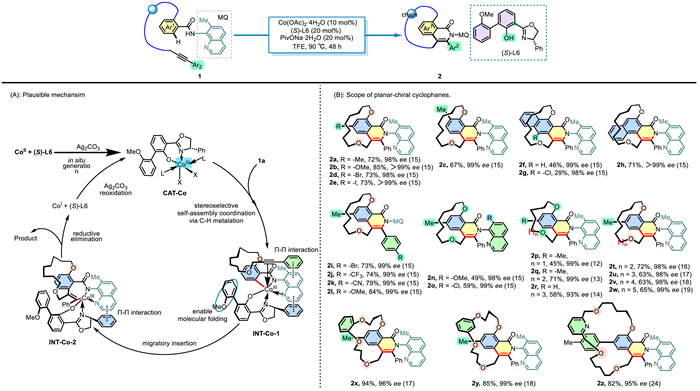
Subsequently, the linear substrates featuring electron-withdrawing or electron-donating substituents on the benzene ring of benzamides, varied terminal alkyne substituents, quinoline-based directing groups and a range of ring sizes were investigated. The corresponding cyclophanes were afforded with good yields and excellent enantioselectivities (2b-2z, 29%–85%, 93% to > 99% ee). Notably, this reaction was compatible with substrates with chain topologies as well as pyridine moiety (2x-2z) as detailed in Scheme 1B. Furthermore, the authors successfully synthesized planar chiral crown ethers under the standard conditions, such as, the 21-crown-7 and a gram-scale synthesis was successfully achieved. In subsequent transformations, the authors observed that varying the electrophilic reagent could significantly tune the stereocontrol.
Finally, optical properties of the planar-chiral cyclophanes, including ultraviolet-visible (UV–vis) absorption, fluorescence emission, electronic circular dichroism (ECD), circularly polarized luminescence (CPL), and photoluminescence quantum yield (PLQY), were evaluated. These results demonstrate that these planar-chiral cyclophanes exhibit remarkable chiroptical activity and efficient luminescence properties, evidencing their great potential for utilization in chiral photonics and optoelectronic devices.
In conclusion, Shi's group has successfully utilized the chiral assembly principles of octahedral Co(Ⅲ) complexes for macrocyclization reactions: The coordination-driven preorganization strategy concurrently mitigates both ring-strain and stereoselectivity challenges, thereby establishing a general protocol for the efficient synthesis of planar chiral cyclophanes. Studies on the optical properties of the products demonstrate their great promise for deployment in chiral optics and supramolecular devices. While this work represents a significant advance, the exploration of novel and efficient de novo strategies toward diverse planar-chiral macrocycles continues to be attractive, albeit challenging.
The authors declare that they have no known competing financial interests or personal relationships that could have appeared to influence the work reported in this paper.
Chaoyu Wang: Writing – original draft. Xiuling Cui: Conceptualization, Writing – review & editing.
Z. Hassan, E. Spuling, D.M. Knoll, J. Lahann, S. Bräse, Chem. Soc. Rev. 47 (2018) 6947–6963. doi: 10.1039/C7CS00803A
C.Y. Wang, H. Zhang, L.T. Chen, et al., SynOpen 9 (2025) 302–314. doi: 10.1055/a-2747-8835
G. Islas-Gonzalez, M. Bois-Choussy, J.P. Zhu, Org. Biomol. Chem. 1 (2003) 30–32. doi: 10.1039/b208905j
H.X. Zhai, K. Lv, J.Y. Li, et al., J. Am. Chem. Soc. 146 (2024) 29214–29223. doi: 10.1021/jacs.4c11873
V. Martí-Centelles, M.D. Pandey, M.I. Burguete, S.V. Luis, Chem. Rev. 115 (2015) 8736–8834. doi: 10.1021/acs.chemrev.5b00056
B.J. Wang, T.Y. Jiang, Y.L. Jiang, et al., J. Am. Chem. Soc. 147 (2025) 45785–45792. doi: 10.1021/jacs.5c18900

 扫一扫看文章


扫一扫关注我们
 DownLoad:

 下载:
下载:

 下载:
下载: