
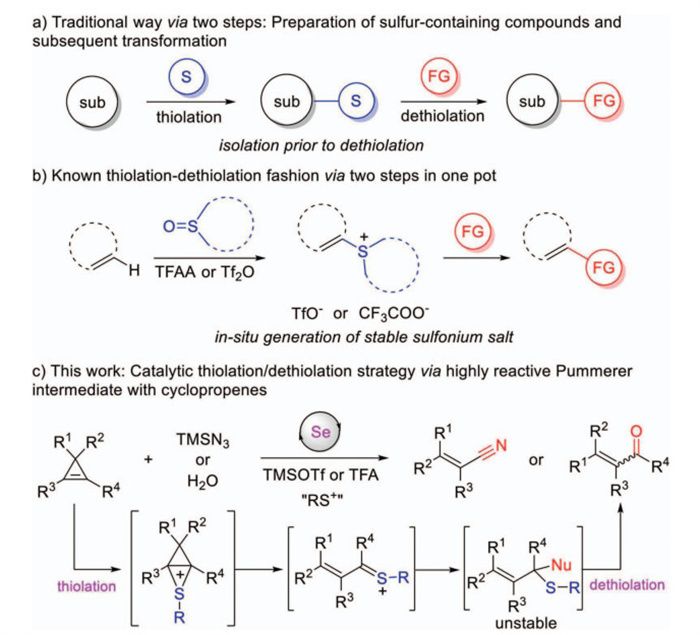
Scheme 1.
Strategies for constructing compounds through thiolation and dethiolation.


Due to the atomic radius, electronegativity, and the characteristics of the valence electrons of sulfur, sulfur-based organic compounds can exist in various valence states and possess unique properties. For instance, they exhibit biological activity [1,2] and can serve as drugs [3,4] or catalysts [5,6], facilitating chemical reactions that are otherwise difficult to achieve. They can also act as important precursors or intermediates in the construction of valuable compounds [7]. When organosulfur compounds are used as precursors or intermediates, they can be transformed into sulfur-free compounds through transition metal catalysis [8–11], photochemical or electrochemical processes [12–14], or by oxidizing the sulfur center followed by the elimination of sulfur-containing structural units [15–19]. Consequently, they find extensive applications in organic synthetic chemistry. Traditionally, when utilizing organic sulfur compounds to construct sulfur-free molecules, the organosulfur compounds are first synthesized and isolated, and then the sulfur-containing groups are eliminated to yield the target products (Scheme 1a) [20–29]. This pathway requires multiple steps and the isolation of sulfur-containing intermediates. Another approach involves generating stable sulfonium salt intermediates, which can be converted into the target products in a one-pot, two-step process without the need for isolation (Scheme 1b) [30–32]. Due to the step economy in synthesis, this fashion has garnered increasing attention in recent years [33–35]. For example, Procter and other groups have developed methods by using sulfoxide as a mediating reagent to accomplish the regioselective functionalization of C―H bonds [36–44]. Although both methods have achieved significant progress, they both require the formation of stable sulfur-containing intermediates to facilitate subsequent isolation and transformation. An important research question is whether unstable sulfur-containing intermediates formed during reactions can also undergo in-situ dethiolation to construct valuable target molecules.
Our research group has been focusing on the electrophilic reactions of alkenes, particularly catalytic electrophilic thiolation [45–48]. We are eager to challenge the transformation of in-situ thiolation to construct unstable intermediates, which are then dethiolated to form valuable target molecules. We noticed that the smallest cyclic alkene, cyclopropene, is more reactive than ordinary alkene and can undergo ring-opening through various pathways to transform into different compounds [49–68]. We hypothesize that when cyclopropenes react with electrophilic sulfur reagents, a highly reactive Pummerer intermediate might be formed, which, upon nucleophilic attack, may desulfurize to form valuable target compounds. Herein, we report our discovery that the hypothesis is feasible. A catalytic thiolation/dethiolation strategy enables the ring-opening transformation of cyclopropenes, efficiently synthesizing stereo-specific α,β-unsaturated nitriles and carbonyl compounds (Scheme 1c). Notably, this work serves as a valuable addition to the field of organic sulfur chemistry, and offers a new pathway for the conversion of cyclopropenes.
Alkenyl nitriles are an important class of reactants in organic synthesis [69,70], and their structural units exist in pharmaceutical molecules and natural products [71,72]. Their synthesis is a desirable task for synthetic chemists, and became our goal. Consequently, we initiated the synthesis of alkenyl nitriles by the reaction of 3-methyl-3-phenylcyclopropene (1a) with azidotrimethylsilane (TMSN3, 2) in the presence of electrophilic sulfur reagents (Table 1). To our delight, when the reaction was carried out using PhSePh (10 mol%) as catalyst, TMSOTf as Lewis acid, and N-(p-tolylthio)succinimide (3a, 1.5 equiv.) as electrophilic sulfur reagent in CH2Cl2 at -20 ℃, the desired product 4a was formed in excellent yield in a stereo-specific fashion (entry 1). Using less amounts of electrophilic reagent 3a, the reactions gave the products in lower yields (entries 2 and 3). Increasing the amount of 3a was not helpful to achieve higher yield (entry 4). Other electrophilic sulfur reagents were effective for this transformation, but did not give better results (entries 5–7). The reaction temperature is important for this transformation. Higher or lower reaction temperature lead to lower yields of the products (entries 8 and 9). Futhermore, the product was generated in only 53% yield in the absence of PhSePh catalyst, which indicated an important role of the Lewis basic chalcogenide catalyst (entry 10). The reaction did not occur without sulfur reagent or acid (entries 11 and 12). It is noted that the azidothiolated cyclopropane product by the direct difunctionalization on the double bond of 1a was not observed in the reaction.
 DownLoad:
CSV
 |
|||||||||||||||||||||||||||||||||||||||||||||||
| Entry | 3 (equiv.) | Temp. (℃) | Yield of 4a (%)b | ||||||||||||||||||||||||||||||||||||||||||||
| 1 | 3a (1.5) | -20 | 87 (83) | ||||||||||||||||||||||||||||||||||||||||||||
| 2 | 3a (1.0) | -20 | 69 | ||||||||||||||||||||||||||||||||||||||||||||
| 3 | 3a (0.5) | -20 | 40 | ||||||||||||||||||||||||||||||||||||||||||||
| 4 | 3a (2.0) | -20 | 83 | ||||||||||||||||||||||||||||||||||||||||||||
| 5 | 3b (1.5) | -20 | 85 | ||||||||||||||||||||||||||||||||||||||||||||
| 6 | 3c (1.5) | -20 | 55 | ||||||||||||||||||||||||||||||||||||||||||||
| 7 | 3d (1.5) | -20 | 73 | ||||||||||||||||||||||||||||||||||||||||||||
| 8 | 3a (1.5) | 0 | 60 | ||||||||||||||||||||||||||||||||||||||||||||
| 9 | 3a (1.5) | -40 | 65 | ||||||||||||||||||||||||||||||||||||||||||||
| 10c | 3a (1.5) | -20 | 53 | ||||||||||||||||||||||||||||||||||||||||||||
| 11d | – | -20 | 0 | ||||||||||||||||||||||||||||||||||||||||||||
| 12e | 3a (1.5) | -20 | 0 | ||||||||||||||||||||||||||||||||||||||||||||
| a Reaction conditions: 1a (0.1 mmol), TMSN3 (2, 4.0 equiv.), PhSePh (10 mol%), CH2Cl2 (2 mL), 20 h. b Refers to NMR yield with CH2Br2 as the internal standard; yield of isolated product is in parentheses. c No PhSePh. d No electrophilic sulfur reagents. e No TMSOTf and other acids. |
|||||||||||||||||||||||||||||||||||||||||||||||
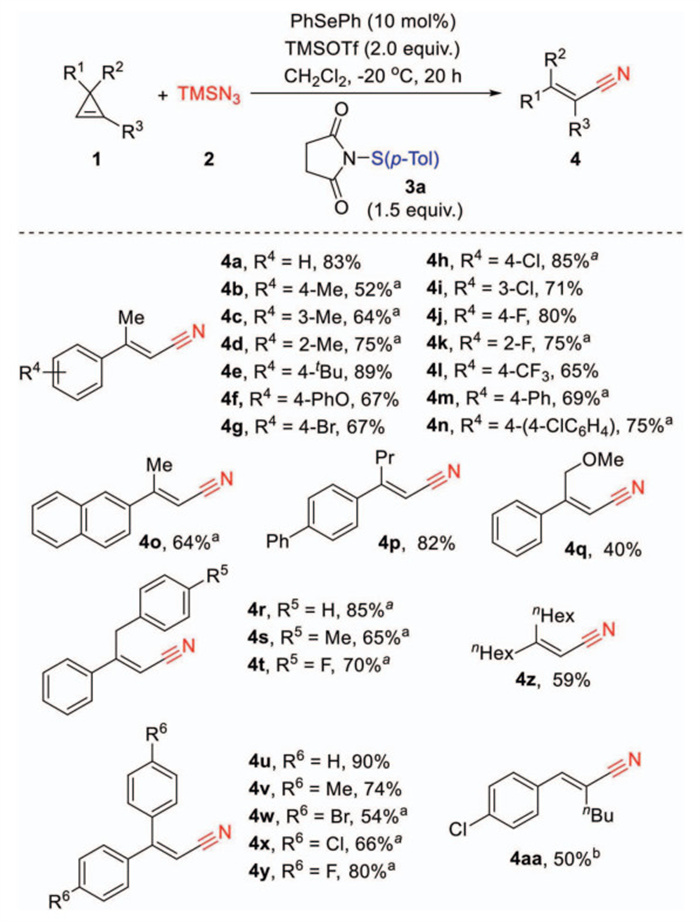
With the optimized reaction conditions established, the generality of the protocol was investigated using a diverse range of cyclopropenes (Scheme 2). When electron-donating substituents, i.e., methyl, tert-butyl, and phenoxy, were introduced onto the phenyl ring of the cyclopropenes, the reactions proceeded smoothly, affording the desired products in satisfactory yields (4c–4f, 64%–89%). Notably, the presence of a 4-methyl group on the aryl ring of the substrate led to a somewhat reduced reaction efficiency, yielding 4b in 52% yield. Cyclopropenes bearing aryl rings substituted with electron-withdrawing groups (chloro, bromo, fluoro, and trifluoromethyl) also effectively furnished the desired products 4g–4l in yields ranging from 65% to 85%. Biphenyl- and naphthyl-substituted cyclopropenes underwent analogous reactions, generating 4m–4o in yields of 64%–75%. When a cyclopropene with an n-propyl substituent was employed in place of the methyl group, the corresponding product 4p could be obtained in 82% yield. Using a cyclopropene bearing a methyloxymethyl group, the desired product 4q was still generated in moderate yield. 3-Benzyl-3-phenylcyclopropenes also performed well in the reaction, providing the desired products 4r–4t in good yields (65%–85%). The 3, 3-diarylcyclopropenes exhibited favorable reactivities, and their reactions efficiently produced the desired products 4u–4y. 3, 3-Dialkylcyclopropene gave product 4z in 59% yield. Pleasingly, 1-butyl-3-arylcyclopropene also underwent a similar reaction, affording the corresponding product 4aa in 50% yield when Tf2NH was used as the acid instead of TMSOTf. It is worth highlighting that all of the alkenyl nitrile products obtained from this transformation displayed complete E/Z-selectivity (> 20:1).
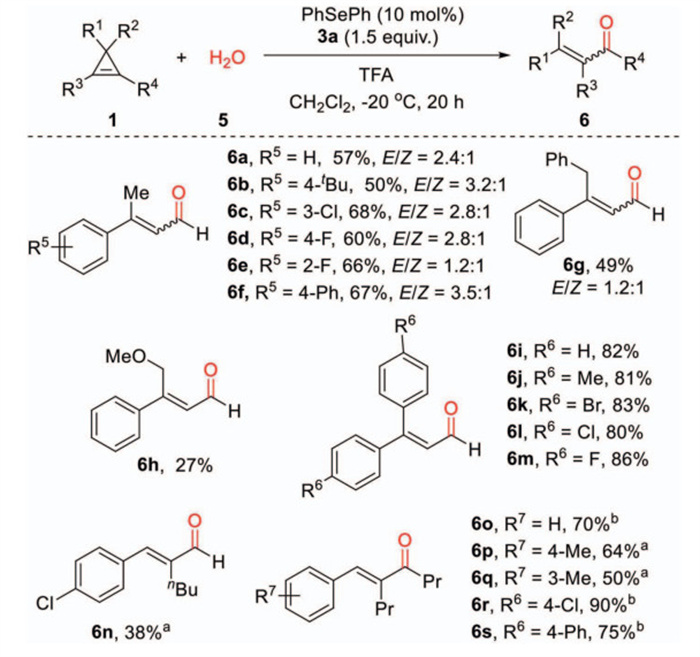
Encouraged by the success of the reaction of cyclopropenes with TMSN3, we wondered whether other nucleophiles would be suitable for this thiolation/dethiolation method. To explore this possibility, cyclopropenes were treated with H2O as the nucleophile in the presence of the electrophilic sulfur reagent 3a and PhSePh catalyst. Interestingly, the valuable α,β-unsaturated aldehyde products could be obtained as E/Z isomers (Scheme 3). It was found that using 15.0 equiv. of TFA as the acid could promote the reaction most effectively. Cyclopropenes containing either electron-donating or electron-withdrawing groups at the para, meta, or ortho position of the aryl group all furnished the desired products 6a–6f in good yields (50%–68%). When the methyl substituent was replaced with a benzyl substituent, the product was also formed in 49% yield. However, when a methyloxymethyl group was used instead, the reaction yielded the (Z)-product 6h as the major isomer, albeit in a lower yield of 27%, along with a small amount of the (E)-isomer. 3, 3-Diarylcyclopropenes displayed excellent reactivities, yielding β-diaryl substituted α,β-unsaturated aldehydes 6i–6m in 80%–86%. In the presence of 2.0 equiv. of TfOH as the acid, 1-butyl-3-arylcyclopropene could undergo the reaction to afford α-butyl α,β-unsaturated aldehyde 6n in a relatively low yield (38%). 1, 2-Dipropyl-3-arylcyclopropanes are also suitable substrates for the transformation. With 2.0 equiv. of TfOH as the acid at -20 ℃ or 2.0 equiv. of Tf2NH as the acid at -40 ℃, substrates containing either electron-donating (e.g., Me) or electron-withdrawing (e.g., Cl) groups on the aromatic group underwent reactions with H2O, producing α-propyl-α,β-unsaturated ketones 6o–6s in 50%–90% yields. For the products 6n–6s, almost (E)-configuration products were achieved.
To further investigate the generality of this method, sulfonamides were employed as nucleophiles in an attempt to generate the corresponding products. However, when 1a reacted with benzenesulfonamide, the desired products were not obtained. It was found that when 1-butyl-3-(4-chlorobenzene)cyclopropene (1y) was used in combination with Tf2NH as the acid, the N-indenylsulfonamide product 8a was obtained with a yield of 44%. When 4-methylphenyl and 4-methoxyphenyl sulfonamides were used in place of benzenesulfonamide, the reactions still proceeded successfully (Eq. 1). Indene derivatives are an important class of structural motifs present in numerous biologically active compounds, functional materials, and useful catalysts [73–75]. Although the scope of substrates was restricted, these results demonstrated the potential generality of this method and provided an alternative pathway to indenamine derivatives.
|
|
(1) |
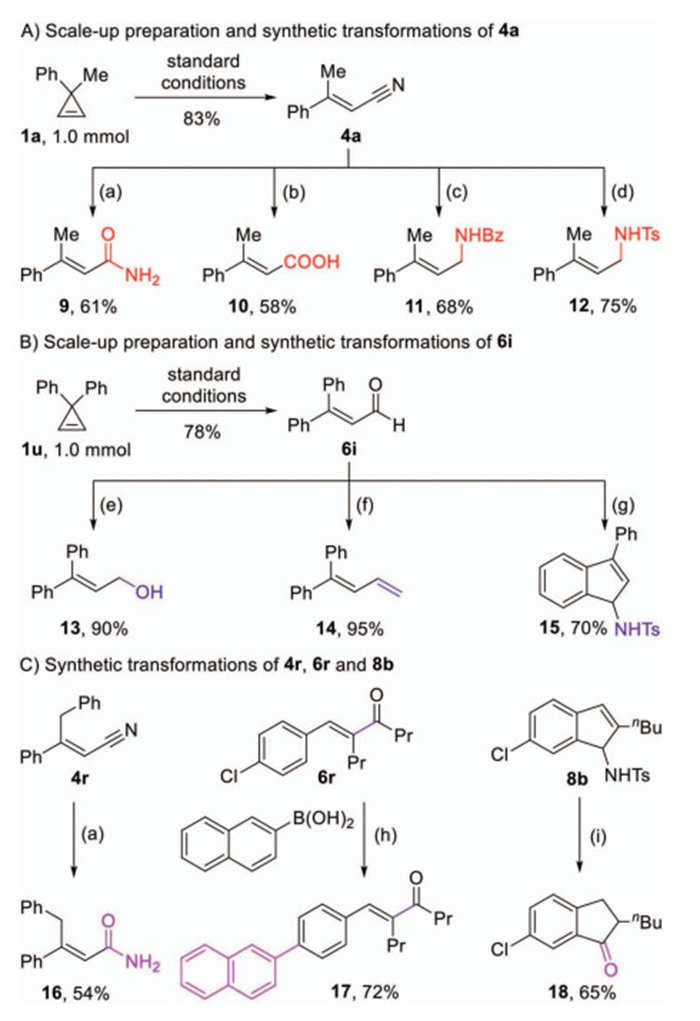
To elucidate the synthetic utility of the developed method, scale-up reactions and further transformations of the products were carried out (Scheme 4). Under the established conditions, the reaction of cyclopropene 1a with TMSN3 and the reaction of 1u with H2O could be successfully performed on a 1.0 mmol scale without significant yield loss. Subsequently, the derivatizations of the resulting alkenyl nitrile 4a were evaluated. Reaction of 4a with H2O2 smoothly furnished alkenyl amide 9 in a 61% yield. Through the hydrolysis of the nitrile group, 4a could be converted to alkenyl carboxylic acid 10 in a 58% yield. Reduction of 4a with LiAlH4 led to an allylic amine, which then reacted with benzoyl chloride and tosyl chloride to afford N-allylic amide 11 and N-allylic sulfonamide 12, respectively (Scheme 4A). These are important reactants [76–79]. Transformations of α,β-unsaturated aldehyde 6i were also conducted. Reduction of 6i with NaBH4 gave allylic alcohol 13 in a 90% yield. A Wittig reaction of 6i produced the olefination product 14 in an excellent yield. In the presence of polyphosphoric acid, 6i reacted smoothly with TsNH2 to afford the N-indenylsulfonamide product 15 in a 70% yield (Scheme 4B). In addition, the derivatizations of 4r, 6r, and 8b were carried out. 4r could also be transformed into the corresponding alkenyl amide 16, and the (E)-configuration of 16 was determined by X-ray crystallographic single-crystal structure analysis. Therefore, the alkenyl nitrile product 4r bearing a Ph and a benzyl group was confirmed to have an (E)-configuration. Moreover, by employing a Pd-catalyzed Suzuki coupling reaction, the 2-naphthyl group could be converted into a chloro-substituted ketone 6r, and the product 17 containing a large conjugated system was obtained in a 72% yield. The molecular structures of the α,β-unsaturated ketone products were further confirmed by the X-ray single-crystal structural determination of 17. Treatment of indenylsulfonamide 8b with SmI2, pyrrolidine, and H2O in THF produced indanone 18 in a 65% yield (Scheme 4C). These transformations demonstrated that the resulting products have good convertibility and great potential in synthetic utility.
On the basis of the result in Table 1, the reactions did not take place in the absence of an electrophilic sulfur reagent. The result clearly demonstrated that the sulfur reagent played a crucial role and participated in the reaction to give reactive intermediate. To trap the possible intermediate, cyclopropene 1n was prepared to react in the presence of Et3SiH as the nucleophilic hydride source (Scheme 5a). To our delight, the thiochromane product 20 was formed in a 50% yield. Based on the previous studies [80], a plausible pathway for the formation of 20 can be proposed. First, the electrophilic sulfur reagent 3a is activated by the catalyst PhSePh to form adduct Ⅱ via transition state Ⅰ with the assistance of TMSOTf [81,82]. Then, the reaction of Ⅱ with cyclopropene 1n generates the bicyclic thiiranium ion intermediate Ⅲ [63]. This bicyclic structure, which contains two bridged cyclopropanes, is unstable. It may undergo a concerted process involving C-C bond cleavage, C-S bond cleavage, double bond formation, and sulfur-stabilized allylic cation generation to form the vinylogous thionium ion intermediate Ⅳ. This vinylogous Pummerer-type intermediate plays a pivotal role in the transformation. The hydride reduction of Ⅳ at the α-position gives the allylic sulfide Ⅴ, which then undergoes a 6-membered Friedel-Crafts type reaction to afford the thiochromane product 20.
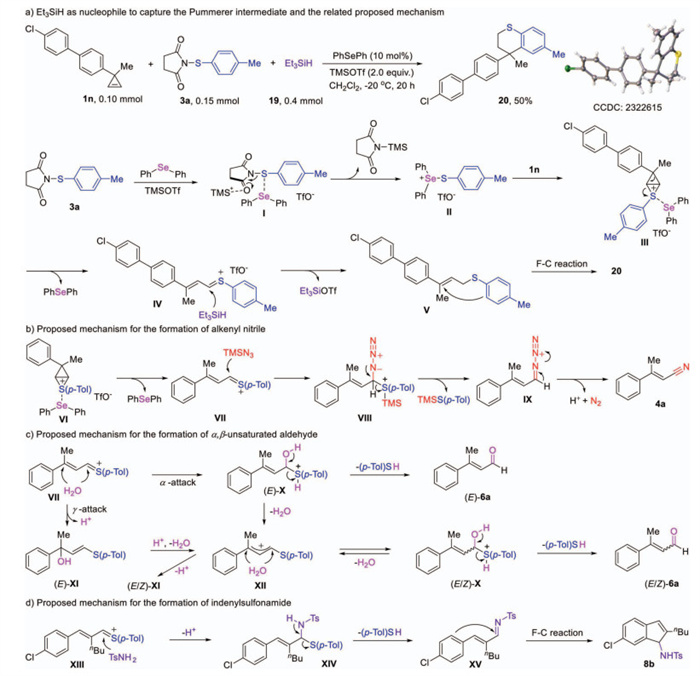
Based on experimental observations and literature reports regarding the construction of nitrile compounds using azide as a nitrogen source [83–87], a possible mechanism for the formation of alkenyl nitrile is depicted in Scheme 5b. As shown in Scheme 5b, the vinylogous Pummerer intermediate Ⅶ is generated from the reaction of cyclopropene 1a and the electrophilic sulfur reagent 3a, with the assistance of the PhSePh catalyst and TMSOTf. Notably, the nucleophilic attack of TMSN3 towards the α-position of Ⅶ leads to azido sulfide Ⅷ [88–90]. The elimination of intermediate Ⅷ gives rise to the carbocation species Ⅸ and TMSS(p-Tol). Finally, the carbocation Ⅸ undergoes a Schmidt-type rearrangement, resulting in product 4a upon the loss of nitrogen and H⁺. It is important to note that the configuration of intermediate Ⅶ is the thermodynamically stable (E)-type, and the (E)-configuration of the C=C double bond is retained in the further transformation. Therefore, the configuration of the alkenyl nitrile product remains in the (E)-type. When H2O serves as the nucleophile in the reaction, intermediate Ⅶ is attacked by H2O at either the α or γ position, leading to O, S-acetal (E)-X and allylic alcohol (E)-XI. This proposal is consistent with the literature reports on the use of O-nucleophiles in the vinylogous Pummerer reaction [91,92]. Additionally, both (E)- and (Z)-type α,β-unsaturated aldehyde products are obtained in the reaction. The elimination of intermediate O, S-acetal (E)-X produces (E)-product 6a after the loss of p-toluenethiol. On the other hand, (E)-X and (E)-XI are prone to generate allylic sulfide XII through a dehydration process under acidic conditions. Meanwhile, allylic sulfide XII can be hydrolyzed to form (E/Z)-X and (E/Z)-XI. The hydrolysis of XII and the dehydration of X and XI are reversible. It is highly likely that this reversible process leads to the formation of both (E)- and (Z)-type O, S-acetal X isomers. The elimination of (E/Z)-X upon the loss of p-toluenethiol leads to (E/Z)-α,β-unsaturated aldehyde 6a (Scheme 5c). 1, 2-Dipropyl-3-arylcyclopropanes react with H2O in a similar fashion to yield the α,β-unsaturated ketones. For the reaction of 1-butyl-3-(4-chlorobenzene)cyclopropane (1y) with TsNH2 (7b), the corresponding intermediate XIII is first formed. Then, TsNH2 nucleophilically attacks the α-position of intermediate XIII to generate N, S-acetal XIV. The elimination of p-toluenethiol from XIV produces α,β-unsaturated sulfonimide XV. Finally, an intramolecular Friedel-Crafts reaction of sulfonimide XV occurs to afford the indenylsulfonamide product 8b (Scheme 5d).
In summary, we have developed an efficient catalytic thiolation/dethiolation method for the ring-opening transformation of cyclopropenes. The reaction proceeds via the generation of reactive Pummerer intermediates through the electrophilic thiolation of cyclopropenes. In the presence of nucleophiles such as TMSN3, H2O, and arylsulfonamides, subsequent dethiolation Pummerer fragmentations take place to yield a wide variety of valuable products, including α,β-unsaturated nitriles, carbonyl compounds, and indenamines. The obtained products can be readily converted into other valuable functional molecules. Control experiments have indicated that the vinylogous thionium ion is the key intermediate in this transformation. Further investigations into new vinylogous Pummerer reactions are currently underway in our laboratory.
Quanbin Jiang: Writing – original draft, Validation, Methodology, Investigation, Formal analysis, Data curation. Hui Jiao: Validation, Methodology, Investigation. Long Jiang: Validation, Formal analysis, Data curation. Xiaodan Zhao: Writing – review & editing, Supervision, Project administration, Funding acquisition, Data curation, Conceptualization.
The authors declare that they have no known competing financial interests or personal relationships that could have appeared to influence the work reported in this paper.
We are grateful to the National Natural Science Foundation of China (Nos. 21901261, 22371308, and 22171292) and Guangdong Basic Research Center of Excellence for Functional Molecular Engineering for the financial support. The authors are grateful to Instrument Analysis & Research Center, Sun Yat-sen University for the single-crystal X-ray structure analysis.
Supplementary material associated with this article can be found, in the online version, at doi:
C.S. Jiang, W.E.G. Müller, H.C. Schröder, et al., Chem. Rev. 112 (2012) 2179-2207. doi: 10.1021/cr200173z
P. Devendar, G.F. Yang, Top. Curr. Chem. 375 (2017) 82. doi: 10.1007/s41061-017-0169-9
E.A. Ilardi, E. Vitaku, J.T. Njardarson, J. Med. Chem. 57 (2014) 2832-2842. doi: 10.1021/jm401375q
M. Feng, B. Tang, S.H. Liang, et al., Curr. Top. Med. Chem. 16 (2016) 1200-1216. doi: 10.2174/1568026615666150915111741
S. Otocka, M. Kwiatkowska, L. Madalińska, et al., Chem. Rev. 117 (2017) 4147-4181. doi: 10.1021/acs.chemrev.6b00517
G. Sekar, V.V. Naira, J. Zhu, Chem. Soc. Rev. 53 (2024) 586-605. doi: 10.1039/d3cs00503h
C. Chatgilialoglu, K.D. Asmus, Sulfur-centered reactive intermediates in chemistry and biology, Springer Verlag, New York, 1991.
S.G. Modha, V.P. Mehtazb, E.V. Van der Eycken, Chem. Soc. Rev. 42 (2013) 5042-5055. doi: 10.1039/c3cs60041f
F. Pan, Z.J. Shi, ACS Catal. 4 (2014) 280-288. doi: 10.1021/cs400985m
J. Lou, Q. Wang, P. Wu, et al., Chem. Soc. Rev. 49 (2020) 4307-4359. doi: 10.1039/c9cs00837c
R. Fan, C. Tan, Y.G. Liu, et al., Chin. Chem. Lett. 32 (2021) 299-312. doi: 10.1016/j.cclet.2020.06.003
Á. Péter, G.J.P. Perry, D.J. Procter, Adv. Synth. Catal. 362 (2020) 2135-2142. doi: 10.1002/adsc.202000220
Z. Jin, T. Yu, H. Wang, et al., Org. Chem. Front. 11 (2024) 6573-6588. doi: 10.1039/d4qo01644k
X. Zeng, Chem. Eur. J. 30 (2024) e202402220. doi: 10.1002/chem.202402220
L.H.S. Smith, S.C. Coote, H.F. Sneddon, et al., Angew. Chem. Int. Ed. 49 (2010) 5832-5844. doi: 10.1002/anie.201000517
I. Colomer, M. Velado, R.F. de la Pradilla, et al., Chem. Rev. 117 (2017) 14201-14243. doi: 10.1021/acs.chemrev.7b00428
D. Kaiser, I. Klose, R. Oost, et al., Chem. Rev. 119 (2019) 8701-8780. doi: 10.1021/acs.chemrev.9b00111
C.A.D. Caiuby, L.G. Furniel, A.C.B. Burtoloso, Chem. Sci. 13 (2022) 1192-1209. doi: 10.1039/d1sc05708a
M. Nambo, Y. Maekawa, C.M. Crudden, ACS Catal. 12 (2022) 3013-3032. doi: 10.1021/acscatal.1c05608
P. Chauhan, S. Mahajan, D. Enders, Chem. Rev. 114 (2014) 8807-8864. doi: 10.1021/cr500235v
C. Shen, P. Zhang, Q. Sun, et al., Chem. Soc. Rev. 44 (2015) 291-314. doi: 10.1039/C4CS00239C
K.L. Dunbar, D.H. Scharf, A. Litomska, et al., Chem. Rev. 117 (2017) 5521-5577. doi: 10.1021/acs.chemrev.6b00697
Y. Lv, H. Cui, N. Meng, et al., Chin. Chem. Lett. 33 (2022) 97-114. doi: 10.1117/12.2642676
D. Yang, Q. Yan, E. Zhu, et al., Chin. Chem. Lett. 33 (2022) 1798-1816. doi: 10.1016/j.cclet.2021.09.068
S. Huang, M. Wang, X. Jiang, Chem. Soc. Rev. 51 (2022) 8351-8377. doi: 10.1039/d2cs00553k
I.P. Beletskaya, V.P. Ananikov, Chem. Rev. 122 (2022) 16110-16293. doi: 10.1021/acs.chemrev.1c00836
R.F. Cao, Z.M. Chen, Sci. China Chem. 66 (2023) 3331-3346. doi: 10.1007/s11426-023-1811-1
P. Song, W. Rao, T. Chivers, et al., Org. Chem. Front. 10 (2023) 3378-3400. doi: 10.1039/d3qo00496a
L. Bai, X. Jiang, CCS Chem. 7 (2025) 1889-1902. doi: 10.31635/ccschem.025.202505568
S.I. Kozhushkov, M. Alcarazo, Eur. J. Inorg. Chem. 2020 (2020) 2486-2500. doi: 10.1002/ejic.202000249
H. Meng, M.S. Liu, W. Shu, Chem. Sci. 13 (2022) 13690-13707. doi: 10.1039/d2sc04507a
X. Wu, P. Gao, F. Chen, Eur. J. Org. Chem. 26 (2023) e202300864. doi: 10.1002/ejoc.202300864
L. van Dalsen, R.E. Brown, J.A. Rossi-Ashton, et al., Angew. Chem. Int. Ed. 62 (2023) e202303104. doi: 10.1002/anie.202303104
S. Timmann, Z. Feng, M. Alcarazo, Chem. Eur. J. 30 (2024) e202402768. doi: 10.1002/chem.202402768
M.J. Kim, K. Targos, D.E. Holst, et al., Angew. Chem. Int. Ed. 63 (2024) e202314904. doi: 10.1002/anie.202314904
M.H. Aukland, F.J.T. Talbot, J.A. Fernández-Salas, et al., Angew. Chem. Int. Ed. 57 (2018) 9785-9789. doi: 10.1002/anie.201805396
F. Berger, E.M. Alvarez, N. Frank, et al., Org. Lett. 22 (2020) 5671-5674. doi: 10.1021/acs.orglett.0c02067
Y. Wu, Y.H. Huang, X.Y. Chen, et al., Org. Lett. 22 (2020) 6657-6661. doi: 10.1021/acs.orglett.0c02458
D.E. Holst, D.J. Wang, M.J. Kim, et al., Nature 596 (2021) 74-79. doi: 10.1038/s41586-021-03717-7
Y.L. Zhang, G.H. Wang, Y. Wu, et al., Org. Lett. 23 (2021) 8522-8526. doi: 10.1021/acs.orglett.1c03229
A. Dewanji, L. van Dalsen, J.A. Rossi-Ashton, et al., Nature Chem. 15 (2023) 43-52. doi: 10.1038/s41557-022-01092-y
H. Xu, X. Li, J. Ma, et al., Chin. Chem. Lett. 34 (2023) 108403. doi: 10.1016/j.cclet.2023.108403
M.J. Kim, D.J. Wang, K. Targos, et al., Angew. Chem. Int. Ed. 62 (2023) e202303032. doi: 10.1002/anie.202303032
S. Wang, J. h. Shi, S. Xu, et al., Chin. Chem. Lett. 37 (2026) 111225. doi: 10.1016/j.cclet.2025.111225
Q. Jiang, X. Zhao, Chin. J. Org. Chem. 41 (2021) 443-454. doi: 10.6023/cjoc202010005
L. Liao, X. Zhao, Acc. Chem. Res. 55 (2022) 2439-2453. doi: 10.1021/acs.accounts.2c00201
A. Matviitsuk, J.L. Panger, S.E. Denmark, Angew. Chem. Int. Ed. 59 (2020) 19796-19819. doi: 10.1002/anie.202005920
Y.F. Wei, W.C. Gao, H.H. Chang, et al., Org. Chem. Front. 9 (2022) 6684-6707. doi: 10.1039/d2qo01447e
Z.B. Zhu, Y. Wei, M. Shi, Chem. Soc. Rev. 40 (2011) 5534-5563. doi: 10.1039/c1cs15074j
A. Archambeau, F. Miege, C. Meyer, et al., Acc. Chem. Res. 48 (2015) 1021-1031. doi: 10.1021/acs.accounts.5b00016
L. Dian, I. Marek, Chem. Rev. 118 (2018) 8415-8434. doi: 10.1021/acs.chemrev.8b00304
R. Vicente, Chem. Rev. 121 (2021) 162-226. doi: 10.1021/acs.chemrev.0c00151
D.Y. Li, W.Q. Zang, M.J. Bird, et al., Chem. Rev. 121 (2021) 8685–8755. doi: 10.1021/acs.chemrev.0c00624
C. Li, Y. Zeng, H. Zhang, et al., Angew. Chem. Int. Ed. 49 (2010) 6413-6417. doi: 10.1002/anie.201002673
Z. Li, J. Zhao, B. Sun, et al., J. Am. Chem. Soc. 139 (2017) 11702-11705. doi: 10.1021/jacs.7b06523
H.L. Teng, Y. Luo, M. Nishiura, et al., J. Am. Chem. Soc. 139 (2017) 16506-16509. doi: 10.1021/jacs.7b10786
X. Wang, A. Lerchen, C.G. Daniliuc, et al., Angew. Chem. Int. Ed. 57 (2018) 1712-1716. doi: 10.1002/anie.201712019
B. Muriel, J. Waser, Angew. Chem. Int. Ed. 60 (2021) 4075-4079. doi: 10.1002/anie.202013516
S. Nie, A. Lu, E.L. Kuker, et al., J. Am. Chem. Soc. 143 (2021) 6176-6184. doi: 10.1021/jacs.1c00939
R.B. Hu, S. Qiang, Y.Y. Chan, et al., Org. Lett. 23 (2021) 9533-9537. doi: 10.1021/acs.orglett.1c03751
M. Zhang, H. Li, J. Zhao, et al., Chem. Sci. 12 (2021) 11805-11809. doi: 10.1039/d1sc02930d
M.Y. Huang, Y.T. Zhao, C.D. Zhang, et al., Angew. Chem. Int. Ed. 61 (2022) e202203343. doi: 10.1002/anie.202203343
B. Liu, L. Wang, Y. Qin, et al., Org. Lett. 24 (2022) 5693-5697. doi: 10.1021/acs.orglett.2c02072
X. Tang, K. Liu, Z. Qu, et al., Chin. Chem. Lett. 33 (2022) 2982-2986. doi: 10.1016/j.cclet.2022.02.031
M.Y. Huang, J.B. Zhao, C.D. Zhang, et al., J. Am. Chem. Soc. 146 (2024) 9871-9879. doi: 10.1021/jacs.3c14766
W. Gao, L. Zhang, C. Zhao, et al., Chin. Chem. Lett. 35 (2024) 109447. doi: 10.1016/j.cclet.2023.109447
H. Zhu, X. Yang, Y. Liu, et al., Angew. Chem. Int. Ed. 64 (2025) e202423746. doi: 10.1002/anie.202423746
M. Wang, Y. Zhang, S. Liu, et al., Chin. Chem. Lett. 36 (2025) 110758. doi: 10.1016/j.cclet.2024.110758
F.F. Fleming, Q. Wang, Chem. Rev. 103 (2003) 2035-2078. doi: 10.1021/cr020045d
Y. Nakao, Chem. Rev. 121 (2021) 327-344. doi: 10.1021/acs.chemrev.0c00301
F.F. Fleming, Nat. Prod. Rep. 16 (1999) 597-606. doi: 10.1039/a804370a
F.F. Fleming, L. Yao, P.C. Ravikumar, et al., J. Med. Chem. 53 (2010) 7902-7917. doi: 10.1021/jm100762r
A.C. Grimsdale, K. Müllen, Angew. Chem. Int. Ed. 44 (2005) 5592-5629. doi: 10.1002/anie.200500805
B. Wang, Coord. Chem. Rev. 250 (2006) 242-258. doi: 10.1016/j.ccr.2005.05.012
J.W. Blunt, B.R. Copp, R.A. Keyzers, et al., Nat. Prod. Rep. 32 (2015) 116-211. doi: 10.1039/C4NP00144C
A. Jaganathan, A. Garzan, D.C. Whitehead, et al., Angew. Chem. Int. Ed. 50 (2011) 2593-2596. doi: 10.1002/anie.201006910
B. Soltanzadeh, A. Jaganathan, Y. Yi, et al., J. Am. Chem. Soc. 139 (2017) 2132-2135. doi: 10.1021/jacs.6b09203
T. Niwa, K. Nishibashi, H. Sato, et al., J. Am. Chem. Soc. 143 (2021) 16599-16609. doi: 10.1021/jacs.1c06783
L. Liao, X. Xu, J. Ji, et al., J. Am. Chem. Soc. 144 (2022) 16490-16501. doi: 10.1021/jacs.2c05668
Y. Liang, H. Jiao, H. Zhang, et al., Org. Lett. 24 (2022) 7210-7215. doi: 10.1021/acs.orglett.2c03009
Q. Wang, T. Nilsson, L. Eriksson, et al., Angew. Chem. Int. Ed. 61 (2022) e202210509. doi: 10.1002/anie.202210509
W.J. Wei, K.J. Szabo, F. Himo, Org. Chem. Front. 12 (2025) 2994-3003. doi: 10.1039/d4qo02170c
T. Wang, N. Jiao, Acc. Chem. Res. 47 (2014) 1137-1145. doi: 10.1021/ar400259e
W. Zhou, J. Xu, L. Zhang, et al., Org. Lett. 12 (2010) 2888-2891. doi: 10.1021/ol101094u
B.V. Rokade, S.K. Malekar, K.R. Prabhu, Chem. Commun. 48 (2012) 5506-5508. doi: 10.1039/c2cc31256e
X. Huang, N. Jiao, Org. Biomol. Chem. 12 (2014) 4324-4328. doi: 10.1039/c4ob00888j
Z. Cheng, K. Huang, C. Wang, et al., Science 387 (2025) 1083-1090. doi: 10.1126/science.adq8918
K. Shimada, Y. Kikuta, H. Koganebuchi, et al., Tetrahedron Lett. 41 (2000) 4637-4640. doi: 10.1016/S0040-4039(00)00681-X
T. Shen, X. Huang, Y.F. Liang, et al., Org. Lett. 17 (2015) 6186-6189. doi: 10.1021/acs.orglett.5b03179
K. Ishihara, T. Shioiri, M. Matsugi, Tetrahedron Lett. 58 (2017) 3932-3935. doi: 10.1016/j.tetlet.2017.08.065
Y. Shimizu, S.L. Shi, H. Usuda, et al., Tetrahedron 66 (2010) 6569-6584. doi: 10.1016/j.tet.2010.05.086
T. Nishimura, A.K. Unni, S. Yokoshima, et al., J. Am. Chem. Soc. 133 (2011) 418-419. doi: 10.1021/ja109516f

Scheme 2 The reactions of cyclopropenes with TMSN3 for the synthesis of alkenyl nitriles. Conditions: 1 (0.1 mmol), 2 (0.4 mmol), 3a (0.15 mmol), PhSePh (0.01 mmol), TMSOTf (0.2 mmol), CH2Cl2 (2 mL), -20 ℃, 20 h. a TMSOTf (3.0 equiv.). b Tf2NH (2.0 equiv).

Scheme 3 The reactions of cyclopropenes with H2O for the synthesis of α,β-unsaturated aldehydes and ketones. Conditions: 1 (0.2 mmol), 5 (0.8 mmol), 3a (0.3 mmol), PhSePh (0.02 mmol), TFA (15.0 equiv.), CH2Cl2 (4 mL), -20 ℃, 20 h. a 1 (0.1 mmol), 5 (0.4 mmol), 3a (0.15 mmol), PhSePh (0.01 mmol), TfOH (2.0 equiv.), CH2Cl2 (2 mL), -20 ℃, 20 h. b 1 (0.1 mmol), 5 (0.4 mmol), 3a (0.15 mmol), PhSePh (0.01 mmol), Tf2NH (2.0 equiv.), CH2Cl2 (2 mL), -40 ℃, 20 h.

Scheme 4 Scale-up preparation and synthetic transformations of the products. Conditions: (a) H2O2, K2CO3, DMSO, air, r.t., 12 h. (b) KOH, EtOH/H2O, reflux, 20 h; then HCl. (c) LiAlH4, Et2O, 0 ℃-r.t., 2.5 h; then BzCl, Et3N, CH2Cl2, 0 ℃-r.t., 12 h. (d) LiAlH4, Et2O, 0 ℃-r.t., 2.5 h; then TsCl, Et3N, CH2Cl2, 0 ℃-r.t., 4 h. (e) NaBH4, MeOH, 0 ℃, 2 h. (f) PPh3CH3Br, tBuOK, THF, r.t., 12 h. (g) TsNH2, PPA, toluene, 80 ℃, 16 h. (h) Pd(OAc)2, SPhos, K3PO4, toluene, 100 ℃, 10 h. (i) SmI2, pyrrolidine, H2O, THF, r.t., 0.5 h.
Table 1. Screening of reaction conditions.a
|
|||||||||||||||||||||||||||||||||||||||||||||||
| Entry | 3 (equiv.) | Temp. (℃) | Yield of 4a (%)b | ||||||||||||||||||||||||||||||||||||||||||||
| 1 | 3a (1.5) | -20 | 87 (83) | ||||||||||||||||||||||||||||||||||||||||||||
| 2 | 3a (1.0) | -20 | 69 | ||||||||||||||||||||||||||||||||||||||||||||
| 3 | 3a (0.5) | -20 | 40 | ||||||||||||||||||||||||||||||||||||||||||||
| 4 | 3a (2.0) | -20 | 83 | ||||||||||||||||||||||||||||||||||||||||||||
| 5 | 3b (1.5) | -20 | 85 | ||||||||||||||||||||||||||||||||||||||||||||
| 6 | 3c (1.5) | -20 | 55 | ||||||||||||||||||||||||||||||||||||||||||||
| 7 | 3d (1.5) | -20 | 73 | ||||||||||||||||||||||||||||||||||||||||||||
| 8 | 3a (1.5) | 0 | 60 | ||||||||||||||||||||||||||||||||||||||||||||
| 9 | 3a (1.5) | -40 | 65 | ||||||||||||||||||||||||||||||||||||||||||||
| 10c | 3a (1.5) | -20 | 53 | ||||||||||||||||||||||||||||||||||||||||||||
| 11d | – | -20 | 0 | ||||||||||||||||||||||||||||||||||||||||||||
| 12e | 3a (1.5) | -20 | 0 | ||||||||||||||||||||||||||||||||||||||||||||
| a Reaction conditions: 1a (0.1 mmol), TMSN3 (2, 4.0 equiv.), PhSePh (10 mol%), CH2Cl2 (2 mL), 20 h. b Refers to NMR yield with CH2Br2 as the internal standard; yield of isolated product is in parentheses. c No PhSePh. d No electrophilic sulfur reagents. e No TMSOTf and other acids. |
|||||||||||||||||||||||||||||||||||||||||||||||
 下载: 导出CSV

 扫一扫看文章


扫一扫关注我们


 下载: