

图1 试样TG (A) 和DTG (B) 曲线图
Figure 1. TG (A) and DTG (B) curves of samples


木塑复合材料(WPC) 的主要原料-植物纤维和塑料的易燃性,在很大程度上限制了产品的应用范围。因此,赋予WPC的阻燃性能越来越受到重视。目前,国内外解决PP基WPC易燃性的最主要方法是添加膨胀型阻燃剂[1-3]。其中以聚磷酸铵(APP) 为酸源和季戊四醇(PER) 为碳源构成的膨胀型阻燃剂(IFRs) 应用最为广泛[4-6]。但与卤素类阻燃剂相比,IFRs的阻燃效率低,添加量大,影响WPC的机械性能。阻燃协效剂被认为是解决这一问题最有效的途径之一[7]。大量研究表明,膨胀石墨(EG)[8]、二氧化硅(SiO2)[9]、金属氧化物[10-12]、有机蒙脱土(OMMT)[13]、硼酸锌(ZB)[14]、硅灰石(Wollastonite)[15]等为IFRs的有效阻燃协效剂。但很少有文献[16-17]研究这些阻燃协效剂共同使用时对IFRs阻燃效率的影响。本文通过正交试验研究8种阻燃协效剂EG、ZB、ZnO、CaO、MgO、OMMT、SiO2和Wollastonite对在PP阻燃中应用广泛、效果良好的膨胀型阻燃剂(IFRs, m(APP):m(PER)=2:1) 的阻燃增效影响,筛选出具有显著协效阻燃作用的协效剂组。通过热重分析和锥形量热分析评价IFRs及协效剂组对WPC热稳定性能和阻燃性能的影响。
基体树脂PPH-T03型聚丙烯(PP,中国石化上海石油化工有限公司),工业级,熔体流动速率为3.0 g/10 min (230 ℃/2.16 kg),等规指数96%;黄杨木粉(wood flour, WF)(福建省闽侯华峰材料有限公司),粒径50 μm、250~425 μm两种;相容剂聚丙烯接枝马来酸酐(PP-g-MAH/St),实验室自制,接枝率2.5%;聚磷酸铵(APP),工业级,长沙江龙化工科技有限公司;季戊四醇(PER),化学纯,启东市名成化工有限公司;可膨胀石墨(EG),工业级,青岛恒胜石墨有限公司;SiO2,工业级,杭州万景新材料有限公司;MgO,化学纯,宜兴阿拉丁化工贸易有限公司;ZnO,化学纯,上海埃彼化学试剂有限公司;CaO,化学纯,上海展云化工有限公司;有机蒙脱土(OMMT),工业级,灵寿县燕国矿产品加工厂;硼酸锌(ZB),工业级,上海瀚思化工有限公司;硅灰石(Wollastonite),工业级,海城信诺西尔矿业有限公司。
TE-34型双螺杆混炼挤出机(南京科亚挤出机有限公司);JN55-E型注射成型机(震雄塑料机械有限公司);SHR-25A型高速混合机(张家港轻工机械有限公司);HC-2型氧指数测定仪(江宁县分析仪器厂);X (S) K-180型双辊开放式炼胶机(上海双翼橡塑机械有限公司);YX-25(O) 型半自动压力成型机(上海西玛伟力橡塑机械有限公司);HC-2型氧指数测定仪(南京江宁分析仪器厂) 用于测定材料的氧指数;CZF-3型水平垂直燃烧测定仪(南京江宁分析仪器厂) 用于测定材料的线性燃烧速率;TGA/SDTA851e型热重分析仪(瑞士Mettler-Toledo公司) 用于热失重分析,N2气气氛下进行,N2流量为50 mL/min,升温速率为10 ℃/min;JCZ-2型锥形量热仪(南京市江宁区分析仪器厂) 用于材料的锥形量热分析,热辐照功率为35 kW/m2。
WPC的组成为m(PP):m(木粉):m(PP-g-MAH/St)=100:40:6。膨胀型阻燃剂IFRs的组成为m(APP):m(PER)=2:1,用量为0.365 g/g PP。第一次正交试验采用50 μm木粉,第二次正交试验采用250~425 μm木粉。取计量的、105 ℃下干燥2 h的WF、PP、PP-g-MAH/St、IFRs及协效剂,在高速混合机中室温混合10 min,混合物用双螺杆挤出机造粒,加料口到口模的温度分别为150、189、185、190、195、200和195 ℃,螺杆转速为30 r/min。取部分挤出粒料于注射成型机中制备极限氧指数和线性燃烧速率测试样条,注射机料筒至口模的温度依次为165、180和190 ℃。同时取剩余的挤出粒料于170 ℃的双辊开炼机中打片,然后于180 ℃的半自动压力成型机中压制锥形量热测试样块,样块尺寸为100 mm×100 mm×2 mm。
WPC、WPC/IFRs和WPC/IFRs/MgO/EG/SiO2在N2气氛中的热失重曲线见图 1A,从它们的DTG曲线(见图 1B) 中获得各阶段的最大失重速率对应温度见表 9。从图表中可见,它们均呈两段失重过程。
图1 试样TG (A) 和DTG (B) 曲线图
Figure 1. TG (A) and DTG (B) curves of samples
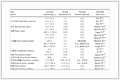 表9
TGA和DTG数据
Table9.
Data of TGA and DTG
表9
TGA和DTG数据
Table9.
Data of TGA and DTG
| Sample | Tmax1/℃ | Tmax2/℃ | Char yield at 600 ℃/% |
| WPC | 342 | 465 | 7.51 |
| WPC/IFRs | 300 | 472 | 17.36 |
| WPC/IFRs/MgO/EG/SiO2 | 281 | 498 | 22.42 |
| Tmax1:the maximum decomposition temperature for the first period; Tmax2:the maximum decomposition temperature for the second period. | |||
WPC第一失重阶段主要归因于木粉中半纤维素的降解和脱水,其最大失重温度为342 ℃;第二失重阶段在367~490 ℃之间,是由PP降解而引起,其最大分解速率对应温度为465 ℃。高于490 ℃时,WPC基本分解完全,600 ℃时残炭率为7.51%。
采用IFRs阻燃的WPC-WPC/IFRs第一失重阶段的起始分解温度降低,温区变窄,失重增加,最大失重温度提前到300 ℃。这是因为IFRs的加入促使木粉提前分解而炭化。WPC/IFRs第二失重阶段的起始降解温度低于WPC,失重温区变宽,最大分解速率对应温度(472 ℃) 推后,失重减少,600 ℃时的残炭率提高至17.36%。这说明IFRs的加入减缓了PP的降解,有利于阻燃。
添加MgO/EG/SiO2后,WPC/IFRs/MgO/EG/SiO2第一失重阶段的最大失重温度进一步提前到281 ℃,第二失重阶段的温区也进一步变宽,失重减少,600 ℃时的残炭率提高至22.42%。这说明协效剂组和IFRs的协同作用进一步减缓了PP的降解。
EG能吸附APP的降解产物,增强炭层结合力[8];ZB为低熔点玻璃体,可将块状炭之间的缝隙封闭起来,提高炭层的阻隔效果[14];金属氧化物可与APP发生脱氨脱水的交联反应,形成桥键,增加膨胀炭层稳定性[10];OMMT可与APP反应,生成硅铝磷酸盐及类似陶瓷结构的物质,提高炭层强度[13];SiO2耐热性好,可提高膨胀炭层的牢固程度[9];硅灰石可催化IFRs中酸源和碳源发生酯化反应,提高炭层的致密程度和强度[15]。故确定EG、ZB、ZnO、CaO、MgO、OMMT、SiO2和硅灰石为研究对象。上述文献中这些协效剂在整个材料中的质量分数占比一般为1%~5%,故确定这8个因素的两个水平分别为0.49%和0.98%,换算为0.009和0.018 g/g PP。初步判断EG和ZB、EG和ZnO、CaO和MgO可能存在交互作用,因此,选正交表L16(215) 来考察8种协效剂对IFRs的阻燃增效作用。正交试验的因素水平设计表见表 1,正交试验的因素安排及结果(以极限氧指数和线性燃烧速率为考察指标) 见表 2,极差分析和方差分析分别见表 3和表 4。正交试验表中未安排因素的空列可用于考察实验误差。
表1
第一轮正交试验的因素水平表
Table1.
The factor levels table of orthogonal experiment for the first round
| Factors | Levels | |
| 1/(g·g-1 PP) | 2/(g·g-1 PP) | |
| EG | 0.009 | 0.018 |
| ZB | 0.009 | 0.018 |
| ZnO | 0.009 | 0.018 |
| CaO | 0.009 | 0.018 |
| MgO | 0.009 | 0.018 |
| OMMT | 0.009 | 0.018 |
| SiO2 | 0.009 | 0.018 |
| Wollastonite | 0.009 | 0.018 |
表2
第一轮正交试验结果与极差分析
Table2.
The design and results of orthogonal experiment for the first round
| Samplecode | EG | ZB | EG×ZB | ZnO | EG×ZnO | OMMT | CaO | MgO | SiO2 | Wollastonite | CaO×MgO | Linear burning rate/(mm·min-1) | Limitedoxygen index/% | ||||
| 1 | 1 | 1 | 1 | 1 | 1 | 1 | 1 | 1 | 1 | 1 | 1 | 1 | 1 | 1 | 1 | 21.3 | 22.6 |
| 2 | 1 | 1 | 1 | 1 | 1 | 1 | 1 | 2 | 2 | 2 | 2 | 2 | 2 | 2 | 2 | 21.2 | 22.4 |
| 3 | 1 | 1 | 1 | 2 | 2 | 2 | 2 | 1 | 1 | 1 | 1 | 2 | 2 | 2 | 2 | 19.9 | 22.9 |
| 4 | 1 | 1 | 1 | 2 | 2 | 2 | 2 | 2 | 2 | 2 | 2 | 1 | 1 | 1 | 1 | 20.2 | 22.7 |
| 5 | 1 | 2 | 2 | 1 | 1 | 2 | 2 | 1 | 1 | 2 | 2 | 1 | 1 | 2 | 2 | 19.3 | 22.5 |
| 6 | 1 | 2 | 2 | 1 | 1 | 2 | 2 | 2 | 2 | 1 | 1 | 2 | 2 | 1 | 1 | 18.6 | 22.3 |
| 7 | 1 | 2 | 2 | 2 | 2 | 1 | 1 | 1 | 1 | 2 | 2 | 2 | 2 | 1 | 1 | 20.4 | 22.6 |
| 8 | 1 | 2 | 2 | 2 | 2 | 1 | 1 | 2 | 2 | 1 | 1 | 1 | 1 | 2 | 2 | 20.4 | 22.5 |
| 9 | 2 | 1 | 2 | 1 | 2 | 1 | 2 | 1 | 2 | 1 | 2 | 1 | 2 | 1 | 2 | 18.9 | 22.4 |
| 10 | 2 | 1 | 2 | 1 | 2 | 1 | 2 | 2 | 1 | 2 | 1 | 2 | 1 | 2 | 1 | 21.0 | 22.8 |
| 11 | 2 | 1 | 2 | 2 | 1 | 2 | 1 | 1 | 2 | 1 | 2 | 2 | 1 | 2 | 1 | 18.3 | 23.5 |
| 12 | 2 | 1 | 2 | 2 | 1 | 2 | 1 | 2 | 1 | 2 | 1 | 1 | 2 | 1 | 2 | 19.4 | 22.2 |
| 13 | 2 | 2 | 1 | 1 | 2 | 2 | 1 | 1 | 2 | 2 | 1 | 1 | 2 | 2 | 1 | 17.8 | 22.9 |
| 14 | 2 | 2 | 1 | 1 | 2 | 2 | 1 | 2 | 1 | 1 | 2 | 2 | 1 | 1 | 2 | 19.9 | 22.8 |
| 15 | 2 | 2 | 1 | 2 | 1 | 1 | 2 | 1 | 2 | 2 | 1 | 2 | 1 | 1 | 2 | 17.4 | 22.6 |
| 16 | 2 | 2 | 1 | 2 | 1 | 1 | 2 | 2 | 1 | 1 | 2 | 1 | 2 | 2 | 1 | 19.8 | 21.9 |
表3
第一轮正交试验的极差分析表
Table3.
The range analysis table of orthogonal experiment for the first round
| Index | Range analysis | EG | ZB | ZnO | CaO | MgO | OMMT | SiO2 | Wollastonite |
| Linear burning rate/(mm·min-1) | k1 | 20.2 | 20.0 | 19.8 | 19.8 | 19.2 | 20.1 | 20.1 | 19.6 |
| k2 | 19.1 | 19.2 | 19.5 | 19.4 | 20.1 | 19.2 | 19.1 | 19.9 | |
| R(Range value) | 1.1 | 0.8 | 0.3 | 0.4 | 0.9 | 0.9 | 1.0 | 0.3 | |
| Limited oxygen index/% | k1 | 22.6 | 22.7 | 22.6 | 22.7 | 22.7 | 22.5 | 22.6 | 22.6 |
| k2 | 22.6 | 22.5 | 22.6 | 22.5 | 22.5 | 22.7 | 22.7 | 22.6 | |
| R(Range value) | 0.0 | 0.2 | 0.0 | 0.2 | 0.2 | 0.2 | 0.1 | 0.0 |
表4
第一轮正交试验的方差分析表
Table4.
The variance analysis table of orthogonal experiment for the first round
| Index | Parameter | EG | ZB | ZnO | CaO | MgO | OMMT | SiO2 | Wollas-tonite | EG×ZB | EG×ZnO | CaO×MgO |
| Linear burning rate/(mm·min-1) | F vaule | 40.6** | 22.8** | 2.5 | 6.8* | 27.2** | 25.7** | 35.2** | Δ | Δ | 5.39⊙ | Δ |
| Limited oxygen index/% | F vaule | Δ | Δ | Δ | Δ | Δ | Δ | Δ | Δ | Δ | Δ | Δ |
| Annotation:F0.1(1, 7)=3.59, F0.05(1, 7)=5.59, F0.01(1, 7)=12.2; Δ:error; **highly significant effects; *significant effects; ⊙:few effects. | ||||||||||||
由表 3的极差分析可知,影响线性燃烧速率的最优水平为(EG)2(ZB)2(ZnO)2(CaO)2(MgO)1(OMMT)2(SiO2)2(wollastonite)1;影响极限氧指数的最优水平为(EG)(ZB)1(ZnO)(CaO)1(MgO)1(OMMT)2(SiO2)2(wollastonite)。由表 4的方差分析可知,对线性燃烧速率而言,EG、ZB、MgO、OMMT和SiO2的F值均大于F0.01(1, 7)=12.2,具有高度显著影响;CaO的F值大于F0.05(1, 7)=5.59,小于F0.01(1, 7)=12.2,具有显著性影响;EG×ZnO的F值大于F0.1(1, 7)=3.59,小于F0.05(1, 7)=5.59,具有一定影响;ZnO、wollastonite、EG×ZB和CaO×MgO的F值小于F0.1(1, 7)=3.59,无影响,视为误差;所以,影响线性燃烧速率各因素的主次关系为EG>SiO2>MgO>OMMT>ZB>CaO>EG×ZnO>ZnO>EG×ZB>CaO×MgO>wollastonite。就极限氧指数而言,8种协效剂及其相关交互作用之间没有主次之分,不同水平之间的差距也可以忽略。
最后,结合极差分析和方差分析,仅保留对阻燃性能有高度显著影响的因素,得到第一轮正交试验的最佳结果为(EG)2(SiO2)2(MgO)1(OMMT)2(ZB)2。因素CaO的F值接近显著性影响的判断下限,因素ZnO、wollastonite及EG×ZB、EG×ZnO、CaO×MgO影响很小,可以不再考虑。
本轮试验剔除对IFRs阻燃增效无高度显著影响的因素(CaO、ZnO和硅灰石),保留EG、SiO2、MgO、OMMT和ZB 5个因素,选正交表L8(27) 来考察这5种协效剂对IFRs的增效作用。根据第一轮正交试验得到因素的重要性和方向,确定第二轮正交试验因素水平(见表 5) 的变化幅度和大小,正交试验的因素安排及结果见表 6,极差分析见表 7,方差分析见表 8。
表5
第二轮正交试验的因素水平表
Table5.
The factor levels table of orthogonal experiment for the second round
| Factors | Levels | |
| 1/(g·g-1 PP) | 2/(g·g-1 PP) | |
| EG | 0.018 | 0.030 |
| SiO2 | 0.018 | 0.030 |
| MgO | 0.002 | 0.006 |
| OMMT | 0.012 | 0.024 |
| ZB | 0.012 | 0.024 |
表6
第二轮正交试验的试验设计及结果
Table6.
The design and results of orthogonal experiment for the second round
| Sample code | EG | SiO2 | EG×SiO2 | MgO | OMMT | ZB | Linear burning rate/(mm·min-1) | Limited oxygen index/% | |
| 1 | 1 | 1 | 1 | 1 | 1 | 1 | 1 | 20.2 | 21.8 |
| 2 | 1 | 1 | 1 | 2 | 2 | 2 | 2 | 19.8 | 21.9 |
| 3 | 1 | 2 | 2 | 1 | 1 | 2 | 2 | 19.4 | 22.1 |
| 4 | 1 | 2 | 2 | 2 | 2 | 1 | 1 | 18.6 | 22.2 |
| 5 | 2 | 1 | 2 | 1 | 2 | 1 | 2 | 19.9 | 22.0 |
| 6 | 2 | 1 | 2 | 2 | 1 | 2 | 1 | 17.9 | 22.1 |
| 7 | 2 | 2 | 1 | 1 | 2 | 2 | 1 | 18.6 | 21.9 |
| 8 | 2 | 2 | 1 | 2 | 1 | 1 | 2 | 17.6 | 21.9 |
表7
第二轮正交试验的极差分析表
Table7.
The range analysis table of orthogonal experiment for the second round
| Index | Range analysis | EG | SiO2 | MgO | OMMT | ZB |
| Linear burning rate/(mm·min-1) | k1 | 19.5 | 19.4 | 19.5 | 18.8 | 19.0 |
| k2 | 18.5 | 18.5 | 18.5 | 19.2 | 18.9 | |
| R(Range value) | 1.0 | 0.9 | 1.0 | 0.4 | 0.1 | |
| Limited oxygen index/% | k1 | 22.0 | 22.0 | 22.0 | 22.0 | 22.0 |
| k2 | 22.0 | 22.0 | 22.0 | 22.0 | 22.0 | |
| R(Range value) | 0.0 | 0.0 | 0.0 | 0.0 | 0.0 |
表8
第二次正交试验的方差分析表
Table8.
The variance analysis table of orthogonal experiment for the second round
| Index | Parameter | EG | SiO2 | MgO | OMMT | ZB | EG×SiO2 |
| Linear burning rate/(mm·min-1) | F value | 22.7* | 18.3* | 26.3* | 4.9 | Δ | Δ |
| Limited oxygen index/% | F value | Δ | Δ | Δ | Δ | Δ | Δ |
| Annotation:F0.1(1, 3)=5.54, F0.05(1, 3)=10.1, F0.01(1, 3)=34.1; Δ:error; **highly significant effects; *significant effects. | |||||||
从表 7中极差分析可知,影响线性燃烧速率的最优水平为(EG)2(SiO2)2(MgO)2(OMMT)1(ZB)2;两个水平对极限氧指数的影响无区别。从表 8中方差分析可知,就线性燃烧速率而言,EG、SiO2和MgO的F值大于F0.05(1, 3)=10.1,小于F0.01(1, 3)=34.1,对阻燃性能有显著影响;EG×SiO2、OMMT和ZB的F值小于F0.1(1, 3)=5.54,对阻燃性能无影响。所以,5种因素的主次关系为MgO>EG>SiO2>OMMT>ZB。就极限氧指数而言,5种协效剂及其相关交互作用之间没有主次之分,不同水平之间的差距也可以忽略。
最后,结合极差分析和方差分析,得到第二轮正交试验的最佳结果为(MgO)2(EG)2(SiO2)2(OMMT)1(ZB)2,因素OMMT、ZB的影响很小,可以不再考虑。即本轮正交试验的最优配方为0.006 g/g PP MgO、0.030g/g PP EG、0.030g/g PP SiO2。
将0.006 g/g PP MgO、0.030 g/g PP EG、0.030 g/g PP SiO2加入WPC/IFRs中进行验证实验,得到材料的线性燃烧速率为16.48 mm/min,极限氧指数为22.4%,为本次正交实验的最佳结果。
最终,本研究得到与IFRs的最佳协效作用的协效剂组MgO/EG/SiO2,其组成为m(MgO):m(EG):m(SiO2)=1:5:5,其与IFRs的最佳配比为m(IFRs):m(MgO/EG/SiO2)=1:0.18。
热害、烟气和缺氧是火灾的3种危害作用。其中,烟气的危害最大,有毒烟气是约80%的火灾死亡人员致死的主要原因[18]。因此,材料的烟释放特性是考察阻燃材料性能的重要因素。
烟释放速率(SPR) 和总烟释放量(TSP):从图 3可知,WPC的SPR曲线较为陡峭,在130.1 s时出现烟释放速率峰,峰值PSPR为0.11 m2/s。而WPC/IFRs和WPC/IFRs/MgO/EG/SiO2的SPR曲线相对来说较为平缓,分别在142.2和170.1 s时出现峰值,为0.072和0.062 m2/s;从TSP曲线可知,300 s时WPC的TSP为1137 m2/m2,WPC/IFRs和WPC/IFRs/MgO/EG/SiO2的TSP分别为886和907 m2/m2,比WPC降低了22%和20%。说明IFRs的加入可以有效提高WPC的抑烟性能,但是MgO/EG/SiO2对提高IFRs的抑烟性能无显著性效果。

图3 复合材料燃烧时的烟释放速率(A) 和总烟释放量(B) 曲线
Figure 3. Smoke production release (A) and total smoke production (B) curves of composites in combustion
CO2释放量:烟雾中的CO2是火灾中造成死亡的重要因素。从图 4可见,燃烧进程中的CO2的体积分数曲线和HRR曲线类似,主要产生于有焰燃烧阶段。WPC的CO2的最高体积分数为0.78%,WPC/IFRs为0.56 %,比WPC下降了28.21%。WPC/IFRs/MgO/EG/SiO2CO2的最高体积分数为0.49%,比WPC降低了37.18%。说明IFRs可以有效降低WPC的CO2释放量,MgO/EG/SiO2与IFRs的协效互配可以进一步抑制CO2的释放。

图4 复合材料燃烧释放的CO2曲线
Figure 4. CO2 curves of composites in combustion
图 5和图 6分别为阻燃型木塑复合材料的残炭曲线图和残炭宏观照片。从残炭曲线可以看出,WPC点燃后,曲线急剧下降,300 s时残炭率为2.96%,WPC/IFRs的残炭曲线较WPC平缓,高温残炭率提高至10.41%;WPC/IFRs/MgO/EG/SiO2的残炭率进一步提高至19.32%。从图 6中可以看出,在高温辐照条件下的WPC (图 6A) 只剩下薄薄的一层残留物,这是因为WPC中PP属于非积碳型材料,燃烧时很少有残留物存在[10],而木粉作为积碳型材料,随着热解和燃烧的进行,会产生少量炭,但形不成致密炭层,无法完全覆盖在PP表面,阻止PP燃烧,所以仅留下少量的木粉碳化物[19]。WPC/IFRs (图 6B) 和WPC/IFRs/MgO/EG/SiO2(图 6C) 的燃烧产物含有大量炭渣,后者膨胀炭较厚,且较为均匀。协效剂的加入使WPC/IFRs/MgO/EG/SiO2的炭层最为均匀、致密,阻燃性能得到进一步提高。

图5 复合材料燃烧的质量变化曲线
Figure 5. The quality change curves of composites in combustion

图6 复合材料的残炭照片
Figure 6. Images of chars of composites
从图 2和表 10中可知,WPC在18.1 s被点燃,随后HRR曲线急剧上升,出现一个高而较尖锐的热释放速率峰,峰值PHRR为536.29 kW/m2,THR达到了58.68 MJ/m2。整个燃烧只持续了170.5 s,可见WPC容易剧烈燃烧。加入膨胀型阻燃剂IFRs后,WPC/IFRs的最初点燃时间推迟至23.6 s,燃烧时间延长,热量释放缓和,燃烧过程较为平缓,PHRR和THR分别降低至418.77 kW/m2和53.57 MJ/m2,比WPC分别降低了21.9%和8.7%。MgO/EG/SiO2的加入可以进一步提高IFRs的阻燃效率,WPC/IFRs/MgO/EG/SiO2的最初点燃时间推迟至26.3 s,PHRR和THR分别降低至359.28 kW/m2和50.60 MJ/m2,分别比WPC降低了33.0%和13.8%。

图2 复合材料燃烧时的热释放速率(A) 和总热释放量(B) 曲线
Figure 2. Heat release rate (A) and total heat release (B) curves of composites in combustion
表10
锥形量热测试的主要数据
Table10.
Main data of cone calorimeter test
| Sample | TTI/s | PHRR/(kW·m-2) | THR/(MJ·m-2) | Char residue/% | TSP/(m2·m-2) |
| WPC | 18.1 | 536.29 | 58.68 | 2.96 | 1137 |
| WPC/IFRs | 23.6 | 418.77 | 53.57 | 10.41 | 886 |
| WPC/IFRs/MgO/EG/SiO2 | 26.3 | 359.28 | 50.60 | 19.32 | 907 |
| Annotation: TTI:time to ignition; PHRR:peak heat release rate; THR:total heat release; TSP:total smoke production. | |||||
本文通过两次正交试验,得到对在PP阻燃中常用的膨胀型阻燃剂(IFRs, m(聚磷酸铵,APP):m(季戊四醇,PER)=2:1) 的最优阻燃增效协效剂组MgO/EG (可膨胀石墨)/SiO2,其组成为m(MgO):m(EG):m(SiO2)=1:5:5,其与IFRs的最佳配比为m(IFRs):m(MgO/EG/SiO2)=1:0.18。MgO/EG/SiO2可以进一步推迟和减缓聚丙烯基木塑复合材料(WPC)/IFRs的分解,提高最大分解速率对应温度(由472 ℃提高到498 ℃),提高木塑复合材料的热稳定性能和高温残炭率(由17.36%提高到22.42%)。相比于WPC,WPC/IFRs的热释放速率峰(PHRR)、总热释放量(THR) 和总烟释放量(TSP) 和CO2的最高体积分数分别降低了21.9%、8.7%、22%和28.21%。MgO/EG/SiO2可以进一步提高IFRs的阻燃和抑烟效率。相比于WPC,WPC/IFRs/MgO/EG/SiO2的PHRR、THR、TSP和CO2的最高体积分数分别降低了33.0%、13.8%、20%和37.18%。
Jeencham R, Suppakarn N, Jarukumjorn K. Effect of Flame Retardants on Flame Retardant, Mechanical, and Thermal Properties of Sisal Fiber/Polypropylene Composites[J]. Compos Part B, 2014, 56(1): 249-253.
Bras M L, Duquesne S, Fois M. Intumescent Polypropylene/Flax Blends:A Preliminary Study[J]. Polym Degrad Stab, 2005, 88(1): 80-84. doi: 10.1016/j.polymdegradstab.2004.04.028
Zhou L, Guo C G, Li L P. Influence of Ammonium Polyphosphate Modified with 3-(Methylacryloxyl) Propyltrimethoxy Silane on Mechanical and Thermal Properties of Wood Flour-Polypropylene Composites[J]. J Appl Polym Sci, 2011, 122(2): 849-855. doi: 10.1002/app.v122.2
Laoutid F, Bonnaud L, Alexandre M. New Prospects in Flame Retardant Polymer Materials:From Fundamentals to Nanocomposites[J]. Mater Sci Eng, 2009, 63(3): 100-125. doi: 10.1016/j.mser.2008.09.002
Wu Z P, Hu Y C, Shu W Y. Effect of Ultrafine Zinc Borate on the Smoke Suppression and Toxicity Reduction of a Low-density Polyethylene/Intumescent Flame-retardant System[J]. J Appl Polym Sci, 2010, 117(1): 443-449.
Nie S B, Song L, Bao C L. Synergistic Effects of Ferric Pyrophosphate (FePP) in Intumescent Flame-retardant Polypropylene[J]. Polym Adv Technol, 2011, 22(6): 870-876. doi: 10.1002/pat.v22.6
杜建新, 郝建薇, 王建祺. SiO2和Al2O3对PP/APP/PER膨胀阻燃体系的协同作用[J]. 高分子材料科学与工程, 2004,20,(1): 165-167. DU Jianxin, HAO Jianwei, WANG Jianqi. An Investigation of Synergism Between SiO2, Al2O3 and PP/APP/PER IFR System[J]. Polym Mater Sci Eng, 2004, 20(1): 165-167.
Zhu H F, Zhu Q L, Li J. Synergistic Effect Between Expandable Graphite and Ammonium Polyphosphate on Flame Retarded Polylactide[J]. Polym Degrad Stab, 2011, 96(2): 183-189. doi: 10.1016/j.polymdegradstab.2010.11.017
Gao S L, Li B, Bai P. Effect of Polysiloxane and Silane-modified SiO2 on a Novel Intumescent Flame Retardant Polypropylene System[J]. Polym Adv Technol, 2011, 22(12): 2609-2616. doi: 10.1002/pat.v22.12
Ye L, Zhang Y J, Wang S H. Synergistic Effects and Mechanism of ZnCl2 on Intumescent Flame-retardant Polypropylene[J]. J Therm Anal Calorim, 2014, 115(2): 1065-1071. doi: 10.1007/s10973-013-3381-z
Ma Z L, Fan C R, Lyu G Y. Synergy of Magnesium and Calcium Oxides in Intumescent Flame-retarded Polypropylene[J]. J Appl Polym Sci, 2012, 125(5): 3567-3574. doi: 10.1002/app.v125.5
Lin M, Li B, Li Q F. Synergistic Effect of Metal Oxides on the Flame Retardancy and Thermal Degradation of Novel Intumescent Flame-retardant Thermoplastic Polyurethanes[J]. J Appl Polym Sci, 2011, 121(4): 1951-1960. doi: 10.1002/app.v121.4
Ren Q, Zhang Y, Li J. Synergistic Effect of Vermiculite on the Intumescent Flame Retardance of Polypropylene[J]. J Appl Polym Sci, 2011, 120(2): 1225-1233. doi: 10.1002/app.v120.2
Chen X Y, Sun T, Cai X F. The Investigation of Intumescent Flame-retarded ABS Using Zinc Borate as Synergist[J]. J Therm Anal Calorim, 2014, 115(1): 185-191. doi: 10.1007/s10973-013-3302-1
Zhou R M, Lai X J, Li H Q. Enhancement of Wollastonite on Flame Retardancy and Mechanical Properties of PP/IFR Composite[J]. Polym Compos, 2014, 35(1): 158-166. doi: 10.1002/pc.v35.1
聂芹, 张佳欢, 陈思. 改性海泡石与金属氧化物对膨胀阻燃PP燃烧性能的影响[J]. 塑料工业, 2012,40,(3): 108-111. NIE Qin, ZHANG Jiahuan, CHEN Si. Effect of Modified Sepiolite and Metal Oxides on the Combustion of Intumescent Flame Retardant PP[J]. China Plast Ind, 2012, 40(3): 108-111.
吴娜, 杨荣杰, 郝建薇. 金属氧化物对聚丙烯膨胀阻燃体系阻燃性能的影响[J]. 高分子学报, 2009(12): 1205-1210. WU Na, YANG Rongjie, HAO Jianwei. Synergistic Effect of Metal Oxides on Intumescent Flame-Retardant PP Systems[J]. Acta Polym Sin, 2009, (12): 1205-1210.
李林杰.高层建筑竖向通道内烟气输运规律及着火房间火行为特性研究[D].合肥:中国科学技术大学, 2014.LI Linjie. Study on Smoke Movement in Vertical Shaft of High-rise Building and Flame Behavior in the Fire Compartment[D]. Hefei:University of Science and Technology of China, 2014(in Chinese).
Li B, He J M. Investigation of Mechanical Property, Flame Retardancy and Thermal Degradation of LLDPE-wood-fibre Composites[J]. Polym Degrad Stab, 2004, 83(2): 241-246. doi: 10.1016/S0141-3910(03)00268-4

图 2 复合材料燃烧时的热释放速率(A) 和总热释放量(B) 曲线
Figure 2 Heat release rate (A) and total heat release (B) curves of composites in combustion

图 3 复合材料燃烧时的烟释放速率(A) 和总烟释放量(B) 曲线
Figure 3 Smoke production release (A) and total smoke production (B) curves of composites in combustion

图 6 复合材料的残炭照片
Figure 6 Images of chars of composites
A.WPC; B.WPC/IFRs; C.WPC/IFRs/MgO/EG/SiO2
表 1 第一轮正交试验的因素水平表
Table 1. The factor levels table of orthogonal experiment for the first round
| Factors | Levels | |
| 1/(g·g-1 PP) | 2/(g·g-1 PP) | |
| EG | 0.009 | 0.018 |
| ZB | 0.009 | 0.018 |
| ZnO | 0.009 | 0.018 |
| CaO | 0.009 | 0.018 |
| MgO | 0.009 | 0.018 |
| OMMT | 0.009 | 0.018 |
| SiO2 | 0.009 | 0.018 |
| Wollastonite | 0.009 | 0.018 |
 下载: 导出CSV
表 2 第一轮正交试验结果与极差分析
Table 2. The design and results of orthogonal experiment for the first round
| Samplecode | EG | ZB | EG×ZB | ZnO | EG×ZnO | OMMT | CaO | MgO | SiO2 | Wollastonite | CaO×MgO | Linear burning rate/(mm·min-1) | Limitedoxygen index/% | ||||
| 1 | 1 | 1 | 1 | 1 | 1 | 1 | 1 | 1 | 1 | 1 | 1 | 1 | 1 | 1 | 1 | 21.3 | 22.6 |
| 2 | 1 | 1 | 1 | 1 | 1 | 1 | 1 | 2 | 2 | 2 | 2 | 2 | 2 | 2 | 2 | 21.2 | 22.4 |
| 3 | 1 | 1 | 1 | 2 | 2 | 2 | 2 | 1 | 1 | 1 | 1 | 2 | 2 | 2 | 2 | 19.9 | 22.9 |
| 4 | 1 | 1 | 1 | 2 | 2 | 2 | 2 | 2 | 2 | 2 | 2 | 1 | 1 | 1 | 1 | 20.2 | 22.7 |
| 5 | 1 | 2 | 2 | 1 | 1 | 2 | 2 | 1 | 1 | 2 | 2 | 1 | 1 | 2 | 2 | 19.3 | 22.5 |
| 6 | 1 | 2 | 2 | 1 | 1 | 2 | 2 | 2 | 2 | 1 | 1 | 2 | 2 | 1 | 1 | 18.6 | 22.3 |
| 7 | 1 | 2 | 2 | 2 | 2 | 1 | 1 | 1 | 1 | 2 | 2 | 2 | 2 | 1 | 1 | 20.4 | 22.6 |
| 8 | 1 | 2 | 2 | 2 | 2 | 1 | 1 | 2 | 2 | 1 | 1 | 1 | 1 | 2 | 2 | 20.4 | 22.5 |
| 9 | 2 | 1 | 2 | 1 | 2 | 1 | 2 | 1 | 2 | 1 | 2 | 1 | 2 | 1 | 2 | 18.9 | 22.4 |
| 10 | 2 | 1 | 2 | 1 | 2 | 1 | 2 | 2 | 1 | 2 | 1 | 2 | 1 | 2 | 1 | 21.0 | 22.8 |
| 11 | 2 | 1 | 2 | 2 | 1 | 2 | 1 | 1 | 2 | 1 | 2 | 2 | 1 | 2 | 1 | 18.3 | 23.5 |
| 12 | 2 | 1 | 2 | 2 | 1 | 2 | 1 | 2 | 1 | 2 | 1 | 1 | 2 | 1 | 2 | 19.4 | 22.2 |
| 13 | 2 | 2 | 1 | 1 | 2 | 2 | 1 | 1 | 2 | 2 | 1 | 1 | 2 | 2 | 1 | 17.8 | 22.9 |
| 14 | 2 | 2 | 1 | 1 | 2 | 2 | 1 | 2 | 1 | 1 | 2 | 2 | 1 | 1 | 2 | 19.9 | 22.8 |
| 15 | 2 | 2 | 1 | 2 | 1 | 1 | 2 | 1 | 2 | 2 | 1 | 2 | 1 | 1 | 2 | 17.4 | 22.6 |
| 16 | 2 | 2 | 1 | 2 | 1 | 1 | 2 | 2 | 1 | 1 | 2 | 1 | 2 | 2 | 1 | 19.8 | 21.9 |
下载: 导出CSV
表 3 第一轮正交试验的极差分析表
Table 3. The range analysis table of orthogonal experiment for the first round
| Index | Range analysis | EG | ZB | ZnO | CaO | MgO | OMMT | SiO2 | Wollastonite |
| Linear burning rate/(mm·min-1) | k1 | 20.2 | 20.0 | 19.8 | 19.8 | 19.2 | 20.1 | 20.1 | 19.6 |
| k2 | 19.1 | 19.2 | 19.5 | 19.4 | 20.1 | 19.2 | 19.1 | 19.9 | |
| R(Range value) | 1.1 | 0.8 | 0.3 | 0.4 | 0.9 | 0.9 | 1.0 | 0.3 | |
| Limited oxygen index/% | k1 | 22.6 | 22.7 | 22.6 | 22.7 | 22.7 | 22.5 | 22.6 | 22.6 |
| k2 | 22.6 | 22.5 | 22.6 | 22.5 | 22.5 | 22.7 | 22.7 | 22.6 | |
| R(Range value) | 0.0 | 0.2 | 0.0 | 0.2 | 0.2 | 0.2 | 0.1 | 0.0 |
下载: 导出CSV
表 4 第一轮正交试验的方差分析表
Table 4. The variance analysis table of orthogonal experiment for the first round
| Index | Parameter | EG | ZB | ZnO | CaO | MgO | OMMT | SiO2 | Wollas-tonite | EG×ZB | EG×ZnO | CaO×MgO |
| Linear burning rate/(mm·min-1) | F vaule | 40.6** | 22.8** | 2.5 | 6.8* | 27.2** | 25.7** | 35.2** | Δ | Δ | 5.39⊙ | Δ |
| Limited oxygen index/% | F vaule | Δ | Δ | Δ | Δ | Δ | Δ | Δ | Δ | Δ | Δ | Δ |
| Annotation:F0.1(1, 7)=3.59, F0.05(1, 7)=5.59, F0.01(1, 7)=12.2; Δ:error; **highly significant effects; *significant effects; ⊙:few effects. | ||||||||||||
下载: 导出CSV
表 5 第二轮正交试验的因素水平表
Table 5. The factor levels table of orthogonal experiment for the second round
| Factors | Levels | |
| 1/(g·g-1 PP) | 2/(g·g-1 PP) | |
| EG | 0.018 | 0.030 |
| SiO2 | 0.018 | 0.030 |
| MgO | 0.002 | 0.006 |
| OMMT | 0.012 | 0.024 |
| ZB | 0.012 | 0.024 |
下载: 导出CSV
表 6 第二轮正交试验的试验设计及结果
Table 6. The design and results of orthogonal experiment for the second round
| Sample code | EG | SiO2 | EG×SiO2 | MgO | OMMT | ZB | Linear burning rate/(mm·min-1) | Limited oxygen index/% | |
| 1 | 1 | 1 | 1 | 1 | 1 | 1 | 1 | 20.2 | 21.8 |
| 2 | 1 | 1 | 1 | 2 | 2 | 2 | 2 | 19.8 | 21.9 |
| 3 | 1 | 2 | 2 | 1 | 1 | 2 | 2 | 19.4 | 22.1 |
| 4 | 1 | 2 | 2 | 2 | 2 | 1 | 1 | 18.6 | 22.2 |
| 5 | 2 | 1 | 2 | 1 | 2 | 1 | 2 | 19.9 | 22.0 |
| 6 | 2 | 1 | 2 | 2 | 1 | 2 | 1 | 17.9 | 22.1 |
| 7 | 2 | 2 | 1 | 1 | 2 | 2 | 1 | 18.6 | 21.9 |
| 8 | 2 | 2 | 1 | 2 | 1 | 1 | 2 | 17.6 | 21.9 |
下载: 导出CSV
表 7 第二轮正交试验的极差分析表
Table 7. The range analysis table of orthogonal experiment for the second round
| Index | Range analysis | EG | SiO2 | MgO | OMMT | ZB |
| Linear burning rate/(mm·min-1) | k1 | 19.5 | 19.4 | 19.5 | 18.8 | 19.0 |
| k2 | 18.5 | 18.5 | 18.5 | 19.2 | 18.9 | |
| R(Range value) | 1.0 | 0.9 | 1.0 | 0.4 | 0.1 | |
| Limited oxygen index/% | k1 | 22.0 | 22.0 | 22.0 | 22.0 | 22.0 |
| k2 | 22.0 | 22.0 | 22.0 | 22.0 | 22.0 | |
| R(Range value) | 0.0 | 0.0 | 0.0 | 0.0 | 0.0 |
下载: 导出CSV
表 8 第二次正交试验的方差分析表
Table 8. The variance analysis table of orthogonal experiment for the second round
| Index | Parameter | EG | SiO2 | MgO | OMMT | ZB | EG×SiO2 |
| Linear burning rate/(mm·min-1) | F value | 22.7* | 18.3* | 26.3* | 4.9 | Δ | Δ |
| Limited oxygen index/% | F value | Δ | Δ | Δ | Δ | Δ | Δ |
| Annotation:F0.1(1, 3)=5.54, F0.05(1, 3)=10.1, F0.01(1, 3)=34.1; Δ:error; **highly significant effects; *significant effects. | |||||||
下载: 导出CSV
表 9 TGA和DTG数据
Table 9. Data of TGA and DTG
| Sample | Tmax1/℃ | Tmax2/℃ | Char yield at 600 ℃/% |
| WPC | 342 | 465 | 7.51 |
| WPC/IFRs | 300 | 472 | 17.36 |
| WPC/IFRs/MgO/EG/SiO2 | 281 | 498 | 22.42 |
| Tmax1:the maximum decomposition temperature for the first period; Tmax2:the maximum decomposition temperature for the second period. | |||
下载: 导出CSV
表 10 锥形量热测试的主要数据
Table 10. Main data of cone calorimeter test
| Sample | TTI/s | PHRR/(kW·m-2) | THR/(MJ·m-2) | Char residue/% | TSP/(m2·m-2) |
| WPC | 18.1 | 536.29 | 58.68 | 2.96 | 1137 |
| WPC/IFRs | 23.6 | 418.77 | 53.57 | 10.41 | 886 |
| WPC/IFRs/MgO/EG/SiO2 | 26.3 | 359.28 | 50.60 | 19.32 | 907 |
| Annotation: TTI:time to ignition; PHRR:peak heat release rate; THR:total heat release; TSP:total smoke production. | |||||
下载: 导出CSV

 扫一扫看文章


扫一扫关注我们


 下载:
下载: