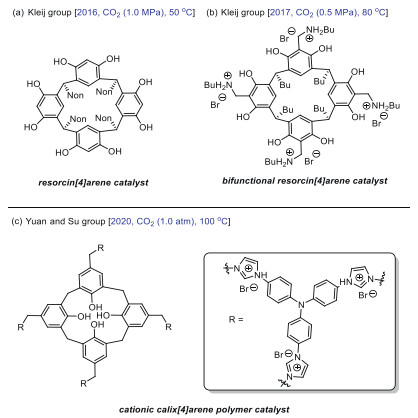
Figure 1.
Previous strategies for the synthesis of cyclic carbonates via CO2 and epoxides based on the calix[4]arene-derived catalysts.

Cycloaddition of epoxides and atmospheric CO2 in aqueous catalyzed by an upper-rim functionalized calix[4]arene organocatalyst
Zheng-Yi Li , Tao Li , Zuquan Wang , Yi Zhao , Jing Shi , Xiaoqiang Sun , Ke Yang


Carbon dioxide (CO2) is one of the most significant greenhouse gases in the Earth's atmosphere [1,2]. Despite being a greenhouse gas implicated in global warming, CO2 is also a plentiful and renewable C1 resource that undergoes chemical transformations to yield high-value compounds [3-6]. In this field, the cycloaddition of epoxides with CO2 to construct cyclic carbonates has been regarded as one of the most promising CO2 conversion routes [7,8]. Furthermore, cyclic carbonates are also high-value organic compounds serving as electrolytes for lithium-ion secondary batteries, monomers for polymers, and intermediates in pharmaceuticals [9-16]. Although extensive efforts have been attempted for the synthesis of cyclic carbonates from epoxides and CO2, the development of a novel green and efficient strategy would be of great significance.
Recently, upper- or lower-rim functionalized calix[4]arenes have been recognized as ideal catalysts in organic chemistry due to their exceptional selectivity and efficient phase transfer catalytic function [17-21]. However, only a few reports focused on the cycloaddition of epoxides with CO2 [22-24]. In 2016, the Kleij group used the resorcin[4]arene catalyst for the cycloaddition of epoxides with CO2 in the presence of TBAI at a high pressure (Fig. 1a) [22]. Furthermore, they also designed a bifunctional resorcin[4]arene catalyst to achieve the same reaction without TBAI (Fig. 1b) [23]. In 2020, Yuan and co-workers modified the upper rim of calix[4]arene to obtain a cationic calix[4]arene polymer catalyst, which can synthesize cyclic carbonates from CO2 and epoxides at elevated temperature (100 ℃) under atmospheric pressure (Fig. 1c) [24]. In addition, both metal-based catalysts and ionic liquids also serve as typical catalysts for the synthesis of cyclic carbonates from CO2 [25-30]. Despite their potential, these approaches are predominantly limited by requirements for high reaction pressures and temperatures, as well as a restricted substrate scope. Consequently, the development of novel functionalized calix[4]arene organocatalysts to address these issues would represent a significant advancement in synthetic chemistry.
In our continuing efforts for developing novel supramolecular catalysis reactions [31-34], the designed upper-rim functionalized calix[4]arenes bearing hemisquaramides (cat-1, cat-2 and cat-3), squaramides (cat-4) and salophens (cat-5) have been used as organocatalysts for the cycloaddition of epoxides and CO2 in aqueous at a mild temperature under normal pressure (Fig. 2).
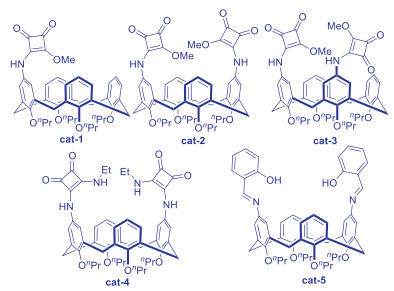
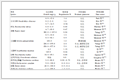
Our investigation began with the reaction of styrene oxide (1a), TBAI (tetrabutylammonium iodide) and CO2 (1.0 atm) in H2O solvent at room temperature for 24 h using the upper-rim functionalized calix[4]arene bearing mono-hemisquaramide cat-1 as the organocatalyst. The desired cyclic carbonate 2a was isolated with 22% yield (Table 1, entry 1). To our delight, the yield of 2a was increased to 90% by using 1,3-bis-hemisquaramides calix[4]arene catalyst cat-2. This observation suggests that the synergistic effect between two hemisquaramide groups can significantly contribute to improved catalytic performance (Table 1, entry 2). However, the use of 1,2-bis-hemisquaramides calix[4]arene catalyst cat-3 only afforded 13% yield indicating that the positioning of hemisquaramide groups is also crucial for this process (Table 1, entry 3). Additionally, the utilization of 1,3-bis-squaramides calix[4]arene catalyst cat-4 resulted in an 81% isolated yield, whereas the employment of the 1,3-bis-salophens calix[4]arene catalyst cat-5 failed to generate product 2a. This implies that the hemisquaramide group exhibits optimal performance within our strategy (Table 1, entries 4 and 5). Next, the examination on iodide additive revealed that other iodide additives including KI or NH4I failed to provide the desired product 2a (Table 1, entries 6 and 7). Furthermore, the use of TBAB (tetrabutylammonium bromide) afforded the desired product 2a in 65% yield (Table 1, entry 8). The subsequent investigation on the amounts of cat-2 and TBAI revealed that 5 mol% of cat-2 and 10 mol% of TBAI are optimal (Table 1, entries 9–12). It is worth noting that the yield of 2a was increased to 99% by improving the reaction temperature to 40 ℃ (Table 1, entry 13). Finally, the yield of 2a decreased to 23% in the absence of cat-2, while only a trace amount of product was detected in the absence of TBAI (Table 1, entries 14 and 15).
 DownLoad:
CSV
DownLoad:
CSV
 |
||||
| Entry | cat (mol%) | Additive (mol%) | Temp (℃) | Yield (%)b |
| 1 | cat-1 (5) | TBAI (10) | 25 | 22 |
| 2 | cat-2 (5) | TBAI (10) | 25 | 90 |
| 3 | cat-3 (5) | TBAI (10) | 25 | 13 |
| 4 | cat-4 (5) | TBAI (10) | 25 | 81 |
| 5 | cat-5 (5) | TBAI (10) | 25 | trace |
| 6 | cat-2 (5) | KI (10) | 25 | trace |
| 7 | cat-2 (5) | NH4I (10) | 25 | trace |
| 8 | cat-2 (5) | TBAB (10) | 25 | 65 |
| 9 | cat-2 (3) | TBAI (10) | 25 | 83 |
| 10 | cat-2 (10) | TBAI (10) | 25 | 81 |
| 11 | cat-2 (5) | TBAI (5) | 25 | 76 |
| 12 | cat-2 (5) | TBAI (20) | 25 | 87 |
| 13 | cat-2 (5) | TBAI (10) | 40 | 99 |
| 14 | – | TBAI (10) | 40 | 23 |
| 15 | cat-2 (5) | – | 40 | trace |
| a Reaction conditions: 1a (2.0 mmol), CO2 (1.0 atm), calix[4]arene (cat), additive, H2O (5 mL), temperature, 24 h. b Isolated yields. | ||||
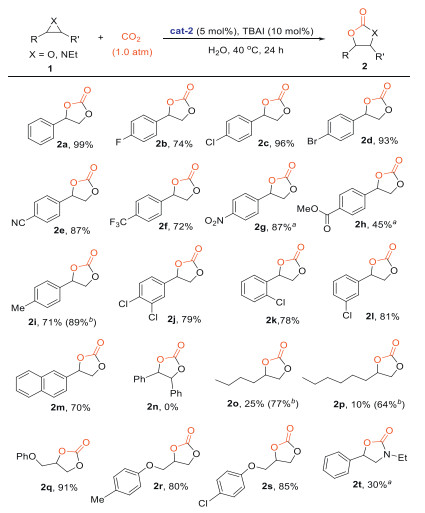
With the optimized reaction conditions in hand, the substrate scope study of epoxides was carried out in Scheme 1. A variety of 2-aryl oxiranes generated the corresponding cyclic carbonates 2a-2m in good to excellent yields. Both electron-withdrawing and electron-donating groups at the para-, meta- or ortho-position on the aryl group were suitable in this catalytic system. Unfortunately, the use of 2,3-diphenyloxirane failed to provide the desired product 2n due to the steric hindrance effect. Additionally, this catalytic system was compatible with 2-alkyl oxiranes such as 2-butyloxirane and 2-hexyloxirane, resulting in moderate to good yields of the desired products 2o-p. Furthermore, 2-alkyl oxiranes bearing an ether group also provided the desired products 2q-2s in good yield. Finally, 1-ethyl-2-phenylaziridine was also utilized in our protocol to form the desired product 2t with a moderate yield.
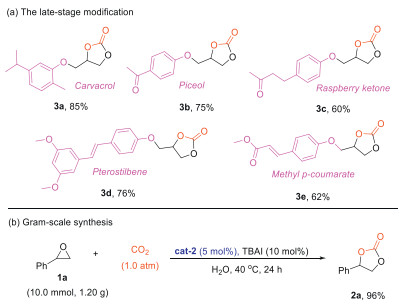
To illustrate the synthetic utility of this novel catalytic approach, the late-stage modification of natural products was first performed in Scheme 2a. As expected, natural products containing epoxides derived from complex organic skeletons, such as carvacrol, piceol, raspberry ketone, pterostilbene and methyl p-coumarate, have also been easily converted into the desired products 3a-e with good yields. In addition, a gram-scale reaction of styrene oxide (1a) and CO2 was also conducted under standard conditions. To our delight, 4-phenyl-1,3-dioxolan-2-one (2a) was obtained with a yield of 96% (Scheme 2b).
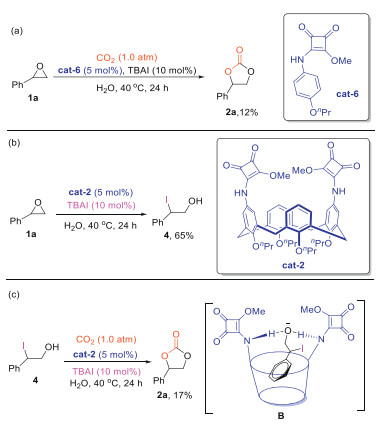
To gain some insights into the reaction mechanism, several control experiments have been performed (Scheme 3). The utilization of cat-6 led to the isolation of only a 12% yield of the desired product 2a in the model reaction. This comparative experiment suggests the possible existence of π···π supramolecular interaction between the calixarene cavity and substrate 1a. Furthermore, the model reaction without CO2 was also examined, and the product 4 was isolated with a yield of 65%. This result demonstrates that the acid ring-opening of 1a occurs in our catalytic system. Additionally, under standard conditions, product 4 only yielded 17% of the desired product 2a, suggesting that our system may proceed through an anionic intermediate B.
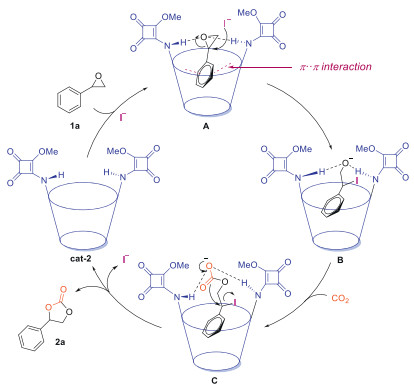
Based on our control experiments and the previous reports, a plausible catalytic cycle is proposed (Scheme 4) [7,8,31-39]. Initially, 2-phenyloxirane 1a interacts with cat-2 to form the intermediate A through both hydrogen bonding and π···π interactions [32,33,39]. Notably, the solvent water may also facilitate the transfer of substrate 1a into the hydrophobic cavity of calix[4]arene. In this case, the C–O bond of 1a is activated by a hydrogen bonding interaction with two hemisquaramide groups, while its aryl group is stabilized by π···π interaction with the calix[4]arene cavity. Subsequently, the sterically hindered carbon of 1a is attacked by an iodide ion to form the anionic intermediate B. Next, CO2 reacts with the anionic intermediate B to afford the carbonate anion intermediate C. Finally, the desired product 2a is formed through an intramolecular cyclization process, accompanied by the regeneration of cat-2 and iodide ion.
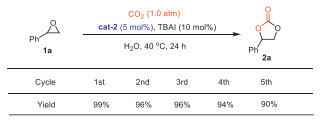
To evaluate the recyclability of calix[4]arene organocatalyst cat-2 within this process, five consecutive reaction cycles between 1a and CO2 were carried out under the same catalyst. The results indicated that the catalytic activity of cat-2 showed only a minor decrease after five cycles, maintaining a yield of 90% (Scheme 5).
In summary, the cycloaddition of epoxides and CO2 in aqueous has been developed by using an upper-rim functionalized calix[4]arene organocatalyst bearing two hemisquaramides at the 1,4-positions. Compared with previous catalytic systems, our catalytic protocol operates at a mild temperature under normal pressure, demonstrating excellent functional group compatibility and good isolated yields. The mechanism studies demonstrate the essential role of the calixarene cavity, and suggest that the reaction may involve a π···π supramolecular interaction between the calixarene cavity and epoxide. The late-stage modification of natural products, gram-scale synthesis, and catalyst recyclability experiments further demonstrated the synthetic utility of this innovative methodology. The mild strategy presented here offers an important complementary approach for the synthesis of cyclic carbonates from epoxides and CO2 in the field of organic chemistry.
The authors declare that they have no known competing financial interests or personal relationships that could have appeared to influence the work reported in this paper.
Zheng-Yi Li: Writing – review & editing, Supervision, Funding acquisition, Formal analysis, Conceptualization. Tao Li: Formal analysis, Data curation. Zuquan Wang: Formal analysis, Data curation. Yi Zhao: Data curation. Jing Shi: Writing – review & editing. Xiaoqiang Sun: Writing – review & editing. Ke Yang: Writing – review & editing, Writing – original draft, Supervision, Data curation.
We gratefully acknowledge the financial support from The Innovation Support Program of Jiangsu Province (No. BZ2023055), the Changzhou University, Advanced Catalysis and Green Manufacturing Collaborative Innovation Center, and Jiangsu Key Laboratory of Advanced Catalytic Materials and Technology. We also acknowledge the analytical testing support from Analysis and Testing Center of Changzhou University.
Supplementary material associated with this article can be found, in the online version, at doi:
C. Song, Catal. Today 115 (2006) 2–32. doi: 10.1016/j.cattod.2006.02.029
N. von der Assen, P. Voll, M. Peters, A. Bardow, Chem. Soc. Rev. 43 (2014) 7982–7994. doi: 10.1039/C3CS60373C
J. Hong, M. Li, J. Zhang, B. Sun, F. Mo, ChemSusChem 12 (2019) 6–39. doi: 10.1002/cssc.201802012
M.D. Burkart, N. Hazari, C.L. Tway, E.L. Zeitler, ACS Catal. 9 (2019) 7937–7956. doi: 10.1021/acscatal.9b02113
E.S. Sanz-Perez, C.R. Murdock, S.A. Didas, C.W. Jones, Chem. Rev. 116 (2016) 11840–11876. doi: 10.1021/acs.chemrev.6b00173
K. Beydoun, J. Klankermayer, Top. Organomet. Chem. 63 (2018) 39. doi: 10.1007/3418_2018_16
T. Yan, H. Liu, Z.X. Zeng, W.G. Pan, J. CO2 Util. 68 (2023) 102355. doi: 10.1016/j.jcou.2022.102355
P.P. Pescarmona, Curr. Opin. Green Sustain. Chem. 29 (2021) 100457. doi: 10.1016/j.cogsc.2021.100457
X. Wei, W. Xu, M. Vijayakumar, et al., Adv. Mater. 26 (2014) 7649–7653. doi: 10.1002/adma.201403746
B. Schaffner, F. Schaffner, S.P. Verevkin, A. Borner, Chem. Rev. 110 (2010) 4554–4581. doi: 10.1021/cr900393d
V. Besse, F. Camara, C. Voirin, et al., Polym. Chem. 4 (2013) 4545–4561. doi: 10.1039/c3py00343d
M. Fleischer, H. Blattmann, R. Mülhaupt, Green Chem. 15 (2013) 934–942. doi: 10.1039/c3gc00078h
M. Bahr, R. Mulhaupt, Green Chem. 14 (2012) 483–489. doi: 10.1039/c2gc16230j
A.J. Kamphuis, F. Picchioni, P.P. Pescarmona, Green Chem. 21 (2019) 406–448. doi: 10.1039/c8gc03086c
R.R. Shaikh, S. Pornpraprom, V. D' Elia, ACS Catal. 8 (2018) 419–450. doi: 10.1021/acscatal.7b03580
N.S. Suveges, A.A. Rodriguez, C.C. Diederichs, et al., Eur. J. Org. Chem. 2018 (2018) 2931–2938. doi: 10.1002/ejoc.201800345
S. Sayin, M. Yilmaz, Tetrahedron 72 (2016) 6528–6535. doi: 10.1016/j.tet.2016.08.066
M. Durmaz, E. Halay, S. Bozkurt, Beilstein J. Org. Chem. 14 (2018) 1389–1412. doi: 10.3762/bjoc.14.117
H. Zhao, X.H. Yang, Y.C. Pan, et al., Chin. Chem. Lett. 31 (2020) 1873–1876. doi: 10.1016/j.cclet.2020.01.042
Z. Ma, Y. Li, X.Q. Sun, K. Yang, Z.Y. Li, Chin. J. Org. Chem. 41 (2021) 2188–2201. doi: 10.6023/cjoc202012034
B. Banerjee, G. Kaur, N. Kaur, Curr. Org. Chem. 25 (2021) 209–222.
L. Martinez-Rodriguez, J.O. Garmilla, A.W. Kleij, ChemSusChem 9 (2016) 749–755. doi: 10.1002/cssc.201501463
T. Jose, S. Canellas, M.A. Pericas, A.W. Kleij, Green Chem. 19 (2017) 1–3.
Y. Zhang, K. Su, Z. Hong, Z. Han, D. Yuan, Ind. Eng. Chem. Res. 59 (2020) 7247–7254. doi: 10.1021/acs.iecr.9b05312
H. Büttner, L. Longwitz, J. Steinbauer, C. Wulf, T. Werner, Top. Curr. Chem. 375 (2017) 1–56.
J. Kiriratnikom, N. Laiwattanapaisarn, K. Vongnam, et al., Inorg. Chem. 60 (2021) 6147–6151. doi: 10.1021/acs.inorgchem.0c03732
Y.Y. Kang, Y. Kim, J. Lee, H. Park, Bull. Korean Chem. Soc. 36 (2015) 1296–1299. doi: 10.1002/bkcs.10236
S. Lian, C. Song, Q. Liu, et al., J. Environ. Sci. 99 (2021) 281–295. doi: 10.1016/j.jes.2020.06.034
M. Liu, L. Liang, X. Li, X. Gao, J. Sun, Green Chem. 18 (2016) 2851–2863. doi: 10.1039/C5GC02605A
X. Zhang, D. Su, L. Xiao, W. Wu, J. CO2 Util. 17 (2017) 37–42. doi: 10.1016/j.jcou.2016.11.005
Y. Wu, Z. Ma, J. Shi, et al., Chin. Chem. Lett. 33 (2022) 5116–5119. doi: 10.1016/j.cclet.2022.03.125
K. Yang, Z.Y. Ma, H.X. Tong, X.Y. Hu, Z.Y. Li, Chin. Chem. Lett. 31 (2020) 3259–3262. doi: 10.1016/j.cclet.2020.02.057
Z.Y. Li, H.X. Tong, Y. Chen, et al., Beilstein J. Org. Chem. 14 (2018) 1901–1907. doi: 10.3762/bjoc.14.164
Z.Y. Li, Y. Chen, C.Q. Zheng, et al., Tetrahedron 73 (2017) 78–85. doi: 10.1016/j.tet.2016.11.052
C. Wei, Y. He, X. Shi, Z. Song, Coordin. Chem. Rev. 385 (2019) 1–19.
M. Delbianco, P. Bharate, S. Varela-Aramburu, P.H. Seeberger, Chem. Rev. 116 (2016) 1693–1752. doi: 10.1021/acs.chemrev.5b00516
K. Takaishi, T. Okuyama, S. Kadosaki, M. Uchiyama, T. Ema, Org. Lett. 21 (2019) 1397–1401. doi: 10.1021/acs.orglett.9b00117
S. Sopena, E. Martin, E.C. Escudero-Adan, A.W. Kleij, ACS Catal. 7 (2017) 3532–3539. doi: 10.1021/acscatal.7b00475
H. Huang, D.M. Li, W. Wang, et al., Org. Biomol. Chem. 10 (2012) 729–735. doi: 10.1039/C1OB06358H

Figure 1 Previous strategies for the synthesis of cyclic carbonates via CO2 and epoxides based on the calix[4]arene-derived catalysts.

Scheme 1 Scope of epoxides. Reaction conditions: 1 (2.0 mmol), CO2 (1.0 atm), cat-2 (5 mol%), TBAI (10 mol%), H2O (5 mL), 40 ℃, 24 h. Isolated yield. a 48 h. b TBAI (5 mol%), EtOH (5 mL).
Table 1. Optimization of reaction conditions.a
|
||||
| Entry | cat (mol%) | Additive (mol%) | Temp (℃) | Yield (%)b |
| 1 | cat-1 (5) | TBAI (10) | 25 | 22 |
| 2 | cat-2 (5) | TBAI (10) | 25 | 90 |
| 3 | cat-3 (5) | TBAI (10) | 25 | 13 |
| 4 | cat-4 (5) | TBAI (10) | 25 | 81 |
| 5 | cat-5 (5) | TBAI (10) | 25 | trace |
| 6 | cat-2 (5) | KI (10) | 25 | trace |
| 7 | cat-2 (5) | NH4I (10) | 25 | trace |
| 8 | cat-2 (5) | TBAB (10) | 25 | 65 |
| 9 | cat-2 (3) | TBAI (10) | 25 | 83 |
| 10 | cat-2 (10) | TBAI (10) | 25 | 81 |
| 11 | cat-2 (5) | TBAI (5) | 25 | 76 |
| 12 | cat-2 (5) | TBAI (20) | 25 | 87 |
| 13 | cat-2 (5) | TBAI (10) | 40 | 99 |
| 14 | – | TBAI (10) | 40 | 23 |
| 15 | cat-2 (5) | – | 40 | trace |
| a Reaction conditions: 1a (2.0 mmol), CO2 (1.0 atm), calix[4]arene (cat), additive, H2O (5 mL), temperature, 24 h. b Isolated yields. | ||||
 下载: 导出CSV

 扫一扫看文章


扫一扫关注我们


 下载:
下载: