
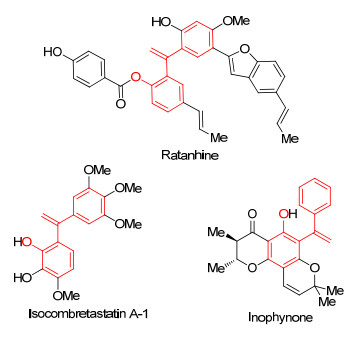
Figure 1.
Bioactive compounds containing a 1, 1-diaryl alkenes unit


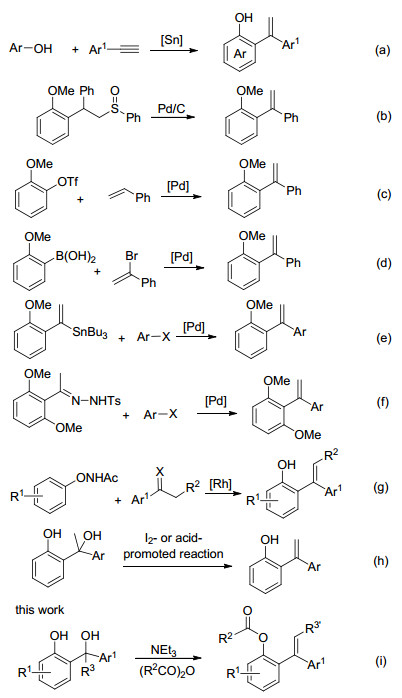
Substituted 2-(1-arylvinyl)phenol derivatives exist extensively in bioactive compounds, such as isocombretastatin A-1, [1] ratanhine, [2] inophynone, [3] etc. (Figure 1), and are also served as key starting materials in the synthesis of pharmaceutically active compounds, for example, tolterodine and fendline, [4] as well as natural products, e.g., Coumarin derivatives.[5] In addition, this 2-(1-arylvinyl)-phenol unit can achieve the construction of benzofuran skeleton through a dehydrogenative oxygenation of C(sp2)—H bonds with intramolecular phenolic hydroxy groups, [6] and can also react with propargylic alkynols or allenes to generate chromene-like products.[7] Moreover, lots of reactions can be performed to functionalize the C=C double bond, such as asymmetric hydrogenation, [8] epoxidation, [9] halogenations, [10] asymmetric hydroboration, [11] Sharpless asymmetric dihydroxylation, [12] aminoflurination, [13] and Heck coupling.[14] Given their high importance, there is ongoing interest in the development of convenient and general protocols for the synthesis of 2-(1-arylvinyl)phenol derivatives. With the exception for the traditional Wittig olefination of ortho-oxygen substituted diarylketones, [15] several approaches such as nucleophilic addition of phenols to phenylacetylenes (Scheme 1a), [16] Pd/C-mediated intramolecular [2, 3]-sigmatropic rearrangement of sulfoxides to synthetise ortho-oxygen substituted diarylalkenes (Scheme 1b), [17] Heck reactions of ortho-oxygen substituted aryl triflates and styrene (Scheme 1c), [18] Suzuki couplings of α-bromostyrenes with ortho-oxygen substituted ArB(OH)2 (Scheme 1d), [19] Stille cross-coupling reaction of ortho-oxygen substituted vinylstannanes with aryl halides (Scheme 1e), [20] cross-coupling of ortho-oxygen substituted N-tosylhydrazones with aryl halides (Scheme 1f), [21] and rhodium-mediated reactions of N-phenoxyacetamides with N-tosylhydrazones, diazoesters or aromatic ketones (Scheme 1g)[22] have been reported in recent years. However, these reported methods involved the uses of metal catalysts and phenol group protected substrates. Some metal-free synthetic strategies such as iodine-[23] or acid-[24]promoted reaction of 2-(1-hydroxy-1-arylalkyl)-phenol were also established to achieve the green synthesis of ortho-oxygen substituted diarylalkenes (Scheme 1h). Inspired by these excellent results, herein, we report a method using acetic anhydride to synthesize acylated 2-(1-arylvinyl)phenol derivatives from easily available 2-(1-hydroxy-1-phenylalkyl) phenols (Scheme 1i). The present method features mild conditions, high yields and broad substrate scope.
At the beginning of our studies, reactions of 2-(1-hydroxy-1-(o-tolyl)ethyl)phenol (1a) with Ac2O (2a) were investigated as our model reaction to optimize the reaction conditions (Table 1). We were glad to see that when the starting materials 1a and 2a were stirred in CH2Cl2 at 25 ℃ under the presence of P(OEt)3 for 12 h, the desired product 3aa was obtained in 42% (Table 1, Entry 1). Then, to improve the yield, the solvent efffect was examined (Table 1, Entries 2~7). It was found that 1, 2-dichloroethane (DCE) was the best solvent. From the screen of reaction temperature, it was found that increasing the reaction temperature from 0 to 60 ℃ could remarkably raise the yield of 3aa (Table 1, Entries 8~11), and the highest yield was obtained in 87% at 60 ℃ (Table 1, Entry 11). However, the yield was silghtly decreased when the temperature was further raised to 80 ℃ (Table 1, Entry 12). P(OEt)3 was supposed to be a base in this process, and therefore, the addition of base was further screened (Table 1, Entries 13~18). It was found that the use of organic base such as NEt3 and 1, 4-diazabicyclo[2.2.2]octane (DABCO), and inorganic base such as K2CO3 can significantly promote this process, affording 3aa in up to 97% yield using NEt3 as the base (Table 1, Entry 13). The employment of thiourea was also investigated, but no desired product 3aa was obtained (Table 1, Entry 18).
 下载:
导出CSV
下载:
导出CSV
 |
||||
| Entry | Solvent | T/℃ | Base | Yieldb/% |
| 1 | CH2Cl2 | 25 | P(OEt)3 | 42 |
| 2 | THF | 25 | P(OEt)3 | 8 |
| 3 | CH3CN | 25 | P(OEt)3 | 17 |
| 4 | PhMe | 25 | P(OEt)3 | 37 |
| 5 | Et2O | 25 | P(OEt)3 | 11 |
| 6 | DMF | 25 | P(OEt)3 | 2 |
| 7 | DCE | 25 | P(OEt)3 | 43 |
| 8 | DCE | 0 | P(OEt)3 | 0 |
| 9 | DCE | 20 | P(OEt)3 | 40 |
| 10 | DCE | 40 | P(OEt)3 | 82 |
| 11 | DCE | 60 | P(OEt)3 | 87 |
| 12 | DCE | 80 | P(OEt)3 | 85 |
| 13 | DCE | 60 | NEt3 | 97 |
| 14 | DCE | 60 | DMAP | 29 |
| 15 | DCE | 60 | DABCO | 95 |
| 16 | DCE | 60 | K2CO3 | 93 |
| 17 | DCE | 60 | NaOH | 39 |
| 18 | DCE | 60 | Thiourea | 0 |
| a Reagents and conditions: 1a (0.4 mmol), Ac2O (0.8 mmol, 2 equiv.), NEt3 (1.2 mmol, 3 equiv.), solvent (2 mL). b Isolated yield. | ||||
With the optimized reaction conditions in hand, the substrate scope of this reaction was explored (Table 2). A series of 2-(1-hydroxy-1-arylalkyl)phenols with different substituents (1b~1m) were firstly tested. It was important to note that more steric phenols such as 1b and 1c could mainly afford products E-3ba and E-3ca in high yields, respectively. E-Configuration of 3ba was determined by 1H-NOESY spectrum, and the ratio of E-3 to Z-3 was established by crude 1H NMR. Substrate 1d~1f with R2 groups in different position of the bezene ring reacted well with the optimal conditions, affording the desired products (3da~3fa) in excellent yields. Moreover, substrates with electron-donating group or electron-withdrawing group such as halogen substituent, nitro group and cyano group on the phenol ring could afford the desired products 3ga~3oa in medium to excellent yields. It was also worth mentioning that anhydrides other than acetic anhydride, for example, malanic anhydride, butyric anhydride, butenic anhydride and Boc-anhydride, were also suitable for this transformation, giving their corresponding ortho-acyloxy diarylethylenes 3ab~3ae in good yields.
下载:
导出CSV
 |
 |
| a Reagents and conditions: 1 (0.4 mmol), (R4CO)2O (0.8 mmol, 2 equiv.), NEt3 (1.2 mmol, 3 equiv.), DCE (2 mL). Isolated yield based on 1. b Configuration are determined by NOESY spectrum. c The ratio of E-3 to Z-3 was determined by crude 1H NMR. |
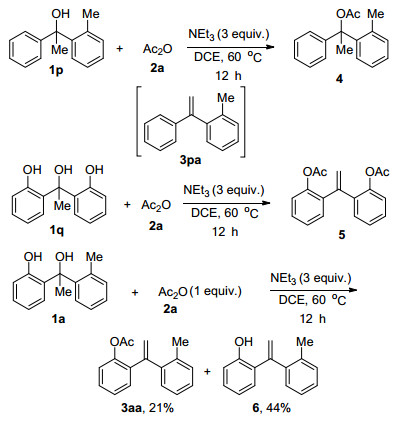
Phenyl-1-(o-tolyl)ethan-1-ol 1p without a phenolic hydroxyl group as the substrate was also investigated in this anhydride-mediated process (Scheme 2). This reaction can't afford the desired 3pa, but the acylated product 4 with 41% yield. It suggests that the existence of phenolic hydroxyl group is very important to achieve the transformation of substrate 1 to product 3. In addition, 2, 2'-(1- hydroxyethane-1, 1-diyl)diphenol (1q) was also tested in this process, and the desired ortho-acyloxy diarylalkene 5 was obtained in 43% yield. If 1 equiv. acetic anhydride was used in this reation of substrate 1a, products 3aa and 6 were isolated at yields of 21% and 44%, respectively.
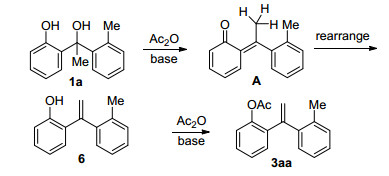
Based on the above controlled experiment, a plausible mechanism for this transformation is proposed in Scheme 3. Under the presence of acetic anhydride and NEt3, 2-(1-hydroxy-1-arylalkyl)phenol 1a is firstly transformed to the corresponding o-quinone methide intermediate A, [25] which is subjected to a rearrange to give the product 6. Under the presence of overloaded acetic anhydride and NEt3, product 6 with a phenolic hydroxyl group was further converted to acylated product 3aa.
In summary, we have developed a mild, one-pot method to afford ortho-acyloxylated diarylalkenes in up to 99% yields from easily available starting materials of 2-(1-hydroxy-1-arylalkyl)phenols, anhydride and NEt3. This process exhibits a broad substrate scope and good functional group tolerance. The present protocol is mild, operationally simple, and environmentally friendly.
All commercially available reagents were used without further purification. 2-(1-Hydroxy-1-phenylalkyl)phenols were prepared via 2-hydroxy-acetophenone and Grignard reagents according to the literature procedure.[26]1H NMR (400 MHz) and 13C NMR (100 MHz) were recorded on an NMR spectrometer with CDCl3 as solvent. The residual solvent signals were used as references, and the chemical shifts were converted to the TMS scale (CDCl3: TMS: δH=0.00, δC=77.00). Column chromatography was performed on silica gel 300~400 mesh.
To a solution of 1 equiv. of 2-(1-hydroxy-1-phenylalkyl)- phenol derivatives 1 (0.4 mol) in dry ClCH2CH2Cl (3 mL) were added acetic anhydride (0.8 mmol, 2 equiv.) on a magnetic stirrer under N2. Then added NEt3 (1.2 mmol, 3 equiv.) to the round-bottomed flask dropwise, the stirring was continued 12 h or overnight. The solvent evaporation under vacuum afforded the crude product, column chromatography using different mixtures of ethyl acetate/hexane as eluent allowed to obtain the pure product.
2-(1-(o-Tolyl)vinyl)phenyl acetate (3aa): 97% yield. 1H NMR (400 MHz, CDCl3) δ: 1.78 (s, 3H), 2.06 (s, 3H), 5.37 (d, J=1.6 Hz, 1H), 5.62 (d, J=1.2 Hz, 1H), 6.98 (d, J=8.0 Hz, 1H), 7.12~7.22 (m, 5H), 7.31 (td, J=7.6, 1.6 Hz, 1H), 7.40 (dd, J=7.6, 1.2 Hz, 1H); 13C NMR (100 MHz, CDCl3) δ: 20.3, 20.6, 119.9, 123.1, 125.7, 126.1, 127.5, 128.6, 129.5, 130.4, 130.4, 134.4, 135.6, 141.4, 146.6, 147.7, 168.9. HRMS (Micromass GCT, TOF MS ESI+) calcd for C17H16O2Na [M+Na]+ 275.1048, found 275.1048.
(E)-2-(1-(o-Tolyl)prop-1-en-1-yl)phenyl acetate (3ba): 88% yield. 1H NMR (400 MHz, CDCl3) δ: 1.65 (d, J=6.8 Hz, 3H), 1.93 (s, 3H), 2.11 (s, 3H), 6.09 (q, J=6.8 Hz, 1H), 6.93 (d, J=8.0 Hz, 1H), 7.10~7.18 (m, 6H), 7.29 (dd, J=1.6, 8.0 Hz, 1H); 13C NMR (100 MHz, CDCl3) δ: 15.6, 19.9, 20.6, 123.1, 125.4, 125.9, 127.0, 127.8, 128.6, 130.1, 130.3, 130.63, 135.4, 136.4, 138.2, 138.9, 147.7, 169.2. HRMS (Micromass GCT, TOF MS ESI+) calcd for C18H18O2Na [M+Na]+ 289.1204, found 289.1203.
(E)-2-(1-(o-Tolyl)but-1-en-1-yl)phenyl acetate (3ca): 82% yield. 1H NMR (400 MHz, CDCl3) δ: 0.99 (t, J=7.6 Hz, 3H), 1.96~2.03 (m, 5H), 2.10 (s, 3H), 6.00 (t, J=7.2 Hz, 1H), 6.95 (d, J=8.4 Hz, 1H), 7.13~7.17 (m, 5H), 7.22~7.23 (m, 2H); 13C NMR (100 MHz, CDCl3) δ: 14.1, 20.0, 20.7, 23.0, 123.1, 125.3, 125.9, 127.0, 127.7, 130.1, 130.3, 130.6, 135.2, 136.0, 136.3, 136.5, 139.3, 147.7, 169.2. HRMS (Micromass GCT, TOF MS ESI+) calcd for C19H20O2Na [M+Na]+ 303.1361, found 303.1360.
2-(1-Phenyl vinyl) phenyl acetate (3da): 99% Yield. 1H NMR (400 MHz, CDCl3) δ: 1.76 (s, 3H), 5.35 (s, 1H), 5.66 (s, 1H), 7.07 (d, J=8.0 Hz, 1H), 7.24-7.29 (m, 6H), 7.34~7.40 (m, 2H); 13C NMR (100 MHz, CDCl3) δ: 20.2, 116.7, 122.9, 126.04, 126.8, 127.7, 128.2, 128.8, 131.2, 134.5, 140.7, 146.2, 148.1, 168.9. HRMS (Micromass GCT, TOF MS ESI+) calcd for C16H14O2Na [M+Na]+ 261.0891, found 261.0892.
2-(1-(m-Tolyl)vinyl)phenyl acetate (3ea): 98% yield. 1H NMR (400 MHz, CDCl3) δ: 1.76 (s, 3H), 2.30 (s, 3H), 5.32 (d, J=1.2 Hz, 1H), 5.64 (d, J=0.8 Hz, 1H), 7.06~7.09 (m, 4H), 7.17~7.20 (m, 1H), 7.23~7.28 (m, 1H), 7.34~7.39 (m, 2H); 13C NMR (100 MHz, CDCl3) δ: 20.2, 21.3, 116.5, 122.9, 123.9, 126.0, 127.5, 128.1, 128.4, 128.8, 131.2, 134.6, 137.8, 140.7, 146.3, 148.1, 168.9. HRMS (Micromass GCT, TOF MS ESI+) calcd for C17H16O2Na [M+Na]+ 275.1048, found 275.1047.
2-(1-(p-Tolyl)vinyl)phenyl acetate (3fa): 98% yield. 1H NMR (400 MHz, CDCl3) δ: 1.80 (s, 3H), 2.33 (s, 3H), 5.28 (d, J=1.2 Hz, 1H), 5.63 (d, J=1.2 Hz, 1H), 7.06~7.11 (m, 3H), 7.16~7.18 (m, 2H), 7.24~7.28 (m, 1H), 7.34~7.38 (m, 2H). 13C NMR (100 MHz, CDCl3) δ: 20.3, 21.1, 115.8, 122.8, 126.0, 126.7, 128.7, 128.9, 131.2, 134.8, 137.5, 137.8, 145.9, 148.1, 169.0. HRMS (Micromass GCT, TOF MS ESI+) calcd for C17H16O2Na [M+Na]+ 275.1048, found 275.1047.
2-Methyl-6-(1-(o-tolyl)vinyl)phenyl acetate (3ga): 97% yield. 1H NMR (400 MHz, CDCl3) δ: 1.84 (s, 3H), 2.08 (s, 3H), 2.10 (s, 3H), 5.35 (d, J=2.0 Hz, 1H), 5.59 (d, J=2.0 Hz, 1H), 7.12~7.21 (m, 7H). 13C NMR (100 MHz, CDCl3) δ: 16.4, 20.1, 20.6, 119.9, 125.6, 126.0, 127.4, 128.2, 129.6, 130.4, 130.4, 131.0, 134.8, 135.7, 141.5, 146.6, 146.9, 168.2. HRMS (Micromass GCT, TOF MS ESI+) calcd for C18H18O2Na [M+Na]+ 289.1204, found 289.1205.
5-Methyl-2-(1-(o-tolyl)vinyl)phenyl acetate (3ha): 95% yield. 1H NMR (400 MHz, CDCl3) δ: 1.77 (s, 3H), 2.07 (s, 3H), 2.34 (s, 3H), 5.32 (d, J=1.6 Hz, 1H), 5.59 (d, J=1.6 Hz, 1H), 6.79 (s, 1H), 7.02 (d, J=8.0 Hz, 1H), 7.11~7.20 (m, 4H), 7.27 (d, J=8.0 Hz, 1H). 13C NMR (100 MHz, CDCl3) δ: 20.3, 20.5, 21.0, 119.2, 123.6, 125.6, 127.0, 127.4, 129.5, 130.1, 130.3, 131.4, 135.6, 138.9, 141.6, 146.5, 147.5, 169.0. HRMS (Micromass GCT, TOF MS ESI+) calcd for C18H18O2Na [M+Na]+ 289.1204, found 289.1203.
4-Methyl-2-(1-(o-tolyl)vinyl)phenyl acetate (3ia): 96% yield. 1H NMR (400 MHz, CDCl3) δ: 1.76 (s, 3H), 2.08 (s, 3H), 2.34 (s, 3H), 5.34 (d, J=1.6 Hz, 1H), 5.60 (d, J=1.6 Hz, 1H), 6.85 (d, J=8.4 Hz, 1H), 7.10~7.20 (m, 6H); 13C NMR (100 MHz, CDCl3, TMS): δ 20.3, 20.6, 20.9, 119.7, 122.8, 125.7, 127.4, 129.3, 129.5, 130.3, 130.8, 134.0, 135.6, 135.7, 141.5, 145.5, 146.7, 169.2. HRMS (Micromass GCT, TOF MS ESI+) calcd for C18H18O2Na [M+Na]+ 289.1204, found 289.1205.
5-Bromo-2-(1-(o-tolyl)vinyl)phenyl acetate (3ja): 89% yield. 1H NMR (400 MHz, CDCl3, TMS): δ 1.77 (s, 3H), 2.05 (s, 3H), 5.38 (d, J=1.2 Hz, 1H), 5.61 (d, J=1.2 Hz, 1H), 7.12~7.20 (m, 5H), 7.26 (d, J=8.4 Hz, 1H), 7.36 (dd, J=2.0, 8.4 Hz, 1H); 13C NMR (100 MHz, CDCl3) δ: 20.2, 20.6, 120.3, 121.3, 125.8, 126.5, 127.7, 129.4, 129.5, 130.5, 131.4, 133.6, 135.6, 140.9, 145.8, 148.1, 168.4. HRMS (Micromass GCT, TOF MS ESI+) calcd for C17H15BrO2Na [M+Na]+ 353.0153, found 353.0151.
2-Bromo-6-(1-(o-tolyl)vinyl)phenyl acetate (3ka): 94% yield. 1H NMR (400 MHz, CDCl3) δ: 1.91 (s, 3H), 2.08 (s, 3H), 5.40 (d, J=1.2 Hz, 1H), 5.62 (d, J=1.6 Hz, 1H), 7.08~7.22 (m, 5H), 7.31 (dd, J=1.6, 7.6 Hz, 1H), 7.54 (dd, J=1.6, 8.0 Hz, 1H); 13C NMR (100 MHz, CDCl3) δ: 20.2, 20.6, 117.7, 120.8, 125.7, 127.2, 127.7, 129.6, 129.6, 130.4, 132.5, 135.7, 137.1, 140.9, 145.5, 146.1, 167.5. HRMS (Micromass GCT, TOF MS ESI+) calcd for C17H15BrO2Na [M+Na]+ 353.0153, found 353.0151.
4-Bromo-2-(1-(o-tolyl)vinyl)phenyl acetate (3la): 93% yield. 1H NMR (400 MHz, CDCl3) δ: 1.75 (s, 3H), 2.08 (s, 3H), 5.40 (d, J=1.2 Hz, 1H), 5.62 (d, J=1.2 Hz, 1H), 6.86 (d, J=8.4 Hz, 1H), 7.12~7.21 (m, 4H), 7.41 (dd, J=2.4, 8.4 Hz, 1H), 7.55 (d, J=2.4 Hz, 1H); 13C NMR (100 MHz, CDCl3) δ: 20.1, 20.6, 119.2, 120.9, 124.9, 125.8, 127.7, 129.5, 130.5, 131.5, 132.9, 135.5, 136.5, 140.6, 145.5, 146.8, 168.5. HRMS (Micromass GCT, TOF MS ESI+) Calcd for C17H15BrO2Na [M+Na]+ 353.0153, found 353.0151.
4-Chloro-2-(1-(o-tolyl)vinyl)phenyl acetate (3ma): 84% yield. 1H NMR (400 MHz, CDCl3) δ: 1.76 (s, 3H), 2.08 (s, 3H), 5.41 (d, J=1.6 Hz, 1H), 5.63 (d, J=1.2 Hz, 1H), 6.92 (d, J=8.8 Hz, 1H), 7.13~7.21 (m, 5H), 7.40 (d, J=2.4 Hz, 1H); 13C NMR (100 MHz, CDCl3) δ: 20.2, 20.6, 120.9, 124.5, 125.8, 127.7, 128.5, 129.5, 123.0, 130.5, 131.4, 135.6, 136.06, 140.7, 145.6, 146.2, 168.7. HRMS (Micromass GCT, TOF MS ESI+) calcd for C17H15ClO2Na [M+Na]+ 309.0658, found 309.0660.
4-Nitro-2-(1-phenylvinyl)phenyl acetate (3na): 54% yield. 1H NMR (500 MHz, CDCl3, TMS): δ 1.78 (s, 3H), 5.45 (s, 1H), 5.78 (s, 1H), 7.23~7.34 (m, 6H), 8.25 (dd, J=2.5, 9.0 Hz, 1H); 13C NMR (100 MHz, CDCl3) δ: 20.1, 118.5, 124.10, 124.13, 126.5, 126.7, 128.3, 128.6, 136.0, 139.5, 144.7, 145.6, 152.9, 168.0. HRMS (Micromass GCT, TOF MS ESI+) calcd for C16H13NO4Na [M+ Na]+ 306.0742, found 306.0743.
4-Cyano-2-(1-phenylvinyl)phenyl acetate (3oa): 62% yield. 1H NMR (500 MHz, CDCl3) δ: 1.77 (s, 3H), 5.39 (d, J=0.8 Hz, 1H), 5.74 (d, J=0.8 Hz, 1H), 7.20~7.24 (m, 3H), 7.30~7.33 (m, 3H), 7.67 (dd, J=2.4, 8.4 Hz, 1H), 7.71 (d, J=2.0 Hz, 1H); 13C NMR (100 MHz, CDCl3) δ: 20.1, 110.2, 118.2, 124.4, 126.7, 128.2, 128.5, 132.6, 135.1, 136.2, 139.6, 144.6, 151.5, 168.1. HRMS (Micromass GCT, TOF MS ESI+) calcd for C17H13NO2Na [M+Na]+ 286.0844, found 286.0845.
2-(1-(o-Tolyl)vinyl)phenyl propionate (3ab): 94% yield. 1H NMR (400 MHz, CDCl3) δ: 0.99 (t, J=7.6 Hz, 3H), 2.06 (s, 3H), 2.05 (q, J=7.6 Hz, 2H), 5.37 (d, J=1.6 Hz, 1H), 5.61 (d, J=1.6 Hz, 1H), 6.97 (dd, J=1.2 Hz, J2=8.0 Hz, 1H), 7.10~7.23 (m, 5H), 7.30 (td, J=1.6, 7.2 Hz, 1H), 7.38 (dd, J=1.6, 7.6 Hz, 1H); 13C NMR (100 MHz, CDCl3) δ: 8.6, 20.6, 26.9, 119.8, 123.2, 125.7, 126.0, 127.4, 128.6, 129.5, 130.3, 130.4, 134.5, 135.7, 141.5, 146.6, 147.8, 172.3. HRMS (Micromass GCT, TOF MS ESI+) calcd for C18H18O2Na [M+Na]+ 289.1204, found 289.1205.
2-(1-(o-Tolyl)vinyl)phenyl butyrate (3ac): 92% yield. 1H NMR (400 MHz, CDCl3) δ: 0.90 (t, J=7.2 Hz, 3H), 1.52 (m, 2H), 2.02 (t, J=7.2 Hz, 2H), 2.06 (s, 3H), 5.37 (d, J=1.6 Hz, 1H), 5.61 (d, J=1.6 Hz, 1H), 6.98 (d, J=8.0 Hz, 1H), 7.10~7.23 (m, 5H), 7.29 (td, J=2.0, 7.6 Hz, 1H), 7.35 (dd, J=1.6, 7.6 Hz, 1H); 13C NMR (100 MHz, CDCl3) δ: 13.5, 17.9, 20.6, 35.4, 119.8, 123.2, 125.6, 126.0, 127.4, 128.5, 129.6, 130.3, 130.4, 134.5, 135.7, 141.6, 146.5, 147.8, 171.5. HRMS (Micromass GCT, TOF MS ESI+) calcd for C19H20O2Na [M+Na]+ 303.1361, found 303.1362.
2-(1-(o-Tolyl)vinyl)phenyl (E)-but-2-enoate (3ad): 81% yield. 1H NMR (400 MHz, CDCl3) δ: 1.82 (dd, J=1.6, 6.8 Hz, 3H), 2.06 (s, 3H), 5.36 (d, J=1.6 Hz, 1H), 5.62 (d, J=1.6 Hz, 1H), 5.65 (dd, J=1.6, 15.2 Hz, 1H), 6.69~6.78 (m, 1H), 7.01 (dd, J=0.8, 8.0 Hz, 1H), 7.09~7.23 (m, 5H), 7.28~7.36 (m, 2H); 13C NMR (100 MHz, CDCl3) δ: 18.0, 20.6, 119.8, 121.5, 123.2, 125.5, 125.9, 127.2, 128.5, 129.6, 130.2, 130.4, 134.7, 135.5, 141.5, 146.2, 146.3, 147.8, 164.2. HRMS (Micromass GCT, TOF MS ESI+) calcd for C19H18O2Na [M+Na]+ 301.1204, found 301.1208.
tert-Butyl (2-(1-(o-tolyl)vinyl)phenyl) carbonate (3ae): 90% yield. 1H NMR (400 MHz, CDCl3) δ: 1.41 (s, 9H), 2.12 (s, 3H), 5.39 (d, J=1.6 Hz, 1H), 5.68 (d, J=1.6 Hz, 1H), 7.09 (d, J=8.0 Hz, 1H), 7.12~7.18 (m, 4H), 7.21~7.23 (m, 2H), 7.28 (td, J=2.0, 7.6 Hz, 1H); 13C NMR (100 MHz, CDCl3) δ: 20.4, 27.6, 83.0, 119.7, 122.9, 125.6, 125.9, 127.4, 128.5, 129.7, 130.2, 130.4, 134.6, 135.7, 141.7, 145.9, 148.2, 151.4. HRMS (Micromass GCT, TOF MS ESI+) calcd for C20H22O3Na [M+Na]+ 333.1467, found 333.1468.
Phenyl-1-(o-tolyl)ethyl acetate (4): 41% yield. 1H NMR (400 MHz, CDCl3) δ: 1.95 (s, 3H), 2.08 (s, 3H), 2.34 (s, 3H), 7.22~7.26 (m, 2H), 7.29~7.33 (m, 4H), 7.39~7.43 (m, 3H); 13C NMR (100 MHz, CDCl3) δ: 19.1, 20.6, 36.6, 84.2, 122.9, 126.1, 126.8, 127.7, 128.3, 128.9, 131.2, 134.5, 140.71, 146.2, 172.3. HRMS (Micromass GCT, TOF MS ESI+) calcd for C17H18O2Na [M+Na]+ 277.1204, found 277.1205.
Ethene-1, 1-diylbis(2, 1-phenylene) diacetate (5): 43% yield. 1H NMR (400 MHz, CDCl3) δ: 2.35 (s, 6H), 5.66 (s, 2H), 7.22~7.26 (m, 2H), 7.29~7.33 (m, 4H), 7.40~7.43 (m, 2H); 13C NMR (100 MHz, CDCl3) δ: 20.3, 114.4, 119.9, 120.1, 125.7, 126.6, 128.3, 148.7, 150.4, 169.0. HRMS (Micromass GCT, TOF MS ESI+) calcd for C18H16O4Na [M+Na]+ 319.0946, found 319.0947.
2-(1-(o-Tolyl)vinyl)phenol (6)[27]: 44% yield. 1H NMR (400 MHz, CDCl3) δ: 2.06 (s, 3H), 5.50 (m, 2H), 5.64 (d, J=1.2 Hz, 1H), 6.84 (td, J=7.6, 0.8 Hz, 1H), 6.89 (dd, J=8.0, 0.8 Hz, 1H), 7.03 (dd, J=8.0, 2.0 Hz, 1H), 7.15~7.26 (m, 4H), 7.32 (dd, J=6.8, 1.6 Hz, 1H).
Supporting Information Copies of 1H NMR and 13C NMR spectra of the products. The Supporting Information is available free of charge via the Internet at http://siocjournal.cn/.
Jain, N. K.; Krishnamurty, H. G. Indian J. Chem., Sect. B 2000, 39, 817.
Arnone, A.; Modugno, V. D.; Nasini, G.; Pava, O. V. Gazz. Chim. Ital. 1990, 120, 397.
Shaiq, A. M.; Shaukat, M.; Shaista, P.; Uddin, A. U.; Hafeez, G. Phytochemistry 1999, 50, 1385. doi: 10.1016/S0031-9422(98)00480-4
(a) Zheng, Y.-L.; Liu, Y.-Y.; Wu, Y.-M.; Wang, Y.-X. Lin, Y.-T.; Ye, M.-C. Angew. Chem., Int. Ed. 2016, 55, 6315.
(b) Botteghi, C.; Corrias, T.; Marchetti, M.; Paganelli, S.; Piccolo, O. Org. Process Res. dev. 2002, 6, 379.
(a) Zhang, Z.; Ju, T.; Miao, M.; Han, J.-L.; Zhang, Y.-H.; Zhu, X.-Y.; Ye, J.-H.; Yu, D.-J.; Zhi, Y.-G. Org. Lett. 2017, 19, 396.
(b) Sasano, K.; Takaya, J.; Iwasawa, N. J. Am. Chem. Soc. 2013, 135, 10954.
(c) Li, J.-F.; Chang, W.-J.; Ren, W.-L.; Liu, W.; Wang, H.-N.; Shi, Y. Org. Biomol. Chem. 2015, 13, 10341.
(a) Ghorai, J.; Reddy, A. C. S.; Anbarasan, P. Chem.-Eur. J. 2016, 22, 16042.
(b) Yang, D.-J.; Zhu, Y.-F.; Yang, N.; Jiang, Q.-Q.; Liu, R.-H. Adv. Synth. Catal. 2016, 358, 1731.
(c) Chang, M.-Y.; Huang, Y.-H.; Wang, H.-S. Tetrahedron 2016, 72, 3022.
(a) Han, Y.-P.; Song, X.-R.; Qiu, Y.-F.; Li, X.-S.; Zhang, H.-R.; Zhu, X.-Y.; Liu, X.-Y.; Liang, Y.-M. Org. Lett. 2016, 18, 3866.
(b) Casanova, N.; Seoane, A.; MascareÇas, J. L.; Gulias, M. Angew. Chem., Int. Ed. 2015, 54, 2374.
(a) Wang, Z.-B.; Ai, F.-J.; Wang, Z.; Zhao, W.-X.; Zhu, G.-G.; Lin, Z.-Y.; Sun, J.-W. J. Am. Chem. Soc. 2015, 137, 383.
(b) Chen, J.-H.; Chen, C.-H.; Ji, C.-L.; Lu, Z. Org. Lett. 2016, 18, 1594.
Nicolaou, K. C.; Snyder, S. A.; Huang, X.-H.; Simonsen, K. B.; Koumbis, A. E.; Bigot, A. J. Am. Chem. Soc. 2004, 126, 10162. doi: 10.1021/ja040090y
Kaswan, P.; Shelke, M. G.; Rao, K. V.; Kumar, A. Synlett 2016, 27, 2553. doi: 10.1055/s-0035-1560559
Wang, Z.-N.; He, X.-X.; Zhang, R.; Zhang, G.; Xu, G. X.; Zhang, Q.; Xiong, T.; Zhang, Q. Org. Lett. 2017, 19, 3067.
Han, P.; Wang, R.-J.; Wang, D. Z. Tetrahedron 2011, 67, 8873. doi: 10.1016/j.tet.2011.09.073
Zhang, Q.; Zheng, G.-F.; Zhang, Q; Li, Y. J. Org. Chem. 2017, 82, 8258. doi: 10.1021/acs.joc.7b01089
Xie, J.; Li, J.; Weingand, V.; Rudolph, M.; Hashmi, A. S. K. Chem.-Eur. J. 2016, 22, 12646. doi: 10.1002/chem.v22.36
Moure, M. J.; Martin, R. S.; Dominguez, E. Angew. Chem., Int. Ed. 2012, 57, 3220.
(a) Haldar, S.; Koner, S. Beilstein J. Org. Chem. 2013, 9, 49.
(b) Tochigi, A.; Tsukamoto, K.; Suzuki, N.; Masuyama, Y. Eur. J. Org. Chem. 2016, 5678.
Chang, M.-Y.; Huang, Y.-H.; Wang, H.-S. Tetrahedron 2016, 72, 3022. doi: 10.1016/j.tet.2016.04.018
Zou, Y.-J.; Qin, L.-N.; Ren, X.-F.; Lu, Y.-P.; Li, Y.-X.; Zhou, J.-R. Chem. Eur. J. 2013, 19, 3504. doi: 10.1002/chem.201203646
Berthiol, F.; Doucet, H.; Santelli, M. Eur. J. Org. Chem. 2003, 1091.
Hamze, A.; Veau, D.; Provot, O.; Brion, J. D.; Alami, M. J. Org. Chem. 2009, 74, 1337. doi: 10.1021/jo802460z
Roche, M.; Hamze, A.; Provot, O.; Brion, J. D.; Alami, M. J. Org. Chem. 2013, 78, 445. doi: 10.1021/jo3023268
(a) Zhang, Y.; He, Y.; Li, L.-S.; Ji, M.-M.; Li, X.-Z.; Zhu, G.-G. J. Org. Chem. 2018, 83, 2898.
(b) Hu, F.-D.; Xia, Y.; Ye, F.; Liu, Z.-X.; Ma, C.; Zhang, Y.; Wang, J.-B. Angew. Chem., Int. Ed. 2014, 53, 1364.
Sasano, K.; Takaya, J.; Iwasawa, N. J. Am. Chem. Soc. 2013, 135, 10954. doi: 10.1021/ja405503y
(a) Brady, W. T.; Giang, Y. F. J. Org. Chem. 1985, 50, 5177.
(b) Wang, Z.-B.; Ai, F.-J.; Wang, Z.; Zhao, W.-X.; Zhu, G.-Y.; Lin, Z.-Y.; Sun, Z.-W. J. Am. Chem. Soc. 2015, 137, 383.
(c) Ogawa, N.; Yamaoka, Y.; Yamada, K.; Takasu, K. Org. Lett. 2017, 19, 3327.
(a) Chiang, Y.; Jerry, K. A. Org. Biomol. Chem. 2004, 2, 1090.
(b) Uchida, M.; Kuma, M.; Irie, M. Bull. Chem. Soc. Jpn. 1996, 69, 1023.
(c) Guo, L.; Zhang, F.-Y.; Hu, W.-M.; Lia, L.; Jia, Y.-X. Chem. Commun. 2014, 50, 3299.
(d) Sasano, K.; Takaya, J.; Iwasawa, N. J. Am. Chem. Soc. 2013, 135, 10954.
Hull, F. J.; Balcells, D.; Sauer, L. O. E.; Raynaud, C.; Brudvig, W. G.; Crabtree, H. R.; Eisenstein, O. J. Am. Chem. Soc. 2010, 132, 7605. doi: 10.1021/ja908744w
Sasano, K.; Takaya, J.; Iwasawa, N. J. Am. Chem. Soc. 2013, 135, 10954. doi: 10.1021/ja405503y
Table 1. Optimizations of the reaction conditionsa
|
|
||||
| Entry | Solvent | T/℃ | Base | Yieldb/% |
| 1 | CH2Cl2 | 25 | P(OEt)3 | 42 |
| 2 | THF | 25 | P(OEt)3 | 8 |
| 3 | CH3CN | 25 | P(OEt)3 | 17 |
| 4 | PhMe | 25 | P(OEt)3 | 37 |
| 5 | Et2O | 25 | P(OEt)3 | 11 |
| 6 | DMF | 25 | P(OEt)3 | 2 |
| 7 | DCE | 25 | P(OEt)3 | 43 |
| 8 | DCE | 0 | P(OEt)3 | 0 |
| 9 | DCE | 20 | P(OEt)3 | 40 |
| 10 | DCE | 40 | P(OEt)3 | 82 |
| 11 | DCE | 60 | P(OEt)3 | 87 |
| 12 | DCE | 80 | P(OEt)3 | 85 |
| 13 | DCE | 60 | NEt3 | 97 |
| 14 | DCE | 60 | DMAP | 29 |
| 15 | DCE | 60 | DABCO | 95 |
| 16 | DCE | 60 | K2CO3 | 93 |
| 17 | DCE | 60 | NaOH | 39 |
| 18 | DCE | 60 | Thiourea | 0 |
| a Reagents and conditions: 1a (0.4 mmol), Ac2O (0.8 mmol, 2 equiv.), NEt3 (1.2 mmol, 3 equiv.), solvent (2 mL). b Isolated yield. | ||||
 下载: 导出CSV
Table 2. Substrate scope of 2-(1-hydroxy-1-phenylethyl)phenolsa
|
|
|
|
| a Reagents and conditions: 1 (0.4 mmol), (R4CO)2O (0.8 mmol, 2 equiv.), NEt3 (1.2 mmol, 3 equiv.), DCE (2 mL). Isolated yield based on 1. b Configuration are determined by NOESY spectrum. c The ratio of E-3 to Z-3 was determined by crude 1H NMR. |
下载: 导出CSV

 扫一扫看文章


扫一扫关注我们


 下载:
下载: