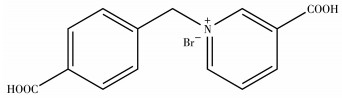
Scheme1.
Molecular structure of ligand (H2L)Br

Structures and Luminescence Property of Two Co(Ⅱ) and Cd(Ⅱ) Supramolecular Coordination Networks Created via Synergistic Effect of Coordination Bonds and Secondary Interactions
Yong-He REN , Lu-Chao LI , Qi-Hui DING , Yong-Qing HUANG , Yue ZHAO


In the past decades, supramolecular coordination chemistry has been booming. Much attention has been focused on the structures and properties of supramolecular coordination compounds (SCCs). The driving force of related research mainly stems from the variability and tunability of structures of SCCs, as well as their potential applications[1-6]. So far, according to interactions between building blocks, 2D and 3D supramolecular coordination networks (SCNs) can be divided into two categories. The 2D and 3D SCNs assembled mainly by coordination bonds, which we are more concerned with, belong to the first category, in which the weak secondary interactions play subsidiary role[7-9]. The 2D and 3D SCNs constructed by the link of coordinationbonded 0D, 1D, even 2D SCCs via weak secondary interactions, fall into the second category, in which coordination bonds and weak secondary interactions play synergistic effects[10-12]. For instance, with the aid of N—H…Cl and C—H…Cl hydrogen bonds, monomeric [Ln(ntb)Cl3] (ntb=tris(benzimidazole-2-ylmethyl) amine) are consolidated to form two series of thermally stable porous SCNs, featuring robustness and dynamics upon guest uptake[10a]. For the latter, relatively little attention has been paid, so far, therefore more effort needs to be paid to continue researching them.
Secondary interactions include hydrogen bonds, π -π stacking interactions, halogen-halogen, silver-silver, etc., which have widely taken part in the construction of SCNs[13-16]. To make full use of these secondary interactions, deliberative selection of building blocks, especially ligands, is crucial. To obtain hydrogen bonds, the ligands should possess abundant hydrogen donors and/ or acceptors[17-18]. To obtain π-π stacking interactions, ligands should own aromatic moieties[19-20]. Pyridiniums containing carboxylate, possessing both hydrogen bonding acceptor and aromatic moieties, are apt to generate hydrogen bonding and π-π stacking interaction, which make them good candidates for studying the synergistic effect of coordination bonds and secondary interactions on the final structures of SCNs. Up to now, a variety of meaningful SCNs have been reported[21-24]. For example, Huang and his coworkers presented two 1D porous Cd(Ⅱ) metallacyclic chains with 4-carboxy-1-(4-carboxybenzyl) pyridinium ligand, which are further assembled into 2D layer via π-π stacking interactions, displaying interesting pseudopolymorphism phenomenon[11]. With this in mind and as a continuation of our study, we select 3-carboxy-1-(4-carboxybenzyl)-pyridinium bromide ((H2L)Br, Scheme 1), isomer of 4-carboxy-1-(4carboxybenzyl)pyridinium bromide ligand, and Co(Ⅱ) and Cd(Ⅱ) metal salts to assembly supramolecular coordination networks. Specially, (H2L)Br ligand has the following advantages: firstly, the organic skeleton of (H2L) Br ligand is semirigid, which gives it the ability to adjust its configuration as needed; secondly, it has two different aromatic moieties: phenyl ring and electron deficient pyridyl ring, which provides us a chance to compare the difference of π-π stacking between different type of aromatic moieties; lastly, in contrast to fixed V-shaped configuration with its isomer 4-carboxy-1-(4carboxybenzyl)pyridinium bromide ligand, (H2L)Br possesses more flexible configuration[25-26].
In this paper, we present two SCNs, namely [Co(L)2(H2O)4] ·2H2O (1) and [Cd(L)2(H2O)] ·3H2O (2), and show how two 3D SCNs have been achieved by secondary interactions. In addition, we also studied the fluorescence property of 2.
All commercially available reagents and chemicals are of reagent grade and used directly as received. The ligand (H2L)Br was synthesized according to the previously reported literature[27]. Elemental analyses (C, H and N) were executed on a Perkin-Elmer 240C Elemental Analyzer. Infrared spectra data were obtained on a Nicolet 380 FT-IR spectrometer using KBr pellets. Powder X-ray diffraction (PXRD) analyses were performed on a Rigaku Ultima Ⅳ diffractometer with Cu Kα radiation (λ=0.154 18 nm) at 40 kV and 40 mA in a 2θ range of 5°-50°. The phase purity of crystalline samples of 1 and 2 were ensured by comparing experimental PXRD values with calculated ones (Fig.S1 and S2, Supporting information), which were obtained via simulation of single crystal data using Mercury software[28]. Thermogravimetric analysis (TGA) was performed under N2 atmosphere using a Mettler-Toledo thermal analyser. The photoluminescent spectra were measured using a Hitachi F-4600 FL spectrophotometer. The luminescence lifetime studies were conducted with a HORIBA Jobin Yvon Fluorolog-3 spectro-fluorometer fitted with a time-correlated single photon counting detector and a NanoLED pulsed laser diode excitation source (340 nm). UV-Vis spectra were recorded on a Hitachi UH4150 spectrophotometer.
An aqueous solution (5 mL) of (H2L)Br (33.8 mg, 0.1 mmol) and NaOH (8.0 mg, 0.2 mmol) was mixed with an aqueous solution (5 mL) of CoCl2·6H2O (23.8 mg, 0.1 mmol), which was then filtered to provide a clear solution. After about fifteen days, red-purple tufted crystals were obtained by slow diffusion of acetone into the clear reaction solution in 40% yield. Anal. Calcd. for C 28H32CoN2O14(%): C, 49.49; H, 4.75; N, 4.12. Found(%): C, 49.52; H, 4.71; N, 4.03. IR (KBr, cm-1): 3 346s, 3 079w, 1 639s, 1 608s, 1 545s, 1 496m, 1 394vs, 1 374vs, 1 215m, 1 188m, 1 137w, 1 116w, 1 017w, 913w, 838w, 768s, 687m, 650m, 554w, 479w, 413w.
(H2L) Br (33.8 mg, 0.1 mmol), Cd(OAc)2·2H2O (53.2 mg, 0.2 mmol), NaOH (8.0 mg, 0.2 mmol) and water (10 mL) were sealed in a Teflon-lined stainlesssteel container (20 mL), and then heated at 150 ℃ for 72 h. After cooling to room temperature (5 ℃ ·h-1), colorless transparent tufted acicular crystals were obtained in 62% yield. Anal. Calcd. for C28H28CdN2O12 (%): C, 48.25; H, 4.05; N, 4.02. Found(%): C, 48.17; H, 4.12; N, 4.08. IR (KBr, cm-1): 3 440vs, 2 991w, 1 640s, 1 611s, 1 483w, 1 390s, 1 351w, 1 182w, 1 000w, 767w, 606m.
Data collections of single crystal structure of complexes 1 and 2 were carried out using Bruker Smart Apex Ⅱ CCD diffractometer with graphitemonochromatized Mo Kα radiation (λ =0.071 073 nm) in the ω-φ scan mode. The structure solutions and refinements of 1 and 2 were achieved by direct methods using the SHELXS-97 program and by full-matrix least-squares techniques on F2 using the SHELXL 2014 program, respectively. All non-hydrogen atoms were refined with anisotropic thermal parameters. All hydrogen atoms bound to carbon atoms were placed at the theoretically calculated positions and refined using a riding model. The positions of H atoms of H2O were found in the difference electron density. Details of the crystal parameters, data collection and refinement for 1 and 2 are summarized in Table 1. Selected bond lengths and bond angles of 1 and 2 are collected in Table 2, and the relevant data for hydrogen bonding and π-π interactions are given in Table 3 and 4.

 下载:
导出CSV
下载:
导出CSV
| Parameter | 1 | 2 |
| Empirical formula | C28H32CoN2O14 | C28H28CdN2O12 |
| Formula weight | 679.48 | 696.92 |
| Crystal system | Triclinic | Monoclinic |
| Space group | P1 | P21/n |
| a/nm | 0.767 49(7) | 1.290 90(7) |
| b/nm | 0.902 95(8) | 1.625 48(8) |
| c/nm | 1.139 56(10) | 1.442 41(7) |
| α/(°) | 85.698 0(10) | |
| β/(°) | 71.996 0(10) | 114.514 0(10) |
| γ/(°) | 79.651 0(10) | |
| V/nm3 | 0.738 67(11) | 2.753 8(2) |
| Z | 1 | 4 |
| Dc/(g.cm-3) | 1.527 | 1.681 |
| μ/mm-1 | 0.656 | 0.864 |
| F(000) | 353 | 1 416 |
| θ range for data collection/(°) | 2.29-28.3 | 2.76-27.6 |
| Independent reflection | 3 324 | 6 284 |
| Data, restraint, parameter | 3 324, 4, 211 | 6 284, 0, 412 |
| Rint | 0.020 1 | 0.035 3 |
| Goodness-of-fit on F2 | 1.041 | 1.054 |
| R1, wR2 [I>2σ(I)] | 0.035 0, 0.094 2 | 0.024 7, 0.068 4 |
| R1, wR2 (all data) | 0.036 7, 0.095 8 | 0.026 5, 0.069 9 |
下载:
导出CSV
| 1 | |||||
| Co1—O2W#1 | 0.205 59(13) | Co1—02W | 0.205 59(13) | Co1—03#1 | 0.207 42(13) |
| Co1—03 | 0.207 42(13) | Co1—01W#1 | 0.213 60(13) | Co1—01W | 0.213 60(13) |
| O2W#1—Co1—O2W | 180.0 | 02W#1—Co1—03#1 | 91.12(6) | 02W—Co1—03#1 | 88.88(6) |
| O2W#1—Co1—O3 | 88.88(6) | 02W—Co1—03 | 91.12(6) | 03#1—Co1—03 | 180.0 |
| O2W#1—Co1—O1W#1 | 87.45(5) | 02W—Co1—01W#1 | 92.55(5) | 03#1—Co1—01W#1 | 86.33(5) |
| O3—Co1—O1W#1 | 93.67(5) | 01W#1—Co1—01W | 180.0 | 02W#1—Co1—01W | 92.55(5) |
| 02W—Co1—01W | 87.45(5) | 03#1—Co1—01W | 93.67(5) | 03—Co1—01W | 86.33(5) |
| 2 | |||||
| Cd1—01W | 0.226 85(13) | Cd1—08 | 0.239 05(12) | Cd1—01#2 | 0.244 06(13) |
| Cd1—03 | 0.232 26(11) | Cd1—02#2 | 0.240 25(12) | Cd1—07 | 0.234 03(12) |
| Cd1—04 | 0.242 77(12) | ||||
| 01W—Cd1—03 | 86.82(4) | 01W—Cd1—07 | 87.37(5) | 01W—Cd1—08 | 90.65(5) |
| 03—Cd1—08 | 170.82(4) | 01W—Cd1—02#2 | 80.13(5) | 03—Cd1—02#2 | 103.06(4) |
| 08—Cd1—02#2 | 85.17(4) | 01W—Cd1—04 | 129.34(5) | 07—Cd1—04 | 82.15(4) |
| 08—Cd1—04 | 121.20(4) | 01W—Cd1—01#2 | 129.91(5) | 03—Cd1—01#2 | 84.75(5) |
| 08—Cd1—01#2 | 103.57(4) | 02#2—Cd1—01#2 | 54.29(4) | 03—Cd1—07 | 115.77(4) |
| 02#2—Cd1—04 | 135.31(4) | 07—Cd1—08 | 55.25(4) | 07—Cd1—01#2 | 139.84(5) |
| 07—Cd1—02#2 | 138.39(4) | 04—Cd1—01#2 | 83.08(4) | 03—Cd1—04 | 55.24(4) |
| Symmetry codes: #1:-x, -y+1, -z; #2: x+1, y, z. | |||||
下载:
导出CSV
| D—H…A | d/(D—H)/nm | d(H…A)/nm | d(D…A)/nm | ∠DHA/(°) |
| 1 | ||||
| O1W—H1WA…O4#1 | 0.086 | 0.191 | 0.270 6(2) | 155 |
| O1W—H1WB…O2#2 | 0.085 | 0.198 | 0.283 1(2) | 175 |
| O2W—H2WA…O1#2 | 0.086 | 0.181 | 0.264 3(2) | 164 |
| O2W—H2WB…O1#3 | 0.085 | 0.184 | 0.268 1(2) | 171 |
| O3W—H3WA…O2#4 | 0.088 | 0.239 | 0.324 0(3) | 163 |
| O3W—H3WB…O4#1 | 0.085 | 0.212 | 0.282 6(2) | 140 |
| 2 | ||||
| O1W—H1WA…O7#5 | 0.078 | 0.192 | 0.268 9(2) | 171 |
| O1W—H1WB…O4W | 0.090 | 0.180 | 0.269 5(2) | 172 |
| O2W—H2WA…O1#6 | 0.079 | 0.207 | 0.282 7(2) | 162 |
| O2W—H2WB…O3W#7 | 0.098 | 0.171 | 0.268 3(2) | 178 |
| O3W—H3WA…O5#8 | 0.086 | 0.198 | 0.281 8(2) | 163 |
| O3W—H3WB…O4 | 0.081 | 0.199 | 0.276 8(2) | 161 |
| O4W—H4WA…O2W#9 | 0.083 | 0.196 | 0.278 1(2) | 170 |
| O4W—H4WB…O5#7 | 0.083 | 0.197 | 0.279 8(2) | 175 |
| Symmetry codes: #1: -x, -y+1, -z; #2: -x, -y, -z-1; #3: x-1, y+1, z+1; #4: x, y, z+1; #5: -x, -y, -z+1; #6: x+1, y, z; #7: x+1/2, -y+1/2, z+1/2; #8: -x, -y+1, -z+1; #9: -x+1/2, y-1/2, -z+3/2. | ||||
下载:
导出CSV
| Ring Cg(i)-Cg(j) | d/nm | τ/(°) | d(Cgi_perp)/nm | d(Cgj_perp)/nm | Symmetry code |
| 1b | |||||
| Cg(1)-Cg(1) | 0.368 | 0 | 0.352 | 0.352 | -x, 1-y, 1-z |
| 2c | |||||
| Cg(1)-Cg(1) | 0.384 | 0 | 0.357 | 0.357 | 1-x, -y, 2-z |
| Cg(2)-Cg(2) | 0.363 | 0 | 0.344 | 0.344 | -π, 1-π, -π |
| Cg(3)-Cg(3) | 0.385 | 0 | 0.369 | 0.369 | 2-x, -y, 2-z |
| a Cg(i)=ring number i; τ=dihedral angle between ring i and j; d=distance between ring centroids; d(Cgi_perp)=perpendicular distance of Cg(i) on ring j; d(Cgj_perp)=perpendicular distance of Cg(j) on ring i; b Cg(1): C8, C9, C10, C11, C12, C13; c Cg(1): N1, C1, C2, C3, C4, C5; Cg(2): N2, C15, C16, C17, C18, C19; Cg(3): C8, C9, C10, C11, C12, C13. | |||||
CCDC: 1865438, 1; 1865439, 2.
Crystal analysis revealed that complex 1 possesses a neutral mononuclear coordination entity [Co(L)2(H2O)4], which crystallizes in the triclinic space group P1. The repeat unit of 1 contains half Co(Ⅱ) ions, one deprotonated L ligand, two coordinated water molecules and one lattice water molecule. Fig. 1a shows the coordination environment of Co(Ⅱ) centers, which lie on the inversion center. Each Co(Ⅱ) ion exhibits an octahedral geometry with {O6} donor set, in which four O atoms from four coordinated water molecules constitute the equatorial plane (Co—Owater distances: 0.205 59(13) and 0.213 60(13) nm) and the rest two O atoms from two L ligands occupy two apex sites (Co—Ocarboxyalte 0.207 42(13) nm).
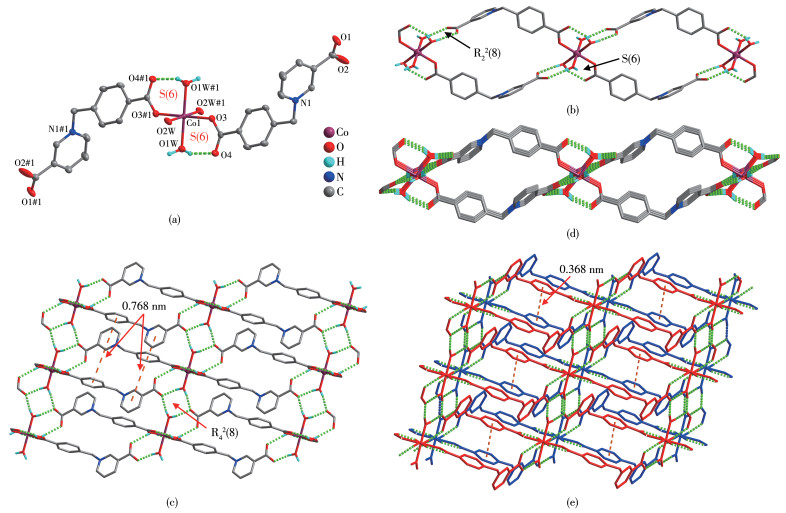
Symmetry code: #1:-x, -y+1, -z
The neutral [Co(L)2(H2O)4] coordination entities, containing abundant potential hydrogen bond components: O—H proton donors and O proton acceptors from coordinated water molecules and carboxylic groups, can serve as synthons to form supramolecular network via hydrogen bonds, which is consistent with its IR spectrum (Fig.S3) [23, 29]. Crystal data affirmed that one type of intramolecular hydrogen bond (O1W…O4#1 0.271 nm, symmetry code: #1:-x, 1-y, 2-z) with graphset symbol of S(6) in the coordination entity [Co(L)2(H2O)4] (Fig. 1a) and another three kinds of classic O—H…O intermolecular hydrogen bonds take part in the creation of supramolecular network of 1 (Table 3). Firstly, [Co(L)2(H2O)4] coordination entities are connected together through intermolecular hydrogen bonded cyclic dimers with graph-set symbol of R22(8) (O1W…O2#2 0.283 nm, O2W…O1#2 0.264 nm, symmetry code: #2:-x, -y, 1-z), which consist of one deprotonated pyridine carboxylic group and two adjacent coordinated water molecules, leading to the formation of 1D beaded chain with Co…Co separation of 1.506 nm (Fig. 1b). Interestingly, a similar hydrogen bonded 1D Co(Ⅱ) chain with V-shaped 4-carboxy-1-(4carboxybenzyl)pyridinium ligand has been reported by Chen and his coworkers, while, in the presence of NaN3, a 2D Co(Ⅱ) coordination network based on the chain with (μ-1, 1-N3)(μ-1, 3-COO)2 bridges has been obtained by Gao and his coworkers[30-31]. Then, above mentioned 1D beaded chains are linked together, leading to the formation of 2D layers via hydrogen-bonded cyclic tetramers with graph-set symbol of R42(8) (O2W …O1#3 0.268 nm, symmetry code: #3:-1+x, 1+y, 1+z) along a-axis (Fig. 1c). It is noteworthy that hydrogenbonded cyclic dimers and tetramers share the common side. Moreover, the hydrogen-bonded M2(H2O)6L2 rings of 1D beaded chain are almost perpendicular to the 2D layer, so viewed along a-axis, the 2D layers are composed of side-by-side 1D tubes (Fig. 1d). From a topological viewpoint, the hydrogen-bonded network of 1 can be described as (4, 4) grid. Intriguingly, one type of sides of this grid actually adopts double-bridge fashion to link two adjacent Co(Ⅱ) centers, resulting in the formation of M2(H2O)6L2 rings. In another word, the abovementioned 1D tubes consist of parallel M2(H2O)6L2 rings. However, the shortest distances between two centroids of parallel phenyl rings or pyridyl rings in 1D tubes are both 0.768 nm, beyond the scope of π-π interactions (Fig. 1c). To achieve dense packing, these 2D layers take an interdigitating way to produce a 3D porous structure. At the same time, the shortest distance between two centroids of parallel phenyl rings (ring 1: C8, C9, C10, C11, C12, C13) from two different layers is shortened to 0.368 nm (Table 4), leading to the formation of π-π stacking interactions[14] (Fig. 1e). Whereas, there is no π-π stacking between charged pyridyl rings for their head-to-tail alignment. Finally, especially to deserve to be mentioned, after interdigitating packing, the 1D channels in 1 remain and are occupied by lattice water molecules stabilized by O—H…O hydrogen bonds (Table 3).
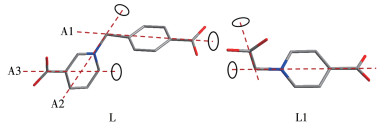
It is noticeable, however, that in our previous work a totally different 3D hydrogen-bonded network, consisting of analogous [Cd(L1)2(H2O)4] supramolecular synthons similar to [Co(L)2(H2O)4], has been reported[24], where L1 represents semirigid angular 1-carboxymethylpyridinium-4-carboxylate (Scheme 2). By detailed structure analysis, we notice that four coordinated water molecules in above two complexes display the same hydrogen bonding modes and the structure differences between them mainly result from different flexibility of L and L1. As shown in Scheme 2, L ligand in 1 has three rotating directions, larger than two ones of L1 ligands in [Cd(L1)2(H2O)4] supramolecule, meaning L ligand features greater flexibility.
In contrast to the mononuclear structure and P1 space group of 1, complex 2 displays an infinite 1D zigzag chain structure and P21/n space group, in which each asymmetric unit contains one Cd(Ⅱ) ion, two L ligands, one coordinated water molecule and three lattice water molecules. Each Cd(Ⅱ) center is bound to seven coordinated oxygen atoms, six O atoms of which are from three chelate carboxylate and the rest one is from one water molecule. As depicted in Fig. 2a, if chelate carboxylate is deemed as one coordination site, the geometry of Cd(Ⅱ) ions is tetrahedron. The average bond distances of Cd—Ocarboxylate and Cd—Owater are 0.238 74 and 0.226 85 nm, respectively, which are comparable to the reported Cd—O bond lengths in Scheme 2 Flexible conformation of L and L1 ligands other Cd(Ⅱ) complexes with positional isomer of L ligand[25] and longer than Co—O bond distances in 1. The bond angles range from 54.29(4)° to 139.84(5)°, among which three smallest angles of 54.29(4)°, 55.24(4)° and 55.24(4)° are bite angles of three chelate carboxylate anions (Table 2).
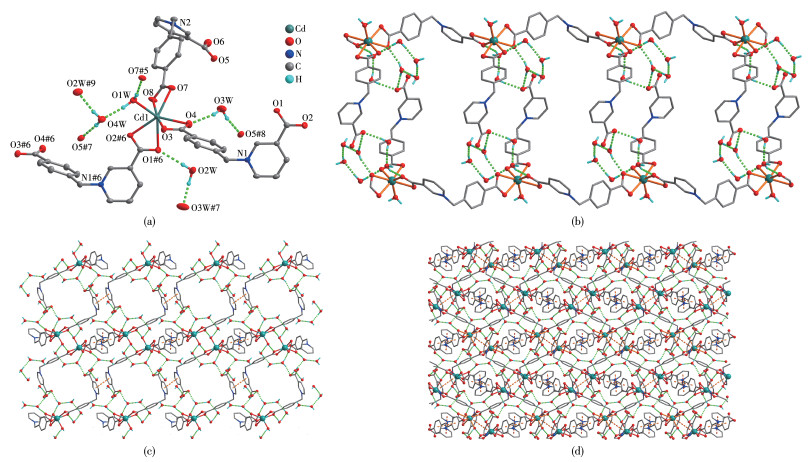
Symmetry codes: #5: -x, -y, -z+1; #6: x+1, y, z; #7: x+1/2, -y+1/2, z+1/2; #8: -x, -y+1, -z+1; #9: -x+1/2, y-1/2, -z+3/2
In contrast to one type of L ligand in 1, two types of L ligands are founded in 2. One type of L ligand functions as terminal ligands, similar to that in 1, but the carboxylate anion far away from pyridyl motif in 2 adopts chelate mode, rather than mono-dentate mode as taken in 1, to bind to central Cd(Ⅱ) ions. The other type of L ligand serves as bridging ligand, taking bis-chelate mode to link two Cd(Ⅱ) ions. At the same time, regardless of pendent L and coordinated water molecule, Cd(Ⅱ) ions can be treated as 2-connected nodes, which connect with V-shaped 2-connected L linkers to give rise to 1D polymeric zigzag chains with shortest Cd…Cd distance of 1.291 nm along crystallographic a-axis (Fig. 2b). In contrast, by the reaction of Cd(Ⅱ) salts and rigid V-shaped 4-carboxy-1-(4-carboxybenzyl)pyridinium ligand, three same 1D Cd(Ⅱ) metallacyclic chains with different space groups, rather than 1D zigzag chain of 2, have been synthesized[11, 32]. Intriguingly, two adjacent 1D zigzag chains are joined face to face by abundant intermolecular O—H…O hydrogen bonds with graph-set symbol of R55(12) (O3W …O4 0.277 nm, O2W…O3W#7 0.268 nm, O4W… O2W#9 0.278 nm, O1W…O4W 0.270 nm, O1W…O7#5 0.269 nm; symmetry codes: #5: -x, -y, -z+1; #7: x+1/2, -y+1/2, z+1/2; #9: -x+1/2, y-1/2, -z+3/2) and R54(12) (O3W…O4 0.277 nm, O3W…O5#8 0.282 nm, O4W… O5#7 0.280 nm, O4W…O2W#9 0.278 nm, O2W…O1#6 0.283 nm; symmetry codes: #6: x+1, y, z; #8: -x, -y+1, -z+1), forming a 1D tube along a-axis (Fig. 2b). Such 1D tubes further extends side by side via Cd—O1W coordination bonds and three types of π-π interactions (Table 4), forming a 3D framework (Fig. 2c). To avoid large voids, two identical networks are further combined with each other by the shared hydrogen bonds described above, generating a 3D supramolecular structure (Fig. 2d). From another point of view, the structures of 2 can also be described as follows: two face-to-face 1D zigzag chains are joined together via π-π interactions between two charged pyridyl rings (centroid-to centroid distance for Cg(2)-Cg(2) is 0.363 nm) from the pendent L ligands, generating a ladder 1D chain (Fig. S4). That is to say: two hanging terminal L ligands constitute the rungs and two 1D polymeric chains are side rails of the ladder. At the same time, the repeated Cd4L6 rings in each ladder chain display large dimensions of 2.243 nm× 1.291 nm. In addition to the π-π stacking between two pyridyl rings from the terminal L ligands, the π-π interactions also exist between two pyridyl rings (ring 1: N1, C1, C2, C3, C4, C5), as well as two phenyl rings (ring 3: C8, C9, C10, C11, C12, C13), from two side rails of the adjacent two ladder chains (Fig. S5). The corresponding centroid-to-centroid distances are 0.384 and 0.385 nm, respectively. This implies that above 1D ladder chains are further joined together side by side via weak π-π stacking of two side rails from adjacent 1D ladder chains, resulting in wavy 2D sheets. Such 2D sheets are further assembled via eight types of O—H…O hydrogen bonds to form a 3D structure. From a topological point of view, the packing mode of 2 can be described as the plywood-like array of 1D zigzag chains, which are further solidified via π-π interactions and abundant O—H…O hydrogen bonding to form a 3D supramolecular structure.
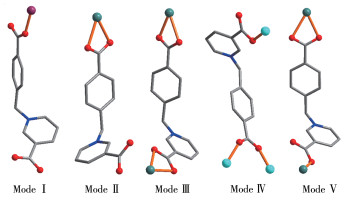
From the above descriptions, we can clearly realize that semirigid L ligand plays critical roles in the formation of 1 and 2. Thus, it is very interesting and essential to compare the structural data of this semirigid building block in 1 and 2 and other two related compounds [Zn(L) (4, 4-bpy)0.5]ClO4 (3) and [Cd(L) (4, 4' bpy)·H2O]ClO4·2H2O (4)[25-26]. In the case of 1, terminal L ligand adopts only monodentate mode (Scheme 3). In contrast to 1, there are two types of L ligands in 2. Terminal L ligand takes chelate mode and bridging ones adopt bis-chelate mode. In particular, the coordinated carboxylic groups from terminal L ligands of 1 and 2 are all bound to phenyl rings rather than pyridyl rings, which was attributed to the electrostatic repulsion between central metal ion and charged pyridyl moieties. All in all, by strong coordination bonds, L ligands and Co(Ⅱ) or Cd(Ⅱ) salts are bonded to form 0D and 1D coordination compounds 1 and 2. While in documented complexes 3 and 4, L ligands both act as bridging ligand with different coordination modes Ⅳ and Ⅴ, respectively (Scheme 3 and Table 5). Then, both 1 and 2 are further assembled into 3D supramolecular coordination networks via hydrogen bonds and π-π stacking. The IR spectra of 1 and 2 showed broad vibration band of H2O molecules, proving the existence of O—H…O hydrogen bonds (Fig.S3). Moreover, compared with 2, the vibration peak of H2O molecules in 1 had significant red shift, which results from the inductive effect of central Cd(Ⅱ) ions on the O—H bonds of coordinated water molecules. Besides hydrogen bonds, π-π interactions also play important roles during the creation of SCNs. In order to generate as many hydrogen bonds and π-π interactions as possible to reduce the energy of 1 and 2, the flexibility of ligand L also plays crucial role[33-34]. To study the influence of flexibility on the structure in detail, we compared dihedral angles formed between the benzene ring and the pyridine ring, as well as torsion angles between A1 and A3 axis along A2 direction (Scheme 2). As shown in Table 5, the dihedral angles fall within the scope of 78.1° 89.0°. Whereas, torsion angles vary widely, ranging from 73.1° to 116.5°. By analysis, we can draw a conclusion that the coordination modes and flexibility of L ligands play a subtle role for the construction of SCNs.
下载:
导出CSV
| Complex | Coordination mode | Ligand type | Dihedral angle φ/(°) | Torsion angle ω/(°) |
| [Co(L)2(H2O)4]·2H2O(1) | Ⅰ | terminal | 85.8 | 116.5 |
| [Cd(L)2(H2O)]·3H2O(2) | Ⅱ | terminal | 89.0 | 76.6 |
| Ⅲ | bridging | 88.9 | 81.2 | |
| [Zn(L)(4, 4'-bpy)0.5]·ClO4(3) [25] | Ⅳ | bridging | 78.5 | 73.1 |
| [Cd(L)(4, 4'-bpy)·H2O] • ClO4·2H2O (4) [26] | Ⅴ | bridging | 78.1 | 84.3 |
The thermal and chemical stabilities of 1 and 2 were studied, which are critical for the potential future application. TG curves of 1 and 2 are shown in Fig.S6. For 1, along with the heating, a weight loss of 15.77% (Calcd. 15.89%) were first observed in the temperature region of 30.00-128.42 ℃, which are attributed to the departure of guest and coordinated water molecules. In contrast to 1, all guest and coordinated water molecules of 2 were removed with weight loss of 11.54% (Calcd. 10.33%) below 112.09 ℃. On the other hand, two complexes both have high decomposition temperature, 261.61 ℃ for 1 and 278.11 ℃ for 2. In addition to high thermal stabilities, 1 and 2 also possess good chemical stabilities in acidic, basic and neutral aqueous solutions. The powder samples of 1 and 2 were first placed into aqueous solutions with different pH values for 12 h. After filtration, the soaked solid samples were then analyzed by PXRD to verify their chemical stabilities. As shown in Fig.S7 and S8, complex 1 is stable in the solution with a pH value range of 3-9, while 2 is stable in solutions with a pH value range of 4-8. In a word, complexes 1 and 2 have good thermal and chemical stabilities.
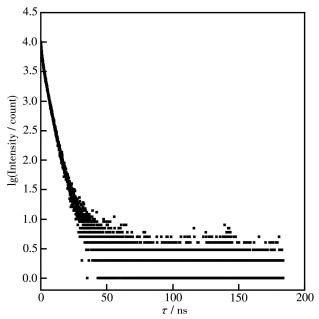
Considering the transparency, indissolubility in common solvents and abundant π-π interactions, the solid photoluminescence of complex 2 was investigated in detail at room temperature. The photoluminescence experiment showed that 2 had a narrow maximum emission at 390 nm upon excitation at 350 nm. To further find out the luminescence mechanism, the solid luminescence property of ligand L was also investigated under the same experimental conditions. Interestingly, the spectrum of (H2L)Br ligand displayed a broad emission band centered at 445 nm upon excitation at 370 nm, where there were apparent red shift of 55 and 20 nm for the maximum emission and excitation peaks compared with those of complex 2, respectively (Fig. 3). Compared to different fluorescence spectra, solid free (H2L)Br ligand and complex 2 gave comparable absorption bands centered at about 300 nm, which are attributed to n-π* and π-π* transitions (Fig.S9). It is worthwhile that 2 exhibited stronger absorption intensity above 350 nm than free (H2L)Br ligand. Based on above experimental results, namely, narrower and stronger peak and large blue shift for 2, we judge that the luminescence mechanism of 2 is different from that of (H2L)Br ligand. To further elucidate the emission property, luminescence lifetime of complex 2 was investigated. Fig. 4 exhibits the decay curve, which corresponds to three-exponential function accompanied with decay lifetimes of 0.94 ns (16.12%), 3.65 ns (79.21%) and 11.36 ns (4.67%), thus proving the presence of three kinds of emissive center (π-π*, LMCT and n-π*) in 2[35-38]. In short, the experimental results reveal the structure of 2 has a subtle effect on the final luminescence property.
By utilizing semirigid ligand (H2L)Br, together with Co(Ⅱ) and Cd(Ⅱ) salts, two complexes featuring mononuclear and polymeric 1D chain structures have been successfully created via strong coordination interaction. Both complexes further assembly into 3D supramolecular architectures via weak hydrogen bonds and π-π stacking, indicating that, by carefully selecting ligands, complicated 3D supramolecular architectures can also be generated from the simplest mononuclear coordination entity. Such structure modulation enables us to endow simple 0D and 1D structures with important functions, such as side-by-side channels which usually appear in 2D or 3D network. Furthermore, the luminescence investigations demonstrate that the structures of crystalline coordination supramolecules have great influence on their photoluminescent properties, which even totally different from those of their building components.
Sapianik A A, Kovalenko K A, Samsonenko D G, Barsukova M O, Dybtsev D N, Fedin V P. Exceptionally Effective Benzene/Cyclohexane Separation Using a Nitro-Decorated Metal-Organic Framework[J]. Chem. Commun., 2020, 56(59): 8241-8244. doi: 10.1039/D0CC03227A
Sun Y Y, Wang F, Zhang J. Synthesis of Anionic Metal-Organic Zeolites for Selective Gas Adsorption and Ion Exchange[J]. Inorg. Chem., 2019, 58(7): 4076-4079. doi: 10.1021/acs.inorgchem.9b00261
Wu N N, Li Q, Li J, Wu D P, Li Y S. 4-Connected Cobalt-Based 3D Framework with a High Affinity for Acetylene[J]. Inorg. Chem., 2020, 59(14): 9461-9464. doi: 10.1021/acs.inorgchem.0c01168
Sharma S, Mittal D, Verma A K, Roy I. Copper-Gallic Acid Nanoscale Metal-Organic Framework for Combined Drug Delivery and Photodynamic Therapy[J]. ACS Appl. Bio Mater., 2019, 2(5): 2092-2101. doi: 10.1021/acsabm.9b00116
Huang Y Q, Chen H Y, Wang Y, Ren Y H, Li Z G, Li L C, Wang Y. A Channel-Structured Eu-Based Metal-Organic Framework with a Zwitterionic Ligand for Selectively Sensing Fe3+ Ions[J]. RSC Adv., 2018, 8(38): 21444-21450. doi: 10.1039/C8RA02809E
Cai K, Tan W J, Zhao N, He H M. Design and Assembly of a Hierarchically Micro-and Mesoporous MOF as a Highly Efficient Heterogeneous Catalyst for Knoevenagel Condensation Reaction[J]. Cryst. Growth Des., 2020, 20(7): 4845-4851. doi: 10.1021/acs.cgd.0c00636
Kharitonov A D, Trofimova O Y, Meshcheryakova I N, Fukin G K, Khrizanforov M N, Budnikova Y H, Bogomyakov A S, Aysin R R, Kovalenko K A, Piskunov A V. 2D-Metal-Organic Coordination Polymers of Lanthanides (La(Ⅲ), Pr(Ⅲ) and Nd(Ⅲ)) with Redox-Active Dioxolene Bridging Ligands[J]. CrystEngComm, 2020, 22(28): 4675-4679. doi: 10.1039/D0CE00767F
Ponjan N, Kielar F, Dungkaew W, Kongpatpanich K, Zenno H, Hayami S, Sukwattanasinitt M, Chainok K. Self-Assembly of Three-Dimensional Oxalate-Bridged Alkali(Ⅰ)-Lanthanide(Ⅲ)Heterometal-Organic Frameworks[J]. CrystEngComm, 2020, 22(29): 4833-4841. doi: 10.1039/D0CE00099J
Li H Y, Xu J, Li L K, Du X S, Li F A, Xu H, Zang S Q. Photochromic Properties of a Series of Zinc(Ⅱ)-Viologen Complexes with Structural Regulation by Anions[J]. Cryst. Growth Des., 2017, 17(12): 6311-6319. doi: 10.1021/acs.cgd.7b00995
Ye Z M, Zhang X W, Liao P Q, Xie Y, Xu Y T, Zhang X F, Wang C, Liu D X, Huang N Y, Qiu Z H, Zhou D D, He C T, Zhang J P. A Hydrogen-Bonded yet Hydrophobic Porous Molecular Crystal for Molecular-Sieving-like Separation of Butane and Isobutane[J]. Angew. Chem. Int. Ed., 2020, 59(51): 23322-23328. doi: 10.1002/anie.202011300
Huang Y Q, Li Z G, Chen H Y, Cheng H D, Wang Y, Ren Y H, Zhao Y, Liu L. Pseudopolymorphism Based on 1D Metallacyclic Chains Constructed from an Angular Zwitterionic Ditopic Diacid Organic Linker[J]. CrystEngComm, 2017, 19(44): 6686-6693. doi: 10.1039/C7CE01568B
丁埼晖, 刘瑶瑶, 李鲁超, 黄永清, 赵越. 三个Zn(Ⅱ)/Co(Ⅱ) 配位聚合物的合成、结构与光带能隙[J]. 无机化学学报, 2020,36,(11): 2014-2022. doi: 10.11862/CJIC.2020.245DING Q H, LIU Y Y, LI L C, HUANG Y Q, ZHAO Y. Syntheses, Structures and Optical Band Gaps of Three Zn(Ⅱ)/Co(Ⅱ) Coordination Polymers[J]. Chinese J. Inorg. Chem., 2020, 36(11): 2014-2022. doi: 10.11862/CJIC.2020.245
Zhou M, Liu G L, Ju Z F, Su K Z, Du S F, Tan Y X, Yuan D Q. Hydrogen-Bonded Framework Isomers Based on Zr-Metal Organic Cage: Connectivity, Stability, and Porosity[J]. Cryst. Growth Des., 2020, 20(6): 4127-4134. doi: 10.1021/acs.cgd.0c00407
Janiak C. A Critical Account on π-π Stacking in Metal Complexes with Aromatic Nitrogen-Containing Ligands[J]. J. Chem. Soc., Dalton Trans., 2000, (21): 3885-3896. doi: 10.1039/b003010o
Puttreddy R, Essen C V, Rissanen K. Halogen Bonds in Square Planar 2, 5-Dihalopyridine-C opper(Ⅱ)Bromide Complexes[J]. Eur. J. Inorg. Chem., 2018, (20/21): 2393-2398.
Hsiao H L, Wu C J, Hsu W, Yeh C W, Xie M Y, Huang W J, Chen J D. Diverse Ag(Ⅰ) Complexes Constructed from Asymmetric Pyridyl and Pyrimidyl Amide Ligands: Roles of Ag…Ag and π-π Interactions[J]. CrystEngComm, 2012, 14(23): 8143-8152. doi: 10.1039/c2ce25995h
Kumar N, Khullar S, Singh Y, Mandal S K. Hierarchical Importance of Coordination and Hydrogen Bonds in the Formation of Homochiral 2D Coordination Polymers and 2D Supramolecular Assemblies[J]. CrystEngComm, 2014, 16(29): 6730-6744. doi: 10.1039/C4CE00387J
Jiang J J, Zheng S R, Liu Y, Pan M, Wang W, Su C Y. Self-Assembly of Triple Helical and meso-Helical Cylindrical Arrays Tunable by BisTripodal Coordination Converters[J]. Inorg. Chem., 2008, 47(22): 10692-10699. doi: 10.1021/ic801516b
Harms S, Köferstein R, Görls H, Robl C. Syntheses and Crystal Structures of Two Cadmium Methanetetrabenzoates Featured by Open Framework and Infinite Layers[J]. Z. Anorg. Allg. Chem., 2019, 645(14): 912-918. doi: 10.1002/zaac.201900089
Lescop C. Coordination-Driven Syntheses of Compact Supramolecular Metallacycles toward Extended Metallo-Organic Stacked Supramo-lecular Assemblies[J]. Acc. Chem. Res., 2017, 50(4): 885-894. doi: 10.1021/acs.accounts.6b00624
Liu J J, Que Q T, Liu D, Suo H B, Liu J M, Xia S B. A Multifunctional Photochromic Metal-Organic Framework with Lewis Acid Sites for Selective Amine and Anion Sensing[J]. CrystEngComm, 2020, 22(24): 4124-4129. doi: 10.1039/D0CE00560F
Aulakh D, Nicoletta A P, Pyser J B, Varghese J R, Wriedt M. Design, Structural Diversity and Properties of Novel Zwitterionic Metal-Organic Frameworks[J]. Dalton Trans., 2017, 46(21): 6853-6869. doi: 10.1039/C7DT00292K
Huang Y Q, Cheng H D, Guo B L, Wan Y, Chen H Y, Li Y K, Zhao Y. Four Alkaline Earth Metal Complexes with Structural Diversities Induced by Cation Size[J]. Inorg. Chim. Acta, 2014, 421: 318-325. doi: 10.1016/j.ica.2014.06.030
Huang Y Q, Chen H Y, Li Z G, Wang Q, Yang Y, Cao X Q, Zhao Y. Influence of N-donor Ancilary Ligands on the Structures of Three Cadmium(Ⅱ)Complexes with L-Shaped Carboxylate Ligand[J]. Inorg. Chim. Acta, 2017, 466: 71-77. doi: 10.1016/j.ica.2017.05.039
Du L, Zhou L Z, Ma Y L, Wang Y N, Wang D W, Zhao Q H. Synthesis, Structures, and Photoluminescence Properties of Five Novel Zinc(Ⅱ)and Cadmium(Ⅱ)Coordination Polymers based on Different Zwitterionic Pyridine Ligands[J]. Z. Anorg. Allg. Chem., 2017, 643(24): 2116-2123. doi: 10.1002/zaac.201700151
Wang K M, Du L, Ma Y L, Zhao Q H. Selective Sensing of 2, 4, 6-Trinitrophenol and Detection of the Ultralow Temperature Based on a Dual-Functional MOF as a Luminescent Sensor[J]. Inorg. Chem. Commun., 2016, 68: 45-49. doi: 10.1016/j.inoche.2016.04.006
Kong G Q, Wu C D. Four Novel Coordination Polymers Based on a Flexible Zwitterionic Ligand and Their Framework Dependent Luminescent Properties[J]. Cryst. Growth Des., 2010, 10(10): 4590-4595. doi: 10.1021/cg100885e
Edgington P R, McCabe P, Macrae C F, Pidcock E, Shields G P, Taylor R, Towler M, Streek J V D. Mercury: Visualization and Analysis of Crystal Structures[J]. J. Appl. Cryst., 2006, 39(3): 453-457. doi: 10.1107/S002188980600731X
Wang Y Q, Gao E Q. Molecular and Supramolecular Structures of Manganese(Ⅱ)and Cobalt(Ⅱ)Complexes with 1-Carboxymethylpyri-dinium-4-carboxylate[J]. Chin. J. Struct. Chem., 2010, 29(9): 1331-1336.
Chen M, Chen M Z, Zhou C Q, Lin W E, Jiang Z H. Towards Polynuclear Metal Complexes with Enhanced Bioactivities: Synthesis, Crystal Structures and DNA Cleaving Activities of CuⅡ, NiⅡ, ZnⅡ, CoⅡ and MnⅡ Complexes Derived from 4-Carboxy-1-(4-carboxybenzyl) Pyridinium Bromide[J]. Inorg. Chim. Acta, 2013, 405: 461-469. doi: 10.1016/j.ica.2013.02.008
Zhang J Y, Wang K, Li X B, Gao E Q. Magnetic Coupling and Slow Relaxation of Magnetization in Chain-Based MnⅡ, CoⅡ, and NiⅡ Coordination Frameworks[J]. Inorg. Chem., 2014, 53(17): 9306-9314. doi: 10.1021/ic5014279
丁芳芳, 张娜, 张建勇, 王敏, 高恩庆. 两个由两性二酸配体构筑的Cd(Ⅱ) 低维配合物的合成、结构及荧光性质[J]. 无机化学学报, 2015,31,(10): 1929-1937. DING F F, ZHANG N, ZHANG J Y, WANG M, GAO E Q. Two Low Dimensional Cd(Ⅱ) Coordination Polymers Constructed from Zwitterionic Dicarboxylate Ligand: Syntheses, Structures, and Fluorescent Properties[J]. Chinese J. Inorg. Chem., 2015, 31(10): 1929-1937.
Huang Y Q, Cheng H D, Chen H Y, Wan Y, Liu C L, Zhao Y, Xiao X F, Chen L H. Structural Diversity in Coordination Polymers with a Semirigid Lewis Acidity Ligand: Structures and Properties[J]. CrystEngComm, 2015, 17(30): 5690-5701. doi: 10.1039/C5CE00677E
Lin Z J, Lü J, Hong M C, Cao R. Metal-Organic Frameworks Based on Flexible Ligands (FL-MOFs): Structures and Applications[J]. Chem. Soc. Rev., 2014, 43(16): 5867-5895. doi: 10.1039/C3CS60483G
Yang Q Y, Pan M, Wei S C, Hsu C W, Lehn J M, Su C Y. Photoluminescent 3D Lanthanide MOFs with a Rare (10, 3)-d Net Based on a New Tripodal Organic Linker[J]. CrystEngComm, 2014, 16(28): 6469-6475. doi: 10.1039/C4CE00586D
Hu Z C, Deibert B J, Li J. Luminescent Metal-Organic Frameworks for Chemical Sensing and Explosive Detection[J]. Chem. Soc. Rev., 2014, 43(16): 5815-5840. doi: 10.1039/C4CS00010B
Xiao X, Zhu W W, Lei Y B, Liu Q Y, Li Q, Li W W. Zwitterionic Buffer-Induced Visible Light Excitation of TiO2 for Efficient Pollutant Photodegradation[J]. RSC Adv., 2016, 6(42): 35449-35454. doi: 10.1039/C6RA02979E
Allendorf M D, Bauer C A, Bhakta R K, Houk R J T. Luminescent Metal-Organic Frameworks[J]. Chem. Soc. Rev., 2009, 38(5): 1330-1352. doi: 10.1039/b802352m

Symmetry codes: #5: -x, -y, -z+1; #6: x+1, y, z; #7: x+1/2, -y+1/2, z+1/2; #8: -x, -y+1, -z+1; #9: -x+1/2, y-1/2, -z+3/2
| Parameter | 1 | 2 |
| Empirical formula | C28H32CoN2O14 | C28H28CdN2O12 |
| Formula weight | 679.48 | 696.92 |
| Crystal system | Triclinic | Monoclinic |
| Space group | P1 | P21/n |
| a/nm | 0.767 49(7) | 1.290 90(7) |
| b/nm | 0.902 95(8) | 1.625 48(8) |
| c/nm | 1.139 56(10) | 1.442 41(7) |
| α/(°) | 85.698 0(10) | |
| β/(°) | 71.996 0(10) | 114.514 0(10) |
| γ/(°) | 79.651 0(10) | |
| V/nm3 | 0.738 67(11) | 2.753 8(2) |
| Z | 1 | 4 |
| Dc/(g.cm-3) | 1.527 | 1.681 |
| μ/mm-1 | 0.656 | 0.864 |
| F(000) | 353 | 1 416 |
| θ range for data collection/(°) | 2.29-28.3 | 2.76-27.6 |
| Independent reflection | 3 324 | 6 284 |
| Data, restraint, parameter | 3 324, 4, 211 | 6 284, 0, 412 |
| Rint | 0.020 1 | 0.035 3 |
| Goodness-of-fit on F2 | 1.041 | 1.054 |
| R1, wR2 [I>2σ(I)] | 0.035 0, 0.094 2 | 0.024 7, 0.068 4 |
| R1, wR2 (all data) | 0.036 7, 0.095 8 | 0.026 5, 0.069 9 |
 下载: 导出CSV
| 1 | |||||
| Co1—O2W#1 | 0.205 59(13) | Co1—02W | 0.205 59(13) | Co1—03#1 | 0.207 42(13) |
| Co1—03 | 0.207 42(13) | Co1—01W#1 | 0.213 60(13) | Co1—01W | 0.213 60(13) |
| O2W#1—Co1—O2W | 180.0 | 02W#1—Co1—03#1 | 91.12(6) | 02W—Co1—03#1 | 88.88(6) |
| O2W#1—Co1—O3 | 88.88(6) | 02W—Co1—03 | 91.12(6) | 03#1—Co1—03 | 180.0 |
| O2W#1—Co1—O1W#1 | 87.45(5) | 02W—Co1—01W#1 | 92.55(5) | 03#1—Co1—01W#1 | 86.33(5) |
| O3—Co1—O1W#1 | 93.67(5) | 01W#1—Co1—01W | 180.0 | 02W#1—Co1—01W | 92.55(5) |
| 02W—Co1—01W | 87.45(5) | 03#1—Co1—01W | 93.67(5) | 03—Co1—01W | 86.33(5) |
| 2 | |||||
| Cd1—01W | 0.226 85(13) | Cd1—08 | 0.239 05(12) | Cd1—01#2 | 0.244 06(13) |
| Cd1—03 | 0.232 26(11) | Cd1—02#2 | 0.240 25(12) | Cd1—07 | 0.234 03(12) |
| Cd1—04 | 0.242 77(12) | ||||
| 01W—Cd1—03 | 86.82(4) | 01W—Cd1—07 | 87.37(5) | 01W—Cd1—08 | 90.65(5) |
| 03—Cd1—08 | 170.82(4) | 01W—Cd1—02#2 | 80.13(5) | 03—Cd1—02#2 | 103.06(4) |
| 08—Cd1—02#2 | 85.17(4) | 01W—Cd1—04 | 129.34(5) | 07—Cd1—04 | 82.15(4) |
| 08—Cd1—04 | 121.20(4) | 01W—Cd1—01#2 | 129.91(5) | 03—Cd1—01#2 | 84.75(5) |
| 08—Cd1—01#2 | 103.57(4) | 02#2—Cd1—01#2 | 54.29(4) | 03—Cd1—07 | 115.77(4) |
| 02#2—Cd1—04 | 135.31(4) | 07—Cd1—08 | 55.25(4) | 07—Cd1—01#2 | 139.84(5) |
| 07—Cd1—02#2 | 138.39(4) | 04—Cd1—01#2 | 83.08(4) | 03—Cd1—04 | 55.24(4) |
| Symmetry codes: #1:-x, -y+1, -z; #2: x+1, y, z. | |||||
下载: 导出CSV
| D—H…A | d/(D—H)/nm | d(H…A)/nm | d(D…A)/nm | ∠DHA/(°) |
| 1 | ||||
| O1W—H1WA…O4#1 | 0.086 | 0.191 | 0.270 6(2) | 155 |
| O1W—H1WB…O2#2 | 0.085 | 0.198 | 0.283 1(2) | 175 |
| O2W—H2WA…O1#2 | 0.086 | 0.181 | 0.264 3(2) | 164 |
| O2W—H2WB…O1#3 | 0.085 | 0.184 | 0.268 1(2) | 171 |
| O3W—H3WA…O2#4 | 0.088 | 0.239 | 0.324 0(3) | 163 |
| O3W—H3WB…O4#1 | 0.085 | 0.212 | 0.282 6(2) | 140 |
| 2 | ||||
| O1W—H1WA…O7#5 | 0.078 | 0.192 | 0.268 9(2) | 171 |
| O1W—H1WB…O4W | 0.090 | 0.180 | 0.269 5(2) | 172 |
| O2W—H2WA…O1#6 | 0.079 | 0.207 | 0.282 7(2) | 162 |
| O2W—H2WB…O3W#7 | 0.098 | 0.171 | 0.268 3(2) | 178 |
| O3W—H3WA…O5#8 | 0.086 | 0.198 | 0.281 8(2) | 163 |
| O3W—H3WB…O4 | 0.081 | 0.199 | 0.276 8(2) | 161 |
| O4W—H4WA…O2W#9 | 0.083 | 0.196 | 0.278 1(2) | 170 |
| O4W—H4WB…O5#7 | 0.083 | 0.197 | 0.279 8(2) | 175 |
| Symmetry codes: #1: -x, -y+1, -z; #2: -x, -y, -z-1; #3: x-1, y+1, z+1; #4: x, y, z+1; #5: -x, -y, -z+1; #6: x+1, y, z; #7: x+1/2, -y+1/2, z+1/2; #8: -x, -y+1, -z+1; #9: -x+1/2, y-1/2, -z+3/2. | ||||
下载: 导出CSV
| Ring Cg(i)-Cg(j) | d/nm | τ/(°) | d(Cgi_perp)/nm | d(Cgj_perp)/nm | Symmetry code |
| 1b | |||||
| Cg(1)-Cg(1) | 0.368 | 0 | 0.352 | 0.352 | -x, 1-y, 1-z |
| 2c | |||||
| Cg(1)-Cg(1) | 0.384 | 0 | 0.357 | 0.357 | 1-x, -y, 2-z |
| Cg(2)-Cg(2) | 0.363 | 0 | 0.344 | 0.344 | -π, 1-π, -π |
| Cg(3)-Cg(3) | 0.385 | 0 | 0.369 | 0.369 | 2-x, -y, 2-z |
| a Cg(i)=ring number i; τ=dihedral angle between ring i and j; d=distance between ring centroids; d(Cgi_perp)=perpendicular distance of Cg(i) on ring j; d(Cgj_perp)=perpendicular distance of Cg(j) on ring i; b Cg(1): C8, C9, C10, C11, C12, C13; c Cg(1): N1, C1, C2, C3, C4, C5; Cg(2): N2, C15, C16, C17, C18, C19; Cg(3): C8, C9, C10, C11, C12, C13. | |||||
下载: 导出CSV
| Complex | Coordination mode | Ligand type | Dihedral angle φ/(°) | Torsion angle ω/(°) |
| [Co(L)2(H2O)4]·2H2O(1) | Ⅰ | terminal | 85.8 | 116.5 |
| [Cd(L)2(H2O)]·3H2O(2) | Ⅱ | terminal | 89.0 | 76.6 |
| Ⅲ | bridging | 88.9 | 81.2 | |
| [Zn(L)(4, 4'-bpy)0.5]·ClO4(3) [25] | Ⅳ | bridging | 78.5 | 73.1 |
| [Cd(L)(4, 4'-bpy)·H2O] • ClO4·2H2O (4) [26] | Ⅴ | bridging | 78.1 | 84.3 |
下载: 导出CSV

 扫一扫看文章


扫一扫关注我们



 下载:
下载: