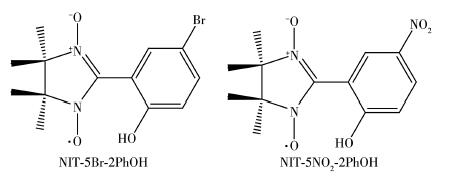
Scheme 1.
Nitronyl nitroxide radicals NIT-5Br-2PhOH and NIT-5NO2-2PhOH

Three Binuclear Lanthanide Complexes Constructed from Nitronyl Nitroxide Radical Ligands Containing Phenol Groups: Structure and Magnetic Properties
Xue-lan MEI , Jian-ni GUO , Min-jie DU , Pei-pei YANG , Qian LI , Zong-qun LI , An-rong JU


Single-molecule magnets (SMMs) have become one of the most popular research in molecular area for their potential applications in the molecular spintronics, quantum computing, and high density magnetic storage.Since the first Ln (Ⅲ) radical based SMM [Dy(hfac)3NITpPy]2[1] was discovered, rare earth-radical complexes have attracted tremendous attention.The rather large and anisotropic magnetic moments of lanthanide.ions and effective magnetic exchange between the radical and metal ion make this approach very appealing for the preparation of magnetic materials[2-7].Up to now, various 4f-radical systems revealing appealing magnetic properties have been achieved, e.g. mononuclear 4f-radical[8-15] and 4f-biradical complexes[16-19], dinuclear 4f-radical[20-29] and 4f-biradical dimmers[30], polynuclear 4f-radical complexes[31-34].Furthermore, magnetic characterization indicates that some of these 4f-radical complexes have the SMM behaviors.A perusal of the literature displays that the nitronyl nitroxide radicals (NITR) have more advantages to design magnetic materials comparing to others for their relative stability and chemically modifying easily to obtain derivatives with substituents containing donor atoms[35], and so on.Based on these advantages, we can also find that using the nitronyl nitroxide radicals including functionalized nitronyl nitroxides with 4f ions is an excellent strategy to build magnetic complexes.Actually, the strategy has been responsible for many developments in single-molecule magnetism, obtaining a lot of 4f-NITR SMMs with different structures and remarkable magnetic properties, such as ringlike 4f-NITR SMMs[36-37].But still more problems need to be solved for increasing magnetic exchange interactions and the rational design of spin topologies with interesting magnetic properties.
On account of the above consideration, to investigate the magnetic properties and structures of 4f-NITR complexes further, we focused on nitronyl nitroxide radicals with phenol group which could act as a commendable candidate to coordinate with lanthanide ions via chelating and bridging mode, leading to complexes with appealing structures.Accordingly, the radicals NIT-5Br-2PhOH and NIT-5NO2-2PhOH (NIT-5Br-2PhOH=2-(2′-hydroxy-5′-bromophenyl)-4, 4, 5, 5-tetra-methylimidazoline-1-oxyl-3-oxide, NIT-5NO2-2PhOH=2-(2′-hydroxy-5′-nitrophenyl)-4, 4, 5, 5-tetramethylimid-azoline-1-oxyl-3-oxide, Scheme 1) were employed to construct 2p-4f complexes, in which both the radicals have the same parent structures but different substituents, for probing the effects of ligand field perturbation on the properties of complexes.Meanwhile, we chose trifluoroacetylacetonate (tfac) as the coligand to strengthen Lewis acidity necessary for the coordination of the radicals to the 4f ions.We synthesized three new Ln-radical-based complexes, [Ln2(tfac)4(NIT-5Br-2PhO)2(Ln=Gd (1), Dy (2)) and [Dy2(tfac)4(NIT-5NO2-2PhO)2](3), whose crystal structures and magnetic properties were also investigated.
All solvents and chemicals used in the syntheses were reagent-grade without further purification.Syntheses of Ln(tfac)3·2H2O (Ln=Gd, Dy) have been performed according to the method in the literature[38].The radical ligands NIT-5Br-2PhOH and NIT-5NO2-2PhOH were prepared by the reported methods[39-41] Elemental analyses for C, H and N were carried out at the Institute of Elemental Organic Chemistry, Nankai University.IR spectra were recorded in a range of 400~4 000 cm-1 on a Bruker Tensor 27 FT-IR spectrometer with samples as KBr disks.Magnetic measurements were performed on a SQUID MPMS XL-7 magnetometer.Meanwhile, diamagnetic corrections were made with Pascal′s constants for all of the constituent atoms.
Gd(tfac)3·2H2O (0.131 g, 0.2 mmol) was dissolved in 30 mL dry boiling heptane, and the solution remained refluxing for 3 h and then was cooled down to 70℃.Then a solution of NIT-5Br-2PhOH (0.066 g, 0.2mmol) in 5 mL of CH2Cl2 was added.The resulting solution was stirred for 10 min at 70℃, then cooled to room temperature.Whereafter, the mixture was filtrated, and the filtrate was kept in the dark and concentrated slowly by evaporation at room temperature.Aubergine crystals were obtained after two days.Yield: 77%.Elemental analysis Calcd.for C46H46N4O14F12Br2Gd2(%): C, 34.94;H, 2.93;N, 3.54.Found(%): C, 34.95;H, 3.22;N, 3.62.IR (KBr, cm-1): 3 445(w), 1 630(s), 1 531(m), 1 486(m), 1 368(s), 1 224(s), 1 187(m), 1 132(s), 857(w), 826(w), 775(w), 725(w), 676(w), 626(w), 561(w).
The process was same as that for complex 1 except that Dy(tfac)3·2H2O (0.132 g, 0.2 mmol) was used in place of Gd(tfac)3·2H2O (0.131 g, 0.2 mmol).Yield: 72%.ElementalanalysisCalcd.for C46H46N4O14F12Br2Dy2(%): C, 34.71;H, 2.91;N, 3.50.Found(%): C, 34.75;H, 3.10;N, 3.63.IR (KBr, cm-1): 3 447(w), 1 630(s), 1 532(m), 1 486(m), 1 368(s), 1 224(s), 1 186(m), 1 132(s), 857(w), 826(w), 775(w), 728(w), 677(w), 626(w), 563(w).
A same procedure as that for complex 2 was followed to prepare complex 3, except that NIT-5Br-2PhOH was replaced by NIT-5NO2-2PhOH (0.059 g, 0.2 mmol).Yield: 72%.Elemental analysis Calcd.for C46H46F12N6O18Dy2(%): C, 36.26;H, 3.04;N, 5.51.Found(%): C, 36.63;H, 3.32;N, 5.90.IR (KBr, cm-1): 1 620(s), 1 577(m), 1 345(m), 1 291(m), 1 161(s), 1 067(s), 948(s), 861(s), 547(s), 517(s).
X-ray single-crystal diffractions of complexes 1~3 were performed on a Rigaku mercury CCD diffractometer with graphite monochromated Mo Kα radiation (λ=0.071 073 nm) at 113(2) K.In each case, absorption corrections were applied.The structures were solved by direct methods and refined with full-matrix least-squares technique using the SHELXS-97 and SHELXL-97 programs[42-43].All non-hydrogen atoms were refined anisotropically while hydrogen atoms were added theoretically and refined isotropically using a riding mode.Some disordered fragments of structures were found for some carbon, oxygen and fluorine atoms of tfac.The restraints by ISOR, DFIX, DELU and SIMU were applied to three complexes to keep the disordered mol-ecules reasonable[44].More specifically, for complex 1, the F1, F2, F3 atoms of one tfac ligand were disordered over two orientations and refined with site-occupation factors of 0.501∶0.499;for complex 2, the F4, F5, F6atoms of the disordered coordinated tfac ligand were divided into two parts with occupancies tatio of 0.500∶0.500;and for complex 3, the C16, C17, C21, C22, C23, O6 and F4 atoms in the two tfac ligands were positionally disordered and each disorder components were refined as half-occupied.Meanwhile, the bond lengths of C1—F1′, C1—F2′, C1—F3′, C5—F1, C5—F2, C5—F3 (complex 1), C6—F4′, C6—F5′, C6—F6′, C10—F4, C10—F5, C10—F6 (complex 2) and C2—C3, C17—C16, Dy1—O4 (complex 3) were restrained to be the same within a standard deviation of 0.001 nm, respectively.Detailed data collection and refinement parameters of complexes 1~3 are summarized in Table 1.Selected important bond lengths and angles are listed in Table 2.
 下载:
导出CSV
下载:
导出CSV
| Complex | 1 | 2 | 3 |
| Empirical formula | C46H46N4O14F12Br2Gd2 | C46H46N4O14F12Br2Dy2 | C46H46F12N6O18Dy2 |
| Formula weight | 1 581.17 | 1 591.67 | 1 523.89 |
| Crystal system | Triclinic | Triclinic | Triclinic |
| Space group | P1 | P1 | P1 |
| a/nm | 1.174 5(2) | 1.175 72(17) | 1.100 29(19) |
| b/nm | 1.185 43(18) | 1.184 27(16) | 1.169 49(19) |
| c/nm | 1.242 4(2) | 1.244 83(18) | 1.230 59(10) |
| α/(°) | 66.141(17) | 66.639(11) | 71.707(16) |
| β/(°) | 73.93(2) | 73.949(14) | 72.531(15) |
| γ/(°) | 65.166(16) | 64.922(11) | 86.792(19) |
| V/nm3 | 1.423 7(4) | 1.428 9(4) | 1.432 9(4) |
| Z | 1 | 1 | 1 |
| D/(g.cm-3) | 1.844 | 1.850 | 1.776 |
| μ/mm-1 | 3.815 | 4.095 | 2.699 |
| θ range/(°) | 1.81~25.01 | 1.80~25.01 | 3.04~25.00 |
| F(000) | 768 | 772 | 748 |
| Crystal size/mm | 0.20×0.19×0.04 | 0.18×0.17×0.05 | 0.20×0.18×0.06 |
| Reflection collected | 14 845 | 11 881 | 13 042 |
| Unique reflection | 5 003 | 5 003 | 4 944 |
| Rint | 0.031 8 | 0.032 2 | 0.058 0 |
| GOF (F2) | 1.069 | 1.035 | 1.077 |
| R1[I>2σ(I)] | 0.027 3 | 0.027 7 | 0.062 9 |
| wR2 [I>2σ(I)] | 0.067 9 | 0.061 3 | 0.143 7 |
| R1 (all data) | 0.030 3 | 0.031 2 | 0.087 5 |
| wR2 (all data) | 0.068 9 | 0.062 5 | 0.1629 |
下载:
导出CSV
| 1 | |||||
| Gd1—O1 | 0.225 8(3) | Gd1—07 | 0.232 9(3) | N1—C17 | 0.132 9(5) |
| Gd1—02 | 0.230 8(3) | Gd1—07#1 | 0.228 2(3) | N1—C18 | 0.150 5(5) |
| Gd1—03 | 0.227 4(3) | 05—N1 | 0.130 5(4) | N2—C17 | 0.138 0(5) |
| Gd1—04 | 0.228 5(3) | 06—N2 | 0.127 2(5) | N2—C21 | 0.150 0(6) |
| Gd1—05 | 0.224 4(3) | 07—C11 | 0.134 1(5) | ||
| 01—Gd1—02 | 75.06(11) | 05—N1—C18 | 120.2(3) | 05—Gd1—02 | 79.48(11) |
| 03—Gd1—04 | 76.63(11) | 06—N2—C17 | 125.3(4) | 05—Gd1—03 | 82.04(10) |
| 05—Gd1—07 | 75.32(10) | 06—N2—C21 | 122.7(4) | 05—Gd1—04 | 155.05(11) |
| 05—N1—C17 | 126.5(4) | 05—Gd1—01 | 113.46(11) | ||
| 2 | |||||
| Dy1—01 | 0.228 8(3) | Dy1—05#2 | 0.234 2(3) | N1—C19 | 0.150 2(4) |
| Dy1—02 | 0.230 0(3) | Dy1—06#2 | 0.227 1(2) | N2—C17 | 0.137 3(5) |
| Dy1—03 | 0.228 0(3) | 06—N1 | 0.129 9(4) | N2—C18 | 0.149 3(5) |
| Dy1—04 | 0.232 0(3) | 07—N2 | 0.127 4(4) | 05—C11 | 0.135 1(4) |
| Dy1—05 | 0.230 0(2) | N1—C17 | 0.132 3(5) | ||
| 01—Dy1—02 | 76.06(9) | 06—N1—C17 | 127.1(3) | 05—Dy1—02 | 82.76(9) |
| 06#1—Dy1—05 | 106.82(9) | 06—N1—C19 | 120.3(3) | 03—Dy1—05 | 117.45(9) |
| C11—05—Dy1 | 127.3(2) | 07—N2—C17 | 125.5(3) | 05—Dy1—04 | 159.78(9) |
| C11—05—Dy1#2 | 120.6(2) | 07—N2—C18 | 122.4(3) | ||
| 3 | |||||
| Dy1—01 | 0.227 5(7) | Dy1—07 | 0.233 0(6) | 02—N1 | 0.127 4(11) |
| Dy1—03 | 0.227 1(8) | Dy1—07#3 | 0.234 0(6) | N2—C4 | 0.148 8(14) |
| Dy1—04 | 0.229 1(6) | 07—Dy1#3 | 0.234 0(6) | N2—C7 | 0.132 7(12) |
| Dy1——O5 | 0.224 5(8) | Dy1——Dy1#3 | 0.386 27(11) | O7——C13 | 0.133 5(12) |
| Dy1——O6 | 0.238 5(16) | O1——N2 | 0.129 5(10) | ||
| O5——Dy1——O3 | 148.2(3) | O3——Dy1——O1 | 85.2(3) | O5——Dy1——O7 | 119.5(3) |
| O5——Dy1——O6 | 68.1(5) | O6——Dy1——O1 | 161.0(4) | O2——N1——C7 | 125.5(10) |
| O3——Dy1——O6 | 92.2(5) | O5——Dy1——O4 | 76.0(3) | O1——N2——C7 | 125.2(8) |
| O5——Dy1——O1 | 105.2(3) | O5——Dy1——O7#3 | 80.3(3) | ||
| Symmetry codes: #1: -x, -y+1, -z+1 for 1; #2: -x+2, -y+1, -z for 2; #3: -x+1, -y+1, -z+1 for 3. | |||||
CCDC: 1981623, 1; 1981622, 2; 2021836, 3.
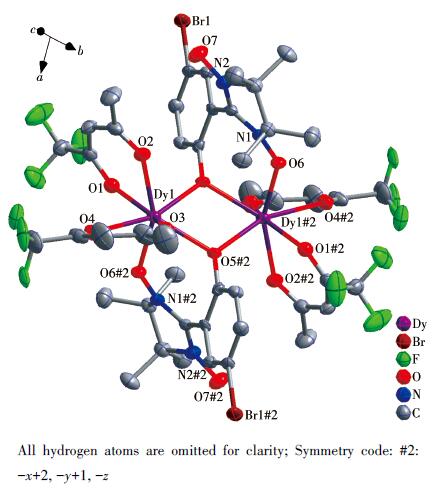
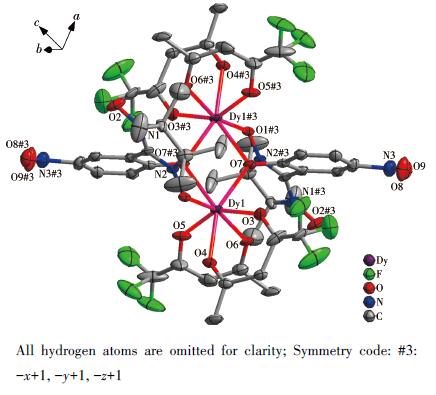
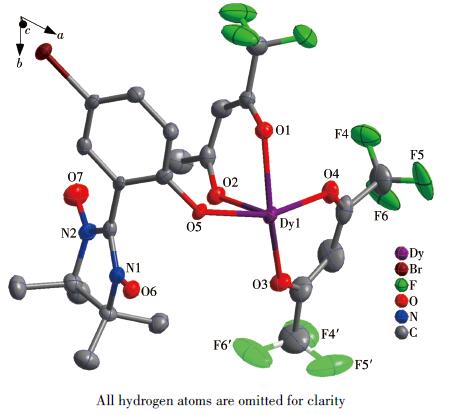
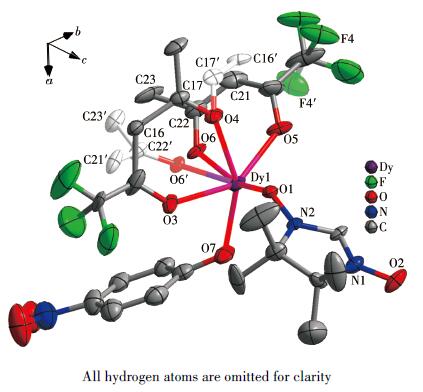
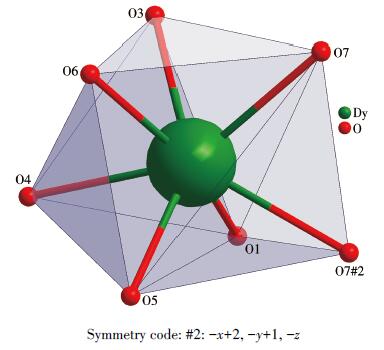
X-ray single-crystal diffraction analyses confirmed that the structures of all the three complexes are similar and crystallize in the triclinic space group P1, and that the same radicals were applied to complexes 1 and 2.Therefore, only the crystal structures of complexes 2 and 3 are described in detail as the representative samples.As shown in Fig. 1 and 2, complexes 2 and 3 are dinuclear complexes comprising of two [Dy(tfac)2(NIT-5Br-2PhO)]/[Dy(tfac)2(NIT-5NO2-2PhO)] units bridged through two phenoxo groups.For both complexes, seven-coordinated Dy(Ⅲ) ions are surrounded by four oxygen atoms from two chelating ligand of tfac anions, one oxygen atom from the N—O group and two phenoxo-O anions of two nitronyl nitroxide radicals(Fig. 3 and 4).And the phenoxo-O atoms also link to the other Dy(Ⅲ) ion forming one binuclear complex.The coordinated N—O bond length of the radicals are 0.129 9(4) and 0.128 8(10) nm, while the uncoordinat-ed ones are 0.127 3(4) and 0.128 0(12) nm, for 2 and 3, respectively, indicating the existence of the nitronyl nitroxide radical on complexes.The Dy—Ophenoxo distances are 0.230 0(2) and 0.234 2(3) nm for complex 2, 0.232 9(6) and 0.234 1(6) nm for complex 3; the Dy—Oradical distances are 0.227 0(2) nm for 2 and 0.227 9(7) nm for 3; the Dy—Otfac bond lengths are in a range of 0.228 0(3)~0.231 9(3) nm and 0.224 8(9)~0.229 0(6) nm for complexes 2 and 3, respectively; the Dy—Dy distances in Dy2O2 cores are 0.384 80(9) nm for 2 and 0.386 25(11) nm for 3;the Dy—O—Dy bridge bond angle are 111.98(9)° and 111.6(3)° for complexes 2 and 3, respectively, which are slightly changed but comparable to those of the reported complexes assembled by Dy(Ⅲ) ions with phenoxo-O anions nitronyl nitroxide radicals[45-46].For example, apparently the Dy—Oradical bond lengthes in complexes 2 and 3 are slightly shorter than the corresponding Dy—Oradical bond length (0.232 0(3) nm) in [Dy2(acac)4(NITPhO)2] and longer than the corresponding Dy—Oradical bond length (0.221 9(4) nm) in [Dy2(hfac)4(NIT5BrPhO)2]; the Dy—O—Dy bridge bond angles of complexes 2 and 3 are smaller than the bond angle of 112.88(12)° in [Dy2(acac)4(NITPhO)2][45] but bigger than the bond angle of 110.64(17)° in [Dy2(hfac)4(NIT5BrPhO)2][46].The analysis of complexes 2~3 and [Dy2(acac)4(NITPhO)2], [Dy2(hfac)4(NIT5BrPhO)2] as reported in the previous literatures shows that maybe the distinct differences of them are the number of F-substituent on the β-diketonate coligands and the symmetry of the β-diketonate coligands.This will result in a different electro-withdrawing effect induced by F atoms, and the strength of the local ligand field of the Dy(Ⅲ) ion in complexes 2 and 3 will be weaker than the Dy(Ⅲ) in [Dy2(acac)4(NITPhO)2] but stronger than the Dy(Ⅲ) in [Dy2(hfac)4(NIT5BrPhO)2].Furthermore, the data also strongly prove that the modification of coligand and functionalized radical ligand can affect the paramters of crystal structure.The polyhedral shape of the central Ln(Ⅲ) ions has been analyzed by continuous shape measures[47] employing the SHAPE program.The results presented in Table 3 reveal that the capped octahedron is the best description for the geometry of LnO7 in these complexes, and the configuration of DyO7 in complex 2 is shown in Fig. 5. The packing diagrams of complexes 2 and 3 are shown in Fig.S2 and S3 (Supporting information), respectively.The shortest Dy…Dy distance between the adjacent molecules are 0.100 81 and 0.759 6 nm, and the shortest contact between the uncoordinated NO groups is 0.396 6 and 0.753 5 nm for 2 and 3, respectively.The large separation implies the complexes molecules are well isolated in the solid state, but the possible weak intermolecular interaction is not ruled out.
 下载:
导出CSV
下载:
导出CSV
| Complex | PBPY-7(D5h) | COC-7(C3v) | CTPR-7(C2v) | JPBPY-7(D5h) | JETPY-7(C3v) |
| 1 | 7.054 | 0.414 | 1.269 | 10.455 | 18.847 |
| 2 | 7.094 | 0.456 | 1.246 | 10.540 | 18.725 |
| 3 | 6.516 | 0.496 | 1.204 | 10.004 | 18.606 |
| PBPY-7:pentagonal bipyramid; COC-7:capped octahedron; CTPR-7:capped trigonal prism; JPBPY-7:Johnson pentagonal bipyramid J13;JETPY-7:Johnson elongated triangular pyramid J7. | |||||
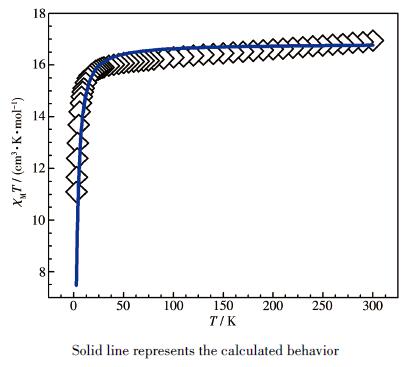
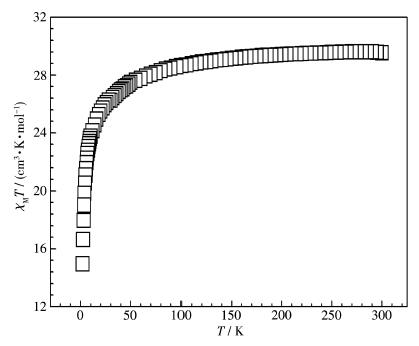
The magnetic properties of complexes 1~3 have been investigated in a temperature range of 2.0~300 K under the applied magnetic field of 1 kOe.Their magnetic behaviors (χMT vs T curves) are shown in Fig. 6~8.
For complex 1, at the highest temperature 300 K, the value of χMT was 16.94 cm3·K·mol-1, which was close to the expected value 16.5 cm3·K·mol-1 for four uncoupled spin carriers: two Gd(Ⅲ) ions (8S7/2, S=7/2, L=0, g=2, χMT=7.88 cm3·K·mol-1) and two organic radical (S=1/2).On lowering temperature, the χMT value gradually decreased to reach a minimum of 11.67 cm3·K·mol-1 at 2 K (Fig. 6).The overall magnetic behavior indicates the antiferromagnetic interactions dominate in this complex.According to the crystal structure, the main existing magnetic interactions include: (1) the interaction between Gd(Ⅲ) ion and coordinated radical(J1); (2) the magnetic coupling interaction between Gd(Ⅲ)-Gd(Ⅲ) by the phenolate bridges (J2).For the present system, the Kambe vector-coupling method cannot be used to calculate the variable-temperature susceptibility data.So, the magnetism package MAGPACK was employed to simulate the magnetic susceptibility data through the spin Hamiltonian theoretical expression
For complexes 2 and 3, the χMT value were 28.70 and 29.51 cm3·K·mol-1, respectively, which were all close to the expected value of 29.09 cm3·K·mol-1for two uncoupled Dy(Ⅲ) ions (6H15/2, χMT=14.17 cm3·K·mol-1) and two uncorrelated radical spins (S=1/2), but slightly different from the expected value.Specifically the χMT value of complex 2 was lower than the expected value while the one of complex 3 was higher than it Upon cooling, the χMT value of complexes 2 and 3 decreased gradually and reached minimum of 17.01 and 14.95 cm3·K·mol-1 at 2 K, respectively (Fig. 7 and 8).Their magnetic behaviors can be mainly ascribed to the progressive depopulation of the levels of multiplet with J=15/2 of the Dy(Ⅲ) ions[50].The Dy(Ⅲ) ion interacted with the coordinated NO group and the indirect interaction mediated through the phenolate bridges of Dy(Ⅲ) ions.The ferromagnetic behavior of the system can be judged according to this behavior.At present, it is hard to quantify the different contributions, but the Dy(Ⅲ) stark sublevel may be dominant.
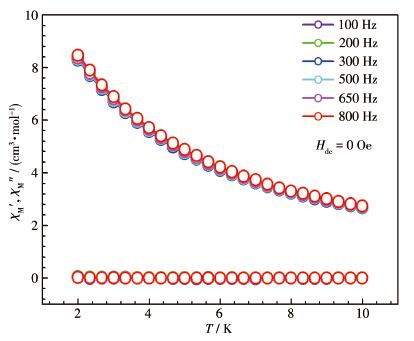
To explore the spin dynamics, the magnetic measurements of alternating current (ac) were carried out for complex 3 under an ac field of 3 Oe based on a zero direct-current (dc) field (Fig. 9).There were no non-zero out-of-phase (χM″) signals, which may be ascribed to quantum tunneling of the magnetization (QTM).To suppress QTM and remove the degeneracy of the levels on opposite sides of the anisotropy barrier further, ac magnetic susceptibilities were measured using a 3 kOe dc field (Fig.S4).But regrettably, non-zero χM″ signals still are not observed, suggesting that the quantum tunneling effect at zero-field is negligible for complex 3.
It is interesting to compare complex 3 with the previously reported complex [Dy2(hfac)4(NITPhO)2][46] for the two complexes owning similar structure but different magnetic behavior.Obviously, after replacing the β-diketonate coligand hfac with the tfac, no distinct deviations have been found in two complexes′crystal structure features, but their magnetic properties are slightly different.The structure analysing for the two complexes show that the distinct difference is the number of F-substituent on the directly coordinated β-diketonate coligand which will result in different strengths of the local ligand field of Dy(Ⅲ) ion for two complexes.In addition, the electro-withdrawing effect induced by the NO2 group of the radical also will have an effect on the strength of the local ligand field of metal ion.So, the different local ligand-fields of the Ln(Ⅲ) ions lead to different magnetic dynamic behaviors of the two complexes.
In conclusion, three new lanthanide-radical complexes have been successfully achieved.These 2p-4f complexes feature a tetra-spin system in which the radical ligands act as a bridge linking two Ln(Ⅲ) ions via the oxygen atoms of the phenolate groups.Furthermore the temperature dependencies of magnetic susceptibilities for the three complexes were studied.The magnetic coupling between the radical and the Gd(Ⅲ) is ferromagnetic while magnetic interaction between two Gd(Ⅲ) ions through the phenolate groups is antiferromagnetic No slow magnetic relaxation behavior was observed for complex 3.
Poneti G, Bernot K, Bogani L, Caneschi A, Sessoli R, Wernsdorfer W, Gatteschi D. Chem. Commun. , 2007, 18: 1807-1809
Gatteschi D, Sessoli R. Angew. Chem. Int. Ed. , 2003, 42: 268-297 doi: 10.1002/anie.200390099
Sessoli R, Powell A K. Coord. Chem. Rev. , 2009, 253: 2328-2341 doi: 10.1016/j.ccr.2008.12.014
Luzon J, Sessoli R. Dalton. Trans. , 2012, 41: 13556-13567 doi: 10.1039/c2dt31388j
Chen Y C, Liu J L, Ungur L, Liu J, Li Q W, Wang L F, Ni Z P, Chibotaru L F, Chen X M, Tong M L. J. Am. Chem. Soc. , 2016, 138: 2829-2837 doi: 10.1021/jacs.5b13584
Woodruff D N, Winpenny R E P, Layfield R A. Chem. Rev. , 2013, 113: 5110-5148 doi: 10.1021/cr400018q
Habib F, Murugesu M. Chem. Soc. Rev. , 2013, 42: 3278-3288 doi: 10.1039/c2cs35361j
胡鹏, 吴燕妮, 黄期晓, 连思绵, 付兴慧, 何高鹏, 陈侠敏. 无机化学学报, 2016, 32(2): 297-304 https://www.cnki.com.cn/Article/CJFDTOTAL-YCJY201602001.htmHU P, WU Y N, HUANG Q X, LIAN S M, FU X H, HE G P, CHEN X M. Chinese J. Inorg. Chem. , 2016, 32(2): 297-304 https://www.cnki.com.cn/Article/CJFDTOTAL-YCJY201602001.htm
胡鹏, 高媛媛, 肖凤仪, 邓肖娟, 黄国洪, 张淼, 苏芬, 王莉娜. 无机化学学报, 2017, 33(1): 33-40 https://www.cnki.com.cn/Article/CJFDTOTAL-ZGZS201903001.htmHU P, GAO Y Y, XIAO F Y, DENG X J, HUANG G H, ZHANG M, SU F, WANG L N. Chinese J. Inorg. Chem. , 2017, 33(1): 33-40 https://www.cnki.com.cn/Article/CJFDTOTAL-ZGZS201903001.htm
Booth C H, Walter M D, Kazhdan D, Hu Y J, Lukens W W, Bauer E D, Maron L, Eisenstein O, Andersen R A. J. Am. Chem. Soc. , 2009, 131: 6480-6491 doi: 10.1021/ja809624w
Caneschi A, Dei A, Gatteschi D, Sorace L, Vostrikova K. Angew. Chem. Int. Ed. , 2000, 39: 246-248 doi: 10.1002/(SICI)1521-3773(20000103)39:1<246::AID-ANIE246>3.0.CO;2-B
Gurek A G, Basova T, Luneau D, Lebrun C, Kol'tsov E, Hassan A K, Ahsen V. Inorg. Chem. , 2006, 45(4): 1667-1676 doi: 10.1021/ic051754n
Kanetomo T, Ishida T. Chem. Commun. , 2014, 50(19): 2529-2531 doi: 10.1039/c3cc48326f
Trifonov A A, Gudilenkov I D, Larionova J, Luna C, Fukin G K, Cherkasov A V, Poddel'sky A I, Druzhkov N O. Organometallics, 2009, 28(23): 6707-6713 doi: 10.1021/om9004143
Ganivet C R, Ballesteros B, de la Torre G, Clemente Juan J M, Coronado E, Torres T. Chem. Eur. J. , 2013, 19(4): 1457-1465 doi: 10.1002/chem.201202600
Bernot K, Pointillart F, Rosa P, EtienneM, Sessoli R, Gatteschi D. Chem. Commun. , 2010, 46(35): 6458-6460 doi: 10.1039/c0cc00966k
Tian L, Sun Y Q, Na B, Cheng P. Eur. J. Inorg. Chem. , 2013(24): 4329-4335
Li X, Li T, Tian L, Liu Z Y, Wang X G. RSC Adv. , 2015, 5(91): 74864-74873 doi: 10.1039/C5RA13386F
Li H D, Xie J, Xi L, Zhai L J, Niu Y L. Inorg. Chim. Acta, 2020, 499: 119188 doi: 10.1016/j.ica.2019.119188
Demir S, Gonzalez M I, Darago L E, Evans W J, Long J R. Nat. Commun. , 2017, 8: 2144 doi: 10.1038/s41467-017-01553-w
Liu R N, Liu L, Fang D, Xu J, Zhao S P, Xu W L. Z. Anorg. Allg. Chem. , 2015, 641(3/4): 728-731
Reis S G, Briganti M, Soriano S, Guedes G P, Calancea S, Tiseanu C, Novak M A, del Aguila Sanchez M A, Totti F, Lopez Ortiz F, Andruh M, Vaz M G F. Inorg. Chem. , 2016, 55(22): 11676-11684 doi: 10.1021/acs.inorgchem.6b01616
Demir S, Nippe M, Gonzalez M I, Long J R. Chem. Sci. , 2014, 5(12): 4701-4711 doi: 10.1039/C4SC02154A
Demir S, Zadrozny J M, Nippe M, Long J R. J. Am. Chem. Soc. , 2012, 134(45): 18546-18549 doi: 10.1021/ja308945d
Rinehart J D, Fang M, Evans W J, Long J R. Nat. Chem. , 2011, 3(7): 538-542 doi: 10.1038/nchem.1063
Meihaus K R, Corbey J F, Fang M, Ziller J W, Long J R, Evans W J. Inorg. Chem. , 2014, 53(6): 3099-3107 doi: 10.1021/ic4030102
Pointillart F, Le Gal Y, Golhen S, Cador O, Ouahab L. Chem. Commun. , 2009(25): 3777-3779 doi: 10.1039/b901932d
Dei A, Gatteschi D, Massa C A, Pardi L A, Poussereau S, Sorace L. Chem. Eur. J. , 2000, 6: 4580-4586 doi: 10.1002/1521-3765(20001215)6:24<4580::AID-CHEM4580>3.0.CO;2-B
Pointillart F, Le Guennic B, Golhen S, Cador O, Ouahab L. Chem. Commun. , 2013, 49: 11632-11634 doi: 10.1039/c3cc47087c
Reis S G, Briganti M, Martins D O T A, Akpinar H, Calancea S, Guedes G P, Soriano S, Andruh M, Cassaro R A A, Lahti P M, Totti F, Vaz M G F. Dalton Trans. , 2016, 45(7): 2936-2944 doi: 10.1039/C5DT04469C
Li H D, Sun Z, Sun J, Xi L, Guo J N, Sun G F, Xie J, Ma Y, Li L C. J. Mater. Chem. C, 2018, 6(8): 2060-2068 doi: 10.1039/C7TC05377K
Chen P Y, Wu M Z, Li T, Shi X J, Tian L, Liu Z Y. Inorg. Chem. , 2018, 57(20): 12466-12470 doi: 10.1021/acs.inorgchem.8b01923
Xi L, Sun J, Li H D, Han J, Huang X H, Li L C. Cryst. Growth Des. , 2020, 20(6): 3785-3794 doi: 10.1021/acs.cgd.0c00060
Raebiger J W, Miller J S. Inorg. Chem. , 2002, 41(12): 3308-3312 doi: 10.1021/ic0201093
Romanov V E, Bagryanskaya I Y, Gorbunov D E, Gritsan N P, Zaytseva E V, Luneau D, Tretyakov E V. Crystals, 2018, 8(9): 334 doi: 10.3390/cryst8090334
Tian H X, Liu R N, Wang X L, Yang P P, Li Z X, Li L C, Liao D Z. Eur. J. Inorg. Chem. , 2009: 4498-4502
Pointillart F, Bernot K, Poneti G, Sessoli R. Inorg. Chem. , 2012, 51(22): 12218-12229 doi: 10.1021/ic301394x
Katagiri S, Tsukahara Y, Hasegawa Y, Wada Y. Bull. Chem. Soc. Jpn. , 2007, 80: 1492-1503 doi: 10.1246/bcsj.80.1492
Das B, Venkateswarlu K, Majhi A, Siddaiah V, Reddy K R. J. Mol. Catal. A, 2007, 267: 30-33 doi: 10.1016/j.molcata.2006.11.002
Ullman E F, Call L, Osiecki J H. J. Org. Chem. , 1970, 35: 3623 doi: 10.1021/jo00836a008
Davis M S, Morokuma K, Kreilick R W. J. Am. Chem. Soc. , 1972, 94: 5588 doi: 10.1021/ja00771a010
Sheldrick G M. SHELXLS-97, Program for the Solution of Crystal Structures, University of Göttingen, Germany, 1997.
Sheldrick G M. SHELXL-97, Program for the Refinement of Crystal Structures, University of Göttingen, Germany, 1997.
Zhang J, Ma X F, Xuan X P. Chin. J. Struct. Chem. , 2020, 39(4): 698-708
Mei X L, Wang X F, Wang J J, Ma Y, Liao D Z. New J. Chem. , 2013, 37: 3620-3626 doi: 10.1039/c3nj00739a
Liu R N, Zhang C M, Li L C, Liao D Z, Sutter J P. Dalton Trans. , 2012, 41(39): 12139-12144 doi: 10.1039/c2dt31310c
SHAPE Ver. 2.1, University of Barcelona and The Hebrew University of Jerusalem, Barcelona, 2005.
Benelli C, Caneschi A, Gatteschi D, Guillou O, Pardi L. Inorg. Chem. , 1990, 29: 1750-1755 doi: 10.1021/ic00334a031
Andruh M, Ramade I, Godjovi E, Guillou O, Kahn O, Trombe J C. J. Am. Chem. Soc. , 1993, 115: 1822-1829 doi: 10.1021/ja00058a029
Datcu A, Roques N, Jubera V, Maspoch D, Fontrodona X, Wurst K, Imaz I, Mouchaham G, Sutter J P, Rovira C, Veciana J. Chem. Eur. J. , 2012, 18(1): 152-162 doi: 10.1002/chem.201102278

Figure 1 Crystal structure of complex 2 with thermal ellipsoids at 50% probability level

Figure 2 Crystal structure of complex 3 with thermal ellipsoids at 50% probability level

Figure 3 Asymmetric unit of complex 2 with thermal ellipsoids at 50% probability level

Figure 4 Asymmetric unit of complex 3 with thermal ellipsoids at 50% probability level

Figure 9 Temperature dependence of in-phase (χM′) and out-of-phase (χM″) components of ac susceptibility for complex 3 in zero dc field with an oscillating of 3 Oe
Table 1. Crystallographic data for complexes 1~3
| Complex | 1 | 2 | 3 |
| Empirical formula | C46H46N4O14F12Br2Gd2 | C46H46N4O14F12Br2Dy2 | C46H46F12N6O18Dy2 |
| Formula weight | 1 581.17 | 1 591.67 | 1 523.89 |
| Crystal system | Triclinic | Triclinic | Triclinic |
| Space group | P1 | P1 | P1 |
| a/nm | 1.174 5(2) | 1.175 72(17) | 1.100 29(19) |
| b/nm | 1.185 43(18) | 1.184 27(16) | 1.169 49(19) |
| c/nm | 1.242 4(2) | 1.244 83(18) | 1.230 59(10) |
| α/(°) | 66.141(17) | 66.639(11) | 71.707(16) |
| β/(°) | 73.93(2) | 73.949(14) | 72.531(15) |
| γ/(°) | 65.166(16) | 64.922(11) | 86.792(19) |
| V/nm3 | 1.423 7(4) | 1.428 9(4) | 1.432 9(4) |
| Z | 1 | 1 | 1 |
| D/(g.cm-3) | 1.844 | 1.850 | 1.776 |
| μ/mm-1 | 3.815 | 4.095 | 2.699 |
| θ range/(°) | 1.81~25.01 | 1.80~25.01 | 3.04~25.00 |
| F(000) | 768 | 772 | 748 |
| Crystal size/mm | 0.20×0.19×0.04 | 0.18×0.17×0.05 | 0.20×0.18×0.06 |
| Reflection collected | 14 845 | 11 881 | 13 042 |
| Unique reflection | 5 003 | 5 003 | 4 944 |
| Rint | 0.031 8 | 0.032 2 | 0.058 0 |
| GOF (F2) | 1.069 | 1.035 | 1.077 |
| R1[I>2σ(I)] | 0.027 3 | 0.027 7 | 0.062 9 |
| wR2 [I>2σ(I)] | 0.067 9 | 0.061 3 | 0.143 7 |
| R1 (all data) | 0.030 3 | 0.031 2 | 0.087 5 |
| wR2 (all data) | 0.068 9 | 0.062 5 | 0.1629 |
 下载: 导出CSV
Table 2. Selected bond lengths (nm) and angles (°) for complexes 1~3
| 1 | |||||
| Gd1—O1 | 0.225 8(3) | Gd1—07 | 0.232 9(3) | N1—C17 | 0.132 9(5) |
| Gd1—02 | 0.230 8(3) | Gd1—07#1 | 0.228 2(3) | N1—C18 | 0.150 5(5) |
| Gd1—03 | 0.227 4(3) | 05—N1 | 0.130 5(4) | N2—C17 | 0.138 0(5) |
| Gd1—04 | 0.228 5(3) | 06—N2 | 0.127 2(5) | N2—C21 | 0.150 0(6) |
| Gd1—05 | 0.224 4(3) | 07—C11 | 0.134 1(5) | ||
| 01—Gd1—02 | 75.06(11) | 05—N1—C18 | 120.2(3) | 05—Gd1—02 | 79.48(11) |
| 03—Gd1—04 | 76.63(11) | 06—N2—C17 | 125.3(4) | 05—Gd1—03 | 82.04(10) |
| 05—Gd1—07 | 75.32(10) | 06—N2—C21 | 122.7(4) | 05—Gd1—04 | 155.05(11) |
| 05—N1—C17 | 126.5(4) | 05—Gd1—01 | 113.46(11) | ||
| 2 | |||||
| Dy1—01 | 0.228 8(3) | Dy1—05#2 | 0.234 2(3) | N1—C19 | 0.150 2(4) |
| Dy1—02 | 0.230 0(3) | Dy1—06#2 | 0.227 1(2) | N2—C17 | 0.137 3(5) |
| Dy1—03 | 0.228 0(3) | 06—N1 | 0.129 9(4) | N2—C18 | 0.149 3(5) |
| Dy1—04 | 0.232 0(3) | 07—N2 | 0.127 4(4) | 05—C11 | 0.135 1(4) |
| Dy1—05 | 0.230 0(2) | N1—C17 | 0.132 3(5) | ||
| 01—Dy1—02 | 76.06(9) | 06—N1—C17 | 127.1(3) | 05—Dy1—02 | 82.76(9) |
| 06#1—Dy1—05 | 106.82(9) | 06—N1—C19 | 120.3(3) | 03—Dy1—05 | 117.45(9) |
| C11—05—Dy1 | 127.3(2) | 07—N2—C17 | 125.5(3) | 05—Dy1—04 | 159.78(9) |
| C11—05—Dy1#2 | 120.6(2) | 07—N2—C18 | 122.4(3) | ||
| 3 | |||||
| Dy1—01 | 0.227 5(7) | Dy1—07 | 0.233 0(6) | 02—N1 | 0.127 4(11) |
| Dy1—03 | 0.227 1(8) | Dy1—07#3 | 0.234 0(6) | N2—C4 | 0.148 8(14) |
| Dy1—04 | 0.229 1(6) | 07—Dy1#3 | 0.234 0(6) | N2—C7 | 0.132 7(12) |
| Dy1——O5 | 0.224 5(8) | Dy1——Dy1#3 | 0.386 27(11) | O7——C13 | 0.133 5(12) |
| Dy1——O6 | 0.238 5(16) | O1——N2 | 0.129 5(10) | ||
| O5——Dy1——O3 | 148.2(3) | O3——Dy1——O1 | 85.2(3) | O5——Dy1——O7 | 119.5(3) |
| O5——Dy1——O6 | 68.1(5) | O6——Dy1——O1 | 161.0(4) | O2——N1——C7 | 125.5(10) |
| O3——Dy1——O6 | 92.2(5) | O5——Dy1——O4 | 76.0(3) | O1——N2——C7 | 125.2(8) |
| O5——Dy1——O1 | 105.2(3) | O5——Dy1——O7#3 | 80.3(3) | ||
| Symmetry codes: #1: -x, -y+1, -z+1 for 1; #2: -x+2, -y+1, -z for 2; #3: -x+1, -y+1, -z+1 for 3. | |||||
下载: 导出CSV
Table 3. SHAPE analysis for complexes 1~3
| Complex | PBPY-7(D5h) | COC-7(C3v) | CTPR-7(C2v) | JPBPY-7(D5h) | JETPY-7(C3v) |
| 1 | 7.054 | 0.414 | 1.269 | 10.455 | 18.847 |
| 2 | 7.094 | 0.456 | 1.246 | 10.540 | 18.725 |
| 3 | 6.516 | 0.496 | 1.204 | 10.004 | 18.606 |
| PBPY-7:pentagonal bipyramid; COC-7:capped octahedron; CTPR-7:capped trigonal prism; JPBPY-7:Johnson pentagonal bipyramid J13;JETPY-7:Johnson elongated triangular pyramid J7. | |||||
下载: 导出CSV

 扫一扫看文章


扫一扫关注我们



 下载:
下载: