
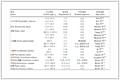
Table 1.
Selected Bond Lengths (Å) of 1


The combination of metal centers and organic ligands leads to the coordination polymers with diverse structural topologies. These functional coordination polymers have wide applications in the fields of gas separation[1, 2], luminescence[3, 4], catalysis[5, 6], magnetism[7], and proton conduction[8, 9]. The lanthanide-based coordination polymers are an important kind of functional coordination polymers. The lanthanide centers owing the intrinsic optical and magnetic characters arising from 4f electrons make the lanthanide coordination polymers highly desirable functional materials with distinct optical and magnetic properties[10, 11]. It is known that the lanthanide ions have a strong affinity for oxygen atoms. Thus the carboxylic ligands are extensively applied to construction of lanthanide coordination polymers. Among the organic ligands, the carboxylic acid ligands with C3-symmetry are interesting. The noted example is the dinuclear copper(II) paddlewheel units are linked by the C3-symmetric carboxylate linker of 1, 3, 5-benzenetricarboxylate to give the (3, 4)-connected net of HKUST-1[12]. In the present study, the C3-symmetric carboxylate linker of 4, 4′, 4′′-nitrilotribenzoate ligand (ntb3–) was used for construction of coordination polymer. The 4, 4′, 4′′-nitrilotribenzoate ligand with three benzoate moieties attached to the central nitrogen atom is an appropriate ligand. Due to the free rotation of the C‒N single bond between the benzene ring and central N atom, the 4, 4′, 4′′-nitrilotribenzoate can adopts various conformations in certain structures, which provide a large amount of coordination polymers[13-15]. For examples, the compound with the [Zn4(μ4-O)] secondary building units and compound based on the [Cu2(COO)4] paddle-wheel secondary building units can be obtained using the 4, 4′, 4′′-nitrilotribenzoate ligand[16, 17]. In this contribution, a Tb(III) compound based on the 4, 4′, 4′′-nitrilotribenzoate ligand is reported with regard to its synthesis, crystal structure, and luminescent emission.
All chemicals were commercially obtained. FT-IR spectrum (KBr pellet) was recorded on the PerkinElmer Spectrum One. The thermogravimetric measurement was performed with a Netzsch STA449C apparatus in the Al2O3 containers at a heating rate of 10 ℃/min from 30 to 800 ℃. Powder X-ray diffraction analyses were performed on a Rigaku Dmax2500 diffractometer with Cu-Kα radiation (λ = 1.5418 Å). Fluorescence spectra were measured with an Edinburgh FLS980 fluorescence spectrophotometer.
A mixture of Tb(NO3)3·6H2O (0.0182 g, 0.05 mmol), H3ntb(0.0191 g, 0.05 mmol), 2-fluorobenzoic acid (0.035 g, 0.25 mmol) and HNO3 (0.3 ml, 0.1 mol/L) in H2O (2 mL) and CH3CN (1 mL) was introduced into a 25 mL Parr Teflon-lined stainless steel vessel. The vessel was sealed and heated to 140 ℃ for 6 days. Then the resulting mixture was cooled naturally to give pale yellow prism crystals of 1. The crystalline product was dried at ambient temperature (yield: 37.5% on the basis of Tb). IR (KBr pellet, v, cm−1): 3413 (w), 3057 (w), 2782 (m), 2220 (w), 1589 (s), 1548 (m), 1439 (s), 1354 (s), 1314 (m), 1286 (m), 1175 (m), 1110 (w), 1095 (w), 1011 (m), 861 (m), 834 (m), 781 (m), 711(m), 684 (m), 666 (w), 628 (w), 568 (m), 511 (w).
A single crystal of 1 with dimensions of 0.11mm × 0.06mm × 0.05mm was selected and mounted on a glass fiber. Single-crystal X-ray diffraction data were collected on a Rigaku Oxford SuperNova Single Source diffractometer with an EOS detector and a Mo-Ka radiation (λ = 0.71073 Å). CrysAlisPro Agilent Technologies software was used for collecting the frames of data, indexing the reflections, determining the lattice constants, absorption correction, and data reduction[18]. The structure was solved by the direct methods and successive Fourier difference syntheses (SHELXT-2015) [19], and refined by the full-matrix least-squares method on F2 (SHELXL-2015)[20]. All non-hydrogen atoms are refined with anisotropic thermal parameters. Hydrogen atoms attached to carbon atoms were assigned to calculated positions. The final R = 0.0184 and wR = 0.0456 (w = 1/[σ2(Fo2) + (0.0260P)2 + 1.6589P], where P = (Fo2 + 2Fc2)/3) for 1883 observed reflections. (∆/σ)max = 0.002, (∆ρ)max = 0.461 and (∆ρ)min = –0.489 e/Å3. The selected important bond distances are listed in Table 1.
 DownLoad:
CSV
DownLoad:
CSV
| Bond | Dist. | Bond | Dist. | |
| Tb(1)–O(2) | 2.335(2) | Tb(1)–O(3D) | 2.485(2) | |
| Tb(1)–O(3A) | 2.361(2) | Tb(1)–O(2D) | 2.335(2) | |
| Tb(1)–O(3B) | 2.485(2) | Tb(1)–O(1E) | 2.374(2) | |
| Tb(1)–O(3C) | 2.361(2) | Tb(1)–O(1F) | 2.374(2) | |
| Symmetry codes for 1: A: x, y, z – 1; B: x, 1 – y, z – 1/2; C: – x + 2, y, – z + 3/2; D: – x + 2, – y + 1, – z + 1; E: – x + 3/2, – y + 1/2, – z + 1; F: x + 1/2, – y + 1/2, z – 1/2. |
||||
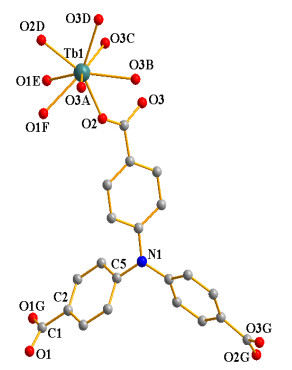
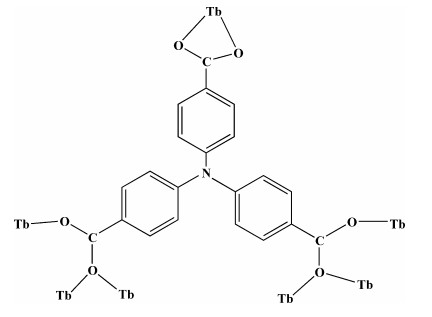
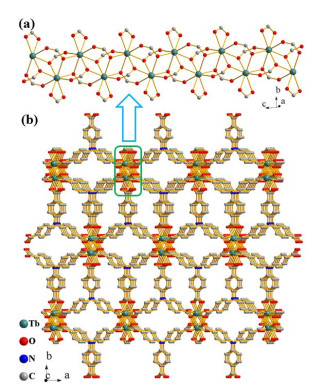
The asymmetric unit of 1 contains one Tb(III) ion with half occupation and one half-occupied ntb3– ligand. Tb(1) atom located in a two-fold axis is eight-coordinated to eight carboxylate oxygen atoms from seven ntb3– ligands (Fig. 1). The Tb‒O bond distances range from 2.335(2) to 2.485(2) Å (Table 1), which are similar to those in other reported Tb-carboxylate coordination compounds[21, 22]. The ntb3– ligand occupies a two-fold axis that passing through the C(1), C(2), C(5), and N(1) atoms (Fig. 1). Due to the free rotation of the C‒N single bond between the C atom of the benzene ring and the central N atom, the ntb3– ligand can adopt different conformation. In the present case, the dihedral angles of the three benzene rings are 72.97, 72.97 and 63.88 o. The ntb3– ligand coordinates to seven Tb(III) ions through its two μ3-η2: η2 carboxylate groups and one chelating carboxylate group (Scheme 1). As illustrated in Fig. 2a, the Tb(III) ions are bridged by the carboxylate groups of the ntb3– ligands to form a one-dimensional (1D) chain running along c axis (Fig. 2). The neighboring Tb···Tb separations of 3.782(2) Å was observed in the 1D chain. The 1D lanthanide-carboxylate chains are commonly observed in the lanthanide coordination polymers based on the carboxylate ligands[23]. In compound 1, each ntb3– ligand connects three 1D Tb-carboxylate chain. The 1D Tb-carboxylate chain are linked by the ntb3– ligands to form a 3D structure (Fig. 2b). It should be noted that a Tb(III) compound based on the ntb3– ligand formulated as {[Tb(ntb)(DMF)]·DMF}n was reported[22]. This compound {[Tb(ntb)(DMF)]·DMF}n with one coordinated DMF and one free DMF solvent molecules is crystallized in a triclinic space group of P-1, which is different from the present compound with a C2/c space group. Moreover, although the Tb(III) ions in both compounds are eight-coordinated, the Tb(III) atoms in {[Tb(ntb)(DMF)]·DMF}n is surrounded by six ntb3– ligands while seven ntb3– ligands encircle one Tb(III) atom in the present compound. The ntb3– ligand in {[Tb(ntb)(DMF)]·DMF}n binds six Tb(III) ions using two μ2-η1: η1 carboxylate groups and one μ2-η2: η1 carboxylate group, which is different the coordination mode in Scheme 1. Finally, the dihedral angles between the three benzene rings of the organic ligand are 76.78, 70.41 and 78.33 o in compound {[Tb(ntb)(DMF)]·DMF}n. As these essential differences, the present compound is a nonporous 3D structure while compound {[Tb(ntb)(DMF)]·DMF}n is a porous 3D structure with 1D channels.
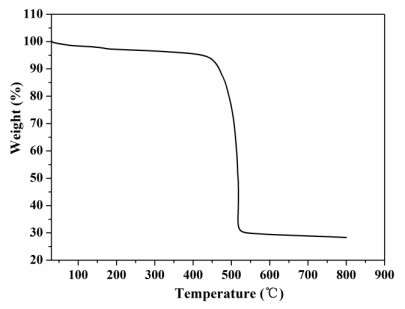
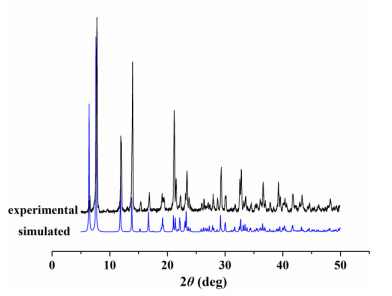
The strong absorption band centered at 1589 cm–1 in the IR spectrum of 1 is attributed to the asymmetric stretching vibrations of carboxylate groups. The strong peaks at 1439 and 1354 cm–1 can be assigned to the symmetric stretching vibrations of carboxylate groups. The TGA curve shows that compound 1 is stable from room temperature to 410 ℃ (Fig. 3). When the temperature is higher than 410 ℃, the collapse of the 3D structure occurred. The experimental PXRD pattern of compound 1 is well matched with the simulated PXRD pattern derived from the single-crystal X-ray diffraction data (Fig. 4), indicating the obtained bulk material is pure phase.
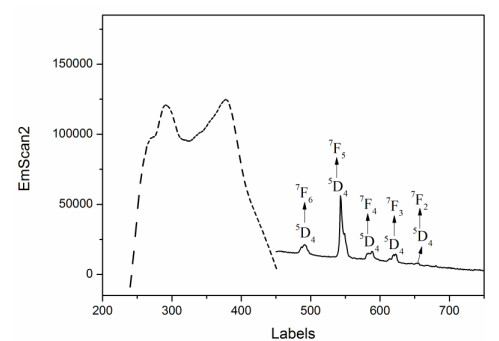
The Tb-compounds have been reported for their characteristic emission. In the present compound, the luminescent properties were studied in the solid state under room temperature. As shown in Fig. 5, the excitation spectrum of 1 shows two peaks at 298 and 394 nm, which are mainly assigned to the intraligand π-π* electron transitions. Upon excitation at 298 nm, compound 1 emits characteristic Tb(III) emission with five emission peaks at 491, 544, 588, 620, and 651 nm, which are assigned to the 5D4 → 7F6, 5D4 → 7F5, 5D4 → 7F4, 5D4 → 7F3, and 5D4 → 7F2 transitions, respectively. Due to the emission spectrum is dominated by the 5D4 → 7F5 transition, the material gives a strong green luminescent output.
In conclusion, a Tb(III) coordination polymer based on the 4, 4′, 4′′-nitrilotribenzoate ligand has been presented. The compound has been characterized by FT-IR, single-crystal X-ray diffraction, PXRD and TG analysis. Compound 1 has a 3D structure containing 1D Tb-carboxylate chains and exhibits luminescent emission in the solid state.
Kitagawa, S.; Kitaura, R.; Noro, R. Functional porous coordination polymers. Angew. Chem., Int. Ed. 2004, 43, 2334–2375. doi: 10.1002/anie.200300610
He, Y.; Zhou, W.; Qian, G.; Chen, B. Methane storage in metal-organic frameworks. Chem. Soc. Rev. 2014, 43, 5657-5678. doi: 10.1039/C4CS00032C
Ma, H. F.; Xiong, L. N.; Chen, L.; Wang, Y. L.; Liu, Q. Y. Crystal structure and luminescent properties of a 3D Cd(II) compound constructed from succinate and 3, 6-di(4-pyridyl)pyridazine. Chin. J. Struct. Chem. 2017, 36, 485–490.
Zhao, Y.; Yang, X. G.; Lu, X. M.; Yang, C. D.; Fan, N. N.; Yang, Z. T.; Wang, L. Y.; Ma, L. F. {Zn6} Cluster based metal–organic framework with enhanced room-temperature phosphorescence and optoelectronic performances. Inorg. Chem. 2019, 58, 6215–6221. doi: 10.1021/acs.inorgchem.9b00450
Yoon, M.; Srirambalaji, R.; Kim, K. Homochiral metal-organic frameworks for asymmetric heterogeneous catalysis. Chem. Rev. 2012, 112, 1196-1231. doi: 10.1021/cr2003147
Zhao, Y.; Deng, D. S.; Ma, L. F.; Ji, B. M.; Wang, L. Y. A new copper-based metal–organic framework as a promising heterogeneous catalyst for chemo-and regio-selective enamination of β-ketoesters. Chem. Commun. 2013, 49, 10299–10301. doi: 10.1039/c3cc45310c
Wang, Y. L.; Han, C. B.; Zhang, Y. Q.; Liu, Q. Y.; Liu, C. M.; Yin, S. G. Fine-tuning ligand to modulate the magnetic anisotropy in a carboxylate-bridged Dy2 single-molecule magnets system. Inorg. Chem. 2016, 55, 5578–5584. doi: 10.1021/acs.inorgchem.6b00653
Yang, F.; Xu, G.; Dou, Y.; Wang, B.; Zhang, H.; Wu, H.; Zhou, W.; Li, J. R.; Chen, B. A flexible metal-organic framework with a high density of sulfonic acid sites for proton conduction. Nat. Energy. 2017, 2, 877-883. doi: 10.1038/s41560-017-0018-7
Zhou, L. J.; Deng, W. H.; Wang, Y. L.; Xu, G.; Yin, S. G.; Liu, Q. Y. Lanthanide-potassium-biphenyl-3, 3′-disulfonyl-4, 4′-dicarboxylate frameworks: gas sorption, proton conductivity, and luminescent sensing of metal ions. Inorg. Chem. 2016, 55, 6271–6277. doi: 10.1021/acs.inorgchem.6b00928
Cui, Y. J.; Yue, Y. F.; Qian, G. D.; Chen, B. L. Luminescent functional metal-organic frameworks. Chem. Rev. 2012, 112, 1126–1162. doi: 10.1021/cr200101d
Li, R. P.; Wang, Y. L.; Liu, Q. Y. A dinuclear dysprosium-2-quinolinecarboxylate-1, 10-phenanthroline compound: crystal structure and magnetism, Chin. J. Struct. Chem. 2018, 37, 407–413.
Chui, S. S. Y.; Lo, S. M. F.; Charmant, J. P. H.; Orpen, A. G.; Williams, I. D. A chemically functionalizable nanoporous material [Cu3(TMA)2(H2O)3]n. Science. 1999, 283, 1148–1150. doi: 10.1126/science.283.5405.1148
Xia, Z. Q.; He, C.; Wang, X. G.; Duan, C. Y. Modifying electron transfer between photoredox and organocatalytic units via framework interpenetration for β-carbonyl functionalization. Nat. Commun. 2017, 8, 361. doi: 10.1038/s41467-017-00416-8
Wu, P. Y.; Guo, X. Y.; Cheng, L. J.; He, C.; Wang, J.; Duan, C. Photoactive metal-organic framework and its film for light-driven hydrogen production and carbon dioxide reduction. Inorg. Chem. 2016, 55, 8153–8159. doi: 10.1021/acs.inorgchem.6b01267
Lee, S. J.; Doussot, C.; Baux, A.; Liu, L. J.; Jameson, G. B.; Richardson, C.; Pak, J. J.; Trousselet, F.; Coudert, F. X.; Telfer, S. G. Multicomponent metal organic frameworks as defect-tolerant materials. Chem. Mater. 2016, 28, 368–375. doi: 10.1021/acs.chemmater.5b04306
Weber, M. E.; Schlesinger, P. H.; Gokel, G. W. Dynamic assessment of bilayer thickness by varying phospholipid and hydraphile synthetic channel chain lengths. J. Am. Chem. Soc. 2005, 127, 637–642.
Wu, P.; Wang, J.; He, C.; Zhang, X.; Wang, Y.; Liu, T.; Duan, C. Luminescent metal-organic frameworks for selectively sensing nitric oxide in an aqueous solution and in living cells. Adv. Funct. Mater. 2012, 22, 1698–1703. doi: 10.1002/adfm.201102157
CrysAlisPro. Rigaku Oxford Diffraction, 2015.
Sheldrick, G. M. SHELXT-integrated space-group and crystal-structure determination. Acta Cryst. 2015, A71, 3–8.
Sheldrick, G. M. Crystal structure refinement with SHELXL. Acta Cryst. 2015, C71, 3–8.
Wang, H. H.; Zhou, L. J.; Wang, Y. L.; Liu, Q. Y. Terbium-biphenyl-3, 3′-disulfonyl-4, 4′-dicarboxylate framework with sulfonate sites for luminescent sensing of Cr3+ ion. Inorg. Chem. Commun. 2016, 73, 94–97. doi: 10.1016/j.inoche.2016.10.006
Wu, P.; Wang, J; Li, Y.; He, C.; Xie, Z.; Duan, C. Luminescent sensing and catalytic performances of a multifunctional lanthanide-organic framework comprising a triphenylamine moiety, Adv. Funct. Mater. 2011, 21, 2788–2794. doi: 10.1002/adfm.201100115
Zhang, W. W.; Wang, Y. L.; Liu, Q.; Liu, Q. Y. Lanthanide-benzophenone-3, 3′-disulfonyl-4, 4′-dicarboxylate frameworks: temperature and 1-hydroxypyren luminescence sensing and proton conduction. Inorg. Chem. 2018, 57, 7805-7814. doi: 10.1021/acs.inorgchem.8b00865

Figure 5 Excitation (dotted line) and emission (solid line) spectra for 1 in the solid state
Table 1. Selected Bond Lengths (Å) of 1
| Bond | Dist. | Bond | Dist. | |
| Tb(1)–O(2) | 2.335(2) | Tb(1)–O(3D) | 2.485(2) | |
| Tb(1)–O(3A) | 2.361(2) | Tb(1)–O(2D) | 2.335(2) | |
| Tb(1)–O(3B) | 2.485(2) | Tb(1)–O(1E) | 2.374(2) | |
| Tb(1)–O(3C) | 2.361(2) | Tb(1)–O(1F) | 2.374(2) | |
| Symmetry codes for 1: A: x, y, z – 1; B: x, 1 – y, z – 1/2; C: – x + 2, y, – z + 3/2; D: – x + 2, – y + 1, – z + 1; E: – x + 3/2, – y + 1/2, – z + 1; F: x + 1/2, – y + 1/2, z – 1/2. |
||||
 下载: 导出CSV

 扫一扫看文章


扫一扫关注我们


 下载:
下载: