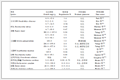
Table 1.
Crystallographic data and structural refinements of complex 1

Two-Dimensional Coordination Polymer [Tb(1, 4-bdc)1.5(phen)(H2O)]n: Synthesis, Crystal Structure and Luminescent Detection of Fe3+
Zi-Wei WANG , Hao-Dong WU , Yaseen Muhammad , Ai-Lin LIANG , He LIU , Zi-Ang NING , Shuai WANG , Gang WANG , Wei QUAN , Hao WANG


The uncontrolled release of iron ions into air and water sources leading to several types of environmental pollutions are human health hazards[1-3]. Therefore, it is important to develop a simple and efficient method for the detection of Fe3+. Among many reported sensing approaches, fluorescence sensing has received extensive attention attributed to its high sensitivity, low detection limit, and fast detection speed[4-5]. Therefore, a fluorescence sensor can be developed to detect lowconcentration of Fe3+[6-9].
Coordination polymers (CPs) are fascinating materials that are both fundamentally important and technologically relevant[10-11] and have been extensively studied, not only because of their diverse structures, but also for their wide application prospects in the fields of molecular storage, luminescence, and magnetism[12-14]. Currently, luminescent coordination polymers (LCPs) as fluorescent probes have become one of the research hotspots, which can effectively monitor the presence of iron ions based on the fluorescence quenching mechanism[15].
The application of the mixed ligands strategy has been proved an effective method to construct a variety of CPs[16-21]. In this work, a new Tb3+ CP with terephthalic acid (1, 4 - bdc) and 1, 10 - phenanthroline (phen), [Tb(1, 4-bdc)1.5(phen) (H2O)]n (1), was synthesized and structurally determined using mixed ligands strategy. The resulting CP exhibited high luminescence sensing performance for Fe3+ with a fluorescence quenching mechanism.
Terbium nitrate hexahydrate, 1, 10 - phenanthroline, and terephthalic acid were of commercial grade and used without further purification. Powder X - ray diffraction (PXRD) patterns were recorded on a Rigaku D/Max-2500 diffractometer (Cu Kα, λ=0.154 06 nm, 2θ =5°-50°, U=40 kV, I=40 mA), having a graphite monochromator. Simulation of the PXRD pattern was carried out by the single - crystal data and diffraction - crystal module of the Mercury program version 1.4.2. Elemental analyses for C, H, and N were performed on a PerkinElemer240C analyzer. FT - IR spectra of the powder samples were collected on a Nicolet IS10 infrared spectrum radiometer in a wavenumber range of 4 000-400 cm-1 using the KBr pellets. The luminescence spectra and luminescence lifetimes properties were measured with the FS5 fluorescence spectrometer (Edinburgh Instruments).
1, 4-H2bdc (8 mg, 0.05 mmol), Tb(NO3)3·6H2O (21 mg, 0.05 mmol), phen (9 mg, 0.05 mmol) and H2O/ DMAC/EtOH (5 mL, 1∶1∶1, V/V) were sealed in a clear glass vial (10 mL), heated at 95 ℃ for 72 h, and then cooled slowly to room temperature. The colorless and sticklike crystals were obtained and washed with ethanol with a yield of 20% (based on Tb3+). Anal. Calcd. for C24H16N2O7Tb(%): C, 47.77; H, 2.65; N, 4.64. Found (%): C, 47.81; H, 2.77; N, 4.83. IR (KBr pellet, cm-1): 2 819(w), 2 671(w), 2 545(w), 1 678(s), 1 396(s), 1 390(s), 1 387(s), 1 286(s), 1 020(m), 933(m), 781(m), 728(vs).
Diffraction data of 1 were collected on a Bruker D8 venture diffractometer with graphite - monochromator at 293(2) K with Mo Kα radiation (λ =0.071 073 nm). The crystal data was solved by direct methods using the SHELXS-2014 program and refined by fullmatrix least-squares methods on F2 using the program SHELXL-2014. Metal atoms in the complex were located from the E - maps while non - hydrogen atoms were located in successive difference Fourier syntheses and refined with anisotropic thermal parameters on F2. Hydrogen atoms of the ligands were generated theoretically onto the specific atoms and refined with fixed thermal factors. The crystallographic data and experimental details for structural analyses are summarized in Table 1. Selected bond lengths for the complex are listed in Table 2.
 下载:
导出CSV
下载:
导出CSV
| Parameter | 1 | Parameter | 1 | |
| Empirical formula | C24H16N2O7Tb | Z | 2 | |
| Formula weight | 603.31 | D / (g·cm-3) | 1.835 | |
| θ range / (°) | 2.2-26.5 | μ / mm-1 | 3.29 | |
| Crystal system | Triclinic | F(000) | 590 | |
| Space group | P1 | Measured reflection | 19 438 | |
| a / nm | 1.028 53(4) | Independent reflection | 6 249 | |
| b / nm | 1.081 88(4) | Reflection with I > 2σ(I) | 5 415 | |
| c / nm | 1.132 75(3) | Rint | 0.049 | |
| α / (°) | 107.375(3) | R [F2 > 2σ(F2)] | 0.034 | |
| β / (°) | 91.669(3) | wR (F2) | 0.089 | |
| γ / (°) | 112.992(4) | Goodness-of-fit (on F2) | 1.07 | |
| V / nm3 | 1.092 04(7) |
下载:
导出CSV
| Tb1—O7ⅰ | 0.228 7(3) | Tb1—O6ⅰ | 0.233 0(3) | Tb1—O1 | 0.233 4(3) |
| Tb1—O4 | 0.235 9(3) | Tb1—O3 | 0.237 4(3) | Tb1—O1W | 0.247 5(3) |
| Tb1—N1 | 0.257 4(3) | Tb1—N2 | 0.260 5(4) | ||
| O7ⅰ—Tb1—O6ⅰ | 73.30(13) | O7ⅰ—Tb1—O1 | 84.33(11) | O6ⅰ—Tb1—O1 | 85.19(11) |
| O7ⅰ—Tb1—O4 | 79.75(11) | O6ⅰ—Tb1—O4 | 124.39(11) | O1—Tb1—O4 | 139.42(11) |
| O7ⅰ—Tb1—O3 | 123.92(11) | O6ⅰ—Tb1—O3 | 81.55(11) | O1—Tb1—O3 | 142.83(11) |
| O4—Tb1—O3 | 74.67(11) | O7ⅰ—Tb1—O1W | 73.81(12) | O6ⅰ—Tb1—O1W | 140.84(12) |
| O1—Tb1—O1W | 70.94(11) | O4—Tb1—O1W | 68.83(11) | O3—Tb1—O1W | 135.42(11) |
| O7ⅰ—Tb1—N1 | 146.31(13) | O6ⅰ—Tb1—N1 | 140.11(13) | O1—Tb1—N1 | 93.16(12) |
| O4—Tb1—N1 | 80.65(11) | O3—Tb1—N1 | 76.00(11) | O1W—Tb1—N1 | 73.65(12) |
| O7ⅰ—Tb1—N2 | 142.82(12) | O6ⅰ—Tb1—N2 | 79.20(13) | O1—Tb1—N2 | 68.68(11) |
| O4—Tb1—N2 | 137.22(12) | O3—Tb1—N2 | 74.77(11) | O1W—Tb1—N2 | 117.52(12) |
| N1—Tb1—N2 | 63.37(12) | ||||
| Symmetry code: ⅰ -x+1, -y+1, -z. | |||||
CCDC: 2095406.
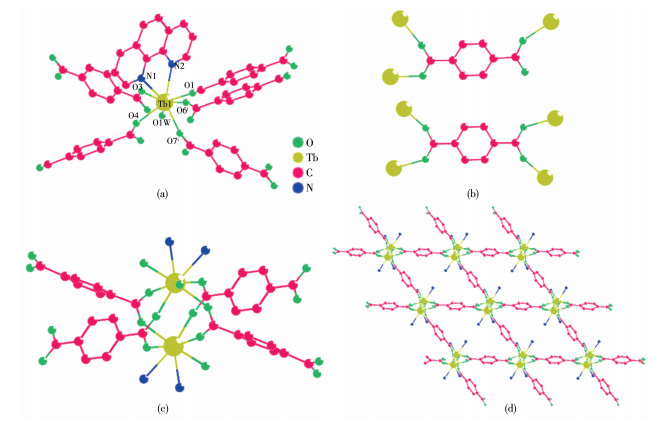
X-ray single-crystal analysis reveals that complex 1 crystallizes in the triclinic space group P1. The asymmetric unit of 1 is composed of one Tb3+ ion, one and a half 1, 4-bdc2- ligands, one phen ligand, and one coordinated water molecule. Tb3+ ion is eight-coordinate and surrounded by five oxygen atoms from five 1, 4 - bdc2-, one oxygen atom from the water molecule, and two nitrogen atoms from one chelating phen molecule (Fig. 1a). As expected, the average distance of Tb—O (0.255 6 nm) is shorter than that of Tb—N (0.257 4 nm). 1, 4-bdc2- adopt two kinds of coordination modes to bridge three Tb3+ ions and four Tb3+ ions (Fig. 1b). Neighboring Tb3+ ions are bridged by —O—C—O— links from four 1, 4 - bdc2- into a binuclear unit with Tb…Tb distance of 0.432 1 nm (Fig. 1c). Such units are further bridged by 1, 4-bdc2- into an infinite 2D plane (Fig. 1d).
Symmetry code: ⅰ-x+1, -y+1, -z
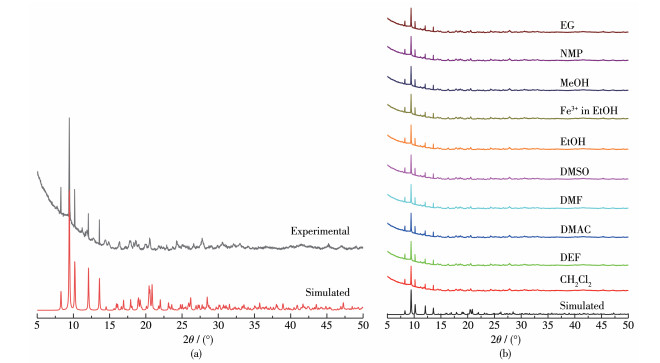
The purity of the crystalline samples of 1 was confirmed by PXRD and the results shown in Fig. 2a confirm that the PXRD pattern of the as-synthesized complex matched well with the simulated one based on the single-crystal diffraction data. To explore its stability in different solvents, crystal samples of 1 were immersed in several common organic solvents, which were ethylene glycol (EG), N-methyl-2-pyrrolidone (NMP), MeOH, EtOH, dimethyl sulfoxide (DMSO), N, N dimethylformamide (DMF), N, N - dimethylacetamide (DMAC), N, N-diethylformamide (DEF), and CH2Cl2, for 24 h. As shown in Fig. 2b, the peak positions of the sample after soaking in different organic solvents and experimental patterns were in good agreement with each other, proving that 1 has good stability in the above organic solvents.
The solid - state luminescence performance of 1 was studied at room temperature and the results are shown in Fig. 3. As shown in Fig. 3a, the luminescence spectrum of 1 showed a characteristic emission of Tb(Ⅲ) with an excitation wavelength of 310 nm. The emission peaks located at 489, 544, 585, 613 nm are ascribed to the 5D4 → 7Fj (j=6, 5, 4, 3) transition of Tb3+. To better understand its luminescent properties, the luminescence lifetime was also studied. Under 310 nm excitation wavelength, the luminescence lifetime was studied by monitoring the most intense peak in the whole spectrum of 1 (5D4 → 7F5). The observed luminescent lifetime determined from Fig. 3b was 708 µs.

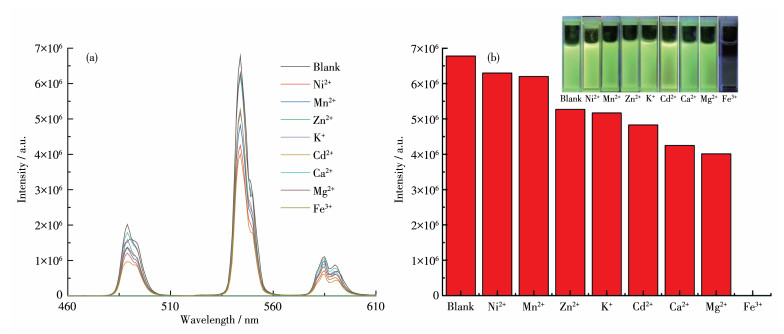
To investigate the sensing ability of different metal ions, the ground powder of complex 1 (3 mg) was introduced into an ethanol solution (3 mL) of M(NO3)m(Mm+=Ni2+, Mn2+, Zn2+, K+, Cd2+, Ca2+, Mg2+, Fe3+, 1 mmol·L-1). The resulting solution was homogenized under ultrasonication for 5 min, and then the fluorescence responses were recorded at room temperature (Fig. 4a). The luminescence intensity at 544 nm showed a slight decrease with the addition of Ni2+, Mn2+, Zn2+, K+, Cd2+, Ca2+, and Mg2+. On the contrary, the addition of Fe3+ prominently decreased the luminescence intensity (almost 0), indicating that complex 1 can selectively detect Fe3+ by fluorescence"turn - off", which also can even be observed by naked eyes (Fig. 4b).
Inset: photographs of 1 under UV lamp after addition of different metal ions
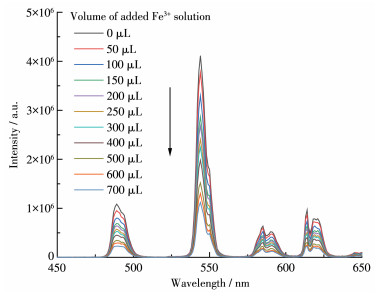
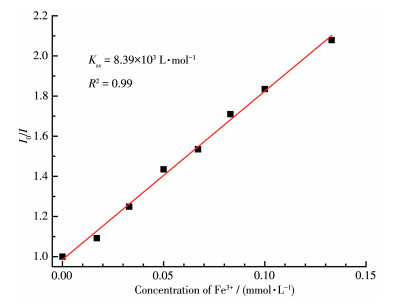
To better understand the sensitivity to Fe3+ ions of complex 1, a luminescence quantitative titration experiment was carried out. The luminescence intensity of complex 1 descended gradually with increasing the concentration of Fe3+ ions (Fig. 5). Quantitatively, the calculated value of Ksv was 8.39 × 10³ L·mol-1 using the Stern-Volmer equation at low concentration with a linear correlation coefficient value (R2) of 0.995[22-26] (Fig. 6). According to LOD=3σ/k[27-30], the calculated detection limit was 0.017 µmol·L-1. The limit of detection of compound 1 was much superior to those CPs based sensor materials reported in the literature (Table 3).
下载:
导出CSV
| CP | LOD / (µmol·L-1) | Ksv / (L·mol-1) | Reference |
| [Eu2(L)2(DMF)4]n | 3.69 | 1.34×10⁵ | [22] |
| [Tb(L)(H2O)3]n | 1.79 | 8.39×10⁴ | [23] |
| {[Tb(μ6-H2cpboda)(μ2-OH2)2]·H2O}n | 0.84 | 6.50×10⁴ | [24] |
| Eu-MOF | 0.027 | 2.45×10⁴ | [25] |
| Eu-BPDA | 0.9 | 1.25×10⁴ | [26] |
| [Eu(atpt)1.5(phen)(H2O)]n | 45 | 7.60×10³ | [27] |
| [Zn(modbc)2]n(Zn-CP) | 0.57 | 7.20×10³ | [28] |
| 534-MOF-Tb | 0.13 | 5.51×10³ | [29] |
| [Zn2(cptpy)(btc)(H2O)]n | 0.433 | 5.46×10³ | [30] |
| [Tb(1, 4-bdc)1.5(phen)(H2O)]n (1) | 0.017 | 8.39×10³ | This work |
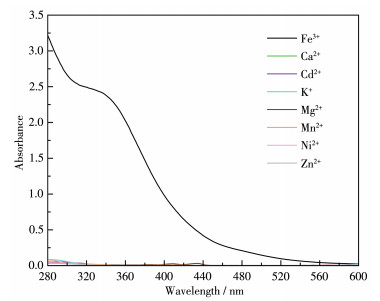
The PXRD patterns of 1 before and after the Fe3+ treatment proved that the crystal structure of 1 remained stable (Fig. 2b), so the luminescence quenching was not caused by the decomposition of the framework. We further obtained the UV - Vis spectra of all the identified metal ions (1 mmol·L-1 in ethanol). In Fig. 7, it can be seen that the absorption band of Fe3+ was in 300 - 400 nm region, which overlaps with the excitation wavelength of 1 (310 nm), indicating that there may be a competitive energy absorption progress. And other metal ions had negligible absorption on 310 nm. So, the quenching mechanism of 1 for Fe3+ may be attributed to competitive energy absorption, which is a common quenching mechanism in CPs sensing for Fe3+[31-32].
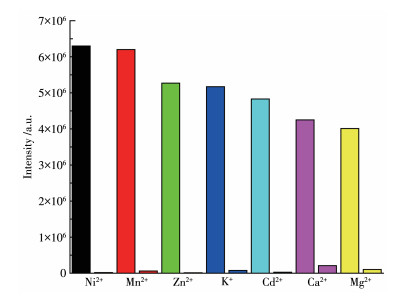
Seven kinds of interference substances were used to selectively detect the identified iron ions. As shown in Fig. 8, initially, with the addition of other metal ions, the fluorescence intensity of 1 showed a negligible change (left column). However, with the addition of Fe3+, the fluorescence intensity decreased rapidly (right column). The decrease in fluorescence intensity indicates that it can detect Fe3+ ions even in the presence of other metal ions.
A 2D coordination polymer, [Tb(1, 4-bdc)1.5(phen) (H2O)]n (1), was synthesized by the solvothermal method and the luminescent emission spectrum and luminescence lifetime were investigated. Compound 1 exhibited good sensitivity and selectivity for detecting Fe3+ ions by fluorescence quenching mechanism with Ksv=8.39× 10³ L·mol-1 and limit of detection of 0.017 µmol·L-1.
Chen C H, Wang X H, Li L, Huang Y B, Cao R. Highly Selective Sensing of Fe3+ by an Anionic Metal-Organic Framework Containing Uncoordinated Nitrogen and Carboxylate Oxygen Sites[J]. Dalton Trans., 2018, 47: 3452-3458. doi: 10.1039/C8DT00088C
黄佳祥, 赵河, 刘淑芹, 张建军. 基于双核{Zn2(COO)4}次级构筑单元的二维发光配位聚合物的晶体结构和对Fe3+的检测[J]. 无机化学学报, 2021,37,(8): 1513-1518. HUANG J X, ZHAO H, LIU S Q, ZHANG J J. Two-Dimensional Luminescent Coordination Polymer Based on Dinuclear {Zn2(COO)4} Second Buildings Units: Crystal Structure and Detection of Fe3+[J]. Chinese J. Inorg. Chem., 2021, 37(8): 1513-1518.
Karmakar A, Joarder B, Mallick A, Samanta P, Desai A V, Basu S, Ghosh S K. Aqueous Phase Sensing of Cyanide Ions Using a Hydrolytically Stable Metal-Organic Framework[J]. Chem. Commun., 2017, 53: 1253-1256. doi: 10.1039/C6CC08557A
Ju P, Liu X C, Zhang E S. A Novel 3D Zn-Based Luminescence Metalorganic Framework: Synthesis, Structure and Fluorescence Enhanced Sensing of Ammonia Vapor in Air[J]. Chin. J. Struct. Chem., 2020, 39: 1458-1464.
Kumar M, Li L Q, Zareba J K, Tashi L, Sahoo S C, Nyk M, Liu S J, Sheikh H N. Lanthanide Contraction in Action: Structural Variations in 13 Lanthanide(Ⅲ) Thiophene-2, 5-dicarboxylate Coordination Polymers (Ln=La-Lu, Except Pm and Tm) Featuring Magnetocaloric Effect, Slow Magnetic Relaxation, and Luminescence-Lifetime-Based Thermometry[J]. Cryst. Growth Des., 2020, 20: 6430-6452. doi: 10.1021/acs.cgd.0c00611
Zhao S, Hao X M, Liu J L, Wang H, Wu Y B, Guo W L. Tuning the Photoluminescence of Zn (Ⅱ) Coordination Polymers by Changing the Coordinated Solvent[J]. Chin. J. Struct. Chem., 2018, 37: 145-151.
Xiao Q Q, Dong G Y, Li Y H, Cui G H. Cobalt(Ⅱ)-Based 3D Coordination Polymer with Unusual 4, 4, 4-Connected Topology as a Dual-Responsive Fluorescent Chemosensor for Acetylacetone and Cr2O72-[J]. Inorg. Chem., 2019, 58: 15696-15699. doi: 10.1021/acs.inorgchem.9b02534
吴琪琪, 温一航. Tb(Ⅲ)金属有机框架材料对Cu2+和Fe3+的荧光检测[J]. 无机化学学报, 2020,36,941-948. doi: 10.11862/CJIC.2020.116WU Q Q, WEN Y H. Tb (Ⅲ)-Based Metal-Organic Framework for Simultaneously Luminescent Detection of Cu2+ and Fe3+ Ions[J]. Chinese J. Inorg. Chem., 2020, 36: 941-948. doi: 10.11862/CJIC.2020.116
Yao Q X, Tian M M, Wang Y, Meng Y J, Wang J, Yao Q Y, Zhou X, Yang H, Wang H W, Li Y W, Zhang J. A Robust, Water-Stable, and Multifunctional Praseodymium-Organic Framework Showing Permanent Porosity, CO2 Adsorption Properties, and Selective Sensing of Fe3+ Ion[J]. Chin. J. Struct. Chem., 2020, 39: 1862-1870.
Zhu H, Li Y H, Xiao Q Q, Cui G H. Three Luminescent Cd(Ⅱ) Coordination Polymers Containing Aromatic Dicarboxylate and Flexible Bis(benzimidazole) Ligands as Highly Sensitive and Selective Sensors for Detection of Cr2O72- Oxoanions in Water[J]. Polyhedron, 2020, 187: 114648. doi: 10.1016/j.poly.2020.114648
Zhai L J, Jiao C X, Liang J F, Zhang J, Niu X Y, Hu T P, Niu Y L. Two New Coordination Polymers Based on H4BIPA-TC: Syntheses and Fluorescence Sensing for Nitroaromatic Compounds and Fe3+ Ion[J]. Chin. J. Struct. Chem., 2020, 39: 772-782.
Kong L J, Liu M, Huang H, Xu Y H, Bu X H. Metal/Covalent-Organic Framework Based Cathodes for Metal-Ion Batteries[J]. Adv. Energy Mater., 2021, : 2100172.
陈丹丹, 衣晓虹, 王崇臣. 机械化学法制备金属-有机骨架及其复合物研究进展[J]. 无机化学学报, 2020,36,(10): 1805-1821. doi: 10.11862/CJIC.2020.212CHEN D D, YI X H, WANG C C. Preparation of Metal-Organic Frameworks and Their Composites Using Mechanochemical Methods[J]. Chinese J. Inorg. Chem., 2020, 36(10): 1805-1821. doi: 10.11862/CJIC.2020.212
杨小青, 贺春雨, 张雁红, 慕现贵, 姜爽. 基于1, 4-双(咪唑-1-基)苯的Mn(Ⅱ)/Co(Ⅱ)配位聚合物的合成、晶体结构及性质[J]. 无机化学学报, 2021,37,(8): 1364-1374. YANG X Q, HE C Y, ZHANG Y H, MU X G, JIANG S. Synthesis, Crystal Structure and Properties of Mn(Ⅱ)/Co (Ⅱ) Coordination Polymers Based on 1, 4-Bis(imidazol-1-yl)benzene[J]. Chinese J. Inorg. Chem., 2021, 37(8): 1364-1374.
Li Y. X, Han Y C, Wang C C. Fabrication Strategies and Cr(Ⅳ) Elimination Activities of the MOF-Derivatives and Their Composites[J]. Chem. Eng. J., 2021, 405: 126648. doi: 10.1016/j.cej.2020.126648
Lv X L, Feng L, Xie L H, He T, Wu W, Wang K Y, Si G R, Wang B, Li J R, Zhou H C. Linker Desymmetrization: Access to a Series of Rare-Earth Tetracarboxylate Frameworks with Eight-Connected Hexanuclear Nodes[J]. J. Am. Chem. Soc., 2021, 143: 2784-2791. doi: 10.1021/jacs.0c11546
Lv X L, Feng L, Wang K Y, Xie L H, He T, Wu W, Li J R, Zhou H C. A Series of Mesoporous Rare-Earth Metal-Organic Frameworks Constructed from Organic Secondary Building Units[J]. Angew. Chem. Int. Ed., 2021, 60: 2053-2057. doi: 10.1002/anie.202011653
Liu A J, Xu F, Han S D, Pan J, Wang G M. Mixed-Ligand Strategy for the Construction of Photochromic Metal-Organic Frameworks Driven by Electron-Transfer between Nonphotoactive Units[J]. Cryst. Growth Des., 2020, 20: 7350-7355. doi: 10.1021/acs.cgd.0c01018
Wan Y H, Zhang L P, Jin L P, Gao S, Lu S Z. High-Dimensional Architectures from the Self-Assembly of Lanthanide Ions with Benzenedicarboxylates and 1, 10-Phenanthroline[J]. Inorg. Chem., 2003, 42: 4985-4994. doi: 10.1021/ic034258c
Wang C C, Wang X, Liu W. The Synthesis Strategies and Photocatalytic Performances of TiO2/MOFs Composites: A State-of-the-Art Review[J]. Chem. Eng. J., 2020, 391: 123601. doi: 10.1016/j.cej.2019.123601
Yu M H, Liu X T, Space B, Chang Z, Bu X H. Metal-Organic Materials with Triazine-Based Ligands: From Structures to Properties and Applications[J]. Coord. Chem. Rev., 2021, 427: 213518. doi: 10.1016/j.ccr.2020.213518
Xue Y S, Ding J, Sun D L, Cheng W W, Chen X R, Huang X C, Wang J. 3D Ln-MOFs as Multi-responsive Luminescent Probes for Efficient Sensing of Fe3+, Cr2O72-, and Antibiotics in Aqueous Solution[J]. CrystEngComm, 2021, 23: 3838-3848. doi: 10.1039/D1CE00399B
Zhang Y X, Wu L, Feng M, Wang D M, Li C X. J. Assembly of Two-Dimension LMOF Materials with Excellent Detection of Fe3+ Ion in Water Based on Overlap Mechanism[J]. Solid State Chem., 2021, 294: 121868. doi: 10.1016/j.jssc.2020.121868
Yang D D, Lu L P, Feng S S, Zhu M L. First Ln-MOF as a Trifunctional Luminescent Probe for the Efficient Sensing of Aspartic Acid, Fe3+ and DMSO[J]. Dalton Trans., 2020, 49: 7514-7524. doi: 10.1039/D0DT00938E
Wu N, Guo H, Wang X Q, Sun L, Zhang T T, Peng L P, Yang W. A Water-Stable Lanthanide-MOF as a Highly Sensitive and Selective Luminescence Sensor for Detection of Fe3+ and Benzaldehyde[J]. Colloids Surf. A, 2021, 616: 126093. doi: 10.1016/j.colsurfa.2020.126093
Wang J, Wang J R, Li Y, Jiang M, Zhang L W, Wu P Y. A Europium(Ⅲ)-Based Metal-Organic Framework as a Naked-Eye and Fast Response Luminescence Sensor for Acetone and Ferric Iron[J]. New J. Chem., 2016, 40: 8600-8606. doi: 10.1039/C6NJ02163H
Kang Y X, Zheng J, Jin L P. A Microscale Multi-Functional Metal-Organic Framework as a Fluorescence Chemosensor for Fe(Ⅲ), Al(Ⅲ) and 2-Hydroxy-1-naphthaldehyde[J]. J. Colloid Interface Sci., 2016, 471: 1-6. doi: 10.1016/j.jcis.2016.03.008
Wu Y, Liu D, Lin M, Qian J. Zinc (Ⅱ)-Based Coordination Polymer Encapsulated Tb3+ as a Multi-Responsive Luminescent Sensor for Ru3+, Fe3+, CrO42-, Cr2O72- and MnO4-[J]. RSC Adv., 2020, 10: 6022-6029. doi: 10.1039/C9RA09541A
Chen M, Xu W M, Tian J Y, Cui H, Zhang J X, Liu C S, Du M. A Terbium(Ⅲ) Lanthanide-Organic Framework as a Platform for a Recyclable Multi-Responsive Luminescent Sensor[J]. J. Mater. Chem. C, 2017, 5: 2015-2021. doi: 10.1039/C6TC05615F
Chen H J, Fan P, Tu X X, Min H, Yu X Y, Li X F, Zeng J L, Zhang S W, Cheng P. A Bifunctional Luminescent Metal-Organic Framework for the Sensing of Paraquat and Fe3+ Ions in Water[J]. Chem. Asian J., 2019, 14: 3611-3619. doi: 10.1002/asia.201900682
Qu T G, Hao X M, Wang H, Cui X G, Chen F, Wu Y B, Yang D, Zhang M, Guo W L. A Luminescent 2D Zinc(Ⅱ) Metal-Organic Framework for Selective Sensing of Fe(Ⅲ) Ions and Adsorption of Organic Dyes[J]. Polyhedron, 2018, 156: 208-217. doi: 10.1016/j.poly.2018.09.039
Yin J C, Li N, Qian B B, Yu M H, Chang Z, Bu X H. Highly Stable Zn-MOF with Lewis Basic Nitrogen Sites for Selective Sensing of Fe3+ and Cr2O72- Ions in Aqueous Systems[J]. J. Coord. Chem., 2020, 73: 2718-2727. doi: 10.1080/00958972.2020.1830976

Figure 1 Crystal structure of complex 1: (a) coordination environment; (b) two kinds of coordination mode of 1, 4-bdc2-; (c) binuclear unit; (d) 2D plane where phen molecules are omitted for clarity
Symmetry code: ⅰ-x+1, -y+1, -z

Figure 2 (a) View of simulated and experimental PXRD patterns of 1; (b) PXRD patterns of 1 soaked in different solvents

Figure 3 (a) Emission spectra of 1 in solid-state; (b) Decay curve of 1 at room temperature

Figure 4 (a) Emission spectra of 1 in ethanol solutions with different metal ions; (b) Luminescence intensity at 544 nm of 1 in different ethanol solutions of various metal ions
Inset: photographs of 1 under UV lamp after addition of different metal ions
Table 1. Crystallographic data and structural refinements of complex 1
| Parameter | 1 | Parameter | 1 | |
| Empirical formula | C24H16N2O7Tb | Z | 2 | |
| Formula weight | 603.31 | D / (g·cm-3) | 1.835 | |
| θ range / (°) | 2.2-26.5 | μ / mm-1 | 3.29 | |
| Crystal system | Triclinic | F(000) | 590 | |
| Space group | P1 | Measured reflection | 19 438 | |
| a / nm | 1.028 53(4) | Independent reflection | 6 249 | |
| b / nm | 1.081 88(4) | Reflection with I > 2σ(I) | 5 415 | |
| c / nm | 1.132 75(3) | Rint | 0.049 | |
| α / (°) | 107.375(3) | R [F2 > 2σ(F2)] | 0.034 | |
| β / (°) | 91.669(3) | wR (F2) | 0.089 | |
| γ / (°) | 112.992(4) | Goodness-of-fit (on F2) | 1.07 | |
| V / nm3 | 1.092 04(7) |
 下载: 导出CSV
Table 2. Selected bond lengths (nm) and bond angles (°) of 1
| Tb1—O7ⅰ | 0.228 7(3) | Tb1—O6ⅰ | 0.233 0(3) | Tb1—O1 | 0.233 4(3) |
| Tb1—O4 | 0.235 9(3) | Tb1—O3 | 0.237 4(3) | Tb1—O1W | 0.247 5(3) |
| Tb1—N1 | 0.257 4(3) | Tb1—N2 | 0.260 5(4) | ||
| O7ⅰ—Tb1—O6ⅰ | 73.30(13) | O7ⅰ—Tb1—O1 | 84.33(11) | O6ⅰ—Tb1—O1 | 85.19(11) |
| O7ⅰ—Tb1—O4 | 79.75(11) | O6ⅰ—Tb1—O4 | 124.39(11) | O1—Tb1—O4 | 139.42(11) |
| O7ⅰ—Tb1—O3 | 123.92(11) | O6ⅰ—Tb1—O3 | 81.55(11) | O1—Tb1—O3 | 142.83(11) |
| O4—Tb1—O3 | 74.67(11) | O7ⅰ—Tb1—O1W | 73.81(12) | O6ⅰ—Tb1—O1W | 140.84(12) |
| O1—Tb1—O1W | 70.94(11) | O4—Tb1—O1W | 68.83(11) | O3—Tb1—O1W | 135.42(11) |
| O7ⅰ—Tb1—N1 | 146.31(13) | O6ⅰ—Tb1—N1 | 140.11(13) | O1—Tb1—N1 | 93.16(12) |
| O4—Tb1—N1 | 80.65(11) | O3—Tb1—N1 | 76.00(11) | O1W—Tb1—N1 | 73.65(12) |
| O7ⅰ—Tb1—N2 | 142.82(12) | O6ⅰ—Tb1—N2 | 79.20(13) | O1—Tb1—N2 | 68.68(11) |
| O4—Tb1—N2 | 137.22(12) | O3—Tb1—N2 | 74.77(11) | O1W—Tb1—N2 | 117.52(12) |
| N1—Tb1—N2 | 63.37(12) | ||||
| Symmetry code: ⅰ -x+1, -y+1, -z. | |||||
下载: 导出CSV
Table 3. Comparison of sensing performance of compounds 1 for Fe3+ ions with other reported CPs
| CP | LOD / (µmol·L-1) | Ksv / (L·mol-1) | Reference |
| [Eu2(L)2(DMF)4]n | 3.69 | 1.34×10⁵ | [22] |
| [Tb(L)(H2O)3]n | 1.79 | 8.39×10⁴ | [23] |
| {[Tb(μ6-H2cpboda)(μ2-OH2)2]·H2O}n | 0.84 | 6.50×10⁴ | [24] |
| Eu-MOF | 0.027 | 2.45×10⁴ | [25] |
| Eu-BPDA | 0.9 | 1.25×10⁴ | [26] |
| [Eu(atpt)1.5(phen)(H2O)]n | 45 | 7.60×10³ | [27] |
| [Zn(modbc)2]n(Zn-CP) | 0.57 | 7.20×10³ | [28] |
| 534-MOF-Tb | 0.13 | 5.51×10³ | [29] |
| [Zn2(cptpy)(btc)(H2O)]n | 0.433 | 5.46×10³ | [30] |
| [Tb(1, 4-bdc)1.5(phen)(H2O)]n (1) | 0.017 | 8.39×10³ | This work |
下载: 导出CSV

 扫一扫看文章


扫一扫关注我们


 下载:
下载: