2860879@sina.com (Z. Lai). 1 These authors contributed equally to this work.
Received Date:
13 November 2025 Accepted Date:
15 December 2025 Revised Date:
12 December 2025 Available Online:
15 November 2026
Abstract:
A highly enantioselective Brønsted acid-catalyzed [3 + 3] cyclization between p-quinamines and azomethine imines has been developed, providing efficient access to 6/6/6/6-fused tetracyclic 1,2,4-triazinanes bearing three nitrogen-containing stereocenters. This transformation proceeds under mild conditions mediated by a chiral phosphoric acid catalyst, affording products in up to 94% yield and 99% ee. The reaction exhibits broad substrate scope, tolerating diverse functional groups including alkyl, aryl, heteroaryl, and alkynyl substituents. The utility of this method is demonstrated through gram-scale synthesis and diverse downstream transformations, leading to structurally complex polycyclic and cage-like heterocyclic frameworks. This metal-free strategy not only complements existing metal-catalyzed enantioselective routes to 1,2,4-triazine derivatives but also established a new paradigm for asymmetric [3 + 3] cyclization of p-quinamines. Notably, evaluation of the antifibrotic activity of selected 1,2,4-triazinanes identified the derivative 10 as a promising candidate against liver fibrosis.
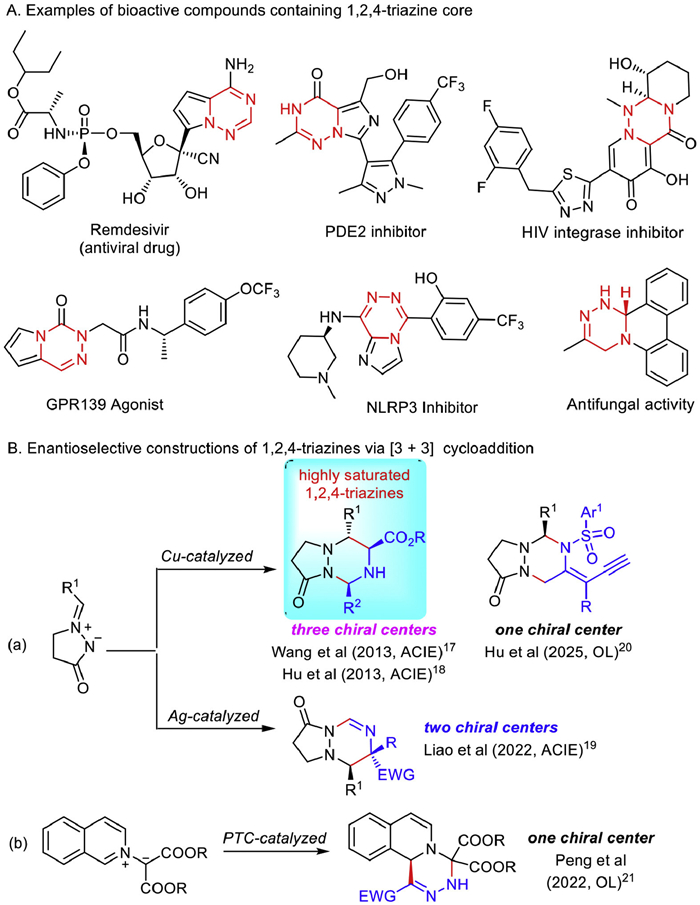
Nitrogen-containing heterocycles represent a fundamental structural motif widely distributed in natural products, bioactive molecules, and pharmaceuticals [1–4]. Among these privileged structures, 1,2,4-triazines and their derivatives have attracted considerable attention in medicinal chemistry due to their distinctive heterocyclic architecture [5–7] and broad-spectrum pharmacological potential (Fig. 1A) [8–10]. The remarkable structural adaptability and therapeutic relevance of these compounds have established them as key scaffolds in contemporary drug discovery. Substantial research efforts have focused on developing efficient synthetic routes to access these valuable heterocycles. In particular, the [3 + 3] cycloaddition of azomethine imines has emerged as a robust and versatile strategy for assembling diverse 1,2,4-triazine derivatives [11–16]. Nevertheless, the catalytic enantioselective synthesis of this scaffold remains challenging, with only limited successful examples reported (Fig. 1B) [17–21]. The field witnessed a major breakthrough in 2013 when Wang et al. [17] and Hu et al. [18] independently pioneered copper-catalyzed asymmetric 1,3-dipolar cycloadditions employing N,N'-cyclic azomethine imines and azomethine ylides. In 2022, Liao et al. subsequently developed a silver-catalyzed asymmetric [3 + 3] cycloaddition utilizing activated isocyanides [19]. Most recently, Hu's group extended the scope of copper-catalyzed asymmetric 1,3-dipolar cycloaddition through the implementation of 2-aminoallyl zwitterions [20]. Complementing these metal-catalyzed approaches, Peng et al. demonstrated in 2022 that phase-transfer catalysis could effectively mediate the [3 + 3] cycloaddition of isoquinolinium methylides with diazo compounds [21]. A critical observation is that existing synthetic methodologies have predominantly targeted unsaturated 1,2,4-triazine systems, while their saturated counterparts, particularly 1,2,4-triazinanes, remain markedly underdeveloped. This disparity is especially noteworthy given the growing pharmaceutical preference for saturated heterocycles, which offer distinct advantages including enhanced three-dimensionality, greater sp3-character, and beneficial conformational constraints [22–23]. Current therapeutic agents incorporating 1,2,4-triazine motifs almost exclusively feature unsaturated architectures, leaving the medicinal potential of saturated variants largely unexplored. Consequently, the development of efficient synthetic strategies for constructing sp3-hybridized 1,2,4-triazines, especially stereochemically complex systems such as triazinanes bearing multiple stereocenters, from readily accessible precursors represents a formidable challenge in contemporary organic synthesis. Given the imperative to expand the chemical diversity of 1,2,4-triazines for drug discovery purposes, the pursuit of robust asymmetric synthetic routes to structurally diverse 1,2,4-triazinanes emerges as a particularly compelling research objective.
Figure 1
Figure 1.
Applications and enantioselective synthesis of 1,2,4-triazine derivatives. (A) Examples of bioactive compounds containing 1,2,4-triazine core. (B) Enantioselective constructions of 1,2,4-triazines via [3 + 3] cycloaddition.
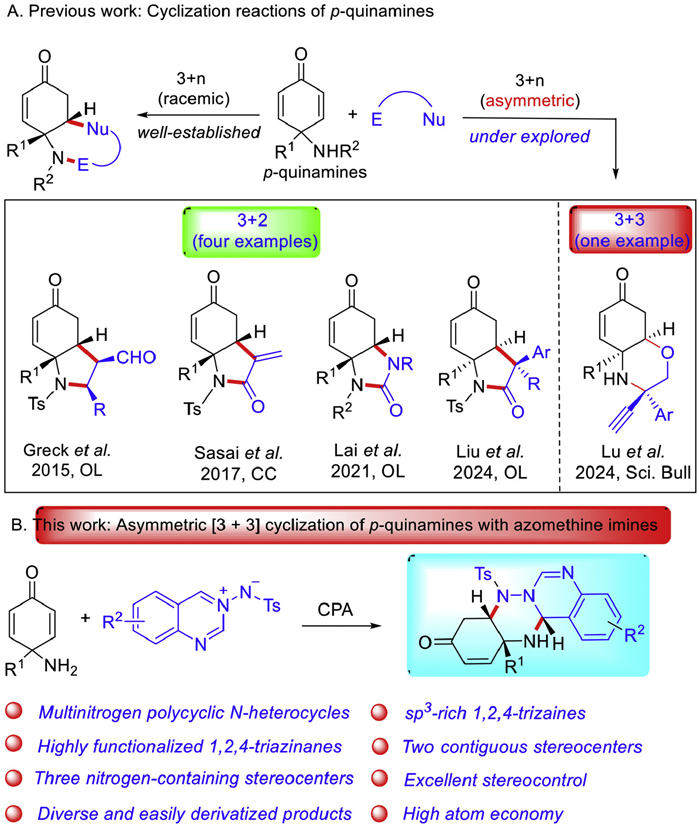
As a privileged subclass of cyclohexadienones, para-quinamines represent a class of versatile synthetic intermediates and highly valuable building blocks that have recently attracted considerable attention due to their broad utility in organic synthesis [24–26]. Their distinctive structural features enable diverse 1,3-dipolar cycloadditions with various reaction partners, allowing efficient construction of bicyclic N-heterocyclic scaffolds through desymmetrization strategies (Scheme 1). Despite these recent advances, to the best of our knowledge most reported [3 + 2] or [3 + 3] cycloadditions involving p-quinamines have been limited to racemic systems [16,27–44], with their catalytic asymmetric variants remaining largely unexplored (Scheme 1A) [45–48]. To date, only four systematic investigations of the catalytic enantioselective [3 + 2] cyclizations of p-quinamines have been documented, pioneered by Greck et al. [45], Sasai et al. [46], our group [47], and Liu et al. [48]. In stark contrast, catalytic enantioselective [3 + 3] cyclizations of p-quinamines remain unprecedented chemistry despite its power in constructing enantioenriched six-membered rings. Indeed, [3 + 3] cyclizations for six-membered ring formation pose significantly greater challenges than [3 + 2] cyclizations for five-membered rings [49–51]. Notably, Lu and co-workers recently achieved the first asymmetric [3 + 3] cyclization of p-quinamines via a Cu-catalyzed propargylic amination/desymmetrization strategy [52]. Therefore, the development of novel asymmetric strategies to achieve the challenging [3 + 3] cycloaddition of p-quinamines remains highly desirable. Building on our ongoing studies of p-quinamine chemistry, we aim to leverage their diverse reactivity patterns in cycloadditions for heterocycle synthesis. Meanwhile, azomethine imines have been widely used as 1,3-dipoles in dipolar cycloaddition for the preparation of multiple nitrogen-containing heterocycles due to their innate structural advantage [53–70]. In our pursuit of innovative heterocycle synthesis [71–73], we hypothesized that combining these two nitrogen-rich building blocks (p-quinamines and azomethine imines) could provide efficient access to 1,2-diaza heterocycles. Specifically, we envisioned that a [3 + 3] cyclization between these partners might enable the direct construction of polycyclic 1,2,4-triazinane scaffolds, a structural motif of considerable synthetic and pharmaceutical relevance. It is worth noting that, our research group have just recently reported the [2 + 3] cycloaddition of N-protected p-quinamines with azomethine imines, in which the unsaturated enone of p-quinamines serves as electrophilic two-atom synthons [74]. Herein, we present our developed method to construct enantioenriched 6/6/6/6-fused tetracyclic 1,2,4-triazinanes via asymmetric [3 + 3] cyclization of p-quinamines and azomethine imines (Scheme 1B).
Scheme 1
Scheme 1.
Profile of cyclization reactions involving p-quinamines.
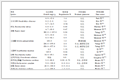
We initiated our investigation by choosing p-quinamine 1a and azomethine imine 2a as model substrates under chiral phosphoric acid (CPA) catalysis (Table 1). The initial reaction, conducted with a 1:1.2 molar ratio of substrates in the presence of CPA (A1, 10 mol%) in dichloromethane (DCM) at –10 ℃ for 48 h, successfully afforded the desired [3 + 3] cycloadduct 3aa in 65% yield and 58% ee (entry 1). Encouraged by this promising outcome, we screened a series of CPA catalysts derived from BINOL, SPINOL, and H8-BINOL scaffolds (see Supporting information for details). The three catalyst structural types showed minimal variation in their impact on reaction activity. In contrast, regarding enantioselectivity, catalysts with greater steric hindrance were observed to provide enhanced enantioselectivity control, among which the (R)-A2 catalyst achieved the highest enantioselectivity (92% ee, entry 2). Subsequently, we examined the influence of solvent (entries 10–14) and found that 1,2-dichloroethane (DCE) provided both excellent yield and the highest enantioselectivity. Reducing the reaction concentration from 0.1 mol/L to 0.05 mol/L resulted in a slight improvement in both yield and enantioselectivity (85% yield, 94% ee; entry 15). Conversely, decreasing the catalyst loading from 10 mol% to 5 mol% led to a modest reduction in both yield and enantioselectivity (80% yield, 90% ee; entry 16).
a1a (0.05 mmol), 2a (0.06 mmol), catalyst (10 mol%), solvent (0.5 mL, 0.1 mol/L), 48 h. b Estimated by 1H NMR of the crude product with CH2Br2 as internal standard. c Determined by HPLC. d Run at 0.05 mol/L concentration for 36 h. e Run with 5 mol% of A2
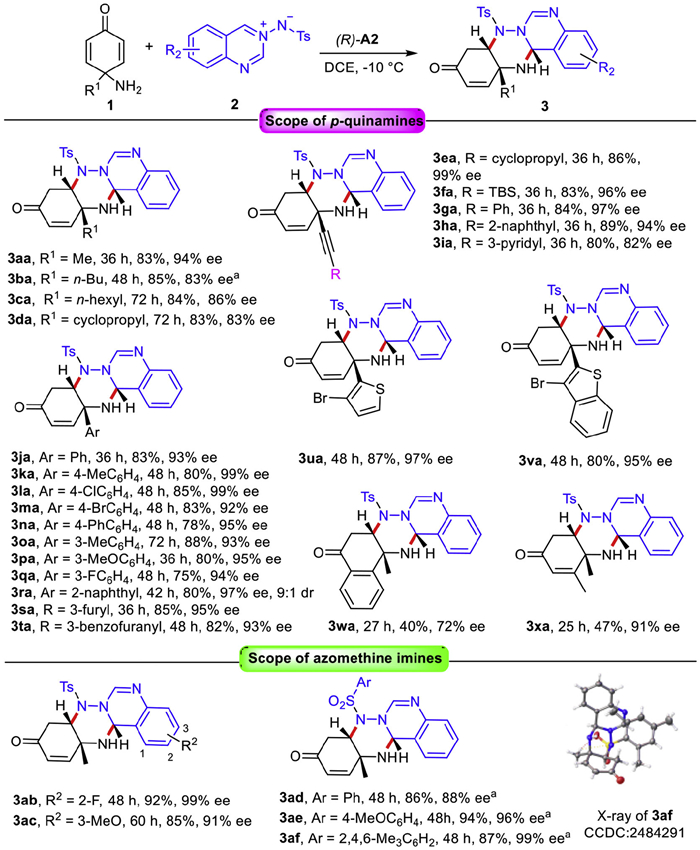
With the optimized conditions in hand, we next evaluated the substrate scope of this reaction (Scheme 2). First, we examining the applicability of the cyclization to various p-quinamines with azomethine imine 2a. The p-quinamines equipped with a linear alkyl group (n-Bu, n-hexyl) or a cyclic alkyl group (cyclopropyl) all underwent smoothly cyclization. Notably, a trend of diminishing enantioselectivity was observed as the length or steric bulk of the alkyl substituent increased (3aa–3da). We then investigated a range of alkynyl substituents, all of which were well tolerated under the standard conditions (3ea–3ha). However, the pyridyl-substituted alkynyl group, which contains an additional Lewis basic site, likely competes for binding with the catalyst, resulting in a slight reduction in enantioselectivity (3ia). Aromatic p-quinamines with either electron-donating, electron-withdrawing, or neutral substituents at the meta- or para-positions of the benzene ring were all compatible with the reaction, affording the desired products in good yields (3ja–3qa). Furthermore, substrates featuring a naphthyl or heteroaromatic group also performed well, delivering products with high stereoselectivities (3ra–3ta). Finally, unsymmetrical p-quinamines were examined, which generated the cyclized products in moderate yields and good enantioselectivities (3wa–3xa). In extending our investigations to the scope of azomethine imines, we evaluated the influence of various aromatic substituents. The reaction demonstrated good compatibility with substituents at different positions. Notably, substrates bearing electron-donating groups (2c) generally exhibited lower reactivity, requiring longer reaction times compared to those with electron-withdrawing substituents (2b). Furthermore, modifications to the phenyl ring of the arylsulfonyl protecting group, including both methyl and methoxyl substituents, were well tolerated and consistently afforded the corresponding products with improved enantioselectivity (3ad–3af). The absolute configurations of the 1,2,4-triazinane products were confirmed by analogy to product 3af, whose structure was unambiguously assigned by X-ray crystallography.
Scheme 2
Scheme 2.
Enantioselective [3 + 3] cycloadditions of p-quinamines with azomethine imines. Reaction conditions: 1a (0.1 mmol), 2a (0.12 mmol), (R)-A2 (10 mol%), DCE (2 mL). Isolated yield. a Run at −20 ℃.
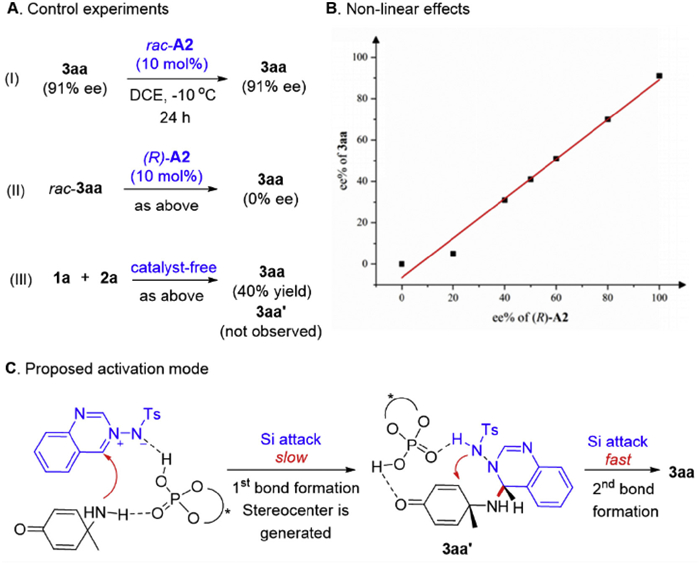
To further understand the reaction mechanism, a series of control experiments were carried out (Fig. 2A, Ⅰ–Ⅲ). Initially, we assessed the potential for chiral modifications by subjecting enantioenriched product 3aa to racemic catalyst A2, resulting in no erosion of enantiopurity (Fig. 2A, Ⅰ). Similarly, exposure of rac-3aa to (R)-A2 led to no change in enantiomeric excess (Fig. 2A, Ⅱ). These results suggest that the [3 + 3] cycloaddition is irreversible. In the absence of a catalyst, the reaction between 1a and 2a proceeded smoothly to afford racemic product 3aa (Fig. 2A, Ⅲ). It is noteworthy that the target product 3aa formed exclusively during the reaction, with or without a catalyst, as monitored by TLC. The absence of any detectable intermediate 3aa′ suggests that its formation is the rate-determining step, whereas the subsequent intramolecular aza-Michael addition proceeds rapidly. A linear correlation between product and catalyst enantiomeric excess was observed (Fig. 2B), supporting the involvement of a single CPA molecule in the enantiodetermining transition state. Based on these experimental findings, a plausible reaction mechanism and an asymmetric-induced reaction mode for the enantioselective transformation are depicted in Fig. 2C. The cyclization proceeds via a two-step addition sequence. Initially, CPA activates both p-quinamine 1a and azomethine imine 2a through hydrogen-bonding interactions, enabling Si-face-selective addition to generate the first stereocenter. Subsequently, CPA again acts in a bifunctional manner to activate 3aa′, facilitating a rapid intramolecular aza-Michael addition from the Si-face to accomplish the [3 + 3] cycloaddition.
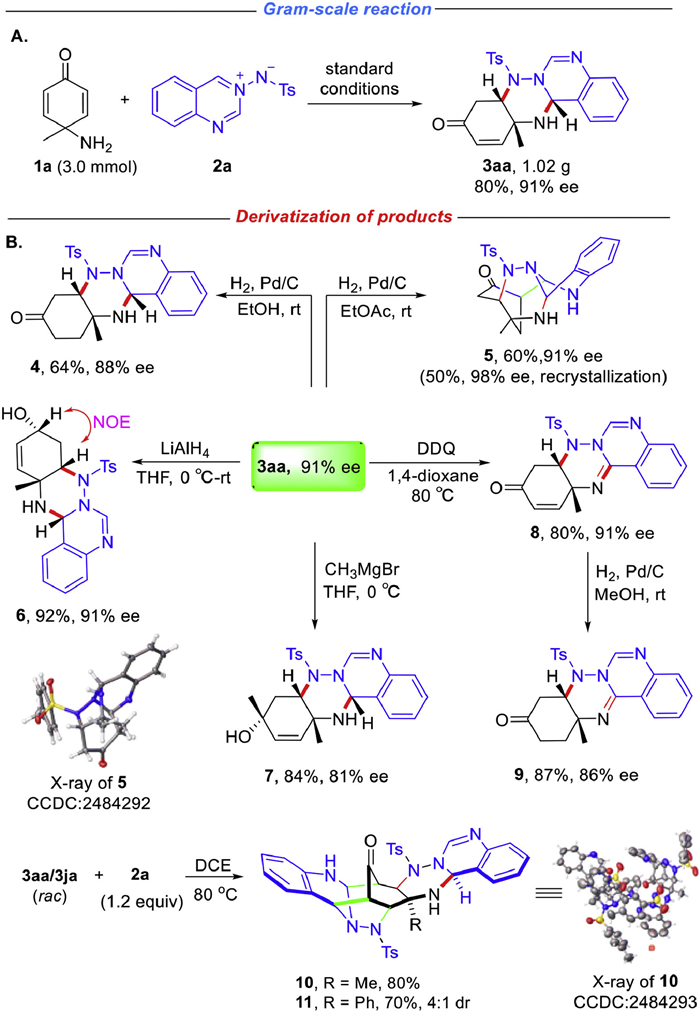
To illustrate the synthetic value of this catalytic enantioselective [3 + 3] cyclization, we conducted gram-scale preparation and synthetic transformations (Scheme 3). Obviously, in comparison with the small-scale reaction, the [3 + 3] cyclization of 1a with 2a can be easily scaled up to generate tetracyclic 1,2,4-triazinane 3aa in almost maintained yield and enantioselectivity (Scheme 3A). Capitalizing on the diverse functional groups present in the 1,2,4-triazinane products, we conducted a series of transformations to access structurally complex motifs that are otherwise challenging to synthesize (Scheme 3B). For instance, Pd/C-catalyzed hydrogenation of 3aa under H2 in ethanol at room temperature yielded the reduced product 4. Intriguingly, switching the solvent to ethyl acetate led to an unexpected domino reduction/cyclization process, delivering the polycyclic cage-like molecule 5. We propose that the moderate dielectric constant of ethyl acetate is conducive to stabilizing the carbon negative ion intermediate obtained through 1,4-addition. The ketone carbonyl in 3aa was stereospecifically reduced to the corresponding alcohol 6 using lithium aluminum hydride. Similarly, treatment of 3aa with methyl magnesium bromide afforded the 1,2-addition product 7. Furthermore, C–N bond oxidation of 3aa smoothly provided product 8, which could be further hydrogenated with Pd/C to furnish compound 9. Notably, subjecting 3aa or 3ja to 1.2 equiv. of azomethine imine 2a under heating conditions induced a tandem [2 + 3] cycloaddition/cyclization, yielding unprecedented cage-like octocyclic N-heterocycles 10 and 11. The structures of 5 and 10 were unambiguously confirmed by single-crystal X-ray diffraction analysis.
Scheme 3
Scheme 3.
Gram-scale synthesis and further transformations. (A) Gram-scale reaction. (B) Derivatization of products.
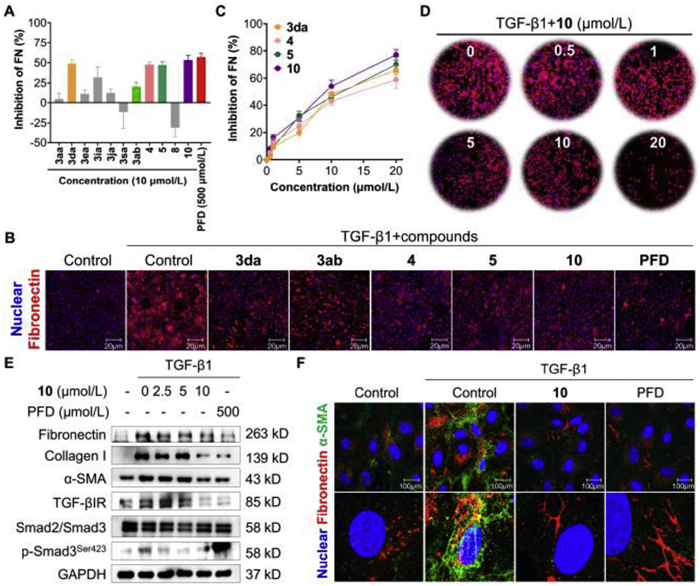
To evaluate the potential anti-fibrosis efficacies of these synthesized compounds, transforming growth factor-β1 (TGF-β1) -treated human fibroblast LX-2 model was adopted as our previously reported [75]. The pan anti-fibrotic agent pirfenidone (PFD, 500 µmol/L) was used as a positive control. Compared with TGF-β1 control cells, PFD addition efficiently decreased the signal of fibronectin (FN) after a 48-h incubation (Fig. 3A). Most of the compounds efficiently suppressed the expression of FN. Among which, compound 3da, 4, 5 and 10 showed over 50% inhibitory effect in FN expression at a concentration of 10 µmol/L (Fig. 3A). The representative images of FN staining in cells were displayed in Fig. 3B. Meanwhile, compounds 3da, 4, 5 and 10 treatment dose dependently decreased the signals of FN (Fig. 3C). The representative images of 10 at each concentration were presented in Fig. 3D. Immunoblot analysis revealed that either PFD or 10 treatment efficiently decreased the expression of fibrosis markers, including collagen I, FN, and α-smooth muscle actin (α-SMA) (Fig. 3E). Immunofluorescence analysis of α-SMA and FN in activated hepatic stellate cells (acHSCs) further confirmed the ameliorative effect of 10 on fibrosis (Fig. 3F). These suppressions were alongside canonical TGF-β1/Smad signaling suppression, a critical feature of fibrogenesis that phosphorylates the downstream mediators Smad2 and Smad3, amplifying fiber production signals in activated fbroblasts. Treating 10 in acHSCs decreased the expression level of transforming growth factor-β1 receptor (TGF-β1R) and the phosphorylation level of Smad 3 (Fig. 3E).
Figure 3
Figure 3.
Identification of potential anti-liver fibrosis agent using the established cell-based high-through screening model. (A) Evaluation of the fibrogenesis inhibitory effect of compounds in TGF-β1 treated LX-2 fibroblasts. (B) Representative images of FN staining. Scale bar: 20 µm. (C) Dose-dependent effect of 3da, 4, 5, and 10 in decreasing FN expression. (D) Representative images of FN staining upon 10 treatment. (E) Determination of protein levels of fibrogenesis markers and TGF-β1/Smad signaling. (F) Immunofluorescence analysis of α-SMA and FN. Scale bar: 100 µm. n = 3 independent biological experiments. Data are presented as mean ± standard error of the mean (SEM). GAPDH, glyceraldehyde−3-phosphate dehydrogenase.
In summary, we have disclosed a novel asymmetric synthesis of 6/6/6/6-fused tetracyclic 1,2,4-triazinanes bearing vicinal chiral stereocenters via enantioselective [3 + 3] cyclization between p-quinamines and azomethine imines enabled by chiral phosphoric acid catalysis. This method features mild reaction conditions, excellent functional group tolerance, a broad substrate scope, and suitability for diversity-oriented synthesis. Mechanistic studies were conducted to elucidate the reaction pathway. This protocol represents not only a new strategy for the enantioselective assembly of 1,2,4-triazine scaffolds, but also a rare example of an asymmetric [3 + 3] cyclization involving p-quinamines. Furthermore, the in vitro assessment of the antifibrotic activity of the resulting 1,2,4-triazinane derivatives reveal that compound 10 may be a potential therapeutic candidate for liver fibrosis and related diseases. Overall, the operational simplicity and versatility of our approach render it a promising strategy for the synthesis of complex 1,2,4-triazine derivatives with significant potential applications in medicinal chemistry.
CRediT authorship contribution statement
Yan Ding: Writing – original draft, Methodology, Investigation. Feng Lv: Writing – original draft, Methodology, Investigation, Data curation. Yue Chen: Writing – original draft, Investigation, Data curation. Zhe Liu: Writing – original draft, Methodology, Investigation, Data curation. Yang Ma: Investigation. Shiru Li: Investigation. Dejing Yin: Data curation. Jian Wen: Investigation. Yong Rao: Writing – review & editing, Writing – original draft, Supervision, Methodology, Funding acquisition, Formal analysis, Data curation. Ling Huang: Writing – review & editing, Supervision, Project administration, Funding acquisition. Zengwei Lai: Writing – review & editing, Writing – original draft, Supervision, Resources, Project administration, Methodology, Funding acquisition, Formal analysis.
Declaration of competing interest
The authors declare that they have no known competing financial interests or personal relationships that could have appeared to influence the work reported in this paper.
Acknowledgments
We are grateful for financial support from National Natural Science Foundation of China (Nos. 22177121, 82260674, 82160653); Excellent Talent Team Project in Hainan Province (No. HNYT20250004). We also thank Dr. Zhanpeng Ge at Shanghai Institute of Materia Medica for helpful drawing some cage-like molecules.
Supplementary materials
Supplementary material associated with this article can be found, in the online version, at doi:10.1016/j.cclet.2025.112288.
[1]
W.R. Pitt, D.M. Parry, B.G. Perry, et al., J. Med. Chem. 52 (2009) 2952–2963. doi: 10.1021/jm801513z
[2]
T.J. Ritchie, S. Macdonald, R.J. Young, et al., Drug Discov. Today 16 (2011) 164–171. doi: 10.1016/j.drudis.2010.11.014
[3]
R.D. Taylor, M. MacCoss, A.D.G. Lawson, J. Med. Chem. 57 (2014) 5845–5859. doi: 10.1021/jm4017625
Figure 3
Identification of potential anti-liver fibrosis agent using the established cell-based high-through screening model. (A) Evaluation of the fibrogenesis inhibitory effect of compounds in TGF-β1 treated LX-2 fibroblasts. (B) Representative images of FN staining. Scale bar: 20 µm. (C) Dose-dependent effect of 3da, 4, 5, and 10 in decreasing FN expression. (D) Representative images of FN staining upon 10 treatment. (E) Determination of protein levels of fibrogenesis markers and TGF-β1/Smad signaling. (F) Immunofluorescence analysis of α-SMA and FN. Scale bar: 100 µm. n = 3 independent biological experiments. Data are presented as mean ± standard error of the mean (SEM). GAPDH, glyceraldehyde−3-phosphate dehydrogenase.
a1a (0.05 mmol), 2a (0.06 mmol), catalyst (10 mol%), solvent (0.5 mL, 0.1 mol/L), 48 h. b Estimated by 1H NMR of the crude product with CH2Br2 as internal standard. c Determined by HPLC. d Run at 0.05 mol/L concentration for 36 h. e Run with 5 mol% of A2


 DownLoad:


 下载:


 下载:

