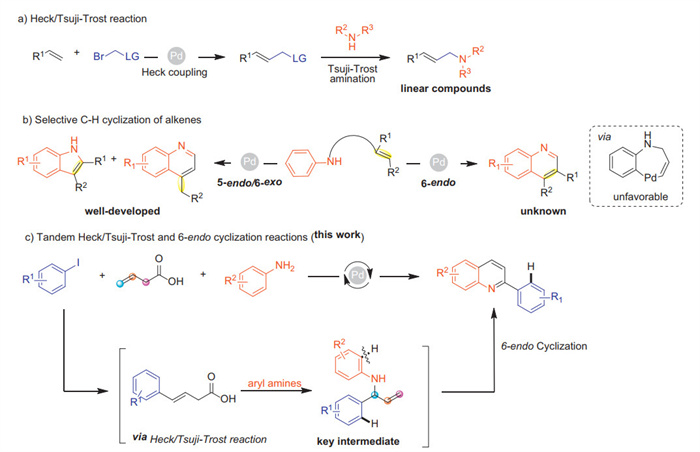
Figure 1.
(a) Heck/Tsuji-Trost reaction. (b) Selective C—H cyclization of alkenes. (c) Desired approach: tandem Heck/Tsuji-Trost and 6-endo cyclization reactions.

Palladium catalyzed tandem Heck/Tsuji-Trost and 6-endo cyclization reactions of aryl iodides, vinylacetic acid, and aryl amines
Xiaoya Zhuo , Xiangwen Tan , Yi Wang , Wanqing Wu , Huanfeng Jiang


Nitrogen-containing heterocycles are important organic compounds existing in various pharmaceuticals [1-3], agricultural chemicals [4], natural products [5-7], and functional materials [8]. Therefore, the development of methods for the efficient synthesis of nitrogen-containing heterocyclic is of great interest and has been long sought [9-13]. Tandem reactions have emerged as one of the most efficient methods for the delivery of different types of nitrogen containing molecules due to their high synthetic efficiency, avoiding the isolation of intermediates, and reducing the production of waste. Among them, the elegant combination of the classical coupling reaction with other reactions (such as cyclization) represents an efficacious synthetic strategy, facilitating the construction of target nitrogen-containing heterocyclic compounds through the regulation of reaction selectivity.
As a classic example of transition-metal-catalyzed reactions, Heck-type reactions have become a robust and versatile tool in organic synthesis [14-17], especially for constructing structurally diverse and densely functionalized linear molecules through three-component tandem Heck and Tsuji-Trost reactions [18-21]. In these transformations, alkenes are commonly used as substrates, yet its potential for subsequent transformations (especially cyclization-integrated reactions) remains underexplored. Of particular significance, the 6-endo cyclization offers a versatile platform for further transformation of alkenes [22-24], which can be effectively integrated with Heck and Tsuji-Trost reactions to access nitrogen-containing heterocyclic compounds.
However, concatenating these two reaction to construct nitrogenous heterocyclic compounds remains challenging because: (1) The Heck/Tsuji-Trost tandem reaction usually results in linear compounds [18], which are relatively simple in structure and lack active sites or functional groups required for further reactions (Fig. 1a). At the same time, the generated intermediates may not be compatible with the conditions required for the subsequent reactions, which makes it difficult for them to directly participate in the subsequent cyclization. (2) Achieving 6-endo cyclization has been a difficult process, because it usually requires the formation of larger-sized metallacycles [25,26], which is energetically unfavorable. In contrast, both the 5-endo and 6-exo cyclization preferentially form thermodynamically stable products, owing to its lower transition-state energy barriers (Fig. 1b) [27-29]. Based on previous work [30-37], we propose that the regulation of reaction regioselectivity is crucial for overcoming these challenges. If the branched-chain compound can be obtained in the Tsuji-Trost reaction, the presence of terminal olefins in branched products not only provides active sites for subsequent reactions but also enables the formation of desired cyclic compounds through 6-endo cyclization under suitable reaction conditions. Herein, we report a three-component tandem Heck/Tsuji-Trost and 6-endo cyclization reactions (Fig. 1c). The branched allylic aniline is generated in situ through the Heck/Tsuji-Trost reaction and subsequently undergoes 6-endo cyclization to afford quinolines. We initially employed iodobenzene 1a, vinyl acetate 2a, and aniline 3a as model substrates to optimize the reaction conditions (Table 1). To our delight, the desired product could be obtained in 52% yield with in the presence of Pd(TFA)2 (10 mol%), L1 (20 mol%), Ag3PO4 (1.5 equiv.) and CsOPiv (1.0 equiv.) in HFIP/HOAc (1:1, 1 mL) at 90 ℃ under O2 atmosphere for 24 h (entry 1) (see Tables S1–S7 in Supporting information for details). In pursuit of higher yields, we screened various substituted o-phenanthroline ligands and found that those with less sterically hindered such as L2, L3, L4, and L5 exhibited inhibitory effects on the reaction (entries 2–5). Other bidentate nitrogen ligands, for instance, L6, L7 and L8, generated merely trace quantities of the desired products (entries 6–8). Increasing the Ag3PO4 loading from 1.5 equiv. to 4.5 equiv. resulted in a significant yield improvement from 52% to 67%, which we ascribe to the multifunctional nature of silver phosphate serving as: (ⅰ) An oxidant, (ⅱ) a decarboxylation facilitator, and (ⅲ) a precipitant for iodide ions from iodobenzene (entry 9). Finally, the target product was obtained in 78% LC yield and 73% isolated yield under the following reaction conditions: Pd(TFA)2 (10 mol%), L1 (20 mol%), Ag3PO4 (4.5 equiv.), and CsOPiv (3.5 equiv.) in HFIP/HOAc (1:1, 1 mL) at 90 ℃ under O2 atmosphere for 24 h (entry 10). Control experiments confirmed that the reaction failed to proceed in the absence of palladium and Ag3PO4 (entries 11 and 12). The absence of Ligand and CsOPiv were found to decrease the yield (entries 13 and 14). Additionally, Oxygen is an essential condition for the reaction (entry 15).

 DownLoad:
CSV
DownLoad:
CSV
 |
||||||||||||||||||||||||||||||||||||||||||||
| Entry | Deviation from the standard conditions | Yields (%)b | ||||||||||||||||||||||||||||||||||||||||||
| 1 | None | 52 | ||||||||||||||||||||||||||||||||||||||||||
| 2 | L2 instead of L1 | 40 | ||||||||||||||||||||||||||||||||||||||||||
| 3 | L3 instead of L1 | 48 | ||||||||||||||||||||||||||||||||||||||||||
| 4 | L4 instead of L1 | 21 | ||||||||||||||||||||||||||||||||||||||||||
| 5 | L5 instead of L1 | Trace | ||||||||||||||||||||||||||||||||||||||||||
| 6 | L6 instead of L1 | Trace | ||||||||||||||||||||||||||||||||||||||||||
| 7 | L7 instead of L1 | Trace | ||||||||||||||||||||||||||||||||||||||||||
| 8 | L8 instead of L1 | Trace | ||||||||||||||||||||||||||||||||||||||||||
| 9 | Ag3PO4 (4.5 equiv.) instead of Ag3PO4 (1.5 equiv.) | 67 | ||||||||||||||||||||||||||||||||||||||||||
| 10 | CsOPiv (3.5 equiv.) instead of CsOPiv (1.0 equiv.) | 78 (73) | ||||||||||||||||||||||||||||||||||||||||||
| 11 | Without Pd(TFA)2 | n.d. | ||||||||||||||||||||||||||||||||||||||||||
| 12 | Without Ag3PO4 | n.d. | ||||||||||||||||||||||||||||||||||||||||||
| 13 | Without Ligand | 38 | ||||||||||||||||||||||||||||||||||||||||||
| 14 | Without CsOPiv | 45 | ||||||||||||||||||||||||||||||||||||||||||
| 15 | Conducted under N2 | 8 | ||||||||||||||||||||||||||||||||||||||||||
| a Reaction conditions: 1a (2.4 equiv.), 2a (0.25 mmol), 3a (2.1 equiv.), Pd(TFA)2 (10 mol%), L1 (20 mol%), Ag3PO4 (1.5 equiv.), CsOPiv (1.0 equiv.) in HFIP/HOAc (1:1, 1 mL), at 90 ℃ under O2 atmosphere for 24 h. b Yield was determined by LC of the crude product using 9-chloroanthracene as internal standard. |
||||||||||||||||||||||||||||||||||||||||||||
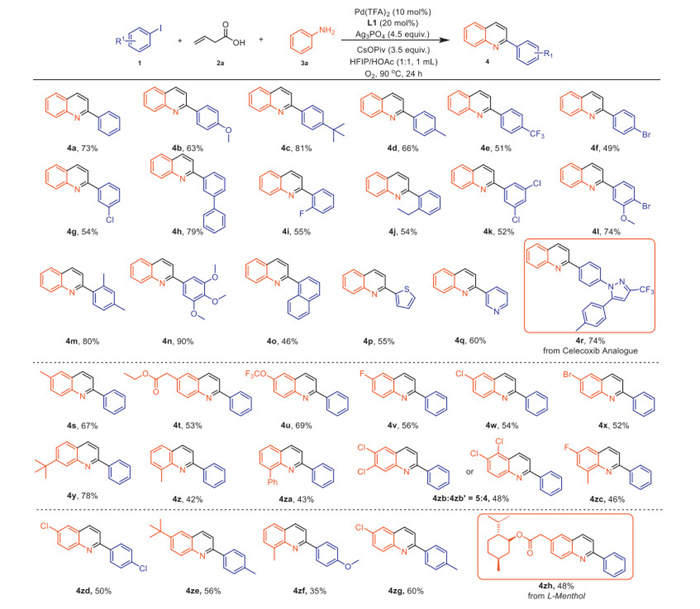
With optimized conditions established, we subsequently investigated the substrate scope (Fig. 2). A range of aryl iodides bearing either electron-withdrawing or electron-donating groups on the aromatic ring at para-, meta-, and ortho-positions were converted to the corresponding products 4b-4j in moderate to good yields. The disubstituted aryl iodides afforded the corresponding products 4k-4m. Moreover, the transformation was compatible with strongly electron-donating substrate, affording the corresponding product 4n in good yields. Products incorporating naphthalene 4o, thiophene 4p and pyridine 4q moieties formed in 46%, 55% and 60% yields, respectively. Significantly, this methodology enables late-stage functionalization modifications of drug molecules, as demonstrated by the efficient conversion of Celecoxib analogue 4r in 74% yield. Next, various para-substituted anilines were efficiently converted to the corresponding products 4s-4x under the standard conditions. Electron-deficient aniline substrates 4v-4x exhibited significantly reduced reactivity. Substrates bearing diverse transformable functional groups, including an ester 4t, chlorine atom 4w, and bromine atom 4x, were readily tolerated, affording the corresponding products. The meta–tert–butyl–substituted aniline underwent highly regioselective transformation to afford the desired product 4y. Anilines with ortho-substitution produced the target compounds 4z-4za in moderate yields. Disubstituted aromatic amine substrates 4zb-4zc participated in the reaction but exhibited poor regioselectivity. Finally, both substituted aryl iodides and anilines were efficiently transformed to afford the corresponding target compounds 4zd-4zg. Notably, the l-menthol-derived aniline underwent efficient late-stage modification to afford the desired product 4zh in 48% yield, demonstrating the utility of this methodology for natural product functionalization.
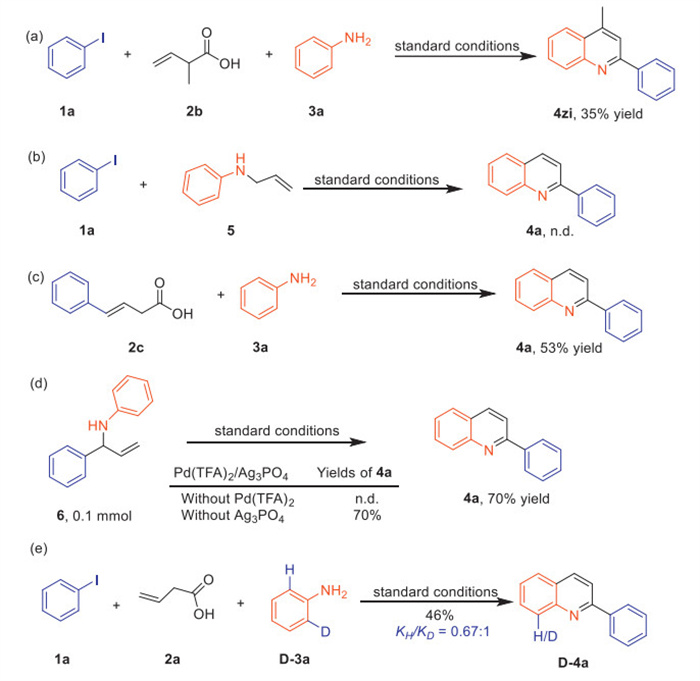
To investigate the reaction mechanism, a series of control experiments were conducted (Fig. 3). In the standard reaction, the introduction of 2-methylbut-3-enoic acid 2b instead of the vinylacetic acid 2a led to the formation of the corresponding product 4zi with a yield of 35%, which demonstrated that all three carbon atoms of vinylacetic acid 2a were involved in the reaction and confirmed the positioning of the carbon atoms (Fig. 3a). To probe the reaction initiation pathway and possible intermediates, substrate 5 was subjected to reaction with iodobenzene 1a under standard conditions. However, the desired product 4a was not detected by GC–MS, implying that the reaction may be initiated through a Heck-type coupling between iodobenzene 1a and 3-butenoic acid 2a (Fig. 3b). Furthermore, when the Heck reaction product 3c was subjected to subsequent coupling with aniline 3a under standard conditions, the target compound 4a was obtained in 53% yield, thereby confirming the proposed Heck reaction-driven initiation pathway (Fig. 3c). We propose that the Heck reaction product 2c undergoes a Tsuji-Trost reaction to generate the key intermediate 6, which subsequently undergoes cyclization to form the target compound. To validate this hypothesis, the synthetic intermediate 6 was subjected to the reaction under standardized conditions. The reaction proceeded smoothly, yielding the target compound 4a in 70% isolated yield and demonstrating the critical role of intermediate 6 in the reaction pathway. In addition, control experiments demonstrate that the palladium catalyst is essential for the reaction to proceed and that the cyclization process is independent of silver phosphate (Fig. 3d). The intramolecular kinetic isotope effect (KIE) study using deuterium-labeled aniline D-3a yielded a KIE value of 0.67, indicating that C(sp2)-H bond cleavage does not dominate the rate-determining step under the current catalytic conditions (Fig. 3e) (see Supporting information for more details).
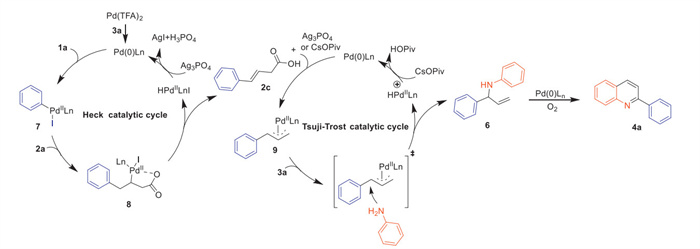
Building upon our mechanistic investigations and prior literature [38-46], a plausible mechanism has been illustrated in (Fig. 4). The catalytic cycle initiates through aniline-assisted reduction of PdⅡ to Pd0, which subsequently undergoes oxidative addition with iodobenzene 1a to form the PdⅡ-aryl intermediate 7. Migratory insertion between the PdⅡ-aryl intermediate 7 and 3-butenoic acid 2a is triggered, yielding intermediate 8, whereupon β-hydrogen elimination occurs to afford intermediate 2c alongside a PdⅡ-hydride complex. The PdⅡ-hydride complex undergoes reductive elimination in the presence of silver phosphate, regenerating the active Pd0 catalyst and thereby completing the Heck catalytic cycle. Subsequently, mediated by either silver phosphate (Ag3PO4) or cesium pivalate (CsOPiv), intermediate 2c undergoes oxidative addition concerted with decarboxylation, generating a π-allylpalladium(Ⅱ) complex 9. Nucleophilic attack of aniline 3a on the π-allylpalladium intermediate 9 forms intermediate 6 with concomitant release of a palladium hydride species. The Pd-H intermediate undergoes base-assisted reductive elimination, facilitated by cesium pivalate (CsOPiv), regenerating the active Pd0 catalyst and thereby closing the Tsuji-Trost catalytic cycle. Finally, intermediate 6 undergoes Pd0-mediated intramolecular C(sp2)-H activation followed by 6-endo cyclization, delivering the target product 4a.
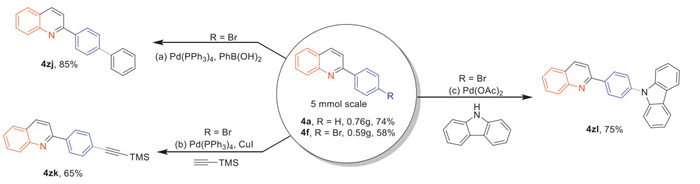
The obtained products were further employed in diverse synthetic applications (Fig. 5), see Supporting information for more details. Initially, the reaction was scaled up to 5 mmol under standard conditions, successfully affording 0.76 g of product 4a in 74% isolated yield and 0.59 g of product 4f in 58% isolated yield (Fig. 5a). Subsequently, to further prove the synthetic practicality of this methodology, the brominated product 4f was successfully employed as a coupling partner for the construction of functionalized quinoline scaffolds. Using phenylboronic acid as the coupling partner, the Suzuki-Miyaura cross-coupling reaction afforded the arylated product 4zj in 85% yield (Fig. 5b). Besides, by performing Sonogashira coupling with trimethylsilylacetylene, the alkynylated product 4zk was delivered in 65% yield (Fig. 5c). The Ullmann type C—N bond coupling with carbazole also demonstrated good compatibility, furnishing corresponding product 4zl in 75% yield (Fig. 5d).
In conclusion, we have reported a palladium-catalyzed tandem Heck/Tsuji-Trost and 6-endo cyclization reaction method for synthesizing substituted quinolines from aryl iodides, vinylacetic acid, and aryl amines. The mechanistic experiments demonstrated that the presence of a branched amination product is essential for this tandem reaction, as it provides active sites for subsequent transformations. The practicality of this strategy has been validated through a broad substrate scope and a wide range of functional group compatibility, high regioselectivity, scale-up experiments, and the late-stage modification of natural products and drug molecules. These findings offer valuable insight for the future synthesis of complex nitrogen-containing heterocyclic compounds.
The authors declare that they have no known competing financial interests or personal relationships that could have appeared to influence the work reported in this paper.
Xiaoya Zhuo: Writing – original draft, Methodology, Investigation, Formal analysis, Data curation. Xiangwen Tan: Writing – review & editing, Investigation, Data curation. Yi Wang: Writing – original draft, Investigation, Data curation. Wanqing Wu: Writing – review & editing, Project administration, Funding acquisition, Conceptualization. Huanfeng Jiang: Writing – review & editing, Supervision, Project administration, Methodology, Funding acquisition, Conceptualization.
We would like to thank the National Key Research and Development Program of China (No. 2022YFB4101800), the National Natural Science Foundation of China (No. 2223002), and the Guangdong Basic and Applied Basic Research Foundation (No. 2024B1515040027) for their financial support.
Supplementary material associated with this article can be found, in the online version, at doi:
B. Baragaña, B. Hallyburton, I. Lee, et al., Nature 537 (2015) 122.
P. Yadav, K. Shah, Bioorgan. Chem. 109 (2021) 104639. doi: 10.1016/j.bioorg.2021.104639
S. Jain, V. Chandra, P.K. Jain, et al., Arab. J. Chem. 12 (2019) 4920–4946. doi: 10.1016/j.arabjc.2016.10.009
Q. Cai, H. Song, Y. Zhang, et al., J. Agric. Food Chem. 72 (2024) 12373–12386. doi: 10.1021/acs.jafc.4c01582
J.P. Michael, Nat. Prod. Rep. 24 (2007) 223–246. doi: 10.1039/b509528j
X.F. Shang, S.L. Morris-Natschke, G.Z. Yang, et al., Med. Res. Rev. 38 (2018) 1614–1660. doi: 10.1002/med.21492
Y.Q. Zhao, X. Li, H.Y. Guo, et al., Molecules 28 (2023) 6478. doi: 10.3390/molecules28186478
S. Tao, L. Li, J. Yu, et al., Chem. Mater. 21 (2019) 1284–1287. doi: 10.1080/09168451.2019.1597621
L.W. Ye, F.L. Hong, Acc. Chem. Res. 53 (2020) 2003–2019.
B. Zhang, A. Studer, Chem. Soc. Rev. 44 (2015) 3505–3521. doi: 10.1039/C5CS00083A
C. Teja, F.R.N. Khan, Chem. Asian J. 15 (2020) 4153–4167. doi: 10.1002/asia.202001156
C. Li, Y.B. Shao, X. Gao, et al., Nat. Commun. 14 (2023) 3380.
G.J. Sherborne, P. Kemmitt, C. Prentice, et al., Angew. Chem. Int. Ed. 62 (2023) e202207829. doi: 10.1002/anie.202207829
A.B. Dounay, L.E. Overman, Chem. Rev. 103 (2003) 2945–2963.
Y. Ping, Y. Li, J. Zhu, W. Kong, Angew. Chem. Int. Ed. 58 (2019) 1562–1573. doi: 10.1002/anie.201806088
R.X. Liang, Y.X. Liang, Acc. Chem. Res. 55 (2022) 734–745. doi: 10.1021/acs.accounts.1c00781
D. Paul, S. Das, S. Saha, H. Sharma, R.K. Goswami, Eur. J. Org. Chem. 15 (2021) 2057–2076. doi: 10.1002/ejoc.202100071
N. Kvasovs, J. Fang, F. Kliuev, V. Gevorgyan, J. Am. Chem. Soc. 145 (2023) 18497–18505. doi: 10.1021/jacs.3c04968
X. Wu, H.C. Lin, M.L. Li, et al., J. Am. Chem. Soc. 137 (2015) 13476–13479. doi: 10.1021/jacs.5b08734
J.H. Liu, W. Wen, Z.L. Wu, et al., Chem. Sci. 15 (2024) 10232–10236. doi: 10.1039/d4sc02594f
R.C. Larock, Y. Lu, A.C. Bain, J. Org. Chem. 56 (1991) 4589–4590. doi: 10.1021/jo00015a002
Z.M. Zhang, B. Xu, L. Wu, et al., Angew. Chem. Int. Ed. 58 (2019) 14653–14659. doi: 10.1002/anie.201907840
Q. Pan, Y. Ping, Y. Wang, Y. Guo, W. Kong, J. Am. Chem. Soc. 143 (2021) 10282–10291. doi: 10.1021/jacs.1c03827
G. Tan, Q. You, J. Lan, J. You, Angew. Chem. Int. Ed. 57 (2018) 6309–6313. doi: 10.1002/anie.201802539
R.S. Thombal, P.Y.M. Rubio, D. Lee, D. Maiti, Y.R. Lee, ACS Catal. 12 (2022) 5217–5230. doi: 10.1021/acscatal.2c00813
M. Gulías, J.L. Mascareñas, Angew. Chem. Int. Ed. 55 (2016) 11000–11019. doi: 10.1002/anie.201511567
J. Zoller, D.C. Fabry, M.A. Ronge, M. Rueping, Angew. Chem. Int. Ed. 53 (2014) 13264–13268. doi: 10.1002/anie.201405478
S. Würtz, S. Rakshit, J.J. Neumann, T. Dröge, F. Glorius, Angew. Chem. Int. Ed. 47 (2008) 7230–7233. doi: 10.1002/anie.200802482
J.J. Neumann, S. Rakshit, T. Dröge, S. Würtz, F. Glorius, Chem. Eur. J. 17 (2011) 7298–7303. doi: 10.1002/chem.201100631
Y. Jin, Y. Jing, C. Li, et al., Nat. Chem. 14 (2022) 1118–1125. doi: 10.1038/s41557-022-01023-x
M. Li, Y. Jing, Y. Chen, W. Wu, H. Jiang, J. Am. Chem. Soc. 145 (2023) 9448–9453. doi: 10.1021/jacs.3c02114
C. Liu, X. Tan, L. Zhan, et al., Angew. Chem. Int. Ed. 61 (2022) e202215020.
C. Liu, J. Wu, X. Tan, et al., ACS. Catal. 13 (2023) 11339–11344. doi: 10.1021/acscatal.3c02864
X. Tan, Y. Jing, J. Wu, et al., Nat. Commun. 15 (2024) 9877.
C. Liu, X. Tan, J. Zhang, et al., Org. Lett. 25 (2023) 2701–2706. doi: 10.1021/acs.orglett.3c00819
J. Zhang, L. Mao, C. Liu, et al., Chem. Commun. 60 (2024) 9404–9407. doi: 10.1039/d4cc03099k
J. Zhang, C. Liu, J. Wu, et al., Org. Lett. 26 (2024) 4422–4426. doi: 10.1021/acs.orglett.4c00880
P. Tosatti, J. Horn, A.J. Campbell, et al., Adv. Synth. Catal. 352 (2020) 3153–3157.
S. Yang, L. Liu, Z. Zhou, Z. Huang, Y. Zhao, Org. Lett. 23 (2021) 296–299.
S. Shu, A. Leitner, J.F. Hartwig, Angew. Chem. Int. Ed. 43 (2004) 4797–4800.
Q.A. Chen, Z. Chen, V.M. Dong, J. Am. Chem. Soc. 137 (2015) 8392–8395. doi: 10.1021/jacs.5b05200
S. Shekhar, B. Trantow, A. Leitner, J.F. Hartwig, J. Am. Chem. Soc. 128 (2006) 11770–11771. doi: 10.1021/ja0644273
A. Sharma, J.F. Hartwig, J. Am. Chem. Soc. 135 (2013) 17983–17989. doi: 10.1021/ja409995w
S. Hansson, P.O. Hansson, M.P.T. Soegren, et al., Organometallics 12 (1993) 4940–4948. doi: 10.1021/om00036a038
P. Fristrup, T. Jensen, J. Hoppe, P.O. Norrby, Chem. Eur. J. 12 (2006) 5352–5360. doi: 10.1002/chem.200600152
G. Satyanarayana, D. Pflästerer, G. Helmchen, Eur. J. Org. Chem. 2011 (2011) 6877–6886. doi: 10.1002/ejoc.201100981

Figure 1 (a) Heck/Tsuji-Trost reaction. (b) Selective C—H cyclization of alkenes. (c) Desired approach: tandem Heck/Tsuji-Trost and 6-endo cyclization reactions.

Figure 2 The substrate scope of substituted aryl iodides and anilines, isolated yields on 0.25 mmol scale.

Figure 5 Synthetic applications of quinolines. (a) Pd(PPh3)4 (6 mol%), K3PO4 (3.2 equiv.), 2-(4-bromophenyl)quinolone (0.1 mmol, 1 equiv.), phenylboronic acid (2.2 equiv.), 1, 4-dioxane (1.0 mL), and H2O (0.1 mL) with N2 under 110 ℃ for 12 h; (b) Pd(PPh3)4 (60 mol%), CuI (120 mol%), 2-(4-bromophenyl)quinolone (0.1 mmol, 1 equiv.), DIPEA (2.0 mL), and ethynyltrimethylsilane (2.2 equiv.) with N2 under 80 ℃ for 12 h; (c) Pd(OAc)2 (10 mol%), PtBu3 (20 mol%), Cs2CO3 (8.0 equiv.), 2-(4-bromophenyl)quinolone (0.1 mmol, 1 equiv.), 9H-carbazole (2 equiv.), and toluene (2.0 mL) with N2 under 110 ℃ for 36 h.
Table 1. Optimization of reaction conditions.a
|
||||||||||||||||||||||||||||||||||||||||||||
| Entry | Deviation from the standard conditions | Yields (%)b | ||||||||||||||||||||||||||||||||||||||||||
| 1 | None | 52 | ||||||||||||||||||||||||||||||||||||||||||
| 2 | L2 instead of L1 | 40 | ||||||||||||||||||||||||||||||||||||||||||
| 3 | L3 instead of L1 | 48 | ||||||||||||||||||||||||||||||||||||||||||
| 4 | L4 instead of L1 | 21 | ||||||||||||||||||||||||||||||||||||||||||
| 5 | L5 instead of L1 | Trace | ||||||||||||||||||||||||||||||||||||||||||
| 6 | L6 instead of L1 | Trace | ||||||||||||||||||||||||||||||||||||||||||
| 7 | L7 instead of L1 | Trace | ||||||||||||||||||||||||||||||||||||||||||
| 8 | L8 instead of L1 | Trace | ||||||||||||||||||||||||||||||||||||||||||
| 9 | Ag3PO4 (4.5 equiv.) instead of Ag3PO4 (1.5 equiv.) | 67 | ||||||||||||||||||||||||||||||||||||||||||
| 10 | CsOPiv (3.5 equiv.) instead of CsOPiv (1.0 equiv.) | 78 (73) | ||||||||||||||||||||||||||||||||||||||||||
| 11 | Without Pd(TFA)2 | n.d. | ||||||||||||||||||||||||||||||||||||||||||
| 12 | Without Ag3PO4 | n.d. | ||||||||||||||||||||||||||||||||||||||||||
| 13 | Without Ligand | 38 | ||||||||||||||||||||||||||||||||||||||||||
| 14 | Without CsOPiv | 45 | ||||||||||||||||||||||||||||||||||||||||||
| 15 | Conducted under N2 | 8 | ||||||||||||||||||||||||||||||||||||||||||
| a Reaction conditions: 1a (2.4 equiv.), 2a (0.25 mmol), 3a (2.1 equiv.), Pd(TFA)2 (10 mol%), L1 (20 mol%), Ag3PO4 (1.5 equiv.), CsOPiv (1.0 equiv.) in HFIP/HOAc (1:1, 1 mL), at 90 ℃ under O2 atmosphere for 24 h. b Yield was determined by LC of the crude product using 9-chloroanthracene as internal standard. |
||||||||||||||||||||||||||||||||||||||||||||
 下载: 导出CSV

 扫一扫看文章


扫一扫关注我们


 下载:
下载: