Synergistic removal of antibiotic-resistant bacteria and genes by UVC-driven advanced oxidation process: Mechanistic insights and environmental challenges
Citation:
Jiamei Liu, Jiali Liu, Shurun Yang, Qingyu Zhao, Xin Wang, Xingxing An, Chuan-Shu He. Synergistic removal of antibiotic-resistant bacteria and genes by UVC-driven advanced oxidation process: Mechanistic insights and environmental challenges[J]. Chinese Chemical Letters,
2026, 37(8): 112699.
doi:
10.1016/j.cclet.2026.112699
Synergistic removal of antibiotic-resistant bacteria and genes by UVC-driven advanced oxidation process: Mechanistic insights and environmental challenges
English
Synergistic removal of antibiotic-resistant bacteria and genes by UVC-driven advanced oxidation process: Mechanistic insights and environmental challenges
Received Date:
11 December 2025 Accepted Date:
31 March 2026 Revised Date:
24 March 2026 Available Online:
15 August 2026
Abstract:
The global spread of antibiotic resistance (AR) poses a critical public health threat, urgently requiring effective strategies to control antibiotic-resistant bacteria (ARB) and antibiotic resistance genes (ARGs) in water. Ultraviolet-based advanced oxidation processes (UVC/AOPs) offer a promising solution. By leveraging synergy between UVC light and oxidants (e.g., H2O2, PMS, O3, PAA, Cl2) to generate reactive radicals, they efficiently inactivate ARB, degrade ARGs, and suppress horizontal gene transfer (HGT). This review synthesizes recent advances, emphasizing: (1) Combined mechanisms of direct UVC damage and radical-mediated oxidation; (2) critical efficacy factors like radical kinetics and water matrix effects (DOM, salinity); and (3) key challenges including mechanistic gaps, particulate shielding of ARGs, and variable microbial susceptibility. To address these, we propose a machine learning-augmented approach integrating quantum chemical calculations and real-time spectroscopy to build predictive "radical-biotarget" models for intelligent optimization. While UVC/AOPs show broad efficacy and environmental promise, future research must prioritize elucidating fundamental mechanisms, optimizing parameters for diverse waters, and developing intelligent control systems to enhance specificity and resilience. Through such innovations, UVC/AOPs can become a core technology for precise AR risk management in water systems, providing a sustainable barrier against resistance spread.
In recent years, the widespread use of antibiotics has led to the global proliferation of antibiotic resistant bacteria (ARB) and antibiotic resistant genes (ARGs) [1], which has posed critical threats to public health and ecological threat [2]. ARB exhibit resistance to multiple classes of antibiotics, rendering conventional treatments complexity and mortality rates of infectious diseases [3–6]. According to the World Health Organisation (WHO), millions of ARB-related infections and hundreds of thousands of associated deaths occur annually worldwide [7] ARGs, serving as the genetic foundation of bacterial resistance, encode specific proteins that confer antibiotic tolerance through mechanisms including drug target modification, enzymatic antibiotic degradation, efflux pump enhancement, or alteration of cell membrane permeability [8,9]. More critically, these ARGs can disseminate across bacterial populations through horizontal gene transfer (HGT) [10,11] even crossing species barriers, thereby accelerating the spread of resistance within microbial communities [12,13]. HGT primarily operates through three mechanisms: (1) Splicing: conjugation direct plasmid or integron-mediated DNA transfer via pilus channels between donor and recipient bacteria; (2) transformation: uptake of extracellular ARG fragments (e.g., from degraded chromosomal or plasmid DNA) followed by homologous recombination into recipient genomes; (3) transduction: phage-mediated packaging and delivery of host-derived ARGs to new bacterial hosts. These interconnected mechanisms facilitate the rapid dissemination of ARGs across environmental matrices (e.g., water, soil), clinical settings (e.g., hospitals), and animal gut microbiomes, driving the evolution of multidrug-resistant bacteria (MDRB) and superbugs [14]. Wastewater treatment plants (WWTPs) [6,15,16], livestock farms [17] and aquaculture farms [18] serve as primary reservoirs for both ARB and ARGs. Critically, effluents discharged form WWTPs-one of these key reservoirs, have been found to contain ARGs at concentrations as high as 107–108 copies/L [7], demonstrating their significant role in disseminating resistance into the environment. These genetic contaminants may enter natural water bodies and subsequently transfer to humans through food chains, amplifying health risks [19–21]. Consequently, developing effective strategies to mitigate ARB and ARG contamination in aquatic environments has emerged as a research priority, with notable advancements achieved in recent years.
Water purification represents a critical barrier against pathogenic threats [22,23], yet conventional treatment methods exhibit significant limitations in eliminating ARB and ARGs [24]. Physical approaches such as sedimentation and filtration primarily target suspended solids and large particulates, demonstrating minimal retention efficiency for micrometer-scale ARB and nanoscale ARGs [25]. While biological treatments can degrade certain organic pollutants, their ARB inactivation efficacy remains low. Furthermore, these systems risk facilitating horizontal transfer of ARGs to environmental microbiota (e.g., indigenous microorganisms) or pathogens via conjugation, transformation, or transduction, thereby amplifying contaminant dissemination [26]. For instance, extracellular DNA release from ARB in activated sludge systems and membrane-mediated contact mechanisms can promote plasmid-driven ARG propagation [12,26]. Chemical disinfectants like chlorine exhibit limited bactericidal efficacy against ARB and may inadvertently select for resistant survivors through sublethal dosing [27,28]. Additionally, chlorine-derived disinfection byproducts (DBPs), including trihalomethanes (THMs) and haloacetic acids (HAAs), pose elevated ecotoxicological and human health risks [26]. In contrast, advanced oxidation processes (AOPs) demonstrate superior ARB inactivation and ARG removal capacities via in situ generation of reactive oxygen species (ROS). Specifically, ultraviolet C (UVC)/peracetic acid (PAA) systems, as an emerging alternative in municipal wastewater and stormwater disinfection, generate minimal DBPs, with PAA decomposition primarily yielding acetic and formic acids, byproducts that pose negligible environmental impacts and leave no residual inorganic salts (e.g., sulfate) [29], thereby eliminating ecotoxicological concerns associated with traditional disinfectants. Similarly, UVC/Peroxymonosulfate (PMS) systems exhibit significantly reduced DBPs formation; for instance, in halogen-containing environments such as seawater, the total DBPs concentration (including chlorinated and brominated species) is only 47.6% of that in UVC/chlorine systems, with no detectable bromate formation, ensuring superior environmental safety [30]. Moreover, when treating humic acid (HA)-laden synthetic seawater, UVC/PMS produces no harmful halogenated DBPs, chlorate, or bromate, instead forming only trace non-halogenated organic byproducts [31]. UVC/AOPs technology synergistically couple ultraviolet irradiation with oxidants (e.g., hydrogen peroxide (H2O2), PMS, or PAA) to produce highly reactive radicals such as hydroxyl radicals (•OH), sulfate radicals (SO4•−) and organic radicals (CH3C(O)O•, CH3C(O)OO•). These radicals concurrently achieve physicochemical disruption of ARB cellular structures (e.g., membrane lipid peroxidation, enzyme inactivation) and molecular-level degradation of ARGs through oxidative DNA strand breakage and base modification. Table S1 (Supporting information) summarizes the operational principles, advantages, and limitations of these treatment technologies. Notably, UVC/AOPs have been successfully implemented in tertiary wastewater treatment, demonstrating potential for full-scale deployment to mitigate ARB/ARG contamination.
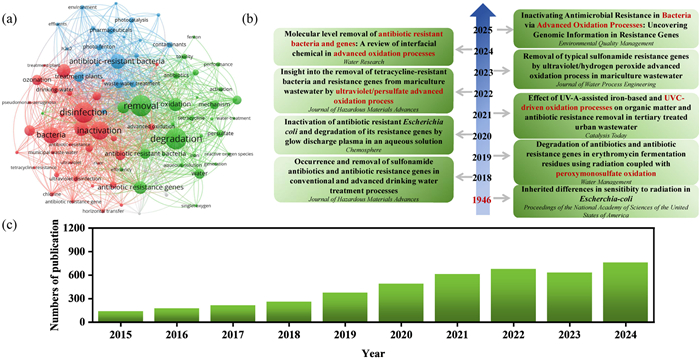
To systematically analyze the research progress and knowledge structure of UVC/AOPs in the elimination of ARB and ARGs, a visual analysis of 319 articles from the Web of Science Core Collection database (2015–2025) was performed using VOSviewer software. As illustrated in the keyword co-occurrence network (Fig. 1a), the clustering patterns reveal three distinct research focuses: (1) The blue cluster analysis reveals that current research primarily focuses on removing ARB and ARGs through oxidation and disinfection processes. These approaches demonstrate robust efficacy, achieving up to 4 log removal of microorganisms (e.g., E. coli ARB) under 15 min UV exposure [32] and 4.74 log reduction of Streptococcus via UVC/peroxydisulfate (PDS). Concurrently, > 90% degradation efficiency is attained for target ARGs (e.g., tetA, sul1) [33], and 1.5 log elimination of clinically prevalent blaNDM-1 using UV/PAA. with predominant applications in water treatment systems such as drinking water (UVC/chlorine) and medical wastewater (UVC/PAA); (2) the red cluster specifically examines the efficacy of various oxidants against ARB/ARGs and elucidates the free radical-mediated mechanisms; (3) while the green section emphasizes mechanistic investigations through reaction rate constants and inactivation efficiency analyses, particularly focusing on reactive species (•OH, SO4•−) generated in UVC-activated systems. Concurrently, this study conducted an investigation of articles published in the relevant field over the past decade. Research publications on the removal of ARB and ARGs by UVC/AOPs in water treatment have demonstrated sustained growth in recent years (Fig. 1b), highlighting that this technology has emerged as a critical research direction for addressing the dissemination of antibiotic resistance (Fig. 1c).
Figure 1
Figure 1.
(a) Comparative analysis of keyword co-occurrence in research on ARB and ARGs removal by UVC/AOPs. (b) Temporal evolution of annual publication volume in ARB and ARGs removal by UVC/AOPs research over the past decade. (c) Concentration-dependent effects of bibliometric parameters on ARB and ARGs removal by UVC/AOPs studies in recent years.
This study systematically elucidates the multiscale mechanisms underlying the inactivation of ARB and degradation of ARGs by UVC/AOPs, with a focus on radical-mediated cellular inactivation, genetic damage, and HGT suppression. While previous reviews have made significant advances in elucidating disinfection mechanisms, quantifying radical kinetics, and optimizing energy efficiency for individual UVC/AOP systems (e.g., UVC/PS or UVC/H2O2), this work provides the first comprehensive integration of scattered findings across five major configurations (UVC/H2O2, UVC/PMS, UVC/O3, UVC/PAA, UVC/Cl2). Notably, dedicated reviews comprehensively addressing UVC/AOPs specifically for the synergistic control of both ARB and ARGs remain notably scarce in the literature. Recent reviews have explored specific aspects of UVC/AOPs, such as the performance of UVC/PS in AR control [34,35] and the energy efficiency of UVC/AOPs [36]. However, a comprehensive review comparing multiple UVC/AOP configurations (e.g., UVC/H2O2, UVC/PMS, UVC/O3, UVC/PAA, and UVC/Cl2) in terms of their mechanisms, efficiency, and practical applicability for ARB/ARGs removal remains lacking. Through comparative analysis of these systems, we reveal intrinsic correlations between the oxidative characteristics (e.g., redox potential, persistence, and substrate selectivity) of radicals generated from different oxidants and their target-specific elimination efficiencies. This work fills a critical gap by integrating scattered findings into a unified framework, highlighting synergies and trade-offs among various UVC/AOPs. Nevertheless, complex aqueous matrices, including light-shielding effects from turbid particles, radical quenching by high-salinity ions, and competitive depletion of ROS by dissolved organic matter (DOM), impose multifaceted constraints on radical mass transfer and reaction kinetics. Furthermore, deciphering the intricate radical-biomolecule interactions at interfaces, predicting system performance across diverse and variable water compositions, understanding the heterogeneous microbial responses to UVC/AOPs across species, and quantifying spatial heterogeneity in degradation efficiency between iARGs and eARGs constitute significant mechanistic and predictive challenges. These factors collectively drive significant variations in the operational suitability of different UVC/AOP configurations. To overcome these complex challenges, this work uniquely integrates ML for multi-scale analysis. By integrating ML-enhanced molecular-level mechanistic insights with process-scale optimization strategies, we propose resolving dynamic competition mechanisms at radical-biomolecule interfaces through quantum chemical calculations coupled with reaction kinetic simulation. This novel approach provides interdisciplinary theoretical foundations for engineering UVC/AOP systems. ML facilitates the deciphering of complex reaction pathways, enables the prediction of treatment efficacy under intricate matrix conditions, and aids in understanding species-specific susceptibility, thereby guiding more robust system design and operation. The findings aim to guide precision implementation of UVC/AOPs in critical resistance hotspots such as medical wastewater and aquaculture effluents, ultimately contributing to global mitigation of antimicrobial resistance (AR) dissemination.
2.
UVC/AOPs technology principles and classification
2.1
Principles of UVC technology
UVC radiation occupies the 100–400 nm spectral region of the electromagnetic spectrum, categorized into three sub-bands based on wavelength: UVA (320–400 nm), UVB (280–320 nm), and UVC (100–280 nm) [37]. The photon energy of germicidal UV-C radiation (particularly at 254 nm) reaches approximately 4.87 eV, sufficient to cleave covalent bonds (e.g., C—C and C—H bonds) and directly damage biomacromolecules such as DNA and proteins through structural and functional alterations [8,38,39]. These photochemical properties, harnessed by conventional UVC disinfection systems predominantly utilizing low-pressure mercury lamps [40], underpin UVC's critical role in antimicrobial and disinfection applications, where microbial inactivation is achieved primarily through thymine dimer formation and subsequent disruption of DNA replication mechanisms [39].
UVC disinfection primarily targets microorganisms by damaging critical biomolecules, including DNA and proteins [39]. Within the germicidal UVC spectrum (200–280 nm), photons interact directly with microbial DNA [8,38], inducing photochemical reactions in pyrimidine bases such as thymine (T) and cytosine (C). This interaction generates pyrimidine dimers (e.g., thymine dimers, TT), which distort the DNA double helix and impede replication/transcription processes, ultimately inhibiting microbial proliferation [41–43]. Concurrently, UVC irradiation triggers the photo-oxidation of aromatic amino acid residues (e.g., tryptophan, tyrosine) in proteins. For instance, the oxidation of tryptophan produces kynurenine derivatives, disrupting protein structural stability and compromising enzymatic activity and functional integrity [44]. The synergistic action of these two mechanisms: DNA damage and protein denaturation, which confers UVC technology its broad-spectrum, high-efficacy bactericidal power against susceptible pathogens.
However, standalone UVC technology exhibits significant limitations in removing ARB and ARGs. DNA repair mechanisms (e.g., photoreactivation, nucleotide excision repair) can partially reverse UVC-induced damage to ARB. This reparative capacity, particularly demonstrated by the pronounced photoreactivation phenomenon where viable E. coli counts rebounded to 104 CFU/mL at 25 h post-treatment from an initial concentration of 107 CFU/mL [39], severely compromises its long-term disinfection efficacy. More fundamentally, while conventional UVC can rapidly inactivate bacteria (achieving 107 CFU/mL removal within 5 s) by inducing pyrimidine dimers (notably thymine dimers) in microbial nucleic acids [33], and partially disrupt ARG function (e.g., 4–5 log removal of tetA, sul1, and other genes at 2 × 10⁸ copies/mL [33]), its capacity for complete degradation of genetic material remains limited. This is especially evident when treating environmentally persistent eDNA harboring ARGs: For eDNA at an initial concentration of 103 copies/mL, UVC treatment for 30 min yielded a stable residual concentration of 5.55 ± 0.34 log copies/mL [45], indicating that UVC is almost ineffective in degrading such eDNA, which serves as a critical reservoir for horizontal gene transfer (HGT) [46,47].
Herein, UVC/AOPs demonstrate distinct advantages. UVC/AOPs introduce a potent oxidative pathway, complementary to direct photolysis, through the in situ generation of highly ROS such as •OH, SO4•−, or RO• [48,49]. These radicals inflict more extensive and irreparable oxidative damage on cellular components (enhancing ARB inactivation and diminishing their repair potential). Crucially, they also directly attack the molecular structure of nucleic acids, leading to the fragmentation and mineralization of both intracellular and extracellular ARGs [50,51]. The non-selective, potent oxidation by radicals significantly reduces HGT-associated risks by degrading free DNA plasmids and compromising the integrity of ARGs within damaged cells [52]. Consequently, UVC/AOPs provide a more robust barrier against the proliferation and environmental persistence of ARB, and more critically against the resistance determinants (ARGs) they carry. This addresses a key gap left by conventional UVC disinfection in mitigating AR dissemination. These molecular-level insights into direct UVC photochemistry and radical-mediated oxidation provide a solid scientific foundation for optimizing not only UVC-based disinfection systems but also advanced UVC/AOP systems for practical applications aimed at controlling resistant pathogens and resistance genes.
2.2
Principles of UVC technology
2.2.1
Sterilization efficiency
UVC/AOPs operate through photolytic activation of oxidants (e.g., H2O2, PMS, O3, PAA, Cl2) to generate highly reactive radicals, including •OH, SO4•−, and CH3C(O)O• [53,54]. The core mechanism involves either direct photodissociation of oxidant molecules by UVC photon energy or photosensitization-induced electron transfer, initiating chain reactions that produce these strongly oxidative species. Representative radical generation pathways for typical oxidants are illustrated in Eqs. S1-S7 (Supporting information). UVC/AOPs have demonstrated superior efficacy in inactivating antibiotic-resistant bacteria (ARB) and suppressing their regeneration [55,56], positioning them as pivotal technologies for combating antimicrobial resistance dissemination. Compared to conventional UVC disinfection, synergistic effects in UVC/AOPs enhance microbial inactivation rates by 2–8-fold [57,58], exhibiting breakthrough performance against chlorine-resistant bacteria [59], bacterial spores [60], and biofilm-encased pathogens [45,61]. Established systems such as UVC/H2O2 [62,63], UVC/peroxynitrite [59], UVC/O3 [34], UVC/PAA [64], and UVC/Cl2 [45] have shown broad applicability in advanced wastewater treatment, drinking water purification, and medical effluent disinfection. However, variations in oxidant properties and radical speciation lead to significant differences in bactericidal efficiency, scenario-specific suitability, and operational limitations across UVC/AOP configurations. Table S2 (Supporting information) provides a comparative analysis of inactivation performance against representative ARB strains by different UVC/AOP systems.
The UVC/H2O2 system achieves rapid inactivation (5.3 log reduction in 2.5 min) of Gram-positive bacteria (e.g., vancomycin-resistant Enterococci, VRE) at low H2O2 doses (0.5 mmol/L) [65]. For Gram-negative bacteria such as Escherichia coli, a 4 log inactivation is attainable with 10 mg/L of H2O2 [32]. However, in wastewater with high DOM loads (e.g., medical effluents, DOM 80–150 mg/L as COD), elevated H2O2 doses (> 10 mmol/L) are required to compensate for •OH scavenging by DOM, which reduces antibiotic degradation efficiency by 40%−60% compared to low-DOM systems [66]. While achieving > 90% inactivation efficiency against E. coli and Staphylococcus aureus [49], residual H2O2 may compromise downstream biological treatment processes [66]. The UVC/PS system leverages the high redox potential (2.5–3.1 V) and extended half-life of sulfate radicals (SO4•−) [39,67], demonstrating superior efficacy against chlorine-resistant spores and biofilm-encased bacteria [35]. In mariculture wastewater, compared to standalone UVC treatment, it enhances inactivation kinetics of E. coli by 139%. Nevertheless, sensitivity to chloride quenching in high-salinity matrices (e.g., seawater) necessitates increased persulfate doses to counteract Cl- induced radical scavenging, thereby escalating operational costs [68]. The UVC/O3 system combines direct ozone oxidation with •OH mediated reactions [39,69], achieving 8 log inactivation of E. coli in high-turbidity aquaculture wastewater through enhanced penetration capacity [70]. Nevertheless, its application is constrained by high energy consumption for ozone generation [71] and reduced efficacy against Gram-negative bacteria due to outer membrane polysaccharide barriers, requiring prolonged contact times for effective inactivation [72]. Treatment with 1 mg/L Cl2 combined with UVC irradiation (254 nm, 0.2 mW/cm2) for 10 min achieves complete inactivation of 7.0 log E. coli (no viable bacteria or VBNC state) [45]. Alternatively, 2.35 mg/L Cl2 with UVC irradiation for 5 s induces irreversible bacterial inactivation [33]. However, the efficacy of the UVC/Cl2 system diminishes under high organic loads due to radical quenching and competition from active chlorine species [73]. Furthermore, in the presence of nitrogen/bromine-containing organics, carcinogenic disinfection byproducts (e.g., bromates) may form during treatment [74], imposing practical limitations on its real-world application. The UVC/PAA system primarily generates organic radicals (e.g., CH3C(O)O•) [75], whose hydrophobicity enables penetration through biofilm lipid layers. PAA's inherent oxidative capacity directly disrupts microbial structures and induces protein dysfunction [76], achieving 7.6 log E. coli inactivation within 40 s [77]. The generated ROS effectively degrade polysaccharide-protein complexes in biofilms, significantly reducing bacterial resistance [78]. In summary, UVC/PAA and UVC/PS systems demonstrate superior rapid disinfection performance, with UVC/PAA emerging as a promising technology due to lower disinfection byproduct risks. UVC/H2O2 and UVC/O3 are more suitable for low-organic matrices or scenarios requiring concurrent micropollutant degradation (e.g., pharmaceutical residues). System selection should be optimized through comprehensive consideration of water matrix characteristics (salinity, turbidity), ARG occurrence states (free vs. intracellular), and full lifecycle cost analysis.
2.2.2
Removal efficiency of ARGs
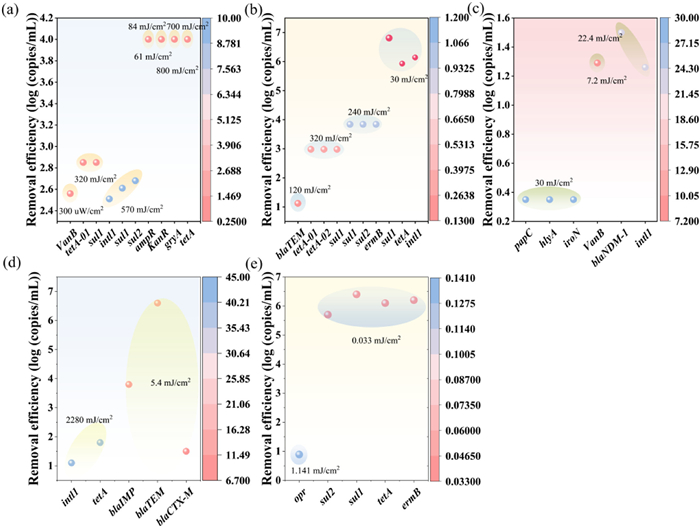
UVC/AOPs demonstrate robust capacity in mitigating ARGs propagation through radical-mediated oxidative degradation, substantially lowering environmental dissemination risks [79,80]. Fig. 2 systematically compares the performance of various UVC/AOPs configurations against representative resistance determinants. Fig. 2a indicates that the degradation rate of ARGs exhibited a significant positive correlation with oxidant dosage. Concurrently, increasing the UVC dose also significantly promoted the degradation of ARGs (Fig. 2c). However, this pattern was not applicable to the removal of all ARGs. As shown in Fig. 2b, under conditions of higher UVC dose and oxidant concentration, the removal rates of papC, hlyA, and iroN were significantly lower than those of vanB and blaNDM-1. For example, in UV/O3 systems (Fig. 2d), with 2280 mJ/cm2 UV and 45 mg/L O3, the removal rates for int1 and tetA were 1.1 log and 1.8 log, respectively, while under lower conditions, blaTEM and blaCTX−M exhibited higher removals of 3.8 log and 6.6 log, indicating that ARG removal depends not only on UV and oxidant dosage but also on differential reaction mechanisms for specific ARG types [81]. Similarly, in UV/chlorine systems (Fig. 2e), no significant difference was observed in the removal of sul2, sul1, tetA, and ermB, whereas with 120 mJ/cm2 UV and 0.141 mmol/L Cl2. This phenomenon demonstrates that the ROS generated by the UVC/AOPs system exhibited a selective removal effect on different structural types of ARGs.
Figure 2
Figure 2.
The removal efficacy of resistant ARGs by different UVC/AOPs: (a) UVC/H2O2, (b) UVC/PS, (c) UVC/PAA, (d) UVC/O3, (e) UVC/Cl2.
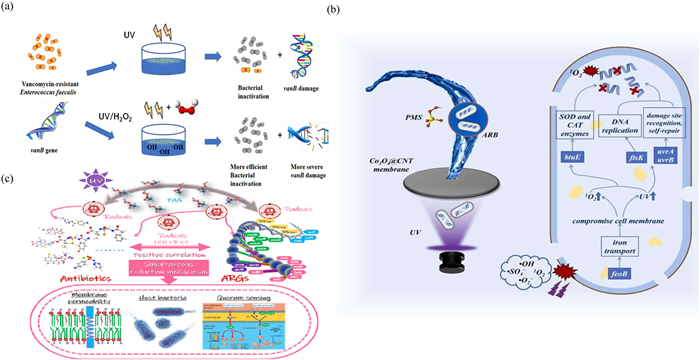
Unlike conventional disinfection methods limited to microbial inactivation, UVC/AOPs synergistically eliminate bacteria while directly targeting both extracellular and intracellular ARGs, exhibiting pronounced efficiency against plasmid-borne genes (e.g., blaNDM-1, vanA) and chromosomally integrated elements (e.g., sul1, tetM) [82–84]. Notably, the UVC/H2O2 system achieves a 2.51 log reduction of blaNDM-1 under optimized conditions (0.01 mol/L H2O2 and 570 mJ/cm2 UVC fluence) (Fig. 2a) [85]. Nevertheless, the ultrashort half-life (< 1 μs) of hydroxyl radicals (•OH) restricts their membrane penetration capacity, necessitating secondary oxidation of ARGs released post-cell lysis for intracellular target elimination (Fig. 3) [65,86–88]. This inherent limitation highlights the system's dependency on complete microbial destruction for comprehensive ARG degradation. In contrast, the UVC/PS system demonstrates superior efficacy under acidic activation (pH 3) with 1.2 mmol/L peroxymonosulfate (PMS), achieving a remarkable 6.81 log removal of the intracelluar sul1 within 90 min; concurrently, the system can efficiently removes eARGs from water (Fig. 2b) [87]. The UVC/Cl system achieves a 2.4-log reduction of the opr gene (from 7.16 log to 5.02 log) within 30 min. Reactive chlorine species (RCS) generated in the system selectively attack nucleic acids, degrading extracellular plasmid-borne ARGs with an efficiency of 2.71 log (from 6.67 log to 3.96 log) [45]. The UVC/PAA system emerges as a technologically advanced solution, combining 8 mg/L PAA with 216 mJ/cm2 UVC to degrade 38.9% of macrolide resistance genes through two synergistic pathways (Fig. 2c) [88]. Mechanistically, acetyloxy radicals (CH3C(O)O•) exhibit a dual-action strategy against antibiotic resistance. They degrade existing resistance elements by targeting plasmid DNA, while concurrently inhibiting the dissemination of ARGs by disrupting HGT machinery [85]. This dual-action strategy not only degrades existing resistance elements but also proactively inhibits ARG dissemination pathways.
Figure 3
Figure 3.
(a) Removal process of vancomycin-resistant Enterococcus and VanB by UVC and UVC/H2O2 synergistic action. Copied with permission [65]. Copyright 2022, Elsevier. (b) Impact of 1O2 and UVC radiation on bacterial metabolic activity and DNA removal mechanisms in UVC/PMS systems. Copied with permission [87]. Copyright 2024, Elsevier. (c) Removal mechanisms of ARGs by •OH and RO• radicals in UVC/PAA systems. Copied with permission [88]. Copyright 2022, Elsevier.
The degradation efficiency of ARGs by UVC/AOPs is inherently governed by the distinct physicochemical properties of reactive radicals and their environmental compatibility, leading to system-specific operational constraints. The UVC/H2O2 system, reliant on •OH with an ultrashort half-life (< 1 μs) and limited membrane permeability [89]. This necessitates synergistic strategies such as oxidant dosage optimization (0.05–0.1 mol/L H2O2) or integration with cell-disruptive pretreatments (e.g., ultrasonication or electroporation) to enhance target exposure. In contrast, the UVC/PS system capitalizes on sulfate radicals (SO4•−), which exhibit extended persistence (particularly under acidic conditions pH 3–5, can reach 30–40 μs) and achieve > 4 log ARG reduction in acidic (pH 3–5) [90] or low-salinity environments (< 0.1 mol/L ionic strength) [31] via selective guanine oxidation. However, its efficacy diminishes markedly in chloride-rich matrices (≥0.5 mol/L Cl−) due to radical scavenging, rendering it unsuitable for marine or hypersaline industrial effluents [31]. The UVC/PAA system emerges as a technologically superior alternative, leveraging the hydrophobic penetration capacity and enzymatic targeting of acetyloxy radicals (CH3C(O)O•). These radicals selectively degrade plasmid-borne ARGs in biofilms through dual mechanisms [85]. Therefore, when selecting practical treatment processes, it is essential to comprehensively evaluate three key factors: water quality characteristics (prioritizing UVC/PAA for high-salinity/Cl- environments and UVC/PS for acidic wastewater), ARG occurrence states (employing UVC/H2O2 combined with cellular disruption for intracellular genes, while utilizing long-lived radicals for free extracellular genes), and economic costs. This holistic approach enables the tailored design of oxidant dosing strategies and reaction conditions to achieve precision control of antimicrobial resistance dissemination.
2.3
Mechanism of UVC/AOPs in sterilization and removing ARGs
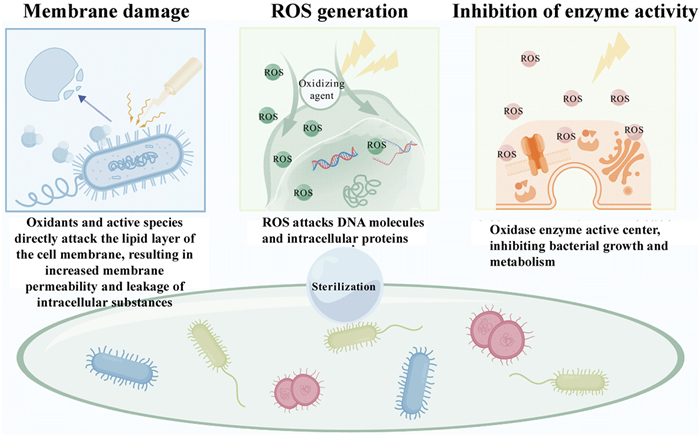
The bactericidal and ARG removal mechanisms of UVC/AOPs fundamentally involve a cascade destruction of bacterial multi-level biological structures by ROS, with the synergistic effect originating from simultaneous radical attacks on cell membranes, genetic material, and metabolic pathways.
2.3.1
Membrane system disruption
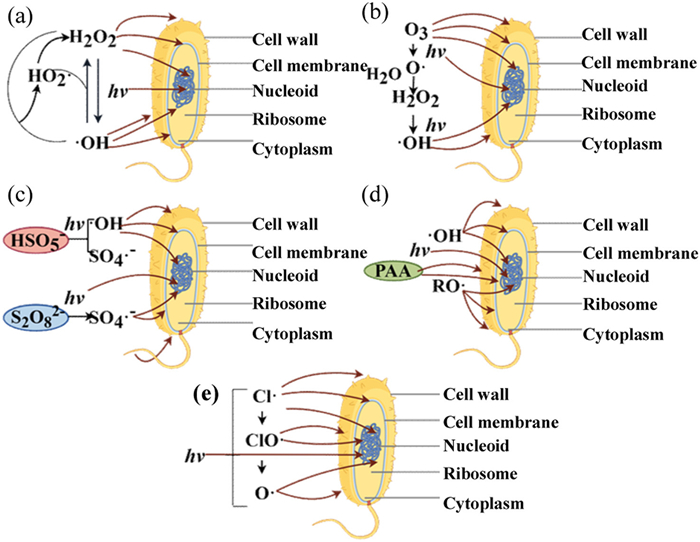
The core pathway for bacterial inactivation and ARG removal by UVC/AOPs initiates from membrane system disintegration. In UVC/AOPs, ROS primarily target the phospholipid bilayer of cell membranes, inducing lipid peroxidation and membrane protein oxidation [83,91,92]. These oxidative attacks result in increased membrane permeability, disruption of ion gradients, and leakage of intracellular components (Fig. S1 in Supporting information) [93,94]. Specifically, •OH and SO4•− preferentially oxidizes thiol groups (-SH) in membrane proteins due to its high reaction rate constant (Figs. 4a and c), causing conformational destabilization of transmembrane channel proteins [95,96]. Simultaneously, CH3C(O)O• embeds into the lipid bilayer owing to its hydrophobicity, preferentially attacking unsaturated fatty acids in cell membranes and triggering a lipid radical chain reaction that compromises membrane integrity (Fig. 4d) [97]. ClO• specifically targets aromatic amino acids in hydrophobic domains of membrane proteins, disrupting the proton motive force and inhibiting respiratory chain complexes (Fig. 4e) [45]. The UVC/O3 system primarily relies on O3 to directly attack hydrophobic regions of membrane proteins [98], thereby degrading the structural integrity of cell membranes (Fig. 4b). This phase causes increased membrane permeability, facilitating passive leakage of intracellular K+, ATP, and ARG-containing substances [93], which subsequently become secondary targets for extracellular radicals.
Figure 4
Figure 4.
Schematic of bacterial inactivation mechanistic effects of different UVC/AOPs on bacterial inactivation: (a) UVC/H2O2 system, (b) UVC/O3 system, (c) UVC/PMS and UVC/PDS system, (d) UVC/PAA system, (e) UVC/Cl2 system.
ROS directly cleave DNA primarily through two modes of action: (1) Hydrolyzing phosphodiester bonds in the sugar-phosphate backbone; and (2) oxidatively modifying nucleobases by adding •OH at the C8 position, particularly guanine, inducing single/double-strand breaks and irreversible genetic code degradation (Fig. 5) [99,100]. Specifically, •OH penetrates the cell wall and selectively damages DNA molecules via hydrogen abstraction, inducing single- or double-strand breaks and oxidizing nucleobases (e.g., converting guanine to 8–hydroxy–2′-deoxyguanosine, 8-OHdG), thereby blocking replication and transcription processes [92,101,102]. SO4•− binds to the DNA phosphate backbone through electrophilic interactions, attacking the phosphorus center of phosphodiester bonds, leading to DNA backbone fracture and helix unwinding [103,104], while O3 crosses the cell wall and directly oxidizes pyrimidine bases in intracellular DNA, inhibiting microbial growth and metabolic activity [97]. Additionally, CH3C(O)O· selectively attacks the C3′/C5′ sites of plasmid supercoils via hydrogen abstraction, reducing superhelical density [85]; whereas RCS preferentially oxidizes extracellular free guanine/thymine, achieving 2.14-log degradation of the opr gene within 30 min [45]. Notably, ARG removal efficiency is constrained by radical penetrability: short-lived •OH (< 1 μs) can only oxidize released extracellular genes, while SO4•− with a longer half-life diffuses into biofilms to directly degrade intracellular genes.
Figure 5
Figure 5.
Schematic diagram of principal pathways for ARGs degradation in UVC/AOPs systems.
ROS disrupt energy metabolism and antioxidant defense systems primarily by oxidizing active sites of key enzymes (e.g., ATPases, superoxide dismutase) [105,106]. •OH impairs enzyme function by oxidizing critical amino acid residues (e.g., histidine, cysteine, tryptophan) within catalytic centers [107,108]; SO4•− induces loss of biological activity through oxidative modification that alters enzyme conformation [79,80]. Such cumulative damage exacerbates metabolic dysregulation, ultimately leading to bacterial inactivation. Concurrently, ROS inhibit bacterial dark repair by damaging DNA repair enzymes (e.g., RecA) [35] and cleave protein thiol bonds via nucleophilic reactions; this targeting of sulfur-containing amino acids (e.g., cysteine) intensifies enzymatic system destruction [103,104]. CH3C(O)O• selectively oxidizes thiol and amino groups in membrane proteins, disrupting transmembrane proton gradients to suppress energy metabolism [109–111] its hydrophobicity facilitates penetration through the EPS layer [112–114], which is critical for multidrug-resistant bacteria inactivation. Furthermore, ROS accelerate intracellular ARG release through lipid membrane peroxidation and glycoprotein network oxidation [83], and further denature DNA repair-associated proteins (e.g., RecA) and ATPases, blocking homologous recombination and plasmid conjugation pathways [115]. Utilizing the nucleophilic property of long-lived SO4•− (30–40 μs) to target plasmid replication origins, RecA enzyme inactivation is achieved via thiol oxidation [116,117]; while the hydrophobic radical CH3C(O)O• preferentially degrades plasmid supercoiled structures and oxidizes resistance gene promoters (e.g., ampR, tetA), concurrently inhibiting conjugation pilus ATPase activity [85]. Additionally, radicals oxidize bacterial-secreted quorum-sensing signaling molecules (e.g., N-acyl-homoserine lactones, AHLs), thereby suppressing bacterial quorum-sensing behavior and reducing gene transfer capacity [86,118,119].
While all UVC/AOPs fundamentally rely on ROS mediated DNA damage and cellular membrane disruption, their differential efficacies stem from the synergistic interplay of radical lifespan, penetrability, and target specificity. In complex biofilm matrices, effective ARG degradation and horizontal transfer inhibition critically depend on sustained radical bioavailability to counteract protective EPS barriers. The UVC/H2O2 system, constrained by the ultrashort half-life of •OH, predominantly facilitates extracellular ARG oxidation via lysis-dependent ARG liberation or secondary oxidation of released genetic fragments. This necessitates synergistic integration of cell-disruptive pretreatments (e.g., ultrasonication) or process optimization (e.g., pH adjustment, staged H2O2 dosing) to enhance intracellular target accessibility in practical implementations. By contrast, UVC/PAA technology utilizes hydrophobic CH3C(O)OO· with high diffusivity to penetrate EPS matrices and selectively cleave plasmid-borne ARGs through intercalative DNA backbone scission. Future breakthroughs should focus on optimizing PAA activation pathways (e.g., transition metal co-catalysis) to enhance radical yields in high-organic-load wastewater. For UVC/PMS systems, while capable of deep biofilm penetration across a broad pH range, chloride quenching remains a bottleneck issue. Anion-selective PMS catalysts may be employed to mitigate halide interference in saline wastewater. UVC/O3 technology generates ROS that selectively oxidize conjugative pili, thereby blocking ARG horizontal transfer. Scaling this technology requires developing advanced bubble-membrane contactors to resolve ozone mass transfer limitations in viscous biofilm environments.
2.4
Synchronous removal of ARB and ARGs by UVC/AOPs
Current research on simultaneous removal of ARB and ARGs by UVC/AOPs reveals varying disinfection efficiencies across different systems. Specifically, the UVC/PAA system primarily inactivates tetracycline, quinolone, and β-lactam-resistant bacteria through •OH and RO• radicals, achieving inactivation rates of 25.7%−100% while significantly reducing the abundance of resistance genes such as tetA, ermB, and sul1 (3.2%−38.9%). However, low PAA doses may lead to enrichment of tetC and sul2 [88]. The UVC/PS system achieves > 90% inactivation of resistant bacteria within 10 min via synergistic effects of •OH and SO4•−, enhancing ARG removal by 0.56 log compared to UVC alone. It also suppresses HGT by reducing mobile genetic elements of 76.09% [120]. The UVC/H2O2 system can efficiently degrade vancomycin resistant Enterococci and vanB genes (0.1–0.8 log removal) under high UVC intensity (300 μW/cm). Core mechanisms involve direct UVC-induced DNA damage combined with radical-mediated membrane disruption, release of intracellular components, and DNA oxidation [65]. Collectively, UVC/AOPs first utilize ROS generated by UVC-activated oxidants to attack cell membranes, causing bacterial death, while residual oxidants and ROS further penetrate cells or oxidize ARGs released from damaged membranes. Limitations include inconsistent ARG removal, interference from natural organic matter and EPS, hindered degradation of iARGs by intact membranes, and risks of bacterial regrowth through photo/dark repair. Additionally, as previously mentioned, the reaction system prioritizes attacking cell membranes during bacterial inactivation and gene removal, increasing membrane permeability to disrupt membrane integrity. This process causes intracellular genes to leak into the reaction environment, enhancing extracellular radical-mediated gene removal. Current research indicates that i-ARGs exhibit poor removal efficiency due to protection by cell walls/membranes. For example, the UVC/Cl2 system achieved only 2.14 log removal of the opr gene after 30 min of treatment, while under identical conditions, its degradation efficiency for extracellular free plasmids (simulating eARGs) reached 2.71 log [45]. Similarly, although the UVC/H2O2 system reduced intracellular blaNDM-1 by 2.51 log, its efficacy highly depended on secondary oxidation after cell lysis released ARGs [85]. The core reasons for this discrepancy lie in the limited penetration of short-lived radicals through intact cell membranes [121]; the potential weakening of ROS attack efficiency on iARGs by intracellular antioxidants (e.g., glutathione) [122]; and the residence of chromosomally integrated iARGs within highly folded DNA-protein complexes [123], where steric hindrance reduces radical accessibility. Although some studies address differences in intra-/extracellular ARG removal, literature systematically comparing degradation kinetics of intracellular versus extracellular genes across different AOP systems under identical conditions remains scarce. Future research should prioritize quantifying this differential efficiency, resolving synergistic mechanisms of membrane penetration efficiency, radical lifetime, and intracellular microenvironments on iARG removal, while optimizing multi-oxidant systems (e.g., UVC/PAA/PS), developing hybrid technologies combining AOPs with membrane filtration, leveraging mechanistic insights from metagenomics/metabolomics, and conducting pilot-scale validation to enable practical wastewater treatment applications for curbing antibiotic resistance dissemination.
3.
Limitations and challenges of UVC/AOPs in the ARBs disinfection and ARGs removal
3.1
Uncertainty about the free radical action mechanisms
The molecular mechanisms underlying reactive species-mediated inactivation of ARB and ARGs in UVC/AOPs remain partially obscured, particularly in terms of site-specific reaction pathways and dynamic interactions within complex aquatic matrices. At present, the application of machine learning (ML) in the field of antibiotic resistance prevention and control mainly focuses on constructing predictive models using environmental monitoring data, which are then used to assess the transmission characteristics of antibiotic resistance in the environment. However, the potential of ML in predicting the mechanism of free radical mediated inactivation of ARB and ARGs in the field of advanced oxidation has been overlooked. This predictive ability is crucial for in-depth understanding of free radical specific reaction sites and optimizing AOPs process parameters to efficiently target and remove drug-resistant pollutants [124,125]. While the CH3C(O)O· generated in UVC/PAA systems demonstrates membrane permeability and preferential plasmid supercoiled structure disruption via intercalative oxidation [85], its sequence-specific DNA base oxidation mechanisms, particularly the C8 guanine adduct formation kinetics and subsequent strand cleavage patterns, lack in situ spectroscopic validation. Furthermore, the synergistic/antagonistic radical interactions in multicomponent water systems remain inadequately quantified. For instance, in UVC/PMS systems under high chloride conditions, SO4•− exhibit rapid scavenging by chloride ions, yielding less reactive chlorine radicals (Cl·) [118]. However, the differential contributions of these transient species to ARG strand breakage versus nucleobase modification remain uncharacterized through kinetic isotope effect studies or transient absorption spectroscopy. Equally critical, the mechanism of radicals by biofilm matrices has not been defined. The binding thermodynamics between CH3C(O)O• and β-glucan-protein complexes, a key component of EPS, have yet to be resolved via free energy perturbation calculations or steered molecular dynamics simulations. Such knowledge gaps hinder the rational design of radical delivery strategies to penetrate EPS-protected ARB microcolonies, where radical lifetime attenuation and nonspecific quenching by polysaccharide hydroxyl groups may dominate over target-specific oxidative reactions.
3.2
Interference of environmental matrices with radical mediated ARGs degradation
The degradation efficiency of eARGs by UVC/AOPs is fundamentally governed by the mass transfer and collision probability between reactive radicals and nucleic acid targets. However, environmental matrices in real water systems impose significant interference through three synergistic mechanisms [126]. Firstly, DOM with high electron-rich moieties (e.g., aromatic structures and conjugated carbonyl groups) acts as a radical sink, preferentially quenching •OH and SO4•−via hydrogen abstraction or electron transfer pathways, thereby reducing their availability for ARG strand scission [127,128]. Secondly, ARGs adsorbed onto particulate carriers including emerging contaminants such as microplastics (MPs) and engineered nanoparticles exhibit attenuated degradation kinetics. Microplastics (e.g., polyethylene, polystyrene) pose unique challenges due to their high hydrophobicity and large specific surface area (up to 500 m2/g), which enhance adsorption of hydrophobic ARGs (e.g., tetM, blaCTX−M) by 2–3 orders of magnitude compared to mineral particles [129]. The combined effects of hydrophobic surface shielding and restricted radical diffusion through tortuous mesopores (2–50 nm) within particle aggregates [130]. The steric hindrance posed by these particulate carriers necessitates pretreatment strategies to oxidize surface organic coatings and increase matrix porosity, thereby enhancing radical penetration depth. Lastly, spatial heterogeneity in radical generation and rapid self-annihilation in aqueous phases further limit effective radical flux toward particle-bound ARGs, underscoring the need for reactor design optimizations to improve radical distribution uniformity.
3.3
Significant species-dependent variability in ARB and ARGs
The differential susceptibility of ARB and ARGs to UVC/AOP induced oxidative stress arises from interspecies variations in cellular architecture and genetic determinants. The outer membrane lipopolysaccharide layer of Gram-negative bacteria (e.g., E. coli NDM-1) [131] can impede the penetration of •OH and O3 through hydrophobicity, which leads to a lower inactivation efficiency than that of Gram-positive bacteria (e.g., MRSA). In addition, the genetic carrier characteristics of ARGs can also directly affect their degradation difficulty, and plasmid-encoded genes (e.g., blaNDM-1) may be degraded more efficiently than chromosomally integrated genes due to their extrachromosomal freedom and loose topology [132]. Meanwhile, ARBs carrying multidrug efflux pumps or SOS repair systems may also reduce the inactivation efficiency by actively discharging free radicals or rapidly repairing oxidative DNA damage [133], and the antagonistic mechanism of their molecular regulatory network and free radical action remains to be elucidated.
3.4
Complexity of multi-drug resistant bacteria and their resistance genes
For pathogenic bacteria carrying multiple drug resistance genes or having strong environmental adaptability (such as carbapenem-resistant Enterobacteriaceae bacteria), the existing UVC/AOPs technologies are facing multiple bottlenecks. The intact plasmids remaining in biological membranes may be transmitted through natural transformation or phage-mediated transduction pathways [134,135]. Therefore, specific free radicals targeting the integrase intl1 need to be developed to block horizontal gene transfer. Furthermore, some drug-resistant bacteria can be revived through the dark repair mechanism after UVC/AOPs treatment [27,136], and oxidative stress during the system reaction process may induce gene mutations [88]. It is necessary to coupling biological inhibition processes (such as denitrification filters or directed lysis of bacteriophages) to block the regeneration pathway and reduce the risk of mutations.
4.
Conclusions and prospectives
This review systematically elaborates on the research progress in controlling antibiotic resistance in aquatic environments using UVC/AOPs. It focuses on three key dimensions: Mechanisms of action (radical-mediated microbial inactivation, genetic damage, and HGT inhibition), efficacy influences (radical properties and aqueous matrix effects), and technological bottlenecks (mechanistic complexity, environmental interference, and microbial variability). Studies demonstrate that UVC/AOPs primarily achieve synchronous removal of ARB and ARGs through multi-tiered attack mechanisms driven by activated radicals such as •OH, SO4•−, and RO•. However, practical applications still face challenges including unclear radical action mechanisms, significant environmental interference, and substantial microbial response variations. To overcome these limitations, future research may focus on the following aspects:
(1) Deepening multi-scale mechanistic analysis: Deepening multi-scale mechanism analysis: Operando spectra (such as transient absorption spectroscopy tracking •OH dynamics) would be combined with quantum-based ML models [137]. The binding energy between free radicals and biological targets (such as guanine bases in ARGs) can be determined by density universal function theory (DFT) calculation as data support, and the convolutional neural network (CNN) would be trained by using electron paramagnetic resonance (EPR) data. The "oxidation potential spatial conformation strand break rate" prediction model can be constructed by combining neural network algorithms, aiming to address the contribution of free radical mediated DNA damage in complex systems, track free radical interactions and reaction pathways in real time, and ultimately clarify the mechanism by which UVC/AOPs removes AR.
(2) Developing precision-enhanced processes: Coupling matrix-specific quenching coefficients and diffusion barrier models helps clarify environmental interference with radical-mediated processes, facilitating the precision design of reaction systems for efficient contaminant removal. Concurrently, combining resistance gene profiling with single-cell oxidative stress visualization allows species-resolved indexing of structural variations and genetic characteristics. This guides the design of tailored ROS-generating systems targeting specific ARB/ARG complexes to address species-dependent limitations.
(3) Constructing dynamic risk assessment frameworks: By integrating pan-genome metabolic networks and HGT predictors, and incorporating real-time monitoring data from hospital wastewater systems, this approach can develop machine learning-driven oxidant dosing optimization platforms. This enables precise prevention and control of AR transmission risks.
(4) Advancing UV-LED-driven AOPs as an emerging research frontier: Current research on the application of UV-LED/AOPs for the removal of ARB and ARGs remains limited, particularly in comparison to conventional UV/AOP systems. To bridge this gap, future studies should prioritize the following directions: Systematically investigate the wavelength-dependent (e.g., 265–280 nm UVC, 280–365 nm UVA/UVB LEDs) generation of reactive species and their subsequent interactions with ARB/ARGs. Employ genomic and metagenomic tools to quantify the efficacy of UV-LED/AOPs against a broad spectrum of ARB and ARG types. And expand pilot-scale testing in realistic environments such as hospital effluents, municipal wastewater, and aquaculture discharges, with continuous monitoring of ARG recurrence and horizontal gene transfer potential post-treatment.
Through synergistic innovation across mechanisms, processes, and risk management, UVC/AOPs are poised to evolve into a core technology for the precision control of antibiotic resistance pollution in aquatic environments, providing critical technical support for the sustainable mitigation of resistance dissemination.
Declaration of competing interest
The authors declare that they have no known competing financial interests or personal relationships that could have appeared to influence the work reported in this paper.
The authors thank the National Natural Science Foundation of China (Nos. 52170088 and U24A20561), and Sichuan Science and Technology Program (Nos. 2023NSFSC1527 and 2025NSFJQ0007) for financially supporting this study.
Supplementary materials
Supplementary material associated with this article can be found, in the online version, at doi:10.1016/j.cclet.2026.112699.
Figure 1
(a) Comparative analysis of keyword co-occurrence in research on ARB and ARGs removal by UVC/AOPs. (b) Temporal evolution of annual publication volume in ARB and ARGs removal by UVC/AOPs research over the past decade. (c) Concentration-dependent effects of bibliometric parameters on ARB and ARGs removal by UVC/AOPs studies in recent years.
Figure 3
(a) Removal process of vancomycin-resistant Enterococcus and VanB by UVC and UVC/H2O2 synergistic action. Copied with permission [65]. Copyright 2022, Elsevier. (b) Impact of 1O2 and UVC radiation on bacterial metabolic activity and DNA removal mechanisms in UVC/PMS systems. Copied with permission [87]. Copyright 2024, Elsevier. (c) Removal mechanisms of ARGs by •OH and RO• radicals in UVC/PAA systems. Copied with permission [88]. Copyright 2022, Elsevier.


 DownLoad:

 下载:
下载:


 下载:
下载:

