

表 1
Physicochemical characterizations of as-prepared catalysts


Maintaining low environment impacts in industrial processes has become one of the major issues of sustainable chemistry. Thus, solid bases have been widely used in chemical industry to solve it. They are proposed as heterogeneous catalysts for a variety of processes such as aldol condensation, olefin isomerization, Guerbet condensation, epoxide ring-opening, production of fatty acid methyl esters from natural fats, NOx adsorption and reaction, transe-sterification of esters and alcohols[1-3]. The replacement of liquid acids and bases with solid acids and bases in organic reactions makes sense because it combines the advantages of less environmental hazard, easier separation from the reaction mixture, and ease of recycling[4-6]. At the industrial scale, a homogeneous catalyst such as KOH or NaOH is often used to promote the transesterification of the prenyl acetate to produce prenyl alcohol[7]. It requires water washing to remove dissolved catalyst from product and suffers from separation problems. Thus, heterogeneous catalysts become competitive candidates because they can avoid these problems.
A large number of crystalline iron solid base catalysts have been investigated for transesterification reactions, especially in the transesterification to biodiesel productions. Macala et al.[8] prepared an iron-doped hydrotalcite with adjustable properties, in which Fe3+ ions replaced some of Al3+ in the Mg/Al layered double hydroxide lattice. Various types of iron doped catalysts such as iron doped zinc oxide catalysts[9], iron doped carbonaceous catalysts[10] and iron oxide supported on silica[11] were studied for the production of biodiesel. In order to enhance the basicity of catalysts, Mg-Fe mixed oxide[12] and Ca-Fe mixed oxide[13] were also commonly used in the production of biodiesel. However, the activity of the catalysts decreased significantly after several uses attributed to the leaching of the Ca or Mg component. Moreover, Shi et al.[14] compared different crystal forms of Fe2O3 and found stronger magnetism could increase the rate of biodiesel transesterification. Ce-Fe mixed oxides were also used in the transesterification of dimethyl carbonate and phenol[15], propylene carbonate and methanol[16], indicating its universality in various transesterification reactions. However, in the crystalline iron-based catalyst, both of Mg-Fe and Ca-Fe had shown excellent transesterification activity but with poor stability due to the leaching of active component. Ce-Fe had the advantage of high stability. However, several shortcoming of Ce-Fe catalysts need to be addressed, including the weak basicity and poor activity.
Herein, we prepared amorphous FeCeOx/SiO2 and crystalline FeCeOx/SiO2 to compare their transes-terification activity. Previous studies showed that the surface acid and base functionalities played a major role in transesterification reaction[17-18]. Amorphous FeCeOx/SiO2 catalyst was prepared by first reduction and oxidation. Fe and Ce formed an amorphous structure during the reduction process, and a large amount of basic sites were formed during the oxidation process. The characterization results showed that the amorphous FeCeOx/SiO2 had more basic sites than the crystalline FeCeOx/SiO2. Moreover, the interaction of Ce with Fe enhanced the stability of the catalyst[19]. The aim of this study is to evaluate the catalytic behavior of amorphous and crystalline FeCeOx/SiO2 in the transesterification reaction of prenyl acetate.
Fe(NO3)3·9H2O, Ce(NO3)3·6H2O and prenyl acetate(AR) were purchased from ShanghaiAladdin Bio-Chem Technology Co., Ltd. SiO2, methanol(AR), K2CO3, KOH and KBH4 were purchased from Shanghai Macklin Biochemical Co., Ltd.
According to the literatures[20-21], an appropriate amount of Ce could not only increase the basic sites of the catalyst, but also improved the stability of the catalyst through the interaction between Fe and Ce. However, excessive Ce blocked the pores and reduced the surface area of the catalyst. Excessive Fe formed agglomeration with Ce, thus requiring a suitable ratio of Fe to Ce(wFe/wCe). After preliminary experiments to determine the metal ratio of Fe and Ce, the crystalline FeCeOx/SiO2 with 5%(w/w) Fe metal and 10%(w/w) Ce metal was prepared by co-precipitation method. The solution of water and ethanol were mixed with 1 mol·L-1 solution of Fe(NO3)3·9H2O and Ce(NO3)3·6H2O under vigorous stirring. The 1 mol·L-1 K2CO3 aqueous solution was used as a precipitant adding dropwise at a constant rate to precipitating batch, maintaining the pH constant (at 8.0) during precipitation and tempera-ture was kept at 303 K. Obtained precipitate was aged for 1 h with the mother liquors still under stirring at the reaction temperature. Then, the precipitate was filtered out and washed with successive portions of 250 mL distilled water and 250 mL methanol. The precipitate were dried in static air at 333 K for 5 h.
The catalyst was obtained by calcination under ambient air at 673 K for 5 h. The amorphous FeCeOx/SiO2 with 5% Fe metal and 10% Ce metal was prepared by chemical reduction under vigorous stirring from 1 mol·L-1 solution of Fe(NO3)3·9H2O and Ce(NO3)3·6H2O, the solution mixed of water and ethanol. The KBH4 solution (n:(nFe+nCe)=2.5:1) as a reducing agent was added dropwise at a constant rate and temperature was kept at 303 K, maintaining the pH constant(at 8.0) by KOH during reduction. After the addition was completed, the precipitate was aged for 1h then filtered out. Then the precipitate was washed with 250 mL distilled water and 250 mL methanol. The catalyst was re-oxidized by static air at 333 K for 5 h. According to metal mass ratio, the as-synthesized catalyst was denoted as 5%Fe10%CeOx/SiO2-M(M=C or A for crystalline or amorphous structure, respectively).
The metal element content of the catalyst was determined using Agilent 7500CE inductively coupled plasma mass spectrometry (ICP-MS).
N2 adsorption at -196℃ was measured using a Micromeritics ASAP 2010 system, the samples were degassed at 200℃ for 6h under high vacuum. The surface area was calculated by using the Brunauer-Emmett-Teller(BET) method. The total pore volume was determined by nitrogen adsorption at a relative pressure of 0.99, and the pore size distributions were calculated from the nitrogen adsorption isotherms by the Barrett-Joyner-Hallenda(BJH) method.
Transmission electron microscopy(TEM) experi-ments were conducted on a JEOL JEM-1200EX electron microscope with an accelerating voltage of 60 kV. Before being transferred into the TEM chamber, the samples dispersed in ethanol were deposited onto holey carbon films supported on Cu grids.
XRD data were acquired with a Rigaku D/Max-2500/PC powder diffraction system, using Cu Kα (λ=0.154 06 nm) radiation at 40 kV and 100 mA. The step size was 5° over the 2θ range of 5°~80°.
XPS data were acquired using an A Kratos AXIS Ultra DLD photoelectron spectrometer with monochro-matic Al Kα (1 486.6 eV) radiation under ultra-high vacuum. The binding energy (BE) values were calibrated internally using the C1s peak with BE=284.8 eV. The experimental error was within ±0.1 eV. An approximate quantitative calculation was made by integrating the areas of the Ce3+ and Ce4+ peaks after curve peak fitting.
CO2/NH3-TPD data were acquired using a Builder PCA-1200 chemical adsorption instrument. Each sample was pretreated in a He flow at 373 K for 1 h and then cooled to room temperature. CO2/NH3 was adsorbed at room temperature for 30 min at 40 mL·min-1, after which a He flow was initiated to purge residual CO2/NH3 for 30 min. The desorption was performed at a heating rate of 10 K·min-1 from 323 to 973 K, using a thermal conductivity detector and He as the carrier gas.
The transesterification reactions of prenyl acetate with methanol were carried out in 500 mL stainless steel autoclave equipped with a magnetic stirrer. 15 mL of prenyl acetate and 135 mL of methanol were mixed well, followed by the introduction of 0.6 g of the catalyst. The reactor was pressurized with N2 to 0.5 MPa and heated to 130℃ under stirring for 10 h. After the reaction, the autoclave was cooled down in ice water and the mixture was centrifuged and analyzed by a GC equipped with a DB-5 capillary column coupled with a FID detector. In the transesterification of prenyl acetate with methanol, prenyl alcohol and methyl acetate were the target molecule and co-product, respectively. In addition to the main products, 3-methyl-3-methoxy-1-butene and 1-methoxy-3-methyl-2-butene were by-product. The conversion(Conv.) of prenyl acetate and selectivity(Sel.) to prenyl alcohol were calculated as follows:
|
$ {\rm{Conversion = }}\frac{{{m_1}/{M_1} - {m_2}/{M_1}}}{{{m_1}/{M_1}}} \times 100\% $ |
|
$ {\rm{Selectivity}} = \frac{{{m_3}/{M_2}}}{{{m_1}/{M_1} - {m_2}/{M_1}}} \times 100\% $ |
where m1 is the mass of prenyl acetate in the feed, m2 is the mass of prenyl acetate in the product, m3 is the mass of prenyl alcohol generated, M1 is the molar mass of prenyl acetate, and M2 is the molar mass of prenyl alcohol.
Table 1 showed the metal loading and textural properties of prepared 5%Fe10%CeOx/SiO2 catalysts, as well as SiO2. It could be seen that the actual loading was slightly lower than the theoretical value, indicating that some metal loss may occur during the preparation step. However, these losses had little effect on the catalyst and could be neglected. Therefore, the actual mass ratio could be replaced by a theoretical value. According to N2 adsorption-desorption results, SiO2 exhibited the largest surface area of 194 m2·g-1 after loading the metal. The surface area and average pore volume decreased owning to the blockage of narrow pores by the introduction of large amount of Fe and Ce species.
 下载:
导出CSV
下载:
导出CSV
| Catalyst | Actual load of Fea/% | Actual load of Cea/% | SBET/(m2·g-1) | Pore diameterb/nm | Pore volumec/(cm3·g-1) |
| SiO2 | - | - | 194 | 14.38 | 1.38 |
| 5%Fe10%CeOx/SiO2-A | 4.9 | 9.7 | 153 | 15.78 | 1.13 |
| 5%Fe10%CeOx/SiO2-C | 4.8 | 9.5 | 189 | 13.35 | 1.21 |
| a Determined by the ICP-MS technique; b Average pore diameter; c BJH desorption pore volume. | |||||
Fig. 1 showed the morphology images of 5%Fe10%CeOx/SiO2-C and 5%Fe10%CeOx/SiO2-A. It revealed that the 5%Fe10%CeOx/SiO2-C was nearly uniform with good dispersity and crystal structures. 5%Fe10%CeOx/SiO2-A exhibited only a densely packed amorphous matrix, while the Fe and Ce oxide phases were homogeneously mixed at quasi-molecular level and formed a prevalently amorphous structure. Solid solution-like FeCeOx species may be present in amorphous samples. In the selected area electron diffraction(SAED) mode, the crystalline catalyst showed a circle of diffracted aura, while the amorphous catalyst showed a diffuse halo, due to the amorphous structure.
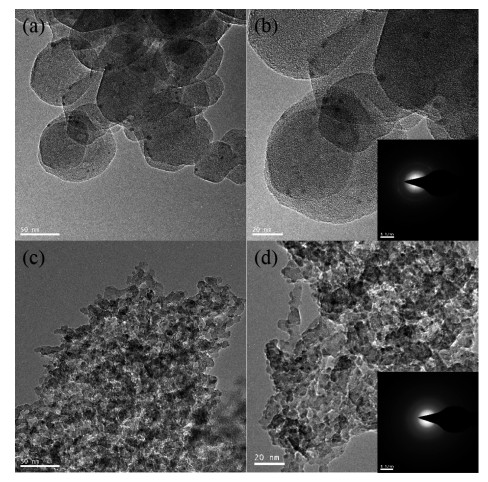
Fig. 2 illustrated XRD patterns of the FeCeOx/SiO2 catalysts. A very broad peak at 2θ of ca. 22.0° was clearly observed on both catalysts, which can be ascribed to amorphous SiO2(PDF No.29-0085)[22]. Diffraction peaks of CeO2 phase were only observed at 2θ=28.1°, 33.1°, 47.5°, 56.5° in the sample prepared by co-precipitation, which was characteristic of a cubic fluorite-structured material (PDF No.81-0792)[23]. The peaks belonging to Fe2O3 were not observed, likely referring to its low content. In the sample prepared by chemical reduction, no diffraction peaks of Fe or Ce were observed. The TEM and XRD results confirm that the catalyst prepared by chemical reduction exists in some amorphous state.

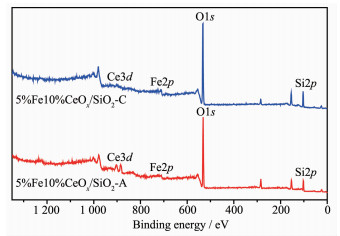
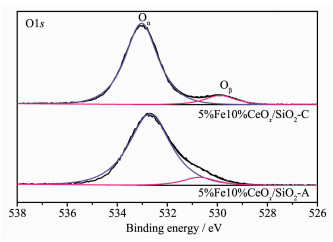
XPS measurements were used to characterize the surface element composition of the resultant FeCeOx/SiO2 (Fig. 3). It revealed that the surface of FeCeOx/SiO2 contained mainly Si and O with a bit amount of Fe and Ce. To determine the chemical components and the oxidation states of each element (Fe, Ce), high-resolution XPS spectra of Fe2p and Ce3d were highlighted. O1s spectra was used to illustrate the basic site on catalyst surface.
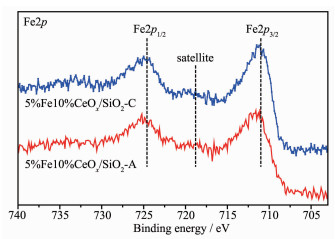
The spectra of Fe2p (Fig. 4) from FeCeOx/SiO2 indicated the existence of doublet Fe2p3/2 and Fe2p1/2 with binding energies of about 711.0 and 724.6 eV, respectively[24-25]. There was satellite peak situated at about 718.8 eV, which was a major characteristic of Fe3+[26]. Fe2p spectra of the two catalysts were almost the same, clearly revealed that most of the Fe on the surface of amorphous catalyst were oxidized to Fe3+.
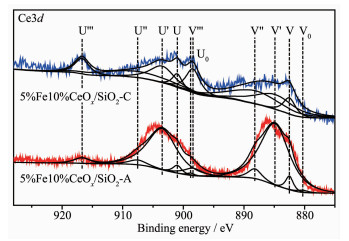
Fig. 5 represents the XPS spectra of Ce3d of FeCeOx/SiO2 catalysts. The Ce3d spectra showed a complex multiple peaks. XPS peaks denoted as U"' (916.7 eV), U″ (907.5 eV), and U (901.0 eV) and V"' (898.4 eV), V″ (888.2 eV), and V (882.5 eV) are attributed to Ce4+ species while U' (903.5 eV), U0 (898.8 eV), V' (884.9 eV), and V0 (880.3 eV) are assigned to Ce3+ species. The peaks assigned U', U0, V', and V0 are the main representatives of the 3d104f1 electronic state of Ce3+ ions, while the peaks assigned U"', U″, U, V"', V″ and V are the main representatives of the 3d104f0 electronic state of Ce4+ ions[27-28]. The Ce3+ relative surface ratio of amorphous and crystalline catalysts was calculated as 82% and 37%, respectively. The increasing amount of Ce3+ was due to the different degrees of catalyst oxidation.
As presented in Fig. 6, two kinds of surface oxygen species were identified by performing a peak-fitting deconvolution. The peaks at higher binding energy of 531.0~533.0 eV are attributed to the surface -OH species (Oα), and the peaks at lower binding energy of 529.0~531.0 eV are characteristic of O2- (Oβ), attributed to carbonate species[29-30]. The Oα relative surface ratio in amorphous catalyst (91.9%) was higher than that in crystalline catalyst (90.6%). This indicates that there are more surface -OH species on the surface of the amorphous catalyst, which may lead to more weak basic sites on the catalyst surface.
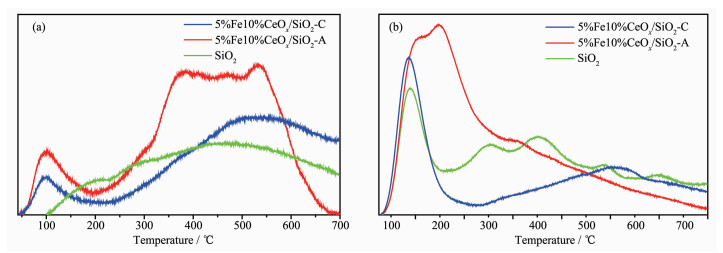
From previous work it appeared that the amount of basic sites of the catalyst is an important factor affecting its catalytic activity in the transesterification reaction[31-32]. CeO2 was a weakly basic oxide, and the addition of Fe enhanced its basicity. In order to prove that the basicity of the catalyst plays a dominant role in this reaction, CO2-TPD profile and NH3-TPD profile of catalysts were acquired and shown in Fig. 7(a, b). Peaks in the CO2/NH3-TPD profiles were classified as corresponding to:weak (< 200℃), moderate (200~450℃) and strong (> 450℃) basic/acid sites in the relative temperature. For the CO2-TPD results, both crystalline and amorphous sample showed significant CO2 uptake. According to literature[33], CeO2 showed a weakly basic peak at around 100℃, while in the amorphous sample, the intensity of weak and moderate basic sites increased. The intensity of the weak and moderate basic sites depends on the Lewis acid-basic paring and OH- bond present on the surface, and the higher basic nature is due to the low coordination of surface O2-[34]. The amount of total basic sites was calculated (Table 2). Thereafter, the basic site density was calculated by dividing the amount of total basic sites per unit mass by the BET surface area[35]. The total amount of CO2 desorbed from SiO2, 5%Fe10%CeOx/SiO2-A and 5%Fe10%CeOx/SiO2-C was 0.85, 2.10 and 1.52 mmol·g-1, respectively. The respectively value of basic site density was:4.39, 13.74 and 8.06 μmol·m-2. The results in Table 2 indicate that the amorphous catalyst has much more basic sites than the crystalline catalyst.
下载:
导出CSV
| Catalyst | TPD analysis of absorbed CO2 / (mmol·g-1) | Total evolved CO2 / (mmol·g-1) |
Basic site density / (μmol·m-2) |
||
| Weak (< 200 ℃) | Moderate (200~450 ℃) | Strong (>450 ℃) | |||
| SiO2 | 0.05 | 0.38 | 0.42 | 0.85 | 4.39 |
| 5%Fe10%CeOx/SiO2-A | 0.23 | 0.94 | 0.93 | 2.10 | 13.74 |
| 5%Fe10%CeOx/SiO2-C | 0.13 | 0.44 | 0.95 | 1.52 | 8.06 |
NH3 desorption temperature and amount acid sites were calculated (Table 3). The total amount of NH3 desorbed from SiO2, 5%Fe10%CeOx/SiO2-A and 5%Fe10%CeOx/SiO2-C was 0.96, 2.19 and 0.59 mmol·g-1, respectively. The respectively value of acidic site density was:4.96, 14.33 and 3.13 μmol·m-2. It can be seen that the amorphous catalyst had both basic and acidic sites, and SiO2 also exhibited a small amount of basicity and acidity. Although SiO2 had more acid sites than crystalline catalyst, its reaction performance was much worse. The crystalline catalyst had higher activity than SiO2 due to its stronger basicity. Therefore, this could explain that in the transesterification reaction of prenyl acetate, the activity of the catalyst was mainly derived from the basic site rather than acidic site.
下载:
导出CSV
| Catalyst | TPD analysis of absorbed NH3/(mmol·g-1) | Total evolved NH3/(mmol·g-1) |
Acidic site density/ (μmol·m-2) |
||
| Weak (< 200℃) | Moderate (200~450℃) | Strong (>450℃) | |||
| SiO2 | 0.28 | 0.43 | 0.25 | 0.96 | 4.96 |
| 5%Fe10%CeOx/SiO2-A | 1.09 | 0.84 | 0.26 | 2.19 | 14.33 |
| 5%Fe10%CeOx/SiO2-C | 0.25 | 0.13 | 0.21 | 0.59 | 3.13 |
The transesterification performance of the catalysts is listed in Table 4. The formation rate of prenyl alcohol in the unit of mmol product per gram of catalyst per hour(k) was also calculated and listed. It can be seen that the amorphous catalyst had much better transesterification performance than the crystalline catalyst, attributing to more basic sites.
下载:
导出CSV
| Catalyst | Conv. of prenyl acetatea/% | Sel. of prenyl alcohola/% | kb/(mmol·g-1·h-1) |
| SiO2 | 24.3 | 64.9 | 2.82 |
| 5%Fe10%CeOx/SiO2-A | 95.2 | 96.5 | 16.45 |
| 5%Fe10%CeOx/SiO2-C | 65.6 | 89.0 | 10.45 |
| a Reaction conditions: mmethanol/mprenyl acetate=9, catalyst dosage=0.48%(w/w), 130 ℃, 10 h; b k is the formation rate of prenyl alcohol in the unit of mmol product per gram of catalyst per hour. | |||
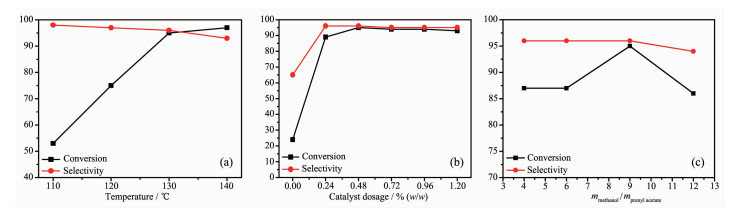
The reaction conditions were optimized to achieve maximum yield of prenyl alcohol. The effect of temperature, the amount of catalyst and mass ratio were studied for prenyl acetate with 5%Fe10%CeOx/SiO2-A catalyst. The reaction temperature was varied from 110 to 140℃ and the results are shown in Fig. 8(a). The results suggested that the conversion of prenyl acetate increased with the increase in the temperature from 110 to 140℃. At 110℃, the prenyl acetate conversion was 53%, which increased to 97% upon increase in the temperature to 140℃. Correspondingly, the selectivity of prenyl alcohol decreased with increasing reaction temperature. The yield of prenyl alcohol was maximized at a reaction temperature of 130℃.
Conditions: (a) mmethanol/mprenyl acetate=9, catalyst dosage=0.48%(w/w), reaction time=10 h; (b) mmethanol/mprenyl acetate=9, temperature=130℃, reaction time=10 h; (c) catalyst dosage=0.48%(w/w), temperature=130℃, reaction time=10 h
An important variable affecting the yield of prenyl alcohol was the catalyst dosage which was varied from 0 to 1.2%(w/w) keeping the temperature at 130℃ and mmethanol/mprenyl acetate of 9. Upon increasing the catalyst dosage from 0 to 1.2%, the results are shown in Fig. 8(b). Hence, the catalyst dosage of 0.48%(w/w) with respect to the total reactant was found to be the optimum to get high prenyl alcohol yield.
The effect of mass ratio was studied for prenyl acetate with 0.48%(w/w) dosage of 5%Fe10%CeOx/SiO2-A at 130℃. The stoichiometry of the transes-terification reaction required 1 mol of methanol per mole of prenyl acetate to yield 1 mol of methyl acetate and prenyl alcohol. To shift the transesterification reaction to the right, it was necessary to use a large excess of methanol, and hence the mass ratio of alcohol to ester was varied from 4 to 12 (Fig. 8(c)). The mass ratio being 9 was considered to be the optimum mass ratio to get high conversion of prenyl acetate.
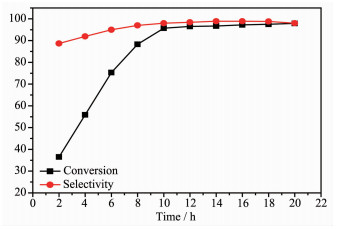
Since each experiment needed a work-up to get the conversion and yield, effect of reaction time was studied independently by carrying out transesterifica-tion for 2~20 h under the identical conditions (130℃, catalyst dosage=0.48%(w/w), mmethanol/mprenyl acetate=9) for prenyl acetate using 5%Fe10%CeOx/SiO2-A catalyst. The results are shown in Fig. 9. With an increase in reaction time, yield of prenyl alcohol increased gradually and it remained constant after some point. From the results, it is clear that the yield hardly increases after 10 hours. Once the reaction mixture is saturated with the product, a small amount of unreacted prenyl acetate may not be able to interact with the catalyst active sites.
Conditions: mmethanol/mprenyl acetate=9, catalyst dosage=0.48%(w/w), temperature=130℃
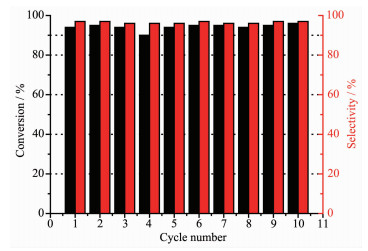
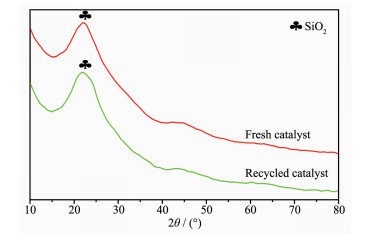
The transesterification reaction of prenyl acetate with methanol using 5%Fe10%CeOx/SiO2-A showed 95% conversion for 10 hours. The reusability study was conducted with 5%Fe10%CeOx/SiO2-A catalyst for the transesterification of prenyl acetate. The test was performed up to 10 successive cycles for the reactions. The catalyst stayed active and showed consistent performance (Fig. 10). Interestingly, the catalyst without regeneration at high temperatures was able to retain the activity after successive reuse. Furthermore, XRD patterns of both fresh and recycled catalysts for transesterification of prenyl acetate indicate that there is no change in phase purity and the amorphous structure remains stable after ten cycles (Fig. 11). Iron oxide forms a stable amorphous dislocation with the cerium oxide component.
Conditions: mmethanol/mprenyl acetate=9, catalyst dosage=0.48%(w/w), temperature=130℃, reaction time=10 h
Conditions: mmethanol/mprenyl acetate=9, catalyst dosage=0.48%(w/w), temperature=130℃, reaction time=10 h
In summary, amorphous FeCeOx/SiO2 and crystalline FeCeOx/SiO2 catalyst were obtained by chemical reduction and co-precipitation methods. For the transesterification of prenyl acetate and methanol, the high activity of 5%Fe10%CeOx/SiO2-A is attributed to the basicity properties. Under the optimized reaction conditions, the 5%Fe10%CeOx/SiO2-A catalyst offered the highest prenyl acetate conversion of 95% with an excellent prenyl alcohol selectivity of 96%. The 5%Fe10%CeOx/SiO2-A catalyst has more basic sites, and it has excellent stability due to the interaction of Fe and Ce. Furthermore, the catalyst remained active after 10 cycles of using, which is a composite oxide and an amorphous form. Compared with the previous reported transesterification catalysts, the FeCeOx/SiO2-A catalyst has remarkable merits in catalyst preparation, recycling and catalytic activity. Therefore, it can be inferred that the FeCeOx/SiO2-A will be of practical potential for the transesterification reaction.
The authors gratefully acknowledge the National Key Research and D & P of China (Grant No.2017YFC0210901).
Xiong Z B, Lu C M, Guo D X, et al. J. Chem. Technol. Biotechnol., 2013, 88:1258-1265 doi: 10.1002/jctb.3966
Busca G. Chem. Rev., 2010, 110:2217-2249 doi: 10.1021/cr9000989
Bhanage B M, Fujita S I, Ikushima Y, et al. Appl. Catal. A, 2001, 219:259-266 doi: 10.1016/S0926-860X(01)00698-6
Adriana M, Nadine E, Lorraine C, et al. Appl. Catal. A, 2013, 468:1-8 doi: 10.1016/j.apcata.2013.08.001
Wang H, Wang M H, Zhao N, et al. Catal. Lett., 2005, 105:253-257 doi: 10.1007/s10562-005-8699-0
刘守庆, 李雪梅, 和献武, 等.无机化学学报, 2017, 33(7):1153-1160 http://www.wjhxxb.cn/wjhxxbcn/ch/reader/view_abstract.aspx?flag=1&file_no=20170706&journal_id=wjhxxbcnLIU Shou-Qing, LI Xue-Mei, HE Xian-Wu, et al. Chinese J. Inorg. Chem., 2017, 33(7):1153-1160 http://www.wjhxxb.cn/wjhxxbcn/ch/reader/view_abstract.aspx?flag=1&file_no=20170706&journal_id=wjhxxbcn
Vani V S N P, Chida A S, Srinivasan R, et al. Synth. Commun., 2001, 31:219-224 doi: 10.1081/SCC-100000202
Macala G S, Robertson A W, Johnson C L, et al. Catal. Lett., 2008, 122:205-209 doi: 10.1007/s10562-008-9480-y
Baskar G, Soumiya S. Renewable Energy, 2016, 98:101-107 doi: 10.1016/j.renene.2016.02.068
Dhawane S H, Kumar T, Halder G. Energy Convers. Manage., 2016, 122:310-320 doi: 10.1016/j.enconman.2016.06.005
Suzuta T, Toba M, Abe Y. J. Am. Oil Chem. Soc., 2012, 89:1981-1989 doi: 10.1007/s11746-012-2101-3
Hájek M, Kocík J, Frolich K, et al. J. Cleaner Prod., 2017, 161:1423-1431 doi: 10.1016/j.jclepro.2017.05.199
Joshi G, Rawat D S, Lamba B Y. Energy Convers. Manage., 2015, 96:258-267 doi: 10.1016/j.enconman.2015.02.061
Shi M, Zhang P B, Fan M M. Fuel, 2017, 197:343-347 doi: 10.1016/j.fuel.2017.02.060
Dibenedetto A, Angelini A, Bitonto L D, et al. ChemSusChem, 2014, 7:1155-1161 doi: 10.1002/cssc.201301025
Kumar P, Srivastava V C, Mishra I M, et al. Renewable Energy, 2016, 88:457-464 doi: 10.1016/j.renene.2015.11.052
Song Z W, Jin X, Hu Y F, et al. ACS Sustainable Chem. Eng., 2017, 5:4718-4729 doi: 10.1021/acssuschemeng.7b00095
Murugan C, Bajaj H C, Jasra R V. Catal. Lett., 2010, 137:224-231 doi: 10.1007/s10562-010-0348-6
Zhang L, Wu Y S, Bian X F, et al. J. Non-Cryst. Solids, 2000, 262:169-176 doi: 10.1016/S0022-3093(99)00699-7
毛东森, 郭强胜, 俞俊, 等.物理化学学报, 2011, 27:2639-2645 doi: 10.3866/PKU.WHXB20111125MAO Dong-Sen, GUO Qiang-Sheng, YU Jun, et al. Acta Phys.-Chim. Sin., 2011, 27:2639-2645 doi: 10.3866/PKU.WHXB20111125
Liu J H, Yang X B, Zhang C, et al. J. Ind. Eng. Chem., 2016, 67:1287-1293 http://www.hgxb.com.cn/CN/abstract/abstract17753.shtml
Liu W G, Wang S, Wang S D. Appl. Catal. A, 2016, 510:227-232 doi: 10.1016/j.apcata.2015.11.032
Kurian M, Kunjachan C, Sreevalsan A. Chem. Eng. J., 2017, 308:67-77 doi: 10.1016/j.cej.2016.09.039
Yamashita T, Hayes P. Appl. Surf. Sci., 2008, 254:2441-2449 doi: 10.1016/j.apsusc.2007.09.063
Sánchez G, Dlugogorski B Z, Kennedy E M, et al. Appl. Catal. A, 2016, 509:130-142 doi: 10.1016/j.apcata.2015.09.039
Kendelewicz T, Liu P, Doyle C S. Surf. Sci., 2000, 69:144-163 https://www.sciencedirect.com/science/article/pii/S0039602800008086
Chang L H, Sasirekha N, Chen Y W. Ind. Eng. Chem. Res., 2006, 45:4927-4935 doi: 10.1021/ie0514408
Zou Z Q, Meng M, Guo L H, et al. J. Hazard. Mater., 2009, 163:835-842 doi: 10.1016/j.jhazmat.2008.07.035
Zhan S H, Zhang H, Zhang Y, et al. Appl. Catal. B, 2017, 203:199-209 doi: 10.1016/j.apcatb.2016.10.010
Nivangune N T, Ranade V V, Kelkar A A. Catal. Lett., 2017, 147:2558-2569 doi: 10.1007/s10562-017-2146-x
Xu J, Long K Z, Wu F, et al. Appl. Catal. A, 2014, 484:1-7 doi: 10.1016/j.apcata.2014.07.009
Liao Y H, Li F, Pu Y F, et al. RSC Adv., 2018, 8:785-791 doi: 10.1039/C7RA10832J
Hong W J, Iwanmoto S, Inoue M. Catal. Lett., 2010, 135:190-196 doi: 10.1007/s10562-010-0296-1
Rossi P F, Busca G, Lorenzelli V, et al. Langmuir, 1991, 7:2677-2681 doi: 10.1021/la00059a046
Kumar P, Srivastava V C, Mishara I M, et al. Catal. Commun., 2015, 60:27-31 doi: 10.1016/j.catcom.2014.11.006

图 1 TEM images of FeCeOx/SiO2 samples:(a, b) 5%Fe10%CeOx/SiO2-C, (c, d) 5%Fe10%CeOx/SiO2-A

图 2 XRD patterns of FeCeOx/SiO2 samples: (a) 5%Fe10%CeOx/SiO2-C, (b) 5%Fe10%CeOx/SiO2-A

图 8 Effect of temperature (a), catalyst dosage (b), mass ratio of methanol to prenyl acetate (c) on transesterification performance of 5%Fe10%CeOx/SiO2-A catalysts
Conditions: (a) mmethanol/mprenyl acetate=9, catalyst dosage=0.48%(w/w), reaction time=10 h; (b) mmethanol/mprenyl acetate=9, temperature=130℃, reaction time=10 h; (c) catalyst dosage=0.48%(w/w), temperature=130℃, reaction time=10 h

图 9 Effect of time on prenyl acetate transesterification reaction catalyzed by 5%Fe10%CeOx/SiO2-A catalyst
Conditions: mmethanol/mprenyl acetate=9, catalyst dosage=0.48%(w/w), temperature=130℃

图 10 Recyclability test of 5%Fe10CeOx/SiO2-A catalyst for transesterification reaction of prenyl acetate
Conditions: mmethanol/mprenyl acetate=9, catalyst dosage=0.48%(w/w), temperature=130℃, reaction time=10 h

图 11 XRD patterns of fresh and recycled 5%Fe10%CeOx/SiO2-A catalyst
Conditions: mmethanol/mprenyl acetate=9, catalyst dosage=0.48%(w/w), temperature=130℃, reaction time=10 h
表 1 Physicochemical characterizations of as-prepared catalysts
| Catalyst | Actual load of Fea/% | Actual load of Cea/% | SBET/(m2·g-1) | Pore diameterb/nm | Pore volumec/(cm3·g-1) |
| SiO2 | - | - | 194 | 14.38 | 1.38 |
| 5%Fe10%CeOx/SiO2-A | 4.9 | 9.7 | 153 | 15.78 | 1.13 |
| 5%Fe10%CeOx/SiO2-C | 4.8 | 9.5 | 189 | 13.35 | 1.21 |
| a Determined by the ICP-MS technique; b Average pore diameter; c BJH desorption pore volume. | |||||
 下载: 导出CSV
表 2 TPD analysis using absorbed CO2 for determining the basic properties of as-prepared catalysts
| Catalyst | TPD analysis of absorbed CO2 / (mmol·g-1) | Total evolved CO2 / (mmol·g-1) |
Basic site density / (μmol·m-2) |
||
| Weak (< 200 ℃) | Moderate (200~450 ℃) | Strong (>450 ℃) | |||
| SiO2 | 0.05 | 0.38 | 0.42 | 0.85 | 4.39 |
| 5%Fe10%CeOx/SiO2-A | 0.23 | 0.94 | 0.93 | 2.10 | 13.74 |
| 5%Fe10%CeOx/SiO2-C | 0.13 | 0.44 | 0.95 | 1.52 | 8.06 |
下载: 导出CSV
表 3 TPD analysis using absorbed NH3 for determining the acidic properties of as-prepared catalysts
| Catalyst | TPD analysis of absorbed NH3/(mmol·g-1) | Total evolved NH3/(mmol·g-1) |
Acidic site density/ (μmol·m-2) |
||
| Weak (< 200℃) | Moderate (200~450℃) | Strong (>450℃) | |||
| SiO2 | 0.28 | 0.43 | 0.25 | 0.96 | 4.96 |
| 5%Fe10%CeOx/SiO2-A | 1.09 | 0.84 | 0.26 | 2.19 | 14.33 |
| 5%Fe10%CeOx/SiO2-C | 0.25 | 0.13 | 0.21 | 0.59 | 3.13 |
下载: 导出CSV
表 4 Catalytic performance of as-prepared catalysts
| Catalyst | Conv. of prenyl acetatea/% | Sel. of prenyl alcohola/% | kb/(mmol·g-1·h-1) |
| SiO2 | 24.3 | 64.9 | 2.82 |
| 5%Fe10%CeOx/SiO2-A | 95.2 | 96.5 | 16.45 |
| 5%Fe10%CeOx/SiO2-C | 65.6 | 89.0 | 10.45 |
| a Reaction conditions: mmethanol/mprenyl acetate=9, catalyst dosage=0.48%(w/w), 130 ℃, 10 h; b k is the formation rate of prenyl alcohol in the unit of mmol product per gram of catalyst per hour. | |||
下载: 导出CSV

 扫一扫看文章


扫一扫关注我们


 下载:
下载: