Study on Self-assembly Behaviors of an Amphiphilic Block Polymer by Terminally Grafting Tetraphenylethene-Based Aggregation-Induced Emission Active Moietys
Institute of Advanced Materials, National Jiangsu Synergetic Innovation Center for Organic Electronics and Information Displays, Key Laboratory of Organic Electronics and Information Displays, Nanjing University of Posts and Telecommunications, Nanjing 210023, China
Corresponding author:
JIANG Hongji, professor; Tel/Fax:025-85866332; E-mail:iamhjjiang@njupt.edu.cn; Research interests:organic optoelectronic materials and devices
Received Date:
05 June 2018 Accepted Date:
21 September 2018 Revised Date:
08 August 2018 Available Online:
01 April 2019
Fund Project:
Supported by the National Major Basic Research Program of China(No.2012CB933301), the National Natural Science Foundation of China(No.21574068), the Project Funded by the Priority Academic Program Development of Jiangsu Higher Education Institutions(No.YX03001)
Abstract:
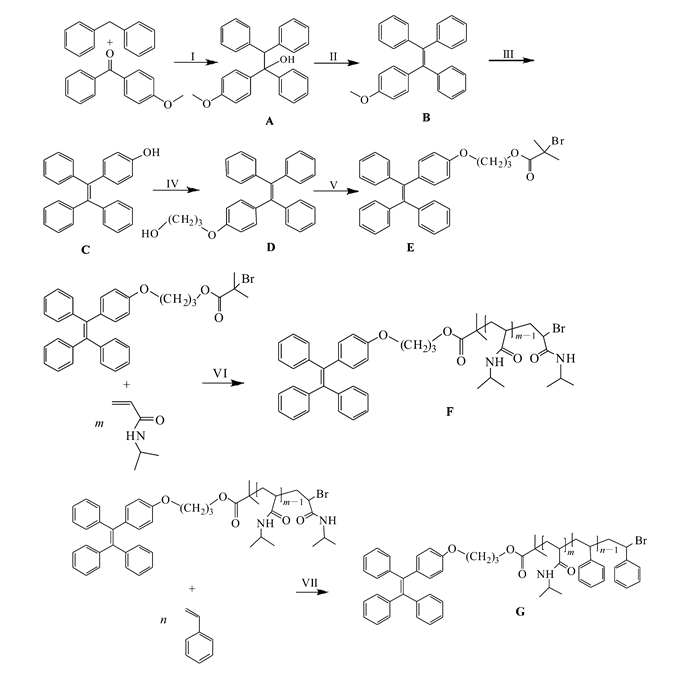
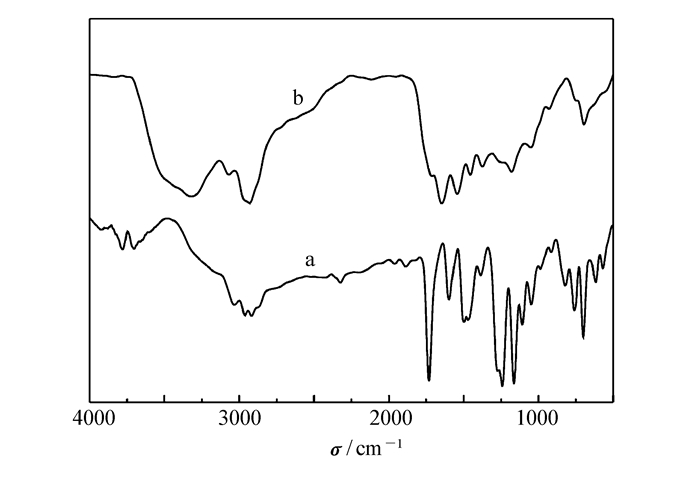
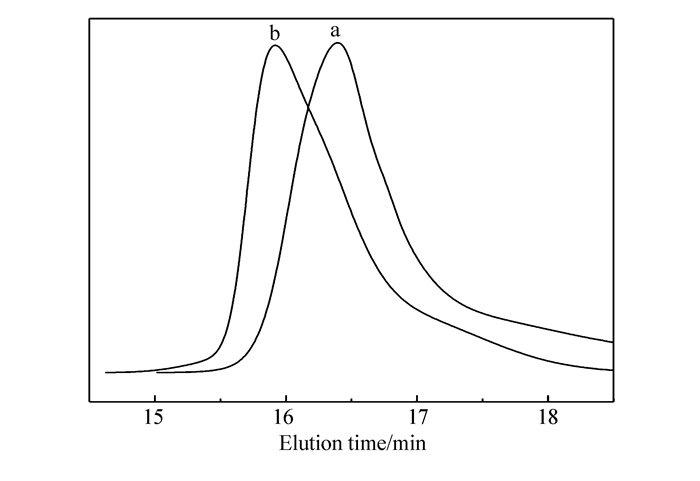
Poly(N-isopropylacrylamide)(PNIPAM) is an amphiphilic thermosensitive polymer with the hydrophilic amide group and the hydrophobic isopropyl group in the side chain. A reversible phase change occurs due to intermolecular interaction with the change of outside temperature. Tetraphenylethene derivatives have advantages of easy-to-synthesize, highly efficient chemical modification feasibility, aggregation-induced emission(AIE) characteristic and high quantum yield. Therefore, a macromolecular initiator F was prepared by the polymerization of N-isopropylacrylamide through single electron transfer-living free radical polymerization with tetraphenylethene derivative as the initiator. Then styrene was used as comonomer to convert the active PNIPAM initiator to an amphiphilic block polymer G, which was characterized by gel permeation chromatography and Fourier transform infrared spectra. Using tetraphenylethene-based AIE-active initiator as the research object of reference, the photophysical properties of amphiphilic block polymer at different temperatures and concentrations were studied to correlate the AIE activity with the amphiphilic nature of the block polymer in detail. It was found that the fluorescence intensity of AIE-active initiators decreased with the increase of temperature at the same concentration of dispersion, while the fluorescence intensity of the block polymer increased firstly, and then decreased after the temperature exceeded 37℃. Under the same conditions, by changing the concentrations of AIE-active initiators and block polymer in tetrahydrofuran/water mixed solvents, we found that the fluorescence intensity of AIE-active initiator decreased with the decrease of concentration, while the change tendency of fluorescence intensity for block polymer was similar as those obtained from the temperature changes. It is feasible to investigate the self-assembly behaviors of the amphiphilic block polymer by grafting the AIE active moiety to the terminal of polymer.
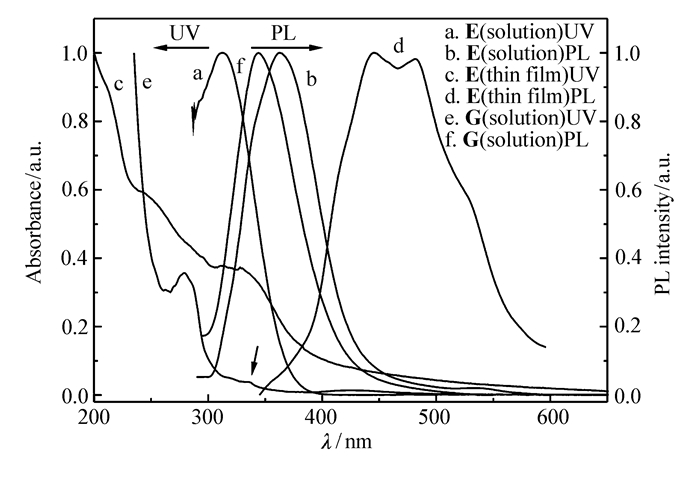
Figure 3.
The normalized UV-Vis absorption and PL emission spectra of the initiator E and block polymer G in dichloromethane and the normalized UV-Vis absorption and PL emission spectra of initiator E in the thin solid film state
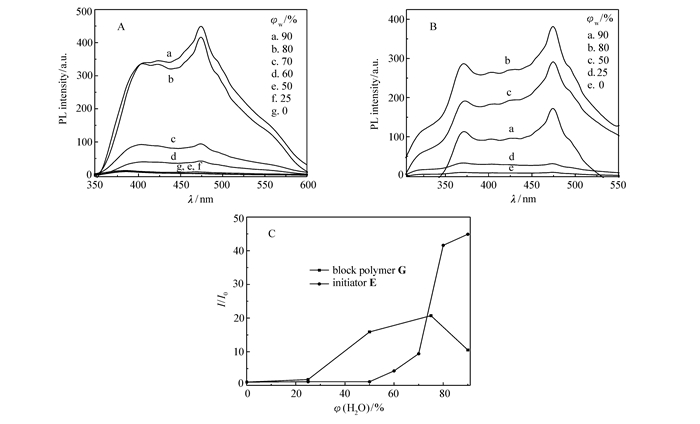
Figure 4.
PL emission spectra of the initiator E(A) and block polymer G(B) in THF and H2O mixture with different H2O volume fractions. The PL intensity versus H2O volume fraction plots(C) of E and G in THF and H2O mixture(λex(E)=311 nm, c(E)=2×10⁻⁴ mol/L; λex(G)=280 nm, c(G) =2×10⁻⁴ mol/L; The dispersion of E and G was treated by ultrasound for 2 min before tested)
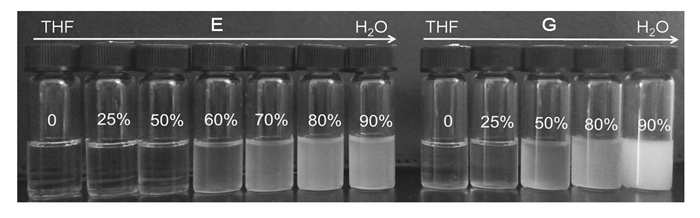
Figure 5.
Photographs of the initiator E and block polymer G dispersion in THF and H2O mixture(the final concentrations of the initiator E and block polymer G are 2×10⁻⁴ mol/L)
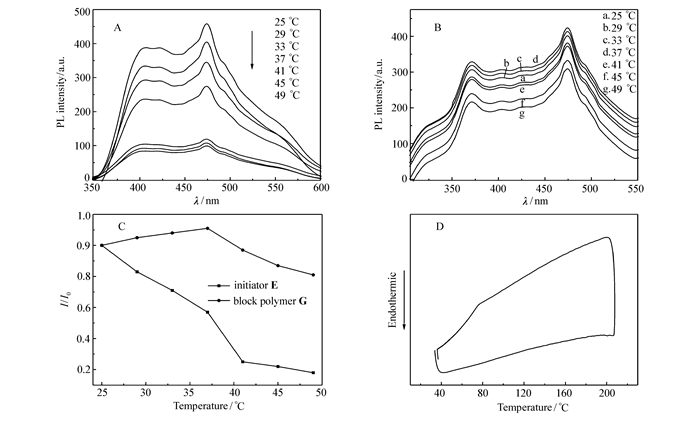
Figure 6.
Fluorescent emission spectra of the initiator E(A) and block polymer G(B) at different temperatures in THF and H2O mixture with 80% volume fraction of water. The fluorescent intensity versus temperature plots(C) of the initiator E and block polymer G in THF and H2O mixture(λex(E)=311 nm, c(E)=2×10⁻⁴ mol/L; λex(G)=280 nm, c(G) =2×10⁻⁴ mol/L; The dispersions of the initiator E and block polymer G were treated by ultrasound for 2 min before tested), and the DSC curve(D) of amphiphilic block polymer G in thin solid film state
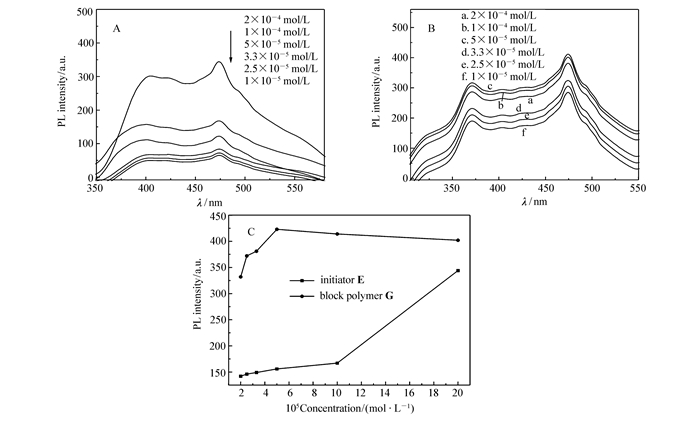
Figure 7.
PL emission spectra of the initiator E(A) and block polymer G(B) at different concentrations in THF and H2O mixtures with 80% volume fraction of water. The plots(C) PL intensity versus the concentrations of the dispersion in THF/H2O mixtures of the initiator E and block polymer G(λex(E)=311 nm, c(E)=2×10⁻⁴ mol/L; λex(G)=280 nm, c(G)=2×10⁻⁴ mol/L; The dispersions of E and G were treated by ultrasound for 2 min before tested)
Luo J D, Xie Z L, Lam J W Y. Aggregation-Induced Emission of 1-Methyl-1, 2, 3, 4, 5-pentaphenylsilole[J]. Chem Commun,
2001, 18(12):
1740-1741.
[2]
Tang B Z, Zhan X, Yu G. Efficient Blue Emission from Siloles[J]. J Mater Chem,
2001, 11(12):
2974-2978.
doi: 10.1039/b102221k
[3]
Hu R, Leung N L C, Tang B Z. AIE Macromolecules:Syntheses, Structures and Functionalities[J]. Chem Soc Rev,
2014, 43(13):
4494-4562.
doi: 10.1039/C4CS00044G
[4]
Yang Z Y, Qin W, Leung N L C. A Mechanistic Study of AIE Processes of TPE Luminogens:Intramolecular Rotation vs Configurational Isomerization[J]. J Mater Chem C,
2016, 4(1):
99-107.
doi: 10.1039/C5TC02924D
[5]
Chen L, Jiang Y B, Nie H. Rational Design of Aggregation-induced Emission Luminogen with Weak Electron Donor-Acceptor Interaction to Achieve Highly Efficient Undoped Bilayer OLEDs[J]. ACS Appl Mater Interfaces,
2014, 6(19):
17215-17225.
doi: 10.1021/am505036a
[6]
Kim J Y, Yasuda T, Yang Y S. Bifunctional Star-burst Amorphous Molecular Materials for OLEDs:Achieving Highly Efficient Solid-State Luminescence and Carrier Transport Induced by Spontaneous Molecular Orientation[J]. Adv Mater,
2013, 25(19):
2666-2671.
doi: 10.1002/adma.v25.19
[7]
Du X, Qi J, Zhang Z. Efficient Non-doped Near Infrared Organic Light-Emitting Devices Based on Fluorophores with Aggregation-Induced Emission Enhancement[J]. Chem Mater,
2012, 24(11):
2178-2185.
doi: 10.1021/cm3008733
[8]
Yuan W Z, Chen S M, Lam J W Y. Towards High Efficiency Solid Emitters with Aggregation-Induced Emission and Electron-transport Characteristics[J]. Chem Commun,
2011, 47(40):
11216-11218.
doi: 10.1039/c1cc14122h
[9]
Mu G Y, Zhang W Z, Xu P. Constructing New n-Type, Ambipolar, and p-Type Aggregation-induced Blue Luminogens by Gradually Tuning the Proportion of Tetrahphenylethene and Diphenylphophine Oxide[J]. J Phys Chem C,
2014, 118(16):
8610-8616.
doi: 10.1021/jp501752a
[10]
Shi Y, Cai Y J, Wang Y J. 3, 4, 5-Triphenyl-1, 2, 4-triazole-based Multifunctional n-Type AIEgen[J]. Sci China Chem,
2017, 60(5):
635-641.
doi: 10.1007/s11426-016-0433-x
[11]
Aragay G, Pino F, Merkoci A. Nanomaterials for Sensing and Destroying Pesticides[J]. Chem Rev,
2012, 112(10):
5317-5338.
doi: 10.1021/cr300020c
[12]
Chen A, Chatterjee S. Nanomaterials Based Electrochemical Sensors for Biomedical Applications[J]. Chem Soc Rev,
2013, 42(12):
5425-5438.
doi: 10.1039/c3cs35518g
[13]
Biju V. Chemical Modifications and Bioconjugate Reactions of Nanomaterials for Sensing, Imaging, Drug Delivery and Therapy[J]. Chem Soc Rev,
2014, 43(3):
744-764.
doi: 10.1039/C3CS60273G
[14]
Blackburn W H, Dickerson E B, Smith M H. Peptide-functionalized Nanogels for Targeted siRNA Delivery[J]. Bioconjugate Chem,
2009, 20(5):
960-968.
doi: 10.1021/bc800547c
[15]
Hong S W, Kim D Y, Lee J. Synthesis of Polymeric Temperature Sensor Based on Photophysical Property of Fullerene and Thermal Sensitivity of Poly(N-isopropylacrylamide)[J]. Macromolecules,
2009, 42(7):
2756-2761.
doi: 10.1021/ma802862h
[16]
Park T G, Hoffman A S. Sodium Chloride-induced Phase-transition in Nonionic Poly(N-isopropylacrylamide) Gel[J]. Macromolecules,
1993, 26(19):
5045-5048.
doi: 10.1021/ma00071a010
[17]
Percec V, Guliashvili T, Ladislaw J S. Ultrafast Synthesis of Ultrahigh Molar Mass Polymers by Metal-catalyzed Living Radical Polymerization of Acrylates, Methacrylates, and Vinyl Chloride Mediated by SET at 25℃[J]. J Am Chem Soc,
2006, 43(128):
14156-14165.
[18]
Shibayama M, Fujikawa Y, Nomura S. Dynamic Light Scattering Study of Poly(N-isopropylacrylamide-co-acrylic acid) Gels[J]. Macromolecules,
1996, 29(6):
2019-2014.
doi: 10.1021/ma951390q
[19]
Tang X D, Liang X C, Yang Q. AB(2)-Type Amphiphilic Block Copolymers Composed of Poly(ethylene glycol) and Poly(N-isopropylacrylamide) via Single-electron Transfer Living Radical Polymerization:Synthesis and Characterization[J]. J Polym Sci Part A:Polym Chem,
2009, 47(17):
4420-4427.
doi: 10.1002/pola.v47:17
[20]
Deng Y, Zhang J Z, Li Y J. Thermoresponsive Graphene Oxide-PNIPAM Nanocomposites with Controllable Grafting Polymer Chains via Moderate in Situ SET-LRP[J]. J Polym Sci Part A:Polym Chem,
2012, 50(21):
4451-4458.
doi: 10.1002/pola.v50.21
[21]
Heng C N, Liu M Y, Wang K. Fabrication of Silica Nanoparticle Based Polymer Nanocomposites via a Combination of Mussel Inspired Chemistry and SET-LRP[J]. RSC Adv,
2015, 5(111):
91308-91314.
doi: 10.1039/C5RA19658B
[22]
Zhou H, Liu F, Wang X B. Aggregation Induced Emission Based Fluorescence pH and Temperature Sensors:Probing Ppolymer Interactions in Poly(N-isopropyl Acrylamide-co-tetra(phenyl)ethene Acrylate)/Poly(methacrylic acid) Interpenetrating Polymer Networks[J]. J Mater Chem C,
2015, 3(21):
5490-5498.
doi: 10.1039/C5TC00752F
[23]
Situ B, Chen S J, Zhao E G. Real-time Imaging of Cell Behaviors in Living Organisms by a Mitochondria-targeting AIE Fluorogen[J]. Adv Funct Mater,
2016, 26(39):
7132-7138.
doi: 10.1002/adfm.v26.39
[24]
Masci G, Giacomelli L, Crescenzi V. Atom Transfer Radical Polymerization of N-Isopropylacrylamide[J]. Macromol Rapid Commun,
2004, 25(12):
559-564.
[25]
Feng C, Shen Z, Li Y G. PNIPAM-b-(PEA-g-PDMAEA) Double-hydrophilic Graft Copolymer:Synthesis and Its Application for Preparation of Gold Nanoparticles in Aqueous Media[J]. J Polym Sci Part A:Polym Chem,
2009, 47(6):
1811-1824.
[26]
Feng C, Li Y J, Yang D. Synthesis of Well-defined PNIPAM-b-(PEA-g-P2VP) Double Hydrophilic Graft Copolymer via Sequential SET-LRP and ATRP and Its "Schizophrenic" Micellization Behavior in Aqueous Media[J]. J Polym Sci Part A:Polym Chem,
2010, 48(1):
15-23.
doi: 10.1002/pola.v48:1
[27]
Salimimarand M, La D D, Al Kobaisi M. Influence of Odd and Even Alkyl Chains on Supramolecular Nanoarchitecture via Self-assembly of Tetraphenylethylene-based AIEgens[J]. Sci Rep,
2017, 7:
42898.
doi: 10.1038/srep42898
[28]
Huang Z F, Zhang X Q, Zhang X Y. Synthesis of Amphiphilic Fluorescent PEGylated AIE Nanoparticles via RAFT Polymerization and Their Cell Imaging Applications[J]. RSC Adv,
2015, 5(109):
89472-89477.
doi: 10.1039/C5RA15983K
[29]
Ma H C, Qi C X, Cheng C. AIE-active Tetraphenylethylene Cross-linked N-Isopropylacrylamide Polymer:A Long-term Fluorescent Cellular Tracker[J]. ACS Appl Mater Interfaces,
2016, 8(13):
8341-8348.
doi: 10.1021/acsami.5b11091
[30]
Zhang C J, Yao X Y, Wang J. Tunable Emission of a Tetraphenylethylene Copolymer via Polymer Matrix Assisted and Aggregation-induced Emission[J]. Polym Chem,
2017, 33(8):
4835-4841.
[31]
Han T, Gui C, Lam J W Y. High-contrast Visualization and Differentiation of Microphase Separation in Polymer Blends by Fluorescent AIE Probes[J]. Macromolecules,
2017, 50(15):
5807-5815.
doi: 10.1021/acs.macromol.7b00973
Scheme 1
Synthesis of AIE active initiator F and amphiphilic block polymer G
Figure 3
The normalized UV-Vis absorption and PL emission spectra of the initiator E and block polymer G in dichloromethane and the normalized UV-Vis absorption and PL emission spectra of initiator E in the thin solid film state
Figure 4
PL emission spectra of the initiator E(A) and block polymer G(B) in THF and H2O mixture with different H2O volume fractions. The PL intensity versus H2O volume fraction plots(C) of E and G in THF and H2O mixture(λex(E)=311 nm, c(E)=2×10⁻⁴ mol/L; λex(G)=280 nm, c(G) =2×10⁻⁴ mol/L; The dispersion of E and G was treated by ultrasound for 2 min before tested)
Figure 5
Photographs of the initiator E and block polymer G dispersion in THF and H2O mixture(the final concentrations of the initiator E and block polymer G are 2×10⁻⁴ mol/L)
Figure 6
Fluorescent emission spectra of the initiator E(A) and block polymer G(B) at different temperatures in THF and H2O mixture with 80% volume fraction of water. The fluorescent intensity versus temperature plots(C) of the initiator E and block polymer G in THF and H2O mixture(λex(E)=311 nm, c(E)=2×10⁻⁴ mol/L; λex(G)=280 nm, c(G) =2×10⁻⁴ mol/L; The dispersions of the initiator E and block polymer G were treated by ultrasound for 2 min before tested), and the DSC curve(D) of amphiphilic block polymer G in thin solid film state
Figure 7
PL emission spectra of the initiator E(A) and block polymer G(B) at different concentrations in THF and H2O mixtures with 80% volume fraction of water. The plots(C) PL intensity versus the concentrations of the dispersion in THF/H2O mixtures of the initiator E and block polymer G(λex(E)=311 nm, c(E)=2×10⁻⁴ mol/L; λex(G)=280 nm, c(G)=2×10⁻⁴ mol/L; The dispersions of E and G were treated by ultrasound for 2 min before tested)


 下载:
下载:

 下载:
下载:


 下载:
下载:

