
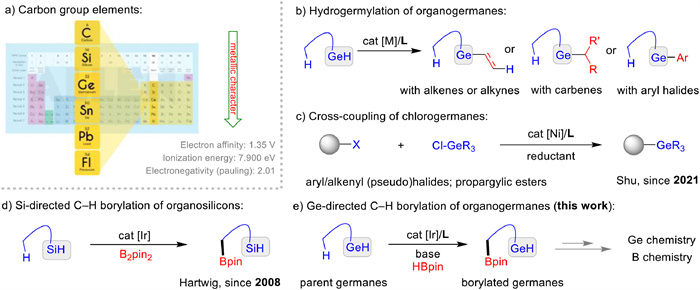
Figure 1.
Background and the discovery of Ge-directed C–H borylation.


Germanium, a key element in Group 14 of the periodic table, shares notable chemical similarities with its congeners, including carbon, silicon, tin, and lead (Fig. 1a) [1,2]. Its distinctive properties, such as the capacity to form stable organometallic compounds and its role in enhancing molecular hydrophobicity, have profound implications across multiple disciplines. In medicinal chemistry, organogermanium compounds are under investigation for their potential therapeutic applications, particularly as anticancer agents and immune system modulators [3–5]. The increased hydrophobicity conferred by germanium can enhance the bioavailability and stability of pharmaceutical compounds, thereby improving their efficacy in vivo [6–8]. In material science, the incorporation of germanium into polymers and coatings can result in materials with exceptional thermal stability, mechanical strength, and resistance to environmental degradation [9]. In morden synthetic chemistry, the use of organogermanium in cross-coupling reactions has broadened to include various activation modes, such as SEAr-type electrophilic substitution [10], transition metal catalysis (e.g., Au [11–13], Pd [14–17]), and visible-light-driven radical pathways [18,19].
The development of efficient synthetic methodologies for organogermanes has emerged as a critical research focus due to their extensive utility in various applications. Among the prominent strategies, the utilization of hydrogermanes as precursors has gained significant attention (Fig. 1b). This approach capitalizes on Ge–H bond functionalization [20], enabling the hydrogermylation of diverse substrates, including alkenes [21–23], alkynes [24–32], and carbenes [33,34]. Additionally, it facilitates the germylation of aryl (pseudo)halides, leading to the formation of organogermanes [35–37]. Another notable strategy involves the use of chlorogermanes as starting materials. Traditionally, this method relies on nucleophilic substitution with Grignard or organolithium reagents in non-catalytic processes [38,39]. However, recent advancements have introduced catalytic methods for their preparation through C–Ge cross-coupling [40]. A groundbreaking contribution in this area comes from Shu and co-workers, who have pioneered nickel-catalyzed reductive C−Ge coupling of aryl [41–45], alkenyl, and propargylic [46] electrophiles with chlorogermanes to construct organogermanes (Fig. 1c). Despite these significant advancements, the synthetic methodologies for organogermanes remain considerably more limited compared to their silicon analogs. This gap underscores the need for continued innovation and exploration in the field to unlock the full potential of organogermanes in various applications.
The synthetic prominence of organoboron compounds is rooted in their remarkable versatility as functional group transformation agents [47–55]. The advent of catalytic C–H borylation has revolutionized their preparation, enabling the direct and selective incorporation of boron moieties into complex molecular architectures [56–68]. In this context, silicon has been extensively employed as a directing atom. Over the past decade, a series of organosilicon compounds have been successfully functionalized at a late stage through this approach, as exemplified by the pioneering work of Hartwig [69–75] and others [76] (Fig. 1d). Inspired by these advancements, we envisioned the development of C–H activation in organogermanes, which could pave the way for a novel synthetic strategy for these compounds.
Herein, we report a successful iridium-catalyzed C–H borylation utilizing germanium as a directing atom, thereby establishing a robust platform for the construction of innovative bifunctional architectures (Fig. 1e). Given germanium’s pronounced metallic character and the low bond dissociation energies of the Ge–H and C–Ge bonds, achieving this reaction while maintaining the stability of organogermanium skeleton posed significant challenges [77,78]. This methodology addresses two critical issues: (1) Overcoming germanium’s inherent reactivity limitations through systematic optimization of catalysts and reaction parameters, and (2) facilitating efficient access to densely functionalized organogermanes derived from diverse parent substrates. Considering the well-established synthetic utility of both Ge-H and Bpin, their simultaneous integration within a single molecular framework opens unprecedented pathways for the assembly of complex Ge-containing molecules.
To develop an efficient catalytic system for this transformation, we first investigated the reaction between germane 1a and HBpin under various conditions (Table 1). The initial attempt employing [Ir(cod)OMe]2 as the catalyst in combination with a bipyridine-type ligand L1 in THF at 115 ℃ yielded merely trace quantities of the target C–H borylation product 1b (entry 1). Subsequent investigations revealed that the incorporation of LiOAc significantly enhanced the yield of 1b to 43% (entry 2). Further exploration demonstrated that NaOAc exhibited even higher reactivity, achieving a yield of 53%, whereas the use of KOAc and CsOAc markedly reduced the yield (entries 3–5). Screening various sodium salts, such as Na2CO3, was entirely unreactive (entry 6). These findings underscore the critical role of both the Na+ cation and the OAc- anion in influencing the reaction’s overall efficiency. Moreover, we examined the impact of different ligands on the reaction. The use of an F-substituted bpy ligand L2 resulted in lower reactivity (entry 7). In contrast, 1,10-phenanthroline L3 and the analogues L4-L6 proved to be optimal in promoting the reaction (entries 8–11), with the 75% yield of 1b achieved in the presence of L5 (entry 8). Additionally, employing bipyrazine L7 and terpyridine L8 as ligands also yielded comparable results (entries 12 and 13). Notably, increasing the amount of ligand L5 to 20 mol% led to the best outcome, achieving an 80% yield of product 1b, with excellent mono-selectivity. Interestingly, alternative iridium sources such as [Ir(coe)2Cl]2 and [Ir(cod)2BF4]2 resulted in a substantial decrease in yield (entries 15 and 16), while other transition metals like [Rh(cod)Cl]2 almost failed to promote the reaction (entry 17). We also explored the potential of alternative boron reagents, such as B2pin2, which only led to the product 1b only in trace amount (entry 18). Finally, control experiments confirmed that the reaction yielded only 18% in the absence of the ligand (entry 19) and did not proceed at all without the catalyst (entry 20).
 DownLoad:
CSV
DownLoad:
CSV
 |
|||||
| Entry | [B] (equiv.) | cat [M] (mol%) | L (mol%) | Base (equiv.) | Yield (%)b |
| 1 | HBpin (2.5) | [Ir(cod)OMe]2 (2.5) | L1 (5.0) | - | <5 |
| 2 | HBpin (2.5) | [Ir(cod)OMe]2 (2.5) | L1 (5.0) | LiOAc (2.5) | 43 |
| 3 | HBpin (2.5) | [Ir(cod)OMe]2 (2.5) | L1 (5.0) | NaOAc (2.5) | 53 |
| 4 | HBpin (2.5) | [Ir(cod)OMe]2 (2.5) | L1 (5.0) | KOAc (2.5) | 22 |
| 5 | HBpin (2.5) | [Ir(cod)OMe]2 (2.5) | L1 (5.0) | CsOAc (2.5) | 6 |
| 6 | HBpin (2.5) | [Ir(cod)OMe]2 (2.5) | L1 (5.0) | Na2CO3 (2.5) | 0 |
| 7 | HBpin (2.5) | [Ir(cod)OMe]2 (2.5) | L2 (5.0) | NaOAc (2.5) | 38 |
| 8 | HBpin (2.5) | [Ir(cod)OMe]2 (2.5) | L3 (5.0) | NaOAc (2.5) | 68 |
| 9 | HBpin (2.5) | [Ir(cod)OMe]2 (2.5) | L4 (5.0) | NaOAc (2.5) | 24 |
| 10 | HBpin (2.5) | [Ir(cod)OMe]2 (2.5) | L5 (5.0) | NaOAc (2.5) | 75 |
| 11 | HBpin (2.5) | [Ir(cod)OMe]2 (2.5) | L6 (5.0) | NaOAc (2.5) | 73 |
| 12 | HBpin (2.5) | [Ir(cod)OMe]2 (2.5) | L7 (5.0) | NaOAc (2.5) | 71 |
| 13 | HBpin (2.5) | [Ir(cod)OMe]2 (2.5) | L8 (5.0) | NaOAc (2.5) | 65 |
| 14 | HBpin (2.5) | [Ir(cod)OMe]2 (2.5) | L5 (20.0) | NaOAc (2.5) | 80 (74)c |
| 15 | HBpin (2.5) | [Ir(coe)2Cl]2 (2.5) | L5 (20.0) | NaOAc (2.5) | 31 |
| 16 | HBpin (2.5) | [Ir(cod)2BF4] (5.0) | L5 (20.0) | NaOAc (2.5) | 42 |
| 17 | HBpin (2.5) | [Rh(cod)Cl]2 (2.5) | L5 (20.0) | NaOAc (2.5) | <5 |
| 18 | B2pin2 (2.5) | [Ir(cod)OMe]2 (2.5) | L5 (20.0) | NaOAc (2.5) | <5 |
| 19 | HBpin (2.5) | [Ir(cod)OMe]2 (2.5) | - | NaOAc (2.5) | 18 |
| 20 | HBpin (2.5) | - | L5 (20.0) | NaOAc (2.5) | 0 |
| a Reaction conditions: cat [M] (2.5–5.0 mol%), L (5.0–20.0 mol%), 1a (0.20 mmol), boron reagent (0.5 mmol), and base (0.5 mmol) in 1.5 mL of solvent at 115 ℃ for 6 h under argon. b Determined by crude 1H NMR. c Isolated yield. | |||||
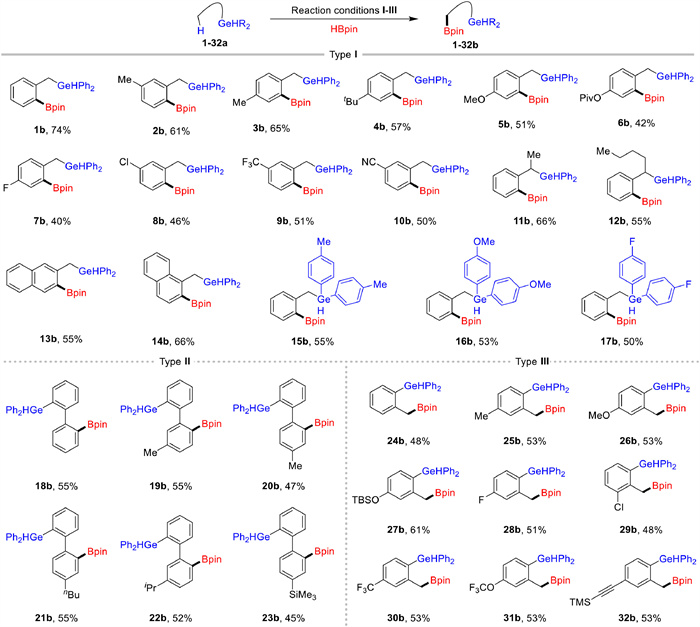
With the optimized reaction conditions established, we proceeded to investigate the applicability of various organogermanes in C–H borylation (Scheme 1). Initially, we explored a series of benzyl-substituted hydrogermanes, which form a five-membered germylmetallacycle during the catalytic cycle. A diverse array of benzylhydrogermanes, featuring both electron-neutral and electron-donating groups such as methyl (2a, 3a), tert-butyl (4a), methoxy (5a), and pivaloyloxy (6a), were subjected to the reaction, yielding products 2b–6b in moderate to good yields and excellent mono-selectivity. Notably, halide substituents like fluorine (7a) and chlorine (8a) were also compatible with the reaction. Additionally, substrates with electron-withdrawing groups, including CF3 (9a), and cyano (10a), were successfully converted into products 9b and 10b, also in modest yields. The reaction exhibited excellent regioselectivity, exclusively targeting the less hindered C–H bonds. Secondary benzyl substrates such as 11a and 12a underwent borylation at the aromatic ring, yielding 11b and 12b with moderate efficiency. Naphthyl-substituted hydrogermanes also participated in the reaction, producing 13b and 14b with exclusive regioselectivity and excellent mono-selectivity. We further examined the influence of aryl substituents on germanium, finding that various groups such as methyl (15a), methoxy (16a), and fluorine (17a) were all compatible, yielding the corresponding products 15–17b with a small amount of di-substituted byproducts. Si-directed C–H borylation via a six-membered metallacycle represents a novel and previously unreported approach in organic synthesis. Remarkably, this transformation has been successfully achieved through the formation of a six-membered metallacyclic intermediate. In the case of biaryl-substituted hydrogermanes, the utilization of a terpyridine ligand L8 facilitated the smooth progression of the reaction, effectively suppressing the formation of any disubstituted byproducts. Under slightly optimized reaction conditions, the ortho-phenyl substrate 18a yielded the mono-borylated product 18b with a respectable 55% yield. The versatility of this methodology was further demonstrated through its successful application to a range of biaryl-substituted hydrogermanes bearing diverse substituents, including methyl (19a, 20a), n-butyl (21a), isopropyl (22a), and trimethylsilyl (23a) groups. These substrates were efficiently converted to their corresponding borylated products (19b-23b) under the established reaction conditions. Of particular note, the molecular structure of compound 22b was unequivocally determined through single-crystal X-ray diffraction analysis, providing definitive structural confirmation (detailed crystallographic data are available in Supporting information). Finally, we explored triaryl-substituted hydrogermanes with an ortho-methyl group. Using ligand L8, the reaction of hydrogermane 24a in the catalytic system led to preferential benzylic C–H borylation, yielding 24b with 48% yield. While Si-directed systems typically give only disubstituted products via dual C–H borylation [72], the germyl-directed protocol affords exclusively mono-borylated species, likely due to the greater steric bulk of the germyl group, which hinders a second activation. Other triarylhydrogermanes with various substituents, including methyl (26a), methoxy (27a), silyl ether (28a), fluorine (29a), chlorine (29a), trifluoromethyl (30a), and trifluoromethoxy (31a), at different positions on the benzene core, underwent smooth benzylic C–H borylation. In the case of hydrogermane 32a, bearing an alkynyl group, borylation occurred exclusively at the benzylic position as well.
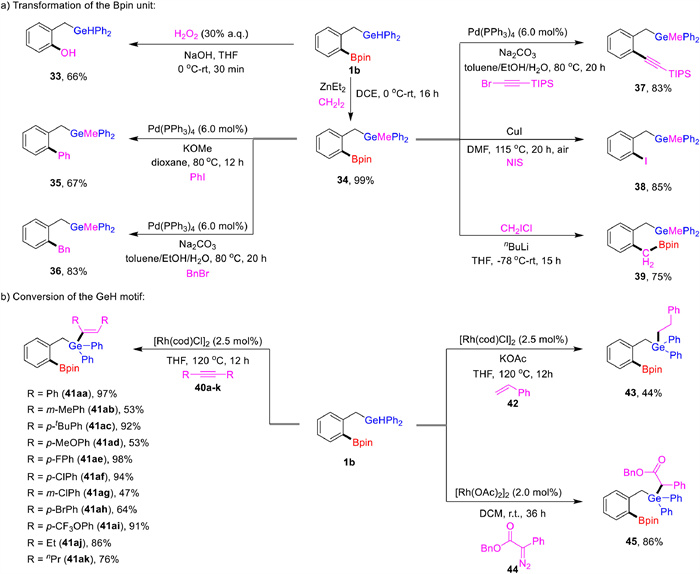
The efficient synthesis of borylated germanes has opened new avenues for the exploration of these bifunctional compounds (Scheme 2). We initially investigated the reactivity of the Bpin moiety in product 1b (Scheme 2a). Oxidation of 1b with H2O2 yielded phenol 33 in 66% yield, while the germyl group remained intact [79]. Unexpectedly, when 1b was treated with ZnEt2 and CH2I2, a germyl-methylated product 34 was obtained in nearly quantitative yield [80]. Further studies revealed that 34 could undergo a Pd-catalyzed Suzuki–Miyaura coupling with PhI, affording the biaryl product 35 in 67% yield. Additionally, the use of BnBr as a coupling partner under Pd catalysis led to the formation of the Csp2–Csp3; coupled product 36 in high yield [81]. Similarly, reaction with (bromoethynyl)triisopropylsilane under Pd catalysis provided the Csp2–Csp coupled product 37 in 83% yield. Further functionalization of 34 was achieved by iodination in the presence of CuI, yielding product 38 in 85% yield [82]. Moreover, the reaction of 1b with ClCH2I and nBuLi, generating the in situ-formed CH2BrLi reagent, resulted in the formation of boronate 39 with an additional methylene group in 75% yield [83]. We then turned our attention to the reactivity of the germyl moiety in compound 1b (Scheme 2b). Notably, in the presence of a rhodium catalyst, 1b underwent hydrogermylation with 1,2-diphenylethyne (40a) to afford product 41aa in 97% yield with exclusive Z-selectivity, while the Bpin group remained unaffected. Building on this discovery, we explored the substrate scope of alkynes. A range of substituted phenylacetylenes, including those with Me (40b), tBu (40c), OMe (40d), F (40e), Cl (40f, 40g), Br (40h), and OCF₃ (40i), were compatible, yielding products 41ab–41ai. Furthermore, alkyl-substituted internal alkynes such as Et (40j) and nPr (40k) also exhibited high reactivity, stereospecifically affording alkenyl-substituted germanes 41aj and 41ak. Under rhodium catalysis, 1b also underwent hydrogermylation with alkenes. For instance, reactions with styrene (42) provided the linear-selective product 43 in a modest yield. Finally, we discovered that the Ge–H bond in 1b could efficiently insert to carbenes under rhodium catalysis [84]. For example, using [Rh(OAc)2]2 as the catalyst, the reaction of 1b with diazo compound 44 yielded product 45 in 86% yield, with no observed side reactions involving the Bpin group. This systematic exploration highlights the versatile reactivity of ortho-borylated germanes, enabling the construction of diverse molecular architectures through selective functionalization of both the Bpin and germyl moieties.
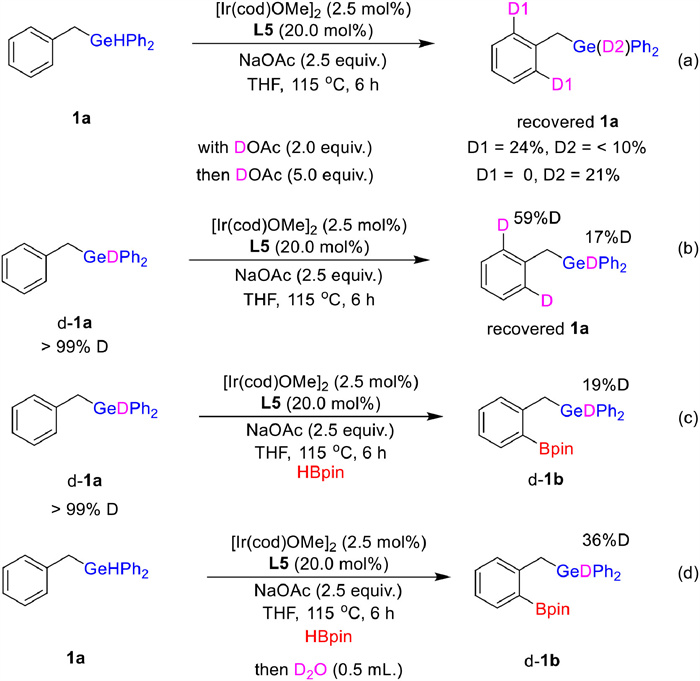
To gain mechanistic insights into the catalytic process, we conducted comprehensive deuterium-labeling studies, which provided valuable information about possible reaction pathways (Scheme 3). When DOAc was introduced to the reaction system containing 1a, deuterium incorporation was observed at the ortho position (24% D), along with trace deuteration at the germanium center of recovered 1a (Scheme 3a). These results indicate that the C–H activation step is reversible. Notably, when DOAc was added after the reaction, 21% deuteration was detected at the germanium atom, suggesting the formation of a sodium germyl intermediate that undergoes hydrolysis. Control experiments confirmed that no deuteration occurs in the absence of the iridium catalyst (Supporting information). Furthermore, reaction of d-1a in the absence of HBpin led to 59% deuterium incorporation at the ortho position of recovered 1a, while 17% deuteration was observed at the germanium center (Scheme 3b). This outcome supports an irreversible oxidative addition of the Ge–H bond to the iridium center, consistent with a germylacyclic metal intermediate in the reaction pathway. When d-1a was subjected to standard reaction conditions with HBpin, 19% Ge–D incorporation was detected in the final product 1b (Scheme 3c). Further mechanistic insight was gained by introducing D2O during the workup of the reaction mixture of 1a and HBpin, which resulted in 36% Ge–D incorporation in 1b (Scheme 3d). These observations confirm that the borylated product originates from a sodium germyl precursor as well. The partial deuteration at germanium suggests that residual protons (e.g., from AcOH or trace H2O in the solvent) protonate the sodium germyl species before it reacts with the external proton source.
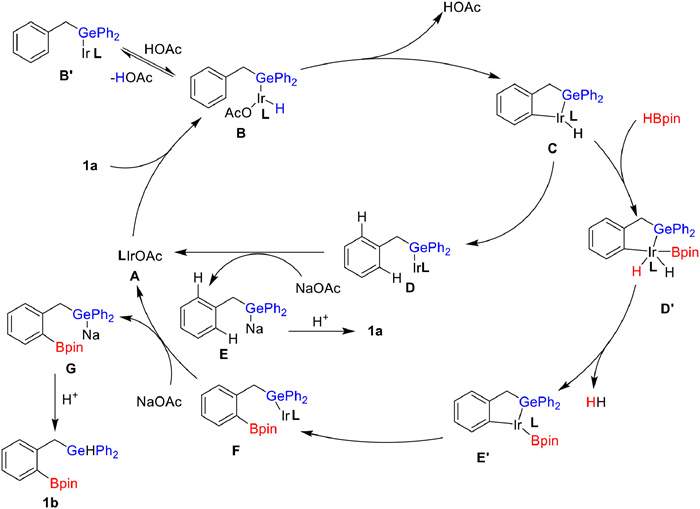
Based on experimental observations, we propose a plausible reaction mechanism (Fig. 2). The catalytic cycle begins with the formation of iridium species A from [Ir(cod)OMe]2, ligand, and base. Species A then undergoes oxidative addition with the Ge–H bond in substrate 1a, yielding intermediate B. Subsequent acetate-assisted C–H activation converts B into a five-membered iridacycle C, releasing HOAc as a byproduct [85–91]. In the absence of HBpin, C undergoes reductive elimination to form intermediate D, which then engages in transmetallation with NaOAc. This step regenerates the active catalyst A while producing sodium salt E. Finally, protonolysis of E recovers the 1a. In the presence of HBpin, species C reacts via oxidative addition to form D’, which then undergoes reductive elimination to generate intermediate E’. Further reductive elimination releases iridium species F, which then undergoes transmetallation with NaOAc forming sodium salt G and regenerate catalytic species A. Protonolysis of G ultimately furnishes the product 1b Deuterium labeling studies reveal an important mechanistic nuance: Intermediate B can alternatively undergo reversible reductive elimination to form B’ in a competing equilibrium process (Schemes 3c and d). This equilibrium explains the partial deuteration observed at the germanium center in the absence of additional DOAc. While the current mechanism is consistent with experimental data, the potential involvement of Ir–Bpin in C–H activation cannot be ruled out, necessitating further investigation for a complete mechanistic understanding [92–94].
We have developed a groundbreaking strategy for Ge-directed C–H borylation enabled by iridium catalysts. This innovative methodology offers a streamlined, one-step synthesis of borylated germanes directly from parent organogermanes, thereby significantly expanding the synthetic chemist’s toolbox. The versatile reactivity of the products, derived from both boron and germanium chemistry, underscores their potential utility in diverse applications. The successful integration of two metalloid atoms within a single organic framework through catalytic C–H activation represents a major advance in the field, offering new solutions to long-standing synthetic challenges. Ongoing studies focus on mechanistic details and practical applications.
The authors declare that they have no known competing financial interests or personal relationships that could have appeared to influence the work reported in this paper.
Qianwei Chen: Methodology. Yuan Xi: Methodology. Zhuangzhi Shi: Supervision.
We would like to thank financial support from National Key R&D Program of China (No. 2022YFA1503200), the National Natural Sci-ence Foundation of China (Nos. 92361201, 22025104 and 22171134), the Natural Science Foundation of Jiangsu Province (Nos. BK20240059, BK20220033), the Fundamental Research Funds for the Central Universities (No. 020514380326) for their financial support.
Supplementary material associated with this article can be found, in the online version, at doi:
S. Nagase, Acc. Chem. Res. 28 (1995) 469–476. doi: 10.1021/ar00059a005
W. Petz, Chem. Rev. 86 (1986) 1019–1047. doi: 10.1021/cr00076a004
L. Li, T. Ruan, Y. Lyu, B. Wu, J. Biosci. Med. 5 (2017) 56–73. doi: 10.4236/jbm.2017.57006
K. Aizawa, T. Nakamura, Y. Shimada, et al., Physiol. Rep. 13 (2025) e70234. doi: 10.14814/phy2.70234
J. Azumi, T. Takeda, Y. Shimada, H. Aso, T. Nakamura, Int. J. Mol. Sci. 24 (2023) 1885. doi: 10.3390/ijms24031885
T. Yamakawa, H. Kagechika, E. Kawachi, Y. Hashimoto, K. Shudo, J. Med. Chem. 33 (1990) 1430–1437. doi: 10.1021/jm00167a024
S. Fujii, Y. Miyajima, H. Masuno, H. Kagechika, J. Med. Chem. 56 (2013) 160–166. doi: 10.1021/jm3013757
P. Lu, S. Yao, J. Cai, P. Yang, Bioorg. Med. Chem. Lett. 24 (2014) 5294–5297. doi: 10.1016/j.bmcl.2014.09.048
H. Yu, T. Helbich, L.M. Scherf, et al., Chem. Mater. 30 (2018) 2274–2280. doi: 10.1021/acs.chemmater.7b04974
C. Fricke, K. Deckers, F. Schoenebeck, Angew. Chem. Int. Ed. 59 (2020) 18717–18722. doi: 10.1002/anie.202008372
A. Dahiya, C. Fricke, F. Schoenebeck, J. Am. Chem. Soc. 142 (2020) 7754–7759. doi: 10.1021/jacs.0c02860
G.J. Sherborne, A.G. Gevondian, I. Funes-Ardoiz, et al., Angew. Chem. Int. Ed. 59 (2020) 15543–15548. doi: 10.1002/anie.202005066
A. Dahiya, F. Schoenebeck, ACS Catal. 12 (2022) 8048–8054. doi: 10.1021/acscatal.2c02179
M.Y. Xu, W.T. Jiang, Y. Li, et al., J. Am. Chem. Soc. 141 (2019) 7582–7588. doi: 10.1021/jacs.9b02776
W.T. Jiang, M.Y. Xu, S. Yang, X.Y. Xie, B. Xiao, Angew. Chem. Int. Ed. 59 (2020) 20450–20454. doi: 10.1002/anie.202008482
A. Dahiya, A.G. Gevondian, F. Schoenebeck, J. Am. Chem. Soc. 145 (2023) 7729–7735. doi: 10.1021/jacs.3c01081
A. Dahiya, M.D. Schoetz, F. Schoenebeck, Angew. Chem. Int. Ed. 62 (2023) e202310380. doi: 10.1002/anie.202310380
A. Selmani, M.D. Schoetz, A.E. Queen, F. Schoenebeck, ACS Catal. 12 (2022) 4833–4839. doi: 10.1021/acscatal.2c00852
Q.H. Xu, L.P. Wei, B. Xiao, Angew. Chem. Int. Ed. 61 (2022) e202115592. doi: 10.1002/anie.202115592
Z. Zhao, F. Zhang, D. Wang, L. Deng, Chin. J. Chem. 41 (2023) 3063–3081. doi: 10.1002/cjoc.202300276
S. Keess, M. Oestreich, Org. Lett. 19 (2017) 1898–1901. doi: 10.1021/acs.orglett.7b00672
W. Lin, L. You, W. Yuan, C. He, ACS Catal. 12 (2022) 14592–14600. doi: 10.1021/acscatal.2c04571
A.E. Queen, A. Selmani, F. Schoenebeck, Org. Lett. 24 (2022) 406–409. doi: 10.1021/acs.orglett.1c04088
H. Kinoshita, T. Nakamura, H. Kakiya, et al., Org. Lett. 3 (2001) 2521–2524. doi: 10.1021/ol0161817
J.W. Faller, R.G. Kultyshev, Organometallics 22 (2003) 199–202. doi: 10.1021/om020714d
T. Schwier, V. Gevorgyan, Org. Lett. 7 (2005) 5191–5194. doi: 10.1021/ol0521026
T. Matsuda, S. Kadowaki, Y. Yamaguchi, M. Murakami, Org. Lett. 12 (2010) 1056–1058. doi: 10.1021/ol1000445
M. Itazaki, M. Kamitani, H. Nakazawa, Chem. Commun. 47 (2011) 7854–7856. doi: 10.1039/c1cc12530c
D.A. Roşca, K. Radkowski, L.M. Wolf, et al., J. Am. Chem. Soc. 139 (2017) 2443–2455. doi: 10.1021/jacs.6b12517
K. de la Vega-Hernández, E. Romain, A. Coffinet, et al., J. Am. Chem. Soc. 140 (2018) 17632–17642. doi: 10.1021/jacs.8b09851
H. Liang, Y.X. Ji, R.H. Wang, et al., Org. Lett. 21 (2019) 2750–2754. doi: 10.1021/acs.orglett.9b00701
V. Debrauwer, A. Turlik, L. Rummler, et al., J. Am. Chem. Soc. 142 (2020) 11153–11164. doi: 10.1021/jacs.0c03556
A.C. Han, L.J. Xiao, Q.L. Zhou, J. Am. Chem. Soc. 146 (2024) 5643–5649. doi: 10.1021/jacs.3c14386
A.C. Han, X.G. Zhang, L.L. Yang, et al., Chem. Catal. 4 (2023) 100826.
T. Nakamura, H. Kinoshita, H. Shinokubo, K. Oshima, Org. Lett. 4 (2002) 3165–3167. doi: 10.1021/ol026613t
A. Lesbani, H. Kondo, Y. Yabusaki, et al., Chem. Eur. J. 16 (2010) 13519–13527. doi: 10.1002/chem.201001437
A. Selmani, A.G. Gevondian, F. Schoenebeck, Org. Lett. 22 (2020) 4802–4805. doi: 10.1021/acs.orglett.0c01609
S. Langle, F. David-Quillot, A. Balland, M. Abarbri, A. Duchêne, J. Organomet. Chem. 671 (2003) 113–119. doi: 10.1016/S0022-328X(03)00053-6
D. Brösamlen, M. Oestreich, Org. Lett. 26 (2024) 977–982. doi: 10.1021/acs.orglett.3c03799
J.L. Tu, B. Huang, Adv. Synth. Catal. 366 (2024) 4618–4633. doi: 10.1002/adsc.202401069
P.F. Su, K. Wang, X. Peng, et al., Angew. Chem. Int. Ed. 60 (2021) 26571–26576. doi: 10.1002/anie.202112876
P. Guo, X. Pang, K. Wang, et al., Org. Lett. 24 (2022) 1802–1806. doi: 10.1021/acs.orglett.2c00207
F. He, J. Wu, Chin. J. Org. Chem. 42 (2022) 312. doi: 10.6023/cjoc202200005
Q. Xu, B. Xiao, Acta Chim. Sin. 80 (2022) 428. doi: 10.6023/a21120608
H. Chen, C. Zhu, H. Yue, M. Rueping, ACS Catal. 13 (2023) 6773–6780. doi: 10.1021/acscatal.3c01244
G.Y. Han, P.F. Su, Q.Q. Pan, X.Y. Liu, X.Z. Shu, Nat. Catal. 7 (2024) 12–20.
R. Jana, T.P. Pathak, M.S. Sigman, Chem. Rev. 111 (2011) 1417–1492. doi: 10.1021/cr100327p
E.C. Neeve, S.J. Geier, I.A.I. Mkhalid, S.A. Westcott, T.B. Marder, Chem. Rev. 116 (2016) 9091–9161. doi: 10.1021/acs.chemrev.6b00193
J.W.B. Fyfe, A.J.B. Watson, Chem 3 (2017) 31–55. doi: 10.1016/j.chempr.2017.05.008
B.S.L. Collins, C.M. Wilson, E.L. Myers, V.K. Aggarwal, Angew. Chem. Int. Ed. 56 (2017) 11700–11733. doi: 10.1002/anie.201701963
F.W. Friese, A. Studer, Chem. Sci. 10 (2019) 8503–8518. doi: 10.1039/c9sc03765a
M. Wang, Z. Shi, Chem. Rev. 120 (2020) 7348–7398. doi: 10.1021/acs.chemrev.9b00384
Y.M. Tian, X.N. Guo, H. Braunschweig, U. Radius, T.B. Marder, Chem. Rev. 121 (2021) 3561–3597. doi: 10.1021/acs.chemrev.0c01236
D.M. Volochnyuk, A.O. Gorlova, O.O. Grygorenko, Chem. Eur. J. 27 (2021) 15277–15326. doi: 10.1002/chem.202102108
S.K. Bose, L. Mao, L. Kuehn, et al., Chem. Rev. 121 (2021) 13238–13341. doi: 10.1021/acs.chemrev.1c00255
I.A.I. Mkhalid, J.H. Barnard, T.B. Marder, J.M. Murphy, J.F. Hartwig, Chem. Rev. 110 (2010) 890–931. doi: 10.1021/cr900206p
J.F. Hartwig, Chem. Soc. Rev. 40 (2011) 1992–2002. doi: 10.1039/c0cs00156b
J.F. Hartwig, Acc. Chem. Res. 45 (2012) 864–873. doi: 10.1021/ar200206a
A. Ros, R. Fernández, J.M. Lassaletta, Chem. Soc. Rev. 43 (2014) 3229–3243. doi: 10.1039/C3CS60418G
L. Xu, G. Wang, S. Zhang, et al., Tetrahedron 73 (2017) 7123–7157. doi: 10.1016/j.tet.2017.11.005
J.S. Wright, P.J.H. Scott, P.G. Steel, Angew. Chem. Int. Ed. 60 (2021) 2796–2821. doi: 10.1002/anie.202001520
J. Lv, B. Zhao, Y. Han, Y. Yuan, Z. Shi, Chin. Chem. Lett. 32 (2021) 691–694. doi: 10.1016/j.cclet.2020.06.028
J. Hu, J. Lv, Z. Shi, Trends Chem. 4 (2022) 685–698. doi: 10.1016/j.trechm.2022.04.011
W. Chang, Y. Wang, Y. Chen, J. Ma, Y. Liang, Chin. Chem. Lett. 34 (2023) 107879. doi: 10.1016/j.cclet.2022.107879
W. Shang, H. Sun, W. Chen, J. Liu, Green Synth. Catal. 4 (2023) 104–123.
Z. Zhang, S. Huang, W. Liu, et al., Green Synth. Catal. 4 (2023) 300–305.
S. Tang, Z. Wang, M. Zhu, et al., Chin. Chem. Lett. 36 (2025) 110503. doi: 10.1016/j.cclet.2024.110503
G. Wu, T. Ma, Chin. Chem. Lett. 36 (2025) 111739.
T.A. Boebel, J.F. Hartwig, J. Am. Chem. Soc. 130 (2008) 7534–7535. doi: 10.1021/ja8015878
D.W. Robbins, T.A. Boebel, J.F. Hartwig, J. Am. Chem. Soc. 132 (2010) 4068–4069. doi: 10.1021/ja1006405
S.H. Cho, J.F. Hartwig, J. Am. Chem. Soc. 135 (2013) 8157–8160. doi: 10.1021/ja403462b
S.H. Cho, J.F. Hartwig, Chem. Sci. 5 (2014) 694–698. doi: 10.1039/C3SC52824C
M.A. Larsen, S.H. Cho, J.F. Hartwig, J. Am. Chem. Soc. 138 (2016) 762–765. doi: 10.1021/jacs.5b12153
B. Su, T.G. Zhou, P.L. Xu, Z.J. Shi, J.F. Hartwig, Angew. Chem. Int. Ed. 56 (2017) 7205–7208. doi: 10.1002/anie.201702628
B. Su, J.F. Hartwig, Angew. Chem. Int. Ed. 57 (2018) 10163–10167. doi: 10.1002/anie.201805086
X. Su, G. Li, L. He, et al., Nat. Commun. 15 (2024) 7549. doi: 10.1038/s41467-024-51997-0
Y.R. Luo, Comprehensive Handbook of Chemical Bond Energies, CRC Press, Boca Raton, 2007.
B. Marciniec, C. Pietraszuk, P. Pawluć, H. Maciejewski, Chem. Rev. 122 (2022) 3996–4090. doi: 10.1021/acs.chemrev.1c00417
K. Sun, M. Ueno, K. Imaeda, et al., ACS Catal. 11 (2021) 9722–9728. doi: 10.1021/acscatal.1c02558
Y.H. Huang, Y. Wu, Z. Zhu, et al., Angew. Chem. Int. Ed. 61 (2022) e202113052. doi: 10.1002/anie.202113052
Y. Li, Z. Jia, S. Xiao, H. Liu, Y. Li, Nat. Commun. 7 (2016) 11637. doi: 10.1038/ncomms11637
Y. Onaka, S. Tanaka, A. Kobayashi, T. Matsuno, H. Isobe, Tetrahedron Lett. 96 (2022) 153774. doi: 10.1016/j.tetlet.2022.153774
K. Okamoto, R. Higuma, K. Muta, et al., Chem. Eur. J. 29 (2023) e202301738. doi: 10.1002/chem.202301738
F.M. Wong, J. Wang, A.C. Hengge, W. Wu, Org. Lett. 9 (2007) 1663–1665. doi: 10.1021/ol070345n
D. García-Cuadrado, A.A.C. Braga, F. Maseras, A.M. Echavarren, J. Am. Chem. Soc. 128 (2006) 1066–1067. doi: 10.1021/ja056165v
S.I. Gorelsky, D. Lapointe, K. Fagnou, J. Am. Chem. Soc. 130 (2008) 10848–10849. doi: 10.1021/ja802533u
D. Lapointe, K. Fagnou, Chem. Lett. 39 (2010) 1118–1126. doi: 10.1246/cl.2010.1118
D. Balcells, E. Clot, O. Eisenstein, Chem. Rev. 110 (2010) 749–823. doi: 10.1021/cr900315k
M. Garcia-Melchor, A.A. Braga, A. Lledos, G. Ujaque, F. Maseras, Acc. Chem. Res. 46 (2013) 2626–2634. doi: 10.1021/ar400080r
D.L. Davies, S.A. Macgregor, C.L. McMullin, Chem. Rev. 117 (2017) 8649–8709. doi: 10.1021/acs.chemrev.6b00839
L. Wang, B.P. Carrow, ACS Catal. 9 (2019) 6821–6836. doi: 10.1021/acscatal.9b01195
H. Tamura, H. Yamazaki, H. Sato, S. Sakaki, J. Am. Chem. Soc. 125 (2003) 16114–16126. doi: 10.1021/ja0302937
B.A. Vanchura Ⅱ, S.M. Preshlock, P.C. Roosen, et al., Chem. Commun. 46 (2010) 7724–7726. doi: 10.1039/c0cc02041a
P.C. Roosen, V.A. Kallepalli, B. Chattopadhyay, et al., J. Am. Chem. Soc. 134 (2012) 11350–11353. doi: 10.1021/ja303443m

Scheme 1 Substrate scope of germanes. Reaction conditions Ⅰ: [Ir(cod)OMe]2 (2.5 mol%), L5 (20.0 mol%), 2–17a (0.20 mmol, 1.0 equiv.), HBpin (0.5 mmol, 2.5 equiv.), NaOAc (0.5 mmol, 2.5 equiv.) in 1.5 mL of THF at 115 ℃ for 6 h under argon; Ⅱ: [Ir(cod)OMe]2 (4.0 mol%), L8 (30.0 mol%), 18–23a (0.20 mmol, 1.0 equiv.), HBpin (1.0 mmol, 5.0 equiv.), KOAc (0.5 mmol, 2.5 equiv.) in 3.0 mL of THF at 115 ℃ for 12 h under argon; Ⅲ: [Ir(cod)OMe]2 (5.0 mol%), L8 (20.0 mol%), 24–32a (0.20 mmol, 1.0 equiv.), HBpin (0.5 mmol, 2.5 equiv.), NaOAc (0.5 mmol, 2.5 equiv.) in 3.0 mL of THF at 115 ℃ for 24 h under argon. The isolated yield was determined after purification.

Scheme 2 Further conversions of bifunctional molecule 1b based on boron and germanium chemistry.
Table 1. Optimization of the reaction conditions.a
|
|||||
| Entry | [B] (equiv.) | cat [M] (mol%) | L (mol%) | Base (equiv.) | Yield (%)b |
| 1 | HBpin (2.5) | [Ir(cod)OMe]2 (2.5) | L1 (5.0) | - | <5 |
| 2 | HBpin (2.5) | [Ir(cod)OMe]2 (2.5) | L1 (5.0) | LiOAc (2.5) | 43 |
| 3 | HBpin (2.5) | [Ir(cod)OMe]2 (2.5) | L1 (5.0) | NaOAc (2.5) | 53 |
| 4 | HBpin (2.5) | [Ir(cod)OMe]2 (2.5) | L1 (5.0) | KOAc (2.5) | 22 |
| 5 | HBpin (2.5) | [Ir(cod)OMe]2 (2.5) | L1 (5.0) | CsOAc (2.5) | 6 |
| 6 | HBpin (2.5) | [Ir(cod)OMe]2 (2.5) | L1 (5.0) | Na2CO3 (2.5) | 0 |
| 7 | HBpin (2.5) | [Ir(cod)OMe]2 (2.5) | L2 (5.0) | NaOAc (2.5) | 38 |
| 8 | HBpin (2.5) | [Ir(cod)OMe]2 (2.5) | L3 (5.0) | NaOAc (2.5) | 68 |
| 9 | HBpin (2.5) | [Ir(cod)OMe]2 (2.5) | L4 (5.0) | NaOAc (2.5) | 24 |
| 10 | HBpin (2.5) | [Ir(cod)OMe]2 (2.5) | L5 (5.0) | NaOAc (2.5) | 75 |
| 11 | HBpin (2.5) | [Ir(cod)OMe]2 (2.5) | L6 (5.0) | NaOAc (2.5) | 73 |
| 12 | HBpin (2.5) | [Ir(cod)OMe]2 (2.5) | L7 (5.0) | NaOAc (2.5) | 71 |
| 13 | HBpin (2.5) | [Ir(cod)OMe]2 (2.5) | L8 (5.0) | NaOAc (2.5) | 65 |
| 14 | HBpin (2.5) | [Ir(cod)OMe]2 (2.5) | L5 (20.0) | NaOAc (2.5) | 80 (74)c |
| 15 | HBpin (2.5) | [Ir(coe)2Cl]2 (2.5) | L5 (20.0) | NaOAc (2.5) | 31 |
| 16 | HBpin (2.5) | [Ir(cod)2BF4] (5.0) | L5 (20.0) | NaOAc (2.5) | 42 |
| 17 | HBpin (2.5) | [Rh(cod)Cl]2 (2.5) | L5 (20.0) | NaOAc (2.5) | <5 |
| 18 | B2pin2 (2.5) | [Ir(cod)OMe]2 (2.5) | L5 (20.0) | NaOAc (2.5) | <5 |
| 19 | HBpin (2.5) | [Ir(cod)OMe]2 (2.5) | - | NaOAc (2.5) | 18 |
| 20 | HBpin (2.5) | - | L5 (20.0) | NaOAc (2.5) | 0 |
| a Reaction conditions: cat [M] (2.5–5.0 mol%), L (5.0–20.0 mol%), 1a (0.20 mmol), boron reagent (0.5 mmol), and base (0.5 mmol) in 1.5 mL of solvent at 115 ℃ for 6 h under argon. b Determined by crude 1H NMR. c Isolated yield. | |||||
 下载: 导出CSV

 扫一扫看文章


扫一扫关注我们


 下载:
下载: