
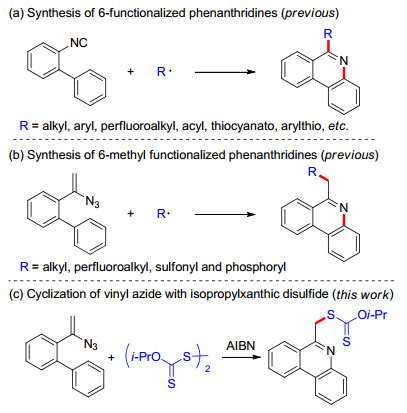
Scheme 1.
Radical-initiated cyclization of ortho-substituted diaryls


Phenanthridines and their derivatives are of great interest in medicinal chemistry and material science due to their potential biological activities, optoelectronic properties and others.[1, 2] As a result, many useful methods for the synthesis of phenanthridines have been well developed.[3~5] Among them, radical-initiated tandem cyclization of ortho-substituted diaryl compounds renders the formation of 6-functionalized phenanthridines in a one-pot procedure.[4] For example, Nanni et al.[4a] disclosed a sequential radical addition/cyclization reaction of biphenyl-2-ylisonitrile with 2, 2'-azobis(2-methylpropionitrile) (AIBN) or dibenzoyl peroxide (DBP). Afterwards, alkyl, aryl, perfluoroalkyl, acyl, silyl, sulfonyl, arylsulfanyl, and thiocyanate substrates were all proved to be versatile radical precursors and were successfully applied to the reaction with biphenyl-2-ylisonitrile (Scheme 1). Alternatively, α-(biaryl-2-yl)vinyl azides have also received much attention to access 6-methyl substituted phenanthridines via a radical pathway.[5] Various functional groups such as alkyl, perfluoroalkyl, sulfonyl and phosphoryl can be incorporated into methyl group at the 6-position of phenanthridines. However, the tandem reaction of α-(biaryl-2-yl)vinyl azides with sulfanyl radicals derived from disulfides is still developed.
It is noteworthy that disulfides are recognized as one class of important sulfur reagents and bidentate ligand donors.[6] They are widely used as synthetic intermediates in organic reactions for the synthesis of organosulfur compounds, such as in the transition-metal-catalyzed cross coupling reactions and addition reactions of S—S bond to alkynes.[7] Other transformations of disulfides involving sulfanyl radicals have also been explored in the past few decades.[8] To further extend the application of disulfides in the synthesis of organosulfur compounds, [9] we herein report an AIBN initiated tandem cyclization of vinyl azides with isopropylxanthic disulfide leading to 6-sulfanylmethyl phenanthridines in moderate to good yields. Notably, this protocol can serve as a supplementary strategy to previous methodologies for the synthesis of 6-functionalized phenanthridines.
Our study began with the cyclization reaction using α-(biaryl-2-yl)vinyl azide (1a) and isopropylxanthic disulfide as model substrates, AIBN as a radical initiator in tetrahydrofuran (THF) for 8 h. To our delight, the desired product 6-sulfanylmethyl phenanthridine (3a) was obtained in 58% yield (Table 1, Entry 1). A control experiment showed that the radical initiator was indispensable to fulfill this transformation which implied a typical radical pathway (Entry 2). Next, dimethyl 2, 2'-azobis(2-methylpro- pionate) (AIBME) was used as a radical initiator instead of AIBN, whereas the yield of 3a was not improved (Entry 3). We then examined the amount of isopropylxanthic disulfide on the reaction. It was found that a comparable yield of 3a was obtained when the amount of disulfide was increased to 1.5 equiv. (Entries 4, 5). Increasing the amount of AIBN further improved the yield of 3a to 84% (Entry 8). Screening various solvents revealed that THF remained the optimal one (Entry 10~12). Furthermore, either elevating or decreasing the temperature provided lower yields of 3a (Entries 13, 14).

 下载:
导出CSV
下载:
导出CSV
 |
||||
| Entry | Radical initiator (equiv.) | Solvent | Temp./℃ | Yieldb/% |
| 1 | AIBN (0.5) | THF | 80 | 58 |
| 2 | — | THF | 80 | 0 |
| 3 | AIBME (0.5)c | THF | 80 | 50 |
| 4 | AIBN (0.5) | THF | 80 | 35d |
| 5 | AIBN (0.5) | THF | 80 | 56e |
| 6 | AIBN (0.3) | THF | 80 | 45 |
| 7 | AIBN (0.75) | THF | 80 | 63 |
| 8 | AIBN (1.0) | THF | 80 | 84 (71f, 80g) |
| 9 | AIBN (1.5) | THF | 80 | 75 |
| 10 | AIBN (1.0) | MeCN | 80 | 24 |
| 11 | AIBN (1.0) | DMSO | 80 | 38 |
| 12 | AIBN (1.0) | Toluene | 80 | Trace |
| 13 | AIBN (1.0) | THF | 60 | 70 |
| 14 | AIBN (1.0) | THF | 100 | 52 |
| 15 | AIBN (1.0) | 2-MeTHF | 80 | 65 |
| a Reaction conditions: 1a (0.3 mmol), isopropylxanthic disulfide (0.3 mmol), radical initiator (0.3 mmol), solvent (3 mL) for 8 h under air. b Isolated yields were given. c AIBME=dimethyl 2, 2'-azobis(2-methylpropionate). d Isopropylxanthic disulfide (0.5 equiv.). e Isopropylxanthic disulfide (1.5 equiv.). f 2 mL of THF was used (0.15 mol/L for 1a). g 4 mL of THF was used (0.075 mol/L for 1a). | ||||
To evaluated the substrate scope of this cyclization reaction, a range of substituted vinyl azides were investigated under the optimized reaction conditions (Table 2). Different substituents R1 on the phenyl ring showed unbiased electronic effect on the reaction outcome (3a~3e). The compatibility of 1 with various sub stituents R2 on the phenyl ring was investigated and the corresponding products were obtained in moderate to good yields (3f~3p). Of note, substrates with electron-donating groups (EDGs) exhibited an inferior reactivity (3j~3o). When 1p was used, the reaction preferred the formation of C—N bond at the less hindered 6'-position of 1p and 2-chloro- phenanthridine derivative 3p was isolated in 45% yield as a major isomer (Entry 16). The substrates that both of the two phenyl rings tethered with functional groups are also workable which provided multi-substituted phenanthridines in moderate yields (3q~3t).
下载:
导出CSV
 |
||||
| Entry | R1 | R2 | Product | Yieldb/% |
| 1 | H | H | 3a | 84 |
| 2 | 5-F | H | 3b | 68 |
| 3 | 5-OCH3 | H | 3c | 55 |
| 4 | 4-Cl | H | 3d | 56 |
| 5 | 4-Me | H | 3e | 53 |
| 6 | H | 4-F | 3f | 72 |
| 7 | H | 4-Cl | 3g | 70 |
| 8 | H | 4-Br | 3h | 74 |
| 9 | H | 4-OCF3 | 3i | 76 |
| 10 | H | 4-CH3 | 3j | 50 |
| 11 | H | 3, 5-(Me)2 | 3k | 52 |
| 12 | H | 4-i-Pr | 3l | 50 |
| 13 | H | 4-t-Bu | 3m | 57 |
| 14 | H | 4-OCH3 | 3n | 52 |
| 15 | H | 2-OCH3 | 3o | 53 |
| 16 | H | 3-Cl | 3p | 45c |
| 17 | 5-OCH3 | 4-Br | 3q | 70 |
| 18 | 5-OCH3 | 4-i-Pr | 3r | 63 |
| 19 | 5-F | 4-i-P | 3s | 73 |
| 20 | 4-Cl | 2-OCH3 | 3t | 73 |
| a Reaction conditions: 1a (0.3 mmol), isopropylxanthic disulfide (0.3 mmol), additive (0.3 mmol), solvent (3 mL) for 8 h under air.b Isolated yield. c The yield of regioisomer 3p' is 7%. | ||||
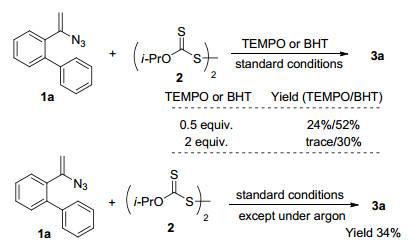
In order to explore the reaction mechanism, the radical inhibiting experiments were carried out. The extra addition of 2, 2, 6, 6-tetramethylpiperidin-1-oxyl (TEMPO)[10] or 2, 6-bis(1, 1-dimethylethyl)-4-methylphenol[11] (BHT) to the model reaction resulted in a drastic yield decrease, respectively (Scheme 2). It implied that a radical pathway might be involved. An attempt to run the reaction under the standard conditions except in argon atmosphere only resulted in low yield of 3a, suggesting O2 in open air plays important role in the reaction.
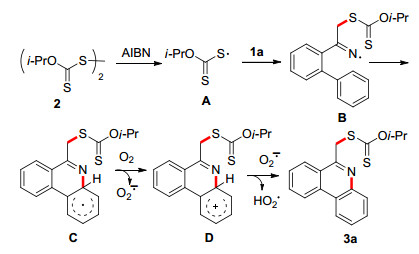
Based on the above investigations and literature clues, [5, 12, 13] a possible reaction mechanism is illustrated in Scheme 3. A sulfanyl radical A is first generated by treatment of isopropylxanthic disulfide with AIBN.[12] The addition of radical A to vinyl azide 1a takes place to give an imine radical B by extrusion of N2.[5] An intramolecular C—N cyclization of B produces an intermediate C.[5] C undergoes an oxidation followed by an aromatization to afford the final product 3a.[13] In the reaction, the O2 in the air may participate as the oxidant.[13, 14]
In summary, we have developed a tandem reaction of vinyl azides with isopropylxanthic disulfide affording 6-sulfanylmethyl phenanthridines in moderate to good yields. The reaction has advantages of good functional group tolerance, high regioselectivity, simple operation, mild reaction conditions, and free-use of transition-metals. The development of novel reactions involving vinyl azides via a radical pathway is underway in our laboratory.
Unless otherwise noted, all reactions were conducted in oven-dried sealed tubes with Teflon screw caps under air. All commercially available reagents and solvents were purchased from chemical suppliers and used as received. Flash column chromatography was performed on silica gel (100~200 mesh) with indicated solvent mixtures. thin- layer chromatography (TLC) analysis was performed on pre-coated, glass-backed silica gel plates and visualized with UV light. The 1H NMR and 13C NMR spectra were recorded on a Bruker 500 AV spectrometers. Chemical shifts (δ) were reported downfield from tetramethylsilane. Melting points were measured and uncorrected. The high resolution mass spectra (HRMS) were obtained on a TOF-MS instrument with ESI source. Vinyl azides were synthesized according to the previous literature.[5a]
Vinyl azide 1a (0.3 mmol, 66.3 mg), isopropylxanthic disulfide 2 (0.3 mmol, 81 mg), azobisisobutyronitrile, AIBN (0.3 mmol, 49.2 mg), tetrahydrofuran (THF) (3 mL), and a stirrer bar were added to a 15 mL sealed tube with Teflon screw cap. The reaction mixture was then stirred at 80 ℃ for 8 h. After cooling, CH2Cl2 and H2O were added to the mixture. The organic layer was separated and dried over anhydrous sodium sulfate and filtered through a short pad of Celite. After evaporation of the solvent under vacuum, the residue was purified by column chromatography on silica gel (100~200 mesh) using petrol ther (PE) and ethyl acetate (EA) (V: V=100: 1) as an eluent to give pure product 3a in 84% yield as a yellow solid.
O-Isopropyl S-(phenanthridin-6-ylmethyl) carbonodithioate (3a): Yellow solid, m.p. 55~56 ℃; 1H NMR (500 MHz, CDCl3) δ: 8.55 (d, J=8.5 Hz, 1H), 8.46 (dd, J=8.0, 1.0 Hz, 1H), 8.18 (d, J=8.0 Hz, 1H), 8.05 (dd, J=8.5, 1.0 Hz, 1H), 7.79~7.75 (m, 1H), 7.67~7.61 (m, 2H), 7.60~7.56 (m, 1H), 5.79~5.71 (m, 1H), 5.04 (s, 2H), 1.35 (d, J=6.0 Hz, 6H); 13C NMR (125 MHz, CDCl3) δ: 213.0, 155.1, 143.3, 133.1, 130.9, 129.8, 128.9, 127.6, 127.3, 126.1, 124.7, 124.0, 122.6, 122.0, 78.3, 41.2, 21.36; HRMS (ESI) calcd for C18H18NOS2 [M+H]+: 328.0830, found 328.0835.
S-((8-Fluorophenanthridin-6-yl)methyl) O-isopropyl car-bonodithioate (3b): Yellow solid, m.p. 102~103 ℃; 1H NMR (500 MHz, CDCl3) δ: 8.50 (d, J=8.0 Hz, 1H), 8.45 (dd, J=9.0, 5.5 HZ, 1H), 8.21 (d, J=8.0 Hz, 1H), 7.37~7.80 (m, 1H), 7.30 (dd, J=8.5, 2.5 Hz, 1H), 7.69~7.65 (m, 1H), 7.40~7.35 (m, 1H), 5.87~5.78 (m, 1H), 5.06 (s, 2H), 1.42 (d, J=6.0 Hz, 6H); 13C NMR (125 MHz, CDCl3) δ: 212.6, 161.3 (d, 1JC—F=248.0 Hz), 154.2 (d, 4JC—F=3.5 Hz), 143.0, 123.0, 129.7 (d, 4JC—F=1.9 Hz), 128.1, 127.6, 125.8 (d, 3JC—F=7.9 Hz), 125.1 (d, 3JC—F=8.3Hz), 123.4, 121.7, 120.0 (d, 2JC—F=23.9 Hz), 110.6 (d, 2JC—F=21.8 Hz), 78.5, 41.1, 21.3; HRMS (ESI) calcd for C18H17FNOS2 [M+H]+: 346.0736, found 346.0739.
O-Isopropyl S-((8-methoxyphenanthridin-6-yl)methyl) carbonodithioate (3c): Yellow solid, m.p. 92~93 ℃; 1H NMR (500 MHz, CDCl3) δ: 8.52 (d, J=9.0 Hz, 1H), 8.44 (dd, J=7.5, 1.0 Hz, 1H), 8.09 (dd, J=8.0, 1.0 Hz, 1H), 7.68~7.60 (m, 2H), 7.55 (d, J=2.5 Hz, 1H), 7.46 (dd, J=9.0, 2.5 Hz, 1H), 5.87~5.77 (m, 1H), 5.13 (s, 2H), 3.95 (s, 3H), 1.42 (d, J=6.2 Hz, 6H); 13C NMR (125 MHz, CDCl3) δ: 213.7, 158.8, 154.4, 142.6, 129.8, 127.8, 127.5, 127.3, 125.9, 124.2, 124.2, 121.6, 121.5, 106.2, 78.6, 55.8, 41.8, 21.3; HRMS (ESI) calcd for C19H20NO2S2 [M+H]+: 358.0935, found 358.0930.
S-((9-Chlorophenanthridin-6-yl)methyl) O-isopropyl car-bonodithioate (3d): Yellow solid, m.p. 90~91 ℃; 1H NMR (500 MHz, CDCl3) δ: 8.45 (d, J=2.0 Hz, 1H), 8.33 (d, J=8.5 Hz, 1H), 8.10 (d, J=8.5 Hz, 1H), 8.06 (d, J=8.2, 1H), 7.72~7.69 (m, 1H), 7.62~7.56 (m, 2H), 5.82 (m, 1H), 5.01 (s, 2H), 1.42 (d, J=6.3Hz, 6H); 13C NMR (125 MHz, CDCl3) δ: 212.8, 154.5, 143.6, 137.2, 134.2, 129.9, 129.4, 128.0, 127.5, 122.4, 122.8, 122.7, 122.1, 121.9, 78.3, 41.2, 21.3; HRMS (ESI) calcd for C18H17ClNOS2 [M+H]+: 362.0440, found 362.0436.
O-isopropyl S-((9-methylphenanthridin-6-yl)methyl) car-bonodithioate (3e): Yellow solid, m.p. 89~90 ℃; 1H NMR (500 MHz, CDCl3) δ: 8.36 (d, J=8.5 Hz, 1H), 8.21 (s, 1H), 8.04~8.02 (m, 1H), 7.98 (d, J=8.0 Hz, 1H), 7.65~7.61 (m, 1H), 7.55~7.52 (m, 1H), 7.36 (d, J=8.5 Hz, 1H), 5.84~5.76 (m, 1H), 4.97 (s, 2H), 2.51 (s, 3H), 1.39 (d, J=6.5 Hz, 6H); 13C NMR (125 MHz, CDCl3) δ: 213.0, 154.5, 143.4, 141.1, 132.9, 129.6, 129.1, 128.5, 126.8, 125.8, 123.7, 122.5, 122.0, 121.8, 78.1, 41.2, 22.1, 21.3; HRMS (ESI) calcd for C19H20NOS2 [M+H]+: 342.0986, found 342.0989.
S-((3-Fluorophenanthridin-6-yl)methyl) O-isopropyl car-bonodithioate (3f): Yellow solid, m.p. 68~69 ℃; 1H NMR (500 MHz, CDCl3) δ: 8.50 (d, J=8.0 Hz, 1H), 8.45 (dd, J=9.0, 5.5 Hz, 1H), 8.21 (d, J=8.0 Hz, 1H), 7.37~7.80 (m, 1H), 7.30 (dd, J=8.5, 2.5 Hz, 1H), 7.69~7.65 (m, 1H), 7.40~7.35 (m, 1H), 5.87~5.78 (m, 1H), 5.06 (s, 2H), 1.42 (d, J=6.0 Hz, 6H); 13C NMR (125 MHz, CDCl3) δ: 212.9, 162.6 (d, 1JC—F=247.0 Hz), 156.5, 144.6 (d, 3JC—F=12.1Hz), 132.7, 131.1, 127.4, 126.0, 124.2, 123.9 (d, 3JC—F=9.3Hz), 122.3, 120.6, 116.2 (d, 2JC—F=23.6 Hz), 114.3 (d, 2JC—F=20.6 Hz), 78.3, 41.1, 21.32; HRMS (ESI) calcd for C18H17FNOS2 [M+H]+: 346.0736, found 346.0740.
S-((3-Chlorophenanthridin-6-yl)methyl) O-isopropyl car-bonodithioate (3g): Yellow solid, m.p. 86~87 ℃; 1H NMR (500 MHz, CDCl3) δ: 8.48 (d, J=8.3 Hz, 1H), 8.35 (d, J=8.8 Hz, 1H), 8.18 (d, J=8.1 Hz, 1H), 8.02 (d, J=8.2Hz, 1H), 7.81~7.77 (m, 1H), 7.67~7.63 (m, 1H), 7.51 (dd, J=8.8, 2.2 Hz, 1H), 5.75 (m, 1H), 5.01 (s, 2H), 1.35 (d, J=6.3 Hz, 6H); 13C NMR (125 MHz, CDCl3) δ: 212.9, 156.5, 144.1, 134.5, 132.6, 131.2, 129.1, 127.9, 127.7, 126.1, 124.6, 123.3, 122.5, 122.5, 78.4, 41.2, 21.4; HRMS (ESI) calcd for C18H17ClNOS2 [M+H]+: 362.0440, found 362.0437.
S-((3-Bromophenanthridin-6-yl)methyl) O-isopropyl car-bonodithioate (3h): Yellow solid, m.p. 82~83 ℃; 1H NMR (500 MHz, CDCl3) δ: 8.52 (d, J=8.0 Hz, 1H), 8.31 (d, J=8.5 Hz, 1H), 8.25 (d, J=2.0 Hz, 1H), 8.23 (d, J=8.1Hz, 1H), 7.86~7.82 (m, 1H), 7.73~7.68 (m, 2H), 5.87~5.78 (m, 1H), 5.06 (s, 2H), 1.43 (d, J=6.3 Hz, 6H); 13C NMR (125 MHz, CDCl3) δ: 212.9, 156.4, 144.2, 132.6, 132.2, 131.2, 130.3, 128.0, 126.1, 124.6, 123.4, 122.8, 122.5, 122.4, 78.4, 41.1, 21.4; HRMS (ESI) calcd for C18H17BrNOS2 [M+H]+: 405.9935, found 405.9930.
O-Isopropyl S-((3-(trifluoromethoxy)phenanthridin-6- yl)methyl) carbonodithioate (3i): Yellow solid, m.p. 95~96 ℃; 1H NMR (500 MHz, CDCl3) δ: 8.53 (d, J=8.5 Hz, 1H), 8.49 (d, J=9.0 Hz, 1H), 8.24 (d, J=8.0 Hz, 1H), 7.95 (dd, J=2.5, 1.0 Hz, 1H), 7.87~7.83 (m, 1H), 7.73~7.69 (m, 1H), 7.48 (dd, J=9.0, 2.0 Hz, 1H), 5.87~5.79 (m, 1H), 5.08 (s, 2H), 1.43 (d, J=6.0 Hz, 6H); 13C NMR (125 MHz, CDCl3) δ: 212.8, 156.8, 149.2, 143.0, 132.4, 131.2, 128.0, 126.1, 124.6, 123.7, 122.5, 122.4, 120.6 (q, J=256.9 Hz), 120.4, 120.4, 78.4, 41.1, 21.3; HRMS (ESI) calcd for C19H17F3NO2S2 [M+H]+: 412.0653, found 412.0659.
O-Isopropyl S-((3-methylphenanthridin-6-yl)methyl) car-bonodithioate (3j): Yellow solid, m.p. 90~91 ℃; 1H NMR (500 MHz, CDCl3) δ: 8.58 (d, J=8.5 Hz, 1H), 8.38 (d, J=8.5 Hz, 1H), 8.21 (d, J=8.0 Hz, 1H), 7.90 (s, 1H), 7.82~7.78 (m, 1H), 7.67~7.63 (m, 1H), 7.46 (dd, J=8.5, 1.5 Hz, 1H), 5.87~5.79 (m, 1H), 5.08 (s, 2H), 5.57 (s, 3H), 1.43 (d, J=6.3Hz, 6H); 13C NMR (125 MHz, CDCl3) δ: 231.2, 154.9, 143.5, 138.7, 133.1, 130.7, 129.4, 128.9, 127.1, 125.9, 124.3, 122.4, 121.7, 121.6, 78.2, 41.3, 21.5, 21.3; HRMS (ESI) calcd for C19H20NOS2 [M+H]+: 342.0986, found 342.0980.
S-((2, 4-Dimethylphenanthridin-6-yl)methyl) O-iso- propyl carbonodithioate (3k): Yellow solid, m.p. 90~91 ℃; 1H NMR (500 MHz, CDCl3) δ: 8.52 (d, J=8.5 Hz, 1H), 8.15 (d, J=8.0 Hz, 1H), 8.08 (s, 1H), 7.75 (t, J=8.0 Hz, 1H), 7.62 (t, J=7.5 Hz, 1H), 7.36 (s, 1H), 5.88~5.80 (m, 1H), 5.08 (s, 2H), 2.78 (s, 3H), 2.53 (s, 3H), 1.42 (d, J=6.0 Hz, 6H); 13C NMR (125 MHz, CDCl3) δ: 14.1, 152.0, 140.2, 137.5, 136.5, 133.0, 131.2, 130.3, 127.1, 125.6, 124.3, 123.6, 122.7, 119.3, 77.9, 42.0, 22.0, 21.4, 18.1; HRMS (ESI) calcd for C20H22NOS2 [M+H]+: 356.1143, found 356.1149.
O-Isopropyl S-((3-isopropylphenanthridin-6-yl)methyl) carbonodithioate (3l): Yellow solid, m.p. 85~87 ℃; 1H NMR (500 MHz, CDCl3) δ: 8.57 (d, J=8.0 Hz, 1H), 8.44 (d, J=8.5 Hz, 1H), 8.23 (d, J=8.2Hz, 1H), 7.98 (d, J=1.5 Hz, 1H), 7.83~7.79 (m, 1H), 7.67~7.63 (m, 1H), 7.54 (dd, J=8.5, 1.5 Hz, 1H), 5.87~5.79 (m, 1H), 5.16 (s, 2H), 3.18~3.09 (m, 1H), 1.42 (d, J=6.0 Hz, 6H), 1.38 (d, J=7.0 Hz, 6H); 13C NMR (125 MHz, CDCl3) δ: 213.1, 154.7, 149.9, 143.6, 133.1, 130.7, 127.1, 126.7, 126.6, 126.0, 124.4, 122.4, 122.0, 121.9, 78.2, 41.3, 34.1, 23.9, 21.4; HRMS (ESI) calcd for C21H24NOS2 [M+H]+: 370.1299, found 370.1293.
S-((3-(tert-Butyl)phenanthridin-6-yl)methyl) O-iso- propyl carbonodithioate (3m): Yellow solid, m.p. 90~91 ℃; 1H NMR (500 MHz, CDCl3) δ: 8.56 (d, J=8.5 Hz, 1H), 8.43 (d, J=9.0 Hz, 1H), 8.24~8.21 (m, 1H), 8.11 (d, J=2.0 Hz, 1H), 7.82~7.78 (m, 1H), 7.72 (dd, J=8.5, 2.0 Hz, 1H), 7.66~7.62 (m, 1H) 5.87~5.79 (m, 1H), 5.11 (s, 2H), 1.45 (s, 9 H), 1.38 (d, J=6.0 Hz, 6H); 13C NMR (125 MHz, CDCl3) δ: 213.1, 154.8, 152.2, 143.4, 133.0, 130.7, 127.1, 126.0, 125.8, 125.5, 124.4, 122.4, 121.7, 121.6, 78.2, 41.3, 35.0, 31.3, 21.3; HRMS (ESI) calcd for C22H26NOS2 [M+H]+: 384.1456, found 384.1449.
O-Isopropyl S-((3-methoxyphenanthridin-6-yl)methyl) carbonodithioate (3n): Yellow solid, m.p. 85~86 ℃; 1H NMR (500 MHz, CDCl3) δ: 8.53 (d, J=8.3 Hz, 1H), 8.42 (d, J=9.0 Hz, 1H), 8.24 (d, J=8.2 Hz, 1H), 7.84~7.80 (m, 1H), 7.63 (dd, J=11.4, 2.0 Hz, 1H), 7.53 (d, J=2.6 Hz, 1H), 7.29 (dd, J=9.0, 2.6 Hz, 1H), 5.88~5.79 (m, 1H), 5.11 (s, 2H), 3.98 (s, 3H), 1.43 (d, J=6.3 Hz, 6H); 13C NMR (125 MHz, CDCl3) δ: 213.0, 160.3, 155.5, 133.3, 131.0, 128.7, 126.5, 126.1, 123.8, 123.2, 122.1, 118.4, 118.1, 109.6, 78.3, 55.6, 41.3, 21.4; HRMS (ESI) calcd for C19H20NO2S2 [M+H]+: 358.0935, found 358.0941.
O-Isopropyl S-((1-methoxyphenanthridin-6-yl)methyl) carbonodithioate (3o): Yellow solid, m.p. 56~57 ℃; 1H NMR (500 MHz, CDCl3) δ: 9.58 (d, J=9.0 Hz, 1H), 8.25 (d, J=8.0 Hz, 1H), 7.84~7.76 (m, 2H), 7.70~7.62 (m, 2H), 7.14 (d, J=8.0 Hz, 1H); 5.87~5.79 (m, 1H), 5.10 (s, 2H), 4.12 (s, 3H), 1.42 (d, J=6.0 Hz, 6H); 13C NMR (125 MHz, CDCl3) δ: 213.2, 158.0, 155.4, 145.4, 133.1, 130.7, 128.4, 128.3, 126.9, 125.4, 125.0, 122.7, 114.7, 108.4, 78.2, 55.9, 41.4, 21.4; HRMS (ESI) calcd for C19H20NO2S2 [M+H]+: 358.0935, found 358.0942.
S-((4-Chlorophenanthridin-6-yl)methyl) O-isopropyl carbonodithioate (3p): Yellow solid, m.p. 87~89 ℃; 1H NMR (500 MHz, CDCl3) δ: 8.59 (d, J=8.5 Hz, 1H), 8.43 (dd, J=7.0, 1.0 Hz, 1H), 8.28 (d, J=8.0 Hz, 1H), 7.89~7.85 (m, 1H), 7.82 (dd, J=7.0, 1.0 Hz, 1H), 7.77~7.73 (m, 1H), 7.55 (t, J=8.0 Hz, 1H), 5.90~5.82 (m, 1H), 5.17 (s, 2H), 1.45 (d, J=6.0 Hz, 6H); 13C NMR (125 MHz, CDCl3) δ: 213.3, 155.8, 139.7, 134.4, 132.8, 131.2, 129.2, 128.2, 127.0, 126.1, 125.6, 124.6, 122.9, 120.8, 78.3, 41.8, 21.3; HRMS (ESI) calcd for C18H17ClNOS2 [M+H]+: 362.0440, found 362.0433.
S-((2-Chlorophenanthridin-6-yl)methyl) O-isopropyl carbonodithioate (3p'): Yellow solid, m.p. 84~85 ℃; 1H NMR (500 MHz, CDCl3) δ: 8.55 (d, J=8.5 Hz, 1H), 8.46 (dd, J=8.0, 1.0 Hz, 1H), 8.18 (d, J=8.0 Hz, 1H), 8.05 (dd, J=8.5, 1.0 Hz, 1H), 7.79~7.75 (m, 1H), 7.67~7.61 (m, 2H), 7.60~7.56 (m, 1H), 5.79~5.71 (m, 1H), 5.04 (s, 2H), 1.35 (d, J=6.0 Hz, 6H); 13C NMR (125 MHz, CDCl3) δ: 212.9, 155.5, 141.9, 133.2, 132.1, 131.4, 131.2, 129.4, 128.3, 126.2, 125.1, 124.9, 126.7, 121.7, 78.4, 41.2, 21.4; HRMS (ESI) calcd for C18H17ClNOS2 [M+H]+: 362.0440, found 362.0443.
S-((3-bromo-8-methoxyphenanthridin-6-yl)methyl) O- isopropyl carbonodithioate (3q): Yellow solid, m.p. 75~76 ℃; 1H NMR (500 MHz, CDCl3) δ: 8.57 (d, J=8.0 Hz, 1H), 8.50 (d, J=7.5 Hz, 1H), 8.29 (d, J=8.0 Hz, 1H), 8.06 (d, J=8.5 Hz, 1H), 7.91~7.87 (m, 1H), 7.79~7.75 (m, 1H), 7.67 (dd, J=9.0, 2.5 Hz, 1H), 5.88~5.80 (m, 1H), 5.11 (s, 2H), 3.95 (s, 3H), 1.44 (d, J=6.0 Hz, 6H); 13C NMR (125 MHz, CDCl3) δ: 213.5, 159.0, 155.6, 144.3, 132.1, 130.3, 126.9, 125.8, 124.0, 122.9, 122.9, 121.9, 121.2, 106.2, 78.7, 55.8, 41.6, 21.3; HRMS (ESI) calcd for C19H19BrNO2S2 [M+H]+: 436.0041, found 436.0037.
O-Isopropyl S-((3-isopropyl-8-methoxyphen anthridin- 6-yl)methyl) carbonodithioate (3r): Yellow solid, m.p. 90~91 ℃; 1H NMR (500 MHz, CDCl3) δ: 8.37 (d, J=9.0 Hz, 1H), 8.27 (d, J=8.5 Hz, 1H), 7.93 (d, J=2.0 Hz, 1H), 7.47 (dd, J=8.0, 1.5 Hz, 1H), 7.45 (d, J=2.5 Hz, 1H), 7.35 (dd, J=9.0, 2.0 Hz, 1H), 5.58~5.77 (m, 1H), 5.08 (s, 2H), 3.89 (s, 3H), 3.15~3.06 (m, 1H), 1.40 (d, J=6.5 Hz, 6H), 1.38 (d, J=7.0 Hz, 6H); 13C NMR (125 MHz, CDCl3) δ: 213.7, 158.3, 154.1, 148.7, 142.7, 127.4, 126.7, 126.3, 125.4, 123.9, 122.0, 121.4, 121.3, 105.9, 78.4, 55.6, 41.8, 33.9, 23.9, 21.24; HRMS (ESI) calcd for C22H26NO2S2 [M+H]+: 400.1405, found 400.1412.
S-((8-Fluoro-3-isopropylphenanthridin-6-yl)methyl) O- isopropyl carbonodithioate (3s): Yellow solid; m.p. 77~78 ℃; 1H NMR (500 MHz, CDCl3) δ: 8.57 (dd, J=9.0, 5.0 Hz, 1H), 8.38 (d, J=8.5 Hz, 1H), 7.97 (d, J=1.5 Hz, 1H), 7.87 (dd, J=9.5, 2.5 Hz, 1H), 7.59~7.54 (m, 2H), 5.88~5.80 (m, 1H), 5.04 (s, 2H), 3.19~3.10 (m, 1H), 1.44 (d, J=6.5 Hz, 6H), 1.38 (d, J=7.0 Hz, 6H); 13C NMR (125 MHz, CDCl3) δ: 213.7, 162.1, 160.2, 154.2 (d, 4JC—F=3.6 Hz), 149.9, 143.3, 129.9, 127.2, 126.7, 125.6 (d, 3JC—F=8.0 Hz), 125.0 (d, 3JC—F=8.3Hz), 121.6 (d, 2JC—F=10.4 Hz), 120.0 (d, 1JC—F=23.9 Hz), 110.7 (d, 2JC—F=21.5 Hz), 78.5, 41.2, 34.1, 23.9, 21.4; HRMS (ESI) calcd for C21H23FNOS2 [M+H]+: 388.1205, found 388.1209.
S-((9-Chloro-1-methoxyphenanthridin-6-yl)methyl) O- isopropyl carbonodithioate (3t): Yellow solid, m.p. 87~89 ℃; 1H NMR (500 MHz, CDCl3) δ: 9.54 (d, J=2.0 Hz, 1H), 8.15 (d, J=8.5 Hz, 1H), 7.75 (dd, J=8.5, 1.0 Hz, 1H), 7.65 (t, J=8.0 Hz, 1H), 7.61 (dd, J=9.0, 2.0 Hz, 1H), 7.13 (d, J=8.0 Hz, 1H), 5.87~5.64 (m, 1H), 5.04 (s, 2H), 4.13 (s, 3H), 1.42 (d, J=6.5 Hz, 6H); 13C NMR (125 MHz, CDCl3) δ: 213.1, 160.2, 155.5, 145.1, 133.3, 130.9, 126.5, 126.0, 123.8, 123.2, 112.1, 118.4, 118.1, 109.6, 78.3, 55.6, 41.3, 21.4; HRMS (ESI) calcd for C19H19Cl- NO2S2 [M+H]+: 392.0546, found 392.0549.
Supporting Information The spectroscopic characterization of the products. The Supporting Information is available free of charge via the Internet at http://sioc-journal.cn.
(a) Keene, B. R. T.; Tissington, P. Adv. Heterocycl. Chem. 1971, 13, 315.
(b) Bernardo, P. H.; Wan, K. F.; Sivaraman, T.; Xu, J.; Moore, F. K.; Hung, A. W.; Mok, H. Y. K.; Yu, V. C.; Chai, C. L. L. J. Med. Chem. 2008, 51, 6699.
(c) Zhang, L.; Ang, G. Y.; Chiba, S. Org. Lett. 2010, 12, 3682.
(a) Cappelli, A.; Anzini, M.; Vomero, S.; Mannuni, L.; Makovec, F.; Doucet, E.; Hamon, M.; Bruni, G.; Romeo, M. R.; Menziani, M. C.; Benedetti, P. G.; Langer, T. J. Med. Chem. 1998, 41, 728.
(b) Lynch, M. A.; Duval, O.; Sukhanova, A.; Devy, J.; MacKay, S. P.; Waigh, R. D.; Nabiev, I. Bioorg. Med. Chem. Lett. 2001, 11, 2643.
(c) Lewis, W. G.; Green, L. G.; Grynszpan, F.; Radic, Z.; Carlier, P. R.; Taylor, P.; Finn, M. G.; Sharpless, K. B. Angew. Chem., Int. Ed. 2002, 41, 1053.
(d) Cappoen, D.; Claes, P.; Jacobs, J.; Anthonissen, R.; Mathys, V.; Verschaeve, L.; Huygen, K.; Kimpe, N. D. J. Med. Chem. 2014, 57, 2895.
(e) Naidua, K. M.; Nagesha, H. N.; Singhb, M.; Sriramc, D.; Yogeeswaric, P.; Sekhara, K. V. G. C. Eur. J. Med. Chem. 2015, 92, 415.
(f) Riddell, I. A.; Johnstone, T. C.; Park, G. Y.; Lippard, S. J. Chem.-Eur. J. 2016, 22, 7574.
(a) Alonso, R.; Campos, P. J.; García, B.; Rodríguez, M. A. Org. Lett. 2006, 8, 3521.
(b) Portela-Cubillo, F.; Lymer, J.; Scanlan, E. M.; Scott, J. S.; Walton, J. C. Tetrahedron 2008, 64, 11908.
(c) McBurney, R. T.; Slawin, A. M. Z.; Smart, L. A.; Yu, Y.; Walton, J. C. Chem. Commun. 2011, 47, 7974.
(d) McBurney, R. T.; Walton, J. C. J. Am. Chem. Soc. 2013, 135, 7349.
(e) McBurney, R. T.; Walton, J. C. Beilstein J. Org. Chem. 2013, 9, 1083.
(f) Jiang, H.; An, X.; Tong, K.; Zheng, T.; Zhang, Y.; Yu, S. Angew. Chem., Int. Ed. 2015, 54, 4055.
(g) Hofstra, J. L.; Grassbaugh, B. R.; Tran, Q. M.; Armada, N. R.; de Lijser, H. J. P. J. Org. Chem. 2015, 80, 256.
(h) Liu, X.; Qing, Z.; Cheng, P.; Zheng, X.; Zeng, J.; Xie, H. Molecules 2016, 21, 1690.
(i) Tang, J.; Sivaguru, P.; Ning, Y.; Zanoni, G.; Bi, X. Org. Lett. 2017, 19, 4026.
(a) Nanni, D.; Pareschi, P.; Rizzoli, C.; Sgarabotto, P.; Tundo, A. Tetrahedron 1995, 51, 9045.
(b) Tobisu, M.; Koh, K.; Furukawa, T.; Chatani, N. Angew. Chem., Int. Ed. 2012, 51, 11363.
(c) Zhang, B.; Mück-Lichtenfeld, C.; Daniliuc, C. G.; Studer, A. Angew. Chem., Int. Ed. 2013, 52, 10972.
(d) Leifert, D.; Daniliuc, C. G.; Studer, A. Org. Lett. 2013, 15, 6286.
(e) Sha, W.; Yu, J.-T.; Jiang, Y.; Yang, H.; Cheng, J. Chem. Commun. 2014, 50, 9179.
(f) Fang, H.; Zhao, J.; Qian, P.; Han, J.; Pan, Y. Asian J. Org. Chem. 2014, 3, 1266.
(g) Xiao, T.; Li, L.; Lin, G.; Wang, Q.; Zhang, P.; Mao, Z.-W.; Zhou, L. Green Chem. 2014, 16, 2418.
(h) Fang, H.; Zhao, J. C.; Qian, P.; Han, J. L.; Pan, Y. Asian J. Org. Chem. 2014, 12, 1266.
(i) Zhang, Z.; Tang, X.; Dolbier, W. R., Jr. Org. Lett. 2015, 17, 4401.
(j) Lu, S.; Gong, Y.; Zhou, D. J. Org. Chem. 2015, 80, 9336.
(k) Zhang, H.; Shi, D.; Ren, S.; Jin, H.; Liu, Y. Eur. J. Org. Chem. 2016, 4224.
(l) Wu, C.; Zhou, Y.; Dong, X.; Qu, J. ARKIOC 2016, 110.
(m) Yang, Z.; Song, X.; Wei, Z.; Cao, J.; Liang, D.; Duan, H.; Lin, Y. Tetrahedron Lett. 2016, 57, 2410.
(n) Singh, M.; Yadav, A. K.; Yadav, L. D. S.; Singh, R. K. P. Synlett 2018, 29, 176.
(a) Wang, Y.-F.; Lonca, G. H.; Runigo, M. L.; Chiba, S. Org. Lett. 2014, 16, 4272.
(b) Yang, J.-C.; Zhang, J.-J.; Guo, L.-N. Org. Biomol. Chem. 2016, 14, 9806.
(c) Sun, X.; Yu, S. Chem. Commun. 2016, 52, 10898.
(d) Mackay, E. G.; Studer, A. Chem. Eur. J. 2016, 22, 13455.
(e) Mao, L.-L.; Zheng, D.-G.; Zhu, X.-H.; Zhou, A.-X.; Yang, S.-D. Org. Chem. Front. 2018, 5, 232.
(f) Li, Y.; Zhu, Y.; Yang, S.-D. Org. Chem. Front. 2018, 5, 822.
(g) Yang, J.-C.; Zhang, J.-Y.; Zhang, J.-J.; Duan, X.-H.; Guo, L.-N. J. Org. Chem. 2018, 83, 1598.
(a) Casellato, U.; Vidali, M.; Vigato, P. A. Coord. Chem. Rev. 1979, 28, 231.
(b) Nief, F. Coord. Chem. Rev. 1998, 178.
(c) Arda, M.; Ozturk, I. I.; Banti, C. N.; Kourkoumelis, N.; Manoli, M.; Tasiopoulos, A. J.; Hadjikakou, S. K. RSC Adv. 2016, 6, 29026.
(d) Ephritikhine, M. Coor. Chem. Rev. 2016, 319, 35.
(e) Boreen, M. A.; Parker, B. F.; Hohloch, S.; Skeel, B. A.; Arnold, J. Dalton Trans. 2018, 47, 96.
(a) Beletskaya, I. P.; Ananikov, V. P. Chem. Rev. 2011, 111, 1596.
(b) Doroszuk, J.; Musiejuk, M.; Demkowicz, S.; Rachon, J.; Witt, D. RSC Adv. 2016, 6, 105449.
(c) Jiao, J.; Wei, L.; Ji, X.-M.; Hu, M.-L.; Tang, R.-Y. Adv. Synth. Catal. 2016, 358, 268.
(d) Dong, Z.-B.; Liu, X.; Bolm, C. Org. Lett. 2017, 19, 5916.
(e) Cao, Q.; Peng, H.-Y.; Cheng, Y.; Dong, Z.-B. Synthesis 2018, 50, 1527.
(a) Fuchigami, T.; Chen, C.-S.; Nonaka, T.; Yen, M.-Y.; Tien, H.-J. Bull. Chem. Soc. Jpn. 1986, 59, 487.
(b) Gueyrard, D.; Tatibouët, A.; Gareau, Y.; Rollin, P. Org. Lett. 1999, 1, 521.
(c) Enders, D.; Rembiak, A.; Liebich, J. X. Synthesis 2011, 281.
(d) Camerel, F.; Jeannin, O.; Yzambart, G.; Fabre, B.; Lorcy, D.; Fourmigué, M. New J. Chem. 2013, 37, 992.
(e) Zhang, L.; Zhu, J.; Ma, J.; Wu, L.; Zhang, W.-H. Org. Lett. 2017, 19, 6308.
(a) Tan, J.; Guo, Y.; Zeng, F.; Chen, G.; Xie, L.; He, W. Chin. J. Org. Chem. 2018, 38, 1740.
(b) Wu, C.; Lu, L.-H.; Peng, A.-Z.; Jia, G.-K.; Peng, C.; Cao, Z.; Tang, Z.; He, W.-M.; Xu, X. Green Chem. 2018, 20, 3683.
(a) Sibbald, P. A.; Michael, F. E. Org. Lett. 2009, 11, 1147.
(b) Albéniz, A.C.; Espinet, P.; López-Fernández, R.; Sen, A. J. Am. Chem. Soc. 2002, 124, 11278.
Winterie, J. S.; Mill, T. J. Am. Chem. Soc. 1980, 102, 6336. doi: 10.1021/ja00540a027
Gareau, Y.; Beauchemin, A. Heterocycles 1998, 48, 2003. doi: 10.3987/COM-98-8230
Curran, D. P.; Keller, A. J. Am. Chem. Soc. 2006, 128, 13706. doi: 10.1021/ja066077q
Liu, K.-J.; Jiang, S.; Lu, L.-H.; Tang, L.-L.; Tang, S.-S.; Tang, H.-S.; Tang, Z.; He, W.-M.; Xu, X. Green Chem. 2018, 20, 3038. doi: 10.1039/C8GC00223A
Table 1. Screening for reaction parametersa
|
||||
| Entry | Radical initiator (equiv.) | Solvent | Temp./℃ | Yieldb/% |
| 1 | AIBN (0.5) | THF | 80 | 58 |
| 2 | — | THF | 80 | 0 |
| 3 | AIBME (0.5)c | THF | 80 | 50 |
| 4 | AIBN (0.5) | THF | 80 | 35d |
| 5 | AIBN (0.5) | THF | 80 | 56e |
| 6 | AIBN (0.3) | THF | 80 | 45 |
| 7 | AIBN (0.75) | THF | 80 | 63 |
| 8 | AIBN (1.0) | THF | 80 | 84 (71f, 80g) |
| 9 | AIBN (1.5) | THF | 80 | 75 |
| 10 | AIBN (1.0) | MeCN | 80 | 24 |
| 11 | AIBN (1.0) | DMSO | 80 | 38 |
| 12 | AIBN (1.0) | Toluene | 80 | Trace |
| 13 | AIBN (1.0) | THF | 60 | 70 |
| 14 | AIBN (1.0) | THF | 100 | 52 |
| 15 | AIBN (1.0) | 2-MeTHF | 80 | 65 |
| a Reaction conditions: 1a (0.3 mmol), isopropylxanthic disulfide (0.3 mmol), radical initiator (0.3 mmol), solvent (3 mL) for 8 h under air. b Isolated yields were given. c AIBME=dimethyl 2, 2'-azobis(2-methylpropionate). d Isopropylxanthic disulfide (0.5 equiv.). e Isopropylxanthic disulfide (1.5 equiv.). f 2 mL of THF was used (0.15 mol/L for 1a). g 4 mL of THF was used (0.075 mol/L for 1a). | ||||
 下载: 导出CSV
Table 2. Substrate scope for vinyl azides1a
|
||||
| Entry | R1 | R2 | Product | Yieldb/% |
| 1 | H | H | 3a | 84 |
| 2 | 5-F | H | 3b | 68 |
| 3 | 5-OCH3 | H | 3c | 55 |
| 4 | 4-Cl | H | 3d | 56 |
| 5 | 4-Me | H | 3e | 53 |
| 6 | H | 4-F | 3f | 72 |
| 7 | H | 4-Cl | 3g | 70 |
| 8 | H | 4-Br | 3h | 74 |
| 9 | H | 4-OCF3 | 3i | 76 |
| 10 | H | 4-CH3 | 3j | 50 |
| 11 | H | 3, 5-(Me)2 | 3k | 52 |
| 12 | H | 4-i-Pr | 3l | 50 |
| 13 | H | 4-t-Bu | 3m | 57 |
| 14 | H | 4-OCH3 | 3n | 52 |
| 15 | H | 2-OCH3 | 3o | 53 |
| 16 | H | 3-Cl | 3p | 45c |
| 17 | 5-OCH3 | 4-Br | 3q | 70 |
| 18 | 5-OCH3 | 4-i-Pr | 3r | 63 |
| 19 | 5-F | 4-i-P | 3s | 73 |
| 20 | 4-Cl | 2-OCH3 | 3t | 73 |
| a Reaction conditions: 1a (0.3 mmol), isopropylxanthic disulfide (0.3 mmol), additive (0.3 mmol), solvent (3 mL) for 8 h under air.b Isolated yield. c The yield of regioisomer 3p' is 7%. | ||||
下载: 导出CSV

 扫一扫看文章


扫一扫关注我们


 下载:
下载: