Multifunctional heterostructure CoS2/FeS2 catalysts for enhancing high-performance lithium–sulfurized polyacrylonitrile batteries through intrinsic electric fields
Citation:
Hao Liu, Qiang Xu, Yun Zhang, Na Han, Haihui Liu, Xingxiang Zhang. Multifunctional heterostructure CoS2/FeS2 catalysts for enhancing high-performance lithium–sulfurized polyacrylonitrile batteries through intrinsic electric fields[J]. Chinese Chemical Letters,
2026, 37(8): 111084.
doi:
10.1016/j.cclet.2025.111084
Multifunctional heterostructure CoS2/FeS2 catalysts for enhancing high-performance lithium–sulfurized polyacrylonitrile batteries through intrinsic electric fields
English
Multifunctional heterostructure CoS2/FeS2 catalysts for enhancing high-performance lithium–sulfurized polyacrylonitrile batteries through intrinsic electric fields
Received Date:
13 January 2025 Accepted Date:
12 March 2025 Revised Date:
07 March 2025 Available Online:
15 August 2026
Abstract:
Lithium-sulfurized polyacrylonitrile (Li-SPAN) batteries have attracted attention as a unique subset of lithium-sulfur batteries owing to their effectiveness in mitigating the shuttle effect caused by the dissolution of polysulfides. However, traditional SPAN electrodes typically exhibit an active material loading capacity of < 40 wt% and demonstrate suboptimal reaction kinetics, which limits their actual performance. In this study, a composite film (CoS2/FeS2@SeSPAN/CNTs) was developed, which is poised to serve as the cathode in commercial Li-SPAN batteries. The film was fabricated by forming a PAN framework through casting, subsequently growing Fe-ZIF-67 on it via hydrothermal processing, and converting it into CoS2/FeS2 heterostructure and SeSPAN through heat treatment. The porous structure of this material provided numerous sites for active material storage. This effect led to an active material loading capacity of 61 wt%. Experimental results and density functional theory simulations indicated that, owing to the shielding effect of the cathode solid electrolyte interface, the additionally stored active material exhibited an extended all-solid-state reaction mechanism. Furthermore, the internal electric field generated by the CoS2/FeS2 heterostructure effectively enhanced the adsorption and catalytic conversion of solid polysulfides, thereby improving lithium-ion migration efficiency. As a result, the active material stored in dual-mode exhibited high utilization rates. At a current density of 1 C, the capacity retention of the CoS2/FeS2@SeSPAN/CNTs cathode was 97.9% after 800 cycles. This result demonstrated that the design and development of the CoS2/FeS2@SeSPAN/CNTs composite film significantly enhanced the electrochemical performance of Li-SPAN batteries while paving the way for the commercial exploration of other heterostructural materials in energy storage systems.
Lithium-sulfur (Li-S) batteries offer unique advantages, which include an energy density six times greater than that of current commercial lithium-ion batteries and low production cost owing to the abundance of sulfur resources [1,2]. Furthermore, the equipment for Li-S battery production is similar to that used for lithium-ion battery production. This condition offers a distinct competitive advantage to Li-S battery manufacturers in the secondary battery market [3,4]. The superior energy density and substantial commercial potential of Li-S batteries have attracted widespread attention in recent years [5]. However, several inherent flaws hinder their commercialization. These flaws include the low electrical conductivity of sulfur, which increases internal resistance and impedes reaction kinetics, and the shuttle effect due to polysulfide dissolution, which reduces sulfur utilization efficiency [6,7].
A common strategy for resolving these flaws involves compositing sulfur with carbon materials to improve conductivity and incorporating polar metallic components to enhance adsorption and catalytic activity. This strategy mitigates the shuttle effect and accelerates electrochemical reaction kinetics [8–12]. However, these methods do not fully resolve the dissolution and shuttling effect of polysulfides. Wang et al. altered the dissolution–precipitation mechanism by covalently bonding sulfur to the main chain of polyacrylonitrile (PAN) to form sulfurized polyacrylonitrile (SPAN). This modification effectively prevents polysulfide formation and significantly improves battery performance [13]. Although SPAN effectively addresses the dissolution and shuttling effects of polysulfides, the scarcity of bonding sites on the PAN molecular chain, along with the need for additional conductive agents, binders, and current collectors, further reduces active material loading capacity [14–16]. Consequently, the actual loading capacity of SPAN rarely exceeds 40 wt% [17]. In our previous work, SeSx was incorporated into the lotus-root-like pores of SPAN to obtain a standalone cathode with a loading capacity of 53 wt% [18]. During discharge, the insoluble products from the nucleophilic reaction of SeSx with carbonate electrolytes form a solid electrolyte interface on the surface of the porous structure. This interface protects the extended solid–solid reaction pathway of S8 to Li2S. However, the low conductivity of the solid discharge product, Li2S, exacerbates sulfur accumulation within the battery, which in turn impedes the transfer of electrons and ions to internal sulfur atoms [19–22]. Moreover, high energy barriers prevent the nucleation and decomposition of solid Li2S. This effect impedes the overall reaction kinetics [23]. These challenges become more pronounced as the surface loading of active materials increases. To advance the commercialization of Li-SPAN batteries, it is crucial to develop innovative electrocatalysts that enhance the kinetics of redox reactions. Integrating these electrocatalysts with SPAN cathode materials effectively anchors polysulfides and substantially lowers the reaction barriers for converting S8 to Li2S, thereby accelerating the redox kinetics along this solid-solid reaction pathway. This strategy is expected to improve the efficiency of battery charge-discharge cycles significantly and extend its operational lifespan [24,25]
In this study, a heterostructure with an embedded electric field is proposed. This contraption features graded porous structures and in situ encapsulation of the cathode solid electrolyte interface (CEI) to enhance active material loading and improve electrochemical reaction kinetics. A self-supporting SeSPAN film integrated with FeS2/CoS2 heterostructure nanocages (denoted as FeS2/CoS2@SeSPAN/CNTs) was synthesized via a simple casting method. First, a casting method was employed to create the PAN film. Following this, Fe-ZIF-67 was grown on the PAN framework through a hydrothermal process, and it was subsequently converted into a CoS2/FeS2@SeSPAN/CNTs via heat treatment. This unique structure provides numerous FeS2/CoS2 heterojunction interfaces, which facilitate electron transfer and increase chemical reactivity. The embedded electric field generated by these heterojunctions further improves reaction kinetics by accelerating the migration of lithium ions and polysulfides across the interface. The well-distributed, uniformly sized FeS2/CoS2 nanoparticles, characterized by a high specific surface area, act as excellent repositories for active materials and promote the formation of a CEI on their surfaces. The porous nanocage structure effectively mitigates volume expansion, while the externally connected membrane structure reduces electron transport distances, which in turn improves overall reaction kinetics. Consequently, FeS2/CoS2@SeSPAN/CNTs achieves an active material loading capacity of 61 wt% and delivers an impressive specific capacity of 602 mAh/g over 200 cycles at 0.2 C. Notably, the capacity retention was 97.9% after 800 cycles at 1 C. Energy level analysis and density functional theory (DFT) calculations provide insights into the influence of the FeS2/CoS2 heterostructure on polysulfide adsorption and interfacial electron transfer. The heterostructure facilitates the rational design of bimetallic sulfides for SPAN cathodes in Li-SPAN batteries.
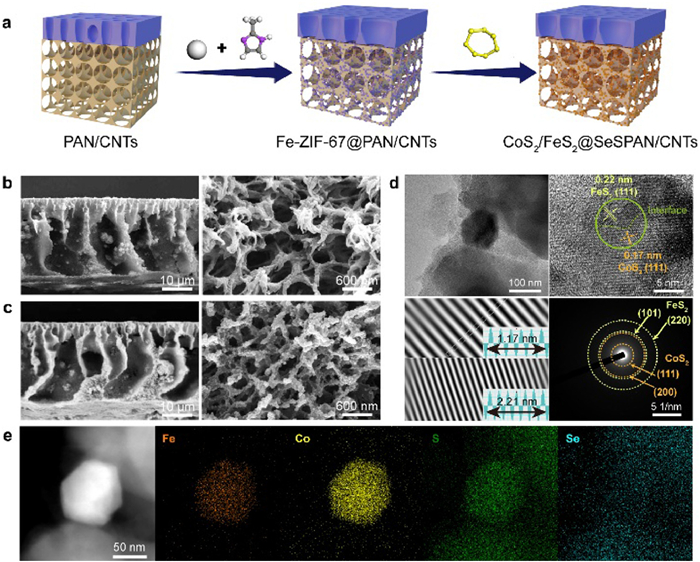
The CoS2/FeS2@SeSPAN/CNTs film with a heterostructure was successfully synthesized via a combination of casting, hydrothermal reaction, and heat treatment processes (Fig. 1a). First, PAN was mixed with CNTs to prepare a PAN precursor film with enhanced conductivity via the casting method. The film (~30 µm thick) formed a structurally intact three-dimensional conductive network (Fig. 1b). Subsequently, the PAN precursor film was immersed in a solution containing 2-Mim, Fe(NO3)3·9H2O, and Co(NO3)2·6H2O for the hydrothermal reaction, which promoted the formation of Fe-ZIF-67 nanoparticles on the film scaffold. Finally, the Fe-ZIF-67@PAN film underwent heat treatment in an argon atmosphere with the addition of SeSx to form the CoS2/FeS2@SeSPAN/CNTs film. The binding of selenium with metals is not discussed in detail, as the primary purpose of adding trace amounts of selenium is to utilize the insoluble products formed from the reaction between SeSx and the electrolyte. These insolubles facilitate the formation of the CEI layer, which prevents direct contact between the electrolyte and the active material [18,26,27]. After heat treatment, the film thickness remained relatively unchanged, and the interconnected network structure remained intact without collapse. CoS2/FeS2 nanoparticles exhibiting the characteristic rhombic dodecahedral ZIF-67 morphology were observed on the scaffold (Fig. 1c), with particle diameters under 100 nm. Element mapping results confirmed the presence of Co, Fe, and S within the framework (Fig. S1 in Supporting information). High-resolution transmission electron microscopy images revealed the interface between CoS2/FeS2 nanoparticles and the SeSPAN membrane. This observation indicated strong bonding between the components (Fig. 1d). Distinct crystal and carbon lattice fringes were observed in the CoS2/FeS2 heterostructure, with lattice fringes corresponding to the (111) crystal planes of CoS2 and FeS2. These planes exhibited interplanar spacings of 0.17 nm and 0.22 nm, respectively. The lattice fringes of CoS2 and FeS2 interweave and extend continuously, indicating a strong coupling between the two materials at the interface, further suggesting the formation of a stable heterostructure. The selected area electron diffraction pattern exhibited diffraction rings corresponding to the (111) and (200) planes of CoS2 and the (101) and (220) planes of FeS2. This result confirmed the excellent crystallinity of the sample. High-angle annular dark-field scanning electron microscopy (HAADF-STEM) and elemental mapping confirmed a uniform distribution of Fe, Co, and S elements. This finding validated the successful preparation of the heterostructure nanoparticles (Fig. 1e). The complete overlap of these elements indicated a uniform distribution at the interface. The presence of crystalline S and Se elements within the nanoparticles confirmed the incorporation of SeSx. Elemental analysis results revealed that the active material content was up to 61 wt% (Table S1 in Supporting information). Thermogravimetric analysis (TGA) was used to analyze the volatilization of elemental SeSx between 200 ℃ and 600 ℃, allowing for a rough estimation of the elemental SeSx loading. The results indicate that the elemental SeSx loading is highest in CoS2/FeS2@SeSeSPAN/CNTs, at approximately 23% (Fig. S2 in Supporting information). The high active material loading capacity demonstrated that the hierarchical porous structure provided ample storage and reaction space for active materials. This condition effectively mitigated volume expansion during the charge-discharge cycles.
Figure 1
Figure 1.
Morphological features: (a) Schematic of the synthesis of CoS2/FeS2@SeSPAN/CNTs composite film; (b) SEM images of the Fe-ZIF-67@PAN composite film; (c) SEM images of the CoS2/FeS2@SeSPAN/CNTs composite film; (d) local TEM image of the CoS2/FeS2@SeSPAN/CNTs composite film, which includes lattice fringe images, lattice spacing details, and diffraction patterns after inverse Fourier transform; and (e) local dark-field image and elemental mapping of the CoS2/FeS2@SeSPAN/CNTs composite film.
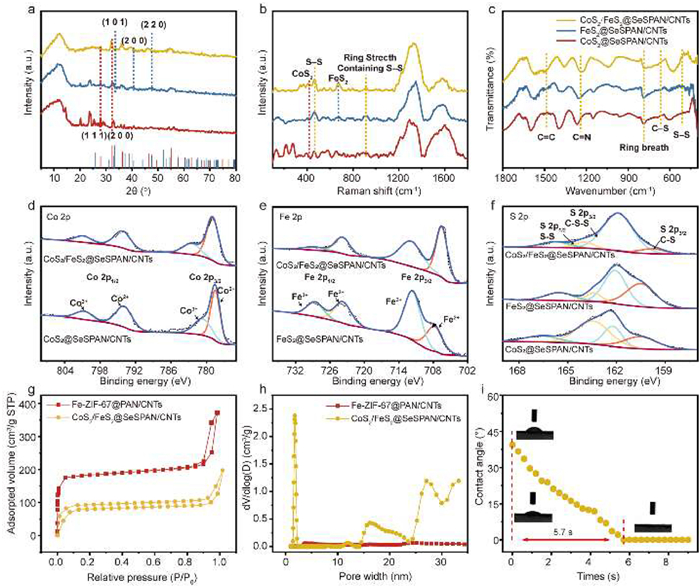
X-ray diffraction (XRD) analysis was utilized to characterize the crystalline structure of the samples (Fig. 2a). CoS2@SeSPAN/CNTs and FeS2@SeSPAN/CNTs exhibited characteristic diffraction peaks corresponding to the monometallic sulfides CoS2 and FeS2. This observation confirmed the successful synthesis of the sulfides. The XRD spectrum of CoS2/FeS2@SeSPAN/CNTs exhibited standard peaks for both CoS2 and FeS2, which included (111) and (200) for CoS2, as well as (101), (200), and (220) for FeS2. This observation provided indirect evidence of the CoS2/FeS2 heterostructure. Raman spectroscopy (Fig. 2b) and FT-IR spectroscopy (Fig. 2c) further elucidated the composite structure of the CoS2/FeS2@SeSPAN/CNTs samples. Tables S2 and S3 (Supporting information) present detailed peak information for the CoS2/FeS2@SeSPAN/CNTs samples. Characteristic peaks corresponding to C–S and S–S bonds indicated that the sulfurization process of PAN and the formation of the six-membered carbon ring framework were unaffected by the incorporation of CoS2 and FeS2.
Figure 2
Figure 2.
Structural characterization: (a) XRD patterns of CoS2@SeSPAN/CNTs, FeS2@SeSPAN/CNTs, and CoS2/FeS2@SeSPAN/CNTs. (b) Raman spectra of the composites. (c) FT-IR spectra indicating functional groups in the samples. (d) Co 2p spectra of CoS2/FeS2@SeSPAN/CNTs. (e) Fe 2p spectra of the composite. (f) S 2p spectra of CoS2/FeS2@SeSPAN/CNTs. (g) Nitrogen adsorption–desorption isotherms for Fe-ZIF-67@PAN and CoS2/FeS2@SeSPAN/CNTs. (h) Pore size distribution of the composites. (i) Changes in water contact angle for CoS2/FeS2@SeSPAN/CNTs during electrolyte wetting.
X-ray photoelectron spectroscopy (XPS) confirmed the presence of Co, Fe, C, S and Se in the CoS2/FeS2@SeSPAN/CNTs composite (Fig. S3 in Supporting information). Characteristic peaks for pyrrolic and pyridinic nitrogen were observed in the N 1s spectrum. These components enhanced both electron and ion conductivity, which facilitated the adsorption of solid polysulfides. This effect prevented the agglomeration of solid polysulfides encapsulated within the CoS2/FeS2 dodecahedral structure and maintained the overall reaction kinetics [25,28]. High-resolution Co 2p spectra exhibited peaks at 779.0 eV and 794.3 eV, attributed to Co2+, with additional peaks at 782.6 eV and 801.0 eV attributed to Co3+ (Fig. 2d). The Co peaks in CoS2/FeS2@SeSPAN/CNTs exhibited a slight positive shift compared with those in pure CoS2@SeSPAN/CNTs. The shift in the Co 2p peak can be attributed to the formation of the CoS2/FeS2 heterostructure. In the heterostructure, the interaction between Co and Fe alters the local electronic environment of Co, resulting in a positive shift of the Co 2p peak. This shift typically indicates a change in the electronic density of Co, which is likely due to the stable formation of the CoS2 and FeS2 heterostructure, affecting the electron affinity and lattice strain of Co. This change in electronic density serves as direct evidence for the formation of the heterostructure, highlighting the strong interaction between CoS2 and FeS2 [29]. High-resolution Fe 2p spectroscopy further supports this conclusion (Fig. 2e). The main peaks of Fe 2p3/2 and Fe 2p1/2 appear at approximately 710 eV and 724 eV, respectively, indicating that Fe primarily exists in the forms of Fe2+ and Fe3+. Compared to the pure FeS2@SeSPAN/CNTs sample, the Fe 2p peaks in CoS2/FeS2@SeSPAN/CNTs shift slightly to higher binding energies, providing further evidence of the interaction between Fe and CoS2/FeS2, thereby strengthening the indirect evidence for the formation of the heterostructure. In the high-resolution S 2p spectrum, all three samples exhibited S–S, C–S, and C–S–S bonds, while CoS2/FeS2@SeSPAN/CNTs exhibited a high proportion of C–S–S bonds (Fig. 2f). This observation indicated that the formation of long-chain sulfur within SeSPAN was promoted. The XPS spectra of Se 3d exhibited peaks at 53.9 eV (Se 3d5/2) and 56.3 eV (Se 3d3/2), which are characteristic of Se in a covalent SeSx environment. No low-binding energy peaks, typically associated with metal selenides such as CoSe or FeSe (around 53 eV), were observed. This absence suggests that selenium in the material remains primarily in its covalently bonded SeSx state, without forming metal selenides with Co or Fe. These findings confirm that Se does not interact with the metal components to form metal selenide phases in the synthesized materials.
Nitrogen adsorption–desorption methods were utilized to assess the surface area and porosity of CoS2/FeS2@SeSPAN/CNTs films before and after heat treatment (Figs. 2g and h). The Fe-ZIF-67@PAN films initially exhibited a pore volume of 0.062 cm3/g and a surface area of 20.3 m2/g. After heat treatment at 450 ℃, the pore volume of CoS2/FeS2@SeSPAN/CNTs films increased to 0.306 cm3/g, and the surface area expanded to 43.3 m2/g. The films exhibited a distinct hierarchical porous structure with pore sizes ranging from 2 nm to 30 nm. The films also exhibited notable flexibility and electrolyte wettability, with an electrolyte contact angle of ~40.1° and a wettability time of 5.7 s. These observations highlighted their potential in self-supporting cathode applications for Li-SPAN batteries (Fig. 2i and Fig. S4 in Supporting information).
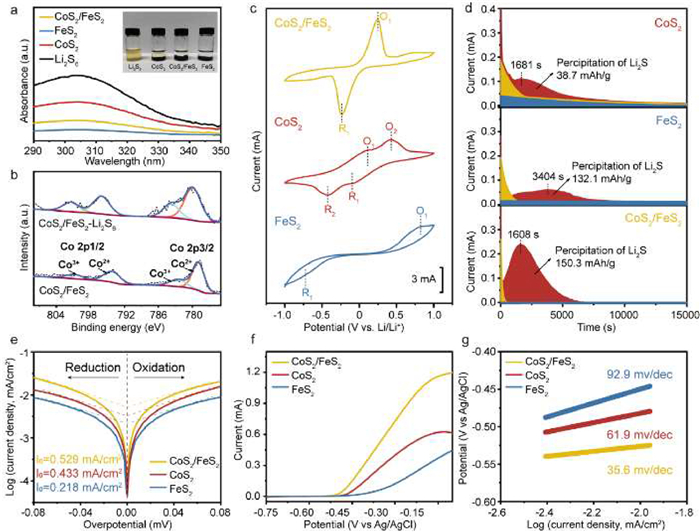
Performance of CoS2/FeS2@SeSPAN/CNTs. Enhancing the capacity for polysulfide adsorption at the phase interface is essential for maximizing active material reactivity and increasing electrochemical reaction efficiency. Static adsorption experiments were performed with Li2S6 solutions to evaluate the polysulfide adsorption capacity of CoS2, FeS2, and CoS2/FeS2. Optical photographs of the post-experiment samples revealed notable changes in color (Fig. 3a). The solutions containing FeS2 and CoS2/FeS2 turned colorless within 12 h, while those with only CoS2 exhibited a lighter hue. This observation indicated superior polysulfide adsorption capacity for CoS2/FeS2. UV–vis absorption spectroscopy confirmed the effective fixation of polysulfides by the CoS2/FeS2 heterostructure. This suitable fixation effect promoted effective contact and sustained electrochemical reactions. XPS analysis revealed negative shifts in the Co and Fe peaks after the adsorption of Li2S6. This observation indicated electron acquisition from polysulfide anions through Lewis acid-base interactions (Fig. 3b and Fig. S5 in Supporting information). This finding demonstrated the significant role of the heterostructure in enhancing electrochemical performance by facilitating robust interactions with polysulfides [30,31]. Notably, during the initial reaction stages, the FeS2 component served as the primary binding site for long-chain polysulfides, which subsequently migrated to CoS2 for catalytic conversion. This process enhanced the interaction between FeS2 and CoS2, which in turn facilitated the formation of an electric field that sustained the catalytic processes. To evaluate electrocatalytic activity, CV tests were conducted on CoS2, FeS2, and CoS2/FeS2 electrodes using Li2S6 electrolyte (Fig. 3c). The CV tests revealed two pairs of redox peaks in the CoS2/FeS2 symmetric cell: One pair corresponded to the conversion from S₈ to Li2Sn (4 ≤ n ≤ 8), and the other corresponded to the conversion from Li2Sn to Li2S [32]. The CoS2/FeS2 electrodes exhibited significantly increased current densities in redox reactions, which indicated superior bidirectional catalytic activity due to enhanced electron transfer efficiency and reduced energy barriers. The Li2S deposition capacity of CoS2/FeS2 reached 150.3 mAh/g, which was notably higher than that of CoS2 at 38.7 mAh/g and that of FeS2 at 132.1 mAh/g (Fig. 3d). These findings demonstrated the effective combination of the catalytic capabilities of CoS2 with the adsorption capabilities of FeS2 in the heterostructure. Tafel plot tests indicated that CoS2/FeS2 exhibited the highest exchange current density at 0.501 mA/cm2, which surpassed that of FeS2 at 0.210 mA/cm2 and that of CoS2 at 0.433 mA/cm2. This observation demonstrated the ability of the heterostructure to accelerate charge transfer processes (Fig. 3e). The decomposition and oxidation behavior of Li2S was evaluated via three-electrode linear sweep voltammetry (LSV) using 0.1 mol/L Li2S in methanol as the electrolyte, along with a platinum counter electrode and an AgCl/Ag reference electrode (Fig. 3f). The CoS2/FeS2 electrode exhibited a lower onset voltage (−0.51 V) and a stronger current response compared with the CoS2 (−0.49 V) and FeS2 (−0.40 V) electrodes. This observation indicated reduced energy barriers for the conversion of Li2S to long-chain polysulfides. The Tafel slope for the CoS2/FeS2 electrode (35.6 mV/dec) was lower than that for the other electrodes, which confirmed the exceptional adsorption and catalytic activity of CoS2/FeS2 owing to its porous heterostructure (Fig. 3g). This analysis demonstrated the unique capabilities of the heterostructure in enhancing electrochemical performance.
Figure 3
Figure 3.
Polysulfide adsorption and electrocatalytic performance: (a) Digital photographs of Li2S6 solutions after the addition of CoS2, FeS2, and CoS2/FeS2. (b) Co 2p spectra of CoS2/FeS2 before and after Li2S6 adsorption tests. (c) CV curves of symmetric cells with CoS2, FeS2, and CoS2/FeS2. (d) Deposition behavior of Li2S on CoS2, FeS2, and CoS2/FeS2 electrodes. (e) Tafel curves of CoS2, FeS2, and CoS2/FeS2. (f) LSV curves of CoS2, FeS2, and CoS2/FeS2 in Li2S methanol and (g) corresponding Tafel slopes of each material.
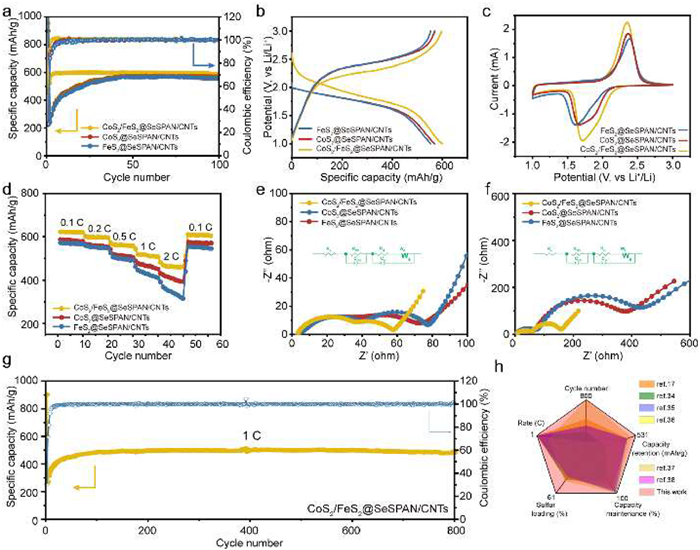
The porous heterostructure of CoS2/FeS2 functions as a nano-reactor in batteries, which accommodates active materials and facilitates electron transfer. To further investigate CoS2/FeS2 performance enhancement in SeSPAN cathodes, a series of electrochemical experiments were conducted for comparison with single-component systems. The cycle stability of CoS2@SeSPAN/CNTs, FeS2@SeSPAN/CNTs, and CoS2/FeS2@SeSPAN/CNTs was evaluated at 0.2 C (Fig. 4a). CoS2/FeS2@SeSPAN/CNTs achieved a peak stable capacity of 602.3 mAh/g after a brief activation period. The activation behavior is primarily attributed to the interaction between the C and N sites within the SeSPAN framework and lithium ions, leading to the formation of irreversible covalent bonds. These bonds effectively enhance the conductivity of the electrode. The reduced activation cycle time indicates that CoS2/FeS2@SeSPAN/CNTs offers significant advantages in improving reaction kinetics. In contrast, CoS2@SeSPAN/CNTs and FeS2@SeSPAN/CNTs required ~50 cycles to reach activation. The charge-discharge curves of the electrode after activation indicated notable advantages for CoS2/FeS2@SeSPAN/CNTs in both capacity and voltage polarization (Fig. 4b). The single discharge plateau observed in the charge–discharge curves and CV curves indicated that the active materials encapsulated within the dodecahedral structure exhibited a solid-solid discharge mode similar to that of SPAN, without generating soluble polysulfides. This observation also indicated the gradual conversion of solid S₈ to Li2S (Fig. 4c). This characterization demonstrated the superior functionality of the CoS2/FeS2 heterostructure and highlighted its potential in enhancing the electrochemical performance of Li-S batteries. The CoS2/FeS2@SeSPAN/CNTs electrodes exhibited higher peak current densities and lower polarization compared with the CoS2@SeSPAN/CNTs and FeS2@SeSPAN/CNTs electrodes. The anodic peaks of the electrodes shifted positively to higher potentials, while the cathodic peaks shifted negatively to lower potentials. This finding confirmed enhanced reaction kinetics attributed to the intrinsic electric field and staged catalytic conversion. The Inductively Coupled Plasma (ICP) analysis revealed that the total Fe and Co content in CoS2/FeS2@SeSPAN/CNTs is 0.9 wt%. In the charge-discharge and CV curves, no significant involvement of CoS2 and FeS2 in lithium-ion insertion/extraction reactions was observed. This indicates that while CoS2 and FeS2 may participate in a small degree of lithium-ion insertion/extraction, their contribution to the overall capacity is minimal. The CoS2/FeS2 heterostructure primarily enhances the battery performance by facilitating polysulfide conversion and adsorption, rather than directly contributing to the capacity. Rate capability tests (Fig. 4d and Fig. S6 in Supporting information) demonstrated the superior charge–discharge performance of CoS2/FeS2@SeSPAN/CNTs across various rates, particularly excelling from 0.1 C to 2 C with high recovery rates. Compared with CoS2@SeSPAN/CNTs and FeS2@SeSPAN/CNTs, CoS2/FeS2@SeSPAN/CNTs exhibited more stable capacities and less capacity fade during high-rate tests. The electrochemical impedance spectroscopy (EIS) results show that the initial electrode impedance is characterized by a curve that does not form a complete semicircle, indicating poor charge transfer resistance (Rct) in the initial stage (Fig. S7 in Supporting information) [17,18]. After 100 charge-discharge cycles, EIS of each electrode curve exhibited a complete semicircle corresponding to Rct and CEI layer resistance (RCEI), confirming that the slow, irreversible insertion of Li+ into the C and N sites of the SPAN framework improves conductivity, thereby reducing Rct (Figs. 4e and f). Additionally, the CEI layer remains stable during cycling. EIS analysis and equivalent circuit fitting results indicate that the CoS2/FeS2@SeSPAN/CNTs electrode demonstrates the lowest Rct and RCEI, highlighting its excellent electrochemical performance (Table S4 in Supporting information). Furthermore, the Rct at 1.0 V during discharge (20 Ω) is lower than at 3.0 V during charge (53 Ω), which is closely related to the interconversion between Li2S and elemental sulfur or SeSPAN, as well as the formation and rupture of covalent bonds between Li+ and the SeSPAN framework. Long-term cyclic stability assessment is crucial for confirming side reactions in Li-SPAN batteries. Cyclic performance tests were conducted on CoS2/FeS2@SeSPAN/CNTs at 1 C to investigate whether the electrolyte reacted nucleophilically with sulfur molecules or formed soluble polysulfides under high current density (Fig. 4g). At 1 C, the CoS2/FeS2@SeSPAN/CNTs electrodes maintained a capacity retention rate of 97.9% after 800 cycles, with only a 0.003% capacity fade per cycle and a coulombic efficiency near 100%. The stable cycling curves indicated that the CEI layer effectively prevented direct contact between the carbonate electrolyte and the sulfur molecules encapsulated within the CoS2/FeS2 structure to avoid performance degradation due to nucleophilic reactions. The significant capacity reduction observed in the second cycle was attributed to the formation of the CEI layer and the irreversible lithiation of carbon and nitrogen within SeSPAN [19,33]. These observations indicated that the Li-SPAN battery, supported by an intrinsic electric field and enhanced adsorptive catalytic actions, exhibited superior active material loading and electrochemical performance, as well as exceptional redox kinetics compared with the batteries from previous studies (Fig. 4h, Fig. S8 and Table S5 in Supporting information) [14,17,34–38]. The comprehensive analyses demonstrated the potential of the CoS2/FeS2 heterostructure in advancing Li-SPAN battery technology.
Figure 4
Figure 4.
Comprehensive electrochemical evaluation: (a) Cyclic performance of CoS2@SeSPAN/CNTs, FeS2@SeSPAN/CNTs, and CoS2/FeS2@SeSPAN/CNTs at 0.2 C. (b) Charge–discharge curves for each material. (c) CV curves. (d) Rate capability of CoS2@SeSPAN/CNTs, FeS2@SeSPAN/CNTs, and CoS2/FeS2@SeSPAN/CNTs at various current densities. (e) Impedance spectra of CoS2@SeSPAN/CNTs, FeS2@SeSPAN/CNTs, and CoS2/FeS2@SeSPAN/CNTs at fully discharged states after 100 cycles. (f) Impedance spectra at fully charged states after 100 cycles. (g) Long-term cyclic performance of CoS2/FeS2@SeSPAN/CNTs at 1 C. (h) Comparative electrochemical performance analysis of Li-S batteries with SPAN-based cathodes from this study and previous literature [14,34–38].
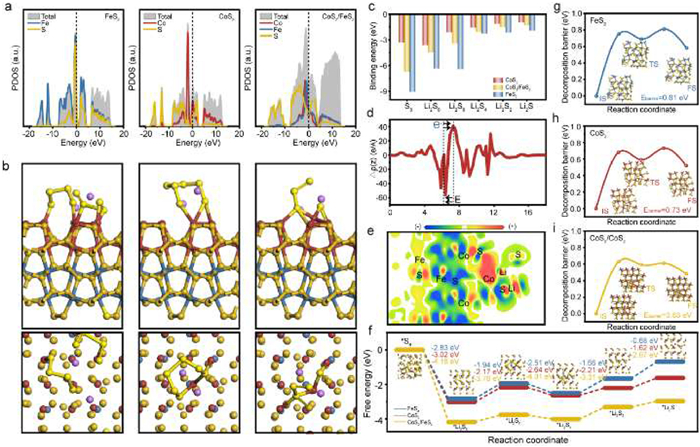
The exceptional performance of CoS2/FeS2@SeSPAN/CNTs was further investigated via DFT calculations to analyze its electronic properties and catalytic capabilities at the atomic level. The configurations of CoS2, FeS2, and CoS2/FeS2 were examined. Partial density of states (PDOS) analysis revealed no energy gap near the Fermi level. This observation indicated intrinsic conductivity (Fig. 5a). The p-band center of the CoS2/FeS2 heterostructure was higher (−0.73 eV) than that of FeS2 (−0.80 eV) and CoS2 (−0.97 eV). This observation indicated enhanced interactions with polysulfides. Meanwhile, the d-band center of the CoS2/FeS2 heterostructure (−1.32 eV) was situated between those of FeS2 (−1.24 eV) and CoS2 (−1.43 eV). This unique electronic configuration indicated optimal electronic properties, which facilitated charge transfer and enhanced catalytic activity for efficient polysulfide conversion. Figs. 5b and c, Figs. S9 and S10 (Supporting information) show the adsorption energies and configurations for various polysulfide intermediates for CoS2, FeS2, and CoS2/FeS2. FeS2 demonstrated the strongest adsorption energy, while CoS2/FeS2 exhibited a suitable amount of adsorption energy, which facilitated the desorption of long-chain polysulfides from the substrate. Differential charge density maps indicated a positive correlation between binding energy and electron density. This finding demonstrated the advanced electronic structure of the CoS2/FeS2 heterostructure (Fig. 5d and Fig. S10). High electron density was observed between Li and S atoms in the transition metal sulfides, where S atoms formed stable covalent bonds with Co and Fe atoms. Cross-sectional charge accumulation diagrams revealed the presence of an intrinsic electric field, which facilitated the adsorption of solid polysulfides and the migration of Li+ (Fig. 5e). Gibbs free energy simulations were conducted to explore the conversion from S₈ to longer-chain polysulfides (Li2S8, Li2S6, Li2S4) and final products (Li2S2, Li2S). Fig. 5f shows the optimized configurations of reaction intermediates and their corresponding free energy curves. CoS2/FeS2 exhibited a high exothermic effect and low positive Gibbs free energy barriers in subsequent endothermic reactions. This observation indicated thermodynamically favorable conditions for predominant solid-state reactions. Figs. 5g-i and Fig. S11 (Supporting information) show the decomposition energy barriers for Li2S on the surfaces of CoS2 (0.73 eV), FeS2 (0.81 eV), and CoS2/FeS2 (0.63 eV). The comprehensive comparison of electronic structures, polysulfide adsorption capacities, and energy barriers demonstrated that the CoS2/FeS2 heterostructure enhanced electronic structure and adsorption capabilities, reduced reaction barriers, and significantly improved electrochemical reaction kinetics. These findings provide theoretical support for the superior electrochemical performance of the CoS2/FeS2 heterostructure, which demonstrates its advanced capabilities in enhancing Li-SPAN battery technology.
Figure 5
Figure 5.
Detailed analysis of cathode electrochemical and physical properties: (a) Calculated PDOS near the Fermi level for CoS2, FeS2, and CoS2/FeS2. (b) Optimized configurations of Li2S8, Li2S6, and Li2S4 on the surface of CoS2/FeS2. (c) Adsorption energies between polysulfides and catalysts. (d) Charge accumulation and dissipation per Å in the cross-section after adsorption on CoS2/FeS2. (e) Corresponding differential charge density map. (f) Gibbs free energy profiles on the surfaces of CoS2, FeS2, and CoS2/FeS2. (g–i) Decomposition energy barriers for Li2S on the surfaces of CoS2, FeS2, and CoS2/FeS2.
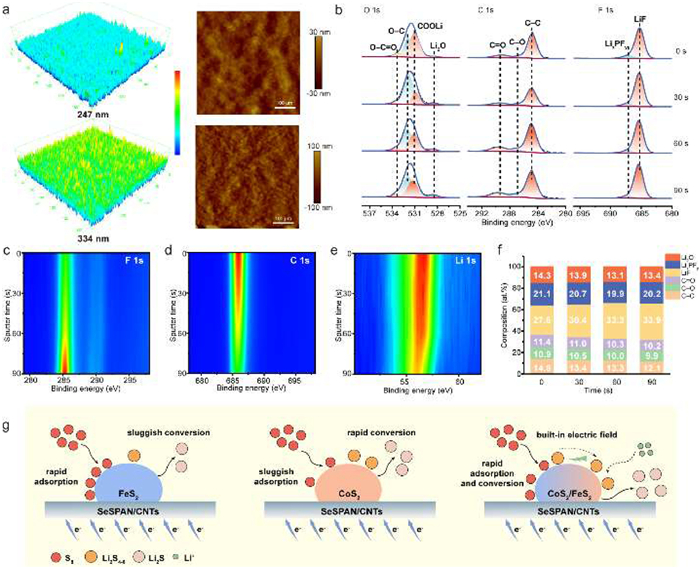
Detailed studies were conducted to comprehensively understand the morphology and chemical composition of the CoS2/FeS2@SeSPAN/CNTs cathode after extensive cycling. After 100 cycles, the cathode surface exhibited increased roughness and was covered by a thick polymer layer, indicative of the microscopic characteristics of the CEI layer (Fig. S12 in Supporting information). True-color confocal and atomic force microscopy revealed significant contrast variations on the membrane surface, which indicated the formation of a CEI layer ~30 nm thick (Fig. 6a). Further characterization of the surface chemistry of the film via XPS etching demonstrated that the outer and sub-surface layers were enriched with C–O and C=O bonds, which was consistent with the decomposition of carbonate electrolytes into organic compounds. Additionally, the XPS spectra indicated the presence of inorganic products, such as Li2O, LiF, and LixPFy, resulting from the decomposition of FEC and LiPF6. This observation confirmed the formation of a composite CEI layer consisting of both organic and inorganic materials on the cathode surface (Fig. 6b, Figs. S13 and S14 in Supporting information). Contour maps of C, F, and Li (Figs. 6c-f and Fig. S15 in Supporting information) further indicated that the outer layer of the CEI predominantly comprised carbon-rich organic compounds, while the inner layer predominantly comprised inorganics, mainly LiF and LixPFy. Furthermore, the consistent presence of Li and S throughout the etching process confirmed the gradual formation of the CEI layer along the dendritic framework of the SeSPAN membrane, and the CEI layer ultimately covered the entire membrane surface. These findings are in agreement with previous studies, which indicate that the formation of the CEI layer involves electrolyte decomposition, followed by the formation of both organic and inorganic layers, along with nucleophilic reactions between S2- and carbonate electrolytes. When the carbonate electrolyte enters the pores and reacts with SeSx, a nucleophilic reaction occurs, producing insoluble solid products that block the pores and prevent further contact between the electrolyte and SeSx. The inorganic species produced from electrolyte decomposition subsequently nucleate on these products, thereby accelerating the formation of the CEI layer. With the protection of the CEI, the additional SeSx in the electrode pores can undergo complete charge-discharge cycles, ensuring high utilization of active material. This design not only optimizes the overall battery performance but also ensures the efficient utilization of active materials [26,33].
Figure 6
Figure 6.
Mechanical and interfacial characterization: (a) Surface roughness comparison of the CoS2/FeS2@SeSPAN/CNTs cathode before and after 100 cycles. (b) XPS characterization of CoS2/FeS2@SeSPAN/CNTs with increasing Ar+ sputtering time. Contour maps of (c) F 1s, (d) C 1s, and (e) Li 1s intensity for CoS2/FeS2@SeSPAN/CNTs under varying sputtering times. (f) corresponding composition content. (g) Schematic of the polysulfide adsorption/conversion processes on CoS2@SeSPAN/CNTs, FeS2@SeSPAN/CNTs, and CoS2/FeS2@SeSPAN/CNTs.
The porous structure of the CoS2/FeS2@SeSPAN/CNTs membrane provided numerous attachment sites for active materials. This effect significantly enhanced active material loading capacity. The CEI layer effectively prevented direct contact between the active materials and the electrolyte, which, in turn, prevented the depletion of the additional active materials. Moreover, the enhanced conductivity of the CoS2/FeS2 heterostructure significantly improves the overall conductivity of the electrode, reducing internal resistance and mitigating early-cycle capacity loss. The intrinsic electric field within the heterostructure facilitates the transport of lithium ions and polysulfides, preventing the formation of dead sulfur and enhancing the utilization of active materials (Fig. 6g). Owing to the synergistic effects of the CEI and the heterostructure, CoS2/FeS2@SeSPAN/CNTs exhibited exceptional electrochemical performance, which demonstrated its substantial potential in industrial applications.
In conclusion, this study presents a novel flexible CoS2/FeS2@SeSPAN/CNTs composite film cathode developed through a combination of straightforward casting technique and hydrothermal reactions. The cathode exhibited remarkable electrochemical performance and substantial potential for industrial applications. The unique graded porous structure of the cathode effectively increased the storage sites for active materials. The cathode achieved a loading capacity of 61 wt%, which significantly exceeded the typical 40 wt% reported in previous studies. Experimental results and DFT calculations indicated that the CoS2/FeS2 heterointerface significantly enhanced the adsorption and catalytic conversion of polysulfides. The intrinsic electric field at the interface enhanced the migration efficiency of lithium ions. This effect significantly improved the electrochemical reaction kinetics. The synergistic effect of the CoS2/FeS2 heterojunction, coupled with a protective CEI, significantly facilitated the utilization efficiency of active materials. Notably, even after 800 cycles at 1 C, the battery retained 97.9% of its capacity. This observation demonstrated the exceptional long-cycle performance of the Li-SPAN battery. This work presents a novel solution for the development of high-energy-density, long-cycle-life Li-S batteries, specifically suitable for future high-performance energy storage applications and wearable technologies.
Declaration of competing interest
Authors declare that they have no known competing financial interests or personal relationships that could have appeared to influence the work reported in this paper.
This work was supported by the New Materials Research Key Program of Tianjin (No. 18ZXJMTG00110) and the Product Development Fund of Cangzhou Institute (No. TGCYY-Z-0203). We thank the Bianshui Riverside Supercomputing Center (BRSC) for help with the simulation calculations in this manuscript and LetPub (www.letpub.com.cn) for language assistance in the preparation of this manuscript.
Supplementary materials
Supplementary material associated with this article can be found, in the online version, at doi:10.1016/j.cclet.2025.111084.
Figure 1
Morphological features: (a) Schematic of the synthesis of CoS2/FeS2@SeSPAN/CNTs composite film; (b) SEM images of the Fe-ZIF-67@PAN composite film; (c) SEM images of the CoS2/FeS2@SeSPAN/CNTs composite film; (d) local TEM image of the CoS2/FeS2@SeSPAN/CNTs composite film, which includes lattice fringe images, lattice spacing details, and diffraction patterns after inverse Fourier transform; and (e) local dark-field image and elemental mapping of the CoS2/FeS2@SeSPAN/CNTs composite film.
Figure 2
Structural characterization: (a) XRD patterns of CoS2@SeSPAN/CNTs, FeS2@SeSPAN/CNTs, and CoS2/FeS2@SeSPAN/CNTs. (b) Raman spectra of the composites. (c) FT-IR spectra indicating functional groups in the samples. (d) Co 2p spectra of CoS2/FeS2@SeSPAN/CNTs. (e) Fe 2p spectra of the composite. (f) S 2p spectra of CoS2/FeS2@SeSPAN/CNTs. (g) Nitrogen adsorption–desorption isotherms for Fe-ZIF-67@PAN and CoS2/FeS2@SeSPAN/CNTs. (h) Pore size distribution of the composites. (i) Changes in water contact angle for CoS2/FeS2@SeSPAN/CNTs during electrolyte wetting.
Figure 3
Polysulfide adsorption and electrocatalytic performance: (a) Digital photographs of Li2S6 solutions after the addition of CoS2, FeS2, and CoS2/FeS2. (b) Co 2p spectra of CoS2/FeS2 before and after Li2S6 adsorption tests. (c) CV curves of symmetric cells with CoS2, FeS2, and CoS2/FeS2. (d) Deposition behavior of Li2S on CoS2, FeS2, and CoS2/FeS2 electrodes. (e) Tafel curves of CoS2, FeS2, and CoS2/FeS2. (f) LSV curves of CoS2, FeS2, and CoS2/FeS2 in Li2S methanol and (g) corresponding Tafel slopes of each material.
Figure 4
Comprehensive electrochemical evaluation: (a) Cyclic performance of CoS2@SeSPAN/CNTs, FeS2@SeSPAN/CNTs, and CoS2/FeS2@SeSPAN/CNTs at 0.2 C. (b) Charge–discharge curves for each material. (c) CV curves. (d) Rate capability of CoS2@SeSPAN/CNTs, FeS2@SeSPAN/CNTs, and CoS2/FeS2@SeSPAN/CNTs at various current densities. (e) Impedance spectra of CoS2@SeSPAN/CNTs, FeS2@SeSPAN/CNTs, and CoS2/FeS2@SeSPAN/CNTs at fully discharged states after 100 cycles. (f) Impedance spectra at fully charged states after 100 cycles. (g) Long-term cyclic performance of CoS2/FeS2@SeSPAN/CNTs at 1 C. (h) Comparative electrochemical performance analysis of Li-S batteries with SPAN-based cathodes from this study and previous literature [14,34–38].
Figure 5
Detailed analysis of cathode electrochemical and physical properties: (a) Calculated PDOS near the Fermi level for CoS2, FeS2, and CoS2/FeS2. (b) Optimized configurations of Li2S8, Li2S6, and Li2S4 on the surface of CoS2/FeS2. (c) Adsorption energies between polysulfides and catalysts. (d) Charge accumulation and dissipation per Å in the cross-section after adsorption on CoS2/FeS2. (e) Corresponding differential charge density map. (f) Gibbs free energy profiles on the surfaces of CoS2, FeS2, and CoS2/FeS2. (g–i) Decomposition energy barriers for Li2S on the surfaces of CoS2, FeS2, and CoS2/FeS2.
Figure 6
Mechanical and interfacial characterization: (a) Surface roughness comparison of the CoS2/FeS2@SeSPAN/CNTs cathode before and after 100 cycles. (b) XPS characterization of CoS2/FeS2@SeSPAN/CNTs with increasing Ar+ sputtering time. Contour maps of (c) F 1s, (d) C 1s, and (e) Li 1s intensity for CoS2/FeS2@SeSPAN/CNTs under varying sputtering times. (f) corresponding composition content. (g) Schematic of the polysulfide adsorption/conversion processes on CoS2@SeSPAN/CNTs, FeS2@SeSPAN/CNTs, and CoS2/FeS2@SeSPAN/CNTs.


 DownLoad:

 下载:
下载:


 下载:
下载:

