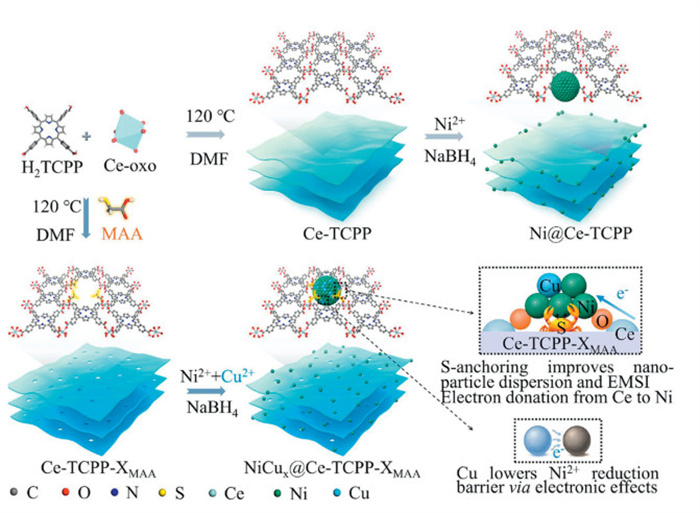
Scheme 1.
Schematic illustration of Ni@Ce-TCPP and NiCux@Ce-TCPP-XMAA synthesis.

Structural and electronic co-engineering of Ce-MOFs enables highly dispersed, electron-rich Ni sites for efficient, durable hydrogenation catalysis
Xinmeng Xu , Zuoshuai Xi , Hongyi Gao , Jing Lin , Jingjing Wang , Xiao Chen , Ge Wang


Hydrogen is a clean and sustainable energy carrier, and hydrogenation is a pivotal catalytic process that accounts for nearly 25% of all chemical transformations, also serving as a key pathway for hydrogen utilization with high atom economy and environmental benefits [1–4]. Catalysts are the driving force in these reactions, directly influencing the activation energy barrier, product selectivity, and energy conversion efficiency. While noble metal catalysts, such as Au, Pd, and Ru, demonstrate exceptional hydrogenation kinetics due to their strong hydrogen adsorption and dissociation capabilities, their scarcity, and high cost significantly limit their application [5–7]. Non-noble metal catalysts, particularly nickel (Ni)-based materials, exhibit comparable catalytic activity for hydrogenation reactions, attributed to their unique d-orbital electronic structure, making them a promising alternative to noble metals [8,9].
To increase the catalytic effectiveness of Ni-based catalysts, mainly two common strategies have been adopted. The first approach involves the construction of nanoscale Ni particles or clusters to maximize the density of active sites [10]. The second strategy focuses on synergistic interactions between Ni and secondary metals (such as Mg, Cu, La) or metal oxides (including CeO2, TiO2, ZrO2), creating heterogeneous interfaces that promote electronic transfer to Ni, leading to a downward shift of the d-band center [11–13]. However, the construction of nanoscale, electron-rich Ni active sites faces several challenges. Spatially, nanoscale Ni particles tend to migrate and aggregate under harsh reaction conditions, which diminishes their activity [14]. Electronically, the Ni-support interface may undergo reconstruction or degradation during dynamic reaction processes, disrupting the pathways for electronic transfer. Additionally, strong adsorption interactions between electron-deficient substrates and electron-rich Ni can block active sites. Recent advancements have shown that the spatial confinement effect of porous supports, such as zeolites and metal-organic frameworks (MOFs), can regulate the particle size and electronic structure of Ni nanoparticles through spatial confinement and interfacial charge transfer, effectively suppressing migration and aggregation at elevated temperatures and pressures [15].
MOFs possess a rich diversity of compositions and molecular-level tunable pore architectures, providing an excellent platform for the design of catalyst supports [16–19]. On one hand, MOFs offer multiple anchoring sites that facilitate the construction of defect sites or the introduction of functional groups, such as amino and pyridine, onto the ligands, thereby promoting the immobilization of nanoscale Ni within a confined pore environment [20]. On the other hand, the metal nodes in MOFs, particularly rare earth elements like Ce, further tune the electronic structure to create electron-rich Ni active sites, leading to significant enhancements in catalytic performance for hydrogenation reactions. Li et al. [21] leveraged these structural features to achieve highly dispersed Ni by modulating the defect structure of UiO-66(Ce) with formic acid. The electronic structure of monometallic Ni is limited, making it difficult to simultaneously maintain catalytic activity and structural stability. In contrast, bimetallic nanoparticles can regulate interfacial charge and coordination environment at the atomic scale through electronic synergy and geometric effects, while also optimizing the kinetics of active sites and resistance to sintering. Wang et al. [22] constructed Co1Ni1@UiO-66-NH2 via a laser-assisted method, significantly enhancing hydrogenation performance through charge transfer between Ni and Co. Although laser reduction enables rapid preparation of metal nanoparticles, it still suffers from low yield, high energy consumption, and operational risks. Moreover, Ni–Co alloy formation is constrained by the slow reduction kinetics of Co2+, requiring harsh reduction conditions. Therefore, developing refined functionalization strategies combined with mild and controllable reduction methods to achieve highly dispersed Ni with tunable electronic structure and structural stability under reaction conditions remains a key scientific challenge.
Herein, this study presents an innovative approach to achieving structural and electronic dual engineering of active Ni sites within MOFs (Scheme 1). In terms of structural stability, mercaptoacetic acid (MAA) containing sulfur, serves as a chemical anchoring ligand, forming S-Ni interactions that enhance the electron metal–support interaction (EMSI). On the electronic regulation front, in-situ construction of nanoscale NiCu alloys within the confined pore environment allows for close contact between Cu and Ni, with distant cerium (Ce) nodes collaboratively regulating the chemical state of Ni to create electron-rich Ni sites. The synergistic effects of the S-Ni interface, pore confinement, and lattice distortion induced by Cu substitution ensure the formation of highly dispersed, electron-rich Ni0 active sites within the MOFs, maintaining stability under reaction conditions. The optimized NiCu0.1@Ce-TCPP-20MAA demonstrates exceptional performance, achieving over 99% conversion and selectivity in the hydrogenation of DCPD while sustaining excellent catalytic activity over eight consecutive cycles. Both in situ experimental results and theoretical simulations indicate that the interaction of Ni with sulfur, Cu, and Ce enhances the electron density of Ni and improves its stability, thereby boosting hydrogenation activity. This work demonstrates dual structural–electronic engineering of Ni sites in MOFs for durable non-noble metal hydrogenation catalysts.
The crystal structures of Ce-TCPP, Ce-TCPP-XMAA, Ni@Ce-TCPP-XMAA, and NiCux@Ce-TCPP-XMAA were characterized using X-ray diffraction (XRD) (Fig. S1a in Supporting information). The Ce-TCPP exhibits distinct peaks at 5.3°, 7.7°, and 11.6°, corresponding to the (020), (021), and (041) crystal planes, respectively, which closely align with the simulated patterns [23]. Fourier transform infrared spectroscopy (FT-IR) analysis (Fig. S1b in Supporting information) showed that the asymmetric stretching vibration peaks of the C ═ O groups in H2TCPP shifted markedly from 1707 cm−1 to 1581 cm−1 and 1539 cm−1. This phenomenon directly confirmed the formation of strong coordination bonds between Ce3+ and carboxyl groups in H2TCPP, successfully constructing the Ce-TCPP material. Additionally, the emergence of a new –SH characteristic peak at 2535 cm−1 verified the effective modification of Ce-TCPP framework by MAA. Notably, the significantly reduced intensity of –SH peaks in the Ni@Ce-TCPP-20MAA system was attributed to coordination bonding between Ni and –SH [24]. Elemental analysis (Table S1 in Supporting information) showed sulfur content rising from 0.8 wt% to 2.8 wt% with increasing MAA.
To accurately evaluate the metal loading in the catalytic materials, quantitative analysis was performed using inductively coupled plasma mass spectrometry (ICP-MS) (Table S2 in Supporting information). ICP-MS gave Ni loadings of 4.7–5.2 wt%, close to the theoretical 5 wt%. The effects of MAA and Cu introduction on the pore structure and specific surface area of MOFs were investigated through N2 adsorption-desorption analysis (Figs. S2a and b, Table S3 in Supporting information). Compared to Ce-TCPP (517 m2/g), Ce-TCPP-XMAA exhibited a remarkable enhancement in specific surface area, ranging from 561 m2/g to 731 m2/g, which is attributed to the ligand deficiency induced by competitive coordination between MAA and TCPP ligands. Such structural modification results in an increase in micropore volume and enlarged mesopore dimensions, providing abundant domain-limited anchor sites for the subsequent formation of highly dispersed nanoparticles. It is noteworthy that when the MAA dosage increased to 30%, the specific surface area of Ce-TCPP-30MAA (633 m2/g) decreased compared to Ce-TCPP-20MAA (731 m2/g) (Figs. S2c and d in Supporting information). This reduction is attributed to excessive MAA, which may induce framework distortion or collapse, thereby disrupting the original ordered structure and diminishing effective porosity. Ni or NiCu loading further decreased pore parameters, but the Ni@Ce-TCPP-20MAA and NiCu0.1@Ce-TCPP-20MAA retain relatively high specific surface areas and pore sizes, ensuring efficient mass transfer during catalytic processes.
TEM characterization analyzed the dispersion behavior of nanoparticles (NPs) on MOFs (Figs. 1a-f). Among them, NPs within Ni@Ce-TCPP-20MAA measured 3.7 ± 1.1 nm on average (Fig. 1c and Fig. S4b in Supporting information). High-resolution TEM (HRTEM) revealed characteristic lattice spacings of 0.203 nm (Fig. 1d, and Fig. S5b in Supporting information), consistent with the standard Ni(111) interplanar spacing (PDF #04–0850), confirming the existence of Ni NPs. High-angle annular dark-field scanning TEM (HAADF-STEM) combined with energy-dispersive X-ray spectroscopy (EDS) elemental mapping (Figs. S6-S8 in Supporting information) revealed the homogeneous distribution of C, O, Ce, Ni, and S elements throughout the nanosheets, confirming the high dispersion of NPs. In contrast, Ni@Ce-TCPP showed similar particle size (3.9 ± 1.6 nm, Fig. 1a and Fig. S4a in Supporting information) but poor dispersion, with particles enriched at nanosheet edges due to high surface energy and unsaturated sites [25]. The comparative results strongly support that –SH groups facilitate better dispersion of Ni NPs. In NiCu0.1@Ce-TCPP-20MAA, the NPs maintained dispersion comparable to that in Ni@Ce-TCPP-20MAA, indicating that the introduction of a small amount of Cu has minimal impact on NP dispersion (Fig. 1e and Fig. S4c in Supporting information). Notably, the lattice spacing of NPs in NiCu0.1@Ce-TCPP-20MAA was measured as 0.204 nm (Fig. 1f and Fig. S5c in Supporting information), intermediate between the (111) lattice spacing of metallic Cu (0.209 nm) and Ni (0.203 nm). This observation, combined with EDS elemental mapping and X-ray photoelectron spectroscopy (XPS), confirms the coexistence of Cu and Ni in an alloyed form (Fig. S9 in Supporting information) [26].
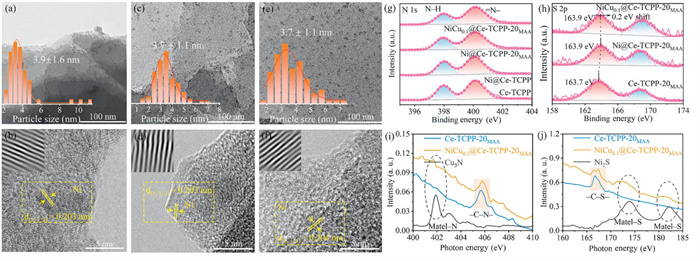
To investigate the chemical interactions between S elements and NPs, XPS and X-ray absorption near-edge structure (XANES) techniques were employed, and the results are shown in Figs. 1g-j. In the XPS analysis (Fig. 1h), the S 2p peak of NiCu0.1@Ce-TCPP-20MAA shifted by approximately 0.2 eV to higher binding energy relative to that of the pristine Ce-TCPP-20MAA, indicating an electron transfer from the S atoms to the M NPs [27]. In the S L-edge XANES spectra (Fig. 1j), two new broad peaks appeared at 174.5 and 182.9 eV for NiCu0.1@Ce-TCPP-20MAA compared to Ce-TCPP-20MAA. Based on the reference spectrum of Ni2S, these two characteristic peaks are indicative of the formation of Matel–S covalent bonds. Such covalent bonds effectively anchor the Ni NPs and inhibit their aggregation. In addition, the interaction between N and NPs was also analyzed. The N 1s XPS spectra of Ce-TCPP and Ce-TCPP-20MAA showed two characteristic peaks at 399.8 and 397.7 eV, corresponding to pyrrolic nitrogen (–NH) and iminic nitrogen (=N–) in the porphyrin framework, respectively. After NPs loading, the positions of these peaks remained essentially unchanged (Fig. 1g). Meanwhile, no significant Matel–N bonding absorption features were observed in the N K-edge XANES spectra of NiCu0.1@Ce-TCPP-20MAA (Fig. 1i). These results indicate that the nickel nanoparticles mainly interact with the –SH groups, while their electronic coupling with the nitrogen atoms in the porphyrin skeleton is relatively weak.
In this study, DCPD was selected as the reaction substrate to systematically evaluate the hydrogenation performance of Ni@Ce-TCPP, Ni@Ce-TCPP-XMAA, and NiCux@Ce-TCPP-XMAA catalysts. The target product, tetrahydrodicyclopentadiene (THDCPD), is a high-density aerospace fuel.
Using NiCu0.1@Ce-TCPP-20MAA as the catalyst, the hydrogenation pathway of DCPD was investigated. In the initial stage (0–10 min), selective hydrogenation occurred exclusively at the norbornene (NB) double bond, producing DHDCPD with 80% conversion. After 30 min, the NB bond was fully hydrogenated while the cyclopentene (CP) bond showed 45% conversion. By 45 min, DCPD was completely transformed into THDCPD (Fig. S10a in Supporting information). A three-step mechanism was proposed (Fig. S11 in Supporting information). (Ⅰ) Selective hydrogenation: Active hydrogen species preferentially adsorb at the NB sites, forming the intermediate DHDCPD. (Ⅱ) Competitive hydrogenation: As DHDCPD accumulates, its increased interaction with active hydrogen promotes gradual hydrogenation of the CP bond. During this stage, the NB and CP hydrogenation pathways compete dynamically. (Ⅲ) Deep hydrogenation: The transformation of DHDCPD to THDCPD remains, proceeding until the CP bond is fully saturated.
Reaction conditions were systematically examined (Figs. S10b and c in Supporting information). At 50 ℃, conversion was limited (66%) with no THDCPD formation due to insufficient activation of the CP bond. Raising the temperature to 60 ℃ enabled full conversion with selectivities of 61.8% (DHDCPD) and 38.2% (THDCPD), while 70 ℃ gave > 99% THDCPD selectivity, indicating efficient double-bond saturation under mild conditions. As shown in Fig. S10c, hydrogen pressure exhibited a positive correlation with catalytic performance, consistent with the gas–liquid mass transfer principles governed by Henry's law. Increased pressure enhanced the solubility of H2 in the solvent phase, thereby improving the transport efficiency of active hydrogen species to the catalyst surface. Based on a process economic evaluation, 2 MPa was identified as the optimal operating pressure, balancing high reaction efficiency with equipment safety and operational cost considerations.
To pinpoint the active sites responsible for hydrogenation in this catalytic system, the performance of Ce-TCPP and Ce-TCPP-20MAA was evaluated under conditions of 100 ℃, 2 MPa H2, and a reaction time of 10 h. As shown in Fig. 2a, each material displayed limited DCPD conversion, with values of 5% and 6%, respectively, indicating that the intrinsic catalytic activity of the MOF metal nodes was negligible. These findings confirm that Ni/Cu nanoparticles serve as the primary active sites for hydrogenation.
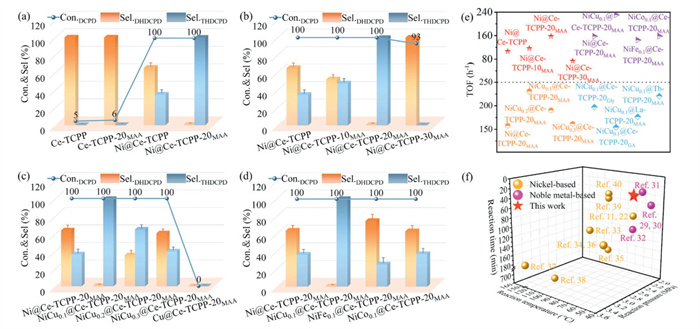
To further investigate the roles of –SH functional groups and Cu species on DCPD hydrogenation, the catalytic activities of Ni@Ce-TCPP, Ni@Ce-TCPP-XMAA, NiCux@Ce-TCPP-20MAA, and Cu@Ce-TCPP-20MAA were comparatively analyzed. The results reveal that Ni@Ce-TCPP could fully convert DCPD, reaching a THDCPD selectivity of 34.6%, thereby confirming the high H2 activation efficiency of the Ni NPs. Notably, the introduction of –SH groups (Ni@Ce-TCPP-20MAA) maintained full DCPD conversion while significantly enhancing THDCPD selectivity to > 99% (Fig. 2b). This improvement was likely attributed to the –SH-induced high dispersion of Ni nanoparticles, which increased the surface exposure of Ni and strengthened its synergistic adsorption and activation of H2 molecules and the substrate.
Building on this, doping 10% Cu enabled NiCu0.1@Ce-TCPP-20MAA to achieve 100% DCPD conversion and 100% THDCPD selectivity (Fig. 2c). In contrast, Cu@Ce-TCPP-20MAA achieved only 50% DCPD conversion, suggesting that Cu possesses relatively weak hydrogenation activity and is not the primary active site. But it can modulate the electronic structure of Ni, thereby indirectly enhancing the activation of H2 and C ═ C bonds. For comparison, other transition metals such as Fe and Co exhibited negligible effects on the hydrogenation performance of Ni (Fig. 2d). Importantly, the excessive introduction of Cu may led to the coverage of Ni active sites, thereby suppressing the overall hydrogenation activity [28].
In addition, to further investigate the effects of metal centers and anchoring groups, the hydrogenation performances of NiCu0.1@La-TCPP-20MAA, NiCu0.1@Tb-TCPP-20MAA, NiCu0.1@Ce-TCPP-20Gly, and NiCu0.1@Ce-TCPP-20GA were successfully prepared and evaluated (Figs. S12 and S13 in Supporting information). As shown in Fig. S13, all of these catalysts exhibited inferior performance compared to NiCu0.1@Ce-TCPP-20MAA. This could be attributed to the lack of redox flexibility in La and Tb compared to Ce, resulting in weaker metal–support interactions (Fig. S14 in Supporting information), The coordination ability of –NH2 and –OH groups with Ni is lower than that of –SH, resulting in reduced dispersion and electronic control capabilities of NPs. These findings further highlight the critical synergistic role of the Ce center and –SH groups in enhancing DCPD hydrogenation activity.
In summary, Ni nanoparticles played a key role as active centers in the hydrogenation of DCPD. Under the synergistic influence of –SH anchoring groups, Ce centers, and Cu, the Ni sites maintained high dispersion and stability, leading to markedly enhanced catalytic activity and selectivity, with NiCu0.1@Ce-TCPP-20MAA exhibiting the best overall performance (Fig. 2e).
Compared with previously reported Ni-based catalysts (such as Ni-53–700 and SiO2@Ni/C), the NiCu0.1@Ce-TCPP-20MAA in this work achieved 100% conversion and selectivity under mild conditions of 70 ℃, 2 MPa H2, and 45 min, exhibiting performance comparable to that of noble metal catalysts (such as Pd/UiO-67(Ce)-bpy and Ir@Ce-UiO-66-NO2) (Table S4 in Supporting information and Fig. 2f) [11,21,29–40]. This highlights its overall advantages in energy consumption, reaction conditions, and selectivity control, and underscores the potential of bimetallic regulation and chemical anchoring in constructing efficient hydrogenation catalytic systems.
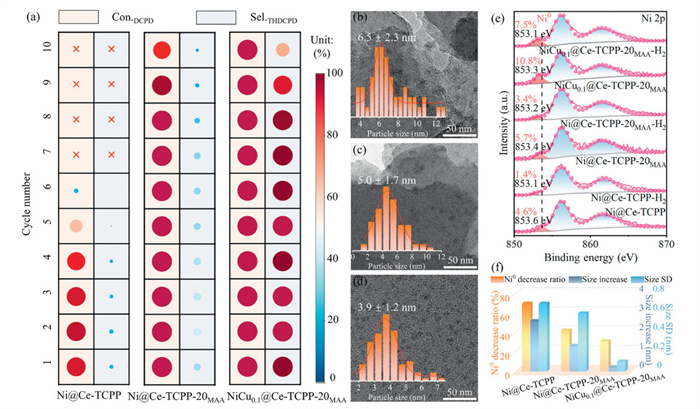
Catalyst stability is a critical performance parameter in practical applications. To evaluate this, we systematically investigated the cycling stability of Ni@Ce-TCPP, Ni@Ce-TCPP-20MAA, and NiCu0.1@Ce-TCPP-20MAA catalysts in the hydrogenation of DCPD under conditions of 70 ℃, 45 min, and 2 MPa hydrogen pressure (Fig. 3a and Table S5 in Supporting information). The results showed that NiCu0.1@Ce-TCPP-20MAA maintained 100% DCPD conversion and high selectivity toward THDCPD over eight consecutive cycles, demonstrating excellent hydrogenation stability. In the ninth cycle, the selectivity for THDCPD decreased by approximately 7%. To clarify the cause of this minor deactivation, we further analyzed the sulfur content, carbon deposition, and structural integrity of NiCu0.1@Ce-TCPP-20MAA. Elemental analysis showed that the sulfur content remained almost unchanged after hydrogenation (Table S6 in Supporting information). Thermogravimetric analysis (TGA) revealed the weight loss of NiCu0.1@Ce-TCPP-20MAA after hydrogenation increased by only 1.1%, indicating negligible carbon deposition (Fig. S15 in Supporting information). XRD, FT-IR, and BET analyses confirmed that the MOFs framework maintained its crystallinity and mesoporous structure, with no evident collapse (Figs. S16 and S17 in Supporting information). HRTEM revealed a slight increase in the average particle size of Ni nanoparticles from 3.7 ± 1.1 nm to 3.9 ± 1.2 nm (Fig. 3d), while XPS analysis revealed that the Ni0 content decreased from 10.8% to 7.5%, corresponding to a 31% reduction (Figs. 3e and f). Therefore, the slight decrease in THDCPD selectivity in the ninth cycle can be primarily attributed to minor Ni nanoparticle aggregation and surface oxidation. In contrast, Ni@Ce-TCPP-20MAA and particularly Ni@Ce-TCPP exhibited inferior stability. Ni@Ce-TCPP experienced a sharp decline in hydrogenation performance after just four cycles, with DCPD conversion dropping to 65%. XPS analysis showed that 70% of Ni0 species were oxidized, and HRTEM observations revealed that Ni nanoparticles, primarily located at the edges of the nanosheets, underwent severe aggregation and leaching, leading to a marked loss in catalytic performance (Fig. 3b). HRTEM analysis confirmed that the chemical anchoring effect of thiol groups in Ni@Ce-TCPP-20MAA effectively stabilized the Ni nanoparticles, which remained well- dispersed even after ten hydrogenation cycles, with an average particle size of 5.0 ± 1.7 nm (Fig. 3c). In NiCu0.1@Ce-TCPP-20MAA, Cu atoms were introduced to occupy specific positions in the Ni lattice, which disrupted the periodic arrangement of the monometallic phase and increased the atomic migration barrier, thereby significantly suppressing Ni oxidation and aggregation and enhancing nanoparticle stability (Fig. 3f) [41].
The interfacial interaction mechanism between Ni and the MOF supports was systematically investigated using XPS, electron paramagnetic resonance spectroscopy (EPR), and hydrogen temperature-programmed reduction (H2-TPR) characterizations, aiming to elucidate the regulatory effects of MAA and Cu introduction on the physicochemical properties of Ni and its hydrogenation catalytic activity. XPS was employed to investigate the regulatory effects of Ce-oxo clusters, –SH, and Cu on the electronic structure of Ni in the catalyst. As shown in Fig. S18a (Supporting information), the high-resolution Ni 2p spectrum was deconvoluted into three characteristic peaks corresponding to Ni0 (853.6 eV), Ni2+ (856.2 eV), and the associated satellite peak (861.6 eV) [42]. The Ce 3d spectrum, after peak fitting, was resolved into eight characteristic peaks, assigned to the spin–orbit splitting of the 3d3/2 and 3d5/2 energy levels (denoted as the u and v series, Fig. S18b in Supporting information). Among them, u′ (885.7 eV) and v′ (904.3 eV) are attributed to Ce3+ species, while u (882.5 eV), v (901.0 eV), u″ (887.9 eV), v″ (906.9 eV), u‴ (898.3 eV), and v‴ (916.9 eV) correspond to Ce4+ species [43]. The coexistence of Ce3+/Ce4+ can accurately control the valence distribution of loaded Ni NPs through dynamic electron modulation, which contributes to the significant enhancement of their catalytic activity [44]. Quantitative analysis of the peak area ratios of Ni0/Nitotal and Ce4+/Cetotal (Fig. S18c in Supporting information) revealed a typical volcano-shaped trend in both ratios with increasing MAA content in the Ni@Ce-TCPP-XMAA catalysts. EPR analysis revealed that MAA introduction increased MOFs defect density via competitive coordination with Ce nodes, while subsequent metal loading partially occupied these sites, reducing the defect density (Fig. 4a). These results indicate that –SH groups enable uniform Ni nucleation and dispersion by providing favorable coordination sites, thereby strengthening metal–support interactions and facilitating Ni–Ce electron transfer.
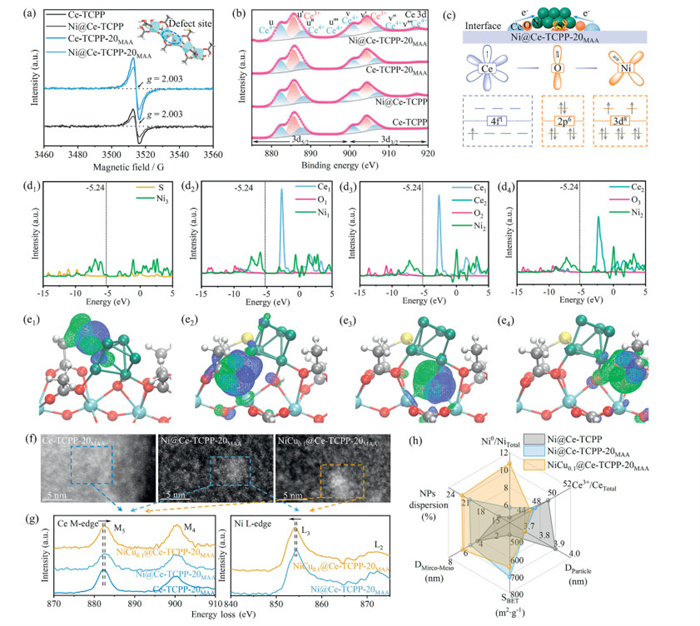
Based on XPS and electron energy loss spectroscopy (EELS) characterization, this study further elucidates the electron transfer mechanism at the Ce–O–Ni heterointerface in the Ni@Ce-TCPP-20MAA catalyst using a simplified electronic coupling model. As shown in Fig. 4b and Fig. S18 (Supporting information), Ni is primarily present in the Ni2+ oxidation state, indicating that it is stably anchored on the Ce matrix surface through Ni2+–O2- bonds. Compared to Ce-TCPP-20MAA, the proportion of Ce4+ in Ni@Ce-TCPP-20MAA increases significantly after the incorporation of Ni nanoparticles, suggesting that electron transfer occurs from Ce3+ to Ni2+ [45]. According to orbital hybridization theory, this electron transfer is mediated by a Ce3+–O2-–Ni2+ coupling mechanism. Specifically, the 4f orbitals of Ce3+ lie at relatively high energy levels and exhibit spin polarization characteristics, whereas the 3d orbitals of Ni2+ are lower in energy and tend to accept electrons to achieve a more stable electronic configuration (Fig. 4c). In the Ce–O–Ni bridge structure, the 2p orbitals of O2- can hybridize with both the 4f orbitals of Ce3+ and the 3d orbitals of Ni2+, establishing an indirect electron transfer pathway (Ce→O→Ni) that facilitates interfacial electron migration [46,47].
To elucidate the electronic coupling mechanism within the Ni@Ce-TCPP-20MAA catalytic system and its influence on catalytic performance, we conducted density of states, charge decomposition, and molecular orbital analyses to explore the interactions between MOFs and Ni nanoparticles at the electronic structure (Figs. 4d1-d4, 4e1-e4, and Fig. S19 in Supporting information). Total density of states (TDOS) analysis showed significant hybridization of molecular orbitals between Ce-TCPP-20MAA and Ni NPs, indicating the formation of stable chemical bonds between them (Fig. S19) [48,49]. Further charge decomposition analysis (CDA) revealed a net electron transfer of 0.968 a.u. from the MOFs to the Ni NPs, highlighting the critical role of MOFs in modulating the electronic structure of metal nanoparticles [50]. To further elucidate the electronic coupling mechanism, molecular orbital and electronic state analyses were performed, which clearly identified four main electron transfer pathways from MOFs to Ni NPs: Pathway 1 (S–Ni3) represents a direct interaction between sulfur atoms in the organic ligand and the Ni NPs. Pathways 2 (Ce1–O1–Ni1), 3 (Ce1/Ce2–O2–Ni2), and 4 (Ce2–O3–Ni2) involve Ce–O–Ni bridges, highlighting the synergistic electron-donating role of Ce–O coordination structures in enhancing Ni electronic density. These multi-channel electron transfer processes collectively endow the Ni@Ce-TCPP-20MAA catalytic system with an excellent ability to regulate electronic structure and provide a solid foundation for catalytic activity.
Compared with Ni@Ce-TCPP-20MAA, NiCu0.1@Ce-TCPP-20MAA exhibits an increase in Ni0/Nitotal from 5.7% to 10.8% and an increase in the Ni L3/L2 edge area ratio from 1.73 to 1.99, accompanied by a low-energy shift of the EELS characteristic edges (Figs. 4f and g, and Table S7 in Supporting information), indicating that the introduction of Cu significantly promotes the reduction of Ni [51]. This enhancement is primarily attributed to the higher standard reduction potential of Cu2+/Cu (+0.34 V) relative to Ni2+/Ni (−0.25 V), which allows Cu2+ to be preferentially reduced. This process generated nucleation sites that facilitated the subsequent reduction of Ni2+ by lowering its activation energy barrier. Furthermore, the comparatively lower electronegativity of Cu facilitates partial electron transfer from Cu to Ni, destabilizing the Ni2+ oxidation state and rendering it more susceptible to reduction [52,53]. Compared with Cu, Fe (−0.44 V) and Co (−0.28 V) have lower standard electrode potentials and thus lack the ability to be preferentially reduced to form nucleation sites, making it difficult to effectively regulate the reduction behavior of Ni2+ during the alloying process (Fig. S20 in Supporting information). Notably, as shown in Fig. S21 (Supporting information), when the Ni: Cu molar ratio reaches 10:1, the Ni0 content peaked at 10.8%. This suggests that moderate Cu loading favors the exposure of active Ni0 sites, while excessive Cu leads to dilution of the catalytically active Ni surface.
To better understand the correlation between the catalysts' electronic structures and their catalytic activity, we conducted a frontier orbital analysis (Fig. S22 in Supporting information). The calculated results show that the HOMO energy levels of Ce-TCPP-20MAA, Ni@Ce-TCPP-20MAA, and NiCu0.1@Ce-TCPP-20MAA increase successively from −6.84 eV to −5.53 eV and −5.41 eV. The upward shift of the HOMO indicates a decrease in electron binding energy and an enhancement in electron-donation capability, which is consistent with the stepwise improvement in catalytic activity observed experimentally. Further average local ionization energy (ALIE) calculations reveal that NiCu0.1@Ce-TCPP-20MAA exhibits the lowest local value (6.13 eV) around the NPs, suggesting that electrons in this region are more easily excited and involved in bond activation. These results collectively demonstrate that the evolution of the electronic structure is consistent with the experimental performance trend, providing theoretical support for the enhancement of key charge-transfer steps in the catalytic reaction.
The radar plot shows that MAA modulates structural defects and Ni dispersion through –SH chelation and competitive coordination of carboxyl groups, while Cu serves as preferential nucleation sites, facilitating charge redistribution and modulating the electronic state of Ni (Fig. 4h). This synergy optimizes the electronic structure and Ni0 enrichment, markedly improving hydrogenation activity. This conclusion is not only observed in Ce-TCPP based catalysts but also applicable to Ce-BTC (Figs. S23 and S24 in Supporting information).
H2-TPR analyses was conducted on Ni@Ce-TCPP, Ni@Ce-TCPP-20MAA, NiCux@Ce-TCPP-20MAA, and Cu@Ce-TCPP-20MAA (Figs. 5a and b). All samples exhibited broad, asymmetric reduction peaks in the temperature range of 200–300 ℃, corresponding to the stepwise reduction of metal oxides [54]. Among them, Ni@Ce-TCPP displayed the highest reduction temperature (243.5 ℃) and the largest peak area (0.087 a.u.), indicating the highest NiO content and the greatest reduction difficulty. Upon the introduction of –SH and Cu, both the NiO content and the reduction temperature decreased accordingly. All reduction profiles could be deconvoluted into a broad low-temperature H2 consumption peak and a sharper high-temperature peak. Specifically, the NiO reduction peak of Ni@Ce-TCPP-20MAA, modified with –SH, shifted significantly to a lower temperature of 198.9 ℃ with a reduced peak area of 0.056 a.u. This was attributed to the anchoring effect of thiol groups, which improved the dispersion of Ni nanoparticles and induced interfacial charge redistribution by enhancing EMSI, thereby weakening the Ni–O bond strength and lowering the reduction activation energy. With further introduction of Cu to form NiCux@Ce-TCPP-20MAA, the low-temperature reduction peak shifted further down to 189.3 ℃, and the peak area decreased to 0.048 a.u., confirming that Cu doping effectively accelerated the reduction kinetics of NiO. These results are consistent with the Ni0 content trends observed by XPS analysis (Fig. S20), providing strong experimental evidence for the regulation of electronic structure.
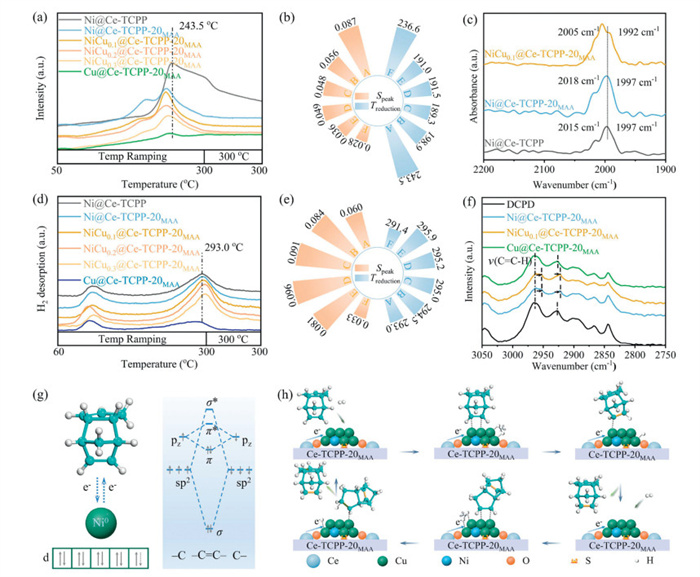
Using diffuse reflectance infrared (DRIFTS), hydrogen temperature-programmed desorption (H2-TPD), the adsorption behavior of the catalyst was systematically studied. First, to gain deeper insight into the adsorption behavior of surface metal sites in the catalytic materials, in-situ DRIFTS spectroscopy using CO as a probe molecule was performed on Ni@Ce-TCPP, Ni@Ce-TCPP-20MAA, and NiCu0.1@Ce-TCPP-20MAA (Fig. 5c and Fig. S25). The results showed that both Ni@Ce-TCPP and Ni@Ce-TCPP-20MAA exhibited characteristic CO adsorption bands in the ranges of 1975–2025 cm−1 and 2050–2250 cm−1 [55,56]. The bands above 2000 cm−1 are attributed to multicarbonyl (multi-coordinated) adsorption on Ni sites, while those below 2000 cm−1 correspond to linear adsorption. The peaks in the 2050–2250 cm−1 region are assigned to physisorbed CO. After purging with N2 for 10 min, the physisorbed CO peaks completely disappeared, while the chemisorbed CO peaks in the 1975–2025 cm−1 range remained stable, confirming the strong chemical bonding interaction between CO and Ni active sites in both catalysts. Notably, the intensity of the CO adsorption peak was significantly enhanced for Ni@Ce-TCPP-20MAA compared to Ni@Ce-TCPP, suggesting that the higher dispersion of Ni nanoparticles brings more exposed active sites, which increases the interaction between CO and Ni. For Cu@Ce-TCPP-20MAA, after N2 purging, vibrational peaks corresponding to multi-coordination adsorption (at 1997 cm−1) and linear adsorption (at 2019 and 2098 cm−1) were observed in the infrared absorption spectra. The absorption peaks of NiCu@Ce-TCPP-20MAA were similar to those of Ni@Ce-TCPP-20MAA, with characteristic peaks for multi-coordination adsorption at 1992 cm−1 and linear adsorption at 2005 cm−1, but with a notably increased proportion of linear adsorption. The introduction of Cu separates the continuous Ni atomic sites, thereby suppressing the multi-coordination adsorption of CO. These results provide important experimental evidence for optimizing the surface structure and adsorption properties of catalytic materials by modulating their metal composition.
To elucidate the characteristics of H2 adsorption sites in the Ni@Ce-TCPP, Ni@Ce-TCPP-20MAA, and NiCux@Ce-TCPP-20MAA materials, H2-TPD tests were conducted. As shown in Figs. 5d and e, the H2-TPD profiles of Ni@Ce-TCPP and Ni@Ce-TCPP-20MAA exhibit pronounced desorption peaks in the temperature ranges of 90–150 ℃ and 200–300 ℃, indicating that the Ni metal sites possess strong H2 adsorption capabilities. In contrast, although Ce-TCPP and Ce-TCPP-20MAA also show some desorption signals within similar temperature ranges, their desorption peak temperatures are lower and the amounts of adsorbed H2 are limited, suggesting that the intrinsic adsorption sites in the MOFs framework have weak affinity and insufficient binding strength for hydrogen [57]. Further comparison with the TPD results of Cu@Ce-TCPP-20MAA reveals that its H2 adsorption capacity is significantly lower than that of the Ni-containing materials, confirming that Ni0 species play a dominant role in H2 adsorption and dissociation. Upon the introduction of Cu to construct a NiCu bimetallic system, both the desorption temperature and the amount of H2 desorbed increase markedly, indicating that electronic coupling between Ni and Cu enhances the H2 adsorption strength of Ni. Moreover, calculations of metal site dispersion (Table S8 in Supporting information) show that the co-introduction of the MAA ligand and Cu significantly improves the dispersion of metal nanoparticles, thereby increasing the exposure of active sites, which is beneficial for optimizing surface adsorption and reaction kinetics during catalysis.
Furthermore, DCPD-DRIFTS characterization was carried out to investigate the adsorption behavior of DCPD on the catalytic materials (Fig. 5f). The DCPD molecule exhibits characteristic νCH stretching vibration peaks of the C ═ C bond at 2965 and 2929 cm−1. Both characteristic peaks are red-shifted (Δν ≈ 12–15 cm−1) when the Ni0 active site is present, indicating that the π-electron cloud of the C ═ C double bond is strongly electronically coupled to the Ni0 surface, resulting in a weakening of the bond energy of the double bond [26]. Specifically, the Ni0 surface contains multiple unpaired d-orbital electrons that can be transferred to the lowest unoccupied molecular orbital of the DCPD molecule, forming a π* antibonding interaction that weakens the C ═ C bond strength. This electron transfer renders Ni0 electron-deficient, while the π-electrons enriched on the sp2-hybridized carbon atoms in DCPD can back-donate to the d-orbitals of Ni0, further enhancing the electronic coupling between Ni0 and DCPD and promoting the activation of the C ═ C bond (Fig. 5g) [58,59]. In contrast, for the Cu@Ce-TCPP-20MAA material containing only Cu, the characteristic peaks of DCPD show no significant shift, indicating that Cu exhibits a weaker chemisorption effect on the C ═ C double bond. This phenomenon confirms that the adsorption and activation of the C ═ C bond primarily occurs at Ni sites rather than at Cu or potential Lewis acid sites within the MOFs.
Based on these findings, we propose a plausible reaction mechanism for DCPD hydrogenation over the NiCu0.1@Ce-TCPP-20MAA catalyst (Fig. 5h). Initially, both the H–H bond (H2) and the C ═ C double bond (the NB bond) are adsorbed onto the Ni0 active sites of the catalyst. The synergistic interaction between EMSI and Cu species promotes electron transfer, facilitates the formation of electron-rich Ni0 sites, and subsequently enhances the homolytic cleavage of H2 into reactive Hδ− species [2]. These Hδ− species then attack the activated NB bond at the Ni0 site, yielding the DHDCPD. After desorption into the solution, the DHDCPD molecule, which retains its C ═ C bond (the CP bond), is re-adsorbed onto Ni0 active sites on the catalyst surface. Subsequently, the CP bond undergoes hydrogenation by Hδ− species generated from adjacent Ni0 sites, completing the transformation of DHDCPD into the fully hydrogenated product, THDCPD. The mechanism reveals the critical role of dynamic adsorption-desorption cycles at Ni0 sites coupled with electronic synergistic effects in facilitating H2 cleavage and the stepwise activation of dual C ═ C bonds.
In summary, this study designed and prepared a MOFs catalyst, NiCu0.1@Ce-TCPP-20MAA, with highly dispersed NiCu NPs by precisely regulating the amounts of anchoring agent MAA and cocatalyst Cu. The catalyst achieved complete DCPD conversion and > 99% THDCPD selectivity under mild conditions and exhibited excellent stability with almost zero decay of catalytic activity after 8 consecutive cycles. The study shows that MAA regulated the pore structure of Ce-TCPP through competitive coordination and introduced –SH groups; the chemical anchoring interaction between –SH groups and metal precursors promoted the high dispersion of NiCu NPs, and enhanced the EMSI between Ce-TCPP and NiCu NPs through Ce–O–Ni electronic coupling. Due to its higher reduction potential, Cu species were preferentially reduced, significantly lowering the activation energy for the reduction of Ni2+. The synergistic effect of both factors formed highly active Ni sites with high dispersion and electron-rich characteristics. Meanwhile, the chemical anchoring effect of –SH and the lattice distortion caused by Cu lattice substitution effectively suppressed the sintering of Ni NPs, maintaining excellent hydrogenation performance. This study provides an important reference for the preparation of high-performance MNPs@MOFs catalysts to improve olefin hydrogenation performance.
Xinmeng Xu: Writing – original draft. Zuoshuai Xi: Writing – review & editing. Hongyi Gao: Writing – review & editing. Jing Lin: Conceptualization. Jingjing Wang: Conceptualization. Xiao Chen: Supervision. Ge Wang: Supervision, Funding acquisition.
The authors declare that they have no known competing financial interests or personal relationships that could have appeared to influence the work reported in this paper.
This work was supported by the National Natural Science Foundation of China (No. 52373261), National Key R & D Program of China (No. 2021YFB3500700) and the Fundamental Research Funds for the Central Universities (No. FRF-BD-25–004). Thanks to SuperComputing Network for providing computing services. We thank the staff members of the Catalysis and Surface Science Endstation at the BL11U beamline (
Supplementary material associated with this article can be found, in the online version, at doi:
C.F. Xia, X. Wang, C.H. He, et al., J. Am. Chem. Soc. 146 (2024) 20530–20538. doi: 10.1021/jacs.4c07502
C.S. Yang, S.C. Ma, Y.M. Liu, et al., Nat. Commun. 15 (2024) 540. doi: 10.1109/icasspw62465.2024.10626762
H. Liu, J. Zhao, Q. Li, et al., Chin. Chem. Lett. 36 (2025) 110593. doi: 10.1016/j.cclet.2024.110593
Z.S. Xi, X.M. Xu, H.Y. Gao, et al., ACS Catal. 15 (2025) 16144–16155. doi: 10.1021/acscatal.5c03214
J. Ballesteros-Soberanas, N. Martín, M. Bacic, et al., Nat. Catal. 7 (2024) 452–463. doi: 10.1038/s41929-024-01130-7
J.C. Ji, H.L. Zhuang, L. Zhou, et al., Appl. Catal. B 35 (2025) 2421357.
X.L. Guo, C. Feng, Z.H. Yang, et al., ACS Nano 19 (2025) 2788–2798. doi: 10.1021/acsnano.4c15582
X. Tang, C.Q. Song, H.B. Li, et al., Nat. Commun. 15 (2024) 3115. doi: 10.1038/s41467-024-47403-4
J. Gong, F.L. Zheng, H.Q. Zhang, et al., Chin. Chem. Lett. 36 (2025) 111122. doi: 10.1016/j.cclet.2025.111122
D.D. He, Y.M. Zhang, T. Li, et al., Adv. Funct. Mater. 35 (2025) 2412895. doi: 10.1002/adfm.202412895
Z.Y. Liu, Y. Gao, C.A. Wang, et al., Chem. Eng. J. 512 (2025) 162497. doi: 10.1016/j.cej.2025.162497
S.N. Chen, L. Costley-Wood, I. Lezcano-Gonzalez, et al., Appl. Catal. B 366 (2025) 125029. doi: 10.1016/j.apcatb.2025.125029
C.X. Wang, H.X. Liu, H. Gu, et al., Nat. Commun. 15 (2024) 8290. doi: 10.1038/s41467-024-52547-4
L.Q.Q. Yang, T.C. Pu, F. Tian, et al., J. Environ. Sci. 140 (2024) 270–278. doi: 10.1016/j.jes.2023.08.028
J.Y. Zhang, Y.Y. Li, H.H. Song, et al., Nat. Commun. 15 (2024) 8566. doi: 10.1038/s41467-024-50729-8
M.L. Barsoum, K.M. Fahy, W. Morris, et al., ACS Nano 19 (2025) 13–20. doi: 10.1021/acsnano.4c14744
D.F. Zhao, J. Lin, R.S. Li, et al., Chin. Chem. Lett. 36 (2025) 110172. doi: 10.1016/j.cclet.2024.110172
S. Mourdikoudis, S. Dutta, S. Kamal, et al., Adv. Mater. 37 (2025) 2415399. doi: 10.1002/adma.202415399
Z.X. Li, X.F. Qiu, P.Q. Liao, Chin. Chem. Lett. 36 (2025) 110473. doi: 10.1016/j.cclet.2024.110473
J.J. Long, Q.L. Yao, X.L. Zhang, et al., Appl. Catal. B 320 (2023) 121989. doi: 10.1016/j.apcatb.2022.121989
R.S. Li, T. Ban, D.F. Zhao, et al., Chin. J. Catal. 72 (2025) 344–358. doi: 10.1016/S1872-2067(24)60284-6
J.L. Wang, L.X. Ren, Y. Kong, et al., Adv. Funct. Mater. 35 (2025) 2421357. doi: 10.1002/adfm.202421357
L.Y. Duan, T. Cheng, Y.Y. Zhu, et al., Inorg. Chem. 64 (2025) 1983–1993. doi: 10.1021/acs.inorgchem.4c04753
J. Li, Y. Liu, Y. Ai, et al., Chem. Eng. J. 354 (2018) 790–801. doi: 10.1016/j.cej.2018.08.041
L.J. Zhou, M.Y. Li, W. Wang, et al., Nano Res. 15 (2022) 9890–9905. doi: 10.1007/s12274-022-4320-8
R.S. Li, T. Ban, D.F. Zhao, et al., Nano Res. 17 (2024) 9550–9563. doi: 10.1007/s12274-024-6954-1
C.L. Yang, L.N. Wang, P. Yin, et al., Science 374 (2021) 459–464. doi: 10.1126/science.abj9980
F. Tang, L. Wang, M. Dessie Walle, et al., J. Catal. 383 (2020) 172–180. doi: 10.1016/j.jcat.2020.01.019
Z.Y. Liu, L.M. Wang, C.A. Wang, et al., Chem. Eng. J. 479 (2024) 147601. doi: 10.1016/j.cej.2023.147601
Z.Y. Liu, C.A. Wang, P. Yang, et al., Chin. J. Catal. 64 (2024) 112–122. doi: 10.1016/S1872-2067(24)60095-1
R.S. Li, L.M. Wang, P.Y. Zhou, et al., Chin. J. Catal. 56 (2024) 150–165. doi: 10.1016/S1872-2067(23)64562-0
T. Ban, L. Yu, R. Li, et al., Carbon Neutral 4 (2025) e70004.
X. Gao, H.H. Zhang, J.Y. Guan, et al., ACS Omega 6 (2021) 11570–11584. doi: 10.1021/acsomega.1c00779
Y.A. Li, D.D. Jia, Z.P. Tao, et al., RSC Adv. 12 (2022) 9044–9050. doi: 10.1039/d2ra00238h
T. Li, J. Chen, D.D. Jia, et al., Mater. Today Chem. 43 (2025) 102521. doi: 10.1016/j.mtchem.2025.102521
D.D. Jia, J. Zhao, R. Yan, et al., Energy Fuels 38 (2024) 12625–12631. doi: 10.1021/acs.energyfuels.4c01644
Z.Q. Fang, D.X. Shi, N. Lin, et al., Appl. Catal. A 574 (2019) 60–70. doi: 10.1016/j.apcata.2019.01.026
D.D. Jia, J. Zhao, Z.P. Tao, et al., Carbon 184 (2021) 855–863. doi: 10.1016/j.carbon.2021.09.002
F.J. Hu, R.S. Li, D.F. Zhao, et al., Appl. Surf. Sci. 697 (2025) 163022. doi: 10.1016/j.apsusc.2025.163022
F.J. Hu, D.F. Zhao, R.S. Li, et al., J. Mater. Chem. A 13 (2025) 11874–11885. doi: 10.1039/d5ta00599j
L.C. Liu, A. Corma, Chem. Rev. 123 (2023) 4855–4933. doi: 10.1021/acs.chemrev.2c00733
D.Z. Li, H.M. Liu, X.W. Xiao, et al., Chin. J. Catal. 70 (2025) 399–409. doi: 10.1016/S1872-2067(24)60249-4
X.M. Xu, Z.S. Xi, D.F. Zhao, et al., J. Colloid Interface Sci. 679 (2025) 1159–1170. doi: 10.1016/j.jcis.2024.10.048
P. Lozano-Reis, P. Gamallo, R. Sayós, et al., ACS Catal. 14 (2024) 2284–2299. doi: 10.1021/acscatal.3c05336
Y.Y. Li, X.Y. Zhang, Z.P. Zheng, Small 18 (2022) 2107594. doi: 10.1002/smll.202107594
M. Li, X. Wang, K. Liu, et al., Adv. Mater. 35 (2023) 2302462. doi: 10.1002/adma.202302462
X. Wang, J.W. Wang, P. Wang, et al., Adv. Mater. 34 (2022) 2206540. doi: 10.1002/adma.202206540
H. Liu, W.L. Liu, G.X. Xue, et al., J. Am. Chem. Soc. 145 (2023) 11085–11096. doi: 10.1021/jacs.3c00460
S.X. Liu, Y. Wang, K.F. Lyu, et al., Nat. Synth. 3 (2024) 1158–1167. doi: 10.1038/s44160-024-00585-7
C.S. Cao, J.Z. Wang, X.Y. Yu, et al., Appl. Catal. B 277 (2020) 119222. doi: 10.1016/j.apcatb.2020.119222
J.H. Seo, S. Na, S.J. Ahn, et al., J. Phys. Chem. C 128 (2024) 9099–9104. doi: 10.1021/acs.jpcc.4c00600
J.C. Hao, Z.C. Zhuang, J.C. Hao, et al., Adv. Energy Mater. 12 (2022) 2200579. doi: 10.1002/aenm.202200579
J.B. Zhu, M.L. Xiao, D.Z. Ren, et al., J. Am. Chem. Soc. 144 (2022) 9661–9671. doi: 10.1021/jacs.2c00937
C.L. Wang, J.B. Lv, X. Guo, et al., ACS Catal. 15 (2025) 2961–2976. doi: 10.1021/acscatal.4c06675
C. Hernández Mejía, J.E.S. van der Hoeven, P.E. de Jongh, et al., ACS Catal. 10 (2020) 7343–7354. doi: 10.1021/acscatal.0c00777
W. Liu, H.S. Feng, Y.S. Yang, et al., Nat. Commun. 13 (2022) 3188. doi: 10.3390/math10173188
Y.X. Liu, X.G. Wang, Z.H. Wang, et al., ACS Catal. 14 (2024) 12610–12622. doi: 10.1021/acscatal.4c02289
Y. Guo, R. Zhang, S.C. Zhang, et al., Angew. Chem. Int. Ed. 63 (2024) e202401501. doi: 10.1002/anie.202401501
Z.W. Wang, Y.Y. Kang, Y.Z. Shi, et al., Appl. Catal. B 340 (2024) 123162. doi: 10.1016/j.apcatb.2023.123162

Figure 1 HRTEM images and size distribution for (a, b) Ni NPs of Ni@Ce-TCPP, (c, d) Ni@Ce-TCPP-20MAA, and (e, f) NiCu0.1@Ce-TCPP-20MAA. The corresponding high-resolution XPS spectra of (g) N 1s and (h) S 2p XANES spectra at the (i) N K-edge and (j) S L-edge were recorded for Ce-TCPP-20MAA, NiCu0.1@Ce-TCPP-20MAA, and reference compounds Cu3N and Ni2S.

Figure 2 DCPD conversion (Con.DCPD) and THDCPD selectivity (Sel.THDCPD) for (a) MOFs before and after loading Ni NPs, (b) Ni@Ce-TCPP-XMAA (X = 0, 10, 20, 30), (c) Ni@Ce-TCPP-20MAA, NiCux@Ce-TCPP-20MAA (x = 0.1, 0.2, 0.3) and Cu@Ce-TCPP-20MAA, (d) Ni@Ce-TCPP-20MAA and NiM0.1@Ce-TCPP-20MAA (M = Cu, Fe, Co). Hydrogenation conditions: 70 ℃, 2 MPa H2, (a) 60 min, (b-d) 45 min. (e) TOF values per C = C bond of all catalytic materials. (f) Comparison chart of DCPD hydrogenation conditions between noble metal- and Ni-based catalytic materials (see Table S4 in Supporting information for details, 100% DCPD conversion and > 99% THDCPD selectivity).

Figure 3 (a) Hydrogenation cycle performance of Ni@Ce-TCPP, Ni@Ce-TCPP-20MAA, and NiCu0.1@Ce-TCPP-20MAA. HRTEM image after hydrogenation of (b) Ni@Ce-TCPP, (c) Ni@Ce-TCPP-20MAA, and (d) NiCu0.1@Ce-TCPP-20MAA. (e) Ni 2p XPS spectra and (f) the evolution of Ni0 content and particle size before and after hydrogenation.

Figure 4 (a) EPR maps and (b) Ce 3d XPS spectra of Ce-TCPP and Ce-TCPP-20MAA before and after loading Ni NPs. (c) Schematic electronic coupling of Ni@Ce-TCPP-20MAA. PDOS of (d1) S–Ni3, (d2) Ce1–O1–Ni1, (d3) Ce1/Ce2–O2–Ni2, and (d4) Ce2–O3–Ni2. Schematic of representative electron transfer pathways in Ni@Ce-TCPP-20MAA based on molecular orbital analysis: (e1) S–Ni3, (e2) Ce1–O1–Ni1, (e3) Ce1/Ce2–O2–Ni2, and (e4) Ce2–O3–Ni2. (f) HAADF-STEM images and (g) EELS spectra of Ce M-edge and Ni L-edge. (h) Radar image of pore structure, NPs particle size, Ni0/NiTotal, and Ce3+/CeTotal for Ni@Ce-TCPP, Ni@Ce-TCPP-20MAA, and NiCu0.1@Ce-TCPP-20MAA.

Figure 5 (a, b) H2-TPR profiles, (c) CO-DIRFTS spectra, (d, e) H2-TPD profiles and (f) DCPD-DIRFTS spectra of catalytic materials. (g) The possible electronic interaction between Ni0 and C=C bond orbital. (h) The potential mechanism of DCPD hydrogenation on the surface of NiCu0.1@Ce-TCPP-20MAA.

 扫一扫看文章


扫一扫关注我们
 DownLoad:

 下载:
 下载: