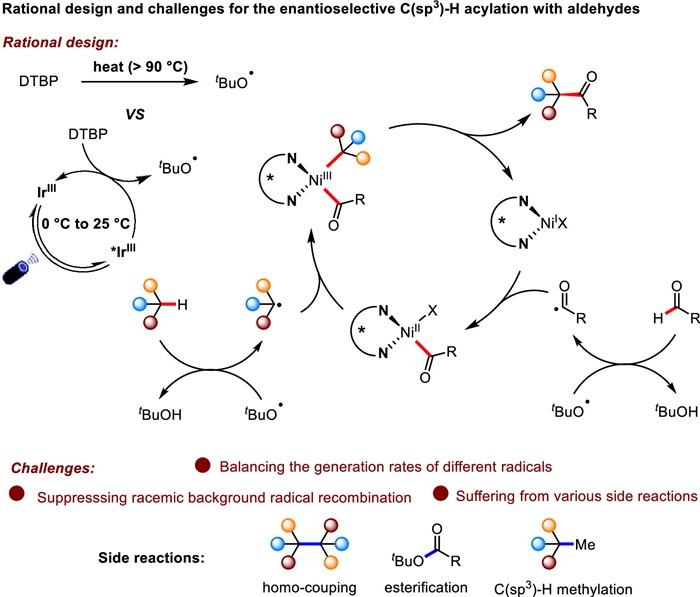
Scheme 1.
The authors’ rational design.

Direct and enantioselective acylation of diverse C(sp3)−H bonds with aldehydes
Fei Yao , Yifan Fan , Bing-Feng Shi , Tao Tu


Chiral ketones bearing α-aryl, α-amino, or α-oxy substituents are common structural motifs in natural products and pharmaceuticals. They also serve as key precursors to valuable chiral building blocks, such as chiral diols and amino alcohols. Although significant progress has been made in enantioselective C(sp3)–H acylation to access chiral ketones, most reported methods rely on the preactivation of acylating reagents—converting carboxylic acids into highly reactive acid anhydrides or acyl chlorides—which compromises atom economy [1,2]. In contrast, aldehydes are widely available and atom-economical acylating reagents that readily generate acyl radicals via a hydrogen atom transfer (HAT) mechanism [3,4], thus avoiding substrate preactivation. Early pioneering studies successfully achieved C(sp3)–H acylation using aldehydes as the acylating reagent. For example, in 2020, the Murakami group reported a nickel/photoredox dual catalytic system for the dehydrogenative coupling of benzylic C(sp3)–H bonds with aldehydes; mechanistic studies corroborated the intermediacy of both benzylic and acyl radical species [5]. In 2023, the Montgomery group achieved the oxidative cross-coupling of α-amino C(sp3)–H bonds with aldehydes using peroxides as HAT reagents and Zn as a reducing agent. Mechanistic investigations supported the existence of α-amino radicals and acyl radicals [6]. Despite these remarkable advances, a critical limitation persisted: the development of a general and highly enantioselective catalytic system for the oxidative dehydrogenative coupling of C(sp3)–H bonds with aldehydes remains highly desirable yet largely unmet.
Recently, the Kong group reported a breakthrough that finally fills this gap [7]. They proposed an asymmetric oxidative dehydrogenative coupling of readily available hydrocarbons with aldehydes using DTBP as a single-electron transfer reagent to access chiral α-keto compounds. To achieve high enantioselectivity, a nickel/photoredox dual catalytic strategy was devised (Scheme 1). Under light irradiation, a trivalent iridium photosensitizer is excited and promotes the slow decomposition of DTBP at ambient or low temperatures, generating tert-butoxy radicals. These radicals serve as single-electron transfer agents, abstracting electrons from both C(sp3)–H and aldehyde C–H bonds to produce alkyl and acyl radicals, respectively, which then enter the catalytic cycle. The proposed mechanism begins with a nickel(Ⅰ) complex formed by coordination of nickel(Ⅰ) with a chiral bidentate nitrogen ligand. This complex captures an acyl radical to generate a nickel(Ⅱ) species, which subsequently captures an alkyl radical to afford a nickel(Ⅲ) intermediate. Reductive elimination then delivers the desired product and regenerates the nickel(Ⅰ) catalyst, closing the cycle. A key challenge of this design is to balance the generation rates of the various radicals while avoiding metal-free radical self-coupling and cross-coupling. The elegance of the reaction lies in the use of a trivalent iridium photosensitizer, which enables the slow decomposition of the relatively reactive DTBP at low temperatures, thereby keeping radical concentrations consistently low and minimizing side reactions. Moreover, the low reaction temperature and the rigid chiral environment provided by the bidentate chelating nitrogen ligand both favor stereocontrol. Building on this design, Kong and co-workers successfully achieved the enantioselective synthesis of chiral α-keto compounds via nickel/photoredox dual catalysis. Using an Ir photosensitizer and a chiral Ni/bisoxazoline complex, this strategy enables the asymmetric cross-coupling of benzylic, α-amino, and α-oxy C(sp3)–H bonds with aldehyde C–H bonds. The reaction proceeds under mild conditions (0–25 ℃) upon irradiation with a 1 W blue light source, without the need for an external base, thus demonstrating excellent atom economy.
The reaction exhibits good substrate scope (Scheme 2). Various arenes bearing different substituents on the alkyl chain, including silyl ether, cyano, and amide groups, undergo smooth acylation at the benzylic position (1–4). Notably, when both an amide ortho C(sp3)–H bond and a benzylic C(sp3)–H bond are present, the reaction occurs selectively at the benzylic position (4). A wide range of aldehydes are compatible with this benzylic acylation, including those bearing tert-butyl groups (5), amide moieties (6), or those derived from drug molecules (7 and 8). Moreover, this strategy is also applicable to the enantioselective acylation of C(sp3)–H bonds in saturated nitrogen- or oxygen-containing heterocycles. Various N-heterocycles, such as pyrrolidines and piperidines, undergo acylation with high enantioselectivity (9 and 10). Notably, the cyclic ketal derived from ethylene glycol can be acylated to afford compound 11, which can be further converted into the valuable chiral 1,2,3-triol fragment. Direct C(sp3)–H acylation of (-)-ambroxide, a complex sclareol-based diterpenoid, proceeded smoothly to give product 12 with excellent diastereoselectivity. Remarkably, this method also enables the acylation of C(sp3)–H bonds adjacent to the nitrogen atom of acyclic amides. Benzamides bearing alkyl chains with various substituents are all compatible with this reaction (13–17). Notably, when both the α-methylene C–H bond adjacent to the amide nitrogen and that adjacent to an oxygen atom are present in the substrate, despite their similar bond dissociation energies, the reaction occurs with high regioselectivity and enantioselectivity at the α-position of the nitrogen atom (15 and 16).

In summary, the Kong group has developed a general and powerful nickel/photoredox dual catalytic strategy for the enantioselective acylation of C(sp3)–H bonds at benzylic, α-amino, and α-oxy positions. This approach enables the synthesis of chiral α-substituted ketones with high enantioselectivity and provides access to important structural motifs found in natural products and pharmaceuticals. By integrating nickel catalysis, photocatalysis, and single-electron transfer, the method uses readily available hydrocarbons and aldehydes as starting materials to achieve asymmetric oxidative dehydrogenative coupling under mild conditions. It overcomes the limitation of previous work that required preactivation of acylating reagents, thereby achieving high atom economy. The slow, photocatalyzed decomposition of peroxides at low temperatures controls radical generation rates and minimizes side reactions. The rigid bidentate chelating environment provided by a bisoxazoline chiral ligand ensures excellent stereocontrol. The ingenious design of this strategy offers valuable inspiration and new insights for nickel/photoredox dual-catalyzed C(sp3)–H functionalization reactions proceeding through radical pathways.
Fei Yao: Conceptualization. Yifan Fan: Data curation. Bing-Feng Shi: Data curation. Tao Tu: Data curation.
The authors declare that they have no known competing financial interests or personal relationships that could have appeared to influence the work reported in this paper.
C.L. Joe, A.G. Doyle, Angew. Chem. Int. Ed. 55 (2016) 4040–4043. doi: 10.1002/anie.201511438
L. Huan, X. Shu, W. Zu, D. Zhong, H. Huo, Nat. Commun. 12 (2021) 3536–3543.
H. Cao, X. Tang, H. Tang, Y. Yuan, J. Wu, Chem Catal. 1 (2021) 523–598.
T. Li, Z. Xu, Y. Huang, W. Zu, H. Huo, J. Am. Chem. Soc. 147 (2025) 10999–11009. doi: 10.1021/jacs.4c15275
T. Kawasaki, N. Ishida, M. Murakami, J. Am. Chem. Soc. 142 (2020) 3366–3370. doi: 10.1021/jacs.9b13920
M. Chen, A.M. Ventura, S. Das, et al., J. Am. Chem. Soc. 145 (2023) 20176–20181. doi: 10.1021/jacs.3c06532
Z. Zhou, F. Hu, X. Lin, Y. Ping, W. Kong, J. Am. Chem. Soc. 148 (2026) 7113–7123. doi: 10.1021/jacs.5c18382

 扫一扫看文章


扫一扫关注我们
 DownLoad:

 下载:

 下载: