School of Chemistry and Materials Science, Jiangsu Key Laboratory of New Power Batteries, Jiangsu Collaborative Innovation Center of Biomedical Functional Materials, Nanjing Normal University, Nanjing 210023, China
b.
School of Chemistry and Chemical Engineering, Southeast University, Nanjing 211189, China
Received Date:
04 May 2025 Accepted Date:
24 September 2025 Revised Date:
09 August 2025 Available Online:
15 November 2026
Abstract:
Oxygen evolution reaction (OER) is a pivotal key-reaction in energy technologies, facing kinetic challenges due to multi-step electron transfer. Spinel oxides (AB2O4) emerge as promising OER catalysts owing to their dual-cation coordination, enabling electronic structure tailoring. However, their intrinsic configuration favors the adsorbate evolution mechanism (AEM) with a theoretical limitation due to scaling relationships between *OOH and *O intermediates. To overcome the limitation, implementation of the lattice oxygen-mediated mechanism (LOM) becomes imperative. Compared with the AEM, the LOM enables direct O—O coupling to circumvent the inherent scaling relationship limitations, thus arousing widespread attention from researchers. Herein, we firstly systematically investigate the activation prerequisites for transformation from the AEM to the LOM in spinel oxides. Subsequently, rational design strategies to tailor LOM-dominant spinel oxide catalysts are comprehensively summarized. Finally, critical challenges in commercialization are subsequently addressed, outlining a roadmap for advancing these high-performance materials toward industrial energy conversion applications.
Oxygen evolution reaction (OER) is a key half-reaction in water splitting [1-6] and metal-air batteries [7-12], playing a crucial role in electrochemical energy conversion and storage technologies [13-17]. Nevertheless, the high energy barriers in the multi-step electron transfer processes hinder the reaction kinetics of OER [18-23]. Therefore, the rational design of high-performance and cost-effective OER electrocatalysts is imperative to enhance the efficiency of energy conversion systems and increase the capacity of storage technologies. Spinel oxides (AB2O4) stand out among metal-based electrocatalysts due to their unique dual-cation coordination structures [10,24-29], where generally A-site (A = Li, Mn, Mg, Zn) cations occupy tetrahedral interstices and B-site (B = Fe, Co, Ni, Al) cations reside in octahedral coordination within a cubic close-packed oxygen framework [30,31]. This distinct structural configuration enables unparalleled flexibility in tailoring electronic structures through diverse cation combinations and multiple cation distribution in two types of coordination units [32-40]. As a result, spinel oxides have been considered as promising candidates for OER catalysts.
However, the catalytic activity of most pristine spinel oxides is limited due to their intrinsic structural configuration, which favors the OER to proceed via the sluggish adsorbate evolution mechanism (AEM) [41]. A universal scaling relationship between the binding energies of *OOH and *O imposes a theoretical minimum overpotential of 370 mV [42-47], posing a significant challenge for further performance enhancement in this pathway. To address this issue, it is essential to gain a deeper understanding of the spinel oxide structure, which can guide the development of effective strategies for overcoming this limitation. For spinel oxides, each oxygen atom is shared by one tetrahedral cation and three octahedral cations. Strong inter-cationic interactions between adjacent transition metal sites weaken the electronic polarization from oxygen anions to metal cations, leading to a low oxygen 2p-band center and reduced oxygen 2p-metal d hybridization. Given this, enhancing oxygen 2p-metal d hybridization to activate oxygen as the redox center and trigger the lattice oxygen-mediated mechanism (LOM) presents a viable strategy to overcome the linear scaling limitation [48-52]. The LOM process enables direct O—O coupling [51,53], circumventing the scaling relationship and breaking the theoretical overpotential barrier [54]. Therefore, a comprehensive understanding of oxygen 2p-metal d hybridization and its influence on OER mechanism plays a key role for spinel oxides and their OER applications [55-61].
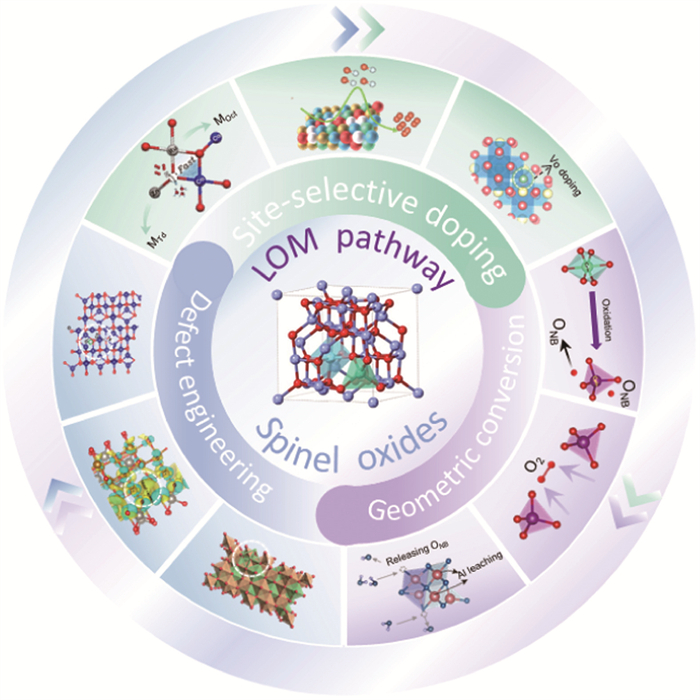
In this review, we focus on the recent advances in the transition of the OER mechanism in spinel oxides from the AEM to the LOM. Firstly, we provide a comprehensive overview of the fundamental reaction pathways of both mechanisms, highlighting their distinct redox centers in the OER process. Given that the redox center is inherently influenced by the electronic structure, we then summarize the electronic properties of spinel oxides to establish the criteria for activating lattice oxygen as the redox center. Next, we discuss effective strategies for triggering LOM in spinel oxides through electronic structure modulation (Fig. 1). Finally, several challenges and perspectives related to the design and commercial application of spinel oxide OER catalysts are discussed. We hope that this review can provide valuable insights for the development of more efficient spinel oxide OER catalysts.
Figure 1
Figure 1.
(a) Schematic diagram of rational design strategies and regulatory targets for spinel oxides to follow the LOM pathway. Reproduced with permission [41,55-59]. Copyright 2023, 2024, Wiley-VCH. Reproduced with permission [60]. Copyright 2023, The Royal Society of Chemistry. Reproduced with permission [61]. Copyright 2023, Elsevier B.V.
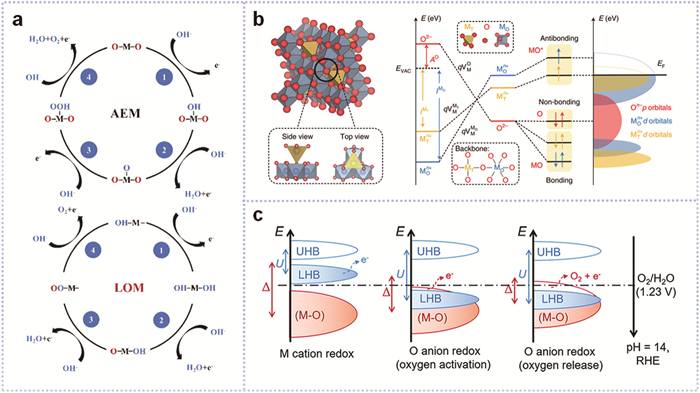
In spinel oxides, two classical OER mechanisms have been proposed and validated through both experimental studies and density functional theory (DFT) calculations [62-65]. Based on the primary redox centers involved, these mechanisms are categorized into two distinct pathways: The AEM and the LOM (Fig. 2a). In the traditional AEM pathway, only metal sites act as active centers during the OER process. As illustrated in Fig. 2a, four main steps occur: (1) The active metal site (M) absorbs water molecules via unoccupied d-orbitals, forming a surface hydroxyl intermediate (M-OH); (2) Subsequent metal oxidation drives deprotonation, leading to the formation of M-O bond; (3) The metal center facilitates electron transfer, enabling the coupling of *O with an oxygen donor species (such as OH- or H2O), leading to the formation of the *OOH intermediate; (4) Oxygen molecules are released through *OOH deprotonation, regenerating the initial M active site. The LOM pathway shares the initial two steps with AEM through similar adsorbate processes. However, from the third step onward, the LOM pathway demonstrates unique mechanistic features through its utilization of lattice oxygen as dynamic redox centers: (3) The enhanced M-O covalency facilitates the activation of lattice oxygen into highly reactive O- species, which enables direct coupling between the adsorbed *O intermediate and activates lattice oxygen for molecular oxygen evolution; (4) The oxygen release process generates an oxygen vacancy defect, which undergoes regenerative healing in subsequent cycles via water molecule adsorption at the metallic active site. The reformation of M-OH bonds completes the catalytic cycle by replenishing the oxygen lattice. This lattice oxygen-mediated mechanism emphasizes the dynamic participation of lattice oxygen species in both oxidative and regenerative phases of the catalytic process.
Figure 2
Figure 2.
(a) Schematic representation of the AEM pathway and the LOM pathway during the OER process. Reproduced with permission [63]. Copyright 2025, Elsevier B.V. (b) The crystal structure and the formation of a density of states (DOS) diagram of spinel oxide. Reproduced with permission [64]. Copyright 2020, Springer Nature. (c) The schematic representations of cation/anion redox chemistry guided by U and Δ, which manifest conventional metal cation oxidation (left), oxygen anion oxidation (middle) and direct oxygen anion release (right) for OER, respectively. Reproduced with permission [65]. Copyright 2021, The Royal Society of Chemistry.
This mechanistic divergence originates from the differences in electron source near the Fermi level: Whether the electrons come from oxygen 2p-band or metal d-band. The energy band with higher energy states, located closer to the Fermi level, preferentially releases electron and emerges as the dominant redox center. In order to explore the electronic states near the Fermi level, Zaanen et al. (1985) first proposed that the Hubbard parameter (U) and charge transfer energy (∆) can serve as critical descriptors for characterizing redox activity behavior [66,67]. When U << ∆ (Fig. 2c), the metal d-band center resides at a higher energy level than the oxygen 2p-band center. Electrons participating in the OER exclusively originate from the metal d-band, with transition metal cations functioning as both active adsorption sites for reaction intermediates and primary redox centers. In this case, the OER process follows the AEM pathway. Conversely, when U >> Δ, the ligand holes (O 2p character) become energetically more favorable than creating d-electron holes upon oxidation [68-71], thereby activating the LOM pathway. Therefore, precise control of the reaction mechanism requires tailored regulation of the relative magnitudes between U and Δ. While U is constrained by intrinsic material properties with limited tunability and negligible effect, Δ is directly governed by M-O orbital interactions, which can be effectively modulated through simple and feasible chemical approaches such as doping and defect engineering. This enables targeted reduction of Δ to fulfill two conditions of activity and priority to activate the LOM: (1) The oxygen 2p-band is elevated, positioning oxygen non-bonding states (ONB) closer to the Fermi level; (2) The energy of the ONB is higher than that of both d bonding orbitals of MOct and MTd to ensure that the lattice oxygen acts as the primary redox center rather than the metal acts as the sole redox center.
3.
Rational design strategies for LOM-dominant spinel oxides
Through in-depth analysis of the aforementioned activation principle, it is established that modulating the charge transfer energy Δ lies at the core of activating the LOM. Recent studies focus on reducing Δ to directionally activate the LOM pathway for the fundamental goal of disrupting the conventional metal-dominant redox paradigm, resulting in transforming lattice oxygen from an inert site to an active participant. The most universal strategies for Δ regulation can be categorized into three approaches: Site-selective doping, defect engineering, and geometric conversion. These strategies decrease the Δ by either selectively modifying specific components of the M-O coordination unit or optimizing charge transfer kinetics between metal and oxygen, thereby shifting the oxygen 2p-band upward and prioritizing its involvement in electron transfer processes.
3.1
Site-selective doping
Doping has emerged as a widely adopted and effective strategy for manipulating the electronic configuration [72-76], which triggers electronic structure redistribution through precise orbital modulation, thereby effectively enhancing M-O covalency, reducing Δ, and ultimately promoting LOM pathway [64,77,78]. Doping strategy design necessitates dual consideration of elemental functionalities and site-specific characteristics. When functioning as active components, charge transfer energy modulation is achieved through their intrinsic orbital hybridization that drives reconstruction of M-O electronic coupling networks. As auxiliary species, charge transfer energy barriers are indirectly reduced through dynamic modulation of host metal oxidation states via charge compensation mechanisms, or through electron density redistribution achieved by structural stabilization effects. Concurrently, doping site selection is governed by inherent coordination characteristics, where structural units with strong covalent bonding and intrinsically low Δ are preferentially targeted. Subsequent electronic structure optimization enables amplification of these intrinsic advantages, thereby achieving multidimensional precision engineering in charge-transfer pathway regulation through coordinated orbital hybridization and band structure modulation.
Guided by the above principles, numerous outstanding studies have demonstrated the critical role of doping in modulating M-O covalency, thereby reducing Δ. In spinel oxides (Fig. 2b), the distinctive crystal architecture of these materials provides an ideal platform for specific doping and precise electronic structure regulation: In a prototypical spinel configuration, one oxygen anion is simultaneously connected to one A cation in tetrahedral interstice and three B cations in octahedral interstices. Based on this ATd-O-BOct connection mode, atomic doping at A/B/O site concurrently affects the electronic structure of both tetrahedral units and octahedral units. This structural flexibility allows systematic tuning of oxygen 2p-band and metal d-band energy levels, which are critically dependent on local coordination environments. Since spinel oxides possess two distinct coordination units, it is crucial to first identify the dominant active coordination unit for LOM before developing targeted doping modulation strategies.
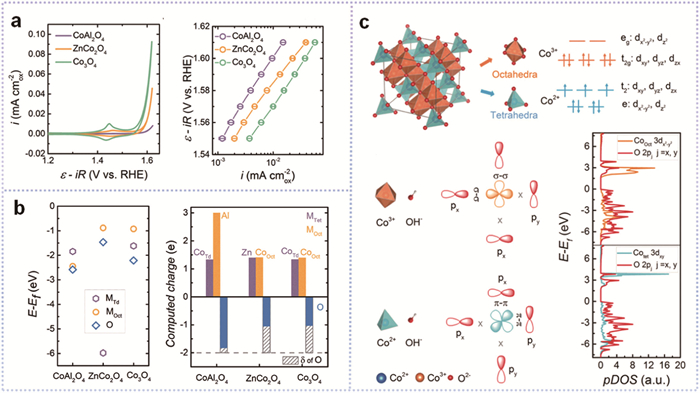
To investigate the LOM-dominant transition metal-oxygen (TM-O) blocks in spinel oxides, the enhanced OER activity was observed in octahedral coordination sites of spinel oxides, which originated from their intrinsically strengthened M-O covalent interactions compared to tetrahedral configurations (Fig. 3) [78]. This coordination geometry-dependent covalent hierarchy has been firstly systematically validated through integrated experimental characterization and theoretical hybridization analysis in cobalt-based spinel systems. Crucially, such electronic structure principles exhibit broad universality across diverse spinel oxide families, meaning that octahedral unit engineering serves as a vital step for activating lattice oxygen redox in transition metal oxides. Therefore, the inherent covalent advantage of octahedral coordination endows it as the active site for LOM pathway, while tetrahedral units are typically designated as the inert structural components in this oxygen redox framework. Based on this understanding, site-selective doping principles can be summarized as follows: Octahedral-site doping is identified as the dominant covalent regulator through direct modification of M-O bond strength. Tetrahedral-site modifications synergistically optimize electron redistribution, while oxygen-site electronegativity engineering enhances octahedral-site covalency through targeted electron density polarization. This tripartite strategy achieves the Δ reduction through differentiated roles of three sites and concerted interplay, collectively activating the LOM.
Figure 3
Figure 3.
(a) CV curves and Tafel plots of CoAl2O4, ZnCo2O4, and Co3O4. (b) Band centers of octahedral TM, tetrahedral TM and O, computed charge values for Zn, Co, Al, and O in ZnCo2O4, Co3O4, and CoAl2O4. (c) An illustration of the orbital splitting of Co 3d in Co3O4 under tetrahedral and octahedral geometry, representative illustration of octahedral and tetrahedral TM 3d-O 2p orbital interaction, PDOS of octahedral Co and O and tetrahedral Co and O. Reproduced with permission [78]. Copyright 2019, Wiley-VCH.
As discussed in Section 3.1, the M-O covalency in the octahedral unit is stronger than tetrahedral one in most spinel oxides. The inherently enhanced M-O covalency within octahedral units of spinel oxides provides a foundation for strategic covalent reinforcement, enabling targeted activation of lattice oxygen. Recent studies demonstrate that targeted cation doping effectively modulates electronic configurations in spinel oxides, whereby the introduction of high-valent metal species dramatically boosts OER activity relative to their low-valent counterparts [79-81], with mechanistic studies conclusively attributing the superior performance to the LOM pathway. From the electronegativity point of view, reduced electronegativity disparity between high-valent cations and oxygen indicates enhanced M-O covalency. Through systematic analysis of energy band structures, an intrinsic relationship is established between valence state modulation and Fermi level position. Matar et al. discovered that when M3+ is oxidized to M4+, the energy of the Fermi level decreases [82]. This phenomenon can be explained by employing the formula derived by Campet et al., which is utilized to assess the Ef of simple ionic-covalent oxides [83]. When the oxidation state of a specific metal is determined, Fermi level and the oxidation states of metal cations follow a straightforward empirical linear relationship, expressed as:
In consequence, when the oxidation state of the metal increases, the Fermi level decreases, and the electronegativity of the metal increases. The metal d-band undergoes a downward shift, with the d-band energy level positioning below oxygen 2p-band edge and the ONB penetrating the Fermi level. Then the lattice oxygen can serve as the redox center to donate electrons to the external circuit, facilitating the direct lattice O—O coupling to generate the species O22− instead of the *OOH species in the AEM, effectively bypassing the scaling correlation.
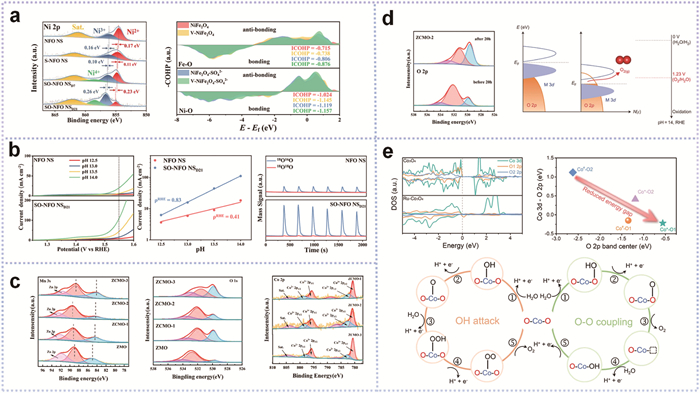
Based on the above results, Cheng’s group grew the sulfate salts on the octahedral sites of spinel NiFe2O4 to form the high-valent Ni4+ cations through the high electronegativity effect from SO42− (Fig. 4a) [84]. Moreover, crystal orbital Hamilton population (COHP) analysis was performed, with the integrated COHP (ICOHP) values quantitatively evaluating M-O bond strength. The high-valent Ni4+ typically caused the downshift of the metal d-band to penetrate the p-band of oxygen ligands [84,85], thereby strengthening the covalency in the Ni-O bond and thermodynamically promoting the oxygen redox cycles in LOM. SO—NFO NSD21 exhibited stronger pH-dependent OER activity than NFO NS, indicating a nonconcerted proton-electron transfer pathway consistent with the LOM pathway. 18O isotope labeling DEMS confirmed direct lattice oxygen participation, with SO—NFO NSD21 showing pronounced 16O18O (m/z = 34) and detectable 18O18O (m/z = 36) signals (Fig. 4b). This demonstrated sulfate-induced activation of lattice oxygen for O—O bond formation and thermodynamically favorable oxygen vacancy generation. In view of the principle of valence regulation, Zheng’s team also fabricated Co-incorporated ZnMn2O4 [63]. The incorporation of Co3+ dopants was found to induce partial oxidation of Mn3+ to Mn4+(Fig. 4c). This valence adjustment enhanced the electron-withdrawing effect from Mn-O bonds in octahedrons, thereby promoting the OER kinetics via the LOM. XPS revealed decreased defect oxygen/lattice oxygen ratio after 20 h OER (Fig. 4d), demonstrating dynamic oxygen vacancy consumption-regeneration cycles during operation. This time-dependent evolution confirmed lattice oxygen participation through vacancy-mediated refilling, directly evidencing the LOM pathway. Sun’s group designed the Ru-Co3O4 catalyst [86]. Results revealed that the doping of Ru3+ reduced the localized gap between the Co 3d-band and O 2p-band center, resulting in the increased Co-O covalency in octahedrons and facilitating the transformation of the OER mechanism from the conventional AEM to the LOM (Fig. 4e). These electronic structure modifications are realized through strategic incorporation of dopants that fundamentally modulate the orbital hybridization of pre-existing octahedral units. The introduced dopants induce localized charge redistribution via electronegativity differentials, leading to enhanced p-d orbital overlap.
Figure 4
Figure 4.
(a) Ni 2p XPS spectra of all kinds of samples, ICOHP (integrated COHP) values for NiFe2O4, V-NiFe2O4, NiFe2O4-SO42− and V-NiFe2O4-SO42−. (b) LSV curves of NFO NS and SO–NFO NSD21 in alkaline electrolytes with different pH, OER specific activities of all catalysts at 1.55 V vs. different pHs of KOH, the DEMS signals of 34O2 and 36O2vs. time for NFO NS and SO–NFO NSD21. Reproduced with permission [84]. Copyright 2023, American Chemical Society. (c) XPS spectra of Mn 3s, O 1s and Co 2p (d) O 2p energy spectra before and after 20 h stability test, schematic energy band diagrams of low-valent and high-valent species. Reproduced with permission [63]. Copyright 2025, Elsevier B.V. Reproduced with permission [51]. Copyright 2017, Springer Nature. (e) Computed DOS of Co 3d and O 2p for Co3O4 and Ru-Co3O4, energy gap between Co 3d and O 2p versus the O 2p band center for Co3O4 and Ru-Co3O4, transformation of the OER mechanism from the AEM to the LOM after the doping of Ru. Reproduced with permission [86]. Copyright 2024, The Royal Society of Chemistry.
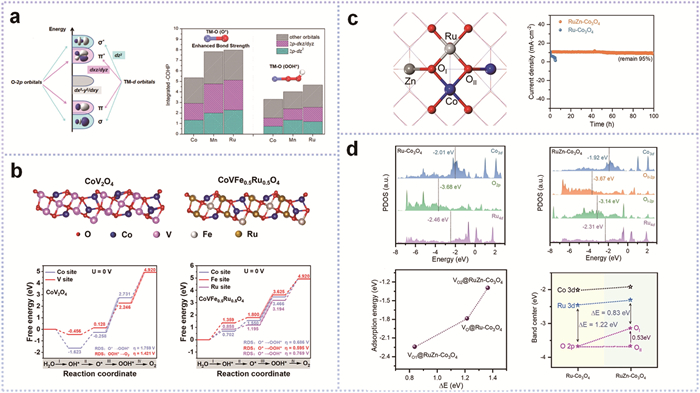
Moreover, direct substitution of octahedral core cations with LOM-active elements enables structural reconstruction of the coordination unit. This strategy creates novel octahedral motifs with distinct electronic configurations, where the implanted heteroatoms serve as catalytic epicenters to dominate lattice oxygen activation pathways. Fu’s group designed a Ru/Mn co-doping Co3O4 catalyst. Ru and Mn both substituted Co at BOct site [87]. The intensified Ru/Mn-O interactions within the octahedral framework significantly enhanced M-O covalency, thereby activating the LOM through orbital hybridization reconfiguration. Furthermore, they discovered that the enhanced *O species adsorption capacity could not only suppress the AEM pathway on account of the increased difficulty in *OOH formation (Fig. 5a) but also supply additional lattice oxygen consumption for LOM to enhance the catalyst stability. However, the reconstruction of octahedral active sites and enhanced *O adsorption strength induced by foreign atoms did not necessarily suppress the AEM pathway or activate the LOM pathway. Yue et al. demonstrated that dual Ru/Fe doping in CoV2O4 triggered active site switching from V to Fe [88]. This transition established Fe as the new octahedral center, modifying O* and *OOH adsorption strengths. Crucially, theoretical calculations revealed that Fe incorporation paradoxically lowered the energy barrier for the rate-determining step (*O → *OOH), accelerating reaction kinetics while maintaining AEM pathway dominance (Fig. 5b).
Figure 5
Figure 5.
(a) Typical bond distribution pattern of d-p orbital hybridization in Co3O4, ICOHP of the different p-d orbital hybridizations of Co, Ru, and Mn with *O and O in *OOH, respectively. Reproduced with permission [87]. Copyright 2024, American Chemical Society. (b) Schematic optimized models for CoV2O4 and CoVFe0.5Ru0.5O4, the elementary steps and free energy diagrams of OER pathways at the Co and V sites for CoV2O4 and Co, Fe, and Ru sites for CoVFe0.5Ru0.5O4. Reproduced with permission [88]. Copyright 2024, Wiley-VCH. (c) DFT calculations for Simulated (100) facet of Ru and Zn co-doped Co3O4, the durability test of RuZn-Co3O4 and Ru-Co3O4 at the current density of 10 mA/cm2. (d) The PDOS and band centers of Co 3d, Ru 4d and O 2p orbitals in Ru-Co3O4 and RuZn-Co3O4, the changes of adsorption energy of O vacancy to OH− with the difference band center between Ru 4d and O 2p, comparison of different band centers and band gaps.
Even though the tetrahedral units are conventionally considered as structurally inert components in spinel oxides, some emerging evidence suggests their potential auxiliary role in facilitating the LOM. During the LOM-driven oxygen evolution reaction, insufficient participation of lattice oxygen fundamentally limits the catalytic activity, whereas excessive activation accelerates structural degradation through irreversible oxygen vacancy accumulation and ultimately leads to catastrophic framework collapse. The doping of inert elements into tetrahedral sites can induce charge redistribution, which modulates the covalency of octahedral units, thereby precisely regulating the participation degree of lattice oxygen in redox processes and improving the stability of catalysts.
Aiming at this goal, Zhang’s group designed the RuZn-Co3O4 catalyst [55]. Ru-Co3O4 is a highly active catalyst following the LOM pathway, but its stability is not satisfied [89-92]. As shown in Fig. 5c, Ru-Co3O4 suffered severe degradation after only a few hours of function. But when Zn was doped to occupy the tetrahedral site, RuZn-Co3O4 displayed exceptional stability. DFT calculations revealed that the p-band center of the OⅠ site, which linked the Ru and Zn atoms, was upshifted and had a strong orbital overlap with the Ru d-orbitals (Fig. 5d), indicating an enhanced Ru-O covalency. In contrast, the interaction between Ru and OⅡ weakened as there was almost no change in the OⅡ p-band center. Consequently, in the vicinity of the surface Ru, the OⅠ was further activated, while some other lattice oxygen such as OⅡ might lose their redox ability. Therefore, the introduction of Zn selectively activated the bridged lattice oxygen between Zn and Ru, strictly limiting the proportion of lattice oxygen participating in the reaction and mitigating the structural collapse of the catalyst to a certain extent.
3.1.3
Oxygen-site modulation
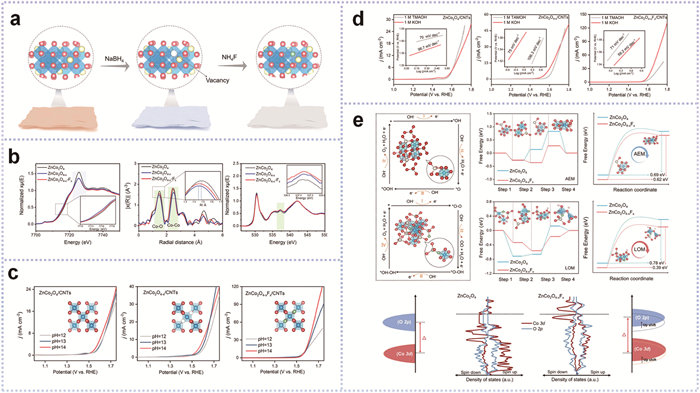
Beyond cation doping in tetrahedral or octahedral sites, strategic anion substitution at O2- sites, which typically employs anions with superior electronic polarizability, enables concurrent electron withdrawal from both metallic and oxygen species within the covalent framework [6,93-95]. The dual electron modulation mechanism observed across multiple studies effectively reduces electronegativity disparities and intensifies covalent bonding characteristics. Liu et al. proposed a strategy for anion refilling in ZnCo2O4 [57]. The F-anion was introduced into oxygen site to synthesize the ZnCo2O4-xFx catalyst (Fig. 6a). Due to the strong electron absorption ability of F-anion, electrons were more likely to escape from oxygen. Hence, the oxygen 2p-band center was successfully upshifted to approach the Ef (Fig. 6e). Simultaneously, the values of the binding energy of Co shifted positively (Fig. 6b). The simultaneous transfer of electrons suggested that the Coulombic force between the cobalt cation and the oxygen anion was weakened, and this effect was beneficial for enhancing the covalency of the Co-O bond. Meanwhile, the F anion in the oxygen site would induce the distortion of the CoO6 octahedron and shorten the Co-O bond, implying the strengthened orbital hybridization between the metal d-band and the oxygen 2p-band. Consequently, ZnCo2O4-xFx/CNTs exhibited strong pH-dependent OER activity, demonstrating the effective activation of the LOM pathway (Fig. 6c). In addition to pH-dependent tests, they also conducted tetramethylammonium (TMA+) probe experiments to validate the LOM pathway (Fig. 6d). This approach exploits the direct O—O coupling in LOM that generates superoxo/peroxo intermediates (O2-/O22-). TMA+ suppresses OER activity via LOM by strongly binding these anionic species. Consistent with this mechanism, ZnCo2O4₋xFx/CNTs and ZnCo2O4₋x/CNTs exhibited significantly reduced activity in 1 mol/L TMAOH versus 1 mol/L KOH, whereas ZnCo2O4/CNTs showed negligible change. Collectively, these results confirmed LOM dominance in ZnCo2O4₋xFx/CNTs.
Figure 6
Figure 6.
(a) Schematic synthesis and structural characterizations of ZnCo2O4-xFx. (b) Co K-edge XANES spectra, Co K-edge EXAFS spectra, O K-edge XANES spectra. (c) The polarization curve of ZnCo2O4/CNTs, ZnCo2O4-x/CNTs, ZnCo2O4-xFx/CNTs in KOH with different pH. (d) Polarization curves and corresponding Tafel slopes of ZnCo2O4/CNTs, ZnCo2O4−x/CNTs and ZnCo2O4−xFx/CNTs in 1 mol/L KOH and TMAOH. (e) Schematic of AEM pathway for ZnCo2O4 and LOM pathway for ZnCo2O4-xFx, Gibbs free energy diagram of AEM pathway, calculated energy barriers of the *OH transformation to *OOH, Gibbs free energy diagram of LOM pathway, calculated energy barriers of the *OOH transformation to *OH–OH, the schematic band diagrams and DOS of ZnCo2O4 and ZnCo2O4-xFx. Reproduced with permission [57]. Copyright 2023, Wiley-VCH.
In spinel oxide systems, both oxygen vacancies [22,96-98] and cation vacancies [99-101] serve as critical structural defects, where tailored modulation of both defect concentration and speciation synergistically remodel electronic configuration and activate the LOM pathway. This section systematically dissects the distinct influences of these two defect types on the LOM pathway.
3.2.1
Oxygen vacancy construction
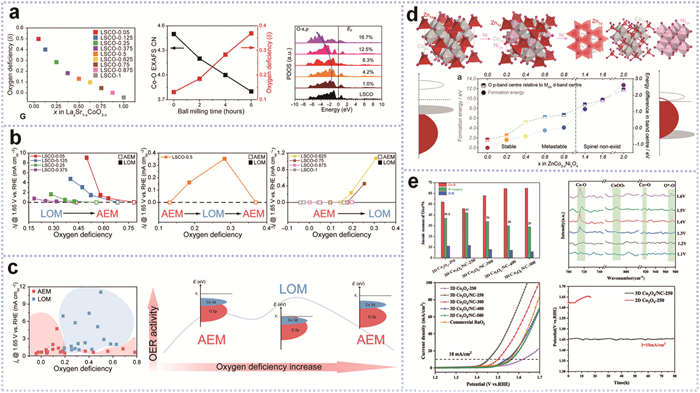
Oxygen defect engineering involves the intentional introduction of defects to disrupt the original oxygen coordination environment of metal, rendering adjacent lattice oxygen atoms metastable due to undercoordinated sites and significantly enhancing their reactivity. This metastable configuration concurrently induces an upward shift of the oxygen 2p-band center toward the Fermi level while optimizing the energy-level alignment between M d-orbitals and O 2p-orbitals, thereby reducing the Δ. Pioneering work by Yan et al. on a perovskite model system revealed a strong correlation between oxygen vacancy concentration and lattice oxygen activity [102]. The oxygen defect concentration exhibited a negative correlation with La substitution content, confirming quantitative defect regulation in LSCO (Fig. 7a). For fixed stoichiometry, defect concentration scaled approximately linearly with ball-milling time. Precise synthesis enabled quantitative oxygen vacancy control in LSCO, revealing three dynamic mechanism transition (Fig. 7b). Specifically, the pristine LSCO-0.5–0 h sample (Fig. 7c) exhibited low oxygen vacancy concentration, resulting in the conventional AEM. Moderate introduction of oxygen vacancies significantly enhanced lattice oxygen activity, activating the LOM pathway. Notably, excessive oxygen vacancies paradoxically reduced lattice oxygen activity, causing the system to revert to AEM dominance. This non-linear relationship demonstrates the existence of an optimal oxygen vacancy concentration window for effective LOM activation. Only when the vacancy concentration reaches a critical range does the lattice oxygen acquire sufficient activation energy to engage in the electrocatalytic process.
Figure 7
Figure 7.
(a) Calculated oxygen deficiencies before ball milling, calculated oxygen deficiencies and fitted Co-O coordination number (CN) of LSCO-0.5 with different ball milling time, PDOS of O-s, p in the LaSrCo2O6 model with varied VO concentrations. (b) Three distinct dynamic transition pathways of oxygen evolution reaction observed across varied catalytic materials. (c) Systematic correlation between standardized current density profiles and reaction pathways under varying oxygen vacancy concentrations. Reproduced with permission [102]. Copyright 2022, AAAS. (d) The crystal structures of Ni substituted ZnCo2O4, the schematic representation of MOct d-band and oxygen p-band for ZnCo2−xNixO4 (x = 0, 0.2) with Moct d-band center higher than oxygen p-band center or oxygen p-band center higher than MOct d-band center, the formation energy of ZnCo2−xNixO4 relative to ZnCo2O4 and oxygen p-band center relative to MOct d-band center of ZnCo2−xNixO4. Reproduced with permission [103]. Copyright 2019, Wiley-VCH. (e) O atomic contents of different catalysts, in-situ ATR-FTIR spectra of 3D Co3O4/NC-250 catalyst at various applied potentials in 0.5 mol/L H2SO4 electrolyte, polarization curves of 2D Co3O4–250, 3D Co3O4/NC electrocatalyst at various calcination temperatures (250, 300, 400 and 500 ℃) and commercial RuO2 catalysts, chronopotentiometry test of 3D Co3O4/NC-250 and 2D Co3O4–250. Reproduced with permission [61]. Copyright 2023, Elsevier B.V.
Realizing that the number of oxygen defects affects the reaction pathway of the OER, Xu’s group subsequently investigated the correlation between oxygen defect thermodynamics and reaction pathways in spinel oxides [103]. Analysis of the ZnCo2₋xNixO4 series revealed that increased oxygen defect concentration correlated with both reduced oxygen vacancy formation energy and an upward shift of the oxygen 2p-band center, thermodynamically activated LOM pathways during the OER (Fig. 7d). However, it also cautioned against excessive defect concentrations, which destabilize the spinel framework and compromise structural integrity. Their theoretical guidance on defect concentration thresholds directly informed experimental design principles, as exemplified by the breakthrough in defect-engineered Co3O4 electrocatalysts [61].
On the basis of the above-mentioned work, Zhou et al. further verified the effect of oxygen defect concentration on OER mechanism by developing a nitrogen-doped 3D-Co3O4/NC architecture through controlled thermal processing. 3D Co3O4/NC-250 achieved an optimal oxygen vacancy concentration (42%), exceeding control samples (29%−36.9%) while maintaining structural integrity (Fig. 7e). This precisely engineered defect density simultaneously ensured optimal activity and exceptional stability. Oxygen vacancies activated the LOM pathway, with in situ spectroscopic detection of O—O groups (971 cm-1) providing direct evidence of O*-O intermediates central to this pathway, enabling the catalyst to achieve an exceptional acidic OER overpotential of 225 mV@10 mA/cm2. The synergy between defect thermodynamics modeling and synthetic precision establishes a universal paradigm: Targeted d-band modulation creates metastable oxygen redox centers that balance LOM activity with structural durability, providing a blueprint for designing robust spinel oxide catalysts.
3.2.2
Cationic vacancy construction
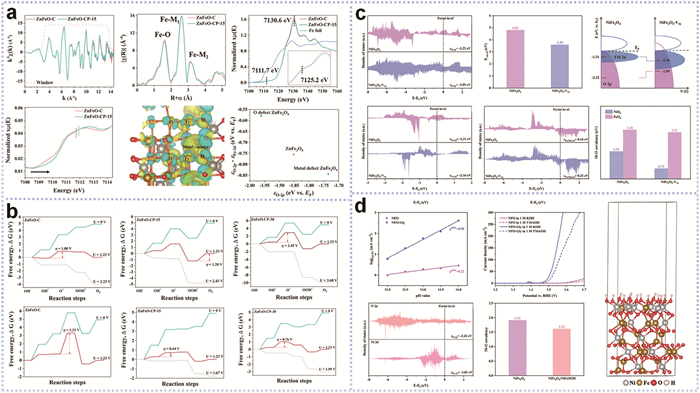
Besides oxygen vacancy, recent advances in cationic vacancy engineering also illuminate a promising defect engineering frontier. The occurrence of cation vacancies triggers electronic rearrangement within the system. Charge compensation is achieved through dual mechanisms: (1) Metal cations are oxidized to higher valence states to release electrons driven by enhanced internal Coulombic repulsion; (2) Oxygen ligands develop hole states to participate charge balancing. This synergistic interplay not only amplifies valence state fluctuations of metal cations but also intensifies M-O orbital hybridization. The resultant cooperative reconstruction of electronic configuration achieves two critical effects: Significant reduction of Δ and effective activation of the LOM. Wang’s team systematically elucidated the interplay between the cation defect and OER mechanism in ZnFe2O4 [60]. XANES analyses demonstrated that cation defects triggered charge delocalization and elevated metal oxidation states (Fig. 8a). These synergistic effects collectively activated lattice oxygen participation (Fig. 8b). Benefiting from optimized vacancy concentration and enhanced lattice oxygen redox activity, the ZnFeO—CP-15 catalyst achieved superior OER performance. This work provides atomic-level insights into cation defect engineering, offering a universal strategy for designing spinel-based electrocatalysts with activated lattice oxygen pathways.
Figure 8
Figure 8.
(a) Fe K-edge EXAFS of ZnFeO–C and ZnFeO–CP-15, shown in k3 weighted k-space and R-space, Fe K-edge XANES spectra of Fe foil, ZnFeO–C and ZnFeO–CP-15, larger scale of pre-edge region, charge density difference for ZnFe2O4, difference between the Fe d-band center and the O p-band center versus the O p-band center relative to the Fermi level for ZnFe2O4. (b) The free energy under different potentials U in AEM and LOM pathway of ZnFeO–C, ZnFeO–CP-15 and ZnFeO–CP-30, respectively. Reproduced with permission [60]. Copyright 2023, The Royal Society of Chemistry. (c) PDOS (O-2p band center, Ni-3d band center and FeTd-3d band center), calculated EO-vac, schematic illustration of band structure, M-O covalency of the FeO4 and NiO6 units in NiFe2O4 and NiFe2O4-VNi. (d) The relationship between the logarithm of current density of cycled NFO and NFO-Gly at 1.6 V (vs. RHE) and pH, polarization curves of cycled NFO and NFO-Gly in 1 mol/L KOH and 1 mol/L TMAOH, respectively, the optimized atomic structure, PDOS (O-2p band center and Ni-3d band center), and Ni-O covalency in NiFe2O4 and NiFe2O4/NiFeOOH. Reproduced with permission [59]. Copyright 2024, Wiley-VCH.
Building on the cation defect-LOM correlation established in ZnFe2O4, the defect engineering paradigm for inverse spinel NiFe2O4 was extended by Shi’s group [59]. By strategically introducing nickel vacancies within octahedral units, an upward shift in the oxygen 2p-band center was induced with widened M-O covalency gap between FeO4 and NiO6 units (Fig. 8c). Such electronic reorganization triggered structural destabilization through the enhanced difference in Fe/Ni-O covalency, which simultaneously enhanced lattice oxygen mobility and activated the LOM pathway (Fig. 8d). Moreover, they revealed a critical structural prerequisite for LOM activation: Cationic defects preferentially resided in octahedral units during oxygen redox cycles (Fig. 8c). The finding bridges the gap between local coordination geometry and global redox activity, establishing octahedral-site defect engineering as a universal design principle for activating metastable oxygen redox in spinel oxides.
3.3
Geometric conversion
Facilitating the formation of accessible ONB is another crucial step for activating lattice oxygen [104-107], which originates from their distinctive electronic configuration. The p-orbital energy levels of ONB exhibit the closest proximity to the Fermi level among oxygen-derived bands due to minimal hybridization with metal orbitals. This unique energetic advantage directly translates to the lowest Δ within the system. Recent research has found that geometric conversion along with a decrease in coordination number will promote the formation of ONB and render them accessible for OER [108-112]. Gent et al. established that TM geometric conversion inherently correlated with the bulk oxygen redox activity [108]. They revealed that this structural evolution triggered a cascade of electronic effects, specifically inducing energy-level reconfiguration between oxygen-derived states and TM-O hybridization. This process contrasted with traditional interpretations of static O2-/O- redox couples. Through combined experimental and theoretical analysis, the researchers proposed a dynamic charge compensation mechanism formally expressed as: (O2- + TM lattice) → (O- + displaced TM) + e-. The team further attributed this metastable redox behavior to TM migration-induced electronic restructuring, which preferentially elevated the energy of ONB relative to TM-O bonding states. Importantly, this dynamic symbiotic relationship between cationic mobility and anionic redox activity fundamentally provides new insights into the induction of ONB release during the oxygen evolution process.
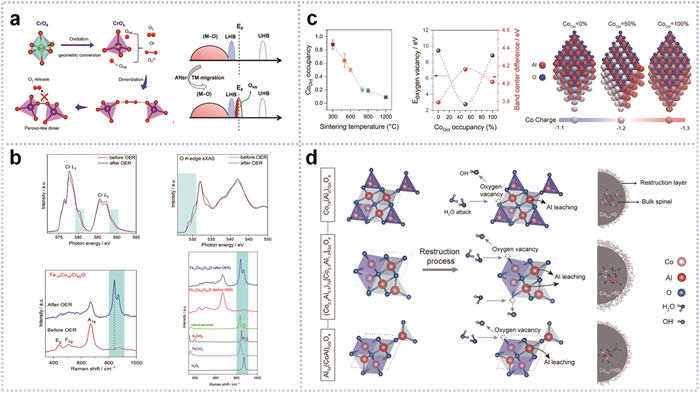
Inspired by the above research, Ahmed et al. developed an in situ geometric transformation mechanism where Cr3+→Cr6+ oxidation during the OER drove dynamic octahedral-to-tetrahedral migration of chromium species (Fig. 9a) [58]. This geometrical transformation led to the creation of ONB, thereby triggering the lattice oxygen in spinel oxides (Fig. 9b). XAS revealed significantly enhanced peak intensities at the Cr L-edge (580/594 eV) and O K-edge (529/530 eV) after OER, indicating increased surface Cr6+ species and a higher density of holes induced by ONB states. This provided evidence for enhanced cation migration. The O K-edge pre-peak at 529 eV was attributed to excitation into the σ* orbital of peroxo species (O22-), confirming oxygen redox activity. Raman spectroscopy showed intensified characteristic peaks within the 800–1000 cm-1 region post-OER. Peaks at ~868 cm-1 (asymmetric stretching of Cr6+O4) and ~839 cm-1 (symmetric stretching of Cr6+O4) corresponded to the stretching vibrations of peroxide species (O22-), demonstrating strong coupling between the peroxo moiety and Cr6+O4 tetrahedra.
Figure 9
Figure 9.
(a) Schematic illustration for the mechanistic pathway of Cr migration followed by the stabilization of peroxide O22- species by CrO4 tetrahedrons, schematic illustration for the creation of ONB after cation migration from octahedral to tetrahedral sites. (b) Cr L-edge and O K-edge sXAS of Fe10Co30Cr60O before and after OER (10 cycles), Raman spectroscopy of Fe10Co30Cr60O before and after OER in comparison with chromate- (PbCrO4 and K2CrO4) and peroxo-(H2O2 and uranyl peroxide) containing compounds. Reproduced with permission [58]. Copyright 2024, Wiley-VCH. (c) CoOct occupancy of the CAFO samples calcined at different sintering temperatures (300–1200 ℃), DFT calculation on the oxygen vacancy formation energy and Co 3d-O 2p band center difference among three theoretical models for CoAl2O4 with different geometric configurations, the diagram of periodic unit cell for spinel with different CoOct occupancy. (d) Schematic illustration of tetrahedral-octahedral phase construction optimization strategy and reconstruction process. Reproduced with permission [113]. Copyright 2024, Wiley-VCH.
Unlike the catalyst designed by Ahmed’s team, where the release of ONB was dynamically triggered during the OER process, Wu’s team intentionally pre-induced ONB generation in the catalyst synthesis stage through phase boundary engineering in a CoFe0.25Al1.75O4 precursor [113]. Specifically, by adjusting the calcination temperature to modulate the ratio of cobalt tetrahedral to octahedral coordination sites (Fig. 9c), the release of ONB was triggered through structural mismatch between tetrahedral and octahedral phases (Fig. 9d). The results revealed that when the proportion of cobalt octahedra reached 64%, the coexistence of tetrahedral and octahedral phases caused lattice mismatch, which facilitated the formation of non-bonding oxygen states and activated the LOM pathway.
4.
Conclusion and outlook
In this review, we elucidate the dominant coordination environment which plays a central role in mechanism switching and emphasizes the critical role of regulating M-O covalency in activating the LOM. By establishing rigorous defect control principles, we delineate the distinct roles of various defects and define optimal defect concentration ranges for targeted catalytic behaviors. Beyond these static regulation strategies, we further summarize another dynamic configuration transformation, which effectively induces the formation of ONB, thereby predictably achieving controllable switching between AEM and LOM dominant reaction mechanisms.
While substantial progress has been made in regulating the activity of spinel oxide catalysts, their commercial development remains constrained by the cumbersome high-throughput screening protocols required to identify LOM-active spinel oxides and the insufficient industrial durability of LOM-dominant materials under practical operating conditions. In order to overcome the current challenges, we also propose several forward-looking research trajectories and practical solutions.
4.1
Develop database for screening LOM-dominant spinel oxides
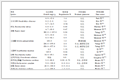
Future research should focus on developing systematic strategies to screen and identify spinel oxides with potential for the LOM pathway. As most unmodified spinel oxides predominantly follow the AEM pathway during OER, computational simulations should be employed to evaluate electronic structural characteristics capable of surpassing AEM constraints and following the LOM pathway. Future research should develop a multi-tiered screening strategy to systematically evaluate spinel oxides through integrated computational simulations and theoretical models. The first tier employs high-throughput first-principles calculations to rapidly scan spinel structures in material databases, enabling preliminary screening of thermodynamically stable candidate systems. The second tier establishes in-depth electronic structure analysis models, focusing on decoupling band gap, metal-oxygen orbital hybridization characteristics, and charge distribution of lattice oxygen (Table 1). This tier aims to identify key electronic states capable of overcoming the constraints of the AEM pathway. The third tier introduces machine learning-assisted optimization. By further improving feature-activity relationship models using prior computational results, this tier predicts the LOM propensity of novel compositional combinations, thereby narrowing the scope for experimental validation. This framework promises to streamline the identification of LOM-active spinel oxides while curbing experimental optimization costs.
Table 1
Table 1.
Key structural parameters of typical spinel oxides.
4.2
Further improve the stability of LOM-dominant spinel oxide catalyst
To address stability challenges in LOM-dominant spinel oxide catalysts, research must prioritize establishing a multi-scale theoretical framework. This framework should specifically decode the critical dynamic coupling between M-O bond strength and oxygen vacancy migration barriers, as this understanding is fundamental for simultaneously balancing activity and stability. Furthermore, integrating first-principles calculations with operando characterization is essential to quantitatively link lattice oxygen depletion rates, local structural evolution, and performance decay trajectories. Most importantly, future efforts should focus on designing metastable catalysts featuring adaptive oxygen coordination networks capable of dynamic oxygen compensation. The goal of these structures is to achieve atomic-level synergy between reactive lattice oxygen and structural integrity during operation. Such an integrated approach ultimately provides cross-scale design principles for developing durable and high-activity LOM catalysts.
In summary, the review aims to propel the large-scale implementation of spinel oxides in oxygen evolution systems while demonstrating that the lattice oxygen engineering strategies proposed herein break through conventional activity limitation. Notably, these regulation strategies transcend material specificity, offering universal design guidelines for achieving mechanism switching in diverse metal oxide systems. This mechanism shift in catalyst design opens new dimensions and formulates a universal framework for developing next-generation high-performance electrocatalysts. Furthermore, the principles of manipulating lattice oxygen reactivity can be systematically extended to diverse oxygen-mediated catalytic processes, including but not limited to nitrate reduction, CO2 reduction, and advanced oxidation processes for pollutant degradation-systems. In a word, the universal framework of lattice oxygen modulation establishes a transformative paradigm for atomic-level manipulation of oxygen-mediated catalytic processes, propelling oxygen-mediated systems in sustainable energy conversion, green synthesis, and environmental governance, while accelerating interdisciplinary translation of fundamental research into industrial-grade technological breakthrough.
The authors declare that they have no known competing financial interests or personal relationships that could have appeared to influence the work reported in this paper.
Acknowledgments
The authors acknowledge financial support from the National Key Research and Development Program of China (Nos. 2021YFA1502700, 2024YFA0917800) and the National Natural Science Foundation of China (Nos. 22422502, 22232004 and 22279062). H. Sun thanks the financial support from Jiangsu Specially Appointed Professorship.
[1]
Z.W. Seh, J. Kibsgaard, C.F. Dickens, et al., Science 355 (2017) 6321.
[2]
I. Roger, M.A. Shipman, M.D. Symes, et al., Nat. Rev. Chem. 1 (2017) 0003. doi: 10.1038/s41570-016-0003
E. McCalla, A.M. Abakumov, M. Saubanère, et al., Science 350 (2015) 1516–1521. doi: 10.1126/science.aac8260
[112]
M. Sathiya, G. Rousse, K. Ramesha, et al., Nat. Mater. 12 (2013) 827–835. doi: 10.1038/nmat3699
[113]
A.Q. Zou, C. Wu, Q. Zhang, et al., Angew. Chem. Int. Ed. 63 (2024) e202409912.
Figure 1
(a) Schematic diagram of rational design strategies and regulatory targets for spinel oxides to follow the LOM pathway. Reproduced with permission [41,55-59]. Copyright 2023, 2024, Wiley-VCH. Reproduced with permission [60]. Copyright 2023, The Royal Society of Chemistry. Reproduced with permission [61]. Copyright 2023, Elsevier B.V.
Figure 2
(a) Schematic representation of the AEM pathway and the LOM pathway during the OER process. Reproduced with permission [63]. Copyright 2025, Elsevier B.V. (b) The crystal structure and the formation of a density of states (DOS) diagram of spinel oxide. Reproduced with permission [64]. Copyright 2020, Springer Nature. (c) The schematic representations of cation/anion redox chemistry guided by U and Δ, which manifest conventional metal cation oxidation (left), oxygen anion oxidation (middle) and direct oxygen anion release (right) for OER, respectively. Reproduced with permission [65]. Copyright 2021, The Royal Society of Chemistry.
Figure 3
(a) CV curves and Tafel plots of CoAl2O4, ZnCo2O4, and Co3O4. (b) Band centers of octahedral TM, tetrahedral TM and O, computed charge values for Zn, Co, Al, and O in ZnCo2O4, Co3O4, and CoAl2O4. (c) An illustration of the orbital splitting of Co 3d in Co3O4 under tetrahedral and octahedral geometry, representative illustration of octahedral and tetrahedral TM 3d-O 2p orbital interaction, PDOS of octahedral Co and O and tetrahedral Co and O. Reproduced with permission [78]. Copyright 2019, Wiley-VCH.
Figure 4
(a) Ni 2p XPS spectra of all kinds of samples, ICOHP (integrated COHP) values for NiFe2O4, V-NiFe2O4, NiFe2O4-SO42− and V-NiFe2O4-SO42−. (b) LSV curves of NFO NS and SO–NFO NSD21 in alkaline electrolytes with different pH, OER specific activities of all catalysts at 1.55 V vs. different pHs of KOH, the DEMS signals of 34O2 and 36O2vs. time for NFO NS and SO–NFO NSD21. Reproduced with permission [84]. Copyright 2023, American Chemical Society. (c) XPS spectra of Mn 3s, O 1s and Co 2p (d) O 2p energy spectra before and after 20 h stability test, schematic energy band diagrams of low-valent and high-valent species. Reproduced with permission [63]. Copyright 2025, Elsevier B.V. Reproduced with permission [51]. Copyright 2017, Springer Nature. (e) Computed DOS of Co 3d and O 2p for Co3O4 and Ru-Co3O4, energy gap between Co 3d and O 2p versus the O 2p band center for Co3O4 and Ru-Co3O4, transformation of the OER mechanism from the AEM to the LOM after the doping of Ru. Reproduced with permission [86]. Copyright 2024, The Royal Society of Chemistry.
Figure 5
(a) Typical bond distribution pattern of d-p orbital hybridization in Co3O4, ICOHP of the different p-d orbital hybridizations of Co, Ru, and Mn with *O and O in *OOH, respectively. Reproduced with permission [87]. Copyright 2024, American Chemical Society. (b) Schematic optimized models for CoV2O4 and CoVFe0.5Ru0.5O4, the elementary steps and free energy diagrams of OER pathways at the Co and V sites for CoV2O4 and Co, Fe, and Ru sites for CoVFe0.5Ru0.5O4. Reproduced with permission [88]. Copyright 2024, Wiley-VCH. (c) DFT calculations for Simulated (100) facet of Ru and Zn co-doped Co3O4, the durability test of RuZn-Co3O4 and Ru-Co3O4 at the current density of 10 mA/cm2. (d) The PDOS and band centers of Co 3d, Ru 4d and O 2p orbitals in Ru-Co3O4 and RuZn-Co3O4, the changes of adsorption energy of O vacancy to OH− with the difference band center between Ru 4d and O 2p, comparison of different band centers and band gaps.
Figure 6
(a) Schematic synthesis and structural characterizations of ZnCo2O4-xFx. (b) Co K-edge XANES spectra, Co K-edge EXAFS spectra, O K-edge XANES spectra. (c) The polarization curve of ZnCo2O4/CNTs, ZnCo2O4-x/CNTs, ZnCo2O4-xFx/CNTs in KOH with different pH. (d) Polarization curves and corresponding Tafel slopes of ZnCo2O4/CNTs, ZnCo2O4−x/CNTs and ZnCo2O4−xFx/CNTs in 1 mol/L KOH and TMAOH. (e) Schematic of AEM pathway for ZnCo2O4 and LOM pathway for ZnCo2O4-xFx, Gibbs free energy diagram of AEM pathway, calculated energy barriers of the *OH transformation to *OOH, Gibbs free energy diagram of LOM pathway, calculated energy barriers of the *OOH transformation to *OH–OH, the schematic band diagrams and DOS of ZnCo2O4 and ZnCo2O4-xFx. Reproduced with permission [57]. Copyright 2023, Wiley-VCH.
Figure 7
(a) Calculated oxygen deficiencies before ball milling, calculated oxygen deficiencies and fitted Co-O coordination number (CN) of LSCO-0.5 with different ball milling time, PDOS of O-s, p in the LaSrCo2O6 model with varied VO concentrations. (b) Three distinct dynamic transition pathways of oxygen evolution reaction observed across varied catalytic materials. (c) Systematic correlation between standardized current density profiles and reaction pathways under varying oxygen vacancy concentrations. Reproduced with permission [102]. Copyright 2022, AAAS. (d) The crystal structures of Ni substituted ZnCo2O4, the schematic representation of MOct d-band and oxygen p-band for ZnCo2−xNixO4 (x = 0, 0.2) with Moct d-band center higher than oxygen p-band center or oxygen p-band center higher than MOct d-band center, the formation energy of ZnCo2−xNixO4 relative to ZnCo2O4 and oxygen p-band center relative to MOct d-band center of ZnCo2−xNixO4. Reproduced with permission [103]. Copyright 2019, Wiley-VCH. (e) O atomic contents of different catalysts, in-situ ATR-FTIR spectra of 3D Co3O4/NC-250 catalyst at various applied potentials in 0.5 mol/L H2SO4 electrolyte, polarization curves of 2D Co3O4–250, 3D Co3O4/NC electrocatalyst at various calcination temperatures (250, 300, 400 and 500 ℃) and commercial RuO2 catalysts, chronopotentiometry test of 3D Co3O4/NC-250 and 2D Co3O4–250. Reproduced with permission [61]. Copyright 2023, Elsevier B.V.
Figure 8
(a) Fe K-edge EXAFS of ZnFeO–C and ZnFeO–CP-15, shown in k3 weighted k-space and R-space, Fe K-edge XANES spectra of Fe foil, ZnFeO–C and ZnFeO–CP-15, larger scale of pre-edge region, charge density difference for ZnFe2O4, difference between the Fe d-band center and the O p-band center versus the O p-band center relative to the Fermi level for ZnFe2O4. (b) The free energy under different potentials U in AEM and LOM pathway of ZnFeO–C, ZnFeO–CP-15 and ZnFeO–CP-30, respectively. Reproduced with permission [60]. Copyright 2023, The Royal Society of Chemistry. (c) PDOS (O-2p band center, Ni-3d band center and FeTd-3d band center), calculated EO-vac, schematic illustration of band structure, M-O covalency of the FeO4 and NiO6 units in NiFe2O4 and NiFe2O4-VNi. (d) The relationship between the logarithm of current density of cycled NFO and NFO-Gly at 1.6 V (vs. RHE) and pH, polarization curves of cycled NFO and NFO-Gly in 1 mol/L KOH and 1 mol/L TMAOH, respectively, the optimized atomic structure, PDOS (O-2p band center and Ni-3d band center), and Ni-O covalency in NiFe2O4 and NiFe2O4/NiFeOOH. Reproduced with permission [59]. Copyright 2024, Wiley-VCH.
Figure 9
(a) Schematic illustration for the mechanistic pathway of Cr migration followed by the stabilization of peroxide O22- species by CrO4 tetrahedrons, schematic illustration for the creation of ONB after cation migration from octahedral to tetrahedral sites. (b) Cr L-edge and O K-edge sXAS of Fe10Co30Cr60O before and after OER (10 cycles), Raman spectroscopy of Fe10Co30Cr60O before and after OER in comparison with chromate- (PbCrO4 and K2CrO4) and peroxo-(H2O2 and uranyl peroxide) containing compounds. Reproduced with permission [58]. Copyright 2024, Wiley-VCH. (c) CoOct occupancy of the CAFO samples calcined at different sintering temperatures (300–1200 ℃), DFT calculation on the oxygen vacancy formation energy and Co 3d-O 2p band center difference among three theoretical models for CoAl2O4 with different geometric configurations, the diagram of periodic unit cell for spinel with different CoOct occupancy. (d) Schematic illustration of tetrahedral-octahedral phase construction optimization strategy and reconstruction process. Reproduced with permission [113]. Copyright 2024, Wiley-VCH.


 DownLoad:

 下载:


 下载:

