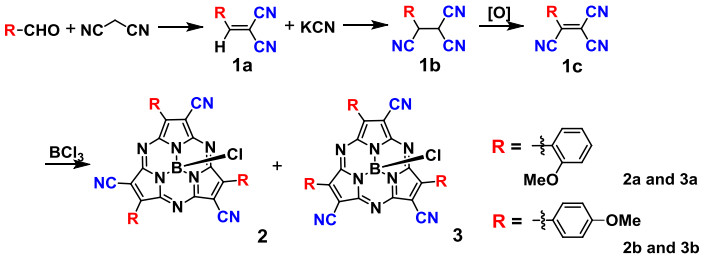
Scheme 1.
Synthesis of triazasubporphyrins 2a~2b and 3a~3b

Synthesis and Electronic Structure of Triazasubporphyrin with Peripherally Low Symmetric Push-pull Substitutions
Yu-Xuan FAN , Tai-Yan YUAN , Qing-Yang LV , Min-Zhi LI , Wei-Hua ZHU , Xu LIANG


Triazasubporphyrin (SubPzs), a contracted congener of porphyrazines (Pzs) with the removal of three benzene rings from subpthalocyanines (SubPcs), which comprises three isoindole units bridged by imino-nitrogen atoms, show great potential as functional chromophores due to their strong fluorescence and strong yellow-green absorptions[1-5]. Although the synthetic chemistry of triazasubporphyrin has been described over 15 years, the lack promotion in this part could be attributed to the difficulties in the isolation and their poor stability. In addition, the key synthetic precursor, aryl-dicyanoethylenes, could react with BCl3 to provide SubPz analogues with -Cl and/or -OH as the axial ligands[6].
As far as we concerned, when peripheral substituents directly attached to the SubPz core, a larger influence on the electronic structures was clearly performed because the macrocyclic core was strongly coupled to their peripheral substituents. Thus, the investigations on the interesting structural, spectroscopic and electrochemical properties were well progressed[7]. For example, β, β′-thioalkyl chain substituted SubPzs reveal the changes of optical properties to give the significant red-shift of the main absorption band to λ = 559 nm. Also, the β, β′ push-pull substituents were used, and the sizeable red-shift of the main absorption and fluorescence were observed. On the other hand, the post-modification of the peripheral substituents of SubPzs by using Pd-catalyzed copper(I) thiophene-2-car-boxylate (CuTC)-mediated coupling of boronic acids is also effective strategies[8]. The small 14π-subpor-phyrinoids/subphthalocyanines generally reveal their main absorption band at yellow-green light region with only one exceptional example to be the β, β′-sp3 hybrid subchlorin (at ca. 550 nm)[9]. Till now, how peripherally low symmetric substitutions exert their influence on both geometric structure and their related electronic structure is still lack of investigation. In this manuscript, the synthesis and characterization of triazasubporphyrins with peripherally low symmetric push-pull substitutions are described.
The general synthetic procedure is described in Scheme 1. Electronic absorption spectra were recorded on a JASCO V-570 spectrophotometer. Circular dichroism (CD) and magnetic circular dichroism (MCD) spectra were recorded on a JASCO J-725 spectrodichrometer equipped with a JASCO electromagnet, which produces magnetic fields up to 1.03 T (1 T = 1 tesla) with both parallel and antiparallel fields. The magnitudes were expressed in terms of molar ellipticity ([θ]M/deg⋅dm3⋅mol-1⋅cm-1⋅T-1) and molar ellipticity per tesla ([θ]M/deg⋅dm3⋅mol-1⋅cm-1⋅T-1), respectively. Fluorescence spectra were measured on a Hitachi F-4500 spectrofluorimeter. 1H NMR spectra were recorded on a Bruker AVANCE 500 spectrometer (operating at 500.13 MHz) using the residual solvent as an internal reference for 1H (for CD2Cl2). High resolution mass spectra were recorded on a Bruker Daltonics solariX 9.4T spectrometer. Preparative separations were performed by silica gel column chromatography. As the important comparison, triazasubporphyrins 2b and 3b were synthesized according to the reported procedure[7].
Boron trichloride (1.0 M p-xylene solution, 0.35 mL, 0.35 equiv.) was added to 1, 1, 2-tricyano-2-o-methoxyphenylethylene 1a (209 mg, 1.0 mmol) at room temperature. The resulting mixture was gradually heated at 140 ℃, and the temperature maintained for 45 min. After the removal of solvent, the reaction mixture was purified by silica gel column chromatography (toluene: ethylacetate = 10:1), bio-beads (Sx-1) column (eluent: CHCl3) and recycling preparative GPC-HPLC (eluent: CHCl3) to afford pure 2a in the 6.7% yield (45.2 mg). HR-MALDI-TOF-MS: m/z = 673.1548 (Calcd. for C36H21BClN9O3 [M]–, 673.1545). 1H NMR (500 MHz, CD2Cl2): δ = 8.29 (dd, J1 = 1.7 Hz, J1 = 7.7 Hz 3H); 7.77 (m, 3H), 7.36 (d, J = 9.0Hz, 2H), 7.30 (d, J = 9.1Hz, 2H), 7.23 (d, J = 9.1Hz, 2H), 3.96 ppm (s, 9H; OMe); UV/vis (toluene): λmax [nm] (ε) = 582 (39000 M-1⋅cm-1).
The triazasubporphyrin 3a was isolated from the reaction mixture of the synthesis of 2a, and the reaction mixture was purified by silica gel column chromatography (toluene: ethylacetate = 10:1) and bio-beads (Sx-1) column (eluent: CHCl3) to afford pure 2b in 1.5% yield (10.1 mg). HR-MALDITOF-MS: m/z = 673.1553 (Calcd. for C36H21BClN9O3 [M]–, 673.1555). 1H NMR (500 MHz, CD2Cl2): δ = 8.91 (d, J = 9.0 Hz, 2H); 8.78 (d, J = 9.0Hz, 2H), 8.71 (d, J = 9.0Hz, 2H), 7.30 (d, J = 9.1Hz, 2H), 7.23 (d, J = 9.1Hz, 2H), 7.20 (d, J = 9.1 Hz, 2H), 4.01 (s, 3H; OMe), 3.98 (s, 3H; OMe), 3.96 ppm (s, 3H; OMe). UV/vis (toluene): λmax [nm] (ε) = 629 (41000), 499 (27100), 435 (22700 M-1⋅cm-1).
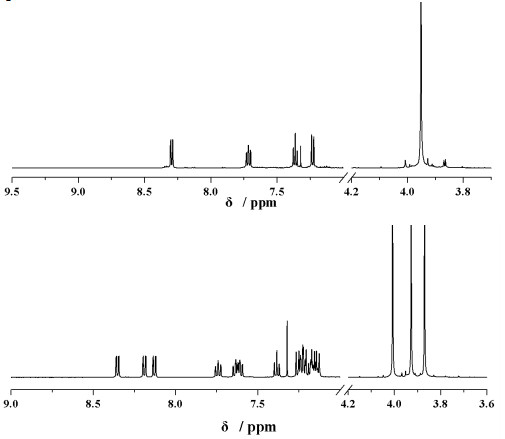
Peripherally low symmetric push-pull type triaza-subporphyrins 2a and 3a were synthesized and isolated in a modulated yield whereas p-methoxylphenyl substituted derivatives were prepared as the comparison according to the reported procedure. HR-ESI-MS (negative mode) for compound 2a revealed an intense parent peak at m/z = 673.1548 (Calcd. for C36H21BClN9O3 [M]–, 673.1545), providing a direct evidence that the C3-β-(2-methxoyl-phenyl)-β′-cyano triazasubporphyrin 2a was successfully obtained. Similar peak was observed in the case of 3a, and only negative mode was suitable for MS characterizations due to the electron-deficient properties of triazasubporphyrin core. The proton signals for β-substitution in the 1HNMR spectra (Fig. 1) lie beyond 7.20 ppm, and protons from OMe units appeared at around 4.0 ppm. In the case of 2a, two doublet and two triplet peaks from phenyl moiety and a singlet peak 3.96 ppm indicate the C3-molecular symmetry of push-pull type triazasub-porphyrin. On the other hand, more complicated peaks from phenyl and three singlet peaks from OMe indicated the C3-molecular symmetry of push-pull type triazasubporphyrin 3a.
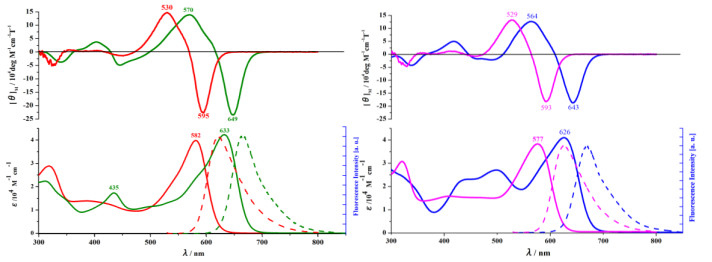
Electronic absorption spectroscopy[10, 11] is one of the most useful methods for characterizing porphyrins and their analogues due to the presence of intense π→π* bands and charge transfer band (CT) in the visible region. The optical spectroscopy of corroles can be understood based on a consideration of perturbations to an ML = 0, ±1, ± 2, ±3, ±4, ±5, ±6 and ±7 sequence in ascending energy terms for the orbital angular momentum quantum number for the MOs of a D15h symmetry parent hydrocarbon perimeter. The HOMO and LUMO have ML = ±4 and ±5, respectively, and are linked by forbidden and allowed ΔML = ±9 and ±1 transitions, which are associated with the Q and B bands of Gouterman's 4-orbital model, respectively, as observed in the 500~600 and 400~450 nm regions of subporphyraizine spectra. Compared with 2b and 3b, due to the weaker electron donating ability of push-substituents, the blue-shifted absorption was clearly observed. It could be explained as the inductive effect of OMe unit was larger when introduced at the para-position of benzene rings. More interestingly, the intensity of charge transfer band appearing at 350~500 nm was also decreased in the case of 2a and 3a. On the other hand, electronic absorption and MCD spectra of H3-triarylcorroles 2a~2b and 3a~3b were recorded in relatively low-polar CH2Cl2 (Fig. 2). The MCD spectra of C3-symmetric SubPz isomers 2a~2b contain Faraday A terms in the Q and B band regions that dominate the spectra of higher symmetric porphyrinoids. When molecular symmetry of 3a and 3b was decreased to C1, the Faraday B0 terms with -/+ sequence were revealed. Michl has demonstrated that the sign sequences observed in the Faraday B0 terms are related to the magnitudes of the splitting of MOs derived from the HOMO and LUMO of the parent hydrocarbon perimeter (the ΔHOMO and ΔLUMO values in Michl's terminology) and that their study is particularly significant for so called soft chromophores where the ΔLUMO and ΔHOMO values are of comparison. In addition, the SubPzs 2a and 3a were also emitted. The mirror-imaged fluorescence peaks compared with Q-band absorption were observed and the larger stokes' shift was reveled in the case of 3a due to its lower symmetric molecular structure.
In summary, two triazasubporphyrins with peripherally low symmetric (both C3 and C1 symmetry) push-and pull substitutions were successfully synthesized and characterized. The molecular structure was well confirmed and electronic structure was investigated by various spectroscopic analyses. Since porphyrinoids with tunable electronic structures have a wide range of applications, such as catalysis and photodynamic therapy (PDT), the synthesis and properties of triazasubporphyrin reported in this study may prove useful for the rational design of functional molecules.
Claessens, C. G.; González-Rodríguez, D.; Rodríguez-Morgade, M. S.; Medina, A.; Torres, T. Subphthalocyanines, subporphyrazines, and subporphyrins: singular nonplanar aromatic systems. Chem. Rev. 2014, 114, 2192−2277. doi: 10.1021/cr400088w
Claessens, C. G.; González-Rodríguez, D.; Torres, T. Subphthalocyanines: singular nonplanar aromatic compounds. Chem. Rev. 2002, 102, 835−854. doi: 10.1021/cr0101454
Rauschnabel, J.; Hanack, M. New derivatives and homologues of subphthalocyanine. Tetra. Lett. 1995, 36, 1629−1632. doi: 10.1016/0040-4039(95)00124-U
Rodríguez-Morgade, M. S.; Esperanza, S.; Torres, T.; Barbera J. Synthesis, characterization, and properties of subporphyrazines: a new class of nonplanar, aromatic macrocycles with absorption in the green region. Chem. Eur. J. 2005, 11, 354−360. doi: 10.1002/chem.200400787
Kobayashi, N.; Ishizaki, T.; Ishii, K.; Konami, H. Synthesis, spectroscopy, and molecular orbital calculations of subazaporphyrins, subphthalocyanines, subnaphthalocyanines, and compounds derived Therefrom by ring expansion. J. Am. Chem. Soc. 1999, 121, 9096−9110. doi: 10.1021/ja983325c
Stork, J. R.; Brewer, J. J.; Fukuda, T.; Fitzgerald, J. P.; Yee, G. T.; Nazarenko, A. Y.; Kobayashi N.; Durfee, W. S. Chloro and hydroxo forms of a boron(III) subtriazaporphyrin macrocycle. Inorg. Chem. 2006, 45, 6148−6151. doi: 10.1021/ic051093u
Liang, X.; Shimizu, S.; Kobayashi, N. Sizeable red-shift of absorption and fluorescence of subporphyrazine induced by peripheral push and pull substitution. Chem. Commun. 2014, 50, 13781−13784. doi: 10.1039/C4CC05943C
Higashino, T.; Rodríguez-Morgade, M. S.; Osuka, A.; Torres, T. Peripheral arylation of subporphyrazines. Chem. Eur. J. 2013, 19, 10353−10359. doi: 10.1002/chem.201301140
Shimizu, S.; Otaki, T.; Yamazaki, Y.; Kobayashi, N. Synthesis and properties of β, β-sp3-hybridized subphthalocyanine analogues. Chem. Commun. 2012, 48, 4100−4102. doi: 10.1039/c2cc30511a
Mack, J.; Bunya, M.; Shimizu, Y.; Uoyama, H.; Komobuchi, N.; Okujima, T.; Uno, H.; Ito, S.; Stillman, M. J.; Ono, N.; Kobayashi, N. Application of MCD spectroscopy and TD-DFT to nonplanar core-modified tetraennoporphyrins: effect of reduced symmetry on nonplanar porphyrinoids. Chem. Eur. J. 2008, 14, 5001−5020. doi: 10.1002/chem.200701611
Mack, J.; Asano, Y.; Kobayashi, N.; Stillman, M. J. Application of MCD spectroscopy and TD-DFT to a highly non-planar porphyrinoid ring system. New insights on red-shifted porphyrinoid spectral bands. J. Am. Chem. Soc. 2005, 127, 17697−17711. doi: 10.1021/ja0540728

 扫一扫看文章


扫一扫关注我们
 DownLoad:

 下载:
下载:


 下载:
下载: