
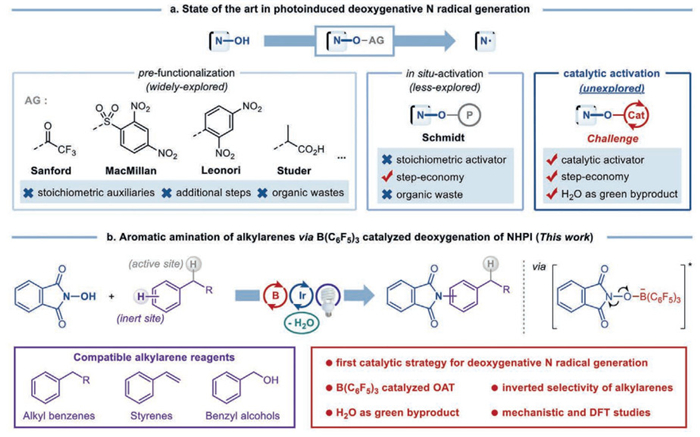
Figure 1.
Background and this work.


Photoinduced deoxygenation is a powerful and efficient approach to accessing highly reactive radicals, especially N-centered radicals, owing to its atom economy and the ready availability of starting materials. However, the high bond dissociation energy of N—OH bonds often requires pre-functionalizing hydroxyl groups as activating groups (AGs) using stoichiometric auxiliaries, such as trifluoroacetyl [1], dinitrophenylsulfonyloxy [2], 2,4-dinitrophenoxy [3], and isopropionic acid group (Fig. 1a). These additional steps increase procedural complexity, involving multiple operations and purification stages. To address this challenge, significant efforts have been directed toward developing in situ activation strategies. A key breakthrough was reported by Schmidt, who developed a triethylphosphite-promoted oxygen atom transfer (OAT) strategy to generate amidyl radicals and achieve an intermolecular anti-Markovnikov hydroamination of alkenes [4]. Since this pioneering work, several extensions of the phosphine-mediated deoxygenation approach have been reported. Despite these advancements, current methodologies typically rely on stoichiometric amounts of auxiliaries or activators and inevitably generate organic wastes. Consequently, developing a catalytic photoinduced deoxygenation strategy to circumvent these inherent limitations in the generation of N-centered radicals remains an unresolved challenge.
Recently, Ma and colleagues represents a significant advance (Fig. 1b) [5]. They developed an elegant catalytic system in which commercially available B(C6F5)3 acts not merely as a classical Lewis acid, but as a versatile catalytic OAT reagent under photoinduced conditions. This strategic elegantly addressed the long-standing dual challenges of stoichiometric waste and inefficient activation. By coordinating in situ with the deprotonated N-hydroxyphthalimide (NHPI), B(C6F5)3 facilitates the formation of a key PhthN—O-B(C6F5)3 anionic intermediate. The true innovation lies in the subsequent activation mode: Instead of following a typical single-electron-transfer (SET) pathway, this intermediate undergoes an energy transfer (EnT)-mediated N—O bond homolysis upon photosensitization. This process cleanly generates the desired phthalimidyl radical (PhthN•) while regenerating the borane catalyst, establishing a rare example of catalytic deoxygenation for N radical generation with H2O as the sole byproduct.
More strikingly, this novel catalytic manifold enables a remarkable reversal of the inherent reactivity and selectivity in a classic system. Under conventional photoredox conditions, the reaction of NHPI with alkylarenes such as toluene overwhelmingly leads to the benzylic C—H oxidation product via the PINO radical pathway. By diverting the mechanism to the deoxygenative PhthN• radical, Ma's strategy completely overrides this preference, achieving exclusive aromatic C(sp2)-H amination while bypassing the intrinsically more labile benzylic C—H bond. This catalyst-controlled selectivity switch is profound, offering direct access to valuable arylamines from simple alkylarene feedstocks in a single step under mild, metal-free conditions. The methodology demonstrates exceptional functional group tolerance and has been successfully applied to the late-stage functionalization of complex biomolecules and the streamlined synthesis of a pharmaceutical precursor, thereby underscoring its immediate synthetic utility and its potential to supplant traditional multi-step approaches.
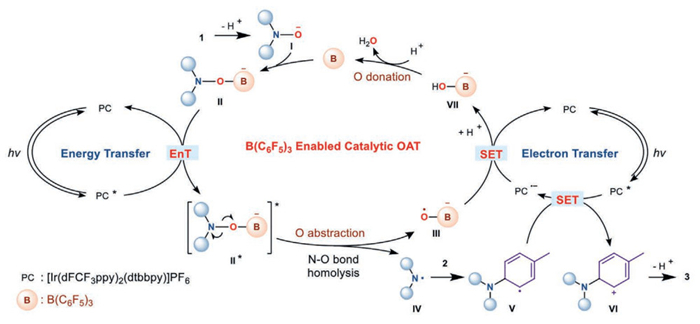
A plausible mechanism, supported by experimental and DFT calculations, reveals the elegance of this design (Fig. 2). The process initiates with deprotonation of NHPI to form anion Ⅰ, which binds strongly to B(C6F5)3, yielding the key adduct Ⅱ. Upon visible-light excitation, the photocatalyst undergoes triplet-triplet energy transfer (TT EnT) to Ⅱ, promoting homolytic cleavage of the N—O bond. The EnT process is corroborated by photoquenching experiments, cyclic voltammetry, the use of an alternative energy-transfer catalyst, UV light irradiation, and TEMPO-trapping studies. The cleavage of Ⅱ generates the phthalimidyl radical Ⅳ along with the O-B radical anion Ⅲ. Radical Ⅳ adds to the aromatic ring of the methylarene, and the resulting adduct Ⅴ is oxidized by the excited photocatalyst to form the Wheland intermediate Ⅵ, which after deprotonation delivers the arylamine product 3. Meanwhile, Ⅲ is reduced and protonated to release H2O and regenerate B(C6F5)3, closing a clean catalytic OAT cycle. Control experiments confirm that water is a weaker Lewis base than NHPI and can be displaced by NHPI when bound to B(C6F5)3.
In conclusion, this study introduces a novel paradigm for the sustainable generation of nitrogen radicals by revealing the OAT capability of a simple borane under photocatalytic conditions. Leveraging this OAT process, the strategy eliminates the requirement for stoichiometric additives, produces only water as a byproduct, and overcomes the traditional preference for benzylic oxidation. This enables exclusive aromatic C—H amination across a broad range of substrates. The approach provides a sustainable and practical alternative to conventional methods for synthesizing arylamines, as further evidenced by its successful application in late-stage functionalization and the synthesis of a key pharmaceutical precursor. This work thus holds broad potential for applications in synthetic chemistry and drug discovery.
Wei-Bao He: Writing – original draft. Cui Xin: Writing – review & editing. Xiuling Cui: Writing – review & editing.
The authors declare that they have no known competing financial interests or personal relationships that could have appeared to influence the work reported in this paper.
L.J. Allen, P.J. Cabrera, M. Lee, M.S. Sanford, J. Am. Chem. Soc. 136 (2014) 5607–5610. doi: 10.1021/ja501906x
G. Cecere, C.M. König, J.L. Alleva, D.W.C. MacMillan, J. Am. Chem. Soc. 135 (2013) 11521–11524. doi: 10.1021/ja406181e
J. Davies, S.G. Booth, S. Essafi, R.A.W. Dryfe, D. Leonori, Angew. Chem. Int. Ed. 54 (2015) 14017–14021. doi: 10.1002/anie.201507641
S.W. Lardy, V.A. Schmidt, J. Am. Chem. Soc. 140 (2018) 12318–12322. doi: 10.1021/jacs.8b06881
Z. Pan, H. Qiu, L. Wang, R. Zheng, Y. Ma, Nat. Commun. 16 (2025) 1167.

 扫一扫看文章


扫一扫关注我们
 DownLoad:

 下载:

 下载: