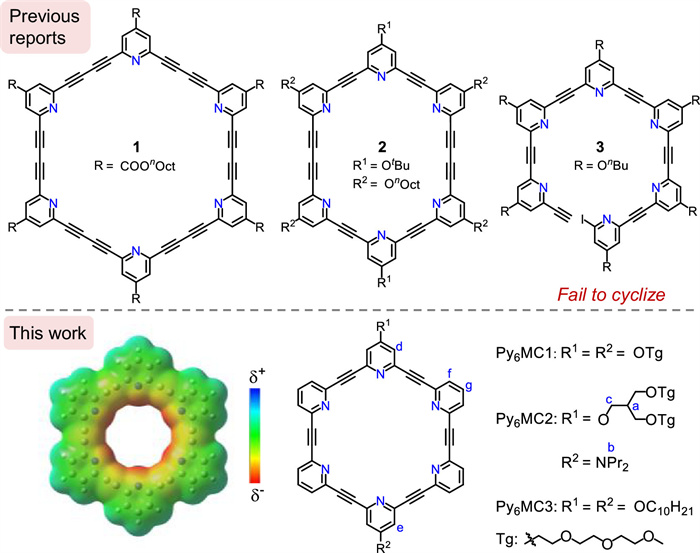
Figure 1.
Alkyne-bridged pyridine oligomers in literature (top). Electrostatic potential map of Py6MC and Py6MC1-Py6MC3 in this work (bottom).

Shape-persistent hexa(ethynylpyridine) macrocycles as adaptive hosts for cations
Pengfei Niu , Jiawei Ma , Beijing Zhang , Ziyao Nie , Haitao Liu , Yong Liang , Xing Jiang


The pursue of new host molecules has been an everlasting theme in supramolecular chemistry since Pedersen’s seminal report of crown ethers [1]. Shape-persistent macrocycles feature cavities of well-defined geometry, and are hence poised to bind guests of complementary size and shape [2-8]. Their host-guest complexation can be enhanced by endo-functionalization, i.e., introducing sites of interaction inside the cavity [9-15]. A facile approach to achieve endo-functionalization of shape-persistent macrocycles is to replace benzene moieties with pyridines, as the inward pointing nitrogen can participate in hydrogen bonds and other intermolecular interactions [16-20]. Tobe prepared butadiyne-bridged pyridinophane 1 (Fig. 1), which forms host-guest complexes with tropylium cation [21]. Inouye reported pyridine macrocycle 2 with acetylene and butadiyne linkers, which binded β-maltoside with high selectivity [22,23]. Hexa(ethynylenepyridylene) macrocycle Py6MC has been a desired host molecule with a moderate-sized polar cavity suitable for binding electron-deficient guests. However, the high electron density inside the macrocycle has rendered Py6MC synthetically challenging. Previous attempts to prepare Py6MC by cyclization of linear precursors such as 3 failed [24]. Acyclic polymers were obtained instead, partially due to unfavored dipole interactions in the “closed” conformation (Fig. S1 in Supporting information). Herein, we report the successful synthesis of three Py6MCs with different substituents by using catalytic amount of PdCl2(PPh3)2 and stoichiometric CuI, or with K2CO3 as an additive in a copper-free condition in the ring-closing Sonogashira reaction. Their crystal structures suggested that Py6MC1–3 could adopt planar and non-planar conformations, and that their cavities are occupied by polar ethylene glycol side chains or water molecules in the solid state. 1H NMR and fluorescence titrations suggested that Py6MCs form 1:1 complexes with pyridinium and quaternary ammonium cations in solution, with association constants (Ka) up to 3.1 × 10⁵ L/mol. We were surprised to find that comparable Ka values were obtained for multiple cationic guests despite their differences in size and shape, which suggested notable adaptivity of Py6MCs. DFT calculations confirmed that cations are bound in the macrocycle cavity by C–H···N hydrogen bonds and analogous weak interactions. Host-guest interactions led to notable distortion of Py6MC to fit guests of different structural features.
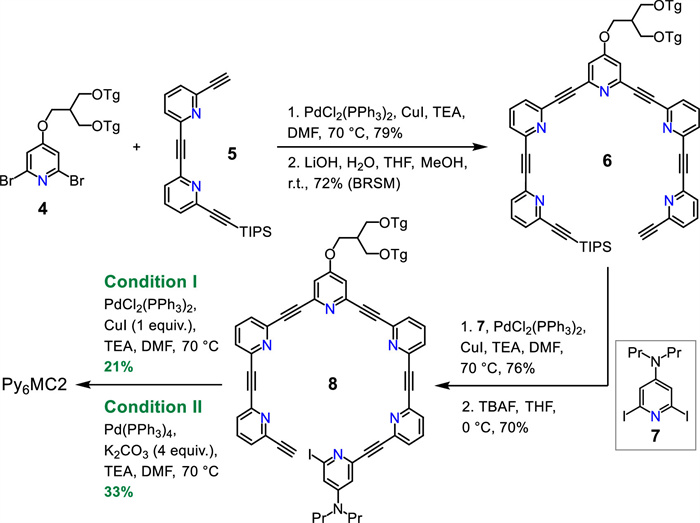
We began our synthetic endeavors from Py6MC2 (Scheme 1), expecting that a bulky ethylene glycol side chain might be able to shift the equilibrium to the “closed” conformation and facilitate the ring-closure (Fig. S1). Sonogashira coupling of 4 with 5 gave a pentapyridine oligomer, which was treated with aqueous LiOH [25] to provide mono-deprotected 6, together with recovered starting material and the bis-deprotected byproduct. The coupling of 6 with 2,6-diiodo-N,N-dipropylpyridin-4-amine 7 followed by TIPS removal gave a linear hexapyridine oligomer 8, whose cyclization was initially attempted using classical Sonogashira catalysts PdCl2(PPh3)2 and CuI under pseudo-high-dilution conditions. The formation of Py6MC2 was observed by mass spectrometry, yet its isolation was complicated by the low yield (8%). We accidentally found that a stoichiometric amount of CuI (relative to 8) improved the reaction and furnished Py6MC2 in 21% yield. This contradicted the traditional wisdom that Cu accelerates the alkyne homocoupling side reaction [26-28]. Meanwhile, a higher yield of 33% was achieved by a copper-free Sonogashira cyclization [29-31] with Pd(PPh3)4 as the sole catalyst and K2CO3 as an additive (Table S1). Py6MC1 and Py6MC3 were prepared under similar conditions (Schemes S4 and S5 in Supporting information). The structures of all three macrocycles were determined unambiguously by single-crystal X-ray diffraction. Py6MC1 and Py6MC2 were also characterized by NMR spectroscopy and mass spectrometry. The low solubility of Py6MC3 in common organic solvents precluded characterizations other than mass spectroscopy.
Single crystals of Py6MC1 and Py6MC2 were both obtained by slow evaporation of their acetonitrile solutions. Py6MC1 crystallized in a triclinic P-1 space group, with two macrocycles and four CH3CN in a unit cell. As shown in Fig. 2a, one molecule of Py6MC1 (yellow) is a planar hexagon, while the other (green) adopts a nonplanar chair-like conformation. Each macrocycle cavity hosts two triethylene glycol (Tg) side chains of neighboring macrocycles. The polar C–H bonds of Tg form C–H···N hydrogen bonds (2.6–2.7 Å) with nitrogen atoms of the pyridines. We also observed parallel-displaced stacking of the pyridine-acetylene-pyridine “edges” of adjacent hexagons, at pyridine-pyridine (centroid-to-centroid) distance of 3.6–3.8 Å. Each Py6MC1 interacts with six neighboring macrocycles, three on the top and bottom sides each (Fig. 2b). Py6MC2 crystallized in a triclinic P-1 space group, with one macrocycle and four CH3CN per unit cell. The macrocycle adopts a nonplanar chair-like conformation, with the two pyridine rings deviating by 11.4° and 20.1° from the central plane, respectively (Fig. 2c). The pyridine-pyridine stacking is weak with an average distance of 3.8 Å. Similar to Py6MC1, C–H···N hydrogen bonds (2.6–2.7 Å) between Tg and pyridine were observed. Two adjacent macrocycles form a slipped head-to-head dimer, allowing the cavity to host the Tg side chains of each other (Fig. 2d). Crystals of Py6MC3 were obtained fortuitously by slow evaporation of a THF solution despite its low solubility. Its structure was solved in an orthorhombic Pna21 space group, with one macrocycle and 10 water molecules per unit cell. Py6MC3 adopts a boat-like conformation (Fig. 2e), with two pyridines bent upwards by 26.0° and 28.9° from the central plane. The (H2O)10 cluster is partially buried within the cavity, forming three strong O–H···N hydrogen bonds (2.1 Å) with pyridines, in addition to eleven hydrogen bonds among water molecules. Since no water was added during crystallization, they were likely captured from the air. Each Py6MC3 is in contact with four neighboring macrocycles, two through pyridine-pyridine stacking (3.6–3.8 Å), and the other two through geometrical complementarity (Fig. 2f).
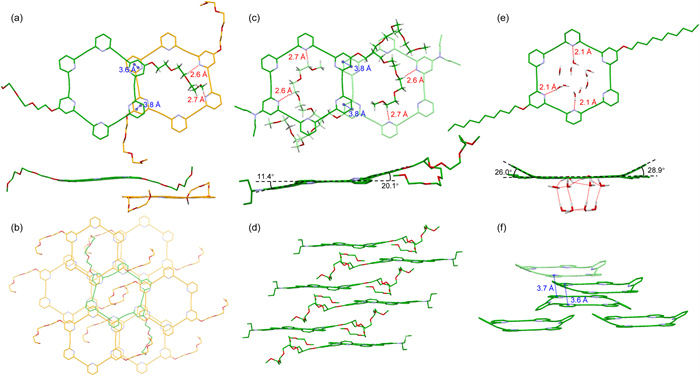
Taken together, the crystal structures of Py6MC1–3 suggest these macrocycles can adopt planar as well as distorted nonplanar conformations. We also concluded that their cavities are highly polar, with strong affinity towards Tg side chains or water molecules. Both features suggest that Py6MCs can serve as excellent supramolecular hosts for polar guests.
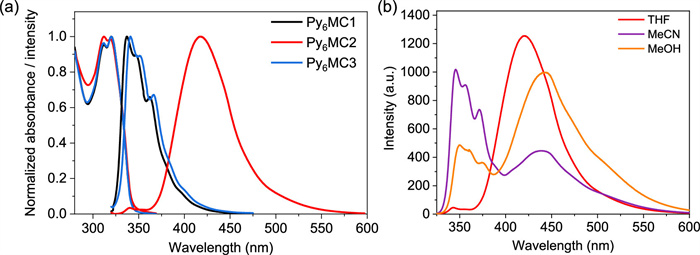
Photophysical properties of the macrocycles were subsequently investigated. Their UV–vis absorption spectra in THF were almost identical, with prominent bands between 280 nm and 350 nm (Fig. 3a). Py6MC1 and Py6MC3 exhibited similar emission features, with maximum emission peaks at 337 and 341 nm, respectively. The Stokes shifts (17 nm and 21 nm) were relatively small, consistent with their rigid macrocyclic structures. The emission spectrum of Py6MC2 showed a small shoulder peak at 343 nm, and a red-shifted broad peak centered at 418 nm, likely a result of excimer-like emission [32]. This conjecture was supported by the presence of a strong “monomer” band at 346 nm and a weaker “excimer” band at 438 nm in CH3CN (Fig. 3b). Similarly, two emission bands were observed for Py6MC2 in MeOH, with the monomer band at a lower intensity. Increasing the temperature or addition of water to a THF solution led to enhanced monomer band and weakened excimer band (Figs. S65 and S66 in Supporting information). All evidences agreed with the formation of a Py6MC2 excimer similar to the solid-state dimer (Fig. 2c).
Given the polar and electron-rich cavities of Py6MCs, we explored their supramolecular interaction with cationic guests, including two moderately sized N-methyl pyridinium derivatives G1 and G2, four quaternary ammonium cations of moderate (G3, G4) and large (G5, G6) size, and cations of two pharmaceutical agents-Neostigmine G7 [33] and Pancuronium G8 [34] (Fig. 4a). 1H NMR experiments were carried out for qualitative studies, and Py6MC2 was used as a host for its high solubility. Upon mixing equimolar amounts of Py6MC2 and the tetrakis[3,5-bis(trifluoromethyl)phenyl]borate (BArF) salt of G1 in CDCl3, notable changes were observed for NMR signals of both the host and the guest (Fig. 4b). Protons H1, H2, and H3 all exhibited pronounced downfield shifts (Δδ = 0.91, 1.25, 0.89 ppm, respectively). Proton H4, which was distant from the cationic N center, also exhibited downfield shift of 0.52 ppm. These suggested strong host-guest interaction, with G1 residing inside the cavity and its protons deshielded due to C–H···N hydrogen bonds, or analogous weak interactions. Meanwhile, pyridine protons of Py6MC2 showed downfield shifts (0.08–0.11 ppm), due to the through-space deshielding by cation G1. Similar chemical shift changes were observed for protons of substituted (Hd and He) and unsubstituted (Hf and Hg) pyridines, likely due to fast rotation of G1 inside the macrocycle cavity. The Job plots obtained from 1H NMR measurements revealed a 1:1 binding mode (Fig. 4c).
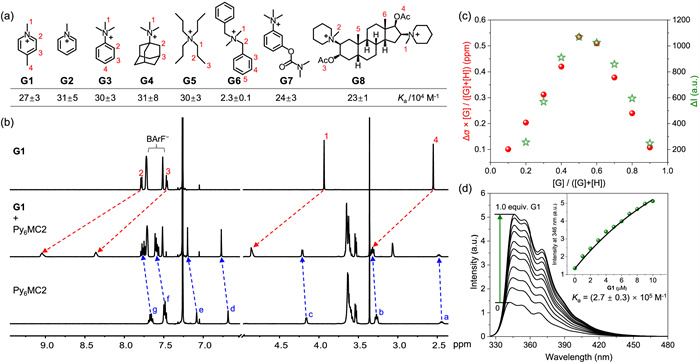
The interactions between Py6MC2 and G2-G8 were studied under identical conditions, and significant chemical shift changes were observed for all guests (Table S4 in Supporting information). The methyl (1.05 ppm) and aromatic (1.27–1.53 ppm) protons of G2 experienced larger downfield shifts than those of G1, indicating that the smaller G2 is also tightly captured. While G3 and G4 appeared to be too large to fit in the cavity, they also had strong interactions with Py6MC2. For G3, the change of chemical shift of methyl protons H1 (0.60 ppm) was smaller than that of G1, suggesting reduced hydrogen-bonding capability. Its aromatic protons H2-H4 showed progressively decreasing downfield shifts (0.67, 0.30, and 0.23 ppm, respectively) with increasing distance from the cationic N center. The methyl protons H1 of G4 exhibited large downfield shifts (0.72 ppm), while smaller changes were observed for protons H2 (0.44 ppm) and H3 (0.10 ppm) of less polarized C–H bonds. The same trend was observed for G5, whose protons H1-H3 showed decreasing downfield shifts (0.58, 0.40, and 0.07 ppm, respectively). The presence of one set of signals also suggested conformational freedom of G5 in the host-guest complex. G6 is similar to G5 in size but with a rod-like geometry instead. Protons H1-H3 of G6 exhibited downfield shifts (0.39, 0.56, and 0.16 ppm, respectively), while aromatic protons H4 and H5 experienced upfield shifts (-0.07 and -0.09 ppm). These peculiar results might stem from π-π interactions between the phenyl group of G6 and pyridines of the host. G7 is an analog of G3 with an additional N,N-dimethylaminoacyloxy group at the meta-position. The change of chemical shifts of most G7 protons were comparable to those of G3 (0.21–0.78 ppm), while the amide methyl protons experienced upfield shifts (-0.28 ppm) due to the shielding effect of pyridines. The bulky G8 also engaged in strong host-guest interaction with significant chemical shift changes. The N-methyl protons H1 and H2 exhibited downfield shifts (0.17 and 0.27 ppm), while H3-H6 showed upfield shifts (-0.07, -0.09, -0.09 and -0.05 ppm, respectively). It is likely that G8 formed a threaded pseudo rotaxane complex with Py6MC2.
Fluorescence titrations were carried out to quantify host-guest interactions. Owing to the complex fluorescence behavior of Py6MC2, the association constant Ka was determined using Py6MC1 as the host. As shown in Fig. 4d, upon addition of G1, a steady increase in fluorescence intensity was observed, which was attributed to the restricted conformation of Py6MC1 in the host-guest complex. The Job plots (Fig. 4c) confirmed the 1:1 binding mode, and Ka was determined to be (2.7 ± 0.3) × 105 L/mol [35]. Similar increases of fluorescence were observed upon titration of Py6MC1 with G2-G8 (Figs. S75-S81 in Supporting information), and high Ka values (2.3-3.1 × 10⁵ L/mol) were obtained for all guests except G6, despite their different sizes and shapes. The binding affinity of Py6MCs towards cationic guests is comparable to Cai’s arene [36] and Li’s BINOL[2]arene [37], and slightly higher than Chen’s helic[6]arene [38]. This highlights the potential of endo-functionalized shape-persistent macrocycles as supramolecular hosts. In addition, the high binding affinity for G7 and G8 makes Py6MCs relevant in biomedicine [39,40].
DFT calculation was performed on complexes Py6MC·G1–8. The optimized structures showed that cationic guests indeed reside in the cavity, and the macrocycle experienced different levels of distortion as a result of cation-binding (Fig. 5a). Py6MC remains largely planar in Py6MC·G1 as G1 fits well with the cavity, and independent gradient model (IGM) analysis [41] highlighted the stabilizing C–H···N and C–H···πalkyne interactions (Fig. 5b). The adaptivity of Py6MC allows for strong binding of a smaller guest G2 and a larger guest G3. Py6MC adopted a distorted boat-like conformation to accommodate sterically demanding G4, with the adamantyl moiety was partially buried in the cavity. The alkyl chains of G5 were fully extended, and Py6MC was distorted to maximize C–H···N interactions. In contrast, the conformation of G6 was restricted due to phenyl-pyridine πPh-πPy interactions, which led to diminished electrostatic host-guest interactions. This observation is consistent with the smaller Ka of 2.3 × 10⁴ L/mol for G6 compared to other guests. Py6MC adopted more distorted conformation upon binding G7 compared to G3, which is likely compensated by C–H···πPy interactions as comparable Ka were obtained for both guests. The Py6MC·G8 complex showed that the bulky steroid threaded through the cavity, in alignment with the chemical shift changes in 1H NMR experiments.
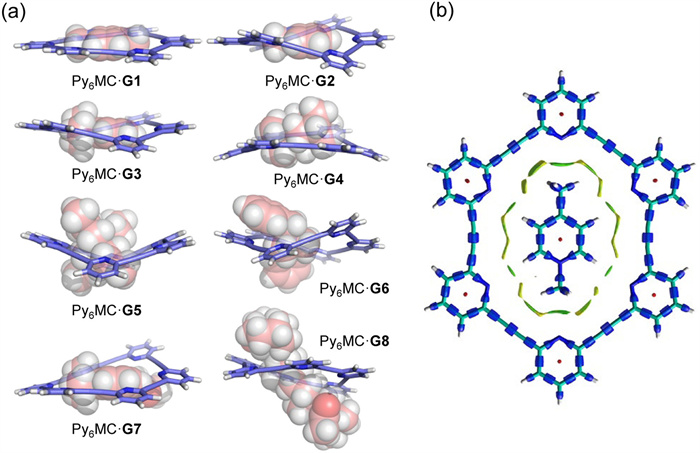
Calculation also provided information on the energetic cost of host deformation during binding. The strain energy ΔE is defined as the electronic energy of Py6MC in the host-guest complex relative to free macrocycle. ΔE was found to be 2.5 and 3.9 kcal/mol for Py6MC·G1 and Py6MC·G2, respectively. Surprisingly, the energetic cost was lower for larger guests G3 (1.3 kcal/mol) and G4 (1.0 kcal/mol). The ΔE of Py6MC·G5 was found to be 4.5 kcal/mol, a result of macrocycle deformation into a “V” shape geometry to maximize C–H···N interactions. Py6MC·G6 exhibited the highest ΔE of 5.8 kcal/mol to meet the geometrical requirements for simultaneous πPh-πPy and C–H···N interactions. The ΔE of Py6MC·G7 was 5.2 kcal/mol, which is 3.9 kcal/mol higher than that of G3. Only a moderate 4.0 kcal/mol strain was noticed for the pseudo rotaxane complex Py6MC·G8.
In summary, we achieved the effective synthesis of Py6MCs with a high level of endo-functionalization. Single-crystal X-ray diffraction revealed their conformational flexibility and cavity polarity. The conjugated framework of Py6MCs endowed them with decent luminescence properties. Strong 1:1 binding with pyridinium and quaternary ammonium cations of various sizes was established by NMR experiments, and binding affinities towards these guests (Ka from 2.4 × 10⁴ L/mol to 3.1 × 10⁵ L/mol) were determined by fluorescence titration. DFT calculations showed that the adaptive structures allow Py6MCs to interact with guests of different sizes and shapes. These unique features of Py6MCs highlight the potential of shape-persistent endo-functionalized macrocycles as supramolecular hosts.
The authors declare that they have no known competing financial interests or personal relationships that could have appeared to influence the work reported in this paper.
Pengfei Niu: Writing – review & editing, Writing – original draft, Investigation, Data curation. Jiawei Ma: Investigation, Conceptualization. Beijing Zhang: Visualization, Investigation. Ziyao Nie: Investigation. Haitao Liu: Investigation. Yong Liang: Writing – review & editing, Supervision, Investigation. Xing Jiang: Writing – review & editing, Writing – original draft, Project administration, Investigation, Funding acquisition, Conceptualization.
This work was supported partially by National Natural Science Foundation of China (No. 22201080), the Recruitment Program of Guangdong (No. 2021QN02C857), and Guangdong Basic and Applied Basic Research Foundation (Nos. 2024A1515012391, 2025A1515010297).
Supplementary material associated with this article can be found, in the online version, at doi:
C.J. Pedersen, J. Am. Chem. Soc. 89 (1967) 2495–2496. doi: 10.1021/ja00986a052
W. Zhang, J.S. Moore, Angew. Chem. Int. Ed. 45 (2006) 4416–4439. doi: 10.1002/anie.200503988
Z. Liu, S.K.M. Nalluri, J.F. Stoddart, Chem. Soc. Rev. 46 (2017) 2459–2478. doi: 10.1039/C7CS00185A
F.Y. Chen, W.C. Geng, K. Cai, D.S. Guo, Chin. Chem. Lett. 35 (2024) 109161. doi: 10.1016/j.cclet.2023.109161
I. Popov, T.H. Chen, S. Belyakov, et al., Chem. Eur. J. 21 (2015) 2750–2754. doi: 10.1002/chem.201406073
G. Liu, S. Guo, L. Liu, et al., J. Org. Chem. 88 (2023) 10171–10179. doi: 10.1021/acs.joc.3c01197
S. Li, Q. Liu, L. Mao, et al., Chin. Chem. Lett. 35 (2024) 109791. doi: 10.1016/j.cclet.2024.109791
Z.H. Song, Y.F. Ma, H. Han, et al., Chem. Eur. J. 31 (2025) e202403271. doi: 10.1002/chem.202403271
L. Adriaenssens, P. Ballester, Chem. Soc. Rev. 42 (2013) 3261–3277. doi: 10.1039/c2cs35461f
C.D. Zhao, H. Yao, S.Y. Li, et al., Chin. Chem. Lett. 35 (2024) 108879. doi: 10.1016/j.cclet.2023.108879
Y. Ohishi, M. Murase, H. Abe, M. Inouye, Org. Lett. 21 (2019) 6202–6207. doi: 10.1021/acs.orglett.9b01980
M. Dong, X. Liu, Z.Y. Zhang, et al., Chem. Commun. 58 (2022) 2319–2322. doi: 10.1039/D1CC06788E
C. Zhai, E.C. Zulueta, A. Mariscal, et al., Chem. Sci. 15 (2024) 19588–19598. doi: 10.1039/D4SC06190J
Y. Lu, S.M. Wang, S.S. He, et al., Chem. Sci. 15 (2024) 14791–14797. doi: 10.1039/D4SC04950K
Y. Mao, J. Ma, J. Ji, et al., Chin. Chem. Lett. 35 (2024) 109927. doi: 10.1016/j.cclet.2024.109927
Y. Yamaguchi, S. Kobayashi, S. Miyamura, et al., Angew. Chem. Int. Ed. 43 (2004) 366–369. doi: 10.1002/anie.200352749
J.L. Alonso-Gómez, A. Navarro-Vázquez, M.M. Cid, Chem. Eur. J. 15 (2009) 6495–6503. doi: 10.1002/chem.200900316
S. Castro-Fernández, I.R. Lahoz, A.L. Llamas-Saiz, et al., Org. Lett. 16 (2014) 1136–1139. doi: 10.1021/ol403778f
H. Abe, K. Ohtani, D. Suzuki, et al., Org. Lett. 16 (2014) 828–831. doi: 10.1021/ol403579e
Y. Ohishi, J. Chiba, M. Inouye, J. Org. Chem. 87 (2022) 10825–10835. doi: 10.1021/acs.joc.2c01095
Y. Tobe, A. Nagano, K. Kawabata, M. Sonoda, K. Naemura, Org. Lett. 2 (2000) 3265–3268. doi: 10.1021/ol006318d
H. Abe, H. Kurokawa, Y. Chida, M. Inouye, J. Org. Chem. 76 (2011) 309–311. doi: 10.1021/jo101921e
H. Abe, Y. Chida, H. Kurokawa, M. Inouye, J. Org. Chem. 76 (2011) 3366–3371. doi: 10.1021/jo2003055
M. Inouye, M. Waki, H. Abe, J. Am. Chem. Soc. 126 (2004) 2022–2027. doi: 10.1021/ja039371g
T.P. Heffron, T.F. Jamison, Org. Lett. 5 (2003) 2339–2342. doi: 10.1021/ol0347040
P. Siemsen, R.C. Livingston, F. Diederich, Angew. Chem. Int. Ed. 39 (2000) 2632–2657. doi: 10.1002/1521-3773(20000804)39:15<2632::AID-ANIE2632>3.0.CO;2-F
G. Evano, N. Blanchard, M. Toumi, Chem. Rev. 108 (2008) 3054–3131. doi: 10.1021/cr8002505
D. Wang, J. Li, N. Li, et al., Green Chem. 12 (2010) 45–48. doi: 10.1039/B917448F
A. Soheili, J. Albaneze-Walker, J.A. Murry, P.G. Dormer, D.L. Hughes, Org. Lett. 5 (2003) 4191–4194. doi: 10.1021/ol035632f
C. Torborg, J. Huang, T. Schulz, et al., Chem. Eur. J. 15 (2009) 1329–1336. doi: 10.1002/chem.200802444
M. Gazvoda, M. Virant, B. Pinter, J. Košmrlj, Nat. Commun. 9 (2018) 4814. doi: 10.1038/s41467-018-07081-5
C.Y. Wu, Y.N. Gao, Z.H. Zhang, et al., Chin. Chem. Lett. 35 (2024) 109649. doi: 10.1016/j.cclet.2024.109649
F. Herbstreit, D. Zigrahn, C. Ochterbeck, J. Peters, M. Eikermann, Anesthesiology 113 (2010) 1280–1288. doi: 10.1097/ALN.0b013e3181f70f3d
T. Raghavendra, J. R. Soc. Med. 95 (2002) 363–367. doi: 10.1177/014107680209500713
P. Thordarson, Chem. Soc. Rev. 40 (2011) 1305–1323. doi: 10.1039/C0CS00062K
H. Han, R. Fu, R. Wang, et al., J. Am. Chem. Soc. 144 (2022) 20351–20362. doi: 10.1021/jacs.2c08144
G. Sun, X. Zhang, Z. Zheng, et al., J. Am. Chem. Soc. 146 (2024) 26233–26242. doi: 10.1021/jacs.4c07924
G.W. Zhang, P.F. Li, H.X. Wang, Y. Han, C.F. Chen, Chem. Eur. J. 23 (2017) 3735–3742. doi: 10.1002/chem.201605394
H.K. Liu, F. Lin, S.B. Yu, et al., J. Med. Chem. 65 (2022) 16893–16901. doi: 10.1021/acs.jmedchem.2c01677
Y. Zhao, L. Chen, J. Chen, et al., Chem. Commun. 59 (2023) 5858–5861. doi: 10.1039/D3CC01405C
T. Lu, Q. Chen, Chem. Methods 1 (2021) 231–239. doi: 10.1002/cmtd.202100007

Figure 1 Alkyne-bridged pyridine oligomers in literature (top). Electrostatic potential map of Py6MC and Py6MC1-Py6MC3 in this work (bottom).

Figure 2 Crystal structures of Py6MC1–3. Solvents and hydrogen atoms were partially omitted for clarity. (a) Top and side views of a unit cell of Py6MC1 and (b) its packing diagram. (c) Top view (dimer) and side view of Py6MC2 and (d) its packing diagram. (e) Top and side views of Py6MC3 and the bound water cluster and (f) the packing diagram of Py6MC3 with side chains omitted. The crystallographic data are available from the Cambridge Crystallographic Data Centre (CCDC) under deposition numbers 2500515–2500517.

Figure 3 (a) Normalized UV–vis and fluorescence emission spectra of Py6MC1–3 in THF (λex = 310 nm, 298 K). (b) Fluorescence emission spectra of Py6MC2 in THF, CH3CN, and CH3OH. Macrocycle concentration at 10 µmol/L.

Figure 4 (a) Guests G1–G8 and corresponding Ka values with Py6MC1. (b) Partial 1H NMR spectra (1.0 mmol/L, 500 MHz, CDCl3, 298 K) of G1, Py6MC2·G1, and Py6MC2. (c) The Job plots of host-guest interactions obtained by 1H NMR (red dots) and fluorescence (green stars) titration experiments. (d) Fluorometric titration spectra of Py6MC1 (10 µmol/L in THF) with G1. Inset: titration data fitted using a 1:1 binding model.

 扫一扫看文章


扫一扫关注我们
 DownLoad:
 下载:
下载:


 下载:
下载: