Key Laboratory of Hunan Province for Advanced Carbon-Based Functional Materials, School of Chemistry and Chemical Engineering, Hunan Institute of Science and Technology, Yueyang 414006, China
b.
International Iberian Nanotechnology Laboratory (INL), Braga, 4715-330, Portugal
The practical performance of room-temperature sodium-sulfur (Na-S) batteries is fundamentally constrained by an intrinsic trade-off in their chemistry [1]. The conventional reliance on the sulfur to sodium sulfide reduction pathway limits discharge voltage to below 1.6 V and necessitates substantial excess sodium metal at the anode to compensate for irreversible loss. This configuration imposes considerable limits on energy density while introducing significant safety risks associated with dendritic growth and increased chemical reactivity [2]. Theoretically, oxidizing sulfur to a tetravalent state, exemplified by sulfur tetrachloride, presents a transformative solution by facilitating a discharge potential approaching 3.6 V [3]. However, the attainment of this high-valence redox couple at ambient temperature has been rendered kinetically challenging, attributable to the substantial activation energy necessary for the stabilization of the reactive intermediates. The strictness of this thermodynamic boundary is highlighted by the parallel trajectory of conventional sulfur reduction systems. Even as concurrent electrocatalytic advancements, specifically the design of symmetry-broken cobalt yttrium diatomic sites, successfully accelerate multielectron reduction kinetics and suppress polysulfide shuttling, they inherently remain confined to the traditional low voltage regime without unlocking the high valence conversion [4].
The research by Geng et al. [5] in Nature (7 January 2026) reports a chemical strategy that overcomes these limitations through a tailored chloroaluminate electrolyte modified with sodium dicyanamide. Their key innovation is a chloroaluminate electrolyte incorporating sodium dicyanamide, in which the dicyanamide anion acts as a dual-functional mediator. On the cathode side, the anion coordinates with sulfur species, lowering the Gibbs free energy change and effectively enabling the reversible conversion of S8 to SCl4. Simultaneously, this formulation fosters a N-rich interphase on the aluminum current collector that suppresses dendrites and enables highly reversible sodium plating without excess anode material. This synergistic approach successfully realizes a high-voltage, anode-free architecture. More profoundly, it breaks the long-standing coupling between high capacity and anode excess in metal-sulfur batteries, thereby establishing a new design paradigm that simultaneously pursues high energy density and intrinsic safety.
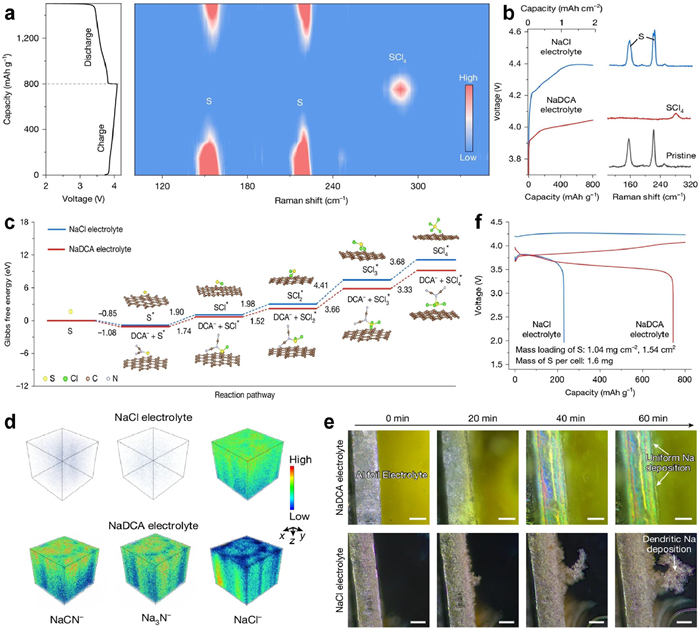
The fundamental obstacle to achieving a high-voltage Na-S battery lies in the stringent kinetic requirements for converting S8 into a tetravalent sulfur species. This conversion entails a complex 32-electron process that is effectively forbidden at ambient conditions due to the instability of the intermediate species. Geng et al. tackled this challenge by using in-situ Raman spectroscopy to monitor sulfur’s chemical evolution within a working cell. The characteristic Raman peaks of S8 diminish and a new band appears at 288 cm−1, which steadily intensifies (Fig. 1a). To isolate this signal from potential interference by other sulfur chloride intermediates, the authors employed ex-situ Raman and X-ray absorption spectroscopy to trace the formation of S2Cl2 and SCl2, distinguishing their distinct spectral features from the 288 cm−1 peak. This assignment is orthogonally validated by gas chromatography coupled to high-resolution mass spectrometry, which detected a pronounced SCl3+ fragment at the charged state. Together with the S4+ state confirmed by S K-edge X-ray absorption spectroscopy, this multidimensional evidence establishes the 288 cm−1 signature as the formation of SCl4. It is equally significant to note that, as illustrated in Fig. 1b, a control cell utilizing a standard NaCl-only electrolyte, devoid of the sodium dicyanamide (NaDCA) additive, does not display such a peak. This result indicates that without the tailored mediator, the S/SCl4 conversion pathway remains inaccessible. Such a pronounced contrast underscores that the NaDCA additive is indispensable for activating SCl4 formation under the specified conditions.
Figure 1
Figure 1.
(a) In-situ Raman spectra of the S cathode in the anode-free Na-S battery at the 1st cycle using NaDCA electrolyte. (b) Initial galvanostatic charge curves and the corresponding Raman spectra of the S cathodes in anode-free Na-S batteries using NaDCA and NaCl electrolytes. (c) Gibbs free energy changes of S oxidation in NaDCA and NaCl electrolytes based on DFT calculations. (d) Depth profiling of the NaCN−, Na3N− and NaCl− secondary-ion fragments acquired by TOF-SIMS using Na-deposited Al foils with NaCl and NaDCA electrolytes, respectively. (e) In-situ optical images of Na plating on Al foil in Na-Al cell using NaDCA or NaCl electrolyte. (f) Galvanostatic charge-discharge curves of anode-free Na-S batteries with the incorporation of 4.5 mol/L NaDCA or NaCl in the AlCl3/SOCl2 electrolyte. Reproduced with permission [5]. Copyright 2026, Springer Nature.
The NaDCA additive’s role in enabling this high-voltage reaction is further clarified by theoretical and experimental analysis, as illustrated in Fig. 1c. Density functional theory (DFT) calculations identify the amide nitrogen within the DCA− anion as the primary active site for establishing intermolecular coordination with sulfur. This specific atomic interaction enhances electron transfer between the sulfur species and the carbon matrix while structurally facilitating the subsequent attack by nucleophilic Cl− ligands. As a result, a stable [DCA···SCl3]+ intermediate complex is formed, which averts the instability of transient high-energy states. Consequently, the calculated overall Gibbs free energy change for SCl4 formation is reduced by roughly 2 eV compared to the DCA-free system. This reduction flattens the kinetic landscape, enabling the S0/S4+ redox couple to be accessed at room temperature. This feat was previously unattainable in Na-S batteries, and its realization suggests a viable route toward high voltage and energy density Na-S cells.
Implementing an anode-free design demands exceptionally reversible Na plating on a bare aluminum current collector. This requirement has historically proven difficult to meet in chloroaluminate electrolytes due to their corrosive nature. Geng et al. demonstrate that the inclusion of the DCA− additive mitigates this issue by serving a second critical function beyond its cathodic role. To probe the interfacial chemistry underlying this improvement, the researchers performed time-of-flight secondary ion mass spectrometry (TOF-SIMS) depth profiling on sodium-plated aluminum current collectors. The analysis reveals that in the presence of the NaDCA-based electrolyte, reduced DCA− anions construct a unique N-rich solid electrolyte interphase (SEI) on the aluminum surface (Fig. 1d). This tailored N-rich SEI contains highly conductive species such as Na3N and NaCN, in contrast to the NaCl-dominated interphase formed with the baseline electrolyte. The chemically rich interface effectively suppresses parasitic reactions and promotes uniform Na nucleation. Moreover, owing to its Na3N and NaCN components, this SEI is likely to enhance Na+ transport across the interface.
Further confirmation of the additive’s impact comes from direct observation of the plating behavior. As shown in Fig. 1e, in-situ optical microscopy reveals that with the NaDCA additive, sodium deposits as a smooth, compact layer. The uniform deposition yields a high Coulombic efficiency (~96%) and eliminates the need for excess sodium at the anode. Using NaDCA as a single additive simultaneously addresses the kinetic limits at the cathode and the instability at the anode. Chemically, the DCA anion enables reversible S/SCl4 conversion and generates a nitrogen-rich interface that supports uniform sodium plating. This dual functionality translates directly into robust full-cell performance. As shown in Fig. 1f, the cell using the NaDCA-modified electrolyte maintains a steady 3.6 V discharge plateau with high-capacity retention. In contrast, the control cell suffers from severe polarization and rapid failure. Translating this electrochemical efficiency into practical metrics requires defining strict mass boundary conditions. Under a lean condition with an electrolyte to sulfur ratio of 5.0 μL/mg, the system demonstrates an electrode level energy density of 226 Wh/kg. This specific metric is calculated by dividing the discharge energy by the total mass of the electrodes and the electrolyte. Integrating these inactive components fundamentally regulates the realistic energy output of the system, thereby validating the practicality of the high voltage chemistry. Resolving distinct electrode bottlenecks with a single additive simplifies cell chemistry and supports the scalability of future Na-S batteries.
The realization of a 3.6 V anode-free system with intrinsic non-flammability marks a significant breakthrough in post-lithium energy storage. Nevertheless, implementing this high-voltage anode-free configuration faces distinct hurdles rooted in the electrolyte's intrinsic chemistry. While thionyl chloride is a non-flammable alternative to organic carbonates, its extreme sensitivity to moisture creates significant handling difficulties. This solvent undergoes rapid hydrolysis when exposed to ambient humidity and releases toxic hydrogen chloride gas. Consequently, the manufacturing process necessitates rigorous environmental controls that far exceed current industry standards for dry rooms.
(1) Material compatibility and corrosion: The chloroaluminate electrolyte’s corrosivity poses a major challenge for long-term material compatibility. Although the research confirms that the aluminum current collector is effectively passivated by the new interphase, the long-term compatibility of standard cell casings and polymer seals remains uncertain. Continuous exposure to this corrosive fluid may degrade conventional gasket materials, necessitating expensive corrosion-resistant alloys or specialized glass-to-metal seals. Such requirements would reintroduce materials engineering challenges that the battery industry has largely overcome.
(2) Chemical safety and packaging integrity: Safety considerations also demand a shift in perspective beyond successful nail-penetration tests. Eliminating the excess-sodium anode significantly reduces the risk of thermal runaway. However, a mechanical failure (e.g., a cell breach) could release hazardous acidic fumes rather than cause a fire. This reality places an immense burden on the packaging's mechanical integrity to ensure robust, hermetic sealing under stress.
(3) Economic trade-offs and manufacturing: A key economic trade-off emerges between low-cost materials and high-cost processing. The capital investment required for specialized production lines to handle toxic fluids could offset the cost advantage derived from cheap sulfur and sodium. Therefore, the path to commercialization depends on resolving these engineering constraints without compromising the economic viability of the system.
Translating this high-voltage, anode-free concept into a viable technology hinge on a coordinated strategy to overcome material limitations and broaden its utility. Accordingly, future work should prioritize three pivotal fronts: Advancing the electrolyte for intrinsic safety, optimizing electrode kinetics for long-term cycling, and validating the chemical universality of this mechanism across alkali-metal systems.
(1) Toward solid-state integration for enhanced safety: Commercializing this high-voltage chemistry requires overcoming the handling and corrosion issues of the liquid electrolyte. The primary objective is to incorporate the dual functions of the dicyanamide anion into solid-state matrices, such as polymer composites. Confining the volatile and corrosive components within a solid framework would mitigate leakage risks and toxic gas generation, thereby relaxing the strict requirements for cell packaging. This transition serves as a critical engineering step to reconcile high performance with manufacturing processability.
(2) Optimizing materials and interfaces: Beyond electrolytes, enhancing cycle life demands precise kinetic control through advanced hosts. Future efforts should develop robust architectures, such as functionalized covalent organic frameworks, that integrate physical confinement with electrocatalysis. Concurrently, the demonstration of fiber-shaped cells points to a direct pathway for wearable electronics, expanding application scenarios beyond grid storage.
(3) Exploring chemical universality: The preliminary success in a Li-S analogue suggests the anion-mediated redox mechanism is not exclusive to sodium. Systematically investigating its applicability to other alkali metals (e.g., potassium) will test its chemical universality. Such studies could unravel distinct cation-anion roles, potentially establishing a general design principle for high-voltage, anode-free metal-sulfur batteries.
In conclusion, Geng and colleagues report a transformative approach to room-temperature Na-S batteries by chemically unlocking the high-valence S/SCl4 redox couple. Central to this success is the dual-functional NaDCA electrolyte, which simultaneously facilitates cathode conversion kinetics and stabilizes the interphase at the anode. This molecular-level control enables a robust anode-free architecture that triples the discharge voltage while eliminating the need for hazardous excess sodium. Although addressing electrolyte corrosivity remains a critical step for future solid-state iterations, this work establishes a new design paradigm. By fundamentally shifting the operative redox couple from S2− to S4+ and the cell configuration from anode-excess to anode-free, it provides a definitive blueprint for decoupling energy density from safety risks in next-generation metal-sulfur batteries.
CRediT authorship contribution statement
Yingqi Cao: Writing – original draft. Yaru Wang: Data curation. Junlin Huang: Validation, Supervision. An Liu: Supervision. Zhaohui Hou: Visualization. Hong Yin: Writing – review & editing, Supervision. Zhipeng Yu: Formal analysis.
Declaration of competing interests
The authors declare that they have no known competing financial interests or personal relationships that could have appeared to influence the work reported in this paper.
Acknowledgments
This work was financially supported by the National Natural Science Foundation of China (Nos. 52271211, 52171207), the Science and Technology Innovation Program of Hunan Province (No. 2022RC3037), China.
[1]
B. Jin, T. Lai, A. Manthiram, J. Am. Chem. Soc. 147 (2025) 26414–26424. doi: 10.1021/jacs.5c05389
[2]
L. Wang, Z. Wang, Y. Bai, et al., Adv. Mater. 37 (2025) e10480.
[3]
P.S. Khaire, D. Kumar, K. Mishra, A. Roy, J. Mater. Chem. A 13 (2025) 8282–8314. doi: 10.1039/d4ta08079c
[4]
J. Chen, Z. Zhou, J. Guo, et al., Energy Mater. Adv. 7 (2026) 0394.
Figure 1
(a) In-situ Raman spectra of the S cathode in the anode-free Na-S battery at the 1st cycle using NaDCA electrolyte. (b) Initial galvanostatic charge curves and the corresponding Raman spectra of the S cathodes in anode-free Na-S batteries using NaDCA and NaCl electrolytes. (c) Gibbs free energy changes of S oxidation in NaDCA and NaCl electrolytes based on DFT calculations. (d) Depth profiling of the NaCN−, Na3N− and NaCl− secondary-ion fragments acquired by TOF-SIMS using Na-deposited Al foils with NaCl and NaDCA electrolytes, respectively. (e) In-situ optical images of Na plating on Al foil in Na-Al cell using NaDCA or NaCl electrolyte. (f) Galvanostatic charge-discharge curves of anode-free Na-S batteries with the incorporation of 4.5 mol/L NaDCA or NaCl in the AlCl3/SOCl2 electrolyte. Reproduced with permission [5]. Copyright 2026, Springer Nature.


 DownLoad:

 下载:


 下载:

