Citation:
Le Ye, Zi-Luo Fang, Ming-Yu Guo, Wei-Xiong Zhang. Hot-pressing boosted nonlinear optical properties in a new ferroelectric plastic crystalline material[J]. Chinese Chemical Letters,
2026, 37(4): 110826.
doi:
10.1016/j.cclet.2025.110826
Hot-pressing boosted nonlinear optical properties in a new ferroelectric plastic crystalline material
English
Hot-pressing boosted nonlinear optical properties in a new ferroelectric plastic crystalline material
Received Date:
02 November 2024 Accepted Date:
06 January 2025 Revised Date:
23 December 2024 Available Online:
15 April 2026
Abstract:
Ferroelectric plastic crystals have garnered significant attention in recent years due to their unique phase-transition behaviors and potential nonlinear optical properties. Nevertheless, most existing examples encounter challenges, such as inadequate transparency and diminished nonlinear optical signal, which constrain their broader applicability. In this study, we present a new ferroelectric plastic crystal, 1-azanorbornanium tetrachlorogallate, which crystallizes in the polar space group Pmc21 at room temperature and undergoes plastic phase transition at above 413 K. This phase transition endows this compound with nonlinear optical performance at polar room-temperature phase, while allowing highly-dynamic molecular rotation to provide excellent mechanical flexibility at high-temperature phase. Through hot-pressing the powder sample, a pressed tablet with an increased density that is 99.4% of crystallographic density (1.70 g/cm3) was obtained. Benefiting from the elimination of crystal grains, such a high-density tablet has significant improvements in light transmittance and second harmonic generation (SHG). Its SHG is increased by approximately 20 times and 6 times those of the loose powder form and referenced KH2PO4, respectively. This work demonstrated the potential of hot-pressing method on enhancing nonlinear optical performance of polar plastic crystals.
Second harmonic generation (SHG) is a crucial phenomenon in nonlinear optics, widely applied in optical communications and laser technologies [1,2]. However, traditional inorganic SHG materials face significant challenges, such as high energy consumption for growing large crystals, complex processing, and limitations in strength and thermal stability [3]. To address these issues, researchers are exploring organic-inorganic hybrid crystals with structural diversity and tunability. These materials show great potential for SHG and provide more flexibility in design and processing, offering new ways to enhance material properties [4-10].
In addition to developing new materials, optimizing processing techniques is key to improving their nonlinear optical performance. Recently, researchers have made progress by combining organic-inorganic hybrid crystals with innovative methods such as facet engineering and rapid thermal annealing [11-14]. We previously used solid-liquid phase transitions to grain hybrid glass and a further precise annealing process to create a hybrid glass-ceramic thin film embedded with uniformly distributed microcrystals [15]. This material possesses the processability of glass with the optical properties of ceramics, and the presence of polar microcrystals enhance its SHG intensity without poling treatment, showing the synergy between materials and processing.
Ferroelectric plastic crystals have drawn many attentions due to their unique phase transitions and excellent electrical properties [16-30]. In particular, plastic crystals offer advantages to be shaped as tablet by hot-pressing processes [20-23]. At high temperatures, plastic crystals allow molecules or ions to rotate freely, which facilitates even stress distribution, reduces stress concentration, and contributes to more uniform structures with fewer defects. As the material cools, the molecules transition into stable structures with ordered or partially ordered configurations, further enhancing mechanical properties and light transmittance [24,25]. These properties enable plastic crystals to form high-quality bulk materials with excellent optical and mechanical performance through hot pressing. Nevertheless, while some studies have investigated the hot-pressing process of plastic crystals, focusing primarily on their ferroelectric, piezoelectric, and pyroelectric properties, their nonlinear optical characteristics remain largely unexplored [16-30]. Critical factors such as transparency and optical signal intensity have not been systematically examined, underscoring a neglected domain that merits further scholarly investigation.
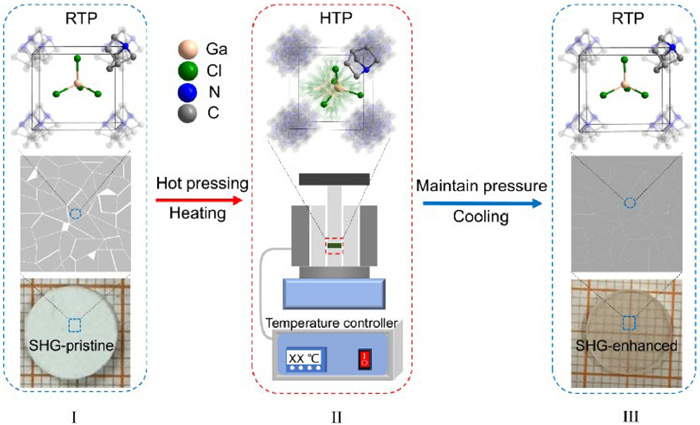
In this study, we selected 1-azanorbornanium cation and GaCl4− anion to assemble plastic crystal. The spheroid-like shape and moderate size of the polar 1-azanorbornanium cation optimizes the plastic phase transition and ferroelectric properties [26], while the GaCl4− anion exhibits high transparency, excellent thermal stability, and strong SHG effects, showing great potential for optical applications [27-30]. Our efforts yielded a new ferroelectric plastic crystal, (C6H12N)[GaCl4] (1), which crystallizes in the polar space group Pmc21 at room temperature and undergoes plastic phase transition at above 413 K. As shown in Scheme 1, we utilized an improved hot-pressing process, i.e., applying pressure at above plastic transition temperature and cooling back to room temperature with maintained pressure, to transform the loose powder sample of 1 into a dense tablet sample with significantly enhanced transparency and nonlinear optical performance. The hot-pressing process optimized densification and grain orientation, improving optical consistency and enhancing nonlinear optical properties [31-33]. This study highlights the potential of combining plastic crystal phase transitions with hot-pressing technology, providing a new approach for developing high-performance SHG materials.
Scheme 1
Scheme 1.
Schematic illustration of the material structure and hot-pressing process: Ⅰ: Loose powder sample at room temperature before hot-pressing; Ⅱ: Pressed tablet under applied pressure at above the plastic crystal transition temperature; Ⅲ: High-density tablet obtained by cooling back to room temperature with maintaining pressure. The white lines and shapes indicate voids, with their reduction in Ⅲ signifying densification after hot-pressing.
The polycrystalline sample of 1 was synthesized via slow evaporation at room temperature. Specifically, GaCl3 and 1-azanorbornanium chloride were dissolved in deionized water in a 1:1 molar ratio, and the resulting solution was left to slowly evaporate over the course of a week. This method yielded colorless and block-shaped crystals with a high yield of 87%. The phase purity of the crystalline sample was confirmed by powder X-ray diffraction (PXRD), which showed sharp diffraction peaks that correspond to the expected structure of 1 (Fig. S1 in Supporting information), verifying the high-quality crystalline nature of the product.
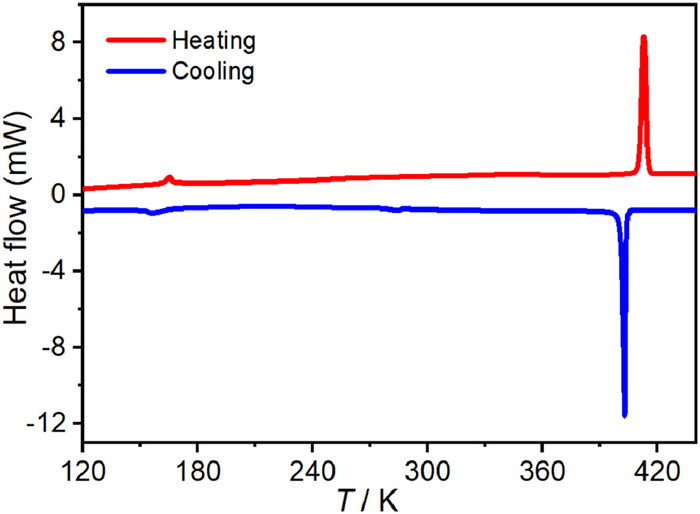
To evaluate the thermal properties of 1, thermogravimetric analysis was performed. The results indicated no significant mass loss below 480 K, demonstrating excellent thermal stability (Fig. S2 in Supporting information), a crucial characteristic for high-temperature applications. Additionally, differential scanning calorimetry (DSC) was employed to investigate the phase transitions of 1. The DSC results revealed two reversible phase transitions occurring at 165 and 413 K during heating, and at 157 and 403 K during cooling, respectively (Fig. 1). These transitions correspond to the low-temperature phase (LTP), room-temperature phase (RTP), and high-temperature phase (HTP), respectively. Notably, the substantial entropy change of 22.86 J mol−1 K−1 observed at 413 K suggests considerable molecular rotational freedom at elevated temperatures. This feature is particularly advantageous for hot-pressing techniques, where molecular mobility aids in achieving higher densification.
Figure 1
Figure 1.
DSC results during a heating and cooling cycle for 1.
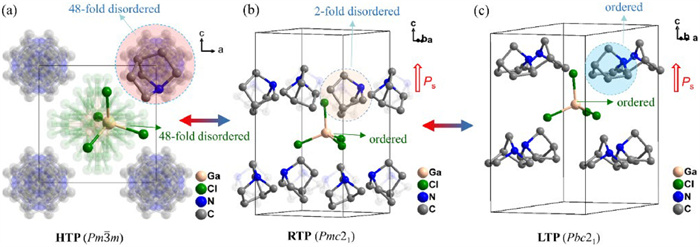
Variable-temperature single-crystal X-ray diffraction and PXRD measurements were conducted for thoroughly investigating the structural phase transitions of 1. As shown in Fig. 2, 1 exhibits typical plastic crystal characteristics, particularly with significant molecular rotational freedom at elevated temperatures. In all phases, 1 maintains a pseudo-cubic CsCl-type structure, where each GaCl4− anion is surrounded by eight 1-azanorbornanium cations and vice versa. The significant entropy change observed at 413 K in the DSC analysis indicates that HTP is a plastic crystal phase, which belongs to space group Pm3¯m. At this phase, both the 1-azanorbornanium cations and GaCl4− anions exhibit 48-fold disorder, reflecting the highly disordered nature of plastic crystals at elevated temperatures (Fig. 2a). This plastic phase enables effective molecular reorganization during the hot-pressing process, contributing to improved material densification and enhanced performance (vide infra).
Figure 2
Figure 2.
Crystal structures in (a) HTP, (b) RTP, and (c) LTP of 1. The Ga, Cl, N, and C atoms are presented as taupe, green, blue, and gray, respectively. Hydrogen atoms are hidden for clarity. The direction of the spontaneous polarization in the ferroelectric crystal in (b) and (c) is indicated by red arrows.
The RTP becomes orthorhombic space group Pmc21, as shown in Fig. 2b, in which the 1-azanorbornanium cations exhibit two-fold disorder, and the molecules align along the c axis, leading to the emergence of spontaneous polarization. This HTP-RTP phase transition belongs to a ferroelectric one with Aizu notation of m3¯mFmm2, implying that RTP is a ferroelectric and nonlinear-optical material [34]. Upon further cooling to the LTP phase, the crystal transitions to the orthorhombic space group Pbc21, where the cations and anions are fully ordered, and the spontaneous polarization remains stable along the c axis (Fig. 2c). In short, the two-step structural phase transitions from HTP to LTP show a gradual increase in molecular ordering and spontaneous polarization, indicating that 1 is a new plastic crystal with potential ferroelectric and nonlinear optical properties.
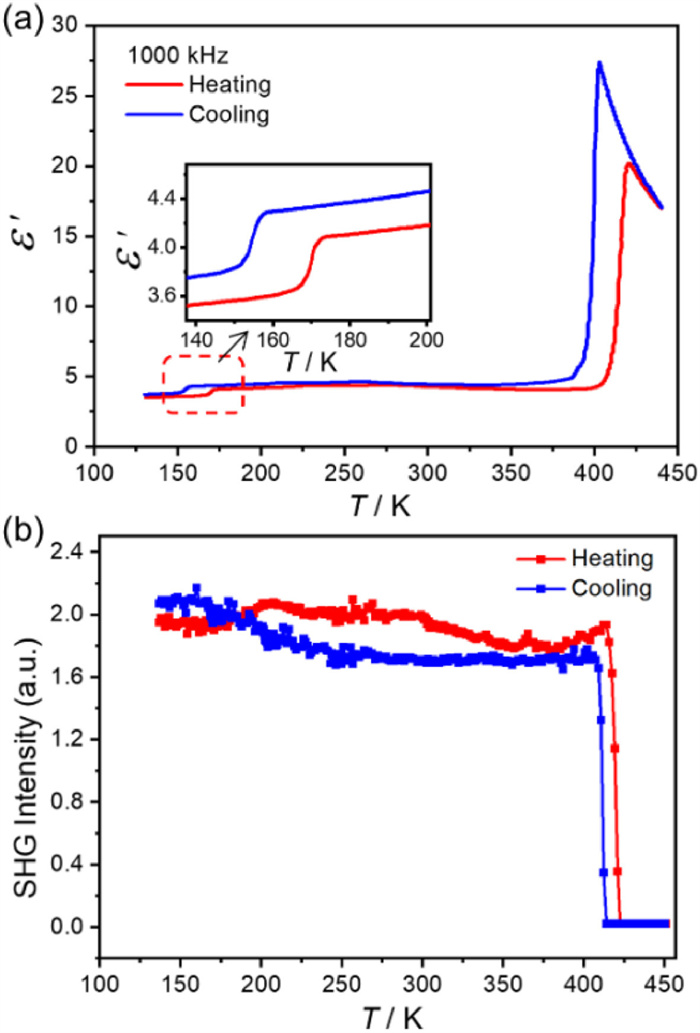
To understand the electrical and optical behavior of 1, its dielectric constant and nonlinear optical properties were further studied [35-38]. Temperature-dependent dielectric measurements offer valuable insights into the material’s electrical performance. Fig. S5 (Supporting information) displays the variation in the real part of the dielectric constant (ε’) of polycrystalline samples of 1 across different frequencies during heating. At a frequency of 1000 kHz, the dielectric constant exhibited typical plastic crystal behavior as a function of temperature (Fig. 3a). In detail, between 130 K and 220 K, the dielectric constant gradually increased from 3.53 to 4.25. Such a small step-like feature indicates the gradual transition of the molecular dynamic from an ordered to a 2-fold disordered state. From 220 K to 400 K, the dielectric constant remained relatively stable. However, beyond 400 K, it rose sharply, reaching a peak value of 20.18 before decreasing to 16.9, consistent with the phase transition of 1 from a 2-fold ordered phase to a 48-fold disorder phase. This dielectric behavior correlates closely with the structural phase transitions of 1, especially as the temperature approaches 413 K. The increase in molecular rotational freedom leads to the loss of polarity. During cooling, the dielectric constant rises again, reaching a peak value of 27.38, indicating that the material regains its polarity during the cooling process. These facts are consistent with the aforementioned reversible phase transition of 1 between polar and non-polar phases arising from the molecular orientation adjustments.
Figure 3
Figure 3.
(a) Temperature-dependent dielectric constants (ε’) for 1 measured at 1000 kHz during a heating-cooling cycle. Insets provide magnified views of specific regions for clarity. (b) The temperature-dependent SHG measurements for 1.
The SHG measurements were performed for 1 by the Kurtz-Perry method [39]. As shown in Fig. 3b, 1 exhibits significant SHG signals in both the LTP and the RTP, consistent with its non-centrosymmetric crystal structure (mm2 point group). This indicates that 1 possesses strong nonlinear optical properties at room temperatures. However, when the temperature rose to 413 K, the SHG intensity dropped sharply, indicating that the material transitioned into the centrosymmetric HTP, causing the SHG signal to disappear. This observation aligns with the phase transitions detected by DSC and the crystal structural analyses, showing that 1 loses its polarity and nonlinear optical response due to centrosymmetric structure with molecular disorder at high temperature.
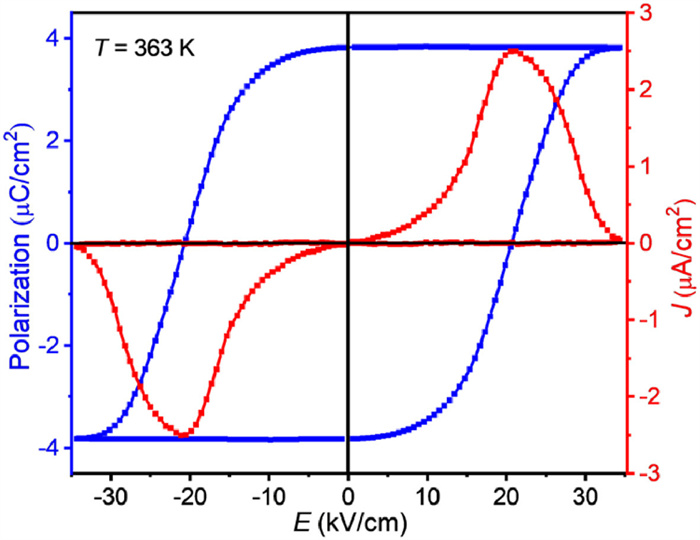
The polarization-electric field (P-E) hysteresis loop test is a critical method for evaluating the performance of ferroelectric materials [40-44]. As shown in Fig. 4, at 363 K, the P-E hysteresis loop and current density-electric field (J-E) curve of 1 were measured using the double-wave method [45,46]. The coercive field (Ec) was determined to be 20.5 kV/cm, with a remnant polarization (Ps) of 3.82 µC/cm2, placing 1 among moderately strong ferroelectrics [47-53]. Due to its mm2 point group symmetry at room temperature, the piezoelectric coefficient d33 along the polar c axis was measured to be 24 pC/N (Fig. S6 in Supporting information), surpassing those of LiNbO3 (8 pC/N) and diisopropylammonium bromide (11 pC/N) [54,55]. The above findings clearly confirmed that 1 is a new ferroelectric plastic crystalline compound with promising potential for usage in advanced electronic and optical applications.
Figure 4
Figure 4.
The J-E curve and P-E hysteresis loop along the c axis direction of 1 at 363 K.
Given the ferroelectric plastic crystal characteristics of 1, particularly its molecular rotational freedom at HTP, we employed an improved hot-pressing technology to shape it for optimizing its optical performance. In the HTP, the high degree of molecular disorder provided ideal conditions for molecular reorganization to eliminate crystal grains during the hot-pressing process. As the temperature decreased to the RTP, the molecular arrangement became more ordered, with polarization stabilizing along the c axis, laying the foundation for the subsequent enhancement of the optical and electrical properties. Additionally, 1 exhibits minimal absorption in the visible light region (Fig. S7 in Supporting information), further contributing to its optimized optical performance.
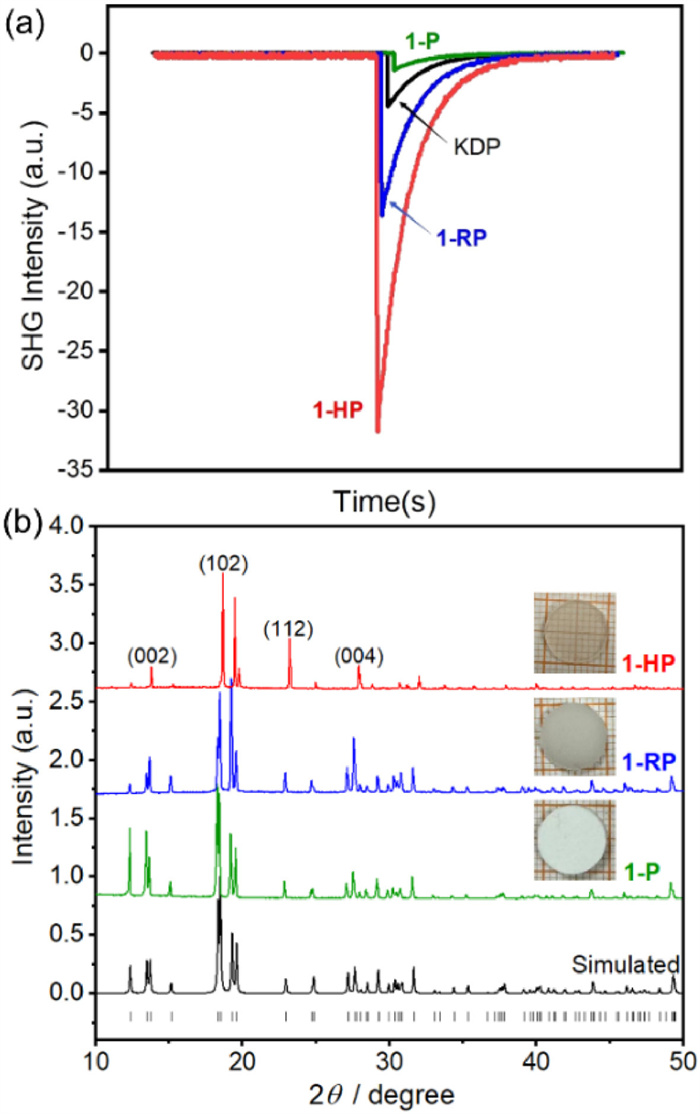
To make a better comparison, we applied two different pressing processes from powder sample of 1: One involved hot-pressing at 433 K (20 K above the plastic phase-transition temperature) by applying a pressure of 1.1 MPa for 1 h, followed by cooling back to room temperature naturally with maintaining applied pressure, resulting in a pressed tablet (named 1-HP); the other one involved pressing at 298 K for 5 h to obtain another pressed tablet (named 1-RP). The schematic of the equipment and process used for both 1-RP and 1-HP is shown in Fig. S8 (Supporting information). For comparative analysis, a loose powder sample (named 1-P) was prepared by lightly pressing the powder in a mold using manual pressure, without additional compression or thermal treatment. The hot-pressing process leveraged the molecular rotational freedom at high temperatures and the ordered transition during cooling, so it could be expected that 1-HP has significantly improved density and optical properties. Indeed, 1-HP has a density of 1.69 g/cm3, which is 99.4% of the crystallographic one (1.70 g/cm3). Moreover, compared with 1-RP, 1-HP exhibits a transmittance of 76%, significantly higher than that of 1-RP (36%) and 1-P (only ca. 6%) (Fig. S9 in Supporting information).
The improvement in optical consistency of 1-HP indicates better grain bonding and reduced light scattering, and brings about significant improvements in SHG performance for 1-HP. As shown in Fig. 5a, the SHG intensity of the 1-HP sample was 20 times higher than that of the 1-P, while the 1-RP sample exhibited a 6 times increase. Compared to the referenced material KDP, the SHG intensity of 1-HP was 7.07 times higher, and that of 1-RP was 2.34 times higher. Furthermore, the PXRD patterns (Fig. 5b) showed that the hot-pressing treatment brings about a preferred grain orientation of planes such as (002) and (004), making an additional contribution for enhancing optical consistency and nonlinear optical performance. As a “molecular ceramic”, 1-HP demonstrated excellent nonlinear optical performance, indicating its great potential for applications in advanced optical device. Different from the previous studies focusing on the ferroelectric, piezoelectric, and pyroelectric properties of plastic crystals [19-26], this work well combined the plastic phase transition of 1 with hot-pressing technology to significantly improve the mechanical strength and optical properties (such as SHG effect) for hybrid plastic crystalline materials. In particular, different from the previously reported hot-pressing methods [24,25], we present an improved hot-pressing method with the optimized hot-pressing temperature and pressure conditions as well as maintaining pressure during the cooling process. These improvements significantly enhanced the material’s transparency and optical consistency, greatly boosting its nonlinear optical properties, especially SHG signal.
Figure 5
Figure 5.
(a) SHG signals of 1 in different forms: 1-HP (hot-pressed at 433 K, 1.1 MPa, 1 h), 1-RP (pressed at 298 K, 5 h), and 1-P (loose powder). (b) Corresponding PXRD patterns and optical photographs.
In summary, we designed a new plastic ferroelectric, i.e., 1, which undergoes a plastic phase transition at 413 K and exhibits polar structural nature at room temperature, leading to its ferroelectric and nonlinear optical properties. Furthermore, we investigated the potentials of hot-pressing process on shaping the plastic crystal like 1 to significantly enhance its nonlinear optical properties. Different from the previous works, we systematically explored the impact of hot pressing on the nonlinear optical performance of plastic crystalline materials. Such that, with a light transmittance of up to 76%, the hot-pressed sample of 1 exhibited a dramatically enhanced SHG intensity, 20 times that of the loose powder and 6 times greater than that of the referenced KDP. Combined with its ferroelectric and nonlinear optical properties, 1 has great potential as a "molecular ceramic" material for fabricating advanced optical devices. This hot-pressing technique offers a new pathway for enhancing the performance of plastic crystalline materials, and further optimization of processing conditions and structural design may expand its application potential.
Declaration of competing
The authors declare that they have no known competing financial interests or personal relationships that could have appeared to influence the work reported in this paper.
CRediT authorship contribution statement
Le Ye: Writing – original draft, Investigation, Formal analysis, Data curation. Zi-Luo Fang: Investigation, Data curation. Ming-Yu Guo: Visualization, Data curation. Wei-Xiong Zhang: Writing – review & editing, Supervision, Project administration, Conceptualization.
Acknowledgments
This work was supported by the National Natural Science Foundation of China (Nos. 22071273, 21821003, and 22488101), Fundamental Research Funds for the Central Universities, Sun Yat-Sen University (No. 23lgzy001).
Supplementary materials
Supplementary material associated with this article can be found, in the online version, at doi:10.1016/j.cclet.2025.110826.
Scheme 1
Schematic illustration of the material structure and hot-pressing process: Ⅰ: Loose powder sample at room temperature before hot-pressing; Ⅱ: Pressed tablet under applied pressure at above the plastic crystal transition temperature; Ⅲ: High-density tablet obtained by cooling back to room temperature with maintaining pressure. The white lines and shapes indicate voids, with their reduction in Ⅲ signifying densification after hot-pressing.
Figure 2
Crystal structures in (a) HTP, (b) RTP, and (c) LTP of 1. The Ga, Cl, N, and C atoms are presented as taupe, green, blue, and gray, respectively. Hydrogen atoms are hidden for clarity. The direction of the spontaneous polarization in the ferroelectric crystal in (b) and (c) is indicated by red arrows.
Figure 3
(a) Temperature-dependent dielectric constants (ε’) for 1 measured at 1000 kHz during a heating-cooling cycle. Insets provide magnified views of specific regions for clarity. (b) The temperature-dependent SHG measurements for 1.


 DownLoad:

 下载:
下载:


 下载:
下载:

