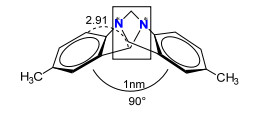
Figure 1.
Structure of Tröger's base

Synthesis of 1, 7-Bis(N-substituted-aminomethyl)-2, 8-dihydroxy-Tröger's Bases and Their Application in Aldol-Ullmann Reaction
Rui Yuan , Hao Cui , Wen Chen , Xuanxuan Ren , Hang Zhou , Hui Xu , Yawen Sun , Yanni Liang , Yu Wan , Jinjuan Liu , Hui Wu


Coumarin is an important compound in pharmaceutical synthesis[1~6] because of the pyranone skeleton, which possesses extensive pharmacological activities such as anti-inflammatory, anti-tuberculosis, antioxidants, anti- virus, antibacterial, anti-cancer, anti-depression and anti-hyperlipidemia, etc.[7~13] Various methods for the synthesis of substituted coumarins have been reported, for example, pyrano[3, 2-c]coumarins have been reported in the literature that utilize different catalytic systems including nanoparticles, H6P2W18O62·18H2O, nanosilica, sodium carbonate, ionic liquids, and proline-melamine.[14~16] Recently, chromeno[3', 4':5, 6]pyrano[2, 3-b]indole derivatives have been obtained via a two-step reaction sequence, but more efficient protocol still need to be developed.[17] Furthermore, as the significant biological and pharmacological activities of coumarin, more attention should be paid to the extension of coumarin derivatives.
Tröger's base (TB, Figure 1) which was firstly found in 1887[18] has aroused wide attention in molecular recognition, bioorganic chemistry, supramolecular chemistry and other fields.[19~21] Their distinctive non-twisted V-shape nitrogen-containing eight-member fused skeleton enables TB and its derivatives to capture appropriate molecules efficiently and display great potential as catalyst.[22]
It is worth noting that the structural advantages of TB and its derivatives are far from being developed. The weak alkalescence, limited active sites (only two bridgehead N atoms) and single hydrogen bond acceptor restricted their application as organocatalyst or ligands.
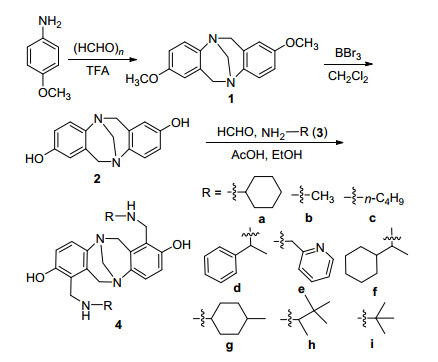
To take full structural advantage of TB and further promote their catalysis by increasing catalytic active sites and enhancing the basicity, herein 1, 7-bis(N-substituted-amino- methyl)-2, 8-dihydroxy type Tröger's bases were designed and synthesized from available raw materials through simple hydrolysis and Mannich reaction. They were then used as efficient organocatalyst for the Aldol reaction of 4-hy- droxylcoumarin and 2-benzylidenemalononitrile (or methyl(ethyl)-2-cyano-3-phenylacrylate) to afford 2-amino- 4-aryl-5-oxo-4H, 5H-pyrano[3, 2-c]chromene-3-carbonitri-les (carboxylates) (8). Subsequently, they were used as the efficient ligand to promote the Pd-catalyzed Aldol-Ullmann reaction to give 7-aryl-7, 12-dihydro-6H-chromeno[3', 4': 5, 6]pyrano[2, 3-b]indol-6-one (10) and 5'(or 5', 7')-substi- tuted-6H, 12H-spiro[chromeno[3', 4':5, 6]pyrano[2, 3-b]in-dole-7, 3'-indoline]-2', 6-dione (12), respectively. The anti- cancer and anti-bacterial activities of catalysts and products in vitro were tested preliminary.
Firstly, a series of catalyst TBs 4 based on TB derivatives was synthesized via simple process (Scheme 1) with high yields (83%~95%).
Then their pH values was tested. It can be seen from Table 1 that the pH values of TBs 4 are in the range of 6.30~7.33, indicated their stronger alkalinity than that of TB (6.07).

 下载:
导出CSV
下载:
导出CSV
| Compd. | R | Yield/% | pHa |
| TB | — | 80 | 6.07 |
| 4a | Cyclohexyl | 83 | 6.30 |
| 4b | Methyl | 87 | 6.25 |
| 4c | Butyl | 85 | 6.16 |
| 4d | 1-Phenylmethyl | 89 | 7.18 |
| 4e | Pyridin-2-methyl | 90 | 7.33 |
| 4f | 1-Cyclohexyl-1-methyl | 95 | 7.24 |
| 4g | 4-Methylcyclohexyl- | 91 | 6.95 |
| 4h | 3, 3-DiMethyl-2-butyl | 93 | 7.14 |
| 4i | tert-Butyl | 87 | 6.94 |
| a Test solution was prepared by dissolving 0.01 mmol of compounds in apropos amount of anhydrous ethanol and diluting to 10.0 mL with anhydrous ethanol. | |||
Next, catalyst 4 was used as catalyst for the synthesis of 2-amino-4-aryl-5-oxo-4H, 5H-pyrano-[3, 2-c]chromene-3-carbonitriles (8) (Scheme 2).
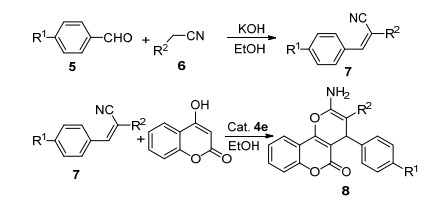
The reaction conditions were then optimized based on the yield of 8a from 7a and 4-hydroxycoumarin subsequently (Table 2). Firstly, the catalysts were screened. As shown in Table 2, the reaction could not occur without catalyst (Entry 1). Tröger's base could promote the reaction (Entry 2) but give low yield (15%). After the addition of TB derivative 4, the yield increased to 43%~81% (Entries 3~10). 4e (Entry 7, 81%) was obviously efficient than others (Entry 3~6, 8~10) due to its strongest basicity and two pyridine rings. Increasing the loading of 4e from 1 mol% to 10 mol% led to a significant enhancement of the yield of 8a from 53% to 92% (Entry 13 vs. Entries 15, 16), which showed the importance of the catalyst loading for the reaction. However, no further yield increase was observed when the catalyst loading was increased to 20 mol% (Entry 7, 93%). Secondly, the solvents were screened (Entries 11~14) and it was found that the best result was obtained in anhydrous EtOH because of its suitable solubility for the substrates and polarity for the reaction. Finally, the reaction time was screened (Entries 18~20). The yield increased with the prolongation of reaction time. When the reaction time was over 8 h, the yield almost did not increase. Above all, using 10 mol% of 4e as catalyst in anhydrous EtOH at room temperature for 8 h was the optimum condition.
下载:
导出CSV
| Entry | 4 | Cat./mol% | Solvent | t/h | Yield/% |
| 1 | — | — | CH3CN | 12 | — |
| 2 | TB | 10 | CH3CN | 12 | 15 |
| 3 | 4a | 10 | CH3CN | 12 | 43 |
| 4 | 4b | 10 | CH3CN | 12 | 56 |
| 5 | 4c | 10 | CH3CN | 12 | 52 |
| 6 | 4d | 10 | CH3CN | 12 | 49 |
| 7 | 4e | 10 | CH3CN | 12 | 81 |
| 8 | 4f | 10 | CH3CN | 12 | 59 |
| 9 | 4g | 10 | CH3CN | 12 | 47 |
| 10 | 4h | 10 | CH3CN | 12 | 55 |
| 11 | 4e | 10 | CH2Cl2 | 12 | 53 |
| 12 | 4e | 10 | Et2O | 12 | 78 |
| 13 | 4e | 10 | EtOH | 12 | 92 |
| 14 | 4e | 10 | CHCl3 | 12 | 47 |
| 15 | 4e | 1 | EtOH | 12 | 53 |
| 16 | 4e | 5 | EtOH | 12 | 70 |
| 17 | 4e | 20 | EtOH | 12 | 93 |
| 18 | 4e | 10 | EtOH | 6 | 75 |
| 19 | 4e | 10 | EtOH | 8 | 92 |
| 20 | 4e | 10 | EtOH | 10 | 92 |
| a Unless otherwise noted, the reactions were carried out by using 7a (1.0 mmol) and 4-hydroxycoumarin (1.0 mmol) at room temperature. | |||||
Under the optimized conditions, the scope of substrates was explored (Table 3). The results in Table 3 showed that the reaction afforded desired products in high yields (84%~95%) with wide substrate scope, which showed the high efficiency and universality of the catalyst. There was no regular relationship between the yield and the steric hindrance and electronic effect of substituents.
下载:
导出CSV
| Compd. | R1 | R2 | Yield/% |
| 8a | p-Br | CN | 92 |
| 8b | p-OCH3 | CN | 93 |
| 8c | p-F | CN | 87 |
| 8d | o-OCH3 | CN | 85 |
| 8e | 2, 4-Cl2 | CN | 95 |
| 8f | p-CH3 | CN | 93 |
| 8g | CN | COOMe | 84 |
| 8h | p-OCH3 | COOEt | 85 |
| 8i | CN | COOEt | 87 |
| 8j | CN | CN | 93 |
| 8k | p-Cl | CN | 90 |
| 8l | o-Cl | CN | 92 |
| 8m | o-F | CN | 84 |
| 8n | o-Br | CN | 90 |
| 8o | H | CN | 95 |
| 8p | 3, 4-(OCH3)2 | CN | 90 |
| 8q | 3, 4, 5-(OCH3)3 | CN | 93 |
| 8r | 2, 3-(OCH3)2 | CN | 89 |
| 8s | o-NO2 | COOEt | 81 |
| 8t | o-NO2 | CN | 86 |
| 8u | 2, 4-Cl2 | COOMe | 88 |
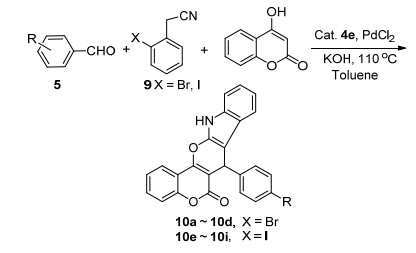
Encouraged by the exciting results, catalyst 4 was then used as ligands for the Pd-catalyzed Aldol-Ullmann reaction of aromatic aldehyde (5), 2-(2-iodo(or bromo)phenyl)- acetonitrile (9) and 4-hydroxycoumarin successfully to afford 7-aryl-7, 12-dihydro-6H-chromeno[3', 4':5, 6]pyrano-[2, 3-b]indol-6-one (10) in high yields (Scheme 3). The reaction conditions were optimized based on the reaction of product 10a (Table 4). From Table 4, the optimum condition is that substrates and 5 mol% of 4e were stirred in toluene at 110 ℃ for 16 h.
下载:
导出CSV
| Entry | 4 | Cat./mol% | t/h | Yield/% |
| 1 | — | — | 12 | — |
| 2 | TB | 10 | 12 | 37 |
| 3 | 4a | 10 | 12 | 63 |
| 4 | 4b | 10 | 12 | 71 |
| 5 | 4c | 10 | 12 | 59 |
| 6 | 4d | 10 | 12 | 53 |
| 7 | 4e | 10 | 12 | 76 |
| 8 | 4f | 10 | 12 | 69 |
| 9 | 4g | 10 | 12 | 75 |
| 10 | 4h | 10 | 12 | 58 |
| 11 | 4e | 1 | 12 | 53 |
| 12 | 4e | 5 | 12 | 73 |
| 13 | 4e | 5 | 10 | 55 |
| 14 | 4e | 5 | 14 | 82 |
| 15 | 4e | 5 | 16 | 95 |
| 16 | 4e | 5 | 18 | 95 |
| a Unless otherwise noted, the reactions were carried out by using aromatic aldehyde (5, 1.0 mmol), 2-(2-iodo(or bromo)phenyl)acetonitrile (9, 1.0 mmol) and 4-hydroxycoumarin (1.0 mmol) in toluene at room temperature. | ||||
The results of Table 5 showed that the reaction afforded high yields (90%~95%) of the desired products 10.
下载:
导出CSV
| Product | R | X | Yield/% |
| 10a | 2-OCH3 | 2-I | 95 |
| 10b | 2, 3-(OCH3)2 | 2-I | 93 |
| 10c | 4-OH | 2-I | 92 |
| 10d | 4-Br | 2-I | 90 |
| 10e | 4-CH3 | 2-Br | 96 |
| 10f | 4-F | 2-Br | 94 |
| 10g | 4-Br | 2-Br | 96 |
| 10h | 4-CN | 2-Br | 92 |
| 10i | 3-NO2 | 2-Br | 90 |
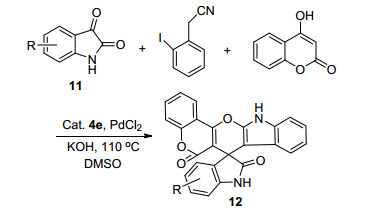
Subsequently, isatins with lower reactivity than aldehydes were used as carbonyl compounds (Scheme 4). As expect, they reacted smoothly and gave relative product 5' (or 5', 7')-substituted-6H, 12H-spiro[chromeno[3', 4':5, 6]py- rano[2, 3-b]indole-7, 3'-indoline]-2', 6-dione (12) in DMSO (Table 6).
下载:
导出CSV
| Compd. | R | Yield/% |
| 12a | 5-Cl | 88 |
| 12b | 5, 7-(CH3)2 | 85 |
| 12c | 5-Br | 90 |
| 12d | 5-CH3 | 82 |
| 12e | 5-OCH3 | 89 |
| 12f | 5-NO2 | 85 |
| a Unless otherwise noted, the reactions were carried out by using isatins (11, 1.0 mmol), 2-(2-iodo(or bromo)phenyl)acetonitrile (9, 1.0 mmol) and 4-hydroxycoumarin (1.0 mmol) and 4e (5 mol %) as ligand, PbCl2 (5 mol %) as catalysts in DMSO (3 mL) at 110 ℃. | ||
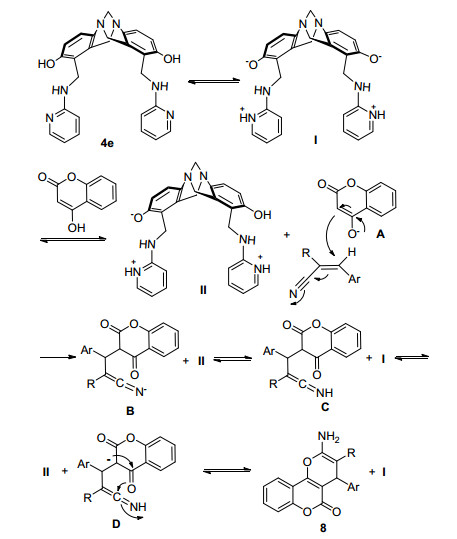
Based on our previous catalytic mechanistic study[20, 21] and literature reports, [10] a possible mechanism for the formation of product 8 was suggested in Scheme 5. Firstly, the catalyst 4e isomerized as I, a inner salt containing two oxygen anions and two nitrogen cations in the pyridine rings. One of the oxygen anion in I took away a proton of 4-hydroxycoumarin and formed intermediate A. Meanwhile, catalyst I changed to II. A reacted to arylmethylenemalononitrile through an 1, 4-electron transfer process to form intermediate B. B took away a proton in II to form C, while II changed back to I. Then one of the oxygen anion in I attacked C to take away a proton and formed intermediate D. D yielded the final product 8 via intramolecular condensation in the presence of II, meanwhile II changed back to I to complete the catalyst cycle.
Above all, we speculated that the key role of catalyst came from its ability to form a bipolar ion. It provided or captured proton efficiently and conveniently.
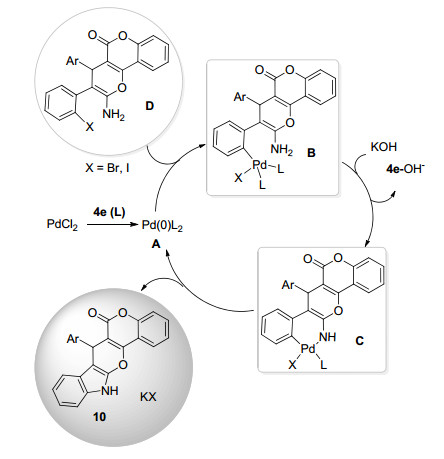
A possible mechanism for the formation of product 10 was also proposed based on the literature (Scheme 6).[23] Firstly, palladium complex A was generated from PdCl2 and catalyst 4e. A captured the iodine atom on D to form complex B. B then took off a molecule of 4e under the effect of alkali to form complex C and 4e-OH-. The reduction and elimination of C formed product 10.
In the last, the anti-cancer activities on human three positive breast cancer cells (MCF-7), human three negative breast cancer cells (MDA-MB-231), human hepatoma cells (HepG2), human hepatoma cells (MHCC-97H) and cytotoxicity on human hepatocyte cells (LO2) of catalyst 4 and all products in vitro were evaluated (Table 7) according to the method of Alamar Blue, while paclitaxel was used as positive control (1 μg/mL). The cells were purchased from Shanghai Institute of Cell Biology, Chinese Academy of Sciences (Shanghai, China) and maintained in RPMI 1640 medium supplemented with 10% fetal bovine serum (FBS), 100 U/mL penicillin and 100 μg/mL streptomycin at 37 ℃ in 5% CO2 atmosphere. Cell viability was determined by the Alamar Blue method. Briefly, cancer cells with same number were inoculated into each well in 96-well plates (Costar, Charlotte, NC) in 100 mL of culture medium. After an overnight incubation, 25 μg/mL compounds were added for 48 h. Thereafter, 200 μL of Alamar Blue solution was added to each well after removal of the sample solution and washing with phosphate-buffered saline and cultured for an additional 4 h. The absorbance was measured using SpectraMax M2 (Molecular Devices) at λex=530 nm and λem=590 nm. Growth inhibition rate was calculated by the following formula and the results were shown in Table 7.
|
$ \begin{gathered} {\text{Growth}}\;\;{\text{inhibition}}\;\;{\text{rate}} = \left[ {1 - \left( {{\text{O}}{{\text{D}}_{{\text{dosing }}\;\;{\text{cell }}}} - {\text{O}}{{\text{D}}_{{\text{blank }}\;\;{\text{group }}}}} \right)/} \right. \hfill \\ \left. {\left( {{\text{O}}{{\text{D}}_{{\text{control }}\;\;{\text{cell }}}} - {\text{O}}{{\text{D}}_{{\text{blank }}\;\;{\text{group }}}}} \right)} \right] \times 100\% \hfill \\ \end{gathered} $ |
下载:
导出CSV
| Compd. | LO2 | MCF-7 | 231 | HepG2 | MHCC97H |
| 4b | 34.29 | 30.84 | — | — | — |
| 4d | 32.09 | — | 37.00 | — | — |
| 4e | 47.14 | — | 40.93 | — | — |
| 8a | 76.28 | 50.21 | 32.45 | 80.21 | 63.08 |
| 8c | 46.02 | — | — | 38.70 | 34.16 |
| 8d | 44.16 | 33.31 | 33.35 | — | — |
| 8e | 89.06 | 71.62 | 82.23 | 79.64 | 61.09 |
| 8l | 41.92 | 30.91 | — | — | — |
| 8m | 72.64 | 40.45 | 42.62 | 82.43 | 75.21 |
| 8n | 74.90 | 48.60 | 53.01 | 78.97 | 74.61 |
| 8q | 68.63 | 36.81 | — | 85.94 | 70.40 |
| Paclitaxel | 47.86 | 89.70 | 65.83 | 80.09 | 42.37 |
| a Data less than 30% was showed as "—". | |||||
Products 10 and 12 did not show any bioactivity owing to their poor solubility in the test solvent.
The results in Table 7 showed that compounds 4d and 4e had selective inhibition on MDA-MB-231 cells. It will be possible to develop them as specific drug for triple negative breast cancer by the further systematic study.
Compound 8q had strong inhibitory effects on three kinds of cancer cells except MDA-MB-231 and had no obvious structure-activity relationship. Compounds 8a, 8e, 8m and 8n had strong inhibitory effects on four kinds of cancer cells. However, they also inhibited LO2 cells which prompt the necessary of structural modification to reduce their toxicity.
In summary, a new series of catalysts was synthesized and used to promote the Aldol and Aldol-Ullmann reaction of 4-hydroxylcoumarin and three different electrophiles. Correspondingly, three series of products with complex structure were synthesized efficiently. The key role of catalyst maybe came from its ability to form a bipolar ion, which provided or captured proton efficiently and conveniently. The results confirmed the rationality and our design. Some compounds showed anti-cancer activity, indicated their potential in new drug development. The study on the specific role of the catalyst is underway.
All the reagents were purchased commercially. Human three positive breast cancer cells (MCF-7), human three negative breast cancer cells (MDA-MB-231), human hepatoma cells (HepG2), human hepatoma cells (MHCC- 97H) and Human hepatocyte (LO2) were purchased from Shanghai Institute of Cell Biology, Chinese Academy of Sciences (Shanghai, China).
All melting points were determined with an electrothermal digital melting point apparatus and were uncorrected. NMR spectra were measured using a Bruker 400 MHz spectrometer. Mass spectra were recorded on a Micro TOF-Q (ESI) instrument. The methyl thiazolyl tetrazolium assay (MTT) assay was performed on a microplate reader (SpectraMax M2).
p-Methoxyaniline (30.0 mmol) and polyformaldehyde (60.0 mmol) were added dropwise into 60 mL of trifluoroacetic acid (TFA) at -15 ℃. After the addition, the reaction temperature was increased slowly to room temperature. After 2 d (TLC), the reaction mixture was poured into ice water, adjusted the pH value to 9 with ammonia water, extracted with CH2Cl2 for three times and dried the organic layer with anhydrous sodium sulfate. The crude product was given by removing solvents under vacuum. It was then purified by column chromatography (Vpetroleum ether:Vethyl acetate=1:3 gradient elution) to give 2, 8-dimethoxy-6H, 12H-5, 11-methanodibenzo[b, f][1, 5]diazocine (1).[24] 1H NMR (400 MHz, CDCl3) δ: 7.13 (d, J=8 Hz, 2H), 6.86~6.80 (m, 2H), 6.62 (d, J=7.6 Hz, 2H), 4.61 (d, J=16.8 Hz, 2H), 4.28 (s, 2H), 4.13 (d, J=16.8 Hz, 2H), 3.81 (s, 3H).
1 (5.0 mmol) and 10 mL of CH2Cl2 were added into a 100 mL dry flask. BBr3 (10.0 mmol) dissolved in 30 mL of CH2Cl2 was added dropwise into the flask at -15 ℃. Then the temperature increased slowly to room temperature after grey solid precipitated out. After the completion (TLC), the reaction mixture was poured into ice water, adjusted the pH to 5 with ammonia water, extracted with ethyl acetate for three times, dried and concentrated the organic layer to give 6H, 12H-5, 11-methanodibenzo[b, f]- [1, 5]diazocine-2, 8-diol (2).[24] 1H NMR (400 MHz, CDCl3) δ: 9.01 (s, 2 H), 6.86 (d, J=8.0 Hz, 2 H), 6.57~6.54 (m, 2 H), 6.29 (d, J=2.4 Hz, 2 H), 4.46 (d, J=16.0 Hz, 2 H), 4.10 (s, 2 H), 3.89 (d, J=16.0 Hz, 2 H).
Formaldehyde (1.2 mmol), amine (1.2 mmol), glacial acetic acid (1 mol%) and anhydrous ethanol (3 mL) were successively added to a 50 mL dry flask to react at 80 ℃ for 2 h, then compound 2 (1.0 mmol) was added. Until the completion (TLC), the excess solvent was removed by vacuum and TBs 4 was obtained by recrystallized with EtOH.
1, 7-Bis((cyclohexylamino)methyl)-6H, 12H-5, 11-meth-anodibenzo[b, f][1, 5]diazocine-2, 8-diol (4a): Yield 83% (0.3958 g). White solid, m.p. 153.5~154.2 ℃; 1H NMR (400 MHz, CDCl3) δ: 6.95 (d, J=8.8 Hz, 2H), 6.66 (d, J=8.8 Hz, 2H), 4.89 (d, J=9.4 Hz, 1H), 4.81 (d, J=10.0 Hz, 1H), 4.44 (d, J=16.6 Hz, 2H), 4.24 (s, 2H), 3.93 (d, J=16.4 Hz, 2H), 3.79 (s, 4H), 2.67 (s, 2H), 2.07 (s, 1H), 1.94 (s, 4H), 1.80~1.59 (m, 8H), 1.24 (d, J=10.2 Hz, 8H); 13C NMR (100 MHz, CDCl3) δ: 140.9, 134.5, 123.9, 122.6, 114.9, 107.4, 71.9, 59.7, 58.6, 47.9, 43.5, 34.3, 25.7, 25.1. HRMS (ESI) calcd for C29H40N4O2 477.3230 [M+H]+, found 477.3267 [M+H]+.
1, 7-Bis((methylamino)methyl)-6H, 12H-5, 11-methano-dibenzo[b, f][1, 5]diazocine-2, 8-diol (4b): Yield 87% (0.2965 g). White solid, m.p. 244.3~247.1 ℃; 1H NMR (400 MHz, CDCl3) δ: 6.97 (d, J=8.8 Hz, 2H), 6.71 (d, J=8.8 Hz, 2H), 4.67 (s, 4H), 4.42 (d, J=16.8 Hz, 2H), 4.23 (s, 2H), 3.92 (d, J=16.8 Hz, 2H), 3.69 (s, 4H), 2.58 (s, 6H); 13C NMR (100 MHz, CDCl3) δ: 141.9, 137.5, 124.0, 122.6, 115.9, 107.4, 71.9, 55.8, 44.4, 35.8. HRMS (ESI) calcd for C19H24N4O2 341.1978 [M+H]+, found 341.1977.
1, 7-Bis((butylamino)methyl)-6H, 12H-5, 11-methanodi-benzo[b, f][1, 5]diazocine-2, 8-diol (4c): Yield 85% (0.3613 g). White solid, m.p. 159.3~161.9 ℃; 1H NMR (400 MHz, CDCl3) δ: 6.95 (d, J=8.8 Hz, 2H), 6.68 (d, J=8.8 Hz, 2H), 4.74 (d, J=2.4 Hz, 4H), 4.42 (d, J=16.8 Hz, 2H), 4.22 (s, 2H), 3.91 (d, J=17.2 Hz, 2H), 3.75 (s, 4H), 2.71 (s, 4H), 1.72 (s, 2H), 1.54 (s, 5H), 1.36 (d, J=7.6 Hz, 6H), 1.27 (d, J=7.0 Hz, 4H), 0.94 (t, J=7.3 Hz, 7H); 13C NMR (100 MHz, CDCl3) δ: 141.1, 139.2, 124.2, 122.8, 115.9, 107.4, 81.6, 55.8, 51.6, 47.5, 30.1, 20.3, 13.9. HRMS (ESI) calcd for C25H36N4O2 425.2917 [M+H]+, found 425.2917.
1, 7-Bis(((1-phenylethyl)amino)methyl)-6H, 12H-5, 11-methanodibenzo[b, f][1, 5]diazocine-2, 8-diol (4d): Yield 89% (0.4654 g). White solid, m.p. 217.2~220.4 ℃; 1H NMR (400 MHz, CDCl3) δ: 7.35~7.27 (m, 10H), 6.85 (d, J=8.8 Hz, 2H), 6.64 (d, J=8.8 Hz, 2H), 5.03 (d, J=10.0 Hz, 2H), 4.73 (d, J=10.2 Hz, 2H), 4.13 (t, J=8.4 Hz, 4H), 3.90 (q, J=6.4 Hz, 2H), 3.74~3.61 (m, 4H), 3.44~3.36 (m, 2H), 1.44 (t, J=7.4 Hz, 6H); 13C NMR (100 MHz, CDCl3) δ: 150.9, 144.4, 128.5, 127.3, 127.2, 125.6, 124.1, 117.3, 115.5, 79.31, 57.9, 55.8, 45.8, 21.4. HRMS (ESI) calcd for C33H36N4O2 521.2915 [M+H]+, found 521.2917.
1, 7-Bis(((pyridin-2-ylmethyl)amino)methyl)-6H, 12H-5, 11-methanodibenzo[b, f][1, 5]diazocine-2, 8-diol (4e): Yield 90% (0.4461 g). White solid, m.p. 106.5~110.3 ℃; 1H NMR (400 MHz, CDCl3) δ: 8.59 (s, 2H), 7.69 (s, 2H), 7.38 (d, J=7.8 Hz, 2H), 7.22 (s, 2H), 6.92 (d, J=8.8 Hz, 2H), 6.71 (d, J=8.8 Hz, 2H), 4.80 (s, 4H), 4.33 (d, J=16.8 Hz, 2H), 4.19 (s, 2H), 4.03 (s, 4H), 3.82~3.68 (m, 4H), 2.10 (s, 2H); 13C NMR (100 MHz, CDCl3) δ: 158.1, 150.3, 149.6, 136.7, 124.3, 123.1, 122.4, 116.9, 116.0, 82.1, 57.8, 55.8, 47.1. HRMS (ESI) calcd for C29H30N6O2 495.2508 [M+H]+, found 495.2505.
1, 7-Bis(((1-cyclohexylethyl)amino)methyl)-6H, 12H-5, 11-methanodibenzo[b, f][1, 5]diazocine-2, 8-diol (4f): Yield 95% (0.5072 g). White solid, m.p. 172.0~173.7 ℃; 1H NMR (400 MHz, CDCl3) δ: 6.92 (d, J=8.8, 2H), 6.65 (d, J=8.8 Hz, 2H), 4.81~4.70 (m, 4H), 4.41~4.36 (m, 2H), 4.22 (s, 2H), 3.91 (d, J=16.8 Hz, 2H), 3.75~3.59 (m, 4H), 1.84~1.63 (m, 8H), 1.44~1.33 (m, 2H), 1.27~1.09 (m, 11H), 1.00~0.89 (m, 9H); 13C NMR (100 MHz, CDCl3) δ: 143.0, 136.9, 124.1, 123.8, 115.9, 81.9, 80.7, 66.1, 62.1, 61.4, 55.8, 44.7, 41.7, 41.4, 30.8, 28.8, 26.6, 26.4, 14.7, 14.1 HRMS (ESI) calcd for C33H48N4O2 533.3856 [M+H]+, found 533.3885.
1, 7-Bis(((4-methylcyclohexyl)amino)methyl)-6H, 12H-5, 11-methanodibenzo[b, f][1, 5]diazocine-2, 8-diol (4g): Yield 91% (0.4613 g). White solid, m.p. 183.1~185.7 ℃; 1H NMR (400 MHz, CDCl3) δ: 6.95 (d, J=8.6 Hz, 2H), 6.65 (d, J=8.8 Hz, 2H), 4.98~4.72 (m, 4H), 4.42 (d, J=16.8 Hz, 2H), 4.23 (s, 2H), 3.95~3.66 (m, 6H), 2.60 (d, J=12.2 Hz, 2H), 1.94 (d, J=11.2 Hz, 4H), 1.72 (d, J=12.2 Hz, 5H), 1.41~1.17 (m, 8H), 0.89~0.76 (m, 9H); 13C NMR (100 MHz, CDCl3) δ: 140.1, 137.8, 124.2, 122.8, 115.9, 106.8, 71.9, 60.0, 58.6, 43.5, 33.0, 31.8, 31.3, 20.7. HRMS (ESI) calcd for C31H44N4O2 505.3543 [M+H]+, found 505.3594.
1, 7-Bis(((3, 3-dimethylbutan-2-yl)amino)methyl)-6H, 12H-5, 11-methanodibenzo[b, f][1, 5]diazocine-2, 8-diol (4h): Yield 93% (0.4480 g). White solid, m.p. 176.3~178.1 ℃; 1H NMR (400 MHz, CDCl3) δ: 6.86 (t, J=7.8 Hz, 2H), 6.57~6.43 (m, 2H), 4.75~4.61 (m, 4H), 4.38~4.26 (m, 2H), 4.16 (d, J=5.6 Hz, 2H), 3.84~3.50 (m, 6H), 2.61~2.54 (m, 2H), 0.95~0.76 (m, 24H); 13C NMR (100 MHz, CDCl3) δ: 151.9, 123.7, 120.3, 119.8, 116.2, 84.5, 82.9, 67.0, 66.2, 66.1, 55.6, 47.1, 44.8, 36.6, 36.5, 26.6, 12.7, 12.5. HRMS (ESI) calcd for C29H44N4O2 481.3579 [M+H]+, found 481.3543.
1, 7-Bis((tert-butylamino)methyl)-6H, 12H-5, 11-meth-anodibenzo[b, f][1, 5]diazocine-2, 8-diol (4i): Yield 87% (0.3698 g). White solid, m.p. 165.4~167.9 ℃; 1H NMR (400 MHz, CDCl3) δ: 6.94 (d, J=8.8 Hz, 2H), 6.66 (d, J=8.8 Hz, 2H), 4.90 (d, J=9.8 Hz, 2H), 4.76 (d, J=10.0 Hz, 2H), 4.44 (d, J=16.8 Hz, 2H), 4.24 (s, 2H), 3.95 (d, J=16.8 Hz, 2H), 3.84~3.70 (m, 2H), 2.06 (s, 2H), 1.29~1.21 (m, 18H); 13C NMR (100 MHz, CDCl3) δ: 140.9, 138.5, 123.9, 122.8, 114.9, 109.4, 71.9, 61.2, 58.6, 40.4, 29.7. HRMS (ESI) calcd for C25H36N4O2 425.2917 [M+H]+, found 425.2967.
Aromatic aldehyde 5 (1.0 mmol), propylene nitrile 6 (1.0 mmol), anhydrous ethanol 3 mL and KOH (10 mol%) were successively added to a 100 mL dry round-bottom flask. 7 was obtained by simple filtration after the completion and recrystallization with anhydrous EtOH.
7 (1.0 mmol), 4-hydroxycoumarin (1.0 mmol), anhydrous ethanol 3 mL and 4e (10 mol%) were added to a 100 mL dry flask in turn, the target compound 8 was obtained by column chromatography (Vpetroleum ether:Vethyl acetate=5:1 gradient elution) after the reaction was completed (TLC) at room temperature.
2-Amino-4-(4-bromophenyl)-5-oxo-4H, 5H-pyrano[3, 2-c]chromene-3-carbonitrile (8a): Yield 92% (0.3647 g). White solid, m.p. 255.2~257.9 ℃; 1H NMR (400 MHz, DMSO-d6) δ: 7.90 (d, J=7.8 Hz, 1H), 7.73 (t, J=7.6 Hz, 1H), 7.49~7.31 (m, 5H), 7.24 (s, 1H), 5.77 (s, 2H), 4.48 (s, 1H); 13C NMR (100 MHz, DMSO-d6) δ: 159.5, 157.9, 153.5, 152.1, 142.7, 133.2, 131.3, 129.9, 124.9, 122.4, 120.1, 116.5, 112.9, 103.3, 57.3, 54.9, HRMS (ESI) calcd for C19H11BrN2O3 361.0699 [M-H]-, found 361.0678.
2-Amino-4-(4-methoxyphenyl)-5-oxo-4H, 5H-pyrano-[3, 2-c]chromene-3-carbonitrie (8b): Yield 93% (0.3228 g). White solid, m.p. 179.3~184.5 ℃; 1H NMR (400 MHz, DMSO-d6) δ: 7.83 (d, J=7.6 Hz, 2H), 7.65 (t, J=7.6 Hz, 2H), 7.36~7.28 (m, 4H), 5.77 (s, 1H), 5.59 (s, 2H), 3.72 (s, 3H); 13C NMR (100 MHz, DMSO-d6) δ: 163.7, 157.2, 153.6, 136.4, 129.1, 128.6, 124.2, 121.4, 121.1, 115.4, 112.3, 97.2, 54.8, 20.2. HRMS (ESI) calcd for C20H14N2O4 345.0875 [M-H]-, found 345.0911.
2-Amino-4-(4-fluorophenyl)-5-oxo-4H, 5H-pyrano[3, 2-c]chromene-3-carbonitrile (8c): Yield 87% (0.2921 g). White solid, m.p. 264.1~267.2 ℃; 1H NMR (400 MHz, DMSO-d6) δ: 7.90 (d, J=7.8 Hz, 1H), 7.72 (t, J=7.4 Hz, 1H), 7.49~7.37 (m, 4H), 7.32~7.25 (m, 2H), 7.14 (t, J=8.8 Hz, 2H), 4.49 (s, 1H); 13C NMR (100 MHz, DMSO-d6) δ: 159.2, 157.9, 153.9, 152.2, 139.3, 132.5, 129.6 (d, J=8.4 Hz), 124.6, 122.8, 119.1, 116.6, 115.7, 115.2, 112.4, 103.4, 57.2. HRMS (ESI) calcd for C19H11FN2O4 333.0675 [M-H]-, found 333.0738.
2-Amino-4-(3-methoxyphenyl)-5-oxo-4H, 5H-dihydro-pyrano[3, 2-c]chromene-3-carbonitrile (8d): Yield 85% (0.2947 g). White solid, m.p. 226.7~234.6 ℃; 1H NMR (400 MHz, DMSO-d6) δ: 7.90 (d, J=7.0 Hz, 1H), 7.73 (t, J=7.4 Hz, 1H), 7.53~7.41 (m, 4H), 7.24 (t, J=7.8 Hz, 1H), 6.86~6.77 (m, 3H), 4.43 (s, 1H), 3.73 (s, 3H); 13C NMR (100 MHz, DMSO-d6) δ 159.5, 158.5, 157.9, 153.9, 152.5, 132.4, 130.69, 129.1, 128.4, 124.6, 122.6, 120.3, 116.4, 112.9, 111.3, 103.7, 56.9, 55.1, 32.1. HRMS (ESI) calcd for C20H14N2O4 345.0875 [M-H]-, found 345.0839.
2-Amino-4-(2, 4-dichlorophenyl)-5-oxo-4H, 5H-dihydro-pyrano[3, 2-c]chromene-3-carbonitrile (8e): Yield 95% (0.3667 g). White solid, m.p. 234.9~239.1 ℃; 1H NMR (400 MHz, DMSO-d6) δ: 7.93~7.87 (m, 1H), 7.78~7.71 (m, 1H), 7.60 (d, J=1.8 Hz, 1H), 7.57~7.47 (m, 4H), 7.37~7.25 (m, 2H), 4.98 (s, 1H); 13C NMR (100 MHz, DMSO-d6) δ: 159.3, 158.2, 154.6, 152.2, 133.5, 131.2, 128.7, 124.6, 122.5, 116.4, 112.5. HRMS (ESI) calcd for C19H10Cl2N2O3 382.9990 [M-H]-, found 382.9929.
2-Amino-5-oxo-4-(p-tolyl)-4H, 5H-pyrano[3, 2-c]chro-mene-3-carbonitrile (8f): Yield 93% (0.3082 g). White solid, m.p. 218.6~220.2 ℃; 1H NMR (400 MHz, DMSO-d6) δ: 7.90~7.87 (m, 1H), 7.75~7.68 (m, 1H), 7.49~7.28 (m, 2H), 7.42 (s, 2H), 7.15~7.09 (m, 4H), 5.77 (s, 2H), 4.40 (s, 1H), 2.26 (s, 3H); 13C NMR (100 MHz, DMSO-d6) δ: 159.1, 157.7, 153.3, 152.7, 140.7, 136.5, 132.9, 129.4, 127.8, 124.6, 122.3, 116.5, 112.4, 104.9, 58.2, 54.7, 20.9. HRMS (ESI) calcd for C20H14N2O3 329.0926 [M-H]-, found 329.0951.
Methyl-2-amino-4-(4-cyanophenyl)-5-oxo-4H, 5H-Pyrano[3, 2-c]chromene-3-carboxylate (8g): Yield 84% (0.3152 g). White solid, m.p. 199.9~203.1 ℃; 1H NMR (400 MHz, DMSO-d6) δ: 7.96 (s, 2H), 7.71 (s, 2H), 7.45 (s, 4H), 5.77 (s, 2H), 4.77 (s, 1H), 3.51 (s, 3H); 13C NMR (100 MHz, DMSO-d6) δ: 167.4, 159.4, 158.7, 153.8, 152.7, 150.9, 132.9, 132.8, 131.9, 129.8, 124.6, 123.9, 123.1, 122.7, 118.8, 116.6, 116.3, 113.0, 109.6, 105.4, 90.4, 75.2, 59.1, 14.1. HRMS (ESI) calcd for C21H14N2O5 373.0824 [M-H]-, found 373.0768.
Ethyl-2-amino-4-(4-methoxyphenyl)-5-oxo-4H, 5H-pyrano[3, 2-c]chromene-3-carboxylate (8h): Yield 85% (0.3356 g). White solid, m.p. 179.6~181.3 ℃; 1H NMR (400 MHz, DMSO-d6) δ: 8.08~7.74 (m, 2H), 7.58~7.33 (m, 2H), 7.31~7.03 (m, 4H), 6.78 (s, 2H), 5.29 (s, 1H), 4.90 (s, 2H), 3.77~3.52 (m, 6H), 2.51 (s, 3H); 13C NMR (100 MHz, DMSO-d6) δ: 163.6, 157.2, 153.6, 136.4, 129.1, 128.6, 124.62, 121.4, 121.1, 115.2, 112.3, 97.2, 54.8, 20.2, HRMS (ESI) calcd for C22H19N1O6 392.1134 [M-H]-, found 392.1127.
Ethyl-2-amino-4-(4-cyanophenyl)-5-oxo-4H, 5H-pyrano-[3, 2-c]chromene-3-carboxylate (8i): Yield 87% (0.3387 g). White solid, m.p. 128.1~130.4 ℃; 1H NMR (400 MHz, DMSO-d6) δ: 7.97 (s, 2H), 7.73 (s, 2H), 7.47 (s, 4H), 5.78 (s, 2H), 4.77 (s, 1H), 4.00 (s, 2H), 1.10 (s, 3H). 13C NMR (100 MHz, DMSO-d6) δ 167.5, 159.8, 158.6, 153.5, 152.6, 150.8, 132.6, 132.2, 129.5, 124.7, 122.7, 118.9, 116.6, 113.0, 109.4, 105.6, 75.4, 54.8, 50.4, HRMS (ESI) calcd for C22H16N2O5 387.0981 [M-H]-, found 387.1034.
2-Amino-4-(4-cyanophenyl)-5-oxo-4H, 5H-pyrano[3, 2-c]chromene-3-carbonitrile (8j): Yield 93% (0.3188 g). White solid, m.p. 241.3~242.2 ℃; 1H NMR (400 MHz, DMSO-d6) δ: 7.95 (d, J=8.4 Hz, 2H), 7.84~7.81 (m, 1H), 7.65~7.57 (m, 3H), 7.38~7.31 (m, 2H), 5.54 (s, 1H); 13C NMR (100 MHz, DMSO-d6) δ: 165.7, 162.7, 153.6, 141.8, 132.7, 132.4, 129.6, 123.9, 123.4, 118.3, 116.4, 115.6, 112.6, 90.2, 52.5. HRMS (ESI) calcd for C22H16N2O5 340.0722 [M-H]-, found 340.0840.
2-Amino-4-(4-chlorophenyl)-5-oxo-4H, 5H-pyrano[3, 2-c]chromene-3-carbonitrile (8k): Yield 90% (0.3164 g). White solid, m.p. 246.2~248.1 ℃; 1H NMR (400 MHz, DMSO-d6) δ: 7.92~7.87 (m, 1H), 7.76~7.70 (m, 1H), 7.54~7.44 (m, 4H), 7.37 (d, J=8.6 Hz, 2H), 7.31 (d, J=8.6 Hz, 2H), 5.76 (s, 1H), 4.49 (s, 1H); 13C NMR (100 MHz, DMSO-d6) δ: 159.2, 157.1, 153.2, 152.4, 142.1, 133.1, 131.6, 129.1, 128.1, 124.8, 122.9, 119.7, 116.7, 112.1, 103.4, 57.4, 54.8. HRMS (ESI) calcd for C19H11Cl- N2O3 349.0380 [M-H]-, found 349.0399.
2-Amino-4-(3-chlorophenyl)-5-oxo-4H, 5H-dihydro-pyrano[3, 2-c]chromene-3-carbonitrile (8l): Yield 92% (0.3238 g). White solid, m.p. 274.1~276.7 ℃; 1HNMR (400 MHz, DMSO-d6) δ: 7.91 (d, J=7.2 Hz, 1H), 7.72 (d, J=7.2 Hz, 1H), 7.57~7.44 (m, 4H), 7.30~7.12 (m, 4H), 4.52 (s, 1H); 13C NMR (100 MHz, DMSO-d6) δ: 159.5, 157.7, 153.3, 152.7, 140.7, 136.5, 132.9, 129.4, 127.8, 124.6, 122.3, 116.4, 112.4, 104.9, 58.2, 54.7, 36.2, 20.9. HRMS (ESI) calcd for C19H11ClN2O3 349.0380 [M-H]-, found 349.0352.
2-Amino-4-(3-fluorophenyl)-5-oxo-4H, 5H-pyrano[3, 2-c]chromene-3-carbonitrile (8m): Yield 84% (0.2818 g). White solid, m.p. 219.6~222.8 ℃; 1H NMR (400 MHz, DMSO-d6) δ: 7.93~7.88 (m, 1H), 7.72 (s, 1H), 7.53~7.45 (m, 4H), 7.36 (s, 1H), 7.10~6.93 (m, 3H), 4.52 (s, 1H); 13C NMR (100 MHz, DMSO-d6) δ: 159.7, 157.4, 153.0, 152.8, 132.8, 130.3 (d, J=8.2 Hz), 129.1, 124.6, 123.7, 122.5, 119.6, 116.5, 115.0, 114.9, 114.4, 112.7, 103.4, 57.4. HRMS (ESI) calcd for C19H11FN2O3 333.0675 [M-H]-, found 333.0763.
2-Amino-4-(3-bromophenyl)-5-oxo-4H, 5H-dihydropy-rano[3, 2-c]chromene-3-carbonitrile (8n): Yield 90% (0.3565 g). White solid, m.p. 231.1~248.5 ℃; 1H NMR (400 MHz, DMSO-d6) δ: 7.90 (d, J=7.4 Hz, 1H), 7.73 (t, J=7.4 Hz, 1H), 7.53~7.44 (m, 6H), 7.29 (d, J=4.6 Hz, 2H), 4.50 (s, 1H); 13C NMR (100 MHz, DMSO-d6) δ 159.6, 157.4, 153.1, 152.1, 146.2, 133.1, 131.9, 130.9, 130.5, 126.3, 124.5, 122.5, 121.8, 116.7, 112.8, 103.1, 57.2, 36.9. HRMS (ESI) calcd for C19H11BrN2O3 392.9875 [M-H]-, found 392.9854.
2-Amino-5-oxo-4-phenyl-4H, 5H-pyrano[3, 2-c]chro-mene-3-carbonitrile (8o): Yield 95% (0.3011 g). White solid, m.p. 217.5~219.1 ℃; 1H NMR (400 MHz, DMSO-d6) δ 7.91 (d, J=7.8 Hz, 1H), 7.72 (s, 1H), 7.53~7.41 (m, 4H), 7.34~7.29 (m, 2H), 7.27~7.21 (m, 3H), 4.45 (s, 1H); 13C NMR (100 MHz, DMSO-d6) δ: 159.3, 157.3, 153.4, 152.1, 143.1, 132.4, 128.9, 127.9, 126.7, 124.8, 122.5, 119.1, 116.6, 112.3, 103.6, 57.9. HRMS (ESI) calcd for C19H12N2O3 315.0770 [M-H]-, found 315.0772.
2-Amino-4-(3, 4-dimethoxyphenyl)-5-oxo-4H, 5H-py-rano[3, 2-c]chromene-3-carbonitrile (8p): Yield 90% (0.3402 g). White solid, m.p. 159.4~164.3 ℃; 1H NMR (400 MHz, DMSO-d6) δ: 7.80~7.78 (m, 1H), 7.42~7.29 (m, 3H), 7.05~6.68 (m, 3H), 5.76 (s, 1H), 4.41 (s, 1H), 3.88~3.64 (m, 6H); 13C NMR (100 MHz, DMSO-d6) δ: 159.9, 151.80, 146.6, 136.0, 135.0, 132.5, 124.3, 123.6, 121.8, 120.0, 119.2, 116.5, 113.9, 103.2, 59.1, 55.7, 32.7, 25.6, 20.2. HRMS (ESI) calcd for C21H16N2O5 375.0981 [M-H]-, found 375.0951.
2-Amino-5-oxo-4-(3, 4, 5-trimethoxyphenyl)-4H, 5H-dihydropyrano[3, 2-c]chromene-3-carbonitrile (8q): Yield 93% (0.3792 g). White solid, m.p. 226.6~228.7 ℃; 1H NMR (400 MHz, DMSO-d6) δ: 7.90 (d, J=7.8 Hz, 1H), 7.74 (s, 1H), 7.55~7.46 (m, 2H), 7.41 (s, 2H), 6.52 (s, 2H), 4.44 (s, 1H), 3.72 (s, 6H), 3.63 (s, 3H); 13C NMR (100 MHz, DMSO-d6) δ: 166.4, 159.1, 157.3, 153.9, 152.9, 152.1, 139.4, 136.8, 132.3, 131.1, 124.9, 122.1, 119.5, 116.1, 113.5, 104.7, 103.1, 59.8, 57.1, 55.5, 40.7, 39.8, 39.5, 39.4, 39.3, 39.2, 38.8, 36.8. HRMS (ESI) calcd for C22H18N2O6 405.1087 [M-H]-, found 405.1066.
2-Amino-4-(2, 3-dimethoxyphenyl)-5-oxo-4H, 5H-pyrano[3, 2-c]chromene-3-carbonitrile (8r): Yield 89% (0.3353 g). White solid, m.p. 206.9~210.7 ℃; 1H NMR (400 MHz, DMSO-d6) δ: 7.91 (d, J=6.8 Hz, 1H), 7.83~7.80 (m, 1H), 7.72 (t, J=7.2 Hz, 1H), 7.47 (d, J=8.2 Hz, 1H), 7.40~7.30 (m, 2H), 7.11 (s, 1H), 6.99~6.90 (m, 2H), 4.70 (s, 1H), 3.78 (d, J=4.2 Hz, 3H), 3.71 (s, 3H); 13C NMR (100 MHz, DMSO-d6) δ: 159.9, 151.8, 146.6, 136.0, 135.7, 132.5, 124.3, 123.6, 122.8, 120.9, 119.6, 116.2, 113.1, 103.2, 59.1, 55.7, 20.2. HRMS (ESI) calcd for C21H16N2O5 375.0981 [M-H]-, found 375.0954.
Ethyl-2-amino-4-(3-nitrophenyl)-5-oxo-4H, 5H-pyrano-[3, 2-c]chromene-3-carboxylate (8s): Yield 81% (0.3316 g). White solid, m.p. 253.5~255.2 ℃; 1H NMR (400 MHz, DMSO-d6) δ: 8.05 (d, J=7.4 Hz, 2H), 8.00 (d, J=7.5 Hz, 3H), 7.72~7.68 (m, 2H), 7.59~7.49 (m, 3H), 7.47 (d, J=8.4 Hz, 1H), 4.82 (s, 2H), 3.98 (s, 3H); 13C NMR (100 MHz, DMSO-d6) δ: 160.8, 158.8, 156.3, 153.7, 146.5, 128.7, 122.8, 122.7, 120.9, 116.4, 115.8, 59.3. HRMS (ESI) calcd for C21H16N2O7 407.0879 [M-H]-, found 407.0880.
2-Amino-4-(3-nitrophenyl)-5-oxo-4H, 5H-pyrano[3, 2-c]-chromene-3-carbonitrile (8t): Yield 86% (0.3121 g). White solid, m.p. 219.6~222.8 ℃; 1H NMR (400 MHz, DMSO-d6) δ: 8.14 (d, J=8.8 Hz, 2H), 7.92 (s, 1H), 7.82 (d, J=7.8 Hz, 1H), 7.77(s, 1H), 7.63~7.56 (m, 3H), 7.55~7.47 (m, 2H), 4.74 (s, 1H); 13C NMR (100 MHz, DMSO-d6) δ: 184.4, 159.5, 157.7, 153.3, 152.7, 140.7, 136.5, 132.9, 129.4, 127.8, 124.6, 122.3, 116.4, 112.4, 104.9, 58.2, 54.7, 20.9. HRMS (ESI) calcd for C19H11N3O5 361.0699 [M-H]-, found 361.0678.
Methyl-2-amino-4-(3, 5-dichlorophenyl)-5-oxo-4H, 5H-pyrano[3, 2-c]chromene-3-carboxylate (8u): Yield 88% (0.3689 g). White solid, m.p. 168.3~171.5 ℃; 1H NMR (400 MHz, DMSO-d6) δ: 8.93 (s, 1H), 8.62 (s, 1H), 8.44 (t, J=6.6 Hz, 2H), 7.94~7.77 (m, 1H), 7.48 (s, 1H), 7.23 (t, J=8.2 Hz, 1H), 4.82 (s, 1H), 3.89 (s, 3H); 13C NMR (100 MHz, DMSO-d6) δ: 168.2, 162.7, 159.2, 158.6, 147.0, 128.3, 125.7, 123.1, 122.4, 121.1, 117.5, 115.6, 108.4, 79.5, 56.4, 39.0. HRMS (ESI) calcd for C20H13Cl2NO5 416.0093 [M-H]-, found 416.0436.
Aromatic aldehyde 5 (1.0 mmol), compound 9 (1.0 mmol), 4-hydroxycoumarin (1.0 mmol), catalyst 4e (5 mol%), palladium dichloride (5 mol%) and toluene 3 mL were added to a 50 mL dry round-bottom flask in turn and stirred at 110 ℃. By the end of the reaction (TLC), a small amount of water was added, extracted with ethyl acetate, combined with organic phase, removed excess solvent and purified by column chromatography (Vpetroleum ether:Vethyl acetate=1:1 gradient elution) to give compound 10.
7-(2-Methoxyphenyl)-7, 12-dihydro-6H-chromeno[3', 4':5, 6]pyrano[2, 3-b]indol-6-one (10a): Yield 95% (0.3761 g). White solid, m.p. 213.1~215.3 ℃; 1H NMR (400 MHz, DMSO-d6) δ: 7.79 (d, J=7.6 Hz, 2H), 7.46 (t, J=7.8 Hz, 2H), 7.21 (d, J=8.4 Hz, 5H), 7.07 (s, 1H), 6.78 (s, 2H), 6.21 (s, 1H), 3.53 (s, 3H); 13C NMR (100 MHz, DMSO-d6) δ: 167.4, 164.8, 152.7, 131.5, 130.4, 129.4, 126.8, 124.5, 123.6, 120.6, 119.8, 115.6, 111.8, 104.1, 55.9, 19.2. HRMS (APCI) calcd for C25H17NO4 396.1236 [M+H]+, found 396.1218.
7-(2, 3-Dimethoxyphenyl)-7, 12-dihydro-6H-chromeno-[3', 4':5, 6]pyrano[2, 3-b]indol-6-one (10b): Yield 93% (0.3969 g). White solid, m.p. 210.7~215.8 ℃; 1H NMR (400 MHz, DMSO-d6) δ: 7.80 (d, J=6.4 Hz, 2H), 7.45 (s, 2H), 7.21 (s, 4H), 6.87~6.77 (m, 3H), 6.28 (s, 1H), 3.71 (s, 3H), 3.43 (s, 3H); 13C NMR (100 MHz, DMSO-d6) δ: 167.3, 164.2, 152.7, 146.7, 137.7, 131.3, 124.3, 123.2, 122.5, 121.6, 120.4, 115.7, 110.7, 104.2, 59.7, 55.9. HRMS (APCI) calcd for C26H19NO5 426.1341 [M+H]+, found 426.1309.
7-(4-Hydroxyphenyl)-7, 12-dihydro-6H-chromeno[3', 4':5, 6]pyrano[2, 3-b]indol-6-one (10c): Yield 92% (0.3520 g). White solid, m.p. 188.8~190.1 ℃; 1H NMR (400 MHz, DMSO-d6) δ: 8.95 (s, 1H), 7.80~7.69 (m, 2H), 7.57~7.43 (m, 2H), 7.23 (s, 4H), 6.86 (d, J=7.8 Hz, 2H), 6.55 (d, J=8.6 Hz, 2H), 6.14 (s, 1H); 13C NMR (100 MHz, DMSO-d6) δ: 168.2, 165.3, 152.2, 131.3, 127.8, 124.4, 120.48, 115.6, 114.4, 104.6, 56.4.
7-Phenyl-7, 12-dihydro-6H-chromeno[3', 4':5, 6]pyrano-[2, 3-b]indol-6-one (10d): Yield 90% (0.3296 g). White solid, m.p. 181.5~184.2 ℃; 1H NMR (400 MHz, DMSO-d6) δ: 7.81 (d, J=6.8 Hz, 2H), 7.50~7.41 (m, 2H), 7.24 (s, 4H), 7.19~7.13 (m, 2H), 7.07~6.91 (m, 3H), 6.26 (s, 1H); 13C NMR (100 MHz, DMSO-d6) δ: 168.6, 165.3, 152.6, 142.3, 131.6, 128.4, 127.1, 125.5, 124.8, 123.3, 120.9, 115.1, 103.6.
7-(p-Tolyl)-7, 12-dihydro-6H-chromeno[3', 4':5, 6]py-rano[2, 3-b]indol-6-one (10e): Yield 96% (0.3657 g). Yellow solid, m.p. 189.7~190.9 ℃; 1H NMR (400 MHz, DMSO-d6) δ: 7.80 (d, J=7.4 Hz, 2H), 7.50 (t, J=7.2 Hz, 2H), 7.23~7.18 (m, 4H), 6.96 (s, 4H), 6.21 (s, 1H), 2.22 (s, 3H); 13C NMR (100 MHz, DMSO-d6) δ: 165.1, 152.9, 131.2, 128.7, 127.3, 124.5, 123.3, 120.4, 115.8, 103.9, 55.3, 20.9.
7-(4-Fluorophenyl)-7, 12-dihydro-6H-chromeno[3', 4':5, 6]pyrano[2, 3-b]indol-6-one (10f): Yield 94% (0.3611 g). Yellow solid, m.p. 183.6~185.1 ℃; 1H NMR (400 MHz, DMSO-d6) δ: 7.81~7.73 (m, 2H), 7.53~7.47 (m, 2H), 7.22-7.03 (m, 4H), 7.09~7.02 (m, 2H), 6.97 (t, J=8.8 Hz, 2H), 6.23 (s, 1H); 13C NMR (100 MHz, DMSO-d6) δ: 168.1, 164.9, 152.9, 138.7 (d, J=7.8 Hz), , 131.4, 128.7, 123.3, 120.3, 115.9, 114.7, 103.8, 55.3, 14.5.
7-(4-Bromophenyl)-7, 12-dihydro-6H-chromeno[3', 4':5, 6]pyrano[2, 3-b]indol-6-one (10g): Yield 96% (0.4278 g). Yellow solid, m.p. 196.4~197.1 ℃; 1H NMR (400 MHz, DMSO-d6) δ: 7.86~7.78 (m, 2H), 7.54~7.43 (m, 2H), 7.34 (d, J=8.6 Hz, 2H), 7.29~7.18 (m, 4H), 7.04 (d, J=7.6 Hz, 2H), 6.20 (s, 1H); 13C NMR (100 MHz, DMSO-d6) δ: 168.2, 164.8, 152.9, 131.4, 130.9, 129.4, 124.5, 123.3, 120.2, 115.9, 55.3.
4-(6-oxo-7, 12-Dihydro-6H-chromeno[3', 4':5, 6]pyrano-[2, 3-b]indol-7-yl)benzonitrile (10h): Yield 92% (0.3596 g). White solid, m.p. 188.3~187.1 ℃; 1H NMR (400 MHz, DMSO-d6) δ: 7.81~7.69 (m, 2H), 7.64 (d, J=8.4 Hz, 2H), 7.56~7.50 (m, 2H), 7.31~7.22 (m, 6H), 6.31 (s, 1H); 13C NMR (100 MHz, DMSO-d6) δ: 168.1, 164.8, 152.9, 132.2, 131.7, 128.2, 124.5, 123.5, 119.9, 116.5, 103.2, 55.3.
7-(2-Nitrophenyl)-7, 12-dihydro-6H-chromeno[3', 4':5, 6]-pyrano[2, 3-b]indol-6-one (10i): Yield 90% (0.3702 g). Yellow solid, m.p. 186.4~187.1 ℃; 1H NMR (400 MHz, DMSO-d6) δ: 8.00 (d, J=8.0 Hz, 1H), 7.88 (s, 1H), 7.82~7.68 (m, 2H), 7.59~7.54 (m, 2H), 7.50~7.41 (m, 2H), 7.33~7.26 (m, 2H), 7.22~7.14 (m, 2H), 6.35 (s, 1H); 13C NMR (100 MHz, DMSO-d6) δ: 168.4, 153.5, 148.2, 131.7, 124.6, 123.5, 121.1, 116.5, 103.8, 55.3, 14.5.
Product 12 was obtained by repeating the synthesis process of 10 via replacing aldehyde with isatin.
5'-Chloro-6H, 12H-spiro[chromeno[3', 4':5, 6]pyrano[2, 3-b]indole-7, 3'-indoline]-2', 6-dione (12a): Yield 88% (0.3884 g). White solid, m.p. 220.5~222.1 ℃; 1H NMR (400 MHz, DMSO-d6) δ: 11.00 (s, 1H), 8.48 (d, J=6.8 Hz, 2H), 7.87~7.80 (m, 2H), 7.59 (t, J=7.4 Hz, 2H), 7.53 (d, J=8.4 Hz, 2H), 7.47 (d, J=2.0 Hz, 1H), 7.26 (s, 1H), 6.86 (d, J=8.4 Hz, 1H), 5.76 (s, 1H); 13C NMR (100 MHz, DMSO-d6) δ 168.2, 161.9, 152.5, 151.9, 136.5, 133.2, 130.4, 129.6, 129.2, 128.3, 127.9, 127.4, 125.4, 123.3, 121.7, 119.8, 118.8, 117.4, 116.4, 111.3, 108.8, 97.9, 54.2.
5', 7'-Dimethyl-6H, 12H-spiro[chromeno[3', 4':5, 6]py-rano[2, 3-b]indole-7, 3'-indoline]-2', 6-dione (12b): Yield 85% (0.3702 g). Red solid, m.p. 187.5~189.3 ℃; 1H NMR (400 MHz, DMSO-d6) δ: 10.37 (s, 1H), 8.47 (s, 1H), 7.87~7.75 (m, 2H), 7.63~7.52 (m, 2H), 7.55 (s, 1H), 7.37 (s, 2H), 7.22 (s, 1H), 6.86 (s, 1H), 2.16~1.96 (m, 3H), 1.41~1.21 (m, 3H); 13C NMR (100 MHz, DMSO-d6) δ: 166.1, 160.2, 154.2, 152.4, 133.9, 131.9, 129.5, 128.7, 128.1, 126.8, 125.7, 124.4, 121.4, 119.8, 118.5, 116.9, 115.6, 113.3, 105.8, 91.4, 42.7, 30.6, 22.6, 19.1, 15.8, 11.7.
5'-Bromo-6H, 12H-spiro[chromeno[3', 4':5, 6]pyrano[2, 3-b]indole-7, 3'-indoline]-2', 6-dione (12c): Yield 90% (0.4387 g). White solid, m.p. 179.5~181.9 ℃; 1H NMR (400 MHz, DMSO-d6) δ: 11.01 (s, 1H), 8.47 (d, J=6.8 Hz, 2H), 7.82~7.74 (m, 2H), 7.58 (t, J=7.6 Hz, 3H), 7.52 (d, J=8.2 Hz, 2H), 7.38 (s, 1H), 6.82 (d, J=8.2 Hz, 1H); 13C NMR (100 MHz, DMSO-d6) δ: 167.2, 165.6, 155.3, 154.1, 133.1, 131.2, 130.6, 129.6, 129.1, 127.3, 127.1, 126.5, 125.8, 121.2, 119.7, 118.5, 117.8, 115.3, 110.3, 109.6.
5'-Methyl-6H, 12H-spiro[chromeno[3', 4':5, 6]pyrano[2, 3-b]indole-7, 3'-indoline]-2', 6-dione (12d): Yield 82% (0.3464 g). Yellow solid, m.p. 185.3~188.6 ℃; 1H NMR (400 MHz, DMSO-d6) δ: 10.75 (s, 1H), 8.47 (d, J=7.0 Hz, 2H), 7.82 (t, J=7.2 Hz, 2H), 7.58 (t, J=7.6 Hz, 2H), 7.51 (d, J=8.4 Hz, 2H), 7.07 (s, 1H), 7.00 (d, J=7.8 Hz, 1H), 6.73 (d, J=7.8 Hz, 1H), 2.12 (s, 2H), 1.91 (s, 1H); 13C NMR (100 MHz, DMSO-d6) δ: 168.2, 161.9, 152.5, 151.9, 138.1, 136.5, 134.5, 131.7, 128.3, 125.4, 123.3, 121.7, 119.8, 118.8, 117.4, 116.4, 115.3, 111.1, 108.8, 97.9, 55.0, 21.6.
5'-Methoxy-6H, 12H-spiro[chromeno[3', 4':5, 6]pyrano-[2, 3-b]indole-7, 3'-indoline]-2', 6-dione (12e): Yield 89% (0.3897 g). Yellow solid, m.p. 197.5~199.2 ℃; 1H NMR (400 MHz, DMSO-d6) δ: 10.67 (s, 1H), 8.47 (d, J=8.0 Hz, 2H), 7.82 (t, J=7.8 Hz, 2H), 7.58 (t, J=7.4 Hz, 2H), 7.52 (d, J=8.2 Hz, 2H), 6.98 (s, 1H), 6.75 (s, 2H), 3.59 (s, 3H); 13C NMR (100 MHz, DMSO-d6) δ: 168.2, 161.9, 156.7, 152.5, 151.9, 136.5, 133.4, 128.8, 128.3, 127.4, 125.4, 121.7, 119.8, 118.8, 117.4, 116.4, 111.5, 108.8, 97.9, 55.0, 55.8.
5'-Nitro-6H, 12H-spiro[chromeno[3', 4':5, 6]pyrano[2, 3-b]indole-7, 3'-indoline]-2', 6-dione (12f): Yield 85% (0.3841 g). Red solid, m.p. 195.4~197.5 ℃; 1H NMR (400 MHz, DMSO-d6) δ: 8.51 (d, J=7.8 Hz, 1H), 7.85~7.78 (m, 2H), 7.51~7.43 (m, 2H), 7.24 (s, 3H), 7.19~7.13 (m, 1H), 7.12~7.03 (m, 2H); 13C NMR (100 MHz, DMSO-d6) δ: 166.1, 161.9, 152.5, 151.9, 147.2, 144.1, 136.5, 133.9, 131.9, 128.3, 127.4, 126.2, 125.4, 124.1, 123.0, 121.7, 119.8, 118.8, 116.8, 91.4, 42.7, 11.2.
Supporting Information 1H NMR and 13C NMR spectra of compounds 4, 8, 10 and 12. The Supporting Information is available free of charge via the Internet at http://sioc-journal.cn/.
Hassanpour, A.; Hosseinzadeh-Khanmiri, R.; Ghorbanpour, K.; Abolhasani, J.; Oskoei, Y. M. Iran. J. Chem. Chem. Eng. 2016, 35, 39.
Manvar, A.; Bavishi, V.; Radadiya, A.; Patel, J.; Vora, V.; Dodia, N.; Rawal, K.; Shah, A. Bioorg. Med. Chem. 2011, 16, 4728.
Vekariya, H. R.; Patel, D. H. Synth. Commun. 2014, 44, 2756. doi: 10.1080/00397911.2014.926374
Sashidhara, K. V.; Kumar, A.; Chatterjee, M.; Rao, K. B.; Singh, S.; Verma, A. K.; Palit, G. Bioorg. Med. Chem. 2011, 7, 1937.
Zheng, Y.; Qiu, L.; Hong, K.; Dong, S.; Xu, X. Chem. Eur. J. 2018, 24, 6705. doi: 10.1002/chem.201704759
Zaki, R. M.; Elossaily, Y. A.; Kamal El-Dean, A. M. Russ. J. Bioorg. Chem. 2012, 38, 639. doi: 10.1134/S1068162012040152
Zolfigol, M. A.; Safaiee, M.; Bahraminejad, N. J. New J. Chem. 2016, 40, 5071. doi: 10.1039/C6NJ00243A
Brahmachari, G.; Banerjee, B. ACS Sustain. Chem. Eng. 2013, 2, 411.
Keri, R. S.; Sasidhar, B. S.; Nagaraja, B.; Santos, M. M. Eur. J. Org. Chem. 2015, 100, 257.
Chen, C.; Lu, M.; Liu, Z.; Wan, J.; Tu, Z.; Zhang, T.; Yan, M. Open J. Med. Chem. 2013, 3, 128.
Nasr, T.; Bondock, S.; Youns, M. Eur. J. Med. Chem. 2014, 76, 539. doi: 10.1016/j.ejmech.2014.02.026
Wickel, S. M.; Citron, C. A.; Dickschat, J. S. Eur. J. Org. Chem. 2013, 14, 2906.
Kumar, D.; Reddy, V. B.; Sharad, S.; Dube, U.; Kapur, S. A. Eur. J. Med. Chem. 2009, 44, 3805. doi: 10.1016/j.ejmech.2009.04.017
Khaleghi-Abbasabadi, M.; Azarifar, D. Res. Chem. Intermed. 2019, 45, 2095. doi: 10.1007/s11164-018-03722-y
Sabbaghan, M.; Sofalgar, P. Comb. Chem. High Throughput Screening 2015, 18, 901. doi: 10.2174/1386207318666150224112853
Nagaraju, S.; Paplal, B.; Sathish, K.; Giri, S.; Kashinath, D. Tetrahedron Lett. 2017, 58, 4200. doi: 10.1016/j.tetlet.2017.09.060
Chen, Z. W.; Zhang, N.; Wang, Z. H.; Su, W. K. Chin. Chem. Lett. 2013, 24, 199. doi: 10.1016/j.cclet.2013.01.033
Tröger, J. J. Prakt. Chem. 1887, 36, 225. doi: 10.1002/prac.18870360123
Veale, E. B.; Frimannsson, D. O.; Lawler, M.; Gunnlaugsson, T. Org. Lett. 2009, 11, 4040. doi: 10.1021/ol9013602
Li, W.; Michinobu, T. Chem. Phys. 2016, 217, 863.
李明琪, 硕士论文, 江苏师范大学, 徐州, 2018.Li, M. Q. M.S. Thesis, Jiangsu Normal University, Xuzhou, 2018 (in Chinese).
Yuan, R.; Li, M. Q.; Xu, J. B.; Huang, S. Y.; Zhou, S. L.; Zhang, P.; Liu, J. J.; Wu, H. Tetrahedron 2016, 72, 4081. doi: 10.1016/j.tet.2016.05.042
Lo, Q. A.; Sale, D.; Braddock, D. C.; Davies, R. P. ACS Catal. 2018, 8, 101. doi: 10.1021/acscatal.7b03664
Malik, Q. M.; Ijaz, S.; Craig, D. C.; Try, A. C. Tetrahedron 2011, 67, 5798. doi: 10.1016/j.tet.2011.05.128

Scheme 2 Synthesis of 2-amino-4-aryl-5-oxo-4H, 5H-pyrano- [3, 2-c]chromene-3-carbonitriles (8)
Table 1. Synthesis and pH value of TBs 4
| Compd. | R | Yield/% | pHa |
| TB | — | 80 | 6.07 |
| 4a | Cyclohexyl | 83 | 6.30 |
| 4b | Methyl | 87 | 6.25 |
| 4c | Butyl | 85 | 6.16 |
| 4d | 1-Phenylmethyl | 89 | 7.18 |
| 4e | Pyridin-2-methyl | 90 | 7.33 |
| 4f | 1-Cyclohexyl-1-methyl | 95 | 7.24 |
| 4g | 4-Methylcyclohexyl- | 91 | 6.95 |
| 4h | 3, 3-DiMethyl-2-butyl | 93 | 7.14 |
| 4i | tert-Butyl | 87 | 6.94 |
| a Test solution was prepared by dissolving 0.01 mmol of compounds in apropos amount of anhydrous ethanol and diluting to 10.0 mL with anhydrous ethanol. | |||
 下载: 导出CSV
Table 2. Synthesis of product 8a under different conditiona
| Entry | 4 | Cat./mol% | Solvent | t/h | Yield/% |
| 1 | — | — | CH3CN | 12 | — |
| 2 | TB | 10 | CH3CN | 12 | 15 |
| 3 | 4a | 10 | CH3CN | 12 | 43 |
| 4 | 4b | 10 | CH3CN | 12 | 56 |
| 5 | 4c | 10 | CH3CN | 12 | 52 |
| 6 | 4d | 10 | CH3CN | 12 | 49 |
| 7 | 4e | 10 | CH3CN | 12 | 81 |
| 8 | 4f | 10 | CH3CN | 12 | 59 |
| 9 | 4g | 10 | CH3CN | 12 | 47 |
| 10 | 4h | 10 | CH3CN | 12 | 55 |
| 11 | 4e | 10 | CH2Cl2 | 12 | 53 |
| 12 | 4e | 10 | Et2O | 12 | 78 |
| 13 | 4e | 10 | EtOH | 12 | 92 |
| 14 | 4e | 10 | CHCl3 | 12 | 47 |
| 15 | 4e | 1 | EtOH | 12 | 53 |
| 16 | 4e | 5 | EtOH | 12 | 70 |
| 17 | 4e | 20 | EtOH | 12 | 93 |
| 18 | 4e | 10 | EtOH | 6 | 75 |
| 19 | 4e | 10 | EtOH | 8 | 92 |
| 20 | 4e | 10 | EtOH | 10 | 92 |
| a Unless otherwise noted, the reactions were carried out by using 7a (1.0 mmol) and 4-hydroxycoumarin (1.0 mmol) at room temperature. | |||||
下载: 导出CSV
Table 3. Synthesis of product 8 under the optimum condition
| Compd. | R1 | R2 | Yield/% |
| 8a | p-Br | CN | 92 |
| 8b | p-OCH3 | CN | 93 |
| 8c | p-F | CN | 87 |
| 8d | o-OCH3 | CN | 85 |
| 8e | 2, 4-Cl2 | CN | 95 |
| 8f | p-CH3 | CN | 93 |
| 8g | CN | COOMe | 84 |
| 8h | p-OCH3 | COOEt | 85 |
| 8i | CN | COOEt | 87 |
| 8j | CN | CN | 93 |
| 8k | p-Cl | CN | 90 |
| 8l | o-Cl | CN | 92 |
| 8m | o-F | CN | 84 |
| 8n | o-Br | CN | 90 |
| 8o | H | CN | 95 |
| 8p | 3, 4-(OCH3)2 | CN | 90 |
| 8q | 3, 4, 5-(OCH3)3 | CN | 93 |
| 8r | 2, 3-(OCH3)2 | CN | 89 |
| 8s | o-NO2 | COOEt | 81 |
| 8t | o-NO2 | CN | 86 |
| 8u | 2, 4-Cl2 | COOMe | 88 |
下载: 导出CSV
Table 4. Synthesis of product 10a under different conditionsa
| Entry | 4 | Cat./mol% | t/h | Yield/% |
| 1 | — | — | 12 | — |
| 2 | TB | 10 | 12 | 37 |
| 3 | 4a | 10 | 12 | 63 |
| 4 | 4b | 10 | 12 | 71 |
| 5 | 4c | 10 | 12 | 59 |
| 6 | 4d | 10 | 12 | 53 |
| 7 | 4e | 10 | 12 | 76 |
| 8 | 4f | 10 | 12 | 69 |
| 9 | 4g | 10 | 12 | 75 |
| 10 | 4h | 10 | 12 | 58 |
| 11 | 4e | 1 | 12 | 53 |
| 12 | 4e | 5 | 12 | 73 |
| 13 | 4e | 5 | 10 | 55 |
| 14 | 4e | 5 | 14 | 82 |
| 15 | 4e | 5 | 16 | 95 |
| 16 | 4e | 5 | 18 | 95 |
| a Unless otherwise noted, the reactions were carried out by using aromatic aldehyde (5, 1.0 mmol), 2-(2-iodo(or bromo)phenyl)acetonitrile (9, 1.0 mmol) and 4-hydroxycoumarin (1.0 mmol) in toluene at room temperature. | ||||
下载: 导出CSV
Table 5. The result of synthesis of product 10 under the opti- mum condition
| Product | R | X | Yield/% |
| 10a | 2-OCH3 | 2-I | 95 |
| 10b | 2, 3-(OCH3)2 | 2-I | 93 |
| 10c | 4-OH | 2-I | 92 |
| 10d | 4-Br | 2-I | 90 |
| 10e | 4-CH3 | 2-Br | 96 |
| 10f | 4-F | 2-Br | 94 |
| 10g | 4-Br | 2-Br | 96 |
| 10h | 4-CN | 2-Br | 92 |
| 10i | 3-NO2 | 2-Br | 90 |
下载: 导出CSV
Table 6. The result of synthesis of product 12a
| Compd. | R | Yield/% |
| 12a | 5-Cl | 88 |
| 12b | 5, 7-(CH3)2 | 85 |
| 12c | 5-Br | 90 |
| 12d | 5-CH3 | 82 |
| 12e | 5-OCH3 | 89 |
| 12f | 5-NO2 | 85 |
| a Unless otherwise noted, the reactions were carried out by using isatins (11, 1.0 mmol), 2-(2-iodo(or bromo)phenyl)acetonitrile (9, 1.0 mmol) and 4-hydroxycoumarin (1.0 mmol) and 4e (5 mol %) as ligand, PbCl2 (5 mol %) as catalysts in DMSO (3 mL) at 110 ℃. | ||
下载: 导出CSV
Table 7. Inhibition rate (%) of compounds 4 and 8a
| Compd. | LO2 | MCF-7 | 231 | HepG2 | MHCC97H |
| 4b | 34.29 | 30.84 | — | — | — |
| 4d | 32.09 | — | 37.00 | — | — |
| 4e | 47.14 | — | 40.93 | — | — |
| 8a | 76.28 | 50.21 | 32.45 | 80.21 | 63.08 |
| 8c | 46.02 | — | — | 38.70 | 34.16 |
| 8d | 44.16 | 33.31 | 33.35 | — | — |
| 8e | 89.06 | 71.62 | 82.23 | 79.64 | 61.09 |
| 8l | 41.92 | 30.91 | — | — | — |
| 8m | 72.64 | 40.45 | 42.62 | 82.43 | 75.21 |
| 8n | 74.90 | 48.60 | 53.01 | 78.97 | 74.61 |
| 8q | 68.63 | 36.81 | — | 85.94 | 70.40 |
| Paclitaxel | 47.86 | 89.70 | 65.83 | 80.09 | 42.37 |
| a Data less than 30% was showed as "—". | |||||
下载: 导出CSV

 扫一扫看文章


扫一扫关注我们


 下载:
下载: