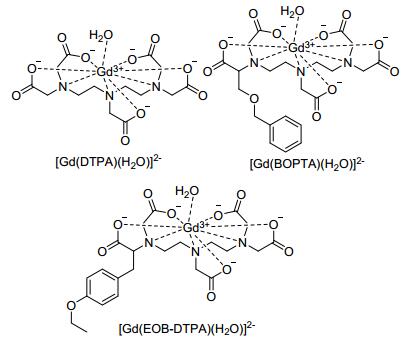
Figure Chart 1.
Some clinical contrast agents

Design, Synthesis and Evaluation of Novel Gd-Based 1, 4, 7, 10-Tetraazacyclododecan-N, N', N, N'-tetraacetic Acid-Hydrazide Derived Contrast Agents for Magnetic Resonance Imaging
Hongshun Sun , Jin Zhou , Yulong Li , Hong Jiang , Yan Zhang , Jianqiang Wang , Cheng Guo , Linjiang Shen


Molecular imaging plays an increasingly important role in bio-medical research, enabling a better understanding of fundamental molecular pathways in living organisms. Various different imaging techniques are used in molecular imaging, such as X-ray computer tomography (CT), positron emission tomography (PET), single photon emission tomography (SPECT), magnetic resonance imaging (MRI) and optical imaging (OI). Over the past few decades, the use of MRI has revolutionized diagnostic medicine and soft tissue imaging. In order to improve the specificity of MRI enhancement, contrast agents (CAs) are widely used to assist in the acquisition and interpretation of MRI images. About one-third of the 60 million MRI procedures done annually worldwide use contrast-enhancing agents, mostly containing the element gadolinium.[1, 2]
The first contrast agent approved for human use was [Gd(DTPA)(H2O)]2- (DTPA: diethylenetriaminepentaacetato) (Chart 1).[3, 4] Up to now, the number of approved CAs has increased to nine, and all of them were gadolinium-based contrast agents (GBCAs) and T1-weighted MRI images. They can be divided into extracellular fluid (ECF) space, organ-specific (or targeted) and blood pool agents.[5] [Gd(BOPTA)(H2O)]2- and [Gd(EOB-DTPA)(H2O)]2- (Chart 1) are liver-targeted agents with lipophilic side groups. The two targeted agents are all linear based on ligand DTPA.[6, 7] However, it has been proved that linear GBCAs have a risk of nephrogenic systemic fibrosis (NSF) in certain patients with kidney dysfunction. But macrocyclic GBCAs have a lower risk for the development of NSF.[2, 8] Because the macrocyclic agents are more stable than the linear agents. For this reason, a lot of macrocyclic GBCAs have been synthesized and researched.[9~15]
DOTA (1, 4, 7, 10-tetraazacyclododecan-N, N', N'', N'''- tetraacetic acid) is the most commonly used macrocyclic chelating agent for the functionalization of peptides, proteins and antibodies with contrast agents, forming thermodynamically stable and kinetically inert complexes with most trivalent metal ions.[16, 17] To enable efficient coupling to biomolecules, reactive groups need to be introduced into the DOTA complex. Amine and hydrazide groups have been established as versatile coupling sites in many different applications in the biomedical research. DOTA-hydrazide (DOTAH) is a good chelating agent for Gd3+ and has been researched in some literatures.[18~20] Herein, we reported the synthesis and characterization of a series of Gd-based DOTA-hydrazide derived contrast agents for MRI. For these agents, we introduced a lipophilic group with benzene ring and hope that it can bind to liver. Then we can get a liver targeted agent based on macrocyclic ligand, which can overcome the drawback of NSF resulting from linear agents.
In this study, DOTAH was chosen as the chelator for Gd3+ to build novel GBCAs. As a macrocyclic ligand, DOTAH has higher thermodynamic stability and slower dissociation kinetics to avoid transmetallation in vivo compared to the linear ligand like DTPA. At the same time, the Gd3+ binding neutralized the charges of the three acetic groups of DOTAH, leading to nonionic CAs, which is beneficial to low osmotic pressure. Then, kinds of lipophilic groups with benzene ring were introduced, which may make these new MRI contrast agents stay a longer time in liver so that they cloud get liver-target property.
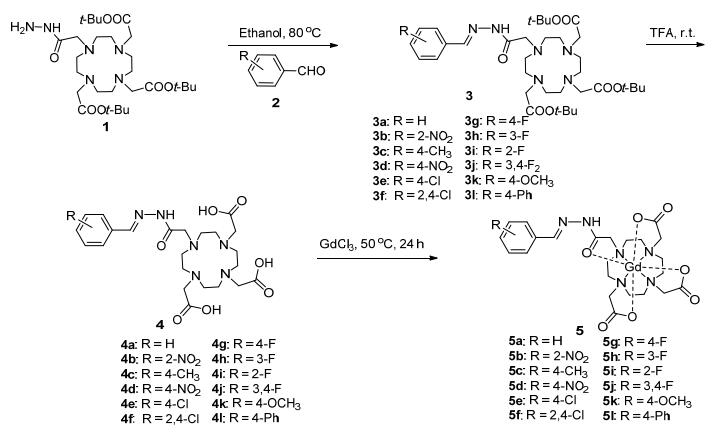
The desired complexes 5a~5l and their precursors were prepared following the procedures in Scheme 1. Raw material of 1, 4, 7-tris(tert-butoxycarbonylmethyl)-10-hydra- zinylcarbonylmethyl-1, 4, 7, 10-tetraazacyclododecane (t-Bu-DOTAH, 1) was synthesized from cyclen according to the literature we have published before.[20] The condensation reaction of the first step was complished using t-Bu-DOTAH and different benzaldehyde (2) in absolute ethanol refluxing for about 4 h. Deprotection of compounds 3a~3l was achieved within 24 h by reacting with trifluoroacetic acid (TFA). Complexes 5a~5l were obtained by combining 4a~4l and gadolinium chloride in an aqueous solution at 50 ℃, and the purification of 5a~5l was accomplished by C-18 SPE cartridge.
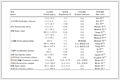
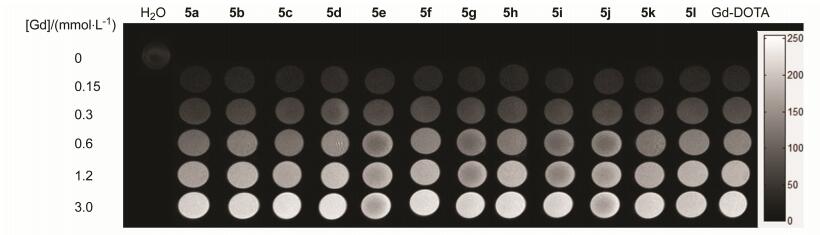
To evaluate the contrast enhancement of the new agents, longitudinal relaxivity r1 and transverse relaxivity r2 of them were calculated from the linear fitting of 1/T1 and 1/T2 plot versus metal concentrations. Commercially available Gd-DOTA was used as control. The values of r1 and r2 are estimated to be 2.94 to 5.33 and 3.63 to 6.32 L·mmol-1·s-1, respectively (Table 1). Among them, The relaxivities r1 of 5d, 5h and 5l are 4.67, 4.85 and 5.33 L·mmol-1·s-1 respectively, which are a little higher than that of the currently used clinical contrast agent Gd-DOTA with relaxivity r1 of 4.41 L·mmol-1·s-1. It means that these three contrast agents may be used at lower dosage of agents and thus reducing the clinical toxicity. At the same time, the ratios of r2/r1 are calculated to be 1.14 to 1.28, the low ratios of r2/r1 indicate that all the new agents can be used as T1-weighted MRI CAs. As shown in Figure 1, all new agents present excellent positive T1 contrast enhancement, and the brightness of MR images enhance with the increasing concentrations of solutions, showing a clear dose-dependent color change, due to the relaxation of water proton increase with the increase of concentration dose.
 下载:
导出CSV
| Entry | Compd. | r2/ (L·mmol-1·s-1) |
r1/ (L·mmol-1·s-1) |
r2/r1 |
| 1 | Gd-DOTA | 5.1289 | 4.4123 | 1.1624 |
| 2 | 5a | 3.9125 | 3.2437 | 1.2062 |
| 3 | 5b | 5.0427 | 4.1717 | 1.2088 |
| 4 | 5c | 3.6309 | 2.9353 | 1.2370 |
| 5 | 5d | 5.7423 | 4.6725 | 1.2290 |
| 6 | 5e | 4.4016 | 3.7504 | 1.1736 |
| 7 | 5f | 4.0837 | 3.5676 | 1.1447 |
| 8 | 5g | 4.8747 | 3.9786 | 1.2252 |
| 9 | 5h | 6.2079 | 4.8494 | 1.2801 |
| 10 | 5i | 4.9583 | 3.9940 | 1.2414 |
| 11 | 5j | 5.1293 | 4.2989 | 1.1932 |
| 12 | 5k | 4.7857 | 3.9714 | 1.2050 |
| 13 | 5l | 6.3216 | 5.3330 | 1.1854 |
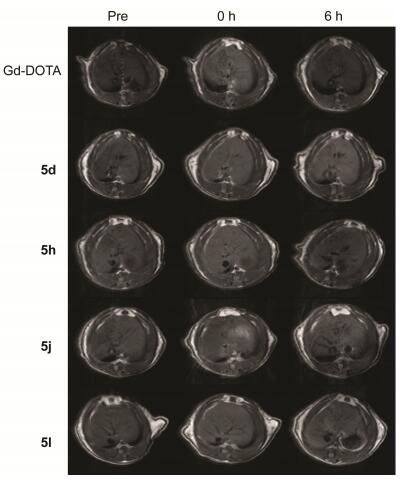
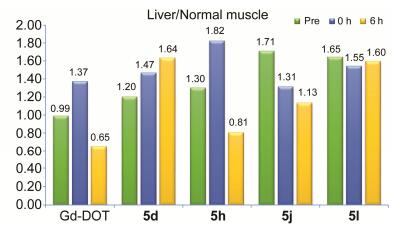
For exploring the liver-target imaging property of these new synthesized contrast agents, we chose four of them with high relaxivity to do in vivo liver-target MRI test. Five adult male Spraque-Dawley (SD) rats weighing 280~300 g were randomly divided into five groups. All rats were scanned for livers with T1 weighted imaging (T1WI). Then they were intravenously injected with 5d, 5h, 5j, 5l and Gd-DOTA as control at a dose of 0.1 mmol/kg in the tail vein, respectively. After administration, T1WI of liver was performed at 0 h and 6 h. As shown in Figure 2, immediately after administration of Gd-DOTA and four new contrast agents, the signal intensities (SIs) of normal livers were all strongly enhanced. But after 6 h, only the SI administrated by 5d was still enhanced. The contrast ratios of liver vs normal muscle at pre- and post-injection shown in Figure 3 also demonstrated that only the rat administrated by 5d could get the continuous liver enhancement signal. All the results show the potential of compound 5d used as a new liver-target contrast agent for MRI.
In summary, a series of novel Gd-based DOTA-hydra- zide derived contrast agents have been designed and synthesized. And we explored their feasibilities as T1 MRI CAs. The results showed that the thus-prepared agents have good positive imaging effect and low r2/r1 ratios suitable as T1-weighted MRI CAs. Moreover, three new agents exhibited a little higher r1 relaxivities and the ideal contrast enhancements in T1-weighted MR images, which were comparable to the clinical contrast agent Gd-DOTA. It means that they may be used at lower dosage of agents and thus reducing the clinical toxicity. In vivo liver-target MRI shows that complex 5d may be used as a novel liver-target contrast agent for MRI.
All chemicals and reagents were used as received without further purification. Glassware was dried in an oven at 130 ℃ and purged with a dry atmosphere prior to use. Unless otherwise mentioned, reactions were performed open to air. Reactions were monitored by thin-layer chromatography (TLC) and visualized by a dual short/long wavelength UV lamp. Flash column chromatography was performed using 200~400 mesh silica gel (Fisher). NMR spectra were recorded on a Bruker AVANCE AV-300 or a Bruker AVANCE AV-500 NMR spectrometer at room temperature. Chemical shifts for 1H NMR and 13C NMR were reported as δ. Spectra were referenced tointernal standards (TMS in CDCl3 and TMSP in D2O). Multiplicity and coupling constants (J) were calculated automatically on MestReNova 10.0, a NMR processing software from Mestrelab Research. MS (ESI) was determined by using a microTOF-Q II HRMS/MS instrument (Bruker). Element analysis was determined by using a Perkin-Elmer 240c elemental analysis instrument. In vitro MRI testing and T1 relaxation time measurements were tested at a 0.5 T NMR120-Analyst NMR Analyzing and Imaging system (Niuman Corporation, Shanghai, China). In vivo MRI was performed on a clinical 1.5 T MR magnet (Echo speed; GE Co., NY).
To a 100 mL round-bottom flask fitted with a magnetic stir bar were added compound 1 (1.17 g, 2 mmol), different benzaldehyde (2 mmol) and 20 mL of absolute ethanol. The mixture was stirred at 75 ℃ for 4 h. After completion of the reaction, ethanol was removed in vacuo, and the resulting residue was recrystallized with ethyl acetate. Filtered, and washed with cold ethyl acetate, the resulting solid was used without further purification.
Tri-tert-butyl 2, 2', 2''-(10-(2-(2-(benzylidene)hydrazineyl)-2-oxoethyl)-1, 4, 7, 10-tetraazacyclododecane-1, 4, 7-triyl)triacetate (3a): White solid, yield 88%. m.p. 204.5~205.8 ℃; 1H NMR (300 MHz, CDCl3) δ: 12.99 (s, 1H), 8.76 (s, 1H), 7.83~7.70 (m, 2H), 7.39~7.25 (m, 3H), 3.62 (s, 2H), 3.29~2.81 (br, 6H), 2.74~1.97 (br, 16H), 1.49 (s, 15H), 1.46 (s, 12H); 13C NMR (75 MHz, CDCl3) δ: 171.9, 171.6, 168.3, 148.1, 134.6, 129.1, 128.2, 127.8, 127.3, 126.8, 81.7, 81.6, 55.6, 55.4, 55.2, 50.0, 27.7, 27.6; ESI-MS m/z: 675.5 [M+H]+, 697.4 [M+Na]+. Anal. calcd for C35H58N6O7: C 62.29, H 8.66, N 12.45; found C 62.23, H 8.68, N 12.47.
Tri-tert-butyl 2, 2', 2''-(10-(2-(2-(2-nitrobenzylidene)hy-drazinyl)-2-oxoethyl)-1, 4, 7, 10-tetraazacyclododecane-1, 4, 7-triyl)triacetate (3b): White solid, yield 90%. m.p. 194.7~195.2 ℃; 1H NMR (300 MHz, CDCl3) δ: 13.31 (s, 1H), 8.90 (s, 1H), 8.73 (s, 1H), 8.14 (d, J=7.8 Hz, 1H), 7.95 (d, J=7.5 Hz, 1H), 7.50 (t, J=7.8 Hz, 1H), 3.62 (s, 2H), 3.44~2.92 (br, 6H), 2.86~1.99 (br, 16H), 1.51 (s, 15H), 1.47 (s, 12H); 13C NMR (75 MHz, CDCl3) δ: 172.2, 168.9, 148.4, 145.3, 137.0, 133.9, 129.1, 123.5, 121.1, 82.2, 82.0, 55.8, 55.7, 55.4, 50.3, 28.0, 27.9; ESI-MS m/z: 720.6 [M+H]+. Anal. calcd for C35H57N7O9: C 58.40, H 7.98, N 13.62; found C 58.45, H 7.96, N 13.60.
Tri-tert-butyl 2, 2', 2''-(10-(2-(2-(4-methylbenzylidene)-hydrazinyl)-2-oxoethyl)-1, 4, 7, 10-tetraaza-cyclododecane-1, 4, 7-triyl)triacetate (3c): White solid, yield 87%. m.p. 188.3~189.3 ℃; 1H NMR (300 MHz, CDCl3) δ: 12.88 (s, 1H), 8.71 (s, 1H), 7.66 (d, J=7.8 Hz, 2H), 7.12 (d, J=7.8 Hz, 2H), 3.61 (s, 2H), 3.47 (s, 2H), 3.30~2.87 (br, 5H), 2.74~1.99 (br, 18H), 1.48 (s, 14H), 1.46 (s, 13H); 13C NMR (75 MHz, CDCl3) δ: 172.1, 168.4, 148.7, 139.4, 132.1, 128.8, 127.6, 82.1, 82.0, 56.0, 55.7, 55.5, 50.3, 28.0, 27.9, 21.3; ESI-MS m/z: 689.5 [M+H]+. Anal. calcd for C36H60N6O7: C 62.77, H 8.78, N 12.20; found C 62.71, H 8.80, N 12.22.
Tri-tert-butyl 2, 2', 2''-(10-(2-(2-(4-nitrobenzylidene)-hydrazinyl)-2-oxoethyl)-1, 4, 7, 10-tetraaza-cyclododecane-1, 4, 7-triyl)triacetate (3d): Yellow solid, yield 87%. m.p. 138.9~140.5 ℃; 1H NMR (300 MHz, CDCl3) δ: 13.26 (s, 1H), 8.87 (s, 1H), 8.18 (d, J=8.6 Hz, 2H), 7.93 (d, J=8.7 Hz, 2H), 3.61 (s, 2H), 2.39~2.87 (br, 6H), 2.81~2.15 (br, 16H), 1.49 (s, 14H), 1.47 (s, 13H); 13C NMR (75 MHz, CDCl3) δ: 172.17, 169.2, 148.0, 145.5, 141.3, 128.0, 123.5, 82.2, 82.1, 55.9, 55.7, 55.5, 50.5, 28.0, 27.9; ESI-MS m/z: 720.5 [M+H]+, 742.5 [M+Na]+. Anal. calcd for C35H57N7O9: C 58.40, H 7.98, N 13.62; found C 58.44, H 7.97, N 13.60.
Tri-tert-butyl 2, 2', 2''-(10-(2-(2-(4-chlorobenzylidene)-hydrazinyl)-2-oxoethyl)-1, 4, 7, 10-tetraaza-cyclododecane-1, 4, 7-triyl)triacetate (3e): White solid, yield 95%. m.p. 182.1~183.9 ℃; 1H NMR (300 MHz, CDCl3) δ: 13.08 (s, 1H), 8.75 (s, 1H), 7.70 (d, J=8.3 Hz, 2H), 7.29 (d, J=8.0 Hz, 2H), 3.61 (s, 2H), 3.38~2.87 (br, 16H), 2.83~1.95 (br, 16H), 1.48 (s, 15H), 1.46 (s, 12H); 13C NMR (75 MHz, CDCl3) δ: 172.1, 168.6, 147.1, 135.1, 133.5, 128.7, 128.3, 114.5, 82.1, 82.0, 55.9, 55.7, 55.5, 50.6, 28.6, 27.9; ESI-MS m/z: 709.5 [M+H]+, 731.4 [M+Na]+. Anal. calcd for C35H57ClN6O7: C 59.27, H 8.10, N 11.85; found C 59.21, H 8.11, N 11.87.
Tri-tert-butyl 2, 2', 2''-(10-(2-(2-(2, 4-dichlorobenzyli-dene)hydrazinyl)-2-oxoethyl)-1, 4, 7, 10-tetraaza-cyclodo-decane-1, 4, 7-triyl)triacetate (3f): White solid, yield 90%. m.p. 164.6~166.1 ℃; 1H NMR (300 MHz, CDCl3) δ: 13.26 (s, 1H), 9.08 (s, 1H), 8.02 (d, J=8.5 Hz, 1H), 7.33 (s, 1H), 7.17 (d, J=8.4 Hz, 1H), 3.62 (s, 2H), 3.40~2.88 (s, 6H), 2.84~2.15 (br, 16H), 1.48 (s, 15H), 1.46 (s, 12H). 13C NMR (126 MHz, CDCl3) δ: 172.2, 169.1, 144.1, 135.4, 135.2, 131.5, 129.4, 128.4, 126.7, 82.1, 82.0, 56.0, 55.8, 55.6, 28.11, 28.0; ESI-MS m/z: 765.4 [M+Na]+. Anal. calcd for C35H56Cl2N6O7: C 56.52, H 7.59, N 11.30; found C 56.57, H 7.58, N 11.28.
Tri-tert-butyl 2, 2', 2''-(10-(2-(2-(4-fluorobenzylidene)-hydrazinyl)-2-oxoethyl)-1, 4, 7, 10-tetraazacyclododecane-1, 4, 7-triyl)triacetate (3g): Light yellow solid, yield 93%. m.p. 184.6~186.0 ℃; 1H NMR (300 MHz, CDCl3) δ: 12.92 (s, 1H), 8.73 (s, 1H), 7.75 (s, 2H), 7.00 (t, J=8.2 Hz, 2H), 3.59 (s, 2H), 3.39~2.89 (br, 6H), 2.78~2.00 (br, 16H), 1.48 (s, 14H), 1.46 (s, 13H); 13C NMR (75 MHz, Chloroform-d) δ: 172.1, 168.6, 165.2, 161.8, 147.3, 131.1 (d), 129.4, 129.3, 115.3, 115.0, 82.1, 82.0, 55.9, 55.7, 55.4, 50.3, 28.0, 27.9; ESI-MS m/z: 693.5 [M+H]+, 715.5 [M+Na]+. Anal. calcd for C35H57FN6O7: C 60.67, H 8.29, N 12.13; found C 60.61, H 8.30, N 12.15.
Tri-tert-butyl 2, 2', 2''-(10-(2-(2-(3-fluorobenzylidene)-hydrazinyl)-2-oxoethyl)-1, 4, 7, 10-tetraaza-cyclododecane-1, 4, 7-triyl)triacetate (3h): Light yellow solid, yield 91%. m.p. 185.3~186.7 ℃; 1H NMR (300 MHz, CDCl3) δ: 12.97 (s, 1H), 8.56 (d, J=9.8 Hz, 1H), 7.45 (d, J=7.7 Hz, 1H), 7.28 (d, J=6.4 Hz, 1H), 7.00 (t, J=7.3 Hz, 1H), 3.59 (s, 2H), 3.36~2.83 (br, 6H), 2.77~1.96 (br, 16H), 1.49 (s, 14H), 1.46 (s, 13H); 13C NMR (75 MHz, CDCl3) δ: 172.17, 169.2, 148.0, 145.5, 141.3, 128.0, 123.5, 82.2, 82.1, 55.9, 55.7, 55.5, 50.5, 28.0, 27.9; ESI-MS m/z: 720.5 [M+H]+, 742.5 [M+Na]+. Anal. calcd for C35H57FN6O7: C 60.67, H 8.29, N 12.13; found C 60.70, H 8.28, N 12.11.
Tri-tert-butyl 2, 2', 2''-(10-(2-(2-(2-fluorobenzylidene)-hydrazinyl)-2-oxoethyl)-1, 4, 7, 10-tetraaza-cyclododecane-1, 4, 7-triyl)triacetate (3i): White solid, yield 89%. m.p. 193.4~195.0 ℃; 1H NMR (300 MHz, CDCl3) δ: 13.10 (s, 1H), 8.93 (s, 1H), 8.00 (t, J=7.2 Hz, 1H), 7.28 (d, J=6.5 Hz, 1H), 7.13~6.91 (m, 2H), 3.63 (s, 2H), 3.41~2.93 (br, 6H), 2.83~1.95 (br, 16H), 1.48 (s, 14H), 1.46 (s, 13H); 13C NMR (75 MHz, CDCl3) δ: 172.1, 168.9, 163.1, 159.7, 141.9, 141.9, 130.8, 127.4, 123.6, 123.5, 115.7, 115.4, 82.0, 81.9, 55.9, 55.7, 55.5, 50.2, 28.0, 27.9; ESI-MS m/z: 693.5 [M+H]+, 715.5 [M+Na]+. Anal. calcd for C35H57FN6O7: C 60.67, H 8.29, N 12.13; found C 60.62, H 8.30, N 12.14.
Tri-tert-butyl 2, 2', 2''-(10-(2-(2-(3, 4-difluorobenzylide-ne)hydrazinyl)-2-oxoethyl)-1, 4, 7, 10-tetraazacyclodode-cane-1, 4, 7-triyl)triacetate (3j): White solid, yield 92%. m.p. 191.2~193.1 ℃; 1H NMR (300 MHz, CDCl3) δ: 13.10 (s, 1H), 8.73 (s, 1H), 7.69 (t, J=9.0, 1H), 7.39 (s, 1H), 7.10 (dd, J=17.8, 8.5 Hz, 1H), 3.59 (s, 2H), 3.42~2.88 (br, 6H), 2.86~1.93 (br, 16H), 1.49 (s, 15H), 1.46 (s, 12H); 13C NMR (75 MHz, CDCl3) δ: 172.1, 168.7, 145.9, 124.6, 117.0, 116.8, 115.2, 114.9, 82.1, 82.0, 55.94, 55.76, 55.49, 50.19, 28.04, 27.92; ESI-MS m/z: 733.5 [M+Na]+. Anal. calcd for C35H56F2N6O7: C 59.14, H 7.94, N 11.82; found C 59.10, H 7.95, N 11.84.
Tri-tert-butyl 2, 2', 2''-(10-(2-(2-(4-methoxybenzylidene)-hydrazinyl)-2-oxoethyl)-1, 4, 7, 10-tetraazacyclododecane-1, 4, 7-triyl)triacetate (3k): White solid, yield 85%. m.p. 177.5~178.9 ℃; 1H NMR (300 MHz, CDCl3) δ: 12.80 (s, 1H), 8.70 (s, 1H), 7.71 (d, J=8.3 Hz, 2H), 6.84 (d, J=8.3 Hz, 2H), 3.81 (s, 3H), 3.59 (s, 2H), 3.36~2.87 (br, 6H), 2.81~1.91 (br, 16H), 1.49 (s, 14H), 1.46 (s, 13H); 13C NMR (75 MHz, CDCl3) δ: 172.1, 168.2, 160.7, 148.3, 129.1, 127.6, 114.5, 113.6, 82.0, 81.9, 56.0, 55.7, 55.5, 55.2, 50.3, 28.0, 27.9; ESI-MS m/z: 727.5 [M+Na]+. Anal. calcd for C36H60N6O8: C 61.34, H 8.58, N 11.92; found C 61.39, H 8.57, N 11.90.
Tri-tert-butyl 2, 2', 2''-(10-(2-(2-(4-phenylbenzylidene)-hydrazinyl)-2-oxoethyl)-1, 4, 7, 10-tetraazacyclodeane-1, 4, 7-triyl)triacetate (3l): White solid, yield 88%. m.p. 148.3~150.2 ℃; 1H NMR (300 MHz, CDCl3) δ: 12.85 (s, 1H), 8.77 (s, 1H), 7.84 (d, J=7.9 Hz, 2H), 7.58 (t, J=8.6 Hz, 4H), 7.42 (t, J=7.0 Hz, 2H), 7.34 (d, J=7.1 Hz, 1H), 3.60 (s, 2H), 3.39~2.86 (br, 6H), 2.80~1.96 (br, 16H), 1.49 (s, 16H), 1.46 (s, 11H); 13C NMR (75 MHz, CDCl3) δ: 172.1, 168.6, 148.2, 142.0, 133.8, 128.6, 128.1, 127.6, 127.3, 127.0, 126.8, 82.1, 82.0, 56.0, 55.7, 55.5, 50.3, 28.0, 27.9. HRMS (ESI+) calcd for C41H62N6O7 [M+H]+ 751.4753, found 751.4752.
A solution of 3 (1.5 mmol) in trifluoroacetic acid (TFA) (10 mL) was stirred at room temperature for 24 h. TFA was removed under reduced pressure and the residue was dissolved in ethyl acetate (5 mL). After freezing for 12 h, the mixture was filtered to obtain solid compounds quantitatively.
2, 2', 2''-(10-(2-(2-(Benzylidene)hydrazinyl)-2-oxoethyl)-1, 4, 7, 10-tetraazacyclododecane-1, 4, 7-triyl)triacetic acid (4a): White solid, yield 100%. m.p. 180.4~182.3 ℃; 1H NMR (300 MHz, D2O) δ: 8.18 (s, 1H), 7.77 (s, 2H), 7.52 (s, 3H), 3.96~2.92 (m, 24H); 13C NMR (75 MHz, D2O) δ: 173.1, 172.6, 154.0, 135.7, 133.9, 133.6, 131.7, 130.5, 130.0, 59.1, 58.2, 56.6, 54.2, 53.5, 53.1, 51.2; ESI-MS m/z: 543.2 [M+K-2H]-. Anal. calcd for C23H34N6O7: C 54.54, H 6.77, N 16.59; found C 54.50, H 6.78, N 16.62.
2, 2', 2''-(10-(2-(2-(2-Nitrobenzylidene)hydrazinyl)-2-oxoethyl)-1, 4, 7, 10-tetraazacyclododecane-1, 4, 7-triyl)tri-acetic acid (4b): White solid, yield 100%. m.p. 169.9~172.0 ℃; 1H NMR (300 MHz, D2O) δ: 8.47 (s, 1H), 8.25 (d, J=9.0 Hz, 1H), 8.14 (s, 1H), 8.03 (d, J=8.5 Hz, 1H), 4.06~2.87 (m, 24H); 13C NMR (126 MHz, D2O) δ: 148.5, 148.1, 148.0, 134.8, 133.8, 130.1, 125.2, 122.3, 117.6, 55.4, 54.1, 50.9, 48.6; ESI-MS m/z: 552.2 [M+H]+, 550.0 [M-H]-. Anal. calcd for C23H33N7O9: C 50.09, H 6.03, N 17.78; found C 50.14, H 6.02, N 17.76.
2, 2', 2''-(10-(2-(2-(4-Methylbenzylidene)hydrazinyl)-2-oxoethyl)-1, 4, 7, 10-tetraazacyclododecane-1, 4, 7-triyl)-triacetic acid (4c): White solid, yield 100%. m.p. 185.7~187.3 ℃; 1H NMR (500 MHz, D2O) δ: 8.14 (s, 1H), 7.66 (d, J=7.0 Hz, 2H), 7.33 (d, J=6.4 Hz, 2H), 3.96~2.96 (m, 24H), 2.38 (s, 3H); 13C NMR (126 MHz, D2O) δ: 170.4, 163.1, 162.8, 151.6, 142.3, 130.3, 129.7, 127.9, 127.4, 117.6, 115.3, 56.5, 54.1, 51.6, 50.9, 48.6, 48.0, 20.7; ESI-MS m/z: 521.2 [M+H]+, 519.1 [M-H]-. Anal. calcd for C24H36N6O7: C 55.37, H 6.97, N 16.14; found C 55.41, H 6.96, N 16.12.
2, 2', 2''-(10-(2-(2-(4-Nitrobenzylidene)hydrazinyl)-2-oxoethyl)-1, 4, 7, 10-tetraazacyclododecane-1, 4, 7-triyl)-triacetic acid (4d): Yellow solid, yield 100%. m.p. 183.8~185.6 ℃. 1H NMR (300 MHz, D2O) δ: 8.23 (t, J=8.0 Hz, 2H), 8.14 (s, 1H), 7.87 (d, J=8.2 Hz, 1H), 7.81 (d, J=8.2 Hz, 1H), 4.04~2.97 (m, 24H); 13C NMR (126 MHz, D2O) δ: 163.0, 162.7, 148.3, 139.5, 128.5, 128.0, 124.0, 117.6, 115.2, 55.3, 53.8, 50.4, 48.6; ESI-MS m/z: 588.2 [M+K-2H]-. Anal. calcd for C23H33N7O9: C 50.09, H 6.03, N 17.78; found C 50.05, H 6.04, N 17.80.
2, 2', 2''-(10-(2-(2-(4-Chlorobenzylidene)hydrazinyl)-2-oxoethyl)-1, 4, 7, 10-tetraazacyclododecane-1, 4, 7-triyl)tra-cetic acid (4e): Light yellow solid, yield 100%. m.p. 186.4~188.6 ℃; 1H NMR (500 MHz, D2O) δ: 8.03 (s, 1H), 7.55 (d, J=45.1 Hz, 2H), 7.32 (d, J=34.5 Hz, 2H), 3.98~2.96 (m, 24H); 13C NMR (126 MHz, D2O) δ: 162.9, 162.6, 149.7, 136.2, 131.9, 129.2, 129.0, 117.6, 115.3, 55.3, 53.9, 50.9, 48.6, 48.1; ESI-MS m/z: 541.2 [M+H]+, 539.0 [M-H]-. Anal. calcd for C23H33ClN6O7: C 51.06, H 6.15, N 15.53; found C 51.10, H 6.14, N 15.50.
2, 2', 2''-(10-(2-(2-(2, 4-Dichlorobenzylidene)hydrazinyl)-2-oxoethyl)-1, 4, 7, 10-tetraazacyclododecane-1, 4, 7-triyl)tri-acetic acid (4f): Light yellow solid, yield 100%. m.p. 184.5~186.4 ℃; 1H NMR (500 MHz, D2O) δ: 8.34 (s, 1H), 8.11 (s, 1H), 7.16 (d, J=24.4 Hz, 1H), 7.02 (s, 1H), 3.97~2.85 (m, 24H); 13C NMR (126 MHz, D2O) δ: 162.9, 162.6, 136.4, 135.8, 134.8, 129.6, 127.3, 117.6, 115.3, 55.7, 50.9, 48.6, 48.1; ESI-MS m/z: 575.1 [M+H]+, 573.0 [M-H]-. Anal. calcd for C23H32Cl2N6O7: C 48.01, H 5.61, N 14.60; found C 48.05, H 5.60, N 14.58.
2, 2', 2''-(10-(2-(2-(4-Fluorobenzylidene)hydrazinyl)-2-oxoethyl)-1, 4, 7, 10-tetraazacyclododecane-1, 4, 7-triyl)tria-cetic acid (4g): White solid, yield 100%. m.p. 163.6~166.5 ℃; 1H NMR (300 MHz, D2O) δ: 8.13 (s, 1H), 8.00 (s, 1H), 7.78 (s, 2H), 7.22 (s, 1H), 4.00~2.95 (m, 24H); 13C NMR (75 MHz, D2O) δ: 168.4, 165.1, 152.9, 132.7, 132.6, 132.2, 132.0, 118.8, 118.5, 58.8, 57.7, 56.6, 53.43, 51.9, 50.7; ESI-MS m/z: 561.2 [M+K-2H]-. Anal. calcd for C23H33FN6O7: C 52.66, H 6.34, N 16.02; found C 52.70, H 6.33, N 16.01.
2, 2', 2''-(10-(2-(2-(3-Fluorobenzylidene)hydrazinyl)-2-oxoethyl)-1, 4, 7, 10-tetraazacyclododecane-1, 4, 7-triyl)tri-acetic acid (4h): White solid, yield 100%. m.p. 170.0~171.5 ℃; 1H NMR (300 MHz, D2O) δ: 8.12 (s, 1H), 7.96 (s, 1H), 7.49 (d, J=14.8 Hz, 3H), 7.23 (d, J=7.5 Hz, 1H), 3.99~3.04 (m, 24H); 13C NMR (75 MHz, D2O) δ: 173.0, 166.9, 163.7, 152.5, 138.0, 133.4, 126.9, 120.6, 116.1, 115.6, 58.9, 57.9, 56.6, 53.5, 51.2; ESI-MS m/z: 525.2 [M+H]+, 523.1 [M-H]-. Anal. calcd for C23H33FN6O7: C 52.66, H 6.34, N 16.02; found C 52.62, H 6.35, N 16.04.
2, 2', 2''-(10-(2-(2-(2-Fluorobenzylidene)hydrazinyl)-2-oxoethyl)-1, 4, 7, 10-tetraazacyclododecane-1, 4, 7-triyl)tria-cetic acid (4i): White solid, yield 100%. m.p. 170.1~172.5 ℃; 1H NMR (500 MHz, D2O) δ: 8.34 (s, 1H), 7.90 (t, J=7.1 Hz, 1H), 7.56~7.46 (m, 1H), 7.32~7.17 (m, 2H), 3.95~3.09 (m, 24H); 13C NMR (126 MHz, D2O) δ: 170.5, 162.4, 160.4, 144.7, 133.1, 127.4, 124.8, 120.7, 117.6, 116.2, 55.5, 53.8, 50.9, 48.6; ESI-MS m/z: 525.2 [M+H]+, 523.1 [M-H]-. Anal. calcd for C23H33FN6O7: C 52.66, H 6.34, N 16.02; found C 52.69, H 6.33, N 16.00.
2, 2', 2''-(10-(2-(2-(3, 4-Difluorobenzylidene)hydrazinyl)-2-oxoethyl)-1, 4, 7, 10-tetraazacyclododecane-1, 4, 7-triyl)tri- acetic acid (4j): White solid, yield 100%. m.p. 182.8~184.6 ℃; 1H NMR (300 MHz, D2O) δ: 8.04 (s, 1H), 7.72~7.22 (m, 3H), 4.01~3.06 (m, 24H); 13C NMR (126 MHz, D2O) δ: 173.3, 155.8, 154.4, 151.6, 148.1, 133.1, 127.9, 120.6, 118.3, 1177, 58.8, 57.8, 56.5, 53.0, 51.5; ESI-MS m/z: 543.2 [M+H]+, 541.1 [M-H]-. Anal. calcd for C23H32F2N6O7: C 50.92, H 5.95, N 15.49; found C 50.95, H 5.94, N 15.47.
2, 2', 2''-(10-(2-(2-(4-Methoxybenzylidene)hydrazinyl)-2-oxoethyl)-1, 4, 7, 10-tetraazacyclododeca-ne-1, 4, 7-triyl)tria- cetic acid (4k): Yellow solid, yield 100%. m.p. 152.9~154.1 ℃; 1H NMR (300 MHz, D2O) δ: 8.09 (s, 1H), 7.71 (d, J=7.8 Hz, 1H), 7.65 (d, J=7.9 Hz, 1H), 7.05 (d, J=7.2 Hz, 2H), 3.98~2.98 (m, 27H); 13C NMR (75 MHz, D2O) δ: 197.5, 164.0, 163.7, 153.8, 135.4, 132.3, 131. 8, 128.9, 128.6, 117.2, 58.9, 58.2, 56.6, 55.0, 53.5, 51.2; ESI-MS m/z: 537.2 [M+H]+, 535.1 [M-H]-. Anal. calcd for C24H36N6O8: C 53.72, H 6.76, N 15.66; found C 53.75, H 6.75, N 15.65.
2, 2', 2''-(10-(2-(2-(4-Phenylbenzylidene)hydrazinyl)-2-oxoethyl)-1, 4, 7, 10-tetraazacyclododecane-1, 4, 7-triyl)tri-acetic acid (4l): White solid, yield 100%. m.p. 180.5~181.7 ℃; 1H NMR (300 MHz, D2O) δ: 8.01 (s, 1H), 7.65~6.57 (m, 9H), 4.07~2.68 (m, 24H); 13C NMR (75 MHz, D2O) δ: 177.4, 173.1, 165.2, 152.1, 148.5, 144.5, 144.1, 142.0, 141.8, 135.2, 131.3, 129.2, 121.0, 117.2, 59.2, 55.7, 54.3, 53.4, 51.2, 50.7. HRMS (ESI+) calcd for C29H38N6O7 [M+H]+ 605.2694, found 605.2701.
To a solution of 4a~4l (1.5 mmol) in water (20 mL) was added a solution of GdCl3 in water (0.05 mol/L, 36 mL, 1.8 mmol) while maintaining the pH at 6.5 by addition of 1 mol/L NaOH. The solution was stirred at 50 ℃ for 24 h. The pH was raised to 8.0. The solution was filtered through a 0.2 μm filter, and the pH was lowered to 7.0 by adding 1 mol/L HCl. The solution was loaded on a Hypersep C-18 cartridge, and the stationary phase was washed extensively with water. The product was recovered after gradient elution with MeOH/H2O from 1:9 to 3:2. The fractions containing the product were evaporated under reduced pressure to give 5a~5l as solid compounds.
Gadolinium 2, 2', 2''-(10-(2-(2-(benzylidene)hydrazin-yl)-2-oxoethyl)-1, 4, 7, 10-tetraazacyclododecane-1, 4, 7-triyl)-triacetic acetate (5a): White solid, yield 85%; ESI-MS m/z: 684.2 [M+Na]+. A correct Gd isotope pattern was observed. Anal. calcd for C23H31GdN6O7: C 41.81, H 4.73, N 12.72; found C 41.74, H 4.74, N 13.19.
Gadolinium 2, 2', 2''-(10-(2-(2-(2-nitrobenzylidene)-hydrazinyl)-2-oxoethyl)-1, 4, 7, 10-tetraazacyclododecane-1, 4, 7-triyl)triacetic acetate (5b): Yellow solid, yield 90%; ESI-MS m/z: 729.1 [M+Na]+. A correct Gd isotope pattern was observed. Anal. calcd for C23H30GdN7O9: C 39.14, H 4.28, N 13.89; found C 39.19, H 4.27, N 13.87.
Gadolinium 2, 2', 2''-(10-(2-(2-(4-methylbenzylidene)-hydrazinyl)-2-oxoethyl)-1, 4, 7, 10-tetraazacyclododecane-1, 4, 7-triyl)triacetic acetate (5c): White solid, yield 88%; ESI-MS m/z: 698.2 [M+Na]+. A correct Gd isotope pattern was observed. Anal. calcd for C24H33GdN6O7: C 42.72, H 4.93, N 12.45; found C 42.66, H 4.94, N 12.47.
Gadolinium 2, 2', 2''-(10-(2-(2-(4-nitrobenzylidene)hydra-zinyl)-2-oxoethyl)-1, 4, 7, 10-tetraazacyclododecane-1, 4, 7-triyl)triacetic acetate (5d): Light yellow solid, yield 92%; ESI-MS m/z: 729.1 [M+Na]+. A correct Gd isotope pattern was observed. Anal. calcd for C23H30GdN7O9: C 39.14, H 4.28, N 13.89; found C 39.18, H 4.27, N 13.86.
Gadolinium 2, 2', 2''-(10-(2-(2-(4-chlorobenzylidene)-hydrazinyl)-2-oxoethyl)-1, 4, 7, 10-tetraazacyclododecane-1, 4, 7-triyl)triacetic acetate (5e): Light yellow solid, yield 95%; ESI-MS m/z: 718.2 [M+Na]+. A correct Gd isotope pattern was observed. Anal. calcd for C23H30ClGdN6O7: C 39.74, H 4.35, N 12.09; found C 39.69, H 4.36, N 12.12.
Gadolinium 2, 2', 2''-(10-(2-(2-(2, 4-dichlorobenzylidene)-hydrazinyl)-2-oxoethyl)-1, 4, 7, 10-tetraazacyclododecane-1, 4, 7-triyl)triacetic acetate (5f): Light yellow solid, yield 90%; ESI-MS m/z: 729.2 [M]+. A correct Gd isotope pattern was observed. Anal. calcd for C23H29Cl2GdN6O7: C 37.86, H 4.01, N 11.52; found C 39.65, H 4.02, N 11.55.
Gadolinium 2, 2', 2''-(10-(2-(2-(4-fluorobenzylidene)-hydrazinyl)-2-oxoethyl)-1, 4, 7, 10-tetraazacyclododecane-1, 4, 7-triyl)triacetic acetate (5g): Light yellow solid, yield 93%; ESI-MS m/z: 702.1 [M+Na]+. A correct Gd isotope pattern was observed. Anal. calcd for C23H30FGdN6O7: C 40.70, H 4.46, N 12.38; found C 40.75, H 4.45, N 12.36.
Gadolinium 2, 2', 2''-(10-(2-(2-(3-fluorobenzylidene)-hydrazinyl)-2-oxoethyl)-1, 4, 7, 10-tetraazacyclododecane-1, 4, 7-triyl)triacetic acetate (5h): Light yellow solid, yield 92%; ESI-MS m/z: 702.1 [M+Na]+. A correct Gd isotope pattern was observed. Anal. calcd for C23H30FGdN6O7: C 40.70, H 4.46, N 12.38; found C 40.66, H 4.47, N 12.40.
Gadolinium 2, 2', 2''-(10-(2-(2-(2-fluorobenzylidene)-hydrazinyl)-2-oxoethyl)-1, 4, 7, 10-tetraazacyclododecane-1, 4, 7-triyl)triacetic acetate (5i): White solid, yield 96%; ESI-MS m/z: 702.1 [M+Na]+. A correct Gd isotope pattern was observed. Anal. calcd for C23H30FGdN6O7: C 40.70, H 4.46, N 12.38; found C 40.73, H 4.45, N 12.36.
Gadolinium 2, 2', 2''-(10-(2-(2-(3, 4-difluorobenzylidene)-hydrazinyl)-2-oxoethyl)-1, 4, 7, 10-tetraazacyclododecane-1, 4, 7-triyl)triacetic acetate (5j): White solid, yield 90%; ESI-MS m/z: 720.1 [M+Na]+. A correct Gd isotope pattern was observed. Anal. calcd for C23H29F2GdN6O7: C 39.65, H 4.20, N 12.06; found C 39.70, H 4.19, N 12.03.
Gadolinium 2, 2', 2''-(10-(2-(2-(4-methoxybenzylidene)-hydrazinyl)-2-oxoethyl)-1, 4, 7, 10-tetraazacyclododecane-1, 4, 7-triyl)triacetic acetate (5k): Light yellow solid, yield 88%; ESI-MS m/z: 714.1 [M+Na]+. A correct Gd isotope pattern was observed. Anal. calcd for C24H33GdN6O8: C 41.73, H 4.82, N 12.17; found C 41.68, H 4.83, N 12.20.
Gadolinium 2, 2', 2''-(10-(2-(2-(4-phenylbenzylidene)-hydrazinyl)-2-oxoethyl)-1, 4, 7, 10-tetraazacyclododecane-1, 4, 7-triyl)triacetic acetate (5l): Light yellow solid, yield 85%; ESI-MS m/z: 760.2 [M+Na]+. A correct Gd isotope pattern was observed. Anal. calcd for C29H35GdN6O7: C 47.27, H 4.79, N 11.41; found C 47.33, H 4.78, N 11.38.
To obtain T1 relaxation times of the aqueous solution of the new agents at different concentrations, following measurement parameters were used: repetition time (TR) is 6000 ms, number of data is 25, and number of averages (NA) is 2. While the T2 relaxation times were determined with the following parameters: TR is 6000 ms, echo time (TE) is 1 ms, echo count is 6000 and NA is 2. Both r1 and r2 relaxivities were calculated by the linear fitting of 1/T1 or 1/T2 as a function of metal concentration. For T1- weighted MR images, the instrument parameters were set as follows: TR=100 ms, TE=18.2 ms, imaging matrix=192×256, slice thickness=5 mm, field of view (FOW)=100 mm×100 mm and NA=2.
Adult male Sprague-Dawley (SD) rats weighing 280~300 g were provided by the Experimental Animal Center, Jiangsu Province Academy of Traditional Chinese Medicine. All the animal experiments were implemented with the approval the institutional animal care and research advisory.
MRI was performed on a clinical 1.5 T MR magnet (Echo speed; GE Co., NY) by using a rat coil. All animals were anaesthetized with isoflurane in a mixture of 80% room air and 20% oxygen. Spin-echo (SE) T1-weighted imaging (T1WI) was performed with the following parameters: TR=550 ms, TE=24 ms, FOV=100 mm×100 mm, imaging acquisition matrix=224×192, a total examination time of 185 s. Contract agents of 5d, 5h, 5j, 5l and Gd-DOTA were used at the same dosage of 0.1 mmol/kg. MRI analyses were performed by using the built-in software of the system (GE, AW 4.3, GE Healthcare Bio-Sciences, Pittsburgh, PA). The signal intensities (SIs) of tissue were measured with an operator-defined circular region of interest (ROI) with 3 mm2 on T1WI. Contrast ratio was used to express the visual conspicuity of adjacent component on the one image and calculated with the formula: CR=SIA/SIB.
Supporting Information 1H NMR and 13C NMR spectra, mass spectra of the synthesized compounds. Longitudinal and transverse relaxivities of Gd-DOTA and 5a~5l. The Supporting Information is available free of charge via the Internet at http://sioc-journal.cn/.
Merbach, A.-E.; Helm, L.; Toth, E. The Chemistry of Contrast Agents in Medical Magnetic Resonance Imaging, Wiley, Chichester, 2013, Preface.
He, W.; Oliver, T.-B.; Michael, G.-K.; Eric, C.-H.; Mariya, B.; Agata, W.; Ou, C.; Yue, C.; Nan, L.; Satoshi, O.; Jose, M. C.; Markus, H.; Christian, T.-F.; Daniel, M.-M.; Gerhard, A.; Harald, I.; Alan, J.; Peter, N.; Moungi, G.-B. Proc. Natl. Acad. Sci. U. S. A. 2017, 114, 2325. doi: 10.1073/pnas.1620145114
Carr, D.-H.; Brown, J.; Bydder, G.-M.; Steiner, R.-E.; Weinmann, H.-J.; Speck, U.; Hall, A.-S.; Young, I.-R. Am. J. Roentgenol. 1984, 143, 215. doi: 10.2214/ajr.143.2.215
Lohrke, J.; Frenzel, T.; Endrikat, J.; Alves, F.-C.; Grist, T.-M.; Law, M.; Lee, J.-M.; Leiner, T.; Li, K.-C.; Nikolaou, K.; Prince, M.-R.; Schild, H.-H.; Weinreb, J.-C.; Yoshikawa, K.; Pietsch, H. Adv. Ther. 2016, 33, 1. doi: 10.1007/s12325-015-0275-4
Pierre, V.-C.; Allen, M.-J.; Caravan, P. J. Biol. Inorg. Chem. 2014, 19, 127. doi: 10.1007/s00775-013-1074-5
Hermann, P.; Kotek, J.; Kubicek, V.; Lukes, I. Dalton Trans. 2008, 23, 3027.
Thian, Y.-L.; Riddell, A.-M.; Koh, D.-M. Cancer Imaging 2013, 13, 567. doi: 10.1102/1470-7330.2013.0050
Huckle, J.-E.; Altun, E.; Jay, M.-J.; Semelka, R.-C. Invest. Radiol. 2016, 51, 236. doi: 10.1097/RLI.0000000000000228
McMahon, M.-T.; Chan, K.-W. Adv. Cancer Res. 2014, 124, 297. doi: 10.1016/B978-0-12-411638-2.00009-4
Frullano, L.; Zhu, J.; Miller, R.-H.; Wang, Y.-J. Med. Chem. 2013, 56, 1629. doi: 10.1021/jm301435z
Song, Y.; Kohlmeir, E.-K.; Meade, T.-J. J. Am. Chem. Soc. 2008, 130, 6662. doi: 10.1021/ja0777990
Zhou, Y.; Kim, Y.-S.; Yan, X.; Jacobson, O.; Chen, X.; Liu, S. Mol. Pharm. 2011, 8, 1198. doi: 10.1021/mp200025m
Barge, A.; Tei, L.; Upadhyaya, D.; Fedeli, F.; Beltrami, L.; Stefania, R.; Aime, S.; Cravotto, G. Org. Biomol. Chem. 2008, 6, 1176. doi: 10.1039/b715844k
Wang, S.-C.; Hsu, Y.-S.; Hsiao, C.-T.; Wu, C.-C.; Sue, Y.-C.; Alshehri, S.-M.; Ahamad, T.; Yamauchi, Y.; Chen, J.-E.; Wu, K.-C.-W.; Shieh, F.-K. J. Inorg. Organomet. Polym. 2016, 26, 165. doi: 10.1007/s10904-015-0280-8
Zhang, W.; Lu, C.; Zhao, G.; Zhang, J.; Fang, X.; Wang, P.; Fang, X.; Xu, J.; Yang, W. Z. Anorg. Allg. Chem. 2015, 641, 578. doi: 10.1002/zaac.201400397
Cresens, E.; Ni, Y.-C.; Adriaens, P.; Verbruggen, A.; Marchal, G. WO 2002038546, 2002[Chem. Abstr. 2002, 136, 379071].
Zhang, J.-D.; Curry, K. WO 2016090491, 2016[Chem. Abstr. 2016, 165, 112684].
Frullano, L.; Tejerina, B.; Meade, T.-J. Inorg. Chem. 2006, 45, 8489. doi: 10.1021/ic0612045
周进, 杨海东, 孙宏顺, 李玉龙, 蒋蕻, 合成化学, 2017, 25, 159. http://www.cqvip.com/QK/96871A/201702/671286767.htmlZhou, J.; Yang, H.-D.; Sun, H.-S.; Li, Y.-L.; Jiang, H. Chin. J. Synth. Chem. 2017, 25, 159(in Chinese). http://www.cqvip.com/QK/96871A/201702/671286767.html
孙宏顺, 李玉龙, 蒋蕻, 郭成, 沈临江, 有机化学, 2018, 38, 1779. http://manu19.magtech.com.cn/Jwk_yjhx/CN/abstract/abstract346519.shtmlSun, H.-S.; Li, Y.-L.; Jiang, H.; Guo, C.; Shen, L.-J. Chin. J. Org. Chem. 2018, 38, 1779(in Chinese). http://manu19.magtech.com.cn/Jwk_yjhx/CN/abstract/abstract346519.shtml
Table 1. r1 and r2 values of the synthesized compounds at 0.5 T, Gd-DOTA is as control
| Entry | Compd. | r2/ (L·mmol-1·s-1) |
r1/ (L·mmol-1·s-1) |
r2/r1 |
| 1 | Gd-DOTA | 5.1289 | 4.4123 | 1.1624 |
| 2 | 5a | 3.9125 | 3.2437 | 1.2062 |
| 3 | 5b | 5.0427 | 4.1717 | 1.2088 |
| 4 | 5c | 3.6309 | 2.9353 | 1.2370 |
| 5 | 5d | 5.7423 | 4.6725 | 1.2290 |
| 6 | 5e | 4.4016 | 3.7504 | 1.1736 |
| 7 | 5f | 4.0837 | 3.5676 | 1.1447 |
| 8 | 5g | 4.8747 | 3.9786 | 1.2252 |
| 9 | 5h | 6.2079 | 4.8494 | 1.2801 |
| 10 | 5i | 4.9583 | 3.9940 | 1.2414 |
| 11 | 5j | 5.1293 | 4.2989 | 1.1932 |
| 12 | 5k | 4.7857 | 3.9714 | 1.2050 |
| 13 | 5l | 6.3216 | 5.3330 | 1.1854 |
 下载: 导出CSV

 扫一扫看文章


扫一扫关注我们


 下载: