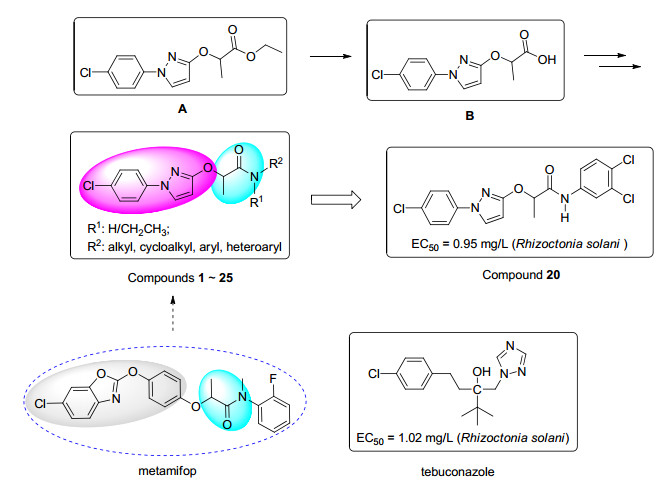
Scheme 1.
Design strategy of new phenylpyrazoloxyl propionic acid derivatives

Design, Synthesis and Fungicidal Activity against Rhizoctonia solani of New Phenylpyrazoloxyl Propionic Acid Derivatives
Fuqiang Yu , Aiying Guan , Xufeng Sun , Huichao Li , Xiaowu Li


The rice is one of important major food crops, which is planted widely around the world with harvested area of 160.1 million ha in 2016, [1] to guarantee the food provision for over half the global population.[2, 3] Rice sheath blight (Rhizoctonia solani Kühn) is one of three most important diseases in rice, which can cause even 40%~50% production loss in crops per year worldwide.[4, 5] There are many ways to prevent and control this destructive disease; however, the application of chemical pesticides is one of the most effective ways. At present, the existing chemical pesticides for control of rice sheath blight are mainly triazoles and strobilurins such as tebuconazole, [6, 7] pyraclostrobin[8, 9] and azoxystrobin.[10, 11] However, after fungicide is used for a period of time, the fungi will develop resistance to it. As been reported by the Fungicide Resistance Action Committee (FRAC), the known target sites had already developed medium to high resistance risk to most triazole and strobilurin fungicides.[12] Furthermore, along with the increase of people’s living standard, the demand for quality, quantity and safety of grain increases daily. So it urgently needed to discover and develop new fungicides with an innovated structure to protect rice from rice sheath blight and further to facilitate resistance management.
To the best of our knowledge, aryloxy carboxylic acid compounds are mostly known as herbicides in agricultural field, such as aryloxyphenoxypropionate (APP) like metamifop[13, 14] and cyhalofop butyl.[15, 16] In recent years, this kind of compounds is being paid more and more attention[17], and it is also found to have good inhibitory effects on fungus and insects.[18~20] Nevertheless, their application as fungicides for control of rice sheath blight has not been reported. On the other hand, pyraclostrobin is a broad spectrum fungicide, and it has a good control effect on cucumber powdery mildew, downy mildew, banana black star, leaf spot, sclerotia and sheath blight.[21] In order to develop new compounds for preventing and controlling rice sheath blight, with the guidance of intermediate derivatisation method (IDM), [22~24] mimicking the skeleton of metamifop, we designed and synthesized a series of new phenylpyrazoloxyl derivatives by retaining the fragment of propanamide and replacing (benzo[d]oxazol-2-yloxy)- phenyl with phenylpyrazolyl of pyraclostrobin (Scheme 1). The detailed syntheses, bioassay results and structure- activity relationships of these derivatives were discussed below.
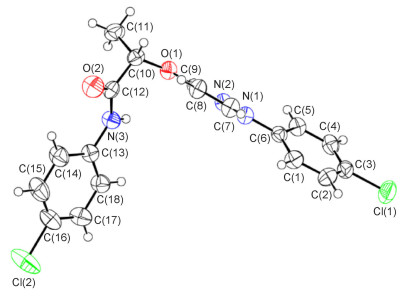
As shown in Scheme 2, twenty-five compounds were synthesized. The synthesized compounds were characterized by 1H NMR, 13C NMR, IR, MS and elemental analyses. All spectral and analytical data were consistent with the assigned structures. The chemical structure of compound 8 was unequivocally determined by single-crystal X-ray crystallography (Figure 1).[25]
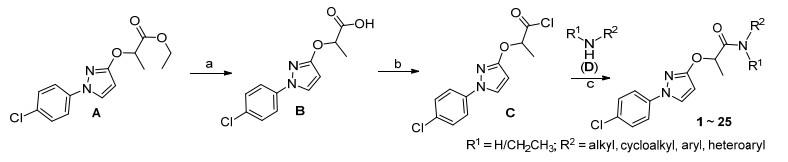
Reaction conditions: (a) NaOH, CH3CH2OH, 60 ℃, 2 h; (b) SOCl2, reflux, 3 h; (c) Et3N/CH2Cl2, r.t., 2 h
Originally, to verify whether phenylpyrazoloxyl propionic acid derivatives designed have fungicidal activity against Rhizoctonia solani or not, some representative alkyl and cycloalkyl amines were employed to synthesize compounds 1~4 (Table 1). Fortunately, all of synthesized compounds showed certain fungicidal activity. These results suggested that the groups linked to nitrogen atom maybe play an important role in the interaction of active molecules with targets. Furthermore, it seemed that a larger cyclic moiety and mono-substituted nitrogen atom will benefit to enhance fungicidal activity.

 下载:
导出CSV
下载:
导出CSV
| Compd. | R1 | R2 | EC50/(mg•L-1) | 95% da |
| 1 | CH2CH3 | CH2CH3 | 21.74 | 17.79~26.56 |
| 2 | H | (CH2)3CH3 | 19.44 | 16.15~23.39 |
| 3 | H | Cyclopropyl | 13.09 | 10.14~16.90 |
| 4 | H | Cyclopentyl | 12.90 | 9.87~16.85 |
| 5 | H | Phenyl | 12.97 | 9.96~16.87 |
| 6 | H | ortho-Chlorophenyl | 17.43 | 13.66~22.23 |
| 7 | H | meta-Chlorophenyl | 47.22 | 24.25~91.97 |
| 8 | H | para-Chlorophenyl | 8.58 | 6.51~11.30 |
| a Confidence limit. | ||||
Then we turned our attention to change R2 when R1 was fixed as H by introducing larger phenyl (Table 1). Compound 5 was synthesized and displayed equal activity to compound 4 (EC50=12.97 mg/L versus 12.90 mg/L), which indicated that phenyl (R2) seems to be helpful for the intact molecule to elaborate its fungicidal activity against Rhizoctonia solani. At the same time, considering a wider modifiable space based on benzene ring than cycloalkyl, using compound 5 as the starting point, our attention was paid to the preparation and evaluation of other analogous around compound 5 by changing substituents on benzene ring.
Firstly, to evaluate the position effect of the substituent on fungicidal activity, compounds 6~8 were synthesized using chlorine atoms as probes. The results indicated that when the single chlorine was attached to ortho-position (compound 6) or meta-position (compound 7), there was no any contribution to the improvement of activity (EC50=17.43 and 47.22 mg/L, respectively). On the contrary, when the single chlorine was located at para-position of phenyl ring (compound 8), we found surprisingly a significant improvement in fungicidal activity (EC50=8.58 mg/L). The result suggested that single substitution at para-position probably has a positive effect on bioactivity. Encouraged by this satisfying finding, we took compound 8 as the lead compound and continued to modify the substituents.
Subsequently, the electronic properties, spatial characteristics, and numbers of substituents were discussed.
Firstly, the single chlorine on para-position was substituted with other halogen atoms (Table 2). Compounds 9, 10 and 11 were synthesized, and they were all much less efficacious with EC50 values ranging from 23.49 mg/L to 19.69 mg/L compared to compound 8, which delivered information that chlorine atom has the best activity among halogens. Secondly, the typical electron-donating groups (CH3 and CH3O for compounds 12 and 13 respectively) were imported, we still did not observe any enhancement (EC50=11.47 and 14.52 mg/L respectively), indicating that the electron-donating groups probably have hardly a positive effect on bioactivity. Then we started to conduct the contrary optimization with typical electron-withdrawing groups, compounds 14, 15, 16 were synthesized, respectively. The bioassay results showed that these three compounds showed very good fungicidal activity with much lower EC50 values, especially compound 16 (EC50=1.34 mg/L), significantly superior to compound 8 and even positive controls. The results implied that the groups with strong electron-withdrawing would be likely to play an important role in bioactivity improvement. Enlightened by this result, we further introduced typical stronger electron-withdrawing group NO2 to para-position of phenyl ring. To our excitement, compound 17 gave a much lower EC50 value of 1.05 mg/L as anticipated, which was comparable to the commercial fungicide tebuconazole (1.02 mg/L). However, the introduction of the bulky moiety C(CH3)3 (compound 18) did not make a greater contribution on bioactivity compared with compound 17.
下载:
导出CSV
 |
|||
| Compd. | Rn | EC50/(mg•L-1) | 95% da |
| 9 | 4-F | 20.50 | 13.61~31.12 |
| 10 | 4-Br | 19.69 | 15.44~25.11 |
| 11 | 4-I | 23.49 | 17.91~30.82 |
| 12 | 4-CH3 | 11.47 | 8.76~15.00 |
| 13 | 4-OCH3 | 14.52 | 8.86~23.81 |
| 14 | 4-COOCH3 | 10.28 | 7.86~13.44 |
| 15 | 4-CN | 3.66 | 2.50~5.33 |
| 16 | 4-CF3 | 1.34 | 0.53~3.37 |
| 17 | 4-NO2 | 1.05 | 0.45~2.45 |
| 18 | 4-C(CH3)3 | 6.48 | 4.08~10.26 |
| 19 | 2, 4-Cl2 | 7.30 | 5.31~10.03 |
| 20 | 3, 4-Cl2 | 0.95 | 0.26~2.39 |
| Tebuconazole | 1.02 | 0.41~2.54 | |
| a Confidence limit. | |||
Finally, to investigate the effect of numbers of substituents on fungicidal activity, we started to introduce one more chlorine atom while holding another at para-position, compounds 19 (Rn=2, 4-Cl2) and 20 (Rn=3, 4-Cl2) were obtained. It is noted that compound 20 possessed a fairly low EC50 of 0.95 mg/L, a little more active than commercial tebuconazole (EC50=1.02 mg/L).
In order to search widely for a valuable lead, the primary structure modification on R2 of heteroaryl groups was unfolded (Table 3). Five compounds 21~25 were obtained by introducing representative pyridinyl or pyridazinyl ring. Among them, compound 22 exhibited an equivalent fungicidal activity to tebuconazole with EC50 of 1.02 mg/L, but it is still slightly inferior to compound 20.
下载:
导出CSV
 |
|||
| Compd. | R2 | EC50/(mg•L-1) | 95% da |
| 21 | 3-Pyridyl | 1.24 | 0.53~2.86 |
| 22 | 2-Pyridyl | 1.02 | 0.38~2.70 |
| 23 | 3-Methylpyridin-2-yl | 5.95 | 4.42~8.01 |
| 24 | 6-Methylpyridin-2-yl | 4.89 | 3.68~6.50 |
| 25 | 6-Chloropyridazin-3-yl | 10.62 | 8.14~13.85 |
| a Confidence limit. | |||
In summary, the preliminary bioassay results showed that some of them exhibited excellent fungicidal activity against Rhizoctonia solani, especially compounds 17 (EC50=1.05 mg/L) and 22 (EC50=1.02 mg/L), which showed close activity to commercial contrasts tebuconazole (EC50=1.02 mg/L), and compound 20 (EC50=0.95 mg/L) is a little more active than tebuconazole (EC50=1.02 mg/L). Further structure optimization studies and field trials of compound 20 are in progress as a promising candidate for further development.
All chemicals such as starting materials and reagents were commercially available (Sinopharm Chemical Reagent Co. Ltd., China) and used without further purification except as indicated. Melting points were determined on a M-569 melting point apparatus (Büchi Labortechnik AG, Switzerland) and were uncorrected. 1H NMR and 13C NMR spectra were recorded with a Mercury 300 MHz spectrometer (Varian, Canada) or a Ultra Shield 600 MHz spectrometer (Bruker BioSpin AG, Switzerland) with deuterochloroform (CDCl3), dimethyl sulfoxide-d6 (DMSO-d6) or acetone-d6 ((CD3)2CO) as the solvent and tetramethylsilane (TMS) as the internal standard. Elemental analyses were determined on an elementar Vario EL cube instrument (Elementar Analysensysteme GmbH, Germany). The mass spectra were acquired with an Agilent 1100 series LC/MSD Trap (Agilent Technologies, America) equipped with electron spray ionization (ESI) source. Infrared spectra (IR) were recorded with an Alpha II infrared spectrometer (Bruker, Germany). X-ray structure determination was recorded with D8 Quest single crystal X-ray diffractometer (Bruker AXS Gmbh, Germany). The isolation of the compounds was conducted by Biotage Isolera Prime flash purification system (Biotage, Sweden).
Compound D was prepared according to the previously reported methods.[26] Briefly, the mixture of ethyl 2-bromopropanoate (11.00, 60.0 mmol), 1-(4-chlorophen- yl)-1H-pyrazol-3-ol (9.93 g, 50.0 mmol) and potassium carbonate (5.60 g, 40.0 mmol) in N, N-dimethylformamide (DMF, 100 mL) was stirred at 100 ℃ for about 5 h. After completion of the reaction (TLC), the reaction mixture was filtered. The filtrate was evaporated to remove DMF in vacuum and the residue was dissolved in ethyl acetate (50 mL). The organic phase was washed with water (20 mL), evaporated, and recrystallized from ethanol, then 12.06 g (81.0% yield) of D was obtained as a white solid. m.p. 77~79 ℃; 1H NMR (300 MHz, CDCl3) δ: 7.69 (d, J=2.7 Hz, 1H, pyrazol-5-H), 7.48 (d, J=8.7 Hz, 2H, 4-Cl-Ph- 2, 6-2H), 7.33 (d, J=8.7 Hz, 2H, 4-Cl-Ph-3, 5-2H), 5.95 (d, J=2.7 Hz, 1H, pyrazol-4-H), 5.14 (q, J=6.9 Hz, 1H, CH), 4.29~4.19 (m, 2H, CH2), 1.63 (d, J=6.9 Hz, 3H, CH3), 1.25 (t, J=7.2 Hz, 3H, CH3); 13C NMR (DMSO-d6, 150 MHz) δ: 171.30, 162.70, 138.31, 129.58, 129.26, 129.12, 118.40, 94.41, 72.55, 60.54, 17.77, 14.02; MS m/z: 295.08 (M+H)+. Anal. calcd for C14H15ClN2O3: C 57.05, H 5.13, N 9.50; found C 57.00, H 5.12, N 9.52.
Aqueous solution of NaOH (36.00 g, 5.0%, 45.0 mmol) was added dropwise over 5 m to a stirred mixture of compound A (8.93 g, 30.0 mmol) in ethanol (99.0%, 20 mL), the reaction mixture was stirred at 60 ℃ for 2 h. After the reaction completed (TLC), the reaction mixture was extracted with toluene (99.0%, 20 mL) and the organic phase was discarded. The water phase was adjusted to pH=3~4 with hydrochloric acid (35.0%, w/w), and then the resulting mixture was extracted with ethyl acetate (98.5%, 150 mL). After evaporation and re-crystallization treatment (from ethanol), 6.88 g (85.2% yield) of B was obtained as a white solid. m.p. 171~172 ℃; 1H NMR ((CD3)2CO, 300 MHz) δ: 8.17 (d, J=2.7 Hz, 1H, pyrazol-5-H), 7.72 (d, J=8.7 Hz, 2H, 4-Cl-Ph-2, 6-2H), 7.45 (d, J=8.7 Hz, 2H, 4-Cl-Ph-3, 5-2H), 5.99 (d, J=2.7 Hz, 1H, pyrazol-4-H), 5.16 (q, J=6.9 Hz, 1H, CH), 1.61 (d, J=6.9 Hz, 3H, CH3); 13C NMR ((CD3)2CO, 75 MHz) δ: 173.07, 164.21, 139.64, 130.48, 130.03, 129.48, 119.32, 95.23, 73.15, 18.32; MS m/z: 267.05 (M+H)+. Anal. calcd for C12H11ClN2O3: C 54.05, H 4.16, N 10.50; found C 53.99, H 4.15, N 10.53.
Under ambient condition, intermediate B (0.67 g, 99.1%, 2.5 mmol) was added to sulfurous dichloride (5.00 g). The reaction mixture was heated to reflux and stirred for 3 h. After the excess sulfurous dichloride was removed in vacuum, 0.71 g of C was obtained as a brown solid, m.p. 44~46 ℃. It can be used directly for next step without further purification.
At room temperature, the substituted amine (D) and intermediate C in a molar ratio of 1:1 were added to dichloromethane. Then the sufficient triethylamine was added cautiously. The reaction mixture was monitored by TLC. After the reaction completed (about 2 h), the mixture was washed with water, dried over anhydrous sodium sulfate and evaporated. The crude product was purified by Biotage flash purification system using mixture of ethyl acetate and petroleum ether (boiling point range 60~90 ℃) as the eluent to obtain corresponding compounds. The yields were not optimized, and each new compound was identified and verified by 1H NMR, 13C NMR, IR, MS and elemental analyses.
2-((1-(4-Chlorophenyl)-1H-pyrazol-3-yl)oxy)-N, N-die-thylpropanamide (1): 77% yield. White solid, m.p. 117~119 ℃; 1H NMR (CDCl3, 300 MHz) δ: 7.67 (d, J=2.7 Hz, 1H, pyrazol-5-H), 7.46 (d, J=9.0 Hz, 2H, 4-Cl-Ph-2, 6- 2H), 7.34 (d, J=9.0 Hz, 2H, 4-Cl-Ph-3, 5-2H), 5.96 (d, J=2.7 Hz, 1H, pyrazol-4-H), 5.40 (q, J=6.9 Hz, 1H, CH), 3.63~3.32 (m, 4H, 2CH2), 1.60 (d, J=6.9 Hz, 3H, CH3), 1.30 (t, J=6.9 Hz, 3H, CH3), 1.12 (t, J=6.9 Hz, 3H, CH3); 13C NMR (DMSO-d6, 150 MHz) δ: 169.44, 162.80, 138.42, 129.53, 129.26, 128.92, 118.36, 94.66, 70.55, 40.99, 39.77, 18.09, 14.33, 12.79; MS m/z: 322.2 (M+ H)+. Anal. calcd for C16H20ClN3O2: C 59.72, H 6.26, N 13.06; found C 59.62, H 6.25, N 13.08.
N-Butyl-2-((1-(4-chlorophenyl)-1H-pyrazol-3-yl)oxy)-propanamide (2): 79% yield. Pale yellow oil. 1H NMR (CDCl3, 300 MHz) δ: 7.74 (d, J=2.7 Hz, 1H, pyrazol-5- H), 7.52 (d, J=9.0 Hz, 2H, 4-Cl-Ph-2, 6-2H), 7.36 (d, J=9.0 Hz, 2H, 4-Cl-Ph-3, 5-2H), 6.49 (s, 1H, NH), 5.95 (d, J=2.7 Hz, 1H, pyrazol-4-H), 5.09 (q, J=6.9 Hz, 1H, CH), 3.32~3.26 (m, 2H, CH2), 1.62 (d, J=6.9 Hz, 3H, CH3), 1.50~1.42 (m, 2H, CH2), 1.32~1.25 (m, 2H, CH2), 0.85 (t, J=6.9 Hz, 3H, CH3); 13C NMR (DMSO-d6, 150 MHz) δ: 170.57, 162.83, 138.40, 129.30, 129.23, 129.02, 118.51, 94.75, 74.52, 37.88, 31.19, 19.34, 18.48, 13.59; MS m/z: 322.1 (M+H)+. Anal. calcd for C16H20ClN3O2: C 59.72, H 6.26, N 13.06; found C 59.68, H 6.25, N 13.09.
2-((1-(4-Chlorophenyl)-1H-pyrazol-3-yl)oxy)-N-cyclo-propylpropanamide (3): 73% yield. White solid, m.p. 141~143 ℃; 1H NMR (CDCl3, 300 MHz) δ: 7.73 (d, J=2.7 Hz, 1H, pyrazol-5-H), 7.52 (d, J=9.3 Hz, 2H, 4-Cl- Ph-2, 6-2H), 7.38 (d, J=9.3 Hz, 2H, 4-Cl-Ph-3, 5-2H), 6.54 (s, 1H, NH), 5.93 (d, J=2.7 Hz, 1H, pyrazol-4-H), 5.07 (q, J=6.9 Hz, 1H, CH), 2.77~2.71 (m, 1H, CH), 1.60 (d, J=6.9 Hz, 3H, CH3), 0.79~0.76 (m, 2H, CH2), 0.51~0.49 (m, 2H, CH2); 13C NMR (DMSO-d6, 150 MHz) δ: 171.86, 162.79, 138.40, 129.33, 129.28, 129.03, 118.46, 94.73, 74.23, 22.19, 18.28, 5.77, 5.46; MS m/z: 306.1 (M+H)+. Anal. calcd for C15H16ClN3O2: C 58.92, H 5.27, N 13.74; found C 58.86, H 5.25, N 13.77.
2-((1-(4-Chlorophenyl)-1H-pyrazol-3-yl)oxy)-N-cyclo-pentylpropanamide (4): 70% yield. Pale yellow oil. 1H NMR (CDCl3, 300 MHz) δ: 7.74 (d, J=2.7 Hz, 1H, pyrazol-5-H), 7.53 (d, J=8.7 Hz, 2H, 4-Cl-Ph-2, 6-2H), 7.37 (d, J=8.7 Hz, 2H, 4-Cl-Ph-3, 5-2H), 6.39 (s, 1H, NH), 5.95 (d, J=2.7 Hz, 1H, pyrazol-4-H), 5.04 (q, J=7.2 Hz, 1H, CH), 4.27~4.20 (m, 1H, CH), 2.02~1.90 (m, 2H, CH2), 1.62~1.59 (m, 7H, CH3; 2CH2), 1.53~1.37 (m, 2H, CH2); 13C NMR (DMSO-d6, 150 MHz) δ: 170.12, 162.84, 138.41, 129.26, 129.23, 129.00, 118.43, 94.69, 74.26, 50.05, 32.22, 32.01, 23.49, 23.47, 18.37; MS m/z: 334.2 (M+H)+. Anal. calcd for C17H20ClN3O2: C 61.17, H 6.04, N 12.59; found C 61.11, H 6.02, N 12.63.
2-((1-(4-Chlorophenyl)-1H-pyrazol-3-yl)oxy)-N-phenyl-propanamide (5): 88% yield. White solid, m.p. 154~156 ℃; 1H NMR (CDCl3, 300 MHz) δ: 8.25 (s, 1H, NH), 7.75 (d, J=2.7 Hz, 1H, pyrazol-5-H), 7.58~7.52 (m, 4H, 4-Cl-Ph-2, 6-2H; Ph-2, 6-2H), 7.39~7.36 (m, 4H; 4-Cl-Ph- 3, 5-2H; Ph-3, 5-2H), 7.33 (t, J=7.2 Hz, 1H, Ph-4-H), 6.02 (d, J=2.7 Hz, 1H; pyrazol-4-H), 5.24 (q, J=6.9 Hz, 1H, CH), 1.72 (d, J=6.9 Hz, 3H, CH3); 13C NMR (DMSO-d6, 150 MHz) δ: 169.77, 162.79, 138.66, 138.35, 129.52, 129.26, 129.06, 128.69, 123.51, 119.57, 118.45, 94.70, 74.51, 18.32; MS m/z: 342.2 (M+H)+. Anal. calcd for C18H16ClN3O2: C 63.25, H 4.72, N 12.29; found C 63.23, H 4.71, N 12.30.
N-(2-Chlorophenyl)-2-((1-(4-chlorophenyl)-1H-pyrazol-3-yl)oxy)propanamide (6): 87% yield. White solid, m.p. 98~100 ℃; 1H NMR (CDCl3, 300 MHz) δ: 8.85 (s, 1H, NH), 8.43 (dd, 3J=8.1 Hz, 4J=1.5 Hz, 1H, 2-Cl-Ph-6-H), 7.74 (d, J=2.4 Hz, 1H, pyrazol-5-H), 7.53 (d, J=9.0 Hz, 2H, 4-Cl-Ph- 2, 6-2H), 7.38~7.25 (m, 4H, 4-Cl-Ph-3, 5-2H; 2-Cl-Ph-3, 5- 2H), 7.03 (ddd, 3J1=7.8, 7.8 Hz, 4J=1.5 Hz, 1H, 2-Cl- Ph-4-H), 6.03 (d, J=2.4 Hz, 1H, pyrazol-4-H), 5.36 (q, J=6.9 Hz, 1H, CH), 1.74 (d, J=6.9 Hz, 3H, CH3); 13C NMR (DMSO-d6, 150 MHz) δ: 170.10, 162.68, 138.33, 134.29, 129.53, 129.45, 129.22, 129.13, 127.47, 126.60, 126.48, 125.82, 118.51, 94.69, 74.33, 18.36; MS m/z: 376.1 (M+H)+. Anal. calcd for C18H15Cl2N3O2: C 57.46, H 4.02, N 11.17; found C 57.39, H 4.01, N 11.20.
N-(3-Chlorophenyl)-2-((1-(4-chlorophenyl)-1H-pyrazol-3-yl)oxy)propanamide (7): 84% yield. White solid, m.p. 117~119 ℃; 1H NMR (CDCl3, 300 MHz) δ: 8.28 (s, 1H, NH), 7.75 (d, J=2.7 Hz, 1H, pyrazol-5-H), 7.70 (dd, 1H, 4J1=1.8, 2.1 Hz, 3-Cl-Ph-2-H), 7.53 (d, J=8.7 Hz, 2H, 4-Cl-Ph-2, 6-2H), 7.42~7.36 (m, 3H, 4-Cl-Ph-3, 5-2H; 3-Cl-Ph-6-H), 7.24 (dd, 3J=8.1, 8.1 Hz, 1H, 3-Cl-Ph-5-H), 7.09 (ddd, 3J=8.1 Hz, 4J=2.1, 0.9 Hz, 1H, 3-Cl-Ph-4- H), 6.01 (d, J=2.7 Hz, 1H, pyrazol-4-H), 5.24 (q, J=6.9 Hz, 1H, CH), 1.71 (d, J=6.9 Hz, 3H, CH3); 13C NMR (DMSO-d6, 150 MHz) δ: 170.23, 162.71, 140.10, 138.32, 133.01, 130.44, 129.59, 129.27, 129.10, 123.25, 119.02, 118.45, 117.95, 94.69, 74.49, 18.23; MS m/z: 376.1 (M+H)+; Anal. calcd for C18H15Cl2N3O2: C 57.46, H 4.02, N 11.17; found C 57.41, H 4.01, N 11.20.
N-(4-Chlorophenyl)-2-((1-(4-chlorophenyl)-1H-pyrazol-3-yl)oxy)propanamide (8): 86% yield. White solid, m.p. 159~161 ℃; 1H NMR (CDCl3, 600 MHz) δ: 8.29 (s, 1H, NH), 7.74 (d, J=2.7 Hz, 1H, pyrazol-5-H), 7.53~7.51 (m, 4H, 4-Cl-Ph-2, 6-2H; 4-Cl-Ph-2, 6-2H), 7.37 (d, J=8.7 Hz, 2H, 4-Cl-Ph-3, 5-2H), 7.28 (d, J=8.7 Hz, 2H, 4-Cl-Ph- 3, 5-2H), 6.00 (d, J=2.7 Hz, 1H, pyrazol-4-H), 5.23 (q, J=6.9 Hz, 1H, CH), 1.70 (d, J=6.9 Hz, 3H, CH3); 13C NMR (CDCl3, 150 MHz) δ: 169.88, 162.59, 138.39, 135.92, 131.31, 129.68, 129.58, 129.13, 128.23, 121.33, 119.11, 94.65, 76.23, 18.37; MS m/z: 376.1 (M+H)+. Anal. calcd for C18H15Cl2N3O2: C 57.46, H 4.02, N 11.17; found C 57.40, H 4.01, N 11.19.
2-((1-(4-Chlorophenyl)-1H-pyrazol-3-yl)oxy)-N-(4-fluo-rophenyl)propanamide (9): 83% yield. White solid, m.p. 146~148 ℃; 1H NMR (CDCl3, 300 MHz) δ: 8.24 (s, 1H, NH), 7.76 (d, J=2.4 Hz, 1H, pyrazol-5-H), 7.55~7.50 (m, 4H, 4-Cl-Ph-2, 6-2H; 4-F-Ph-2, 6-2H), 7.40 (d, J=9.0 Hz, 2H, 4-Cl-Ph-3, 5-2H), 7.02 (t, J=8.7 Hz, 2H, 4-F-Ph- 3, 5-2H), 6.01 (d, J=2.4 Hz, 1H, pyrazol-4-H), 5.24 (q, J=6.6 Hz, 1H, CH), 1.71 (d, J=6.6 Hz, 3H, CH3); 13C NMR (DMSO-d6, 150 MHz) δ: 169.72, 162.76, 158.14 (d, 1J=238.50 Hz, F-C), 138.34, 135.02 (d, 4J=2.25 Hz, F-C), 129.53, 129.27, 129.08, 121.39 (d, 3J=7.65 Hz, F-C), 118.45, 115.26 (d, 2J=22.50 Hz, F-C), 94.70, 74.53, 18.30. MS m/z: 360.1 (M+H)+. Anal. calcd for C18H15- ClFN3O2: C 60.09, H 4.20, N 11.68; found C 60.03, H 4.20, N 11.70.
N-(4-Bromophenyl)-2-((1-(4-chlorophenyl)-1H-pyrazol-3-yl)oxy)propanamide (10): 80% yield. White solid, m.p. 157~159 ℃; 1H NMR (CDCl3, 300 MHz) δ: 8.28 (s, 1H, NH), 7.75 (d, J=2.7 Hz, 1H, pyrazol-5-H), 7.52 (d, J=9.0 Hz, 2H, 4-Cl-Ph-2, 6-2H), 7.45 (m, 4H, 4-Br-Ph-2, 6-2H; 4-Br-Ph-3, 5-2H), 7.37 (d, J=9.0 Hz, 2H, 4-Cl-Ph-3, 5-2H), 6.01 (d, J=2.7 Hz, 1H, pyrazol-4-H), 5.24 (q, J=6.9 Hz, 1H, CH), 1.70 (d, J=6.9 Hz, 3H, CH3); 13C NMR (DMSO-d6, 150 MHz) δ: 169.98, 162.72, 138.32, 138.02, 131.52, 129.56, 129.28, 129.09, 121.51, 118.44, 115.16, 94.69, 74.51, 18.24; MS m/z: 420.0 (M+H)+. Anal. calcd for C18H15BrClN3O2: C 51.39, H 3.59, N 9.99; found C 51.34, H 3.58, N 10.01.
2-((1-(4-Chlorophenyl)-1H-pyrazol-3-yl)oxy)-N-(4-io-dophenyl)propanamide (11): 84% yield. White solid, m.p. 162~164 ℃; 1H NMR (CDCl3, 300 MHz) δ: 8.26 (s, 1H, NH), 7.75 (d, J=2.7 Hz, 1H, pyrazol-5-H), 7.62 (d, J=9.0 Hz, 2H, 4-I-Ph-3, 5-2H), 7.52 (d, J=9.0 Hz, 2H, 4-Cl- Ph-2, 6-2H), 7.38 (d, J=9.0 Hz, 2H, 4-Cl-Ph-3, 5-2H), 7.36 (d, J=9.0 Hz, 2H, 4-I-Ph-2, 6-2H), 6.01 (d, J=2.7 Hz, 1H, pyrazol-4-H), 5.23 (q, J=6.6 Hz, 1H, CH), 1.70 (d, J=6.6 Hz, 3H, CH3); 13C NMR (DMSO-d6, 150 MHz) δ: 169.97, 162.72, 138.49, 138.32, 137.35, 129.56, 129.28, 129.08, 121.77, 118.43, 94.68, 87.11, 74.52, 18.24; MS m/z: 468.0 (M+H)+. Anal. calcd for C18H15ClIN3O2: C 46.23, H 3.23, N 8.98; found 46.19, H 3.22, N 9.00.
2-((1-(4-Chlorophenyl)-1H-pyrazol-3-yl)oxy)-N-(p-tol-yl)propanamide (12): 88% yield. White solid, m.p. 132~134 ℃; 1H NMR (CDCl3, 300 MHz) δ: 8.18 (s, 1H, NH), 7.74 (d, J=2.7 Hz, 1H, pyrazol-5-H), 7.53 (d, J=8.7 Hz, 2H, 4-Cl-Ph-2, 6-2H), 7.44 (d, J=8.4 Hz, 2H, 4-CH3-Ph- 2, 6-2H), 7.39 (d, J=8.7 Hz, 2H, 4-Cl-Ph-3, 5-2H), 7.19 (d, J=8.4 Hz, 2H, 4-CH3-Ph-3, 5-2H), 6.00 (d, J=2.7 Hz, 1H, pyrazol-4-H), 5.22 (q, J=6.9 Hz, 1H, CH), 2.30 (s, 3H, CH3), 1.71 (d, J=6.9 Hz, 3H, CH3); 13C NMR (DMSO-d6, 150 MHz) δ: 169.52, 162.80, 138.36, 136.14, 132.44, 129.46, 129.24, 129.06, 129.04, 119.62, 118.45, 94.70, 74.53, 20.42, 18.33; MS m/z: 356.1 (M+H)+. Anal. calcd for C19H18ClN3O2: C 64.14, H 5.10, N 11.81; found C 64.10, H 5.09, N 11.84.
2-((1-(4-Chlorophenyl)-1H-pyrazol-3-yl)oxy)-N-(4-me-thoxyphenyl)propanamide (13): 79% yield. White solid, m.p. 145~147 ℃; 1H NMR (CDCl3, 300 MHz) δ: 8.15 (s, 1H, NH), 7.75 (d, J=2.7 Hz, 1H, pyrazol-5-H), 7.54 (d, J=9.0 Hz, 2H, 4-Cl-Ph-2, 6-2H), 7.46 (d, J=9.0 Hz, 2H, 4-CH3O-Ph-2, 6-2H), 7.38 (d, J=9.0 Hz, 2H, 4-Cl-Ph-3, 5- 2H), 6.87 (d, J=9.0 Hz, 2H, 4-CH3O-Ph-3, 5-2H), 6.01 (d, J=2.7 Hz, 1H, pyrazol-4-H), 5.23 (q, J=6.9 Hz, 1H, CH), 3.79 (s, 3H, CH3), 1.71 (d, J=6.9 Hz, 3H, CH3); 13C NMR (DMSO-d6, 150 MHz) δ: 169.24, 162.80, 155.40, 138.37, 131.72, 129.48, 129.27, 129.05, 121.16, 118.46, 113.80, 94.72, 74.5, 55.15, 18.34; MS m/z: 372.2 (M+H)+. Anal. calcd for C19H18ClN3O3: C 61.38, H 4.88, N 11.30; found C 61.33, H 4.88, N 11.32.
Methyl 4-(2-((1-(4-chlorophenyl)-1H-pyrazol-3-yl)oxy)- propanamido)benzoate (14): 85% yield. White solid, m.p. 130~132 ℃; 1H NMR (CDCl3, 300 MHz) δ: 8.43 (s, 1H, NH), 8.02 (d, J=8.7 Hz, 2H, 4-CH3OOC-Ph-3, 5-2H), 7.76 (d, J=2.4 Hz, 1H, pyrazol-5-H), 7.66 (d, J=8.7 Hz, 2H, 4-CH3OOC-Ph-2, 6-2H), 7.53 (d, J=8.7 Hz, 2H, 4-Cl-Ph- 2, 6-2H), 7.38 (d, J=8.7 Hz, 2H, 4-Cl-Ph-3, 5-2H), 6.02 (d, J=2.4 Hz, 1H, pyrazol-4-H), 5.27 (q, J=6.9 Hz, 1H, CH), 3.90 (s, 3H, CH3), 1.72 (d, J=6.9 Hz, 3H, CH3); 13C NMR (DMSO-d6, 150 MHz) δ: 170.44, 165.78, 162.71, 143.08, 138.31, 130.25, 129.61, 129.28, 129.09, 124.24, 118.96, 118.43, 94.67, 74.46, 51.90, 18.23; MS m/z: 400.2 (M+ H)+. Anal. calcd for C20H18ClN3O4: C 60.08, H 4.54, N 10.51; found C 60.05, H 4.53, N 10.52.
2-((1-(4-Chlorophenyl)-1H-pyrazol-3-yl)oxy)-N-(4-cya-nophenyl)propanamide (15): 81% yield. White solid, m.p. 155~157 ℃; 1H NMR (CDCl3, 300 MHz) δ: 8.51 (s, 1H, NH), 7.76 (d, J=2.7 Hz, 1H, pyrazol-5-H), 7.72 (d, J=9.0 Hz, 2H, 4-CN-Ph-2, 6-2H), 7.52 (d, J=9.0 Hz, 2H, 4-Cl- Ph-2, 6-2H), 7.45 (d, J=9.0 Hz, 2H, 4-CN-Ph-3, 5-2H), 7.38 (d, J=9.0 Hz, 2H, 4-Cl-Ph-3, 5-2H), 6.02 (d, J=2.7 Hz, 1H, pyrazol-4-H), 5.27 (q, J=6.9 Hz, 1H, CH), 1.71 (d, J=6.9 Hz, 3H, CH3); 13C NMR (DMSO-d6, 150 MHz) δ: 170.69, 162.67, 142.90, 138.29, 133.25, 129.62, 129.26, 129.13, 119.56, 118.98, 118.43, 105.34, 94.65, 74.50, 18.17; MS m/z: 367.1 (M+H)+. Anal. calcd for C19H15- ClN4O2: C 62.22, H 4.12, N 15.27; found C 62.15, H 4.11, N 15.30.
2-((1-(4-Chlorophenyl)-1H-pyrazol-3-yl)oxy)-N-(4-(tri-fluoromethyl)phenyl)propanamide (16): 79% yield. White solid, m.p. 153~155 ℃; 1H NMR (CDCl3, 300 MHz) δ: 8.44 (s, 1H, NH), 7.76 (d, J=2.7 Hz, 1H, pyrazol-5-H), 7.71 (d, J=8.4 Hz, 2H, 4-CF3-Ph-3, 5-2H), 7.58 (d, J=8.4 Hz, 2H, 4-CF3-Ph- 2, 6-2H), 7.53 (d, J=8.7 Hz, 2H, 4-Cl-Ph-2, 6-2H), 7.37 (d, J=8.7 Hz, 2H, 4-Cl-Ph-3, 5-2H), 6.03 (d, J=2.7 Hz, 1H, pyrazol-4-H), 5.27 (q, J=6.9 Hz, 1H, CH), 1.72 (d, J=6.9 Hz, 3H, CH3); 13C NMR (DMSO-d6, 150 MHz) δ: 170.52, 162.72, 142.27, 138.32, 129.58, 129.25, 129.13, 126.06 (q, 3J=3.7 Hz, F-C), 123.61 (q, 2J=31.8 Hz, F-C), 124.33 (q, 1J=269.70 Hz, F-C), 119.50, 118.44, 94.67, 74.52, 18.22; MS m/z: 410.1 (M+H)+. Anal. calcd for C19H15ClF3N3O2: C 55.69, H 3.69, N 10.25; found C 55.65, H 3.70, N 10.25.
2-((1-(4-Chlorophenyl)-1H-pyrazol-3-yl)oxy)-N-(4-nit-rophenyl)propanamide (17): 87% yield. White solid, m.p. 152~154 ℃; 1H NMR (CDCl3, 300 MHz) δ: 8.62 (s, 1H, NH), 8.21 (d, J=9.3 Hz, 2H, 4-NO2-Ph-3, 5-2H), 7.76 (d, J=3.0 Hz, 1H, pyrazol-5-H), 7.77 (d, J=9.3 Hz, 2H, 4-NO2-Ph-2, 6-2H), 7.51 (d, J=8.7 Hz, 2H, 4-Cl-Ph-2, 6- 2H), 7.40 (d, J=8.7 Hz, 2H, 4-Cl-Ph-3, 5-2H), 6.03 (d, J=3.0 Hz, 1H, pyrazol-4-H), 5.29 (q, J=6.9 Hz, 1H, CH), 1.72 (d, J=6.9 Hz, 3H, CH3); 13C NMR (DMSO-d6, 150 MHz) δ: 170.86, 162.65, 144.85, 142.45, 138.29, 129.67, 129.28, 129.12, 124.94, 119.26, 118.42, 94.65, 74.49, 18.14; IR ν: 3368, 3119, 3050, 2998, 2942, 1696, 1532, 1510, 1335, 1532, 1385, 1092, 824, 743 cm-1; MS m/z: 387.1 (M+H)+. Anal. calcd for C18H15ClN4O4: C 55.90, H 3.91, N 14.49; found C 55.82, H 3.90, N 14.47.
N-(4-(tert-Butyl)phenyl)-2-((1-(4-chlorophenyl)-1H-py-razol-3-yl)oxy)propanamide (18): 78% yield. White solid, m.p. 154~156 ℃; 1H NMR (CDCl3, 300 MHz) δ: 8.19 (s, 1H, NH), 7.75 (d, J=2.7 Hz, 1H, pyrazol-5-H), 7.54 (d, J=9.0 Hz, 2H, 4-Cl-Ph-2, 6-2H), 7.48 (d, J=9.0 Hz, 2H, 4-(CH3)3CPh-2, 6-2H), 7.38 (d, J=9.0 Hz, 2H, 4-Cl-Ph- 3, 5-2H), 7.34 (d, J=9.0 Hz, 2H, 4-(CH3)3C-Ph-3, 5-2H), 6.01 (d, J=2.7 Hz, 1H, pyrazol-4-H), 5.22 (q, J=6.6 Hz, 1H, CH), 1.71 (d, J=6.6 Hz, 3H, CH3), 1.29 (s, 9H, 3CH3); 13C NMR (DMSO-d6, 150 MHz) δ: 169.57, 162.81, 145.86, 138.36, 136.08, 129.47, 129.26, 129.05, 125.27, 119.39, 118.46, 94.70, 74.51, 33.99, 31.16, 18.36; MS m/z: 398.1 (M+ H)+. Anal. calcd for C22H24ClN3O2: C 66.41, H 6.08, N 10.56; found C 66.35, H 6.08, N 10.57.
2-((1-(4-Chlorophenyl)-1H-pyrazol-3-yl)oxy)-N-(2, 4-di-chlorophenyl)propanamide (19): 82% yield. White solid, m.p. 141~143 ℃; 1H NMR (CDCl3, 300 MHz) δ: 8.82 (s, 1H, NH), 8.41 (d, J=8.7 Hz, 1H, 2, 4-2Cl-Ph-6-H), 7.75 (d, J=2.7 Hz, 1H, pyrazol-5-H), 7.52 (d, J=8.7 Hz, 2H, 4-Cl-Ph-2, 6-2H), 7.37 (d, J=8.7 Hz, 2H, 4-Cl-Ph-3, 5-2H), 7.36 (d, J=2.1 Hz, 1H, 2, 4-2Cl-Ph-3-H), 7.26 (dd, 3J=9.0 Hz, 4J=2.1 Hz, 1H, 2, 4-2Cl-Ph-5-H); 6.02 (d, J=2.7 Hz, 1H, pyrazol-4-H), 5.36 (q, J=6.9 Hz, 1H, CH), 1.73 (d, J=6.9 Hz, 3H, CH3); 13C NMR (DMSO-d6, 150 MHz) δ: 170.27, 163.03, 138.72, 133.90, 130.13, 129.98, 129.65, 129.50, 129.35, 128.17, 128.03, 127.55, 118.88, 95.08, 74.59, 18.71; MS m/z: 410.1 (M+H)+. Anal. calcd for C18H14Cl3N3O2: C 52.64, H 3.44, N 10.23; found C 52.60, H 3.44, N 10.24.
2-((1-(4-Chlorophenyl)-1H-pyrazol-3-yl)oxy)-N-(3, 4-di-chlorophenyl)propanamide (20): 54% yield. White solid, m.p. 225~227 ℃; 1H NMR (CDCl3, 300 MHz) δ: 7.73 (d, J=2.7 Hz, 1H, pyrazol-5-H), 7.51 (d, J=8.7 Hz, 2H, 4-Cl-Ph-2, 6-2H), 7.39 (d, J=8.7 Hz, 1H, 3, 4-2Cl-Ph-5-H), 7.36 (d, J=8.7 Hz, 2H, 4-Cl-Ph-3, 5-2H), 7.21 (d, J=2.7 Hz, 1H, 3, 4-2Cl-Ph-2-H), 6.94 (dd, 3J=8.7 Hz, 4J=2.7 Hz, 1H, 3, 4-2Cl-Ph-6-H), 5.99 (d, J=2.7 Hz, 1H, pyrazol- 4-H), 5.31 (q, J=6.9 Hz, 1H, CH), 1.78 (d, J=6.9 Hz, 3H, CH3); 13C NMR (DMSO-d6, 150 MHz) δ: 170.01, 162.56, 149.07, 138.25, 131.65, 131.38, 130.02, 129.43, 129.31, 128.80, 123.90, 122.23, 118.50, 94.49, 72.59, 17.58; IR ν: 3233, 3103, 2982, 2930, 1677, 1587, 1541, 1495, 1474, 1386, 1093, 829, 815, 713 cm-1; MS m/z: 410.1 (M+H)+. Anal. calcd for C18H14Cl3N3O2: C 52.64, H 3.44, N 10.23; found C 52.57, H 3.43, N 10.22.
2-((1-(4-Chlorophenyl)-1H-pyrazol-3-yl)oxy)-N-(pyri-din-3-yl)propanamide (21): 70% yield. White solid, m.p. 133~135 ℃; 1H NMR (CDCl3, 300 MHz) δ: 8.61 (d, J=2.4 Hz, 1H, 3-pyridyl-2-H), 8.42 (s, 1H, NH), 8.37 (dd, 3J=4.8 Hz, 4J=1.5 Hz, 1H, 3-pyridyl-6-H), 8.22 (ddd, 3J=8.4 Hz, 4J=2.4, 1.5 Hz, 1H, 3-pyridyl-4-H), 7.76 (d, J=2.7 Hz, 1H, pyrazol-5-H), 7.53 (d, J=9.3 Hz, 2H, 4-Cl-Ph-2, 6-2H), 7.38 (d, J=9.3 Hz, 2H, 4-Cl-Ph-3, 5-2H), 7.28 (dd, 3J=8.4, 4.8 Hz, 1H, 3-pyridyl-5-H), 6.02 (d, J=2.7 Hz, 1H, pyrazol-4-H), 5.28 (q, J=6.9 Hz, 1H, CH), 1.72 (d, J=6.9 Hz, 3H, CH3); 13C NMR (DMSO-d6, 150 MHz) δ: 170.45, 162.71, 144.53, 141.24, 138.33, 135.31, 129.60, 129.29, 129.11, 126.60, 123.61, 118.45, 94.70, 74.47, 18.24; IR ν: 3247, 3185, 3125, 3072, 2984, 2936, 1672, 1599, 1539, 1499, 1475, 1375, 1269, 1092, 832, 749, 706 cm-1; MS m/z: 343.1 (M+H)+. Anal. calcd for C17H15- ClN4O2: C 59.57, H 4.41, N 16.35; found C 59.49, H 4.40, N 16.34.
2-((1-(4-Chlorophenyl)-1H-pyrazol-3-yl)oxy)-N-(pyri-din-2-yl)propanamide (22): 69% yield. Pale yellow oil. 1H NMR (CDCl3, 300 MHz) δ: 8.88 (s, 1H, NH), 8.29~8.26 (m, 2H, 2-pyridyl-3, 6-2H), 7.75~7.69 (m, 2H, 2-pyridyl- 4-H; pyrazol-5-H), 7.52 (d, J=9.0 Hz, 2H, 4-Cl-Ph-2, 6- 2H), 7.36 (d, J=9.0 Hz, 2H, 4-Cl-Ph-3, 5-2H), 7.08~7.03 (m, 1H, 2-pyridyl-5-H), 6.00 (d, J=2.7 Hz, 1H, pyrazol- 4-H), 5.33 (q, J=6.6 Hz, 1H, CH), 1.72 (d, J=6.6 Hz, 3H, CH3); 13C NMR (150 MHz, DMSO-d6) δ: 170.62, 162.77, 151.62, 148.07, 138.34, 138.25, 129.56, 129.22, 129.05, 119.70, 118.44, 113.64, 94.57, 73.86, 18.34; IR ν: 3399, 3123, 3076, 2984, 2935, 1692, 1595, 1577, 1541, 1516, 1500, 1470, 1387, 1295, 1091, 825, 776, 739 cm-1; MS m/z: 343.2 (M+H)+. Anal. calcd for C17H15ClN4O2: C 59.57, H 4.41, N 16.35; found C 59.50, H 4.40, N 16.39.
2-((1-(4-Chlorophenyl)-1H-pyrazol-3-yl)oxy)-N-(3-met-hylpyridin-2-yl)propanamide (23): 74% yield. White solid, m.p. 136~138 ℃; 1H NMR (CDCl3, 300 MHz) δ: 8.51 (s, 1H, NH), 8.29 (dd, 3J=4.8 Hz, 4J=1.2 Hz, 1H, 3-methyl- pyridin-2-yl-6-H), 7.75 (d, J=2.7 Hz, 1H, pyrazol-5-H), 7.56~7.53 (m, 3H, 4-Cl-Ph-2, 6-2H, 3-methylpyridin- 2-yl-4-H), 7.37 (d, J=9.0 Hz, 2H, 4-Cl-Ph-3, 5-2H), 7.11 (dd, 3J=7.8, 4.8 Hz, 1H, 3-methylpyridin-2-yl-5-H), 6.00 (d, J=2.7 Hz, 1H, pyrazol-4-H), 5.32 (q, 6.9 Hz, 1H, CH), 2.21 (s, 3H, CH3), 1.75 (d, J=6.9 Hz, 3H, CH3); MS m/z: 357.2 (M+H)+; 13C NMR (150 MHz, DMSO-d6) δ: 170.02, 162.81, 162.81, 149.53, 145.86, 139.26, 138.37, 129.42, 129.21, 129.03, 121.95, 118.58, 94.73, 73.95, 18.47, 17.35; MS m/z: 357.2 (M+H)+. Anal. calcd for C18H17ClN4O2: C 60.59, H 4.80, N 15.70; found C 60.50, H 4.79, N 15.69.
2-((1-(4-Chlorophenyl)-1H-pyrazol-3-yl)oxy)-N-(6-met-hylpyridin-2-yl)propanamide (24): 77% yield. Pale yellow oil. 1H NMR (CDCl3, 300 MHz) δ: 8.83 (s, 1H, NH), 8.08 (d, J=7.5 Hz, 1H, 6-methylpyridin-2-yl-3-H), 7.72 (d, J=2.4 Hz, 1H, pyrazol-5-H), 7.60 (dd, 3J=7.5, 7.5 Hz, 1H, 6- methylpyridin-2-yl-4-H), 7.53 (d, J=8.7 Hz, 2H, 4-Cl-Ph- 2, 6-2H), 7.35 (d, J=8.7 Hz, 2H, 4-Cl-Ph-3, 5-2H), 6.91 (d, J=7.5 Hz, 1H, 6-methylpyridin-2-yl-5-H), 6.01 (d, J=2.4 Hz, 1H, pyrazol-4-H), 5.30 (q, J=6.9 Hz, 1H, CH), 2.46 (s, 3H, CH3), 1.71 (d, J=6.9 Hz, 3H, CH3); 13C NMR (DMSO-d6, 150 MHz) δ: 170.50, 162.79, 156.59, 150.95, 138.52, 138.34, 129.50, 129.19, 129.04, 118.87, 118.46, 110.50, 94.54, 73.85, 23.55, 18.37; MS m/z: 357.2 (M+ H)+. Anal. calcd for C18H17ClN4O2: C 60.59, H 4.80, N 15.70; found C 60.52, H 4.78 N 15.72.
2-((1-(4-Chlorophenyl)-1H-pyrazol-3-yl)oxy)-N-(6-ch-loropyridazin-3-yl)propanamide (25): 76% yield. White solid, m.p. 149~151 ℃; 1H NMR (CDCl3, 300 MHz) δ: 9.38 (s, 1H, NH), 8.56 (d, J=9.3 Hz, 1H, 6-chloro- pyridazin-3-yl-4-H), 7.74 (d, J=2.7 Hz, 1H, pyrazol-5-H), 7.52~7.50 (m, 3H, 4-Cl-Ph-2, 6-2H; 6-chloropyridazin- 3-yl-5-H), 7.37 (d, J=8.7 Hz, 2H, 4-Cl-Ph-3, 5-2H), 6.03 (d, J=2.7 Hz, 1H, pyrazol-4-H), 5.38 (q, J=6.9 Hz, 1H, CH), 1.73 (d, J=6.9 Hz, 3H, CH3); 13C NMR (DMSO-d6, 150 MHz) δ: 171.70, 16.66, 154.97, 151.35, 138.29, 130.31, 129.67, 129.25, 129.07, 121.59, 118.40, 94.54, 73.69, 18.19; MS m/z: 378.1 (M+H)+. Anal. calcd for C16H13Cl2N5O2: C 50.81, H 3.46, N 18.52; found, C 50.75, H 3.45, N 18.54.
The antifungal activities in vitro of all the synthesized compounds against Rhizoctonia solani Kühn were conducted by the mycelium linear growth rate method as previously reported.[27~29] The details are as follows: each of the tested compounds (30 mg) was completely dissolved in 30 mL of acetone/methanol (V:V=1:1), appropriate water containing 0.1% Tween 80 was then added to generate the stock solution. At the same time, the same volume of acetone/methanol (V:V=1:1) was diluted by water containing 0.1% Tween 80 as blank control. 1 mL of the resulting solution was added to 14 mL of melted PDA agar at 45~50 ℃. After quickly and completely mixing, the above mixture was poured into a Petri dish in a laminar flow chamber. The final concentration of the test compound in the culture medium was 100, 50, 25, 12.5, 6.25 and 3.125 mg/L. When the medium in the plate was partially solidified, a 5 mm thick and 5 mm diameter disc of fungus (Rhizoctonia solani Kühn) cut from sub-cultured Petri dishes ahead of time was placed at the center of the semisolid medium. The dishes were kept in an incubator at (25±1) ℃ for 5~7 d (taking full growth of bacteria as standard). Each experiment was carried out in triplicate. The diameters (in mm) of inhibition zones were measured with cross-bonded methods, and the growth inhibition rates were calculated according to the following formula:
Inhibition rate (%)=[(dc-d0)-(ds-d0)]/(dc-d0)×100%
Wherein: d0 is the diameter of the fungus cut, dc is the diameter of a fungal colony in the blank test, and ds is the diameter of a fungal colony in the compound-treated test.
The EC50 values were calculated by Duncan's new multiple range method using DPS version 14.5. The test results of the fungicidal activities of compounds 1~25 are listed in Tables 1~3.
Supporting Information 1H NMR, 13C NMR, IR and MS spectra for the synthesized compounds. The Supporting Information is available free of charge via the Internet at http://sioc-journal.cn.
顾安乐, 柏亚罗, 现代农药, 2018, 17, 1. http://www.cqvip.com/Main/Detail.aspx?id=10533429
虞国平, 硕士论文, 中国农业科学院, 北京, 2009.Yu, G. P. M.S. Thesis, Chinese Academy of Agricultural Sciences, Beijing, 2009(in Chinese).
公婷婷, 博士论文, 中央民族大学, 北京, 2017.Gong, T. T. Ph.D. Dissertation, Minzu University of China, Beijing, 2017(in Chinese).
王建国, 陈寒松, 赵卫光, 马翼, 李正名, 韩玉芬, 有机化学, 2002, 22, 2043.Wang, J. G.; Chen, H. S.; Zhao, W. G.; Ma, Y.; Li, Z. M.; Han, Y. F. Chin. J. Org. Chem. 2002, 22, 2043(in Chinese).
孟琳, 硕士论文, 南京农业大学, 南京, 2013.Meng, L. M. S. Thesis, Nanjing Agricultural University, Nanjing, 2013(in Chinese).
桂文信, 安徽农学通报, 2012, 18, 109. http://www.wanfangdata.com.cn/details/detail.do?_type=perio&id=ahnxtb201219054Gui, W. X. Anhui Agric. Sci. Bull. 2012, 18, 109(in Chinese). http://www.wanfangdata.com.cn/details/detail.do?_type=perio&id=ahnxtb201219054
冷鹏, 袁蕾, 魏萍, 陆书桥, 张绪芬, 安徽农学通报, 2012, 18, 92.Leng, P.; Yuan, L.; Wei, P.; Lu. S. Q.; Zhang, X. F. Anhui Agric. Sci. Bull. 2012, 18, 92(in Chinese).
马海军, 曹庆亮, 马亚芳, 倪珏萍, 农药, 2013, 52, 408. http://www.cqvip.com/QK/92314X/201306/45982891.htmlMa, H. J.; Cao, Q. L.; Ma, Y. F.; Ni, J. P. Chin. J. Pestic. 2013, 52, 408(in Chinese). http://www.cqvip.com/QK/92314X/201306/45982891.html
孙雪, 硕士论文, 吉林农业大学, 长春, 2015.Sun, X. M.S. Thesis, Jilin Agricultural University, Changchun, 2015(in Chinese).
汪青松, 李俐杰, 蔡真瑜, 叶光武, 世界农药, 2017, 39, 55.Wang, Q. S.; Li, L. J.; Cai, Z. Y. Ye, G. W. World Pestic. 2017, 39, 55(in Chinese).
孟叶挺, 安徽农学通报, 2015, 21(16), 74. doi: 10.3969/j.issn.1007-7731.2015.16.036Meng, Y. T. Anhui Agri. Sci. Bull. 2015, 21(16), 74(in Chinese). doi: 10.3969/j.issn.1007-7731.2015.16.036
Guan, A. Y.; Liu, C. L.; Chen, W.; Yang, F.; Xie, Y.; Zhang, J. B.; Li, Z. N.; Wang, M. A. J. Agric. Food Chem. 2017, 65, 1272. doi: 10.1021/acs.jafc.6b05580
Moon, J. K.; Keum, Y. S.; Hwang, E. C.; Park, B. S.; Chang, H. R.; Li, Q. X.; Kim, J. H. J. Agric. Food Chem. 2007, 55, 5416. doi: 10.1021/jf070358f
曾仲武, 姜雅君, 农药, 2004, 43, 327. doi: 10.3969/j.issn.1006-0413.2004.07.014Zeng, Z. W.; Jiang, Y. J. Chin. J. Pestic. 2004, 43, 327(in Chinese). doi: 10.3969/j.issn.1006-0413.2004.07.014
MacBean, C. The Pesticide Manual, 16th ed., BCPC, Alton, UK, 2012, p. 264. http://agris.fao.org/agris-search/search.do?recordID=XF2015042613
Zhu, G. L.; Yao, R. S.; Zhu, H. X.; Wang, H. Biotechnol. Lett. 2012, 34, 709. doi: 10.1007/s10529-011-0820-4
杨子辉, 陈爱羽, 胡艾希, 叶姣, 有机化学, 2017, 37, 149. http://sioc-journal.cn/Jwk_yjhx/CN/abstract/abstract345718.shtmlYang, Z. H.; Chen, A. Y.; Hu, A. X.; Ye, J. Chin. J. Org. Chem. 2017, 37, 149(in Chinese). http://sioc-journal.cn/Jwk_yjhx/CN/abstract/abstract345718.shtml
Hemmi, S.; Usui, S.; Hatamoto, M.; Fukuchi, T. WO 2017213137, 2017[Chem. Abstr. 2017, 168, 76494]. doi: 10.1186/1742-2094-5-53
Liu, C. L.; Zhou, Y. P.; Li, Z. N.; Liu, Y. X.; Zhang, H. CN 101747263, 2010[Chem. Abstr. 2010, 153, 145329].
Huang, Z. Q.; Feng, C. P.; Shi, J.; Lv, L. J.; Bu, L. X.; Yang, R. J.; Wang, Y. H. CN 106632083, 2017[Chem. Abstr. 2017, 167, 31057]. http://med.wanfangdata.com.cn/Paper/Detail/PeriodicalPaper_PM12138181
MacBean, C. The Pesticide Manual, 16th ed., BCPC, Alton, UK, 2012, p. 963. http://www.sciencedirect.com/science/article/pii/S0261219496900009
刘长令, 农药, 2011, 50, 20. http://www.cqvip.com/QK/88779X/201407/50311862.htmlLiu, C. L. Chin. J. Pestic. 2011, 50, 20(in Chinese). http://www.cqvip.com/QK/88779X/201407/50311862.html
Guan, A. Y.; Liu, C. L.; Yang, X. P.; Dekeyser, M. Chem. Rev. 2014, 114, 7079. doi: 10.1021/cr4005605
Liu, C. L.; Guan, A. Y.; Yang, J. D.; Chai, B. S.; Li, M.; Li, H. C.; Yang, J. C.; Xie, Y. J. Agric. Food Chem. 2016, 64, 45. doi: 10.1021/jf5054707
The atomic coordinates for compound 8 have been deposited at the Cambridge Crystallographic Data Centre. CCDC ID: 1537182 contain the supplementary crystallographic data for this Article. These data can be obtained free of charge from The Cambridge Crystallographic Data Centre via www.ccdc.cam.ac.uk/data_re-quest/cif).
Yu, F. Q.; Guan, A. Y.; Li, M. R.; Hu, L.; Li, X. W. Chin. Chem. Lett. 2018, 29, 915. doi: 10.1016/j.cclet.2018.01.050
Yang, R.; Gao, Z. F.; Zhao, J. Y.; Li, W. B.; Zhou, L.; Miao, F. J. Agric. Food Chem. 2015, 63, 1906. doi: 10.1021/jf505609z
刘阳, 刘明, 陈明桂, 吴长春, 华学文, 周莎, 王宝雷, 李正名, 有机化学, 2017, 37, 403. http://sioc-journal.cn/Jwk_yjhx/CN/abstract/abstract345771.shtmlLiu, Y.; Liu, M.; Chen, M. G.; Wu, C. C.; Hua, X. W.; Zhou, S.; Wang, B. L.; Li, Z. M. Chin. J. Org. Chem. 2017, 37, 403(in Chinese). http://sioc-journal.cn/Jwk_yjhx/CN/abstract/abstract345771.shtml
乔丽丽, 魏艳, 郝双红, 有机化学, 2018, 38, 509. http://sioc-journal.cn/Jwk_yjhx/CN/abstract/abstract346310.shtmlQiao, L. L.; Wei, Y.; hao, S. H. Chin. J. Org. Chem. 2018, 38, 509(in Chinese). http://sioc-journal.cn/Jwk_yjhx/CN/abstract/abstract346310.shtml

Scheme 2 Synthetic route of compounds 1~25
Reaction conditions: (a) NaOH, CH3CH2OH, 60 ℃, 2 h; (b) SOCl2, reflux, 3 h; (c) Et3N/CH2Cl2, r.t., 2 h
Table 1. Fungicidal activity against Rhizoctonia solani of phenylpyrazoloxyl propionic acid derivatives 1~8
| Compd. | R1 | R2 | EC50/(mg•L-1) | 95% da |
| 1 | CH2CH3 | CH2CH3 | 21.74 | 17.79~26.56 |
| 2 | H | (CH2)3CH3 | 19.44 | 16.15~23.39 |
| 3 | H | Cyclopropyl | 13.09 | 10.14~16.90 |
| 4 | H | Cyclopentyl | 12.90 | 9.87~16.85 |
| 5 | H | Phenyl | 12.97 | 9.96~16.87 |
| 6 | H | ortho-Chlorophenyl | 17.43 | 13.66~22.23 |
| 7 | H | meta-Chlorophenyl | 47.22 | 24.25~91.97 |
| 8 | H | para-Chlorophenyl | 8.58 | 6.51~11.30 |
| a Confidence limit. | ||||
 下载: 导出CSV
Table 2. Fungicidal activity against Rhizoctonia solani of phenylpyrazoloxyl propionic acid derivatives 9~20
|
|||
| Compd. | Rn | EC50/(mg•L-1) | 95% da |
| 9 | 4-F | 20.50 | 13.61~31.12 |
| 10 | 4-Br | 19.69 | 15.44~25.11 |
| 11 | 4-I | 23.49 | 17.91~30.82 |
| 12 | 4-CH3 | 11.47 | 8.76~15.00 |
| 13 | 4-OCH3 | 14.52 | 8.86~23.81 |
| 14 | 4-COOCH3 | 10.28 | 7.86~13.44 |
| 15 | 4-CN | 3.66 | 2.50~5.33 |
| 16 | 4-CF3 | 1.34 | 0.53~3.37 |
| 17 | 4-NO2 | 1.05 | 0.45~2.45 |
| 18 | 4-C(CH3)3 | 6.48 | 4.08~10.26 |
| 19 | 2, 4-Cl2 | 7.30 | 5.31~10.03 |
| 20 | 3, 4-Cl2 | 0.95 | 0.26~2.39 |
| Tebuconazole | 1.02 | 0.41~2.54 | |
| a Confidence limit. | |||
下载: 导出CSV
Table 3. Chemical structures and fungicidal activity against Rhizoctonia solani of phenylpyrazoloxyl propionic acid derivatives 21~25
|
|||
| Compd. | R2 | EC50/(mg•L-1) | 95% da |
| 21 | 3-Pyridyl | 1.24 | 0.53~2.86 |
| 22 | 2-Pyridyl | 1.02 | 0.38~2.70 |
| 23 | 3-Methylpyridin-2-yl | 5.95 | 4.42~8.01 |
| 24 | 6-Methylpyridin-2-yl | 4.89 | 3.68~6.50 |
| 25 | 6-Chloropyridazin-3-yl | 10.62 | 8.14~13.85 |
| a Confidence limit. | |||
下载: 导出CSV

 扫一扫看文章


扫一扫关注我们


 下载:
下载: