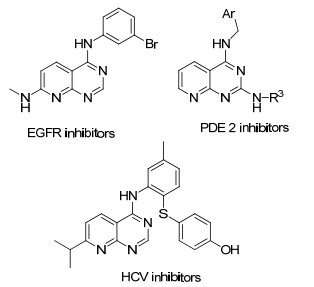
Figure 1.
Representative bioactive pyrido[2, 3-d]pyrimidines

Microwave-Accelerated Dimroth Rearrangement for the Synthesis of Pyrido [2, 3-d]pyrimidin-4-amine Derivatives
Chaoyang Zong , Huiwen Gu , Lijie Zhang , Yudong Jin , Yaquan Sun


Recently, microwave (MW) assisted in organic synthesis has attracted more attention as it was found to be an effective heating source applicable to a wide range of reactions, shortening reaction times, improving yields, and suppressing byproduct formation.[1~4]
Pyridopyrimidines have received considerable attention over the past years because of their potential biological and pharmacological activities.[5~10] Among them, the pyrido[2, 3-d]pyrimidine ring system is present in numbers of biologically active organic compounds, which includes antiviral, [11~13] anti-cancer, [14, 15] anti-bacterial, [16, 17] anti-microbial, [18] potent inhibitor of EGFR, [19, 20] AK[21, 22] and PI3Kα/mTOR[23] (Figure 1).
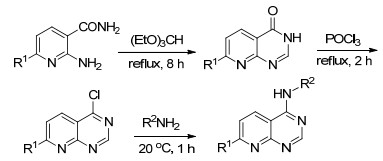
Due to the diverse range of the pharmacological activities of pyrido[2, 3-d]pyrimidines, there are numbers methods available for their synthesis.[24~30] Traditional preparation of pyrido[2, 3-d]pyrimidin-4-amine derivatives involves the reaction of amines and 4-chloropyrido[2, 3-d]pyrimidine. The 4-chloropyrido[2, 3-d]pyrimidine were synthesized by chlorination of the corresponding pyrido[2, 3-d]-pyrimidin-4(3H)-one that were in turn prepared by heating N-formyl derivatives with formic acid, triethyl orthoformate or formamide[31] (Scheme 1).
In search of an efficient method allowing incorporation of the 4-anilino group during ring cyclisation, Zhan et al.[32] have reported the synthesis of thieno[2, 3-d]-pyrim- idin-4-amines performed in only two steps via condensation of anilines with an intermediate (E)-N'-(5-bromo-3- cyano-thiophen-2-yl)-N, N-dimethylformimidamide, which was obtained by reaction between 2-amino-5-bromothio- phene-3-carbonitrile and DMF-DMA. In 2004, Han and co-workers[33] described a microwave approach for the second step performed in a parallel format. Based on the above information, we were able to construct a series of substituted pyrido[2, 3-d]pyrimidine analogs by employing the similar method under microwave irradiation. A new method for the synthesis of substituted pyrido[2, 3-d]pyri- midines was studied 3a~3t(Scheme 2).
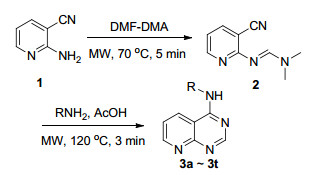
Our study started with the synthesis of the intermediate N-(3-cyano-2-pyridinyl)-N, N-dimethylformimidamide (2). After optimization of the microwave conditions by varying microwave power, solvent, reaction time, temperature and amount of DMF-DMA, we were able to obtain the expected product 2 at 200 W, 70 ℃ in only 5 min with excellent yield (95%).
It was found that microwave irradiation power had little influence on this reaction (Table 1, Entries 1~4). As shown in Table 1, the yield of 2 reached 72% when the microwave irradiation power was 100 W, increasing to 77% when the microwave irradiation power was increased to 200 W. However, if the power was higher than 200 W, the yield of product 2 was invariant.

 下载:
导出CSV
下载:
导出CSV
| Entry | Microwave power | Solvent | Amount of DMF-DMA/equiv. | Temperature/℃ | Time/min | Yieldb/% |
| 1 | 100 | Toluene | 2.5 | 50 | 10 | 72 |
| 2 | 150 | Toluene | 2.5 | 50 | 10 | 73 |
| 3 | 200 | Toluene | 2.5 | 50 | 10 | 77 |
| 4 | 250 | Toluene | 2.5 | 50 | 10 | 77 |
| 5 | 200 | H2O | 2.5 | 50 | 10 | NRc |
| 6 | 200 | THF | 2.5 | 50 | 10 | 74 |
| 7 | 200 | CH3CN | 2.5 | 50 | 10 | 60 |
| 8 | 200 | CH3OH | 2.5 | 50 | 10 | 30 |
| 9 | 200 | — | 2.5 | 50 | 10 | 90 |
| 10 | 200 | — | 2 | 50 | 10 | 84 |
| 11 | 200 | — | 1.5 | 50 | 10 | 80 |
| 12 | 200 | — | 1 | 50 | 10 | 73 |
| 13 | 200 | — | 2.5 | 70 | 10 | 95 |
| 14 | 200 | — | 2.5 | 30 | 10 | NRc |
| 15 | 200 | — | 2.5 | 70 | 15 | 95 |
| 16 | 200 | — | 2.5 | 70 | 5 | 95 |
| a Reaction conditions: compound 1 (3 mmol), solvent (2 mL) and microwave irradiation. b Isolated yield. c No reaction. | ||||||
In order to check the effect of the solvent on the reaction, various solvents were evaluated (Table 1, Entries 5~8). From an economical and environmental point of view, water was first screened as the reaction medium. But due to solubility problem, the yield of the reaction was very low (Table 1, Entry 5). Next, organic solvents were screened as the reaction medium (Table 1, Entries 6, 7 and 8). It was found that aprotic organic solvents including toluene, acetonitrile and THF afforded moderate to good yields of the product 2, whereas reaction in polar protic solvents, such as methanol, provided only 30% yield of product 2 (Table 1, Entry 8). Another interesting finding was that reaction without solvent delivered the product 2 in 90% yield (Table 1, Entry 9).
Furthermore, the amount of DMF-DMA was also important. The yields of product 2 decreased when the amount of DMF-DMA was decreased to 2, 1.5 and 1 equiv., respectively (Entries 10, 11 and 12). Next, we explored the reaction temperature and the study of temperature suggested that 70 ℃ was optimal (Table 1, Entries 9, 13 and 14). When microwave irradiation, solvent, amount of DMF-DMA, temperature were employed, the irradiation time was another important parameter in reaction optimization. We tested the effects of three different reaction times on the yield and the results showed that the ideal microwave irradiation time under our conditions was 5 min. We also proceeded this reaction under traditional thermal heating in heated oil bath with above optimized condition, but the reaction time was longer (90 min) and the yield was only 67%.
The second step of the synthesis consists in heating different amines with 2 in the presence of acetic acid. Initially, 3, 5-dichloroaniline and N-(3-cyano-2-pyridinyl)-N, N- dimethylformimidamide (2) were selected as model substrates for optimization of the reaction conditions (Table 2). The microwave irradiation power had a significant influence on the reaction results. When the reaction was conducted using different irradiation power the reaction yields were widely variable. As shown in Table 2, the yield of 3p reached 57% when the microwave irradiation power was 100 W, increasing to 82% when the microwave irradiation power was increased to 200 W. However, if the power was higher than 200 W, the yield of product 3p fell. This result suggested that higher microwave energy could result in a number of by-products. Moreover, the target product was probably decomposed by the higher energy. Therefore, according to the above analysis, the most suitable power for this reaction is 200 W.
下载:
导出CSV
| Entry | Microwave power | Amount of 3, 5-dichloroaniline/equiv. | Temperature/℃ | Time/min | Yieldb/% |
| 1 | 100 | 1.0 | 110 | 10 | 57 |
| 2 | 150 | 1.0 | 110 | 10 | 68 |
| 3 | 200 | 1.0 | 110 | 10 | 82 |
| 4 | 250 | 1.0 | 110 | 10 | 71 |
| 5 | 200 | 1.1 | 110 | 10 | 85 |
| 6 | 200 | 1.2 | 110 | 10 | 90 |
| 7 | 200 | 1.2 | 120 | 10 | 95 |
| 8 | 200 | 1.2 | 100 | 10 | 90 |
| 9 | 200 | 1.2 | 120 | 15 | 95 |
| 10 | 200 | 1.2 | 120 | 5 | 95 |
| a Reaction conditions: compound 2 (2 mmol), acetic acid (5 mL) and microwave irradiation. b Isolated yield. | |||||
The amount of anilines is another essential factor which affects the yield of 3p. It was observed that the yields of product 3p increased when the amount of anilines was increased to 1.1 and 1.2 equiv., respectively (Table 2, Entries 4~6). The results showed that 1.2 equivalent of anilines was the most suitable reagent amount for this reaction.
The reaction temperature was also explored. It also plays an important role in the reaction. It can be seen from Table 2 that the yield of product 3p reached 90% when the reaction temperature was 100 ℃. But when the reaction temperature was increased to 110 ℃, the yield of product 3p was changeless. However, if the reaction temperature become 120 ℃, the yield of product 3p is 95%.
Furthermore, we found reaction time has little influence on this reaction (Table 2, Entries 7, 9 and 10). The results showed that the ideal microwave irradiation time under our conditions was 5 min. After the establishment of the optimal reaction conditions, a variety of amines were tested for this cyclization and then Dimroth rearrangement reaction with N-(3-cyano-2-pyridinyl)-N, N-dimethylformimidamide (2). As is evident from Table 3, the result of the reaction depends on the nucleophilicity of the aniline and also on its accessibility in connection with the steric hindrance of the substituents. The presence of large atoms or groups on the para-position of the aromatic amine (e.g., 3h, 3i, 3l, 3m, 3k) involved an increase of reaction time and slight decrease of the yields. The reaction time of the aniline in the para-position is slightly longer and the yield is not high for the halogen atom (e.g., 3g, 3h, 3i). The greater the electronegativity reaction is easier to proceed and the higher the yield (e.g., 3g, 3h, 3i).
下载:
导出CSV
| Product | R | Conventional methoda | Microwave methodb | |||
| Yieldc/% | t/min | Yieldc/% | t/min | |||
| 3a | Ph | 81 | 120 | 86 | 10 | |
| 3b | 3-MeOC6H4 | 76 | 90 | 88 | 3 | |
| 3c | 4-MeOC6H4 | 69 | 90 | 83 | 30 | |
| 3d | 3-MeC6H4 | 81 | 80 | 95 | 3 | |
| 3e | 4-MeC6H4 | 75 | 80 | 86 | 15 | |
| 3f | 3-ClC6H4 | 72 | 80 | 85 | 3 | |
| 3g | 4-ClC6H4 | 67 | 80 | 80 | 15 | |
| 3h | 4-BrC6H4 | 65 | 100 | 77 | 20 | |
| 3i | 4-FC6H4 | 74 | 100 | 82 | 10 | |
| 3j | 3-NCC6H4 | 86 | 90 | 92 | 3 | |
| 3k* | 4-NCC6H4 | 66 | 180 | 74 | 50 | |
| 3l | 3-Cl-4-FC6H3 | 75 | 100 | 80 | 15 | |
| 3m | 4-O2NC6H4 | 60 | 180 | 69 | 30 | |
| 3n* | 3-CH≡CC6H4 | 69 | 90 | 73 | 15 | |
| 3o | 3, 4-Cl2C6H3 | 80 | 100 | 89 | 5 | |
| 3p | 3, 5-Cl2C6H3 | 86 | 100 | 95 | 5 | |
| 3q | Ph(CH2) | 83 | 120 | 92 | 10 | |
| 3r | Ph(CH2)2 | 85 | 120 | 88 | 3 | |
| 3s | Ph(CH2)3 | 83 | 120 | 89 | 5 | |
| 3t | (CH3)3CH2 | 79 | 120 | 85 | 3 | |
| a Reaction conditions: 2 (2.5 mmol), amine (3 mmol), acetic acid (5 mL), 120 ℃ and oil bath reflux; b Reaction conditions: 2 (2.5 mmol), amine (3 mmol), acetic acid (5 mL), 120 ℃ and irradiation at 200 W. c Isolated yield. * new compound. | ||||||
With the optimized conditions, our microwave experiment with traditional thermal heating in heated oil bath was compared and the results showed that the method of microwave irradiation for the preparation of pyrido[2, 3-d]- pyrimidin-4-amine was time-saving and high yield (Table 3).
In summary, we described a simple, highly efficient, and facile procedure for the synthesis of pyrido[2, 3-d]pyrim- idin-4-amine derivatives by condensation, cyclization and then Dimroth rearrangement reaction under microwave irradiation. The advantages of our methods are: a short synthetic route, short reaction time, low cost and efficient yield, and work-up easily.
Unless specified otherwise, all starting materials and reagents were obtained from commercial suppliers without further purification. All melting points were taken on a METTLEE TOLEDO MP90 melting point apparatus and were uncorrected. 1H NMR and 13C NMR spectra were recorded on a Bruker AVANCE Ⅲ HD 400 MHz instrument using TMS as the internal standard. IR spectra were recorded as KBr pellets on a VERTEX 80/Raman Ⅱ FTIR spectrometer. Mass spectra were recorded on a Triple TOF™ 5600+(AB SCIEX USA). The microwave assisted reactions have been carried out in a CEM Explorer Hybrid instrument. The reactions were monitored by thin layer chromatography (TLC) using silica gel GF254.
Purity was evaluated by HPLC on an Waters e2695 system using a SUPELCO Discovery® C18 column (150 mm×4.6 mm, 5 μm) at room temperature with a elution using the mobile phase of water and methanol (V:V=10:90) with a flow rate of 0.5 mL•min-1. The injection volume was 10 μL and the detection wavelength was set at 254 nm.
Microwave method: A suspension of 2-aminoni- cotinonitrile (1) (3.57 g, 30 mmol) was suspended in DMF- DMA (10 mL, 75 mmol) and irradiated at 70 ℃ (power input: 200 W) for 5 min. The mixture was cooled to room temperature, and poured into 40 mL of ice cold water. The precipitate was filtered off, washed with water, dried to afford N-(3-cyano-2-pyridinyl)-N, N-dimethylformimida- mide (2), 95% yield. White crystal, m.p. 68~68.5 ℃ (lit.[34] 66~69 ℃); 1H NMR (400 MHz, CDCl3) δ: 8.58 (s, 1H), 8.35 (dd, J=4.9, 2.0 Hz, 1H), 7.79 (dd, J=7.6, 2.0 Hz, 1H), 6.87 (dd, J=7.6, 4.9 Hz, 1H), 3.19 (s, 3H), 3.15 (s, 3H); 13C NMR (100 MHz, CDCl3) δ: 163.4, 155.9, 151.8, 141.9, 117.6, 116.6, 102.4, 34.9; IR (KBr) ν: 3457, 3061, 2916, 2795, 2214, 1960, 1625, 1562, 1395, 1226, 1111, 982, 862, 815, 776, 557, 518 cm-1. HRMS (ESI) calcd for C9H11N4 175.0984, found 175.1005.
Conventional method: A suspension of 2-aminonicotino- nitrile (1) (3.57 g, 30 mmol) was suspended in DMF-DMA (10 mL, 75 mmol) and heated to reflux for 90 min. The mixture was cooled to room temperature and poured into 40 mL of ice cold water. The precipitate was filtered off, washed with water, and dried to afford N-(3-cyano-2- pyridinyl)-N, N-dimethyl-formimidamide, 67% yield.
Microwave method: A mixture of N-(3-cyano-2-pyri- dinyl)-N, N-dimethylformimidamide (2) (0.44 g, 2.5 mmol) and appropriate amine (2.75 mmol) in acetic acid (5 mL) was irradiated at 120 ℃ (power input: 200 W) for different time. On completion, the reaction was cooled to ambient temperature. The resulting mixture was evaporated to dryness and obtained crude product. The crude product was filtered, washed with little acetic acid and ether then dried to afford the target compound.
Conventional method: A mixture of N-(3-cyano-2-pyri- dinyl)-N, N-dimethylformimidamide (2) (0.44 g, 2.5 mmol) and appropriate amine (2.75 mmol) in acetic acid (5 mL) was heated to reflux for different time (120 ℃). On completion, the reaction was cooled to ambient temperature. The resulting mixture was evaporated to dryness and obtained crude product. The crude product was filtered, washed with little acetic acid and ether then dried to afford the target compound.
N-Phenylpyrido[2, 3-d]pyrimidin-4-amine (3a): Yield 82%. White solid, m.p. 260~261 ℃ (lit.[14] 258 ℃); 1H NMR (400 MHz, DMSO-d6) δ: 10.08 (s, 1H), 9.09 (dd, J=4.3, 1.8 Hz, 1H), 9.02 (dd, J=8.3, 1.8 Hz, 1H), 8.74 (s, 1H), 7.89~7.83 (m, 2H), 7.68 (dd, J=8.3, 4.3 Hz, 1H), 7.47~7.40 (m, 2H), 7.23~7.15 (m, 1H); 13C NMR (100 MHz, DMSO-d6) δ: 159.6, 158.9, 158.3, 156.6, 139.3, 133.4, 129.0, 124.7, 123.0, 122.3, 110.6; IR (KBr) ν: 3284, 3107, 1620, 1564, 1487, 1333, 1151, 1078, 971, 899, 838, 795, 747, 691 cm-1; HRMS (ESI) calcd for C13H11N4 223.0984, found 223.0973.
N-(3-Methoxyphenyl)pyrido[2, 3-d]pyrimidin-4-amine (3b): Yield 84%. Pale yellow solid, m.p. 212~214 ℃; 1H NMR (400 MHz, DMSO-d6) δ: 10.00 (s, 1H), 9.04 (dd, J=27.1, 5.5 Hz, 2H), 8.76 (s, 1H), 7.67 (dd, J=8.2, 4.3 Hz, 1H), 7.54 (s, 1H), 7.47 (d, J=8.0 Hz, 1H), 7.31 (t, J=8.1 Hz, 1H), 6.75 (dd, J=8.1, 1.8 Hz, 1H), 3.79 (s, 3H); 13C NMR (100 MHz, DMSO-d6) δ: 159.9, 159.5, 158.8, 158.3, 156.6, 140.5, 133.3, 129.8, 122.3, 115.1, 110.6, 109.9, 108.7, 55.6; IR (KBr) ν: 3301, 3066, 1566, 1479, 1331, 1150, 1085, 1044, 963, 875, 843, 789, 688 cm-1; HRMS (ESI) calcd for C14H13N4O 253.1089, found 253.1081.
N-(4-Methoxyphenyl)pyrido[2, 3-d]pyrimidin-4-amine (3c): Yield 79%. Yellow solid, m.p. 248~250 ℃; 1H NMR (400 MHz, DMSO-d6) δ: 9.99 (s, 1H), 9.04 (dd, J=4.3, 1.8 Hz, 1H), 8.95 (dd, J=8.3, 1.8 Hz, 1H), 8.65 (s, 1H), 7.67 (d, J=9.0 Hz, 2H), 7.63 (dd, J=8.3, 4.4 Hz, 1H), 7.04~6.93 (m, 2H), 3.77 (s, 3H); 13C NMR (100 MHz, DMSO-d6) δ: 159.7, 158.9, 158.5, 156.6, 156.4, 133.2, 132.0, 125.0, 122.2, 114.2, 110.5, 56.5; IR (KBr) ν: 3596, 3075, 1566, 1421, 1332, 1080, 1020, 925, 837, 795, 700 cm-1; HRMS (ESI) calcd for C14H13N4O 253.1089, found 253.1089.
N-(m-Tolyl)pyrido[2, 3-d]pyrimidin-4-amine (3d): Yield 90%. Pale yellow solid, m.p. 255~256 ℃; 1H NMR (400 MHz, DMSO-d6) δ: 10.00 (s, 1H), 9.08 (dd, J=4.3, 1.8 Hz, 1H), 9.01 (dd, J=8.3, 1.8 Hz, 1H), 8.74 (s, 1H), 7.67 (dd, J=8.3, 4.3 Hz, 3H), 7.36~7.24 (m, 1H), 7.00 (d, J=7.5 Hz, 1H), 2.36 (s, 3H); 13C NMR (100 MHz, DMSO-d6) δ: 159.6, 158.9, 158.3, 156.6, 139.2, 138.2, 133.3, 128.9, 125.4, 123.5, 122.3, 120.2, 110.6, 21.7; IR (KBr) ν: 3270, 3066, 1543, 1484, 1335, 1084, 991, 939, 900, 791, 700 cm-1; HRMS (ESI) calcd for C14H13N4 237.1140, found 237.1147.
N-(p-Tolyl)pyrido[2, 3-d]pyrimidin-4-amine (3e): Yield 82%. White solid, m.p. 297~299 ℃; 1H NMR (400 MHz, DMSO-d6) δ: 10.00 (s, 1H), 9.06 (dd, J=4.3, 1.7 Hz, 1H), 8.98 (dd, J=8.3, 1.7 Hz, 1H), 8.69 (s, 1H), 7.70 (d, J=8.3 Hz, 2H), 7.64 (dd, J=8.3, 4.3 Hz, 1H), 7.21 (d, J=8.2 Hz, 2H), 2.31 (s, 3H); 13C NMR (100 MHz, DMSO-d6) δ: 159.6, 158.9, 158.4, 156.5, 136.6, 133.8, 133.3, 129.5, 123.1, 122.2, 110.6, 21.0; IR (KBr) ν: 3239, 3069, 1562, 1479, 1328, 1078, 921, 788, 705 cm-1; HRMS (ESI) calcd for C14H13N4 237.1140, found 237.1148.
N-(3-Chlorophenyl)pyrido[2, 3-d]pyrimidin-4-amine (3f): Yield 81%. White solid, m.p. 230~232 ℃ (lit.[14] 228 ℃); 1H NMR (400 MHz, DMSO-d6) δ: 10.14 (s, 1H), 9.10 (d, J=2.8 Hz, 1H), 9.00 (d, J=8.0 Hz, 1H), 8.81 (s, 1H), 8.11 (s, 1H), 7.83 (d, J=7.8 Hz, 1H), 7.70 (d, J=12.6 Hz, 1H), 7.44 (t, J=8.1 Hz, 1H), 7.21 (dd, J=8.0, 1.3 Hz, 1H); 13C NMR (100 MHz, DMSO-d6) δ: 158.5, 158.3, 157.3, 157.2, 140.7, 135.2, 133.3, 130.7, 124.2, 121.8, 120.7, 116.9, 111.7; IR (KBr) ν: 3442, 3071, 1568, 1478, 1336, 1148, 1083, 991, 882, 785, 695 cm-1; HRMS (ESI) calcd for C13H10ClN4 257.0594, found 257.0596.
N-(4-Chlorophenyl)pyrido[2, 3-d]pyrimidin-4-amine (3g): Yield 76%. White solid, m.p. 358~360 ℃ (lit.[36] 359~360 ℃); 1H NMR (400 MHz, DMSO-d6) δ: 10.13 (s, 1H), 9.15~9.05 (m, 1H), 9.04~8.93 (m, 1H), 8.76 (s, 1H), 7.91 (d, J=8.6 Hz, 2H), 7.68 (d, J=12.6 Hz, 1H), 7.54~7.43 (m, 2H); 13C NMR (100 MHz, DMSO-d6) δ: 159.4, 158.8, 158.1, 156.7, 138.3, 133.4, 128.9, 128.2, 124.3, 122.4, 110.6; IR (KBr) ν: 3259, 3078, 1566, 1489, 1332, 1145, 1082, 790, 696 cm-1; HRMS (ESI) calcd for C13H10ClN4 257.0594, found 257.0628.
N-(4-Bromophenyl)pyrido[2, 3-d]pyrimidin-4-amine (3h): Yield 73%. Pale yellow solid, m.p. 305~307 ℃; 1H NMR (400 MHz, DMSO-d6) δ: 10.14 (s, 1H), 9.10 (dd, J=4.1, 1.4 Hz, 1H), 9.01 (dd, J=8.2, 1.1 Hz, 1H), 8.78 (s, 1H), 7.88 (d, J=8.5 Hz, 2H), 7.70 (dd, J=8.3, 4.3 Hz, 1H), 7.65~7.58 (m, 2H); 13C NMR (100 MHz, DMSO-d6) δ: 158.5, 158.4, 157.3, 135.3, 131.9, 131.9, 124.5, 121.3, 116.8, 116.5, 111.8; IR (KBr) ν: 3291, 3100, 1627, 1596, 1502, 1159, 1081, 798, 676 cm-1; HRMS (ESI) calcd for C13H10BrN4 301.0089, found 301.0090.
N-(4-Fluorophenyl)pyrido[2, 3-d]pyrimidin-4-amine (3i): Yield 78%. White solid, m.p. 264~286 ℃; 1H NMR (400 MHz, DMSO-d6) δ: 10.11 (s, 1H), 9.08 (dd, J=4.4, 1.8 Hz, 1H), 8.98 (dd, J=8.2, 1.9 Hz, 1H), 8.72 (s, 1H), 7.85 (dd, J=8.9, 5.1 Hz, 2H), 7.67 (dd, J=8.3, 4.4 Hz, 1H), 7.34~7.17 (m, 2H); 13C NMR (100 MHz, DMSO-d6) δ: 159.2 (d, 1JC-F=239.7 Hz), 159.6, 158.6, 158.3, 156.5, 135.5, 133.3, 125.1 (d, 3JC-F=8.0 Hz), 122.3, 115.5 (d, 2JC-F=22.3 Hz), 110.5; IR (KBr) ν: 3259, 3078, 1566, 1489, 1332, 1145, 1082, 790, 696 cm-1; HRMS (ESI) calcd for C13H10FN4 241.0889, found 241.0899.
3-(Pyrido[2, 3-d]pyrimidin-4-ylamino)benzonitrile (3j): Yield 87%. White solid, m.p. 272~274 ℃; 1H NMR (400 MHz, DMSO-d6) δ: 10.28 (s, 1H), 9.13 (dd, J=4.4, 1.8 Hz, 1H), 9.02 (dd, J=8.3, 1.9 Hz, 1H), 8.85 (s, 1H), 8.51~8.39 (m, 1H), 8.17 (dt, J=7.5, 2.2 Hz, 1H), 7.73 (dd, J=8.3, 4.3 Hz, 1H), 7.69~7.58 (m, 2H); 13C NMR (100 MHz, DMSO-d6) δ: 159.4, 158.8, 158.0, 157.0, 140.3, 133.3, 130.5, 127.8, 127.1, 125.4, 122.6, 119.2, 111.9, 110.6; IR (KBr) ν: 3382, 3076, 1571, 1486, 1342, 1282, 1085, 787, 678 cm-1; HPLC Purity: 99.71%; HRMS (ESI) calcd for C14H10N5 248.0936, found 248.0971.
4-(Pyrido[2, 3-d]pyrimidin-4-ylamino)benzonitrile (3k): Yield 70%. Yellow solid, m.p. 342~343 ℃; 1H NMR (400 MHz, DMSO-d6) δ: 10.35 (s, 1H), 9.23~9.10 (m, 1H), 9.06 (d, J=8.1 Hz, 1H), 8.89 (s, 1H), 8.18 (d, J=8.6 Hz, 2H), 7.88 (d, J=8.7 Hz, 2H), 7.74 (dd, J=8.3, 4.3 Hz, 1H); 13C NMR (100 MHz, DMSO-d6) δ: 159.2, 158.8, 157.9, 157.1, 143.9, 133.5, 133.4, 122.7, 122.1, 119.6, 110.9, 105.7; IR (KBr) ν: 3295, 3107, 1616, 1408, 1243, 1073, 793, 707 cm-1; HRMS (ESI) calcd for C14H10N5 248.0936, found 248.0936.
N-(3-Chloro-4-fluorophenyl)pyrido[2, 3-d]pyrimidin-4-amine (3l): Yield 76%. Pale yellow solid, m.p. 303~305 ℃; 1H NMR (400 MHz, DMSO-d6) δ: 10.18 (s, 1H), 9.10 (dd, J=4.2, 1.4 Hz, 1H), 8.97 (dd, J=8.3, 1.4 Hz, 1H), 8.79 (s, 1H), 8.19 (dd, J=6.7, 2.1 Hz, 1H), 7.86~7.80 (m, 1H), 7.70 (dd, J=8.3, 4.3 Hz, 1H), 7.48 (t, J=9.1 Hz, 1H); 13C NMR (100 MHz, DMSO-d6) δ: 159.2, 158.6, 157.9, 156.7, 154.1 (d, 1JC-F=239.7 Hz), 136.7, 133.3, 124.3, 123.1 (d, 3JC-F=6.9 Hz), 122.5, 119.3 (d, 2JC-F=18.3 Hz), 117.1 (d, 2JC-F=21.5 Hz), 110.6; IR (KBr) ν: 3339, 3035, 1568, 1500, 1337, 1079, 876, 781, 701 cm-1; HRMS (ESI) calcd for C13H9ClFN4 275.0500, found 275.0503.
N-(4-Nitrophenyl)pyrido[2, 3-d]pyrimidin-4-amine (3m): Yield 66%. White solid, m.p. 347~349 ℃; 1H NMR (400 MHz, DMSO-d6) δ: 10.51 (s, 1H), 9.17 (dd, J=4.3, 1.8 Hz, 1H), 9.09 (dd, J=8.4, 1.8 Hz, 1H), 8.94 (s, 1H), 8.35~8.26 (m, 4H), 7.77 (dd, J=8.3, 4.3 Hz, 1H); 13C NMR (100 MHz, DMSO-d6) δ: 159.2, 158.9, 157.8, 157.2, 146.0, 142.7, 133.6, 125.1, 122.8, 121.5, 111.0; HPLC Purity: 98.87%; IR (KBr) ν: 3203, 3062, 1614, 1564, 1494, 1110, 843, 788, 744, 695 cm-1; HRMS (ESI) calcd for C13H10N5O2 268.0834, found 268.0846.
N-(3-Ethynylphenyl)pyrido[2, 3-d]pyrimidin-4-amine (3n): Yield 69%. Pale yellow solid, m.p. 216~217 ℃; 1H NMR (400 MHz, DMSO-d6) δ: 10.12 (s, 1H), 9.12~9.08 (m, 1H), 9.01 (dd, J=8.3, 1.6 Hz, 1H), 8.80 (s, 1H), 8.07 (s, 1H), 7.91 (d, J=7.9 Hz, 1H), 7.70 (dd, J=8.3, 4.3 Hz, 1H), 7.44 (t, J=7.9 Hz, 1H), 7.29~7.25 (m, 1H), 4.24 (s, 1H); 13C NMR (100 MHz, DMSO-d6) δ: 159.5, 158.8, 158.2, 156.8, 139.6, 133.4, 129.5, 127.7, 125.6, 123.3, 122.5, 122.4, 110.6, 83.8, 81.3; HPLC purity: 99.88%; IR (KBr) ν: 3272, 3067, 1610, 1564, 1483, 1437, 1155, 1080, 808, 841, 786, 729, 667 cm-1; HRMS (ESI) calcd for C15H11N4 247.0984, found 247.0987.
N-(3, 4-Dichlorophenyl)pyrido[2, 3-d]pyrimidin-4-amine (3o): Yield 85%. White solid, m.p. 310~312 ℃; 1H NMR (400 MHz, DMSO-d6) δ: 10.19 (s, 1H), 9.11 (d, J=6.1 Hz, 1H), 8.99 (d, J=10.2 Hz, 1H), 8.83 (s, 1H), 8.32 (d, J=2.5 Hz, 1H), 7.90 (d, J=11.4 Hz, 1H), 7.79~7.59 (m, 2H); 13C NMR (100 MHz, DMSO-d6) δ: 159.2, 158.8, 158.0, 156.9, 139.6, 133.3, 131.2, 130.9, 125.8, 123.6, 122.6, 122.4, 110.7; IR (KBr) ν: 3271, 3085, 1607, 1567, 1529, 1472, 1133, 1080, 1031, 874, 780 cm-1; HRMS (ESI) calcd for C13H9Cl2N4 291.0204, found: 291.0199.
N-(3, 5-Dichlorophenyl)pyrido[2, 3-d]pyrimidin-4-amine (3p): Yield 90%. Yellow solid, m.p. 267~269 ℃; 1H NMR (400 MHz, DMSO-d6) δ: 10.17 (s, 1H), 9.12 (d, J=3.1 Hz, 1H), 8.97 (d, J=8.1 Hz, 1H), 8.88 (s, 1H), 8.08 (s, 2H), 7.72 (dd, J=8.2, 4.3 Hz, 1H), 7.34 (s, 1H); 13C NMR (100 MHz, DMSO-d6) δ: 159.1, 158.7, 157.9, 157.0, 141.9, 134.2, 133.2, 123.2, 122.7, 120.2, 110.6; IR (KBr) ν: 3078, 1613, 1568, 1483, 1445, 1087, 842, 789 cm-1; HRMS (ESI) calcd for C13H9Cl2N4 291.0204, found 291.0208.
N-Benzylpyrido[2, 3-d]pyrimidin-4-amine (3q): Yield 87%. White solid, m.p. 260~262 ℃ (lit.[35] 258~260 ℃); 1H NMR (400 MHz, DMSO-d6) δ: 9.14 (t, J=5.7 Hz, 1H), 9.01 (dd, J=4.4, 1.9 Hz, 1H), 8.77 (dd, J=8.3, 1.9 Hz, 1H), 8.61 (s, 1H), 7.57 (dd, J=8.2, 4.4 Hz, 1H), 7.42~7.31 (m, 4H), 7.30~7.20 (m, 1H), 4.82 (d, J=5.9 Hz, 2H); 13C NMR (100 MHz, DMSO-d6) δ: 161.2, 158.8, 158.7, 156.2, 139.4, 133.0, 128.8, 127.8, 127.4, 121.9, 110.2, 49.1; IR (KBr) ν: 3442, 3226, 3070, 2959, 1572, 1486, 1335, 1073, 991, 892, 839, 790, 749, 700 cm-1; HRMS (ESI) calcd for C14H13N4 237.1140, found 237.1171.
N-Phenethylpyrido[2, 3-d]pyrimidin-4-amine (3r): Yield 84%. White solid, m.p. 256~258 ℃ (lit.[35] 252~254 ℃); 1H NMR (400 MHz, DMSO-d6) δ: 8.96 (dd, J=4.4, 1.9 Hz, 1H), 8.71~8.64 (m, 2H), 8.61 (d, J=5.2 Hz, 1H), 7.52 (dd, J=8.2, 4.4 Hz, 1H), 7.38~7.24 (m, 4H), 7.19 (ddd, J=8.6, 4.2, 1.9 Hz, 1H), 3.85~3.71 (m, 2H), 3.05~2.89 (m, 2H); 13C NMR (100 MHz, DMSO-d6) δ: 161.1, 158.9, 158.7, 156.0, 139.8, 132.8, 129.2, 128.9, 126.6, 121.7, 110.2, 42.9, 34.8; IR (KBr) ν: 3239, 3119, 1579, 1487, 1119, 1021, 840, 794, 744, 697 cm-1; HRMS (ESI) calcd for C15H15N4 251.1297, found 251.1304.
N-(3-Phenylpropyl)pyrido[2, 3-d]pyrimidin-4-amine (3s): Yield 85%. White solid, m.p. 196~198 ℃ (lit.[35] 195~198 ℃); 1H NMR (400 MHz, DMSO-d6) δ: 8.98 (dd, J=4.3, 1.8 Hz, 1H), 8.70 (dd, J=8.3, 1.8 Hz, 1H), 8.63~8.53 (m, 2H), 7.54 (dd, J=8.2, 4.4 Hz, 1H), 7.40~7.06 (m, 5H), 3.58 (s, 2H), 2.77~2.63 (m, 2H), 2.03~1.90 (m, 2H); 13C NMR (100 MHz, DMSO-d6) δ: 161.2, 158.8, 158.7, 156.0, 142.1, 132.9, 128.8, 128.8, 126.2, 121.6, 110.2, 41.0, 33.1, 30.5; IR (KBr) ν: 3241, 3124, 1581, 1487, 1182, 1119, 1040, 853, 791, 750, 696 cm-1; HRMS (ESI) calcd for C16H17N4 265.1453, found 265.1491.
N-Butyl pyrido[2, 3-d]pyrimidin-4-amine (3t): Yield 81%. White solid, m.p. 165~167℃ (lit.[37] 164~167 ℃); 1H NMR (400 MHz, DMSO-d6) δ: 8.71 (d, J=10.2 Hz, 1H), 8.59 (s, 1H), 8.55 (d, J=10.5 Hz, 1H), 7.53 (d, J=12.6 Hz, 1H), 3.55 (d, J=19.9 Hz, 2H), 1.64 (d, J=29.4 Hz, 2H), 1.38 (d, J=37.1 Hz, 2H), 0.93 (d, J=14.7 Hz, 3H); 13C NMR (100 MHz, DMSO-d6) δ: 161.2, 158.9, 158.7, 155.9, 132.9, 121.6, 110.2, 31.0, 21.5, 20.2, 14.2; IR (KBr) ν: 3255, 3133, 1586, 1122, 988, 900, 792, 749, 703 cm-1; HRMS (ESI) calcd for C11H15N4 203.1297, found 203.1306.
Supporting Information NMR, IR, HRMS, HPLC spectra of products 2 and 3a~3t. The Supporting Information is available free of charge via the Internet at http://sioc-journal.cn.
Li, M.; Liu, R.; Tian, Y; Chang, Y.; Xiao, Y. Chin. J. Chem. 2017, 35, 1405. doi: 10.1002/cjoc.v35.9
贾涛, 郑楠楠, 蔡万清, 应磊, 黄飞, 化学学报, 2017, 75, 808. http://www.cqvip.com/QK/91047X/201708/673070809.htmlJia, T.; Zheng, N.; Cai, W.; Ying, L.; Huang, F. Acta Chim. Sinica 2017, 75, 808(in Chinese). http://www.cqvip.com/QK/91047X/201708/673070809.html
林伟, 胡秀秀, 王雅珍, 宋帅, 张梦烨, 史达清, 有机化学, 2018, 38, 855.Lin, W.; Hu, X.; Wang, Y.; Song, S.; Zhang, M.; Shi, D. Chin. J. Org. Chem. 2018, 38, 855(in Chinese).
张变香, 杨丽花, 史瑞雪, 亢永强, 有机化学, 2016, 36, 352. http://www.cqvip.com/QK/93463X/201602/668195253.htmlZhang, B.; Yang, L.; Shi, R.; Kang, Y. Chin. J. Org. Chem. 2016, 36, 352(in Chinese). http://www.cqvip.com/QK/93463X/201602/668195253.html
Insuasty, D.; Abonia, R.; Insuasty, B.; Quiroga, J.; Laali, K. K.; Nogueras, M.; Cobo, J. ACS Comb. Sci. 2017, 19, 555. doi: 10.1021/acscombsci.7b00091
Mamaghani, M.; Hossein Nia, R. J. Heterocycl. Chem. 2017, 54, 1700. doi: 10.1002/jhet.v54.3
Satham, L.; Namboothiri, I. N. N. J. Org. Chem. 2017, 82, 6482. doi: 10.1021/acs.joc.7b00947
Hou, J.; Wan, S. H.; Wang, G. F.; Zhang, T. T.; Li, Z. H.; Tian, Y. X.; Yu, Y. H.; Wu, X. Y.; Zhang, J. J. Eur. J. Med. Chem. 2016, 118, 276. doi: 10.1016/j.ejmech.2016.04.026
Saurat, T.; Buron, F.; Rodrigues, N.; Tauzia de, M.; Colliandre, L.; Bourg, S.; Bonnet, P.; Guillaumet, G.; Akssira, M.; Corlu, A.; Guillouzo, C.; Berthier, P.; Rio, P.; Jourdan, M.; Bénédetti, M.; Routier, S. J. Med. Chem. 2014, 57, 613. doi: 10.1021/jm401138v
Zhang, H. J.; Wang, S. B.; Wen, X.; Li, J. Z.; Quan, Z. S. Med. Chem. Res. 2016, 25, 1287. doi: 10.1007/s00044-016-1559-1
Lacbay, C. M.; Mancuso, J.; Lin, Y. S.; Bennett, N; Götte, M.; Tsantrizos, Y. S. J. Med. Chem. 2014, 57, 7435. doi: 10.1021/jm501010f
Betebenner, D. A. ; Degoey, D. A. ; Maring, C. J. ; Chris Krueger, A. ; Iwasaki, N. ; Rockway, T. W. ; Cooper, C. S. ; Anderson, D. D. ; Donner, P. L. ; Green, B. E. ; Kempf, D. J. ; Liu, D. ; McDaniel, K. F. ; Madigan, D. ; Motter, C. E. ; Pratt, J. K. ; Shanley, J. P. ; Tufano, M. D. ; Wagner, R. ; Zhang, R. ; Molla, A. ; Mo, H. ; Pilot-Matias, T. ; Masse Sherie, V. L. ; Carrick, R. J. ; He, W. ; Lu, L. ; Grampovnik, D. J. WO 2007076034, 2007[Chem. Abstr. 2007, 147, 143454].
Chris Krueger, A.; Madigan, D. L.; Beno, D. W.; Betebenner, D. A.; Carrick, R.; Green, B. E.; He, W.; Liu, D.; Maring, C. J.; McDaniel, K. F.; Mo, H.; Molla, A.; Motter, C. E.; Pilot-Matias, T. J.; Tufano, M. D.; Kempf, D. J. Bioorg. Med. Chem. Lett. 2012, 22, 2212.
Arnold, L. D. ; Moyer, M. P. ; Sobolov-Jaynes, S. B. US 6395733, 2002[Chem. Abstr. 1997, 126, 144288].
Watanabe, K. A. ; Tsann-Long, S. U. ; Huang, J. T. WO 9000172, 1990[Chem. Abstr. 1990, 113, 40343].
Ravi Kanth, S.; Venkat Reddy, G.; Hara Kishore, K.; Shanthan Rao, P.; Narsaiah, B.; Surya Narayana Murthy, U. Eur. J. Med. Chem. 2006, 41, 1011. doi: 10.1016/j.ejmech.2006.03.028
Naresh Kumar, R.; Jitender Dev, G.; Ravikuma, N.; Krishna Swaroop, D.; Debanjan, B.; Bharath, G.; Narsaiah, B.; Nishant Jain, S.; Gangagni Rao, A. Bioorg. Med. Chem. Lett. 2016, 26, 2927. doi: 10.1016/j.bmcl.2016.04.038
Aly, H. M.; Saleh, N. M. Int. J. Adv. Res. 2014, 2, 694.
Song, Z.; Jin, Y.; Ge, Y.; Wang, C.; Zhang, J.; Tang, Z.; Peng, J.; Liu, K.; Li, Y.; Ma, X. Bioorg. Med. Chem. 2016, 24, 5505. doi: 10.1016/j.bmc.2016.09.001
Stuart, G. S. ; Guntrip, S. B. ; Mckeown, S. C. ; Page, M. J. ; Smith, K. J. ; Vile, S. ; Hudson, A. T. ; Barraclough, P. ; Franzmann, K. W. US 6169091, 2001[Chem. Abstr. 1997, 126, 330623].
Zheng, G. Z.; Mao, Y.; Lee, C. H.; Pratt, J. K.; Koenig, J. R.; Perner, R. J.; Cowart, M. D.; Gfesser, G. A.; McGaraughty, S.; Chu, K. L.; Zhu, C.; Yu, H.; Kohlhaas, K.; Alexander, K. M.; Wismer, C. T.; Mikusa, J.; Jarvis, M. F.; Kowaluk, E. A.; Stewart, A. O. Bioorg. Med. Chem. Lett. 2003, 13, 3041. doi: 10.1016/S0960-894X(03)00642-5
Bhagwat, S. S. ; Lee, C. H. ; Richard, R. J. ; Gu, Y. G. WO 0157040, 2001[Chem. Abstr. 2001, 135, 152822].
Al-Ashmawy A. A. K.; Ragab, F. A.; Elokely, K. M.; Anwar, M. M.; Perez-Leal, O.; Rico, M. C.; Gordon, J.; Bichenkov, E.; Mateo, G.; Kassem, E. M. M.; Hegazy, G. H.; Abou-Gharbia, M.; Childers, W. Bioorg. Med. Chem. Lett. 2017, 27, 3117. doi: 10.1016/j.bmcl.2017.05.044
任青云, 王涛, 刘建超, 贺红武, 有机化学, 2005, 25, 1530. doi: 10.3321/j.issn:0253-2786.2005.12.003Ren, Q.; Wang, T.; Liu, J.; He, H. Chin. J. Org. Chem. 2005, 25, 1530(in Chinese). doi: 10.3321/j.issn:0253-2786.2005.12.003
Shamroukh, A. H.; Rashad, A. E.; Abdelmegeid, F. M. J. Chem. Pharm. Res 2016, 8, 734. http://www.ncbi.nlm.nih.gov/pubmed/24801813
王香善, 曾兆森, 史达清, 屠树江, 魏贤勇, 宗志敏, 有机化学, 2006, 26, 256. doi: 10.3321/j.issn:0253-2786.2006.02.021Wang, X.; Zeng, Z.; Shi, D.; Tu, S.; Wei, X.; Zong, Z. Chin. J. Org. Chem. 2006, 26, 256(in Chinese). doi: 10.3321/j.issn:0253-2786.2006.02.021
黄志斌, 刘学成, 胡明华, 林伟, 史达清, 有机化学, 2014, 34, 382. http://www.cqvip.com/QK/93463X/201402/48912056.htmlHuang, Z.; Liu, X.; Hu, M.; Lin, W.; Shi, D. Chin. J. Org. Chem. 2014, 34, 382(in Chinese). http://www.cqvip.com/QK/93463X/201402/48912056.html
Buron, F.; Merour, J. Y.; Akssira, M.; Guillaumet, G.; Routier, S. Eur. J. Med. Chem. 2015, 95, 76. doi: 10.1016/j.ejmech.2015.03.029
邓兰青, 钟宏, 王帅, 有机化学, 2014, 34, 414. http://www.cqvip.com/QK/93463X/201402/48912062.htmlDeng, L.; Zhong, H.; Wang, S. Chin. J. Org. Chem. 2014, 34, 414(in Chinese). http://www.cqvip.com/QK/93463X/201402/48912062.html
Arikkatt, S. D.; Mathew, B.; Joseph, J.; Chandran, M.; Bhat, A. R.; Krishnakumar, K. Int. J. Org. Bioorg. Chem. 2014, 4, 1. doi: 10.4236/ijoc.2014.41001
Rewcastle, G. W.; Palmer, B. D.; Thompson, A. M.; Bridges, A. J.; Cody, D. R.; Zhou, H. R.; Fry, D. W.; McMichael, A.; Denny, W. A. J. Med. Chem. 1996, 39, 1823. doi: 10.1021/jm9508651
詹冬梅, 李思远, 赵红莉, 蓝闽波, 有机化学, 2011, 31, 207. http://www.cqvip.com/QK/93463X/201102/36819436.htmlZhan, D.; Li, S.; Zhao, H.; Lan, M. Chin. J. Org. Chem. 2011, 31, 207(in Chinese). http://www.cqvip.com/QK/93463X/201102/36819436.html
Yoon, D. S.; Han, Y.; Stark, T. M.; Haber, J. C.; Gregg, B. T.; Stankovich, S. B. Org. Lett. 2004, 6, 4775. doi: 10.1021/ol047919y
Vercek, B.; Leban, I.; Stanovnik, B.; Tisler, M. J. Org. Chem. 1979, 10, 1695.
Hackler, R. E. ; Jourdan, J. P. EP 0414386, 1991[Chem. Abstr. 1991, 115, 71630].
Soloducho, J. Arch. Pharm. 1990, 323, 513. doi: 10.1002/(ISSN)1521-4184
Shen, Z.; He, X.; Dai, J.; Mo, W.; Hu, B.; Sun, N.; Hu, X. Tetrahedron 2011, 67, 1665. doi: 10.1016/j.tet.2010.12.067

Scheme 2 Microwave-assisted synthesis of pyrido[2, 3-d]py- rimidines from 2-aminonicotinonitrile
Table 1. Optimization of the reaction conditions for the synthesis 2a
| Entry | Microwave power | Solvent | Amount of DMF-DMA/equiv. | Temperature/℃ | Time/min | Yieldb/% |
| 1 | 100 | Toluene | 2.5 | 50 | 10 | 72 |
| 2 | 150 | Toluene | 2.5 | 50 | 10 | 73 |
| 3 | 200 | Toluene | 2.5 | 50 | 10 | 77 |
| 4 | 250 | Toluene | 2.5 | 50 | 10 | 77 |
| 5 | 200 | H2O | 2.5 | 50 | 10 | NRc |
| 6 | 200 | THF | 2.5 | 50 | 10 | 74 |
| 7 | 200 | CH3CN | 2.5 | 50 | 10 | 60 |
| 8 | 200 | CH3OH | 2.5 | 50 | 10 | 30 |
| 9 | 200 | — | 2.5 | 50 | 10 | 90 |
| 10 | 200 | — | 2 | 50 | 10 | 84 |
| 11 | 200 | — | 1.5 | 50 | 10 | 80 |
| 12 | 200 | — | 1 | 50 | 10 | 73 |
| 13 | 200 | — | 2.5 | 70 | 10 | 95 |
| 14 | 200 | — | 2.5 | 30 | 10 | NRc |
| 15 | 200 | — | 2.5 | 70 | 15 | 95 |
| 16 | 200 | — | 2.5 | 70 | 5 | 95 |
| a Reaction conditions: compound 1 (3 mmol), solvent (2 mL) and microwave irradiation. b Isolated yield. c No reaction. | ||||||
 下载: 导出CSV
Table 2. Optimization of the reaction conditions for the synthesis 3pa
| Entry | Microwave power | Amount of 3, 5-dichloroaniline/equiv. | Temperature/℃ | Time/min | Yieldb/% |
| 1 | 100 | 1.0 | 110 | 10 | 57 |
| 2 | 150 | 1.0 | 110 | 10 | 68 |
| 3 | 200 | 1.0 | 110 | 10 | 82 |
| 4 | 250 | 1.0 | 110 | 10 | 71 |
| 5 | 200 | 1.1 | 110 | 10 | 85 |
| 6 | 200 | 1.2 | 110 | 10 | 90 |
| 7 | 200 | 1.2 | 120 | 10 | 95 |
| 8 | 200 | 1.2 | 100 | 10 | 90 |
| 9 | 200 | 1.2 | 120 | 15 | 95 |
| 10 | 200 | 1.2 | 120 | 5 | 95 |
| a Reaction conditions: compound 2 (2 mmol), acetic acid (5 mL) and microwave irradiation. b Isolated yield. | |||||
下载: 导出CSV
Table 3. Effect of microwave irradiation and traditional refluxing on the compounds 3a~3t
| Product | R | Conventional methoda | Microwave methodb | |||
| Yieldc/% | t/min | Yieldc/% | t/min | |||
| 3a | Ph | 81 | 120 | 86 | 10 | |
| 3b | 3-MeOC6H4 | 76 | 90 | 88 | 3 | |
| 3c | 4-MeOC6H4 | 69 | 90 | 83 | 30 | |
| 3d | 3-MeC6H4 | 81 | 80 | 95 | 3 | |
| 3e | 4-MeC6H4 | 75 | 80 | 86 | 15 | |
| 3f | 3-ClC6H4 | 72 | 80 | 85 | 3 | |
| 3g | 4-ClC6H4 | 67 | 80 | 80 | 15 | |
| 3h | 4-BrC6H4 | 65 | 100 | 77 | 20 | |
| 3i | 4-FC6H4 | 74 | 100 | 82 | 10 | |
| 3j | 3-NCC6H4 | 86 | 90 | 92 | 3 | |
| 3k* | 4-NCC6H4 | 66 | 180 | 74 | 50 | |
| 3l | 3-Cl-4-FC6H3 | 75 | 100 | 80 | 15 | |
| 3m | 4-O2NC6H4 | 60 | 180 | 69 | 30 | |
| 3n* | 3-CH≡CC6H4 | 69 | 90 | 73 | 15 | |
| 3o | 3, 4-Cl2C6H3 | 80 | 100 | 89 | 5 | |
| 3p | 3, 5-Cl2C6H3 | 86 | 100 | 95 | 5 | |
| 3q | Ph(CH2) | 83 | 120 | 92 | 10 | |
| 3r | Ph(CH2)2 | 85 | 120 | 88 | 3 | |
| 3s | Ph(CH2)3 | 83 | 120 | 89 | 5 | |
| 3t | (CH3)3CH2 | 79 | 120 | 85 | 3 | |
| a Reaction conditions: 2 (2.5 mmol), amine (3 mmol), acetic acid (5 mL), 120 ℃ and oil bath reflux; b Reaction conditions: 2 (2.5 mmol), amine (3 mmol), acetic acid (5 mL), 120 ℃ and irradiation at 200 W. c Isolated yield. * new compound. | ||||||
下载: 导出CSV

 扫一扫看文章


扫一扫关注我们


 下载:
下载: