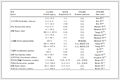
Table 1.
Selected Bond Lengths (Å) and Bond Angles (o) for 1 and 2

Two New Antimony(III) Chloride Hybrids Composed of Mononuclear [SbCl6]3- Unit and Ionic Liquid Cations with Different Length of Alkyl Chain
Zhi-Zhuan ZHANG , Jian-Ce JIN , Liao-Kuo GONG , Ke-Zhao DU , Xiao-Ying HUANG


Inorganic-organic hybrid metal halides (IOMHs) have received increasing attention because of their superior photophysical characteristics with potential applications in photovoltaics, solid-state lighting, etc.[1-10]. Zero dimensional (0D) IOMHs with structurally and electronically isolated halometallate species generally exhibit broadband emission mainly due to self-trapped excitons (STE) from the interaction of excitons with lattice and large structural reorganization in the excited state[11-14]. The STE emission has been observed in the hybrid compounds based on the metal ion with ns2 electron configuration, such as, Ge2+, Sn2+, Pb2+, Sb3+ and Bi3+[15-31].
Sb3+ coordinating with halogen ions X- (X = Cl, Br, I) can form haloantimonate(III) anions with rich structural moieties like [SbX4]-[32], [SbX5]2-[31, 33-41], [SbX6]3-[38, 42], [Sb2X7]-[43], [Sb2X8]2-[44], [Sb2X9]3-[45, 46], [Sb2X10]4-[47] and [Sb2X11]5-[48]. Among them, the mononuclear [SbCl5]2- unit is commonly used to construct photoluminescent (PL) 0D-IOMHs. Such IOMHs generally exhibit broadband emission over a wide range of spectrum originating from 3P1→1S0 transition[31, 33-41], mostly with a near-unity PL quantum yield (PLQY), e.g., in (C9NH20)2SbCl5 (C9NH20 = 1-butyl-1-methylpyrrolidinium)[40], (TEBA)2SbCl5 (TEBA = benzyltriethylammonium)[31], (Ph4P)2SbCl5 (Ph4P = tetraphenylphosphonium)[41], and (PPN)2SbCl5 (PPN = bis(triphenylphosphoranylidene) ammonium cation)[33]. The high PL efficiency might be attributed to the sufficient separation of the neighboring [SbCl5]2- units by cations leading to little-to-no interactions or electronic band formation[40]. Additionally, dual emission as well as white light emission in compounds (Bmim)2SbCl5 (Bmim = 1-butyl-3-methlimidazolium) and (TTA)2SbCl5 (TTA = tetraethylammonium) could be easily and con-veniently realized by adjusting the excitation wavelength[31, 39]. By introducing H2O molecules to expand the distance between [SbCl5]2- species and create more local photoelectrons for the [SbCl5]2- species, the PLQY of 25.3% in (C6N2H16)2SbCl5 (C6N2H16 = 2, 6-dimethylpiperazine) could be enhanced to 39.6% in (C6N2H16)2SbCl5·H2O[36]. These compounds have shown potential applications in emerging fields such as thermal imaging analysis[34], scintillator[33] and anti-counterfeiting luminescent paper[37, 38]. 0D-IOMHs with mononuclear [SbCl6]3- unit also have been widely reported based on CCDC database. However, their PL properties have been rarely demonstrated[38, 42]. Recently, it has been reported that (Bzmim)3SbCl6 (Bzmim = 1-benzyl-3-methylimidazolium) could exhibit green emission with high PLQY of 87.5%[38].
Ionic liquids (ILs), as a kind of "green" reagents and templates, exhibit various excellent properties, such as low volatility, large liquid ranges, nonflammability, and high stability[49-52]. Additionally, a wide variety of ILs and various substitution ways on the parent rings provide favorable conditions for obtaining diverse structures[53-55]. Herein, by using imidazolium based ILs with different-length alkyl chain as the solvent and template, two new hybrid chloroan-timonates, namely, [Prmim]3SbCl6 (1, Prmim = 1-propyl-3-methylimidazolium) and [Hmim]3SbCl6 (2, Hmim = 1-hexyl-3-methylimidazolium), were synthesized. Both feature a 0D structure with isolated [SbCl6]3- octahedron as confirmed by single-crystal X-ray diffraction (SCXRD). Under the excitation wavelength of 370 nm, 1 exhibits orange emission peak at 627 nm with a large Stokes shift of 257 nm, while 2 exhibits orange-yellow emission peak at 607 nm with a large Stokes shift of 242 nm excited at 365 nm. The PLQY for 1 and 2 are 32.5% and 49.2%, respectively. The distinct photophysical properties (emission peak, Stokes shift, and PLQY) of two compounds are revealed to be related to the distortion of isolated [SbCl6]3- octahedron by comparing the title [SbCl6]3- unit with those reported in literature[38, 42].
Antimony(III) chloride (SbCl3, 99%) was purchased from Adamas Reagent Co., Ltd. [Prmim]Cl (99%) and [Hmim]Cl (99%) were purchased from Lanzhou GreenChem ILs, LICP, CAS (Lanzhou, China). All the reagents were utilized without further purification.
Powder X-ray diffraction (PXRD) patterns were recorded on a Rigaku Miniflex II diffractometer with CuKα radiation (λ = 1.54178 Å) at room temperature. Elemental analyses (EA) for C, H and N were conducted on a German Elementary Vario MICRO instrument. Thermogravimetric (TG) analysis was performed on a NETZSCH STA 449F3 instrument at a heating rate of 10 K·min–1 under a N2 atmosphere from 20 to 800 ℃. Solid-state optical diffuse reflectance spectra were performed at room temperature on a Shimadzu 2600 UV/Vis spectrometer in a range of 200~800 nm. BaSO4 with 100% reflectance was used as a standard. The absorption data were obtained from reflectance spectra by using the Kubelka-Munk function α/S = (1 – R)2/2R[56], where α is the absorption coefficient, S the scattering coefficient, and R the reflectance. Photoluminescent excitation (PLE), PL spectra and PL decay spectra were recorded on an Edinburgh FLS1000 UV/V/NIR fluorescence spectrometer. PLQY of the title compounds were measured by the FLSP920(EI) fluorescence spectrometer.
A mixture of SbCl3 (0.2335 g, 1 mmol) and [Prmim]Cl (0.4882 g, 3 mmol) was sealed into a 28 mL Teflon-lined stainless-steel autoclave. In this reaction system, the ionic liquid [Prmim]Cl acts as both solvent and template. The container was closed, heated at 120 ℃ for 3 hours, and then cooled to room temperature naturally. Colourless and transparent block-like crystals were formed after certain time (around two weeks) at room temperature. Long crystallization time possibly relates to the viscosity of the ILs. Once the crystal nuclei were formed, many crystals would be precipitated, and finally 1 could be obtained in a high yield (yield: 0.7042 g, 97% based on Sb). Elemental analysis: calcd. (%) for C21H39N6SbCl6: C, 35.52; H, 5.53; N, 11.83. Found: C, 35.70; H, 6.11; N, 11.99.
A similar synthesis procedure as that for 1 was adopted except that a mixture of SbCl3 (1.1641 g, 5 mmol) and [Hmim]Cl (2.1408 g, 10 mmol) was used. Colourless and transparent block-like crystals were formed with the yield of 3.1045 g (72% based on Sb). Elemental analysis: calcd. (%) for C30H57N6SbCl6: C, 43.08; H, 6.86; N, 10.04. Found: C, 40.94; H, 6.83; N, 9.70.
The colorless-transparent block-like crystals 1 and 2 were selected for SCXRD experiment with dimensions of 0.39mm × 0.39mm × 0.20mm and 0.50mm × 0.25mm × 0.20mm, respectively. For 1, a total of 31441 reflections were collected in the range of 1.99°≤θ≤30.31° with Rint = 0.0371, 15049 of which are independent. Crystal 1 crystallizes in monoclinic, space group Pn with a = 15.2988(12), b = 13.6388(10), c = 15.6761(13) Å, β = 98.677(7)°, V = 3233.5(4) Å3, Z = 4, Dc = 1.459 g·cm-3, F(000) = 1440, μ = 1.370 mm-1, R = 0.0589 and wR = 0.1366 (I > 2σ(I)). For 2, 37899 total reflections were collected in 2.24°≤θ≤29.24° region with Rint = 0.0946, of which 9758 were independent. Crystal 2 is of hexagonal system, space group P63 with a = 27.7471(6), b = 27.7471(6), c = 8.9811(2) Å, V = 5988.2(3) Å3, Z = 6, Dc = 1.391 g·cm-3, F(000) = 2592, μ = 1.121 mm-1, R = 0.0420 and wR = 0.0726 (I > 2σ(I)). SHELX 2018 package was used to solve and refine the structure on F2 by full-matrix least-square methods[57]. Selected bond lengths and bond angles of 1 and 2 are shown in Table 1, and selected hydrogen bond parameters in Table 2.
 DownLoad:
CSV
DownLoad:
CSV
| Compound 1 | ||||
| Bond | Dist. | Bond | Dist. | |
| Sb(1)−Cl(2) | 2.552(3) | Sb(2)−Cl(10) | 2.529(3) | |
| Sb(1)−Cl(5) | 2.568(3) | Sb(2)−Cl(8) | 2.605(4) | |
| Sb(1)−Cl(3) | 2.576(4) | Sb(2)−Cl(12) | 2.617(4) | |
| Sb(1)−Cl(4) | 2.752(4) | Sb(2)−Cl(9) | 2.685(4) | |
| Sb(1)−Cl(1) | 2.754(4) | Sb(2)−Cl(11) | 2.738(4) | |
| Sb(1)−Cl(6) | 2.789(3) | Sb(2)−Cl(7) | 2.838(4) | |
| Angle | (°) | Angle | (°) | |
| Cl(2)−Sb(1)−Cl(5) | 89.77(13) | Cl(10)−Sb(2)−Cl(8) | 89.91(13) | |
| Cl(2)−Sb(1)−Cl(3) | 87.59(14) | Cl(10)−Sb(2)−Cl(12) | 90.11(14) | |
| Cl(5)−Sb(1)−Cl(3) | 90.89(14) | Cl(8)−Sb(2)−Cl(12) | 92.27(13) | |
| Cl(2)−Sb(1)−Cl(4) | 89.57(13) | Cl(10)−Sb(2)−Cl(9) | 86.76(13) | |
| Cl(5)−Sb(1)−Cl(4) | 178.50(16) | Cl(8)−Sb(2)−Cl(9) | 89.21(12) | |
| Cl(3)−Sb(1)−Cl(4) | 87.74(13) | Cl(12)−Sb(2)−Cl(9) | 176.53(13) | |
| Cl(2)−Sb(1)−Cl(1) | 88.75(12) | Cl(10)−Sb(2)−Cl(11) | 88.94(13) | |
| Cl(5)−Sb(1)−Cl(1) | 87.71(14) | Cl(8)−Sb(2)−Cl(11) | 178.46(12) | |
| Cl(3)−Sb(1)−Cl(1) | 176.08(15) | Cl(12)−Sb(2)−Cl(11) | 88.74(14) | |
| Cl(4)−Sb(1)−Cl(1) | 93.62(13) | Cl(9)−Sb(2)−Cl(11) | 89.72(13) | |
| Cl(2)−Sb(1)−Cl(6) | 178.27(14) | Cl(10)−Sb(2)−Cl(7) | 177.55(17) | |
| Cl(5)−Sb(1)−Cl(6) | 88.74(12) | Cl(8)−Sb(2)−Cl(7) | 88.10(13) | |
| Cl(3)−Sb(1)−Cl(6) | 91.55(13) | Cl(12)−Sb(2)−Cl(7) | 91.40(13) | |
| Cl(4)−Sb(1)−Cl(6) | 91.89(12) | Cl(9)−Sb(2)−Cl(7) | 91.79(12) | |
| Cl(1)−Sb(1)−Cl(6) | 92.08(12) | Cl(11)−Sb(2)−Cl(7) | 93.03(13) | |
| Compound 2 | ||||
| Bond | Dist. | Bond | Dist. | |
| Sb(1)−Cl(5) | 2.5480(15) | Sb(1)−Cl(6) | 2.6324(14) | |
| Sb(1)−Cl(1) | 2.6136(16) | Sb(1)−Cl(4) | 2.7367(15) | |
| Sb(1)−Cl(3) | 2.6324(15) | Sb(1)−Cl(2) | 2.7880(15) | |
| Angle | (°) | Angle | (°) | |
| Cl(5)−Sb(1)−Cl(1) | 89.60(5) | Cl(3)−Sb(1)−Cl(4) | 91.94(5) | |
| Cl(5)−Sb(1)−Cl(3) | 89.66(5) | Cl(6)−Sb(1)−Cl(4) | 85.57(5) | |
| Cl(1)−Sb(1)−Cl(3) | 90.41(5) | Cl(5)−Sb(1)−Cl(2) | 176.56(5) | |
| Cl(5)−Sb(1)−Cl(6) | 88.44(5) | Cl(1)−Sb(1)−Cl(2) | 90.00(5) | |
| Cl(1)−Sb(1)−Cl(6) | 92.06(5) | Cl(3)−Sb(1)−Cl(2) | 93.75(5) | |
| Cl(3)−Sb(1)−Cl(6) | 176.88(5) | Cl(6)−Sb(1)−Cl(2) | 88.16(4) | |
| Cl(5)−Sb(1)−Cl(4) | 89.67(5) | Cl(4)−Sb(1)−Cl(2) | 90.59(5) | |
| Cl(1)−Sb(1)−Cl(4) | 177.54(5) | |||
DownLoad:
CSV
| Compound 1 | ||||
| D−H···A | d(D−H) | d(H···A) | d(D···A) | ∠DHA |
| C(1)−H(1A)···Cl(7)#1 | 0.93 | 2.94 | 3.692(18) | 138.8 |
| C(2)−H(2A)···Cl(5)#2 | 0.93 | 2.88 | 3.743(17) | 154.1 |
| C(3)−H(3A)···Cl(6) | 0.93 | 2.76 | 3.549(15) | 142.7 |
| C(4)−H(4A)···Cl(7)#1 | 0.96 | 2.97 | 3.822(18) | 148.1 |
| C(4)−H(4B)···Cl(3) | 0.96 | 2.87 | 3.659(18) | 139.8 |
| C(8)−H(8A)···Cl(1)#3 | 0.93 | 2.82 | 3.585(15) | 140.7 |
| C(9)−H(9A)···Cl(7)#4 | 0.93 | 2.79 | 3.673(15) | 160.0 |
| C(10)−H(10A)···Cl(10)#3 | 0.93 | 2.94 | 3.710(14) | 141.4 |
| C(11)−H(11A)···Cl(4)#3 | 0.96 | 2.78 | 3.631(17) | 148.5 |
| C(11)−H(11C)···Cl(11)#3 | 0.96 | 2.78 | 3.606(17) | 144.9 |
| C(12)−H(12A)···Cl(9)#3 | 0.97 | 2.82 | 3.750(15) | 160.9 |
| C(12)−H(12B)···Cl(12)#4 | 0.97 | 2.75 | 3.617(15) | 148.6 |
| C(15)−H(15A)···Cl(11)#5 | 0.93 | 2.77 | 3.609(19) | 151.2 |
| C(16)−H(16A)···Cl(6)#6 | 0.93 | 2.88 | 3.763(18) | 159.9 |
| C(17)−H(17A)···Cl(8)#7 | 0.93 | 2.90 | 3.549(16) | 127.7 |
| C(17)−H(17A)···Cl(9)#7 | 0.93 | 2.89 | 3.618(16) | 135.6 |
| C(19)−H(19A)···Cl(10)#7 | 0.97 | 2.94 | 3.832(17) | 153.2 |
| C(19)−H(19B)···Cl(3)#6 | 0.97 | 2.73 | 3.616(16) | 151.6 |
| C(23)−H(23A)···Cl(1) | 0.93 | 2.62 | 3.46(2) | 150.0 |
| C(24)−H(24A)···Cl(9)#8 | 0.93 | 2.96 | 3.68(2) | 135.0 |
| C(25)−H(25A)···Cl(9)#8 | 0.96 | 2.56 | 3.50(3) | 165.4 |
| C(25)−H(25B)···Cl(12)#6 | 0.96 | 2.64 | 3.53(3) | 155.9 |
| C(26)−H(26A)···Cl(6) | 0.97 | 2.72 | 3.63(3) | 156.9 |
| C(27)−H(27B)···Cl(3)#9 | 0.97 | 2.95 | 3.74(3) | 140.4 |
| C(29)−H(29A)···Cl(1)#3 | 0.93 | 2.84 | 3.56(3) | 134.3 |
| C(30)−H(30A)···Cl(12)#7 | 0.93 | 2.84 | 3.73(3) | 162.3 |
| C(31)−H(31A)···Cl(2) | 0.93 | 2.61 | 3.34(3) | 135.8 |
| C(31)−H(31A)···Cl(3) | 0.93 | 2.87 | 3.66(2) | 143.6 |
| C(33)−H(33B)···Cl(8)#7 | 0.97 | 2.77 | 3.56(3) | 139.2 |
| C(36)−H(36A···Cl(2) | 0.93 | 2.39 | 3.275(19) | 158.4 |
| C(38)−H(38A)···Cl(11)#5 | 0.93 | 2.66 | 3.468(19) | 145.5 |
| C(39)−H(39A)···Cl(7)#5 | 0.96 | 2.83 | 3.60(3) | 137.7 |
| Compound 2 | ||||
| D−H···A | d(D−H) | d(H···A) | d(D···A) | ∠DHA |
| C(1)−H(1A)···Cl(5) | 0.95 | 2.72 | 3.582(7) | 151.1 |
| C(2)−H(2A)···Cl(3)#1 | 0.95 | 2.64 | 3.470(6) | 146.3 |
| C(3)−H(3A)···Cl(4)#2 | 0.95 | 2.77 | 3.573(6) | 143.3 |
| C(3)−H(3A)···Cl(6)#2 | 0.95 | 2.91 | 3.617(6) | 132.6 |
| C(4)−H(4A)···Cl(2)#2 | 0.98 | 2.68 | 3.570(6) | 151.8 |
| C(4)−H(4C)···Cl(1) | 0.98 | 2.90 | 3.761(7) | 146.6 |
| C(5)−H(5A)···Cl(6)#2 | 0.99 | 2.66 | 3.447(7) | 136.9 |
| C(5)−H(5B)···Cl(3)#1 | 0.99 | 2.91 | 3.808(7) | 151.0 |
| C(12)−H(12A)···Cl(2)#2 | 0.95 | 2.75 | 3.468(6) | 132.6 |
| C(13)−H(13A)···Cl(2)#1 | 0.95 | 2.64 | 3.449(6) | 143.1 |
| C(14)−H(14A)···Cl(6) | 0.98 | 2.79 | 3.368(6) | 118.0 |
| C(14)−H(14C)···Cl(2)#1 | 0.98 | 2.73 | 3.636(6) | 154.1 |
| C(15)−H(15A)···Cl(1)#1 | 0.99 | 2.72 | 3.590(6) | 146.3 |
| C(15)−H(15B)···Cl(6)#2 | 0.99 | 2.78 | 3.568(6) | 137.3 |
| C(15)−H(15A)···Cl(1)#1 | 0.99 | 2.72 | 3.590(6) | 146.3 |
| C(15)−H(15B)···Cl(6)#2 | 0.99 | 2.78 | 3.568(6) | 137.3 |
| C(21)−H(21A)···Cl(4)#1 | 0.95 | 2.90 | 3.683(6) | 140.8 |
| C(22)−H(22A)···Cl(5)#3 | 0.95 | 2.86 | 3.649(6) | 141.5 |
| C(23)−H(23A)···Cl(4) | 0.95 | 2.94 | 3.714(5) | 138.9 |
| C(23)−H(23A)···Cl(5) | 0.95 | 2.80 | 3.552(6) | 136.2 |
| C(24)−H(24A)···Cl(4)#1 | 0.98 | 2.80 | 3.736(5) | 159.2 |
| C(24)−H(24C)···Cl(6) | 0.98 | 2.79 | 3.495(6) | 129.4 |
| C(25)−H(25A)···Cl(4) | 0.99 | 2.86 | 3.668(6) | 139.8 |
| C(25)−H(25B)···Cl(3)#3 | 0.99 | 2.84 | 3.616(6) | 135.7 |
| Compound 1: Symmetry transformations: #1: x + 1/2, –y + 2, z – 1/2; #2: x + 1/2, –y + 1, z + 1/2; #3: x + 1/2, –y + 1, z – 1/2; #4: x, y – 1, z–1; #5: x – 1/2, –y + 2, z – 1/2; #6: x – 1/2, –y + 1, z – 1/2; #7: x, y, z – 1; #8: x, y – 1, z; #9: x – 1/2, –y + 1, z + 1/2 Compound 2: Symmetry transformations: #1: x, y, z + 1; #2: y, –x + y, z + 1/2; #3: –x + 1, –y + 1, z + 1/2 |
||||
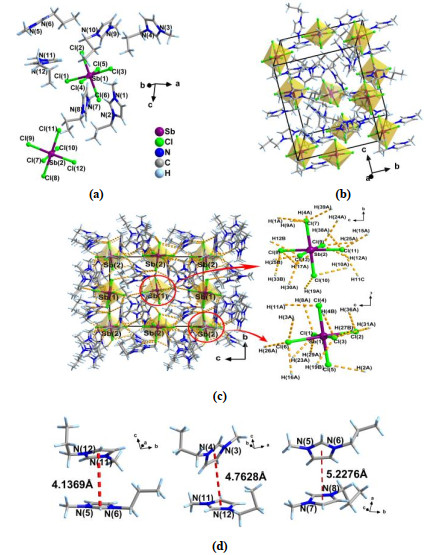
SCXRD analysis reveals that 1 crystallizes in the mono-clinic space group of Pn. As shown in Fig. 1a, the crystallographic asymmetric unit of 1 consists of six [Prmim]+ cations and two isolated [SbCl6]3- anions. Each Sb3+ atom in the crystal is coordinated with six Cl- atoms, forming a mononuclear [SbCl6]3- octahedron. The [SbCl6]3- units are completely separated from each other by [Prmim]+ cations (Fig. 1b). The bond lengths of Sb–Cl fall in the range of 2.529(3)~2.838(4) Å (Table 1), close to those in previously reported [Bzmim]3SbCl6 with a range from 2.4983(19) to 2.8679(19) Å[38]. 1 exhibits a three-dimensional supramolecular network considering the hydrogen bonds among [SbCl6]3- anions and [Prmim]+ cations (Fig. 1c, Table 2). As there are two unique [SbCl6]3- octahedra in the crystal with Sb(1)…Sb(2) distances of 10.1335(11) Å, the hydrogen bonding environments for them are dissimilar (Fig. 1c). Moreover, PLATON calculations indicate different patterns of π…π accumulation between two imidazole rings (Fig. 1d, Table 3).
 DownLoad:
CSV
DownLoad:
CSV
| Cg(I)→Cg(J) | Cg···Cg (Å) | α (°) | β (°) | γ (°) |
| Cg(3)→Cg(6) | 4.1369 | 26.51 | 19.68 | 8.15 |
| Cg(4)→Cg(3) | 5.2276 | 57.60 | 20.93 | 78.44 |
| Cg(6)→Cg(2) | 4.7628 | 62.21 | 9.23 | 61.86 |
| Cg(6)→Cg(3) | 4.1369 | 26.51 | 8.15 | 19.68 |
| Cg(3): N(5)→C(15)→C(16)→N(6)→C(17); Cg(4): N(7)→C(22)→C(23)→N(8)→C(24); Cg(6): N(11)→C(36)→C(37)→N(12)→C(38) | ||||
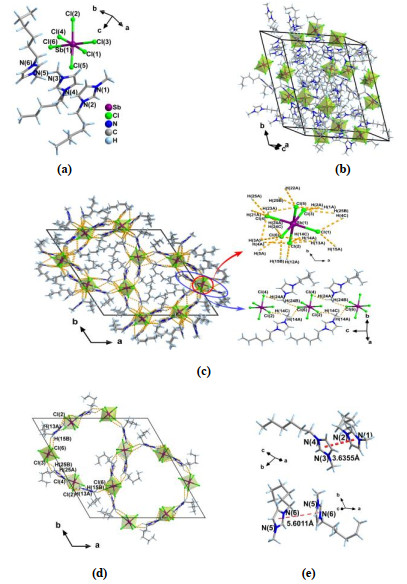
Single crystal of 2 belongs to the hexagonal space group of P63 and the crystallographic asymmetric unit contains three [Hmim]+ cations and one [SbCl6]3- anion, as shown in Fig. 2a. The mononuclear six-coordination [SbCl6]3- units are surrounded by imidazolium cations with a relatively long hexyl chain, resulting in a 0D structure (Fig. 2b). The Sb–Cl bond distances range from 2.5480(15) to 2.7880(15) Å (Table 1), also comparable to those of 2.4983(19)~2.8679(19) Å in [Bzmim]3SbCl6[38]. Hydrogen bonds are also observed in 2 (Table 2). The detailed hydrogen bonding environment for [SbCl6]3- anions are presented in Fig. 2c. The isolated [SbCl6]3- anions are connected to the neighbouring [Hmim]+ cations via C–H···Cl hydrogen bonds, some of which, such as C(13)–H(13A)···Cl(2), C(15)–H(13B)···Cl(6), C(25)–H(25B)···Cl(3) and C(25)–H(25A)···Cl(4), result in a 2D layer along the ab plane (Fig. 2d). Further connected by hydrogen bonds along the c axis (e.g., C(24)–H(24A)···Cl(4) and C(24)–H(24B)···Cl(6), Fig. 2c), a 3D supramolecular structure finally could be obtained. Additionally, π···π interactions between two imidazole rings in 2 were observed (Fig. 2e, Table 4).
 DownLoad:
CSV
DownLoad:
CSV
| Cg(I)→Cg(J) | Cg···Cg (Å) | α (°) | β (°) | γ (°) |
| Cg(1)→Cg(2) | 3.6355 | 6.54 | 26.46 | 20.59 |
| Cg(2)→Cg(1) | 3.6355 | 6.54 | 20.59 | 26.46 |
| Cg(3)→Cg(3) | 5.6011 | 22.02 | 43.29 | 65.06 |
| Cg(1): N(3)→C(11)→C(12)→N(4)→C(13); Cg(2): N(1)→C(1)→C(2)→N(2) →C(3); Cg(3): N(5)→C(21)→C(22)→N(6)→C(23) | ||||
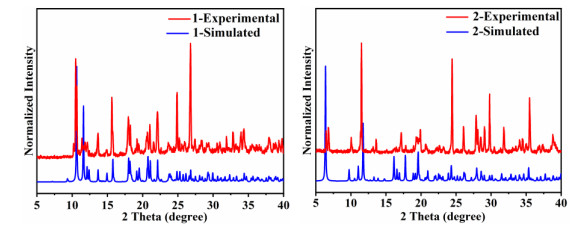
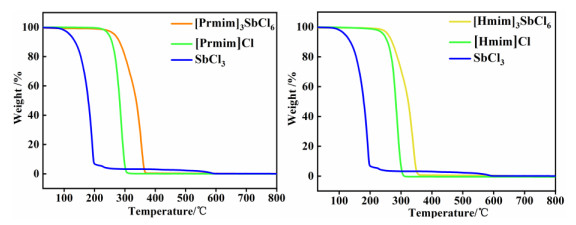
The phase purity of the title compounds was confirmed by PXRD (Fig. 3) and EA (Experimental section). TG analyses of 1 and 2 were performed under a N2 atmosphere from 20 to 800 ℃. As shown in Fig. 4, both compounds display a one-step weight loss from 250 to 370 ℃. Compared with the thermal decomposition procedure of SbCl3 and the corresponding ILs, clearly the thermal properties of the title compounds are highly related to the high thermal stability of ILs.
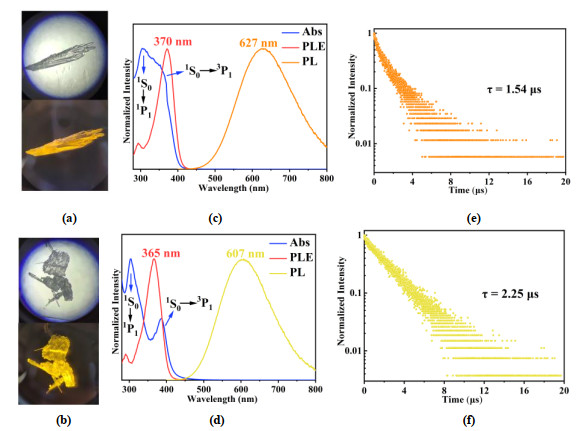
The photophysical properties of the title compounds were further characterized by solid-state optical absorption spectra, PLE, PL as well as PL decay spectra at room temperature. As shown in Figs. 5a and 5b, 1 exhibits bright orange emission under the irradiation of 370 nm light, slightly different from 2 which exhibits bright orange-yellow emission under the irradiation of 365 nm light. Both 1 and 2 represent a similarly colorless and transparent appearance under ambient light, suggesting nearly no absorption in the visible region, which is consistent with the optical absorption spectra, as shown in Figs. 5c and 5d. Based on the electron absorption transition of ns2 electron configuration ions, the two obvious absorption peaks in the absorption spectra can be assigned to 1S0 → 1P1 and 1S0 → 3P1 transition, respectively[58-60]. The PLE bands of 1 and 2 were consistent with the corresponding optical absorption spectra. Under the excitation of 370 nm light, the PL band of 1 is centered at 627 nm with a large Stokes shift of 257 nm, while the PL band of 2 peaks at 607 nm with a large Stokes shift of 242 nm excited at 365 nm. Broadband emissions of 1 and 2 could be ascribed to 3P1→1S0 transition from the Sb-based isolated halometallate species[31, 36, 38, 42, 60]. The microsecond PL lifetime for 1 and 2 is in accordance with that of the reported antimony halide hybrids (Figs. 5e and 5f)[38, 42].
In order to deeply understand the factor that affects the photophysical properties (PL band, Stokes shift, PLQY) of 1 and 2, the distortion degree of the isolated [SbCl6]3- unit in the title compounds and corresponding structures in literature was evaluated by using the following formulas[61-63]:
|
|
|
|
where θn are the Cl−Sb−Cl bond angles, dn are the Sb−Cl bond lengths, and d is the average of the Sb−Cl bond distances. The results of distortion associated with photophysical properties are summarized in Table 5. It can be found that the PL wavelength and Stokes shift increase with the increasing values of σ2 and Δd, especially in the case of compounds with a similar organic ligand (C6H22N4 = tris(2-aminoethyl)amine), which eliminates the influence of organic parts on luminescence. The trend is also observed for the compounds constructed from the ILs with different substituents (e.g., BzmimCl, PrmimCl, and HmimCl). Therefore, the red shift of PL wavelength and larger Stokes shift for 1 should be due to the relatively larger bond length variance (Δd) compared to that for 2. For PLQY, the trend is in contrast. It is decreasing with more distortion of the halometallate species. The higher extent of structural distortion might lead to more energy dissipation from non-radiative transition in the procedure of excited state reorganization into the symmetric structure, finally resulting in less radiative emission with weak luminescent intensity or weak PLQY in 1[42]
DownLoad:
CSV
| Compounds | PL (nm) | Emission colour | Stokes shift (nm) | PLQY (%) | σ2 | Δd (*10-4) | Ref |
| [(C6H22N4)2(Sb2Cl10) (SbCl6)(Cl)2(H3O)]·3(H2O) | 517 | Green | 165 | 45 | 5.95 | 0.03 | [42] |
| (C6H22N4)4(SbCl6)3(Cl)7·4(H2O) | 580 | Yellow | 200 | 43 | 9.57 | 0.18 | [42] |
| (C6H22N4)2(SbCl6)2(Cl)2·3(H2O) | 638 | Red | 290 | 6 | 105.14 | 90.79 | [42] |
| (Bzmim)3SbCl6 | 560 | Green | 202 | 87.5 | 5.54 | 10.08 | [38] |
| [Hmim]3SbCl6 (2) | 607 | Orange-yellow | 242 | 49.2 | 6.91 | 9.07 | Thiswork |
| [Prmim]3SbCl6 (1) | 627 | Orange | 257 | 32.5 | 6.24 | 14.30 | Thiswork |
In summary, by combining SbCl3 and the imidazolium based ILs with different lengths of alkyl chain, two new antimony(III) chloride hybrids featuring a mononuclear [SbCl6]3- unit were obtained. Compound 1 exhibits bright orange emission peaking at 627 nm with relatively larger Stokes shift of 257 nm. 2 exhibits bright orange-yellow emission peaking at 607 nm with Stokes shift of 242 nm. The PL peak, Stokes shift and PLQY for 1 and 2 are highly related to the extent of distortion of halometallate unit. Our studies enrich the family of [SbCl6]3- based luminescent IOMHs.
Gautier, R.; Massuyeau, F.; Galnon, G.; Paris, M. Lead halide post-perovskite-type chains for high-efficiency white-light emission. Adv. Mater. 2019, 31, 1807383−6. doi: 10.1002/adma.201807383
Gong, L. K.; Hu, Q. Q.; Huang, F. Q.; Zhang, Z. Z.; Shen, N. N.; Hu, B.; Song, Y.; Wang, Z. P.; Du, K. Z.; Huang, X. Y. Efficient modulation of photoluminescence by hydrogen bonding interactions between inorganic [MnBr4]2- anions and organic cations. Chem. Commun. 2019, 55, 7303−7306. doi: 10.1039/C9CC03038G
Lin, H. R.; Zhou, C. K.; Tian, Y.; Siegrist, T.; Ma, B. W. Low-dimensional organometal halide perovskites. ACS Energy Lett. 2017, 3, 54−62.
Saidaminov, M. I.; Mohammed, O. F.; Bakr, O. M. Low-dimensional-networked metal halide perovskites: the next big thing. ACS Energy Lett. 2017, 2, 889−896. doi: 10.1021/acsenergylett.6b00705
Shen, N. N.; Wang, Z. P.; Jin, J. C.; Gong, L. K.; Zhang, Z. Z.; Huang, X. Y. Phase transitions and photoluminescence switching in hybrid antimony(III) and bismuth(III) halides. CrystEngComm. 2020, 22, 3395−3405. doi: 10.1039/D0CE00057D
Tsai, H. H.; Nie, W. Y.; Blancon, J. C.; Toumpos, C. S.; Asadpour, R.; Harutyunyan, B.; Neukirch, A. J.; Verduzco, R.; Crochet, J. J.; Tretiak, S.; Pedesseau, L.; Even, J.; Alam, M. A.; Gupta, G.; Lou, J.; Ajayan, P. M.; Bedzyk, M. J.; Kanatzidis, M. G.; Mohite, A. D. High-efficiency two-dimensional Ruddlesden-Popper perovskite solar cells. Nature 2016, 536, 312−316. doi: 10.1038/nature18306
Worku, M.; Tian, Y.; Zhou, C. K.; Lee, S.; Meisner, Q.; Zhou, Y.; Ma, B. W. Sunlike white-light-emitting diodes based on zero-dimensional organic metal halide hybrids. ACS Appl. Mater. Interfaces 2018, 10, 30051−30057. doi: 10.1021/acsami.8b12474
Xuan, T. T.; Xie, R. J. Recent processes on light-emitting lead-free metal halide perovskites. Chem. Eng. J. 2020, 393, 124757−20. doi: 10.1016/j.cej.2020.124757
Zhou, C. K.; Lin, H. R.; He, Q. Q.; Xu, L. J.; Worku, M.; Chaaban, M.; Lee, S. J.; Shi, X. Q.; Du, M. H.; Ma, B. W. Low dimensional metal halide perovskites and hybrids. Mater. Sci. Eng. R 2019, 137, 38−65. doi: 10.1016/j.mser.2018.12.001
Zhou, C. K.; Lin, H. R.; Lee, S. J.; Chaaban, M.; Ma, B. W. Organic-inorganic metal halide hybrids beyond perovskites. Mater. Res. Lett. 2018, 6, 552−569. doi: 10.1080/21663831.2018.1500951
Li, M. Z.; Xia, Z. G. Recent progress of zero-dimensional luminescent metal halides. Chem. Soc. Rev. 2021DOI: 10.1039/d0cs00779j.
Wang, X. M.; Meng, W. W.; Liao, W. Q.; Wang, J. B.; Xiong, R. G.; Yan, Y. F. Atomistic mechanism of broadband emission in metal halide perovskites. J. Phys. Chem. Lett. 2019, 10, 501−506. doi: 10.1021/acs.jpclett.8b03717
Zhou, C. K.; Xu, L. J.; Lee, S. J.; Lin, H. R.; Ma, B. W. Recent advances in luminescent zero-dimensional organic metal halide hybrids. Adv. Opt. Mater. 2020, 2001766−17.
Zhou, G. J.; Su, B. B.; Huang, J. L.; Zhang, Q. Y.; Xia, Z. G. Broad-band emission in metal halide perovskites: mechanism, materials, and applications. Mater. Sci. Eng. R 2020, 141, 100548−21. doi: 10.1016/j.mser.2020.100548
Benin, B. M.; Dirin, D. N.; Morad, V.; Worle, M.; Yakunin, S.; Raino, G.; Nazarenko, O.; Fischer, M.; Infante, I.; Kovalenko, M. V. Highly emissive self-trapped excitons in fully inorganic zero-dimensional tin halides. Angew. Chem. Int. Ed. 2018, 57, 11329−11333. doi: 10.1002/anie.201806452
Dohner, E. R.; Jaffe, A.; Bradshaw, L. R.; Karunadasa, H. I. Intrinsic white-light emission from layered hybrid perovskites. J. Am. Chem. Soc. 2014, 136, 13154−13157. doi: 10.1021/ja507086b
Fu, P. F.; Huang, M. L.; Shang, Y. Q.; Yu, N.; Zhou, H. L.; Zhang, Y. B.; Chen, S. Y.; Gong, J. K.; Ning, Z. J. Organic-inorganic layered and hollow tin bromide perovskite with tunable broadband Emission. ACS Appl. Mater. Interfaces 2018, 10, 34363−34369. doi: 10.1021/acsami.8b07673
Kshirsagar, A. S.; Nag, A. Synthesis and optical properties of colloidal Cs2AgSb1-xBixCl6 double perovskite nanocrystals. J. Chem. Phys. 2019, 151, 161101−6. doi: 10.1063/1.5127971
Mao, L. L.; Guo, P. J.; Kepenekian, M.; Hadar, I.; Katan, C.; Even, J.; Schaller, R. D.; Stoumpos, C. C.; Kanatzidis, M. G. Structural diversity in white-light-emitting hybrid lead bromide perovskites. J. Am. Chem. Soc. 2018, 140, 13078−13088. doi: 10.1021/jacs.8b08691
Morad, V.; Shynkarenko, Y.; Yakunin, S.; Brumberg, A.; Schaller, R. D.; Kovalenko, M. V. Disphenoidal zero-dimensional lead, tin, and germanium halides: highly emissive singlet and triplet self-trapped excitons and X-ray scintillation. J. Am. Chem. Soc. 2019, 141, 9764−9768. doi: 10.1021/jacs.9b02365
Song, G. M.; Li, M. Z.; Yang, Y.; Liang, F.; Huang, Q.; Liu, X. M.; Gong, P. F.; Xia, Z. G.; Lin, Z. S. Lead-free tin(IV)-based organic-inorganic metal halide hybrids with excellent stability and blue-broadband emission. J. Phys. Chem. Lett. 2020, 11, 1808−1813. doi: 10.1021/acs.jpclett.0c00096
Su, B. B.; Song, G. M.; Molokeev, M. S.; Lin, Z. S.; Xia, Z. G. Synthesis, crystal structure and green luminescence in zero-dimensional tin halide (C8H14N2)2SnBr6. Inorg. Chem. 2020, 58, 9962−9968.
Tan, Z. F.; Li, J. H.; Zhang, C.; Li, Z.; Hu, Q. S.; Xiao, Z. W.; Kamiya, T.; Hosono, H.; Niu, G.; Lifshitz, E.; Cheng, Y.; Tang, J. Highly efficient blue-emitting bi-doped Cs2SnCl6 perovskite variant: photoluminescence induced by impurity doping. Adv. Funct. Mater. 2018 1801131−10.
Yangui, A.; Roccanova, R.; Wu, Y.; Du, M. H.; Saparov, B. Highly efficient broad-band luminescence involving organic and inorganic molecules in a zero-dimensional hybrid lead chloride. J. Phys. Chem. C 2019, 123, 22470−22477. doi: 10.1021/acs.jpcc.9b05509
Zhao, Y.; Zhou, C. K.; Tian, Y.; Shu, Y.; Messier, J.; Wang, J. C.; Van De Burgt, L. J.; Kountouriotis, K.; Xin, Y.; Holt, E.; Schanze, K.; Clark, R.; Siegrist, T.; Ma, B. W. One-dimensional organic lead halide perovskites with efficient bluish white-light emission. Nat. Commun. 2017, 8, 14051−7. doi: 10.1038/ncomms14051
Zhang, R. L.; Mao, X.; Yang, Y.; Yang, S. Q.; Zhao, W. Y.; Wumaier, T.; Wei, D. H.; Deng, W. Q.; Han, K. L. Air-stable, lead-free zero-dimensional mixed bismuth-antimony perovskite single crystals with ultra-broadband emission. Angew. Chem. Int. Ed. 2019, 58, 2725−2729. doi: 10.1002/anie.201812865
Zhou, C. K.; Lin, H. R.; Neu, J.; Zhou, Y.; Chaaban, M.; Lee, S. J.; Worku, M.; Chen, B. H.; Clark, R.; Cheng, W. H.; Guan, J. J.; Djurovich, P.; Zhang, D. Z.; Lü, X. J.; Bullock, J.; Pak, C.; Shatruk, M.; Du, M. H.; Siegrist, T.; Ma, B. W. Green emitting single-crystalline bulk assembly of metal halide clusters with near-unity photoluminescence quantum efficiency. ACS Energy Lett. 2019, 4, 1579−1583. doi: 10.1021/acsenergylett.9b00991
Zhou, C. K.; Lin, H. R.; Shi, H. L.; Tian, Y.; Pak, C.; Shatruk, M.; Zhou, Y.; Djurovich, P.; Du, M. H.; Ma, B. W. A zero-dimensional organic seesaw-shaped tin bromide with highly efficient strongly stokes-shifted deep-red emission. Angew. Chem. Int. Ed. 2017, 57, 1021−1024.
Zhou, C. K.; Lin, H. R.; Worku, M.; Neu, J.; Zhou, Y.; Tian, Y.; Lee, S. J.; Djurovich, P.; Siegrist, T.; Ma, B. W. Blue emitting single crystalline assembly of metal halide clusters. J. Am. Chem. Soc. 2018, 140, 13181−13184. doi: 10.1021/jacs.8b07731
Zhou, C. K.; Tian, Y.; Wang, M. C.; Rose, A.; Besara, T.; Doyle, N. K.; Yuan, Z.; Wang, J. C.; Clark, R.; Hu, Y. Y.; Siegrist, T.; Lin, S. C.; Ma, B. W. Low-dimensional organic tin bromide perovskites and their photoinduced structural transformation. Angew. Chem. Int. Ed. 2017, 56, 9018−9022. doi: 10.1002/anie.201702825
Li, Z. Y.; Li, Y.; Liang, P.; Zhou, T. L.; Wang, L.; Xie, R. J. Dual-band luminescent lead-free antimony chloride halides with near-unity photoluminescence quantum efficiency. Chem. Mater. 2019, 31, 9363−9371. doi: 10.1021/acs.chemmater.9b02935
Elleuch, N.; Lhoste, J.; Boujelbene, M. Characterization, Hirshfeld surface analysis and vibrational properties of 2, 6-diaminopurinium chloride tetrachloroantimonates(III) monohydrate (C5H8N6)[SbCl4]Cl∙H2O. J. Mol. Struct. 2020, 1217, 128386−11. doi: 10.1016/j.molstruc.2020.128386
He, Q. Q.; Zhou, C. K.; Xu, L. J.; Lee, S. J.; Lin, X. S.; Neu, J.; Worku, M.; Chaaban, M.; Ma, B. W. Highly stable organic antimony halide crystals for X-ray scintillation. ACS Mater. Lett. 2020, 2, 633−638. doi: 10.1021/acsmaterialslett.0c00133
Morad, V.; Yakunin, S.; Kovalenko, M. V. Supramolecular approach for fine-tuning of the bright luminescence from zero-dimensional antimony(III) halides. ACS Mater. Lett. 2020, 2, 845−852. doi: 10.1021/acsmaterialslett.0c00174
Sedakova, T. V.; Mirochnik, A. G. Luminescence of antimony(III) halogenides complexes with 2-and 4-benzylpyridine. Russ. J. Phys. Chem. A 2017, 91, 791−795. doi: 10.1134/S0036024417030256
Song, G. M.; Li, M. Z.; Zhang, S. Z.; Wang, N. Z.; Gong, P. F.; Xia, Z. G.; Lin, Z. S. Enhancing photoluminescence quantum yield in 0D metal halides by introducing water molecules. Adv. Funct. Mater. 2020, 30, 2002468−6. doi: 10.1002/adfm.202002468
Wang, Z. P.; Xie, D. L.; Zhang, F.; Yu, J. B.; Chen, X. P.; Wong, C. P. Controlling information duration on rewritable luminescent paper based on hybrid antimony(III) chloride/small-molecule absorbates. Sci. Adv. 2020, 6, eabc2181−10. doi: 10.1126/sciadv.abc2181
Wang, Z. P.; Zhang, Z. Z.; Tao, L. Q.; Shen, N. N.; Hu, B.; Gong, L. K.; Li, J. R.; Chen, X. P.; Huang, X. Y. Hybrid chloroantimonates(III): thermally induced triple-mode reversible luminescent switching and laser-printable rewritable luminescent paper. Angew. Chem. Int. Ed. 2019, 58, 9974−9978. doi: 10.1002/anie.201903945
Wang, Z. P.; Wang, J. Y.; Li, J. R.; Feng, M. L.; Zou, G. D.; Huang, X. Y. [Bmim]2SbCl5: a main group metal-containing ionic liquid exhibiting tunable photoluminescence and white-light emission. Chem. Commun. 2015, 51, 3094−3097. doi: 10.1039/C4CC08825E
Zhou, C. K.; Lin, H. R.; Tian, Y.; Yuan, Z.; Clark, R.; Chen, B. H.; Van De Burgt, L. J.; Wang, J. C.; Zhou, Y.; Hanson, K.; Meisner, Q. J.; Neu, J.; Besara, T.; Siegrist, T.; Lambers, E.; Djurovich, P.; Ma, B. W. Luminescent zero-dimensional organic metal halide hybrids with near-unity quantum efficiency. Chem. Sci. 2018, 9, 586−593. doi: 10.1039/C7SC04539E
Zhou, C. K.; Worku, M.; Neu, J.; Lin, H. R.; Tian, Y.; Lee, S. J.; Zhou, Y.; Han, D.; Chen, S. Y.; Hao, A.; Djurovich, P. I.; Siegrist, T.; Du, M. H.; Ma, B. W. Facile preparation of light emitting organic metal halide crystals with near-unity quantum efficiency. Chem. Mater. 2018, 30, 2374−2378. doi: 10.1021/acs.chemmater.8b00129
Biswas, A.; Bakthavatsalam, R.; Mali, B. P.; Bahadur, V.; Biswas, C.; Raavi, S. S. K.; Gonnade, R. G.; Kundu, J. The metal halide structure and the extent of distortion control the photo-physical properties of luminescent zero dimensional organic-antimony(III) halide hybrids. J. Mater. Chem. C 2021, 9, 348−358. doi: 10.1039/D0TC03440A
Chen, F.; Wang, S.; Li, Y. H.; Huang, W. Effects of anionic geometries on hydrogen-bonding networks of 1-(4-pyridyl) piperazine. J. Chem. Crystallogr. 2016, 46, 309−323. doi: 10.1007/s10870-016-0662-y
Wojciechowska, M.; Szklarz, P.; Bialonska, A.; Baran, J.; Janicki, R.; Medycki, W.; Durlak, P.; Piecha-Bisiorek, A.; Jakubas, R. Enormous lattice distortion through an isomorphous phase transition in an organic-inorganic hybrid based on haloantimonate(III). CrystEngComm. 2016, 18, 6184−6194. doi: 10.1039/C6CE01008C
Parmar, S.; Pal, S.; Biswas, A.; Gosavi, S.; Chakraborty, S.; Reddy, M. C.; Ogale, S. Designing a new family of oxonium-cation based structurally diverse organic-inorganic hybrid iodoantimonate crystals. Chem. Commun. 2019, 55, 7562−7565. doi: 10.1039/C9CC03485D
Wojtas, M.; Jakubas, R.; Ciunik, Z.; Medycki, W. Structure and phase transitions in [(CH3)4P]3Sb2Br9 and [(CH3)4P]3Bi2Br9. J. Solid State Chem. 2004, 177, 1575−1584. doi: 10.1016/j.jssc.2003.12.011
Benin, B. M.; Mccall, K. M.; Worle, M.; Morad, V.; Aebli, M.; Yakunin, S.; Shynkarenko, Y.; Kovalenko, M. V. The Rb7Bi3-3xSb3xCl16 family: a fully inorganic solid solution with room-temperature luminescent members. Angew. Chem. Int. Ed. 2020, 59, 14490−14497. doi: 10.1002/anie.202003822
Plecha, A.; Pietraszko, A.; Bator, G.; Jakubas, R. Structural characterization and ferroelectric ordering in (C3N2H5)5Sb2Br11. J. Solid State Chem. 2008, 181, 1155−1166. doi: 10.1016/j.jssc.2008.02.029
Ma, Z.; Yu, J. H.; Dai, S. Preparation of inorganic materials using ionic liquids. Adv. Mater. 2010, 22, 261−285. doi: 10.1002/adma.200900603
Olivier-Bourbigou, H.; Magna, L.; Morvan, D. Ionic liquids and catalysis: recent progress from knowledge to applications. Appl. Catal. A-Gen. 2010, 373, 1−56. doi: 10.1016/j.apcata.2009.10.008
Plechkova, N. V.; Seddon, K. R. Applications of ionic liquids in the chemical industry. Chem. Soc. Rev. 2008, 37, 123−150. doi: 10.1039/B006677J
Zhang, S. G.; Zhang, Q. H.; Zhang, Y.; Chen, Z. J.; Watanabe, M.; Deng, Y. Q. Beyond solvents and electrolytes: Ionic liquids-based advanced functional materials. Prog. Mater. Sci. 2016, 77, 80−124. doi: 10.1016/j.pmatsci.2015.10.001
Li, H. R.; Liu, P.; Shao, H. F.; Wang, Y. G.; Zheng, Y. X.; Sun, Z.; Chen, Y. H. Green synthesis of luminescent soft materials derived from task-specific ionic liquid for solubilizing lanthanide oxides and organic ligand. J. Mater. Chem. 2009, 19, 5533−5540. doi: 10.1039/b902663k
Torimoto, T.; Tsuda, T.; Okazaki, K.; Kuwabata, S. New frontiers in materials science opened by ionic liquids. Adv. Mater. 2010, 22, 1196−1221. doi: 10.1002/adma.200902184
Ichikawa, T.; Kato, T.; Ohno, H. Dimension control of ionic liquids. Chem. Commun. 2019, 55, 8205−8214. doi: 10.1039/C9CC04280F
Wendlandt, W. M.; Hecht, H. G. Reflectance Spectroscopy. Interscience, New York 1966.
Sheldrick, G. M. Crystal structure refinement with SHELXL. Acta Crystallogr. Sect. C 2015, 71, 3−8.
Vogler, A.; Nikol, H. Photochemistry and photophysics of coordination compounds of the main group metals. Pure Appl. Chem. 1992, 64, 1311−1317. doi: 10.1351/pac199264091311
Nikol, H.; Vogler, A. Photoluminescence of antimony(III) and bismuth(III) complexes in solution. J. Am. Chem. Soc. 1991, 113, 8988−8990. doi: 10.1021/ja00023a081
Vogler, A.; Nikol, H. The structures of s2 metal complexes in the ground and sp excited states. Comments Inorg. Chem. 1993, 14, 245−261. doi: 10.1080/02603599308048663
Robinson, K.; Gibbs, G. V.; Ribbe, P. H. Quadriatic elongation-quantitative measure of distortion in coordination polyhedra. Science 1971, 172, 567−570. doi: 10.1126/science.172.3983.567
Yin, J. L.; Zhang, G. Y.; Peng, C. D.; Fei, H. H. An ultrastable metal-organic material emits efficient and broadband bluish white-light emission for luminescent thermometers. Chem. Commun. 2019, 55, 1702−1705. doi: 10.1039/C8CC08726A
Zhou, L.; Liao, J. F.; Huang, Z. G.; Wei, J. H.; Wang, X. D.; Chen, H. Y.; Kuang, D. B. Intrinsic self-trapped emission in 0D lead-free (C4H14N2)2In2Br10 single crystal. Angew. Chem. Int. Ed. 2019, 58, 15435−15440. doi: 10.1002/anie.201907503

Figure 1 (a) Asymmetric unit of compound 1. (b) A diagram showing packing of anions and cations in one unit cell of 1. (c) Three-dimensional supramolecular network for 1 considering hydrogen bonds (left) and the hydrogen bonding environment around the [Sb(1)Cl6]3- and [Sb(2)Cl6]3- anions (right). (d) Selected π…π interactions in 1

Figure 2 (a) Asymmetric unit of compound 2. (b) A diagram showing packing of anions and cations in one unit cell of 2. (c) Three-dimensional supramolecular network for 2 considering hydrogen bonds (left) and the hydrogen bonding environment around the [Sb(1)Cl6]3- anion as well as a one-dimensional supramolecular chain along the c axis for 2 considering partial hydrogen bonds (right). (d) Two-dimensional supramolecular network for 2, considering various hydrogen bonds along he ab plane. t Partial [Hmim]+ cations and hydrogen bonds are omitted for clarity. (e) Selected π…π interactions in 2

Figure 3 Comparison of PXRD patterns of the title compounds with the corresponding simulated ones

Figure 4 Comparison of the thermogravimetric curves of the title compounds and SbCl3 as well as the corresponding ionic liquids

Figure 5 (a) Single crystal of 1 under ambient light (up) and UV light (down). (b) Single crystal of 2 under ambient light (up) and UV light (down). (c) Optical absorption/PLE/PL spectra for 1. (d) Optical absorption/PLE/PL spectra for 2. (e) PL decay spectra for 1. (f) PL decay spectra for 2
Table 1. Selected Bond Lengths (Å) and Bond Angles (o) for 1 and 2
| Compound 1 | ||||
| Bond | Dist. | Bond | Dist. | |
| Sb(1)−Cl(2) | 2.552(3) | Sb(2)−Cl(10) | 2.529(3) | |
| Sb(1)−Cl(5) | 2.568(3) | Sb(2)−Cl(8) | 2.605(4) | |
| Sb(1)−Cl(3) | 2.576(4) | Sb(2)−Cl(12) | 2.617(4) | |
| Sb(1)−Cl(4) | 2.752(4) | Sb(2)−Cl(9) | 2.685(4) | |
| Sb(1)−Cl(1) | 2.754(4) | Sb(2)−Cl(11) | 2.738(4) | |
| Sb(1)−Cl(6) | 2.789(3) | Sb(2)−Cl(7) | 2.838(4) | |
| Angle | (°) | Angle | (°) | |
| Cl(2)−Sb(1)−Cl(5) | 89.77(13) | Cl(10)−Sb(2)−Cl(8) | 89.91(13) | |
| Cl(2)−Sb(1)−Cl(3) | 87.59(14) | Cl(10)−Sb(2)−Cl(12) | 90.11(14) | |
| Cl(5)−Sb(1)−Cl(3) | 90.89(14) | Cl(8)−Sb(2)−Cl(12) | 92.27(13) | |
| Cl(2)−Sb(1)−Cl(4) | 89.57(13) | Cl(10)−Sb(2)−Cl(9) | 86.76(13) | |
| Cl(5)−Sb(1)−Cl(4) | 178.50(16) | Cl(8)−Sb(2)−Cl(9) | 89.21(12) | |
| Cl(3)−Sb(1)−Cl(4) | 87.74(13) | Cl(12)−Sb(2)−Cl(9) | 176.53(13) | |
| Cl(2)−Sb(1)−Cl(1) | 88.75(12) | Cl(10)−Sb(2)−Cl(11) | 88.94(13) | |
| Cl(5)−Sb(1)−Cl(1) | 87.71(14) | Cl(8)−Sb(2)−Cl(11) | 178.46(12) | |
| Cl(3)−Sb(1)−Cl(1) | 176.08(15) | Cl(12)−Sb(2)−Cl(11) | 88.74(14) | |
| Cl(4)−Sb(1)−Cl(1) | 93.62(13) | Cl(9)−Sb(2)−Cl(11) | 89.72(13) | |
| Cl(2)−Sb(1)−Cl(6) | 178.27(14) | Cl(10)−Sb(2)−Cl(7) | 177.55(17) | |
| Cl(5)−Sb(1)−Cl(6) | 88.74(12) | Cl(8)−Sb(2)−Cl(7) | 88.10(13) | |
| Cl(3)−Sb(1)−Cl(6) | 91.55(13) | Cl(12)−Sb(2)−Cl(7) | 91.40(13) | |
| Cl(4)−Sb(1)−Cl(6) | 91.89(12) | Cl(9)−Sb(2)−Cl(7) | 91.79(12) | |
| Cl(1)−Sb(1)−Cl(6) | 92.08(12) | Cl(11)−Sb(2)−Cl(7) | 93.03(13) | |
| Compound 2 | ||||
| Bond | Dist. | Bond | Dist. | |
| Sb(1)−Cl(5) | 2.5480(15) | Sb(1)−Cl(6) | 2.6324(14) | |
| Sb(1)−Cl(1) | 2.6136(16) | Sb(1)−Cl(4) | 2.7367(15) | |
| Sb(1)−Cl(3) | 2.6324(15) | Sb(1)−Cl(2) | 2.7880(15) | |
| Angle | (°) | Angle | (°) | |
| Cl(5)−Sb(1)−Cl(1) | 89.60(5) | Cl(3)−Sb(1)−Cl(4) | 91.94(5) | |
| Cl(5)−Sb(1)−Cl(3) | 89.66(5) | Cl(6)−Sb(1)−Cl(4) | 85.57(5) | |
| Cl(1)−Sb(1)−Cl(3) | 90.41(5) | Cl(5)−Sb(1)−Cl(2) | 176.56(5) | |
| Cl(5)−Sb(1)−Cl(6) | 88.44(5) | Cl(1)−Sb(1)−Cl(2) | 90.00(5) | |
| Cl(1)−Sb(1)−Cl(6) | 92.06(5) | Cl(3)−Sb(1)−Cl(2) | 93.75(5) | |
| Cl(3)−Sb(1)−Cl(6) | 176.88(5) | Cl(6)−Sb(1)−Cl(2) | 88.16(4) | |
| Cl(5)−Sb(1)−Cl(4) | 89.67(5) | Cl(4)−Sb(1)−Cl(2) | 90.59(5) | |
| Cl(1)−Sb(1)−Cl(4) | 177.54(5) | |||
 下载: 导出CSV
Table 2. Selected Hydrogen Bond Lengths (Å) and Bond Angles (°) for 1 and 2
| Compound 1 | ||||
| D−H···A | d(D−H) | d(H···A) | d(D···A) | ∠DHA |
| C(1)−H(1A)···Cl(7)#1 | 0.93 | 2.94 | 3.692(18) | 138.8 |
| C(2)−H(2A)···Cl(5)#2 | 0.93 | 2.88 | 3.743(17) | 154.1 |
| C(3)−H(3A)···Cl(6) | 0.93 | 2.76 | 3.549(15) | 142.7 |
| C(4)−H(4A)···Cl(7)#1 | 0.96 | 2.97 | 3.822(18) | 148.1 |
| C(4)−H(4B)···Cl(3) | 0.96 | 2.87 | 3.659(18) | 139.8 |
| C(8)−H(8A)···Cl(1)#3 | 0.93 | 2.82 | 3.585(15) | 140.7 |
| C(9)−H(9A)···Cl(7)#4 | 0.93 | 2.79 | 3.673(15) | 160.0 |
| C(10)−H(10A)···Cl(10)#3 | 0.93 | 2.94 | 3.710(14) | 141.4 |
| C(11)−H(11A)···Cl(4)#3 | 0.96 | 2.78 | 3.631(17) | 148.5 |
| C(11)−H(11C)···Cl(11)#3 | 0.96 | 2.78 | 3.606(17) | 144.9 |
| C(12)−H(12A)···Cl(9)#3 | 0.97 | 2.82 | 3.750(15) | 160.9 |
| C(12)−H(12B)···Cl(12)#4 | 0.97 | 2.75 | 3.617(15) | 148.6 |
| C(15)−H(15A)···Cl(11)#5 | 0.93 | 2.77 | 3.609(19) | 151.2 |
| C(16)−H(16A)···Cl(6)#6 | 0.93 | 2.88 | 3.763(18) | 159.9 |
| C(17)−H(17A)···Cl(8)#7 | 0.93 | 2.90 | 3.549(16) | 127.7 |
| C(17)−H(17A)···Cl(9)#7 | 0.93 | 2.89 | 3.618(16) | 135.6 |
| C(19)−H(19A)···Cl(10)#7 | 0.97 | 2.94 | 3.832(17) | 153.2 |
| C(19)−H(19B)···Cl(3)#6 | 0.97 | 2.73 | 3.616(16) | 151.6 |
| C(23)−H(23A)···Cl(1) | 0.93 | 2.62 | 3.46(2) | 150.0 |
| C(24)−H(24A)···Cl(9)#8 | 0.93 | 2.96 | 3.68(2) | 135.0 |
| C(25)−H(25A)···Cl(9)#8 | 0.96 | 2.56 | 3.50(3) | 165.4 |
| C(25)−H(25B)···Cl(12)#6 | 0.96 | 2.64 | 3.53(3) | 155.9 |
| C(26)−H(26A)···Cl(6) | 0.97 | 2.72 | 3.63(3) | 156.9 |
| C(27)−H(27B)···Cl(3)#9 | 0.97 | 2.95 | 3.74(3) | 140.4 |
| C(29)−H(29A)···Cl(1)#3 | 0.93 | 2.84 | 3.56(3) | 134.3 |
| C(30)−H(30A)···Cl(12)#7 | 0.93 | 2.84 | 3.73(3) | 162.3 |
| C(31)−H(31A)···Cl(2) | 0.93 | 2.61 | 3.34(3) | 135.8 |
| C(31)−H(31A)···Cl(3) | 0.93 | 2.87 | 3.66(2) | 143.6 |
| C(33)−H(33B)···Cl(8)#7 | 0.97 | 2.77 | 3.56(3) | 139.2 |
| C(36)−H(36A···Cl(2) | 0.93 | 2.39 | 3.275(19) | 158.4 |
| C(38)−H(38A)···Cl(11)#5 | 0.93 | 2.66 | 3.468(19) | 145.5 |
| C(39)−H(39A)···Cl(7)#5 | 0.96 | 2.83 | 3.60(3) | 137.7 |
| Compound 2 | ||||
| D−H···A | d(D−H) | d(H···A) | d(D···A) | ∠DHA |
| C(1)−H(1A)···Cl(5) | 0.95 | 2.72 | 3.582(7) | 151.1 |
| C(2)−H(2A)···Cl(3)#1 | 0.95 | 2.64 | 3.470(6) | 146.3 |
| C(3)−H(3A)···Cl(4)#2 | 0.95 | 2.77 | 3.573(6) | 143.3 |
| C(3)−H(3A)···Cl(6)#2 | 0.95 | 2.91 | 3.617(6) | 132.6 |
| C(4)−H(4A)···Cl(2)#2 | 0.98 | 2.68 | 3.570(6) | 151.8 |
| C(4)−H(4C)···Cl(1) | 0.98 | 2.90 | 3.761(7) | 146.6 |
| C(5)−H(5A)···Cl(6)#2 | 0.99 | 2.66 | 3.447(7) | 136.9 |
| C(5)−H(5B)···Cl(3)#1 | 0.99 | 2.91 | 3.808(7) | 151.0 |
| C(12)−H(12A)···Cl(2)#2 | 0.95 | 2.75 | 3.468(6) | 132.6 |
| C(13)−H(13A)···Cl(2)#1 | 0.95 | 2.64 | 3.449(6) | 143.1 |
| C(14)−H(14A)···Cl(6) | 0.98 | 2.79 | 3.368(6) | 118.0 |
| C(14)−H(14C)···Cl(2)#1 | 0.98 | 2.73 | 3.636(6) | 154.1 |
| C(15)−H(15A)···Cl(1)#1 | 0.99 | 2.72 | 3.590(6) | 146.3 |
| C(15)−H(15B)···Cl(6)#2 | 0.99 | 2.78 | 3.568(6) | 137.3 |
| C(15)−H(15A)···Cl(1)#1 | 0.99 | 2.72 | 3.590(6) | 146.3 |
| C(15)−H(15B)···Cl(6)#2 | 0.99 | 2.78 | 3.568(6) | 137.3 |
| C(21)−H(21A)···Cl(4)#1 | 0.95 | 2.90 | 3.683(6) | 140.8 |
| C(22)−H(22A)···Cl(5)#3 | 0.95 | 2.86 | 3.649(6) | 141.5 |
| C(23)−H(23A)···Cl(4) | 0.95 | 2.94 | 3.714(5) | 138.9 |
| C(23)−H(23A)···Cl(5) | 0.95 | 2.80 | 3.552(6) | 136.2 |
| C(24)−H(24A)···Cl(4)#1 | 0.98 | 2.80 | 3.736(5) | 159.2 |
| C(24)−H(24C)···Cl(6) | 0.98 | 2.79 | 3.495(6) | 129.4 |
| C(25)−H(25A)···Cl(4) | 0.99 | 2.86 | 3.668(6) | 139.8 |
| C(25)−H(25B)···Cl(3)#3 | 0.99 | 2.84 | 3.616(6) | 135.7 |
| Compound 1: Symmetry transformations: #1: x + 1/2, –y + 2, z – 1/2; #2: x + 1/2, –y + 1, z + 1/2; #3: x + 1/2, –y + 1, z – 1/2; #4: x, y – 1, z–1; #5: x – 1/2, –y + 2, z – 1/2; #6: x – 1/2, –y + 1, z – 1/2; #7: x, y, z – 1; #8: x, y – 1, z; #9: x – 1/2, –y + 1, z + 1/2 Compound 2: Symmetry transformations: #1: x, y, z + 1; #2: y, –x + y, z + 1/2; #3: –x + 1, –y + 1, z + 1/2 |
||||
下载: 导出CSV
Table 3. π…π Interactions in Compound 1
| Cg(I)→Cg(J) | Cg···Cg (Å) | α (°) | β (°) | γ (°) |
| Cg(3)→Cg(6) | 4.1369 | 26.51 | 19.68 | 8.15 |
| Cg(4)→Cg(3) | 5.2276 | 57.60 | 20.93 | 78.44 |
| Cg(6)→Cg(2) | 4.7628 | 62.21 | 9.23 | 61.86 |
| Cg(6)→Cg(3) | 4.1369 | 26.51 | 8.15 | 19.68 |
| Cg(3): N(5)→C(15)→C(16)→N(6)→C(17); Cg(4): N(7)→C(22)→C(23)→N(8)→C(24); Cg(6): N(11)→C(36)→C(37)→N(12)→C(38) | ||||
下载: 导出CSV
Table 4. π···π Interactions in Compound 2
| Cg(I)→Cg(J) | Cg···Cg (Å) | α (°) | β (°) | γ (°) |
| Cg(1)→Cg(2) | 3.6355 | 6.54 | 26.46 | 20.59 |
| Cg(2)→Cg(1) | 3.6355 | 6.54 | 20.59 | 26.46 |
| Cg(3)→Cg(3) | 5.6011 | 22.02 | 43.29 | 65.06 |
| Cg(1): N(3)→C(11)→C(12)→N(4)→C(13); Cg(2): N(1)→C(1)→C(2)→N(2) →C(3); Cg(3): N(5)→C(21)→C(22)→N(6)→C(23) | ||||
下载: 导出CSV
Table 5. Summary of the Photophysical Characteristics and Distortion Degree of [SbCl6]3- Octahedron for Selected Hybrid Chloroantimonates (III)
| Compounds | PL (nm) | Emission colour | Stokes shift (nm) | PLQY (%) | σ2 | Δd (*10-4) | Ref |
| [(C6H22N4)2(Sb2Cl10) (SbCl6)(Cl)2(H3O)]·3(H2O) | 517 | Green | 165 | 45 | 5.95 | 0.03 | [42] |
| (C6H22N4)4(SbCl6)3(Cl)7·4(H2O) | 580 | Yellow | 200 | 43 | 9.57 | 0.18 | [42] |
| (C6H22N4)2(SbCl6)2(Cl)2·3(H2O) | 638 | Red | 290 | 6 | 105.14 | 90.79 | [42] |
| (Bzmim)3SbCl6 | 560 | Green | 202 | 87.5 | 5.54 | 10.08 | [38] |
| [Hmim]3SbCl6 (2) | 607 | Orange-yellow | 242 | 49.2 | 6.91 | 9.07 | Thiswork |
| [Prmim]3SbCl6 (1) | 627 | Orange | 257 | 32.5 | 6.24 | 14.30 | Thiswork |
下载: 导出CSV

 扫一扫看文章


扫一扫关注我们
 下载:
下载: