
Table 1.
Selected Bond Lengths (Å) and Bond Angles (°)

A Stable Luminescent MOF Constructed by Bis-(4-pyridyl)thiazolo[5, 4-d]thiazole Containing Multi-electron Donor-acceptor Core
Zeng-Hui LI , Liang HE , Yu-Jun GUO , Ming-Bu LUO , Qi-Pu LIN


Metal organic frameworks (MOFs), a class of crystalline materials constructed by metal clusters and organic ligands, have been one of the most interesting materials due to their tailorability and porosity[1]. They have a vital sub-category named Luminescent MOFs (LMOFs) which can adsorb radiation excitation energy and produce photo emission. To sever as heterogeneous sensors, LMOFs have been largely designed and synthesized. The materials can be applied to detect metal ions, nitroaromatic compounds and other small organic molecules[2]. While most of the detections are performed in water but the majority of MOFs are not stable in it, designing and synthesizing multifunction LMOFs which have water stability are highly demanded[3].
Thermooxidatively stable compounds with unique rigid aromatic bicyclic framework, e.g., thiazolo{5, 4-d}thiazole (TTz) and some of its derivatives, which can be simply synthesized through the double condensation reaction of aromatic aldehyde and dithiooxamide[4, 5], can be used as donor-acceptor-donor (D-A-D) molecules[6], whose central Lewis-basic nitrogen atoms prompt it to be responsive to strong acids[7]. Some literatures reveal that 2, 5-bis(4-pyridyl) thiazolo[5,4]thiazole (Py2TTz), a molecule with rigid π-conjugated system[8], is a long life-time photo-luminescent material with excellent luminescence properties[9]. Meanwhile, it has multiple coordination sites, not only on the pyridine nitrogen, but also on the thiazole nitrogen, a peculiarity which can be flexibly applied on MOFs design. However, MOFs based on Py2TTz are extremely rare, and most of them are based on the strategy of mixing with carboxylic acid ligands[10]. Herein, we synthesized a MOF named CdPyTTz with single Py2TTz and investigated its structure and properties.
All chemicals were obtained from commercial sources and used without further purification. Elemental analyses (EA) for C, H, and N were carried out on a German Elementary Vario EL III instrument. The infrared (IR) spectra (KBr pellets) were recorded on a Nicolet Magna 750 FT-IR spectrometer in the range of 400~4000 cm-1. Powder X-ray diffraction (PXRD) data were recorded on a Rigaku MiniFlex II using CuKα radiation and diffractometer with a scan speed of 5 º·min-1. Thermogravimetric analyses (TGA) were carried out on a NETSCHZ STA-449C thermoanalyzer under N2 (range, 25~800 ºC) at a heating rate of 10 ºC·min-1.
CdPyTTz was obtained by mixing Py2TTz (55 mg, 0.19 mmol) and Cd(NO3)2·4H2O (30 mg, 0.24 mmol) in the solution of DMSO (5 mL) with the addition of 5 drops of HF (40%). Then the mixture was transferred into a 25 mL Teflon-lined stainless-steel vessel, and heated at 150 ºC for 3 days. After cooling down to room temperature, block yellow crystals were obtained. Yield: 60% (based on Py2TTz). FT-IR (4000~400 cm-1): 3780 (w), 3761 (w), 3633 (w), 3567 (w), 2397 (w), 2318 (w), 1717 (w), 1601 (s), 1397 (s), 1363 (s), 1128 (vs), 671 (w), 613 (s), 458 (w). EA calcd. (C14H8CdN4O4S3): C, 25.30; H, 1.20; N, 8.43%. Found: C, 28.90; H, 1.60; N, 9.21%.
A yellow block single crystal was selected and mounted on a glass fiber. Single-crystal X-ray diffraction (SCXRD) data were collected on a MM007 CCD diffractometer equipped with graphite-monochromatic MoKα radiation (λ = 0.71073 Å) at 293 K. A total of 6301 reflections were collected at 293 K in the range of 3.20≤θ≤27.47º by using an ω-scan mode, of which 1057 were unique with Rint = 0.0589. The structure was solved by direct methods with SHELXS and refined by full-matrix least-squares methods with SHELXL2014 program package[11]. Non-hydrogen atoms were located with successive difference Fourier technique and refined anisotropically, while hydrogen atoms were added in the idealized positions. The final R = 0.0434, wR = 0.0948 (w = 1/[σ2(Fo2) + (0.0333P)2 + 0.0412P], where P = (Fo2 + 2Fc2)/3), S = 1.072, (Δ/σ)max = 0.001, (Δρ)max = 1.092 and (Δρ)min = –0.471 e·Å-3. Selected bond lengths and bond angles from X-ray structure analysis are listed in Table 1.
 DownLoad:
CSV
DownLoad:
CSV
| Bond | Dist. | Bond | Dist. | Bond | Dist. | ||
| Cd(1)–N(4) | 2.343(9) | C(6)–S(2) | 1.734(10) | C(4)–N(2) | 1.30(2) | ||
| Cd(1)–O(1) | 2.279(5) | C(6)–N(3) | 1.33(2) | S(3)–C(5) | 1.619(12) | ||
| Cd(1)–N(1)d | 2.420(9) | C(4)–S(3) | 2.747(9) | N(2)–C(5) | 1.38(2) | ||
| Angle | (°) | Angle | (°) | Angle | (°) | ||
| O(1)d–S(1)–O(1) | 110.37(19) | O(1)c–Cd(1)–O(1)a | 91.8(6) | S(1)–O(1)–Cd(1) | 134(3) | ||
| O(1)a–Cd(1)–O(1)b | 131.2(11) | O(1)–Cd(1)–N(1) | 80.4(12) | C(6)–N(3)–C(5) | 115.1(19) | ||
| O(1)c–Cd(1)–O(1)b | 86.2(6) | O(1)–Cd(1)–N(4) | 99.6(12) | C(5)–S(2)–C(6) | 86.2(6) | ||
| Symmetry transformation: a: –1/2 – y, –1/2 – x, z; b: –1/2 + y, 1/2 + x, z; c: x, y, –1 + z; d: –x, –y, z | |||||||
The compound's structure resembles the 'organic-inorganic' polymeric species reported by Zubieta et al., in which sulfate anions act as bridge to link metal ions, like [Cu(bpe)(MoO4)] (MOXI-1), rather than being counterions[12]. Though some compounds using sulfuric acid to bridge the structure have been reported, they used ordinary N-containing ligands as its body (4, 4-bipyridine for instance), not Py2TTz in their structures[13]. The single-crystal X-ray structure analysis indicates the compound's three-dimensional framework structure (Fig. 1a) and its coordination mode of the metal ion and the ligand (Fig. 1b). It crystalizes in the tetragonal with P421m space group. Hexa-coordinated central metal atom Cd(1) locates in a distorted octahedral environment. Its coordination with the bridge oxygen (O(1)) from the SO42- forms an ab-plane, in which average Cd–O bond distance is 2.27 Å and Cd–Cd shortest contacts 4.9 Å. The bond angle of S(1)–O(1)–Cd(1) is 134°. It should be noted that SO42– comes from the decomposition of dimethyl sulfoxide rather than the raw material. To form the 3D framework, the ligand Py2TTz, acting as a pillar, connects the plane by coordinating with the Cd(1). The distance between Cd(1) and N(1) is 2.4 Å, and that between layers is about 17 Å. The bond angle of N(4)– Cd(1)–O(1) is 99.6°, and N(1)–Cd(1)–O(1) is 80.4°.
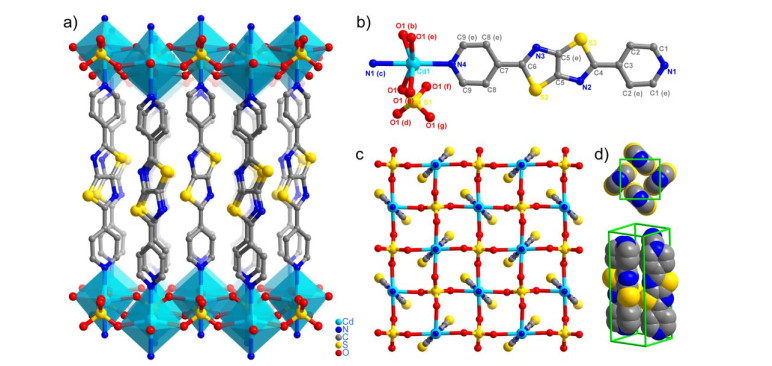
Although the distance between Cd and its neighbor is very short, there is still a certain gap between the ligands. Interestingly, there is a side-to-side pattern between thiophenes with a distance about 4 Å. The distance between thiophenes has been shown to play a key role in materials' electrochromic property[5, 14]. This material provides a good platform for further research on electrochromic and other properties.
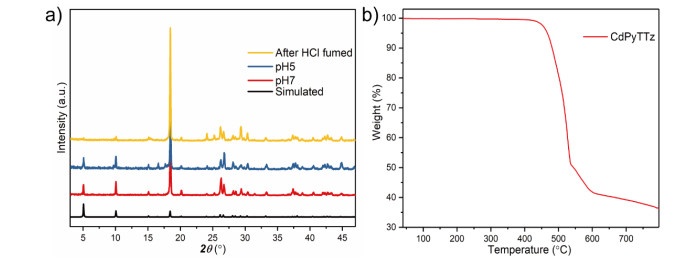
Experiments demonstrated that the compound is very stable and insoluble in common solvents such as DMF, MeOH, EtOH, H2O, MeCN, CHCl3, etc. Besides, we focus on its stability in water. Powder X-ray diffraction results show that it remains stable after being immersed in aqueous solution (pH = 5) for 1 day, also fumed by concentrated hydrochloric acid (37%) (Fig. 2a). The thermogravimetric curve shows that the material can be stabilized to 470 ℃ (Fig. 2b). The excellent stability of the material provides good conditions for performance exploration.
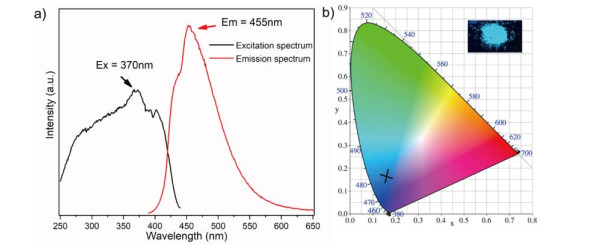
Considering rigid coplanar molecule Py2TTz with strong π-conjugated effect has been proved to have good luminescence, and the central metal ion Cd2+ has d10 electron configuration, so the compound is expected to present fine luminescence properties[15]. As reported, the pristine ligand Py2TTz has two emission peaks, located at 395 and 409 nm, assigned to π*-π transition, upon excitation at 409 nm. The emission peak of the compound appears at 455 nm, which is slightly red-shifted compared to the pristine ligand, upon excitation at 370 nm (Fig. 3a). According to the literature, the redshift can be attributed to the coordination of Cd(II) with the organic linkers which may decrease the π*-π energy gaps of the ligands[10]. Moreover, the commission internationale de I'Eclairage (CIE) coordinate of the compound is calculated, whose value locates at the blue area (Fig. 3b).
This study reports a new luminescent metal-organic framework, CdPyTTz, synthesized under solvothermal conditions. And its structure was determined by single-crystal X-ray structure analysis. The compound shows good luminescent property and excellent water stability, suggesting it may have potential to be a luminescent sensor in detecting small molecule in water phase. In addition, due to the unique molecular structure, which has the characteristics of electron transmission and high free charge carrier mobilities, TTz has been widely used in the solar/optoelectronic applications. With its outstanding stability, TTz and its derivates may have great potential in further exploration.
Lustig, W. P.; Mukherjee, S.; Rudd, N. D.; Desai, A. V.; Li, J.; Ghosh, S. K. Metal-organic frameworks: functional luminescent and photonic materials for sensing applications. Chem. Soc. Rev. 2017, 46, 3242–3285. doi: 10.1039/C6CS00930A
Hu, Z.; Deibert, B. J.; Li, J. Luminescent metal-organic frameworks for chemical sensing and explosive detection. Chem. Soc. Rev. 2014, 43, 5815–5840; Lan, A.; Li, K.; Wu, H.; Olson, D. H.; Emge, T. J.; Ki, W.; Hong, M.; Li, J. A luminescent microporous metal-organic framework for the fast and reversible detection of high explosives. Angew. Chem. Int. Edit. 2009, 48, 2334–2338; Che, W.; Li, G.; Liu, X.; Shao, K.; Zhu, D.; Su, Z.; Bryce, M. R. Selective sensing of 2, 4, 6-trinitrophenol (TNP) in aqueous media with "aggregation-induced emission enhancement" (AIEE)-active iridium(III) complexes. Chem. Commun. 2018, 54, 1730–1733; Huang, R. W.; Wei, Y. S.; Dong, X. Y.; Wu, X. H.; Du, C. X.; Zang, S. Q.; Mak, T. C. W. Hypersensitive dual-function luminescence switching of a silver-chalcogenolate cluster-based metal-organic framework. Nat. Chem. 2017, 9, 689–697.
Jiang, H. L.; Feng, D.; Wang, K.; Gu, Z. Y.; Wei, Z.; Chen, Y. P.; Zhou, H. C. An exceptionally stable, porphyrinic Zr metal-organic framework exhibiting pH-dependent fluorescence. J. Am. Chem. Soc. 2013, 135, 13934–13938; Li, P.; Yin, X. M.; Gao, L. L.; Yang, S. L.; Sui, Q.; Gong, T.; Gao, E. Q. Modulating excitation energy of luminescent metal-organic frameworks for detection of Cr(VI) in water. ACS. Appl. Nano. Mater. 2019, 2, 4646–4654.
Roy, I.; Bobbala, S.; Zhou, J.; Nguyen, M. T.; Nalluri, S. K. M.; Wu, Y.; Ferris, D. P.; Scott, E. A.; Wasielewski, M. R.; Stoddart, J. F. ExTzBox: a glowing cyclophane for live-cell imaging. J. Am. Chem. Soc. 2018, 140, 7206–7212. doi: 10.1021/jacs.8b03066
Woodward, A. N.; Kolesar, J. M.; Hall, S. R.; Saleh, N. A.; Jones, D. S.; Walter, M. G. Thiazolothiazole fluorophores exhibiting strong fluorescence and viologen-like reversible electrochromism. J. Am. Chem. Soc. 2017, 139, 8467–8473. doi: 10.1021/jacs.7b01005
Rizzuto, F. J.; Faust, T. B.; Chan, B.; Hua, C.; D'Alessandro, D. M.; Kepert, C. J. Experimental and computational studies of a multi-electron donor-acceptor ligand containing the thiazolo[5, 4-d]thiazole core and its incorporation into a metal-organic framework. Chem-Eur. J. 2014, 20, 17597–17605. doi: 10.1002/chem.201405089
Wang, K.; Huang, S.; Zhang, Y.; Zhao, S.; Zhang, H.; Wang, Y. Multicolor fluorescence and electroluminescence of an ICT-type organic solid tuned by modulating the accepting nature of the central core. Chem. Sci. 2013, 4, 3288–3293. doi: 10.1039/c3sc51091c
Luo, J.; Hu, B.; Debruler, C.; Liu, T. L. A π-conjugation extended viologen as a two-electron storage anolyte for total organic aqueous redox flow batteries. Angew. Chem. Int. Edit. 2018, 57, 231–235. doi: 10.1002/anie.201710517
Zhai, Z. W.; Yang, S. H.; Cao, M.; Li, L. K.; Du, C. X.; Zang, S. Q. Rational design of three two-fold interpenetrated metal-organic frameworks: luminescent Zn/Cd-metal-organic frameworks for detection of 2, 4, 6-trinitrophenol and nitrofurazone in the aqueous phase. Cryst. Grow. Th. Des. 2018, 18, 7173–7182. doi: 10.1021/acs.cgd.8b01335
Zhai, Z. W.; Yang, S. H.; Luo, P.; Li, L. K.; Du, C. X.; Zang, S. Q. Dicarboxylate-induced structural diversity of luminescent Zn(II)/Cd(II) metal-organic frameworks based on the 2, 5-bis(4-pyridyl)thiazolo[5, 4-d]thiazole ligand. Eur. J. Inorg. Chem. 2019, 2019, 2725–2734.
Sheldrick, G. M. A short history of SHELX. Acta Cryst. 2008, A64, 112–122;
Sheldrick, G. M. Crystal structure refinement with SHELXL. Acta Cryst. 2015, C71, 3–8.
Hagrman, D.; Haushalter, R. C.; Zubieta, J. Three-dimensional organic/inorganic hybrid materials constructed from one-dimensional copper diamine coordination polymers linked by bridging oxoanion tetrahedra: [Cu(dpe)(MoO4)] and [Cu(dpe)(SO4)(H2O)] (dpe = 1, 2-trans-(4-pyridyl)ethene). Chem. Mater. 1998, 10, 361–365. doi: 10.1021/cm9705350
Paul, A. K.; Madras, G.; Natarajan, S. Synthesis, structure, transformation studies and catalytic properties of open-framework cadmium thiosulfate compounds. Dalton Trans. 2010, 39, 2263–2279; Carlucci, L.; Ciani, G.; Proserpio, D. M.; Rizzato, S. New architectures from the self-assembly of MIISO4 salts with bis(4-pyridyl) ligands. The first case of polycatenation involving three distinct sets of 2D polymeric (4, 4)-layers parallel to a common axis. CrystEngComm. 2003, 5, 190–199; Xu, Y.; Bi, W. H.; Li, X.; Sun, D. F.; Cao, R.; Hong, M. C. A three-dimensional coordination framework containing μ4-sulfate anions [Cd(μ4-SO4)(bpy)]n (bpy = 4, 4΄-bipyridine). Inorg. Chem. Commun. 2003, 6, 495–497.
Ding, B.; Hua, C.; Kepert, C. J.; D'Alessandro, D. M. Influence of structure-activity relationships on through-space intervalence charge transfer in metal-organic frameworks with cofacial redox-active units. Chem. Sci. 2019, 10, 1392–1400. doi: 10.1039/C8SC01128A
Peng, Q.; Peng, J. B.; Kang, E. T.; Neoh, K. G.; Cao, Y. Synthesis and electroluminescent properties of copolymers based on fluorene and 2, 5-di(2-hexyloxyphenyl)thiazolothiazole. Macromolecules 2005, 38, 7292–7298; Knighton, R. C.; Hallett, A. J.; Kariuki, B. M.; Pope, S. J. A. A one-step synthesis towards new ligands based on aryl-functionalised thiazolo[5, 4-d]thiazole chromophores. Tetrahedron. Lett. 2010, 51, 5419–5422; Zhang, Z.; Chen, Y. A.; Hung, W. Y.; Tang, W. F.; Hsu, Y. H.; Chen, C. L.; Meng, F. Y.; Chou, P. T. Control of the reversibility of excited-state intramolecular proton transfer (ESIPT) reaction: host-polarity tuning white organic light emitting diode on a new thiazolo[5, 4-d]thiazole ESIPT system. Chem. Mater. 2016, 28, 8815–8824.

Figure 1 (a) Compound's 3D framework structure (b) Compound's coordination mode, symmetry transformation: a: –1/2–y, –1/2–x, z; b: –1/2+y, 1/2+x, z; c: x, y, –1+z; d: –x, –y, z. e: –1–x, –y, z; f: y, –x, –z; g: –y, x, –z (c) View of the compound's structure along the c axis (d) View of the compound's space-filing mode

Figure 2 (a) Compound's PXRD pattern under water condition via pH and (b) TGA curve of CdPyTTz

Figure 3 (a) Excitation and emission spectra of the compound. (b) CIE chromaticity coordinate of the compound (CIE value, x = 0.1611, y = 0.1625)
Table 1. Selected Bond Lengths (Å) and Bond Angles (°)
| Bond | Dist. | Bond | Dist. | Bond | Dist. | ||
| Cd(1)–N(4) | 2.343(9) | C(6)–S(2) | 1.734(10) | C(4)–N(2) | 1.30(2) | ||
| Cd(1)–O(1) | 2.279(5) | C(6)–N(3) | 1.33(2) | S(3)–C(5) | 1.619(12) | ||
| Cd(1)–N(1)d | 2.420(9) | C(4)–S(3) | 2.747(9) | N(2)–C(5) | 1.38(2) | ||
| Angle | (°) | Angle | (°) | Angle | (°) | ||
| O(1)d–S(1)–O(1) | 110.37(19) | O(1)c–Cd(1)–O(1)a | 91.8(6) | S(1)–O(1)–Cd(1) | 134(3) | ||
| O(1)a–Cd(1)–O(1)b | 131.2(11) | O(1)–Cd(1)–N(1) | 80.4(12) | C(6)–N(3)–C(5) | 115.1(19) | ||
| O(1)c–Cd(1)–O(1)b | 86.2(6) | O(1)–Cd(1)–N(4) | 99.6(12) | C(5)–S(2)–C(6) | 86.2(6) | ||
| Symmetry transformation: a: –1/2 – y, –1/2 – x, z; b: –1/2 + y, 1/2 + x, z; c: x, y, –1 + z; d: –x, –y, z | |||||||
 下载: 导出CSV

 扫一扫看文章


扫一扫关注我们
 下载:
下载: