Key Laboratory of Functional Organometallic Materials, Hengyang Normal University, College of Chemistry and Materials Science, Hengyang, Hunan 421008, China
Received Date:
03 September 2020 Accepted Date:
04 November 2020 Available Online:
01 May 2021
Fund Project:
Abstract:
A Fe-based metal-organic framework, [Fe(INAIP)(DMF)]n·0.5nDMF (1), has been synthesized by the reaction of 5-(isonicotinamido)isophthalic acid (H2INAIP) with FeSO4∙7H2O under DMF reaction solvent. Single-crystal X-ray diffraction analysis indicates that complex 1 displays a two-fold interpenetrated three-dimensional (3D) framework with sra topology. The TG, magnetic and adsorption properties of the complex were also studied.
During the last three decades, coordination polymers (CPs) have been considered as developmentally significant materials due to their diverse topologies and potential applications in sensing, heterogeneous catalysis, gas storage/separation and magnetic materials[1-8]. Although many factors can influence the final structures of the target CPs, the rational selection of metal ions and organic ligands with diverse functionalities plays the relatively important roles[9-12]. Therefore, the control assembly of structural and functional diversity for the aiming CPs is a challenge in the field of crystal engineering. On the other hand, surface modification is a useful tool for introducing new functionalities for MOFs and receives much attention. Recently, several MOFs have been constructed with amide decorated multiple carboxylate ligands, which are proved to have guest-accessible functional amide sites in the channel and some materials show high CO2 adsorption capacities due to these functional groups[13-15]. As our continuous work and an attempt to understand the correlation between the structure and property, complex 1 was success- fully prepared under solvothermal conditions with 5-(isonicotinamido)isophthalic acid (H2INAIP) with FeSO4∙7H2O.
2.
EXPERIMENTAL
2.1
Materials and instruments
All the regents and solvents were used as commercial sources without further purification. Elemental analyses were performed on a Perkin-Elmer 240C analyzer. IR spectra were recorded on an FTIR-8700 spectrophotometer using KBr discs. TG curve was recorded on a Perkin-Elmer Pyris Diamond thermoanalyser in flow N2 in the temperature range from 20 to 800 ℃ at a heating rate of 10 ℃·min-1. Power X-ray diffraction patterns (PXRD) were measured on a RigakuD/max-RA rotating anode X-ray diffractometer with graphite-monochromatic CuKα (λ = 1.15442 Å) radiation at room temperature. Magnetic measurements for the complexes in the range of 1.8~300 K were performed on a MPMS- SQUID magnetometer at a field of 2 kOe on crystalline samples in the temperature settle mode. All the measurements were carried out under the same experiment conditions. Gas sorption isotherms were measured on a volumetric adsorption apparatus (Bel-max).
2.2
Synthesis of the title compound
A mixture of FeSO4·7H2O (26.8 mg, 0.1 mmol), H2INAIP (28.7 mg, 0.1 mmol) and 8 mL DMF was sealed in a 16 mL Teflon-lined stainless-steel container and heated at 140 ℃ for 3 days. Subsequently, the mixture was slowly cooled to ambient temperature over 12 h for crystallization. The brown block crystals of 1 suitable for X-ray diffraction analysis were obtained in 32% yield. Anal. Calcd. for C37H37Fe2N7O13: C, 49.36; H, 4.11; N, 10.90. Found: C, 49.38; H, 4.04; N, 10.94. IR (KBr pellet, cm-1): 3418 (m), 1668 (m), 1612 (m), 1559 (s), 1416 (m), 1380 (s), 1329 (m), 1295 (m), 1113 (w), 820 (w), 784 (m), 736 (m), 706 (w), 602 (w).
2.3
X-ray crystallography
A suitable brown block crystal with dimensions of 0.22mm × 0.18mm × 0.14mm was mounted on a glass fiber and the data were collected on a Bruker Smart CCD diffractometer with MoKα radiation (λ = 0.71073 Å) at 293(2) K by using an ω scan mode in the range of 2.00 < θ < 26.00°. A total of 19698 reflections were collected and corrected by SAD-ABS[16], of which 3814 were unique with Rint = 0.0463 and 3221 were observed. The structures were solved by direct methods using the SHELX structure solution program and refined by full-matrix least-squares on F2 using the SHELXL program package[17]. The non-hydrogen atoms were refined anisotropically. H atoms bound to C were placed geome- trically and treated as riding with C–H = 0.93 Å. The amide H atoms were located from difference maps and refined with the N–H distances restrained to 0.86 Å.
3.
RESULTS AND DISCUSSION
3.1
Crystal structure of the complex
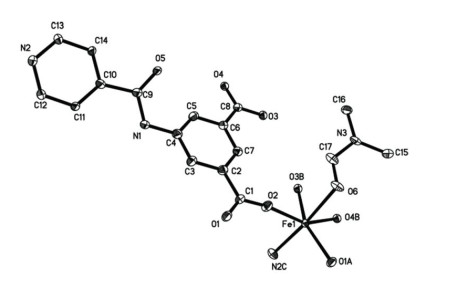
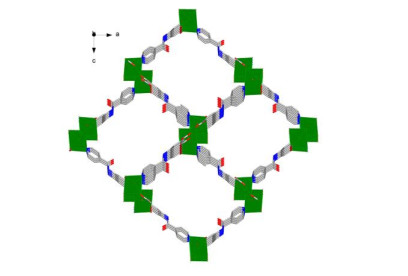
The ORTEP view is shown in Fig. 1 and the selected bond lengths and bond angles are presented in Table 1. The title complex crystallizes in orthorhombic system, space group Pbcn with a 3D two-fold interpenetrated framework. As shown in Fig. 1, the asymmetric unit of 1 contains one unique Fe(II) atom, one ligand INAIP2-, one coordinated DMF and half non-coordinated disorder DMF molecule. Each Fe(II) atom has a NO5 coordination environment with a distorted octahedral coordination geometry. The Fe–N bond length is 2.264(3) Å, and the Fe–O distances fall in the range of 2.092(2)~2.302(2) Å. The sum of bond angles O(2)– Fe(1)–O(1A) (112.58(9)º), O(1A)–Fe(1)–O(4B) (95.28(9)º), O(4B)–Fe(1)–O(3B) (57.22(8)º) and O(4B)–Fe(1)–O(2) (94.70(9)º) is 359.78º, showing the O(2), O(1A), O(4B) and O(3B) atoms are coplanar. In complex 1, each INAIP2– ligand connects four Fe(II) atoms using its two carboxylate groups with μ1-η1: η1-monodentate and μ2-η1: η1-bridge coordination modes and the pyridyl group. In 1, an infinite one-dimen- sional (1D) double-chain with Fe2(COO)2 dinuclear units is formed by the carboxylate groups and iron atoms when the coordination of pyridyl group is omitted. Then the 1D chains are further linked together by 5-isonicotinamido groups to result in the formation of the ultimate 3D framework (Fig. 2). It is noted that the void space in the single 3D framework is so large that two individual 3D frameworks interpenetrate each other to form a two-fold interpenetrated architecture, which is similar to the reported complex {[Mn(INAIP)(DMF)]·0.5DMF}n[18].
Figure 1
Figure 1.
ORTEP view the coordination environment of Fe(II) in complex 1 with the ellipsoids drawn at the 30% probability level. Hydrogen atoms and uncoordinated DMF molecule were omitted for clarity.
Symmetric codes: A: 1 – x, 1 – y, 1 – z; B: 1 – x, 2 – y, 1 – z; C: 3/2 – x, 3/2 – y, 1/2 + z
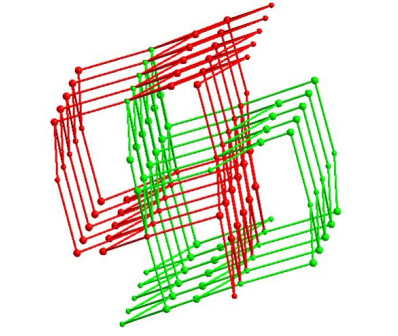
In order to understand the topology of complex 1, as discussed above, each INAIP2- ligand links four Fe(II) atoms and thus can be defined as a 4-connecting node, and each metal atom coordinated by four ligands can also be considered as a 4-connector. According to the simplification principle, the resulting structure of 1 has two-fold interpenetrated uninodal 4-connecting topology with Schläfli symbol of (42·63.8), which is a typical sra structure (Fig. 3). Such structure has also been referred by Smith as an ABW tetrahedral net in Li-ABW zeolite and as a SrAl2 net by O'Keeffe and Hyde[19, 20].
Figure 3
Figure 3.
Two-fold interpenetrated sra topology structure of 1
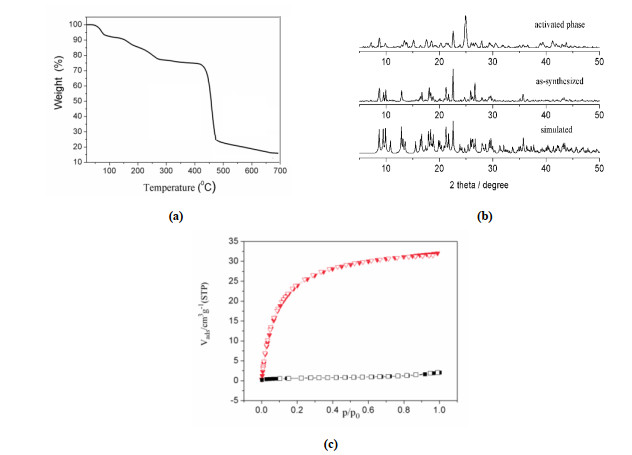
The infrared spectra of the title complex have been recorded and some important assignments are shown above. The strong absorption peaks of asymmetric stretching vibrations have been observed at 1668 and 1612 cm-1, respectively. The strong absorption peaks at 1380 and 1329 cm-1 could be ascribed to symmetric stretching vibrations. And no absorption peaks around 1700 cm-1 are discovered, illustrating complete deprotonation of carboxyl groups in complex 1. The results of TG illustrate that the complex decomposition takes place in three steps, as shown in Fig. 4a. The TG curve shows that the first stage mass loss is 8.14% between 50 and 125 ℃, which coincides with the calculated value (8.11%) of removing free DMF molecules. In the second stage, the loss of one coordinated DMF molecule (calcd. 16.23%) occurred in the temperature range of 125~330 ℃ (loss weight 16.19%). And then decomposition continued upon further heating at 400 ℃. Therefore, it can be concluded that the complex has high thermal stability in the class of MOFs.
Figure 4
Figure 4.
(a) TG of complex 1. (b) Powder X-ray diffraction patterns of complex 1. (c) N2 and CO2 adsorption isotherm (273 K) of 1. (Square and triangle curves represent N2 and CO2 adsorption. Filled shapes: adsorption; open ones: desorption)
As discussed above, the framework of complex 1 is stable even above 400 ℃. After omitting solvent molecules, the PLATON[21] analysis revealed that the 3D porous structure was composed of large voids of 1508.4 Å that represent 38.9% per unit cell volume (3876.4 Å). Before gas adsorption tests, the methanol solvent-exchanged as-synthesized crystal samples were degassed under high vacuum at the optimized temperature of 140 ℃ for 24 hours for removing all the DMF molecules from the pores. To verify whether the framework can be sustained after the departure of solvent molecules, PXRD patterns were measured and the results are shown in Fig. 4b. The framework of the complex still has good crystallinity without DMF molecules, but the PXRD pattern of the activated sample is a little different from the as-synthesized one which might indicate the dynamics and robustness of framework and thus gas adsorption of it was investigated. The N2 and CO2 adsorption isotherms for the complex (273 K) are shown in Fig. 4c, indicating that no N2 uptake was observed at 273 K. However, significant amounts of CO2 (273 K) were adsorbed and the isotherm presents typical type-I curves[22], which is the characteristic of a microporous material. The amounts of CO2 uptake increase abruptly at the beginning and reach 32.48 cm3 (STP)/g at 1.0 atom. Approximately 0.30 CO2 molecules per formula unit was adsorbed for the activated complex. The gas adsorption isotherms show no obvious hysteresis between the adsorption-desorption curves. It is noted that no N2 was adsorbed. Thus, the selective sorption of CO2 rather than N2 gas can also be attributed to the significant quadrupole moment of CO2 (–1.4×10–39 C·m2), which induces specific interactions with the host framework[23, 24].
3.3
Magnetic property
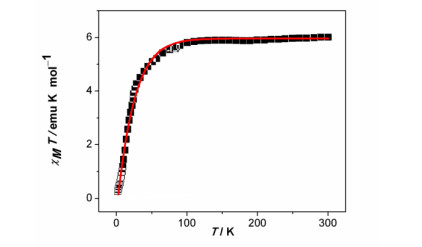
The temperature dependence of the magnetic susceptibility of 1 was measured ranging from 1.8 to 300 K and the χMT vs. T curve is shown in Fig. 5. For complex 1, the value of χMT is 6.13 emu·K·mol-1 at 300 K, which is a little larger than the value of 6.0 emu·K·mol-1 expected for two magnetically independent Fe(II) (S = 2) centers, suggesting the existence of high spin Fe(II), which is the typical for octahedral Fe(II) complex[25]. And the χMT decreases slowly and then more rapidly below 50 K to reach 0.25 emu·K·mol-1 at 1.8 K. Such magnetic behavior indicates the antiferromagnetic coupling within the [Fe(OCO)]2 dinuclear unit in 1 and in this case the spin coupling through INAIP2- ligands is negligible. The magnetic data can be fitted by using the simple isotropic dimer model with a spin Hamiltonian H = –2JS1S2, where J is the coupling constant between the neighboring metal ions; the numerical expression is:
Fitting χMTvs.T of the data to this model leads to g = 2.12 and J = –2.06 cm-1, and the agreement factor R = ∑[(χMT)obsd – (χMT)calcd]2/∑(χMT)obsd2 is 2.4 × 10⁻³.
4.
CONCLUSION
In summary, we successfully prepared a two-fold interpene- trating 3D transition metal coordination polymer with weak antiferromagnetic interaction in the central Fe ions. The adsorption property shows that complex 1 can selectively adsorb CO2 over N2 at 273 K.
[1]
Xuan, W. M.; Zhu, C. F.; Liu, Y.; Cui, Y. Mesoporous metal-organic framework materials. Chem. Soc. Rev.2012, 41, 1677–1695. doi: 10.1039/C1CS15196G
[2]
Dhakshinamoorthy, A.; Asiri, A. M.; Garcia, H. Metal-organic framework (MOF) compounds: photocatalysts for redox reactions and solar fuel production. Angew. Chem. Int. Ed.2016, 55, 5414–5445. doi: 10.1002/anie.201505581
[3]
Gu, Z. G.; Zhan, C. H.; Zhang, J.; Bu, X. H. Chiral chemistry of metal-camphorate frameworks. Chem. Soc. Rev. 2016, 45, 3122–3144. doi: 10.1039/C6CS00051G
[4]
Li, B. Y.; Leng, K. Y.; Zhang, Y. M.; Dynes, J. J.; Wang, J.; Hu, Y. F.; Ma, D. X.; Shi, Z.; Zhu, L. K.; Zhang, D. L.; Sun, Y. Y.; Chrzanowski, M.; Ma, S. Q. Metal-organic framework based upon the synergy of a brønsted acid framework and Lewis acid centers as a highly efficient heterogeneous catalyst for fixed-bed reactions. J. Am. Chem. Soc.2015, 137, 4243–4248. doi: 10.1021/jacs.5b01352
[5]
Zhang, J.; Gao, L. L.; Zhai, L. J.; Wang, X. Q.; Fan, L. M.; Hu, T. P. Gas adsorption, magnetic, and fluorescent sensing properties of four coordination polymers based on 1, 3, 5-tris(4-carbonylphenyloxy) benzene and bis(imidazole) linkers. CrystEngComm.2018, 20, 7666–7676. doi: 10.1039/C8CE01421C
[6]
Lu, L.; Wu, J.; Wang, J.; Liu, J. Q.; Li, B. H.; Singh, A.; Kumar, A.; Batten, S. R. An uncommon 3D 3, 3, 4, 8-c Cd(II) metal-organic framework for highly efficient luminescent sensing and organic dye adsorption: experimental and theoretical insight. CrystEngComm. 2017, 19, 7057–7067. doi: 10.1039/C7CE01638G
[7]
Seth, S.; Savitha, G.; Jhulki, S.; Moorthy, J. N. Diverse metal-organic materials (MOMs) based on 9, 9΄-bianthryl-dicarboxylic acid linker: luminescence properties and CO2 capture. Cryst. Growth Des.2016, 16, 2024–2032. doi: 10.1021/acs.cgd.5b01617
[8]
Du, M.; Zhang, Z. H.; Wang, X. G.; Tang, L. F.; Zhao, X. J. Structural modulation of polythreading and interpenetrating coordination networks with an elongated dipyridyl building block and various anionic co-ligands. CrystEngComm.2008, 10, 1855–1865. doi: 10.1039/b810121c
[9]
Zou, L. F.; Feng, D. W.; Liu, T. F.; Chen, Y. P.; Yuan, S.; Wang, K. C.; Wang, X.; Fordham, S.; Zhou, H. C. A versatile synthetic route for the preparation of titanium metal-organic frameworks. Chem. Sci.2016, 7, 1063–1069. doi: 10.1039/C5SC03620H
[10]
Singh, N.; Singh, U. P.; Butcher, R. J. Luminescent sulfonate coordination polymers: synthesis, structural analysis and selective sensing of nitroaromatic compounds. CrystEngComm.2017, 19, 7009–7020. doi: 10.1039/C7CE01453H
[11]
Li, C.; Deng, Z. P.; Huo, L. H.; Gao, S. Cooperative effects of metal cations and coordination modes on luminescent s-block metal-organic complexes constructed from V-shaped 4, 4΄-sulfonyldiphenol. CrystEngComm.2018, 20, 7513–7525. doi: 10.1039/C8CE01591K
[12]
Lv, S.; Wang, Z. Y.; Gu, X.; Zhang, C.; Gong, Y.; Lin, J. H. Coordination polymer based perovskite device: matched energy levels and photocurrent enhancement in the absence or presence of methanol. CrystEngComm.2017, 19, 7021–7030. doi: 10.1039/C7CE01682D
[13]
Zou, Y.; Yu, C. Y.; Li, Y. Y.; Lah, M. S. A 3-dimensional coordination polymer with a rare lonsdaleite topology constructed from a tetrahedral ligand. CrystEngComm.2012, 14, 7174–7177. doi: 10.1039/c2ce26109j
[14]
Zheng, B. S.; Bai, J. F.; Duan, J. G.; Wojtas, L.; Zaworotko, M. J. Enhanced CO2 binding affinity of a high-uptake rht-type metal-organic framework decorated with acylamide groups. J. Am. Chem. Soc.2011, 133, 748–751. doi: 10.1021/ja110042b
[15]
Liao, J. X.; Zeng, W. J.; Zheng, B. S.; Cao, X. Y.; Wang, Z. X.; Wang, G. Y.; Yang, Q. Y. Highly efficient CO2 capture and conversion of a microporous acylamide functionalized rht-typemetal-organic framework. Inorg. Chem. Front.2020, 7, 1939–1948. doi: 10.1039/D0QI00231C
[16]
Sheldrick, G. M. SADABS: Program for Empirical Absorption Correction of Area Detector Data. University of Göttingen, Göttingen (Germany) 2000.
[17]
Sheldrick, G. M. Acta Crystallogr Sect A2015, 71, 3–8.
[18]
Chen, M. S.; Bai, Z. S.; Okamura, T. A.; Su, Z.; Chen, S. S.; Sun, W. Y.; Ueyama, N. Metal-organic frameworks with pyridyl- and carboxylate-containing ligands: syntheses, structures and properties. CrystEngComm. 2010, 12, 1935–1944. doi: 10.1039/b921850e
[19]
Blatov, V. A. Multipurpose crystallochemical analysis with the program package TOPOS. IUCr CompComm Newsletter2006, 7, 4–38.
[20]
Rosi, N. L.; Kim, J.; Eddaoudi, M.; Chen, B. L.; O'Keeffe, M.; Yaghi, O. M. Rod packings and metal-organic frameworks constructed from rod-shaped secondary building units. J. Am. Chem. Soc. 2005, 127, 1504–1518.
[21]
Spek, A. L. Single-crystal structure validation with the program PLATON. J. Appl. Cryst.2003, 36, 7–13. doi: 10.1107/S0021889802022112
[22]
Cheon, Y. E.; Suh, M. P. Multifunctional fourfold interpenetrating diamondoid network: gas separation and fabrication of palladium nanoparticles. Chem. Eur. J.2008, 14, 3961–3967. doi: 10.1002/chem.200701813
[23]
Chen, M. S.; Chen, S. S.; Chen, W.; Lucier, B. E. G.; Zhang, Y.; Zheng, A. M.; Huang, Y. N. Analyzing gas adsorption in an amide-functionalized metal organic framework: are the carbonyl or amine groups responsible? Chem. Mater.2018, 30, 3613–3617. doi: 10.1021/acs.chemmater.8b00681
[24]
Chen, M. S.; Chen, M.; Okamura, T. A.; Sun, W. Y.; Ueyama, N. Porous zinc(II) frameworks with 5-(isonicotinamido)isophthalate: syntheses, structures and properties. Micropor. Mesopor. Mater.2011, 139, 25–30. doi: 10.1016/j.micromeso.2010.10.011
[25]
Riou-Cavellec, M.; Lesaint, C.; Noguès, M.; Grenèche, J. M.; Férey, G. Synthesis, structure, and mössbauer study of [Fe(H2O)2(C9O6H4)]·H2O: a two-dimensional iron(II) trimellitate (MIL-67). Inorg. Chem.2003, 42, 5669–5674. doi: 10.1021/ic020715y
Figure 1
ORTEP view the coordination environment of Fe(II) in complex 1 with the ellipsoids drawn at the 30% probability level. Hydrogen atoms and uncoordinated DMF molecule were omitted for clarity.
Symmetric codes: A: 1 – x, 1 – y, 1 – z; B: 1 – x, 2 – y, 1 – z; C: 3/2 – x, 3/2 – y, 1/2 + z
Figure 4
(a) TG of complex 1. (b) Powder X-ray diffraction patterns of complex 1. (c) N2 and CO2 adsorption isotherm (273 K) of 1. (Square and triangle curves represent N2 and CO2 adsorption. Filled shapes: adsorption; open ones: desorption)


 DownLoad:


 下载:
下载:


 下载:
下载:

