Citation:
Ming-Jian ZHANG, Yu-Sheng CHEN, Feng PAN, Yang REN. Understanding Structural Evolution in the Synthesis of Advanced Energy Materials[J]. Chinese Journal of Structural Chemistry,
2020, 39(1): 26-30.
doi:
10.14102/j.cnki.0254-5861.2011-2719
Understanding Structural Evolution in the Synthesis of Advanced Energy Materials
Received Date:
25 December 2019 Accepted Date:
26 December 2019 Available Online:
01 January 2020
Fund Project:
Abstract:
Developing a variety of in situ characterization techniques to unravel the structural/chemical evolution during the synthesis of various advanced energy materials for studying the relationship among those experimental conditions and the structure is the key to implement the controllable synthesis of battery materials. This perspective summarizes the recent studies into structural evolution during in situ synthesis of various advanced energy materials by synchrotron X-ray diffraction technique and forecasts the more extensive applications in the future.
Synthesis chemistry is the cornerstone for the development of energy conversion and storage technologies for modern society. Batteries energize the modern information industry and manufacturing industry, and are expecting to significantly energize the transportation industry. Great efforts in battery research are focused on developing high-performance batteries, including safety, high-energydensity, and long calendar/cycling lifetime. However, so far only a small number of known materials show real promise for achieving excellent comprehensive performance. One of the major R & D challenges in preparing new battery materials is the reliance on trial and error as there are a variety of synthesis parameters (precursor concentration, temperature, pressure, cation type and reaction time). This complicates the synthetic control of material properties (e.g., crystal structure, stoichiometry, morphology, particle size) and electrochemical performance (e.g., capacity, rate capability, and durability). Therefore, controllable synthesis of battery materials with desired structures is vitally important to greatly improve the battery performance. Developing a variety of in situ characterization techniques to unravel the structural/chemical evolution during the synthesis of various battery materials for studying the relationship among those experimental conditions (temperature, time, pressure, gas environment) and the structure is the key to implement the controllable synthesis of battery materials.
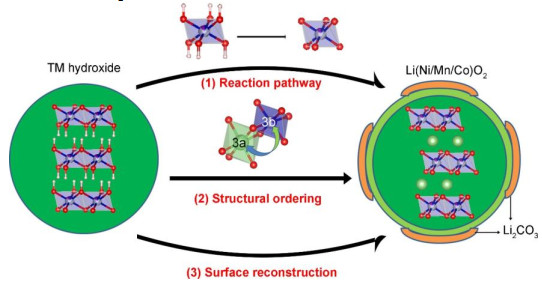
In situ powder diffraction is one of the most powerful techniques to monitor in real time the synthesis reaction. Owing to the high penetration power and high flux of high-energy synchrotron X-rays, in situ high-energy X-ray diffraction (XRD) techniques have been widely used to monitor the transient reactions of the intermediates, which may influence the phases/stoichiometry of the final reaction product. Experimental results have provided insights into the mechanism of product formation through a quantitative analysis of reaction kinetics. Nickel-rich layered transition metal oxides (NMCs) have been intensively studied as promising cathode candidates for next-generation high-voltage and high energy density Li-ion batteries, known for low cost and high theoretical capacity. Taking high-Ni NMCs as an example, we demonstrate how to deploy synchrotron XRD to investigate the structural evolution during synthesis. We can divide the related researches into three parts as shown in Scheme 1: (1) track of reaction pathway, namely phase evolution; (2) control of structural ordering in the bulk; (3) control of the surface structure.
Scheme 1
Scheme 1.
Schematic illustration to demonstrate the high-energy synchrotron XRD to investigate the synthetic reaction of high-Ni NMCs, a promising battery material for next-generation LIBs, from three aspects: (1) reaction pathway; (2) structural ordering in bulk; (3) surface reconstruction
In 2017, Zhao et al. performed in situ synchrotron XRD studies of synthesis reactions in preparing LiNiO2 and the Co-substituted variant, LiNi0.8Co0.2O2, to gain insights into the reaction pathway of high-Ni layered oxides. A direct transformation of the intermediate from the rock salt structure into hexagonal phase was revealed during synthesis. Furthermore, the effect of Co on the reaction kinetics was found to facilitate the nucleation of a Co-rich layered phase at low temperature and subsequent growth and stabilization of solid solution Li(Ni, Co)O2 upon further heat treatment. Stoichiometric LiNi0.8Co0.2O2 was obtained based on in situ studies, and exhibited high capacity (up to 200 mA·h·g−1) with excellent retention[1].
As we know, the practical capacity of high-Ni NMCs is largely determined by structural ordering and has yet to be well controlled during synthesis, largely due to the complexity and non-equilibrium nature of the reactions occurring in the sintering process. To solve this problem about structural ordering, Wang et al. investigated the synthesis reactions for preparing layered LiNi0.7Mn0.15Co0.15O2 (NMC71515) by combining time-resolved in situ high-energy X-ray diffraction and absorption spectroscopy measurements. A strong temperature dependence of the kinetics of cationic ordering in NMC71515 was systematically uncovered (Fig. 1a-b). Through synthetic control of the kinetics of cationic ordering, a layered NMC71515 with low cationic disordering and a high reversible capacity is prepared in air[2]. To further investigate the roles of Co and Mn in the synthesis of high-Ni layered oxides, Wang et al. also investigated the kinetic and thermodynamic aspects of structural ordering (Li/Ni ordering/mixing) during the synthesis of Li(Ni0.7MnxCo0.3−x)O2 (0≤x≤0.3), by quantitative analysis of in situ XRD results. It was found that Co substitution facilitates Li/Ni ordering by relieving the intra-plane magnetic frustration and reducing the inter-plane superexchange (SE) interaction. In contrast, Mn exacerbates magnetic frustration and strengthens SE, thereby aggravating Li/Ni mixing[3]. To further understand the relationship between Li behaviors and structural ordering, Duan et al. also studied NMC71515 under different temperature and holding time using high-energy synchrotron XRD (Fig. 1c-d). Systematic studies indicate that, structural ordering in the bulk is greatly affected by Li2CO3 decomposition and Li loss, occurring concomitantly at the particle surface. Through tuning the sintering temperature and time, highly ordered NMC71515 with high capacity and excellent rate capability was synthesized[4]. Based on those efforts above, we adopted in situ XRD to investigate the origin of structural disordering during the synthesis of high-Ni NMCs (Fig. 1e). A multimodal in situ X-ray characterization approach is employed to investigate the synthesis process in sintering Li(Ni0.77Mn0.13Co0.10)O2 from the hydroxide precursors, at scales varying from the long-range to local individual octahedral units. Real-time observation corroborated by the first-principles calculations reveals a topotactic transformation throughout the entire process, during which the layered framework is retained. However, due to the preferential oxidation of Co and Mn over Ni, significant changes happen locally within NiO6 octahedra. It was found that oxygen loss and the associated symmetry breaking occur in NiO6; as a consequence, Ni2+ ions become highly mobile and tend to mix with Li, causing high cationic disordering upon the formation of the layered oxides. Only through high-temperature heat treatment, Ni is further oxidized, thereby inducing symmetry reconstruction and, concomitantly, cationic ordering within NiO6 octahedra[5, 6].
Figure 1
Figure 1.
Application of high-energy synchrotron XRD to investigate the structural ordering during the synthetic reaction of high-Ni NMCs. (a) Time-resolved high-energy X-ray diffraction patterns during solid-state synthesis of NMC71515. (b) Evolution of cationic disordering (i.e., occupancy of Ni ions at 3b sites) at different holding temperature of 800, 850 and 900 ℃. (c) High-energy X-ray diffraction patterns from NMC71515 sintered at 775 ℃ for different holding time. (d) Occupancy of Ni at 3b sites, Ni(3b), as a function of holding time for samples sintered at different temperature. (e) Schematic of the site-dependent cationic oxidation/reordering in octahedra at three stages I, II and III, to explain the synthetic origin of structural disordering/ordering. Reproduced from Refs. [2, 3, 4], and [5]
The high flux of high-energy synchrotron X-ray allows us to track the evolution of trace components during the synthesis. Taking this advantage, we tracked the content change of Li2CO3 during the cooling process of NMC71515. In situ synchrotron X-ray diffraction, coupled with surface analysis, was applied to study the synthesis process, revealing cooling-induced surface reconstruction involving Li2CO3 accumulation and the formation of a Li-deficient layer and Ni reduction at the particle surface. As shown in Fig. 2, the reconstruction process occurs predominantly at high temperature (above 350 ℃) and is highly cooling-rate dependent. This implies that surface reconstruction can be suppressed through synthetic control, i.e., quenching to improve the surface stability and rate performance of the synthesized materials. It was the first case to use in situ XRD to track the surface structural evolution during the synthesis[7]. Recently, Ti gradient doping was revealed to efficiently suppress the surface reconstruction, and enhance the electro-chemistry of high-Ni NMC[8].
Figure 2
Figure 2.
Application of high-energy synchrotron XRD to investigate the surface reconstruction during the synthetic reaction of high-Ni NMCs. (a) Temperature-resolved high-energy X-ray diffraction patterns during the slow cooling process of NMC71515 to track the evolution of Li2CO3 surface phase. (b) Evolution of the integrated area of 002 peak associated with Li2CO3 as a function of temperature. (c) Schematic illustration of the surface reconstruction in the near surface region due to the thermal driven solid-gas interaction to form Li2CO3 surface phase. Reproduced from Ref. [6]
In summary, all the applications of in situ synchrotron X-ray techniques mentioned above greatly advance the fundamental understanding of synthetic kinetics, including the identification of various intermediates, the origin and control of structural ordering in the bulk as well as the control of structural reconstruction at the surface, thus greatly accelerating the implement of controllable synthetic chemistry. In the future, it is expected to help further track the evolution of particle size and phase, the elemental stoichiometry during the synthesis of battery materials. In addition to high-Ni NMCs, it has been applied to the synthetic reaction of many other battery materials, including Li-Mn-rich cathodes[9], LiFePO4[10, 11], P2-Na2/3MnO2[12], layered Li2MnO3[13], Li2SnO3[14], concentration gradient cathodes[15], etc. With the development and mature of various in situ reactors, in situ XRD study in the synthetic reaction has already been or will be extended to many other synthesis methods, including hydrothermal[11, 16], solution, microwave and so on. It would finally lead the conventional 'trial and error' synthesis method to the real controllable synthesis of advanced battery materials and beyond.
[1]
Zhao, J.; Zhang, W.; Huq, A.; Misture, S. T.; Zhang, B.; Guo, S.; Wu, L.; Zhu, Y.; Chen, Z.; Amine, K.; Pan, F.; Bai, J.; Wang, F. In situ probing and synthetic control of cationic ordering in Ni-rich layered oxide cathodes. Adv. Energy Mater.2017, 7, 1601266. doi: 10.1002/aenm.201601266
[2]
Wang, D.; Kou, R.; Ren, Y.; Sun, C. J.; Zhao, H.; Zhang, M. J.; Li, Y.; Huq, A.; Ko, J. Y. P.; Pan, F.; Sun, Y. K.; Yang, Y.; Amine, K.; Bai, J.; Chen, Z.; Wang, F. Synthetic control of kinetic reaction pathway and cationic ordering in high-Ni layered oxide cathodes. Adv. Mater.2017, 29.
[3]
Wang, D.; Xin, C.; Zhang, M.; Bai, J.; Zheng, J.; Kou, R.; Peter Ko, J. Y.; Huq, A.; Zhong, G.; Sun, C. J.; Yang, Y.; Chen, Z.; Xiao, Y.; Amine, K.; Pan, F.; Wang, F. Intrinsic role of cationic substitution in tuning Li/Ni mixing in high-Ni layered oxides. Chem. Mater.2019, 31, 2731–2740. doi: 10.1021/acs.chemmater.8b04673
[4]
Duan, Y.; Yang, L.; Zhang, M. J.; Chen, Z.; Bai, J.; Amine, K.; Pan, F.; Wang, F. Insights into Li/Ni ordering and surface reconstruction during synthesis of Ni-richlayered oxides. J. Mater. Chem. A2019, 7, 513–519. doi: 10.1039/C8TA10553G
[5]
Zhang, M. J.; Teng, G.; Chen-Wiegart, Y. K.; Duan, Y.; Ko, J. Y. P.; Zheng, J.; Thieme, J.; Dooryhee, E.; Chen, Z.; Bai, J.; Amine, K.; Pan, F.; Wang, F. Cationic ordering coupled to reconstruction of basic building units during synthesis of high-Ni layered oxides. J. Am. Chem. Soc.2018, 140, 12484–12492. doi: 10.1021/jacs.8b06150
[6]
Zheng, J. X.; Ye, Y. K.; Liu, T. C.; Xiao, Y. G.; Wang, C. M.; Wang, F.; Pan, F. Ni/Li disordering in layered transition metal oxide: electrochemical impact, origin, and control. Acc. Chem. Res.2019, 52, 2201–2209. doi: 10.1021/acs.accounts.9b00033
[7]
Zhang, M. J.; Hu, X.; Li, M.; Duan, Y.; Yang, L.; Yin, C.; Ge, M.; Xiao, X.; Lee, W. K.; Ko, J. Y. P.; Amine, K.; Chen, Z.; Zhu, Y.; Dooryhee, E.; Bai, J.; Pan, F.; Wang, F. Cooling induced surface reconstruction during synthesis of high-Ni layered oxides. Adv. Energy Mater.2019, 1901915.
[8]
Kong, D. F.; Hu, J. T.; Chen, Z. F.; Song, K. P.; Li, C.; Weng, M. Y.; Li, M. F.; Wang, R.; Liu, T. C.; Liu, J. J.; Zhang, M. J.; Xiao, Y. G.; Pan, F. Ti-Gradient doping to stabilize layered surface structure for high performance high-Ni oxide cathode of Li-ion battery. Adv. Energy Mater.2019, 9.
[9]
Wang, Z.; Yin, Y. P.; Ren, Y.; Wang, Z. Y.; Gao, M.; Ma, T. Y.; Zhuang, W. D.; Lu, S. G.; Fan, A. L.; Amine, K.; Chen, Z. H. High performance lithium-manganese-rich cathode material with reduced impurities. Nano Energy2017, 31, 247–257. doi: 10.1016/j.nanoen.2016.10.014
[10]
Chen, Z. H.; Ren, Y.; Qin, Y.; Wu, H. M.; Ma, S. Q.; Ren, J. G.; He, X. M.; Sun, Y. K.; Amine, K. Solid state synthesis of LiFePO4 studied by in situ high energy X-ray diffraction. J. Mater. Chem.2011, 21, 5604–5609. doi: 10.1039/c0jm04049e
[11]
Chen, J. J.; Bai, J. M.; Chen, H. Y.; Graetz, J. In situ hydrothermal synthesis of LiFePO4 studied by synchrotron X-ray diffraction. J. Phys. Chem. Lett.2011, 2, 1874–1878. doi: 10.1021/jz2008209
[12]
Ma, T. Y.; Xu, G. L.; Zeng, X. Q.; Li, Y.; Ren, Y.; Sun, C. J.; Heald, S. M.; Jorne, J.; Amine, K.; Chen, Z. H. Solid state synthesis of layered sodium manganese oxide for sodium-ion battery by in-situ high energy X-ray diffraction and X-ray absorption near edge spectroscopy. J. Power Sources2017, 341, 114–121. doi: 10.1016/j.jpowsour.2016.11.022
[13]
Kan, Y. C.; Hu, Y.; Croy, J.; Ren, Y.; Sun, C. J.; Heald, S. M.; Bareno, J.; Bloom, I.; Chen, Z. H. Formation of Li2MnO3 investigated by in situ synchrotron probes. J. Power Sources2014, 266, 341–346. doi: 10.1016/j.jpowsour.2014.05.032
[14]
Wang, Z.; Ren, Y.; Ma, T. Y.; Zhuang, W. D.; Lu, S. G.; Xu, G. L.; Abouimrane, A.; Amine, K.; Chen, Z. H. Probing cation intermixing in Li2SnO3. RSC Adv.2016, 6, 31559–31564. doi: 10.1039/C6RA00977H
[15]
Li, Y.; Xu, R.; Ren, Y.; Lu, J.; Wu, H. M.; Wang, L. F.; Miller, D. J.; Sun, Y. K.; Amine, K.; Chen, Z. H. Synthesis of full concentration gradient, cathode studied by high energy X-ray diffraction. Nano Energy2016, 19, 522–531. doi: 10.1016/j.nanoen.2015.07.019
[16]
Park, Y. U.; Bai, J.; Wang, L.; Yoon, G.; Zhang, W.; Kim, H.; Lee, S.; Kim, S. W.; Looney, J. P.; Kang, K.; Wang, F. In situ tracking kinetic pathways of Li+/Na+ substitution during ion-exchange synthesis of LixNa1.5-xVOPO4F0.5. J. Am. Chem. Soc.2017, 139, 12504–12516. doi: 10.1021/jacs.7b05302
Scheme 1
Schematic illustration to demonstrate the high-energy synchrotron XRD to investigate the synthetic reaction of high-Ni NMCs, a promising battery material for next-generation LIBs, from three aspects: (1) reaction pathway; (2) structural ordering in bulk; (3) surface reconstruction
Figure 1
Application of high-energy synchrotron XRD to investigate the structural ordering during the synthetic reaction of high-Ni NMCs. (a) Time-resolved high-energy X-ray diffraction patterns during solid-state synthesis of NMC71515. (b) Evolution of cationic disordering (i.e., occupancy of Ni ions at 3b sites) at different holding temperature of 800, 850 and 900 ℃. (c) High-energy X-ray diffraction patterns from NMC71515 sintered at 775 ℃ for different holding time. (d) Occupancy of Ni at 3b sites, Ni(3b), as a function of holding time for samples sintered at different temperature. (e) Schematic of the site-dependent cationic oxidation/reordering in octahedra at three stages I, II and III, to explain the synthetic origin of structural disordering/ordering. Reproduced from Refs. [2, 3, 4], and [5]
Figure 2
Application of high-energy synchrotron XRD to investigate the surface reconstruction during the synthetic reaction of high-Ni NMCs. (a) Temperature-resolved high-energy X-ray diffraction patterns during the slow cooling process of NMC71515 to track the evolution of Li2CO3 surface phase. (b) Evolution of the integrated area of 002 peak associated with Li2CO3 as a function of temperature. (c) Schematic illustration of the surface reconstruction in the near surface region due to the thermal driven solid-gas interaction to form Li2CO3 surface phase. Reproduced from Ref. [6]


 DownLoad:


 下载:
下载:


 下载:
下载:

