
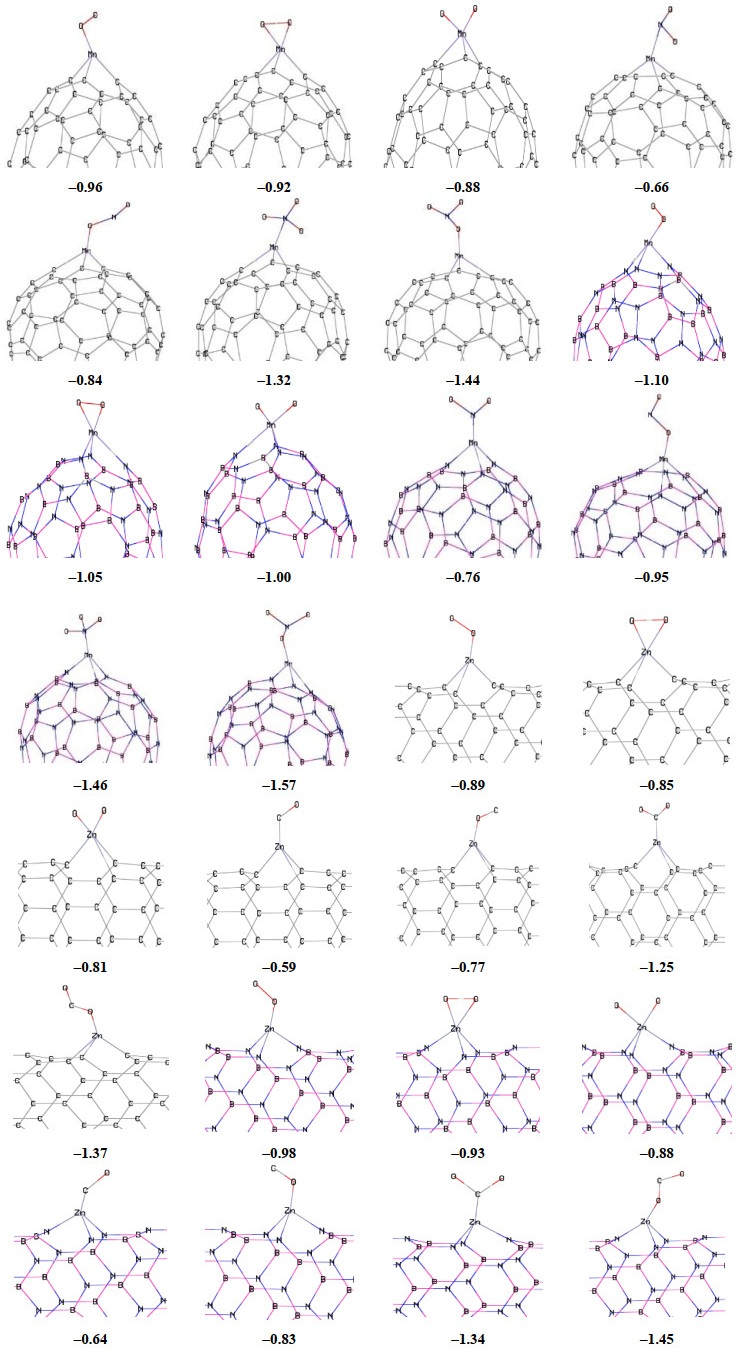
Figure 1.
Structures and ∆Ead values (eV) of molecules with nanocages and nanotubes


The metal-based catalysts have been used to oxidize the toxic molecules with high cost and low abilities at normal temperature. Recently, carbon nano catalysts with high efficiency and low price have been used as novel catalysts to oxidize the toxic molecules[1-6]. The carbon nanotubes and nanocages are active catalysts to oxidize the nitrogen dioxide (NO2) carbon monoxide (CO) at normal temperature[7-12]. The metal doped carbon nanotubes and nanocages have higher catalytic activity than metal-based catalysts, significantly[13-18]. The nanotubes and nanocages as catalysts can oxidize the toxic molecules through the Eley-Rideal (ER) and Langmuir-Hinshelwood (LH) mechanisms[19-21].
Here, the oxidation of nitrogen dioxide (NO2) on the surfaces of Mn-doped carbon nanocage (Mn–C76) and Mn-doped boron nitride nanocage (Mn–B38N38) and that of carbon monoxide (CO) on the surfaces of Zn-doped carbon nanotube (Zn–CNT (6, 0)) and Zn-doped boron nitride nanotube (Zn–BNNT (6, 0)) are investigated. The important goals of this study are to (a) find acceptable mechanisms to the oxidation of NO2 and CO; (b) compare the performances of Mn–C76 and Mn–B38N38 to NO2 oxidation; (c) compare the abilities of Zn–CNT (6, 0) and Zn–BNNT (6, 0) to CO oxidation; and (d) propose the optimum reaction paths to NO2 and CO oxidation.
The geometries of nanocages (Mn–B38N38 and Mn–C76), nanotubes (Zn–CNT (6, 0) and Zn–BNNT (6, 0)) and their complexes with molecules are optimised in GAMESS by DFT/M06-2X/6311G+(2d, 2p) method[22-28]. The ∆Ead values of molecules on nanocages (Mn–B38N38 and Mn–C76), nanotubes (Zn–CNT (6, 0) and Zn–BNNT (6, 0)) are ∆Ead = Ecomplex – Enano – Emolecule. The ∆G values of oxidation reactions of NO2 and CO on nanocages (Mn–B38N38 and Mn–C76), nanotubes (Zn–CNT (6, 0) and Zn–BNNT (6, 0)) are ∆G = ∆H – T∆S[29-40].
Structures of Mn–C76, Mn–B38N38, Zn–CNT (6, 0) and Zn–BNNT (6, 0) are reported in Fig. 1. Adsorption energies (∆Ead) Mn–C76, Mn–B38N38, Zn–CNT (6, 0) and Zn–BNNT (6, 0) are –2.22, –2.38, –2.15 and –2.26 eV, respectively. In Fig. 1, NO2 is joined to Mn–C76 and Mn–B38N38 through O atom with ∆Ead to be –0.84 and –0.95 eV. In Fig. 1, CO is joined to Zn–CNT (6, 0) and Zn–BNNT (6, 0) through O atom and ∆Ead values are –0.77 and –0.83 eV. In Fig. 1, O2 is adsorbed on Mn–C76, Mn–B38N38, Zn–CNT (6, 0) and Zn–BNNT (6, 0) through the π and σ orbitals of Mn and Zn, significantly.
The ∆Ead values of the most complexes of O2 with Mn–C76, Mn–B38N38, Zn–CNT (6, 0) and Zn–BNNT (6, 0) are –0.96, –1.02, –0.89 and –0.98 eV, respectively (in Table 1). In Fig. 1, NO3 is adsorbed on Mn–C76 and Mn–B38N38 through N and O positions and ∆Ead values of the most complexes of NO3 with Mn–C76 and Mn–B38N38 are –1.44 and –1.57 eV, respectively. In Fig. 1, CO is adsorbed on Zn–CNT (6, 0) and Zn–BNNT (6, 0) through C and O positions and ∆Ead values of the most complexes of CO with Zn–CNT (6, 0) and Zn–BNNT (6, 0) are –1.37 and –1.45 eV, respectively.

 DownLoad:
CSV
DownLoad:
CSV
| Mn–C76 | Mn–B38N38 | Zn–CNT (6, 0) | Zn–BNNT (6, 0) | |
| Str. | E (eV) | E (eV) | E (eV) | E (eV) |
| 1 | 0.00 | 0.00 | 0.00 | 0.00 |
| 2 | –0.94 | –0.99 | –0.92 | –0.97 |
| 3 | –2.19 | –2.27 | –2.26 | –2.34 |
| 4 | –2.03 | –2.15 | –2.13 | –2.25 |
| 5, 6, 12 | –2.68 | –2.73 | –2.68 | –2.73 |
| 7 | –3.65 | –3.78 | –3.71 | –3.84 |
| 8 | –2.28 | –2.39 | –2.28 | –2.39 |
| 9 | –2.13 | –2.19 | –2.17 | –2.23 |
| 10 | –1.68 | –1.81 | –1.73 | –1.86 |
| 11 | –2.28 | –2.36 | –2.28 | –2.36 |
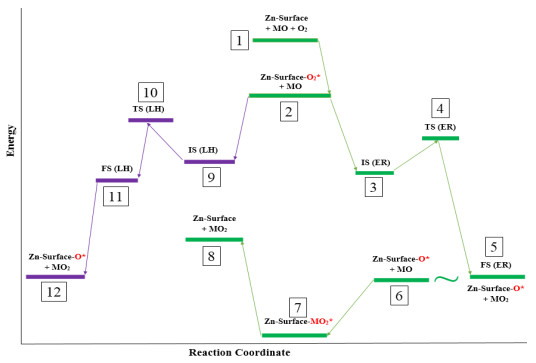
Reaction pathways of NO2 and CO oxidation through the ER and LH mechanism on Mn–C76, Mn–B38N38, Zn–CNT (6, 0) and Zn–BNNT (6, 0) are described in Fig. 2. The relative energies of intermediates of NO2 and CO oxidation on Mn–C76, Mn–B38N38, Zn–CNT (6, 0) and Zn–BNNT (6, 0) are reported in Fig. 2. The structures of intermediates of NO2 and CO oxidation on Mn–C76, Mn–B38N38, Zn–CNT (6, 0) and Zn–BNNT (6, 0) are displayed in Fig. 3. In the LH mechanism, O2 is adsorbed on Mn atoms of Mn–C76 and Mn–B38N38 and Zn atoms of Zn–CNT (6, 0) and Zn–BNNT (6, 0). The NO2 and CO molecules are co-adsorbed on Mn-nanocage-O2* and Zn-nanotube-O2*, respectively.
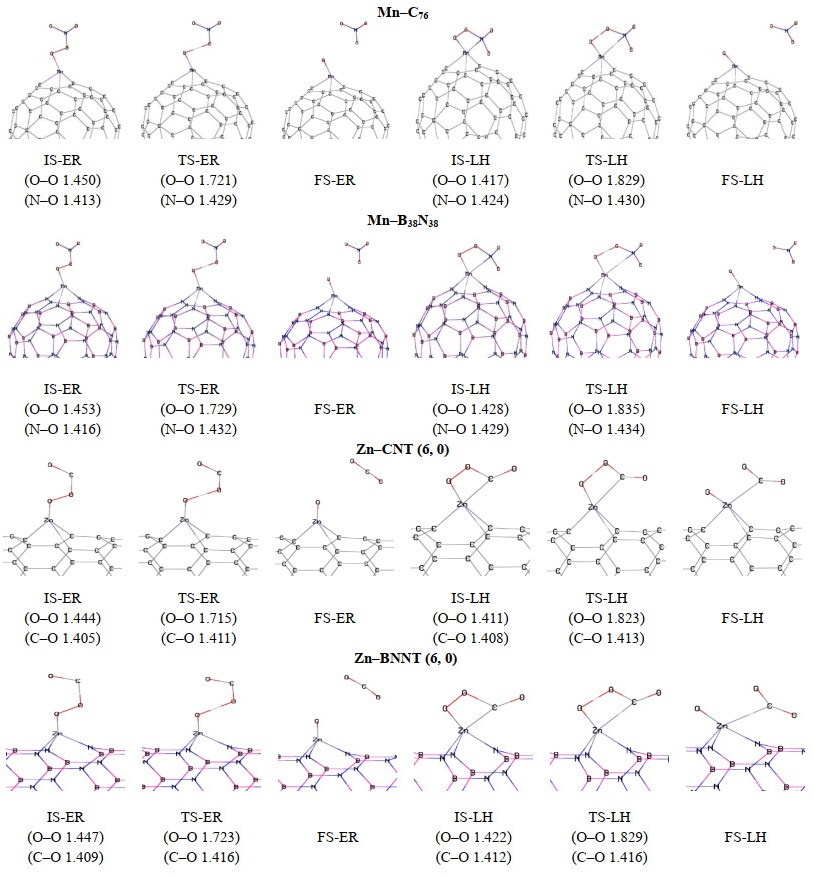
The Mn-nanocage-NO2*OO* and Zn-nanotube-CO*OO* complexes are created and Er values on Mn–C76, Mn–B38N38, Zn–CNT (6, 0) and Zn–BNNT (6, 0) are –1.19, –1.20, –1.25 and –1.26 eV, respectively. Then O–O bonds of Mn-nanocage-NO2*OO* and Zn-nanotube–CO*OO* complexes are braked and Mn-nanocage-O* and Zn-nanotube-O* are created and NO3 and CO2 are released. The Er values on Mn–C76, Mn–B38N38, Zn–CNT (6, 0) and Zn–BNNT (6, 0) are –0.15, –0.17, –0.11 and –0.13 eV, respectively. The Ea values on Mn–C76, Mn–B38N38, Zn–CNT (6, 0) and Zn–BNNT (6, 0) are 0.45, 0.38, 0.44 and 0.37 eV, respectively.
In the ER mechanism, NO2 and CO molecules are connected to Mn-nanocage-O2* and Zn-nanotube-O2*, respectively and Mn-nanocage-NO2*OO* and Zn-nanotube-CO*OO* complexes are created. The Er values on Mn–C76, Mn–B38N38, Zn–CNT (6, 0) and Zn–BNNT (6, 0) are –1.25, –1.28, –1.34 and –1.37 eV, respectively. Then O–O bonds of Mn–nanocage–NO2*OO* and Zn-nanotube-CO*OO* complexes are braked. The Ea values of realising NO3 and CO2 on Mn–C76, Mn–B38N38, Zn–CNT (6, 0) and Zn–BNNT (6, 0) are 0.16, 0.12, 0.09 and 0.11 eV, respectively.
The Er values of realising NO3 and CO2 on Mn–C76, Mn–B38N38, Zn–CNT (6, 0) and Zn–BNNT (6, 0) are –0.49, –0.46, –1.03 and –1.11 eV, respectively. In the LH mechanism, the NO2 and CO cannot adsorb the O* of Mn-nanocage-O* and Zn-nanotube-O*, while in ER mechanism they are adsorbed to O* of Mn-nanocage-O* and Zn-nanotube-O* and the second NO3 and CO2 are released, remarkably. Finally, the Mn–C76, Mn–B38N38, Zn– CNT (6, 0) and Zn–BNNT (6, 0) are proposed to oxidize NO2 and CO molecules with high performances at room temperature.
The NO2 and CO oxidation on Mn–C76, Mn– B38N38, Zn–CNT (6, 0) and Zn–BNNT (6, 0) are examined, respectively. The Mn–C76, Mn–B38N38, Zn–CNT (6, 0) and Zn–BNNT (6, 0) can ooxidize the NO2 and CO molecules through the LH and ER mechanisms. The Mn and Zn atoms are catalytic active positions of Mn–C76, Mn–B38N38, Zn–CNT (6, 0) and Zn–BNNT (6, 0). The Mn-nanocage-NO2*OO* and Zn-nanotube-CO*OO* complexes in the ER pathway are more stable than LH pathway. In ER and LH pathways, the first and second NO3 and CO2 molecules are released, respectively. Finally, the Mn–C76, Mn–B38N38, Zn–CNT (6, 0) and Zn–BNNT (6, 0) are proposed to the oxidation of NO2 and CO molecules with high performance at room temperature.
Sharifian, S.; Harasek, M.; Haddadi, B. Simulation of membrane gas separation process using aspen plus@V8.6. Chem. Prod. Proc. Mod. 2016, 11, 67–72.
Sharifian, S.; Harasek, M. Dynamic simulation of hydrogen generation from renewable energy sources. Chem. Engin. Trans. 2015, 45, 409–414.
Sharifian, S.; Asasian Kolur, N.; Harasek, M. Transient simulation and modeling of photovoltaic-PEM water electrolysis. Energy Sour. 2019, 1, 1–11.
Ho, K.; Hung, W. An amperometric NO2 gas sensor based on Pt/Na on electrode. Sen. Actuat. B: Chem. 2001, 79, 11–16. doi: 10.1016/S0925-4005(01)00782-1
Yang, J. C.; Dutta, P. K. High temperature potentiometric NO2 sensor with asymmetric sensing and reference Pt electrodes. Sen. Actuat. B: Chem. 2010, 143, 459–463. doi: 10.1016/j.snb.2009.09.023
Yan, Y.; Miura, N.; Yamazoe, N. Potentiometric sensor using stabilized zirconia for chlorine gas. Sen. Actuat. B: Chem. 1995, 24, 287–290. doi: 10.1016/0925-4005(95)85062-7
Khodadadi, A.; Mohajerzadeh, S. S.; Mortazavi, Y.; Miri, A. M. Cerium oxide/SnO2-based semiconductor gas sensors with improved sensitivity to CO. Sen. Actuat. B: Chem. 2001, 80, 267–271. doi: 10.1016/S0925-4005(01)00915-7
Korotcenkov, G. Practical aspects in design of one-electrode semiconductor gas sensors: status report. Sen. Actuat. B: Chem. 2007, 121, 664–678. doi: 10.1016/j.snb.2006.04.092
Machado, M.; Mota, R.; Piquini, P. Electronic properties of BN nanocones under electric fields. Microelectron. J. 2003, 34, 545–547. doi: 10.1016/S0026-2692(03)00044-2
Halpern, J. B.; Bello, A.; Gilcrease, J.; Harris, G. L.; He, M. Biphasic GaN nanowires: growth mechanism and properties. Microelectron. J. 2009, 40, 316–318. doi: 10.1016/j.mejo.2008.07.022
Beheshtian, J.; Kamfiroozi, M.; Bagheri, Z.; Ahmadi, A. B12N12 nano-cage as potential sensor for NO2 detection. Chin. J. Chem. Phys. 2012, 25, 60–64. doi: 10.1088/1674-0068/25/01/60-64
Margulis, V. A.; Muryumin, E. E. Chemisorption of single fluorine atoms on the surface of zigzag single-walled carbon nanotubes: a model calculation. Physica B 2007, 390, 134–142. doi: 10.1016/j.physb.2006.08.003
Xiao, B.; Zhao, J.; Ding, Y. Theoretical studies of chemisorption of NO2 molecules on SiC nanotube. Surf. Sci. 2010, 604, 1882–1888. doi: 10.1016/j.susc.2010.07.020
Wu, R. Q.; Yang, M.; Lu, H. Y.; Feng, Y. P.; Huang, Z. G.; Wu, Q. Y. Silicon carbide nano-tubes as potential gas sensors for CO and HCN detection. J. Phys. Chem. C 2008, 112, 15985–15988. doi: 10.1021/jp804727c
Gordillo, M. C. Conditions for H2 adsorption in the interstitials of a bundle of carbon nanotubes. Phys. Rev. B 2007, 76, 115402–115408. doi: 10.1103/PhysRevB.76.115402
Beheshtian, J.; Kamfiroozi, M.; Bagheri, Z.; Ahmadi, A. Theoretical study of hydrogen adsorption on the B12P12 fullerene-like nanocluster. Comp. Mater. Sci. 2012, 54, 115–118. doi: 10.1016/j.commatsci.2011.09.039
Schmidt, M.; Baldridge, K.; Boatz, J.; Elbert, S.; Gordon, M.; Jensen, J.; Koseki, S.; Matsunaga, N.; Nguyen, K.; Su, S.; Windus, T.; Dupuis, M. General atomic and molecular electronic structure system. J. Comput. Chem. 1993, 14, 1347–1363. doi: 10.1002/jcc.540141112
Grimme, S. Accurate description of van der Waals complexes by density functional theory including empirical corrections, J. Comput. Chem. 2004, 25, 1463–1471. doi: 10.1002/jcc.20078
Andzelm, J.; Kolmel, C. Incorporation of solvent effects into density functional calculations of molecular energies and geometries. J. Chem. Phys. 1995, 103, 9312–9320. doi: 10.1063/1.469990
Gan, L. H.; Zhao, J. Q. Theoretical investigation of (5, 5), (9, 0) and (10, 10) closed WCNTs. Physica E 2009, 41, 1249–1252. doi: 10.1016/j.physe.2009.02.014
Beheshtian, J.; Peyghan, A. A.; Bagheri, Z. Adsorption and dissociation of Cl2 molecule on ZnO nanocluster. Appl. Surf. Sci. 2012, 258, 8171–8176. doi: 10.1016/j.apsusc.2012.05.016
Dinadayalane, T. C.; Murray, J. S.; Concha, M. C.; Politzer, P.; Leszczynski, J. Reactivities of sites on 5, 5. Single walled carbon nanotubes with and without a Stone-Wales defect. J. Chem. Theory Comp. 2010, 6, 1351–1357. doi: 10.1021/ct900669t
Hamadanian, M.; Khoshnevisan, B.; KalantariFotooh, F.; Tavangar, Z. Computational study of super cell Al-substituted single-walled carbon nanotubes as CO sensor. Comp. Mater. Sci. 2012, 58, 45–51. doi: 10.1016/j.commatsci.2012.01.001
Hamadanian, M.; Fotooh, F. K. Density functional study of Al/N co-doped (10, 0) zigzag single-walled carbon nanotubes as CO sensor. Comp. Mater. Sci. 2014, 82, 497–502. doi: 10.1016/j.commatsci.2013.10.021
Hamadanian, M.; Khoshnevisan, B.; Fotooh, F. K. Density functional study of super cell N-doped (10, 0) zigzag single-walled carbon nanotubes as CO sensor. Struct. Chem. 2011, 22, 1205–1211. doi: 10.1007/s11224-011-9814-z
Xu, Y. J.; Li, J. Q. The interaction of N2 with active sites of a single-wall carbon nanotube. Chem. Phys. Lett. 2005, 412, 439–444. doi: 10.1016/j.cplett.2005.07.053
Feng, X.; Irle, S.; Witek, H.; Morokuma, K.; Vidic, R.; Borguet, E. Sensitivity of ammonia interaction with single-walled carbon nanotube bundles to the presence of defect sites and functionalities. J. Am. Chem. Soc. 2005, 127, 10533–10538. doi: 10.1021/ja042998u
Boys, S. F.; Bernardi, F. The calculation of small molecular interact ions by the 238differences of separate total energies. Some procedures with reduced errors. Mol. Phys. 1970, 19, 553–566. doi: 10.1080/00268977000101561
Nakashima, N. Soluble carbon nanotubes: fundamentals and applications. Int. J. Nanosci. 2005, 4, 119–137. doi: 10.1142/S0219581X05002985
Razavi, R.; Hosseini, S. M. A.; Ranjbar, M. Production of nanosized synthetic rutile from ilmenite concentrate by sonochemical HCl and H2SO4 leaching. Iran. J. Chem. Chem. Engin. 2014, 33, 29–36.
Razavi, R.; Kardani, M. N.; Ghanbari, A.; Lariche, M. J.; Baghban, A. Utilization of LSSVM algorithm for estimating synthetic natural gas density. Petrol. Sci. Technol. 2018, 36, 807–812. doi: 10.1080/10916466.2018.1447954
Parsaee, Z.; Karachi, N.; Razavi, R. Ultrasound assisted fabrication of a novel optode base on a triazine based Schiff base immobilized on TEOS for copper detection. Ultrason. Sonochem. 2018, 47, 36–46. doi: 10.1016/j.ultsonch.2018.04.007
Zahedifar, M.; Razavi, R.; Sheibani, H. Reaction of (chloro carbonyl) phenyl ketene with 5-amino pyrazolones: synthesis, characterization and theoretical studies of 7-hydroxy-6-phenyl-3-(phenyldiazenyl) pyrazolo [1, 5-a]pyrimidine-2, 5(1H, 4H)-dione derivatives. J. Mol. Struct. 2016, 1125, 730–735. doi: 10.1016/j.molstruc.2016.07.043
Karachi, N.; Hosseini, M.; Parsaee, Z.; Razavi, R. Novel high performance reduced graphene oxide based nanocatalyst decorated with Rh2O3/Rh-NPs for CO2 photoreduction. J. Photochem. Photobio. A: Chem. 2018, 364, 344–354. doi: 10.1016/j.jphotochem.2018.06.024
Bie, R. J.; Siddiqui, M. K.; Razavi, R.; Taherkhani, M.; Najafi, M. Possibility of C38 and Si19Ge19 nanocages in anode of metal ion batteries: computational examination. Acta Chim. Slov. 2018, 65, 303-311.
Gao, W.; Guirao, J. L. G.; Chen, Y. J. A toughness condition for fractional (k, m)-deleted graphs revisited. Acta Math. Sinica 2019, 35, 1227–1237. doi: 10.1007/s10114-019-8169-z
Škrekovski, R.; Dimitrov, D.; Zhong, J. M.; Wu, H. L.; Gao, W. Remarks on multiplicative atom-bond connectivity index. IEEE Access 2019, 7, 76806–76811. doi: 10.1109/ACCESS.2019.2920882
Gao, W.; Guirao, J. L. G. Parameters and fractional factors in different settings. J. Inequ. Appl. 2019, 1, 152–157.
Gao, W.; Ghanbari, B.; Baskonus, H. M. New numerical simulations for some real world problems with Atangana-Baleanu fractional derivative. Chaos. Solitons Fractals 2019, 128, 34–43. doi: 10.1016/j.chaos.2019.07.037
Gao, W.; Aamir, M.; Iqbal, Z.; Ishaq, M.; Aslam, A. On irregularity measures of some dendrimers structures. Mathemat. 2019, 7, 271–274.

Figure 2 Oxidation of CO and NO2 through LH (violet) and ER (green) mechanisms and relative energies
Table 1. Calculated Parameters of Studied Nano Structures
| Mn–C76 | Mn–B38N38 | Zn–CNT (6, 0) | Zn–BNNT (6, 0) | |
| Str. | E (eV) | E (eV) | E (eV) | E (eV) |
| 1 | 0.00 | 0.00 | 0.00 | 0.00 |
| 2 | –0.94 | –0.99 | –0.92 | –0.97 |
| 3 | –2.19 | –2.27 | –2.26 | –2.34 |
| 4 | –2.03 | –2.15 | –2.13 | –2.25 |
| 5, 6, 12 | –2.68 | –2.73 | –2.68 | –2.73 |
| 7 | –3.65 | –3.78 | –3.71 | –3.84 |
| 8 | –2.28 | –2.39 | –2.28 | –2.39 |
| 9 | –2.13 | –2.19 | –2.17 | –2.23 |
| 10 | –1.68 | –1.81 | –1.73 | –1.86 |
| 11 | –2.28 | –2.36 | –2.28 | –2.36 |
 下载: 导出CSV

 扫一扫看文章


扫一扫关注我们


 下载:
下载: