

Table 1.
Selected Bond Lengths (Å) of 1 and 2


Coordination polymers emerging as a new type of functional materials exhibiting wide applications in the fields of gas storage/separation[1, 2], sensing[3], catalysis[4], magnetism[5], and proton conduction[6], have been extensively investigated. Each year a lot of coordination polymers based on the transition metal ions[7], lanthanide ions[8], and even the actinide ions[9], have been reported. Meanwhile, as the key components of coordination polymers, organic ligands take an important role in the construction of functional coordination polymers. Among organic ligands, carboxylic acid ligands, especial for aromatic polycarboxylate ligands, are widely used for the construction of coordination polymers due to their various coordination modes. Therefore, a large number of novel coordination polymers showing diverse structural topologies based on carboxylate ligands are emerged[10, 11]. Furthermore, the carboxylate derivatives with the combination of sulfonate group and carboxylate group are also an interesting kind of ligands[12, 13]. The 5-sulfoisophthalate ligand with two carboxylate groups and one sulfonate group provided the most diversity in this field[14, 15]. While other carboxylate-sulfonate ligands are seldom studied[16, 17]. Recently, a novel ligand of biphenyl-3, 3'-disulfonyl-4, 4'-dicarboxylic acid (H4-BPDSDC) has been synthesized by our group[18]. Due to the hydrophilic sulfonate groups with rapid proton transfer character, its lanthanide coordination polymers exhibit high proton conductivity[18]. Moreover, a Tb(III)-BPDSDC compound shows a luminescent sensing of Cr3+ ion[19]. Thus, the H4-BPDSDC ligand with two carboxylate and two sulfonate groups is an appropriate ligand for the construction of functional coordination polymers. In this paper, two Cd(II) compounds with the BPDSDC4– and 2, 2'-bipyridine (2, 2'-bpy) ligands are presented. Cd(II) was selected for the present work based on the following considerations: (1) It has a 4d10 outer electron configuration and a relatively large ionic radius, leading to interesting topological arrangements; (2) The absence of crystal field stabilization energy effects allows the Cd(II) ion to adopt varied coordination geometries including tetrahedron, trigonal bipyramid and octahedron, which give rise to novel coordination structures; (3) The intrinsic electronic properties of d10 transition metal ions make them particularly attractive for the preparation of luminescent coordination compounds with interesting photochemical and photophysical properties. Herein the reaction of CdCO3, H4-BPDSDC and 2, 2'-bpy led to compound {[Cd(BPDSDC)0.5(2, 2'-bpy)(H2O)]·(H2O)}n (1). While {[Cd(BPDSDC)0.5(2, 2'-bpy)2]·(H2O)}n (2) was obtained under the same reaction system when more 2, 2'-bpy was used.
The H4-BPDSDC ligand was synthesized following our described method[18] and other chemicals were commercially obtained. FT-IR spectrum (KBr pellet) was recorded on the PerkinElmer Spectrum One. The thermogravimetric measurement was performed with a Netzsch STA449C apparatus in the Al2O3 containers at a heating rate of 10 ℃/min from 30 to 800 ℃. Fluorescence spectra were measured with an Edinburgh FLS980 fluorescence spectrophotometer.
A mixture of CdCO3 (0.0172 g, 0.10 mmol), H4-BPDSDC(0.0587 g, 0.2 mmol) and 2, 2'-bipyridine (0.0312 g, 0.2 mmol) in H2O (1.25 mL) and EtOH (1 mL) was introduced into a 25 mL Parr Teflon-lined stainless-steel vessel. The vessel was sealed and heated to 140 ℃ for 3 days. Then the resulting mixture was cooled naturally to form colorless block crystals of 1. The crystalline product was dried at ambient temperature (yield: 37% on the basis of Cd). IR (KBr pellet, v, cm−1): 3433(m), 1601(m), 1575(m), 1512(m), 1470(m), 1465(s), 1420(s), 1363(s), 1325(m), 1291(w), 1205(w), 1190(s), 1166(m), 1130(w), 1061(m), 1050(w), 1041(w), 1025(m), 878(s), 860(m), 821(s), 765(m), 759(s), 745(w), 721(s), 686(w), 663(w), 637(s), 629(m), 556(m), 467(w).
A mixture of CdCO3 (0.0172 g, 0.10 mmol), H4-BPDSDC (0.0587 g, 0.2 mmol) and 2, 2'-bipyridine (0.0624 g, 0.4 mmol) in H2O (1.25 mL) and EtOH (1 mL) was introduced into a 25 mL Parr Teflon-lined stainless-steel vessel. The vessel was sealed and heated to 140 ℃ for 5 days. Then the resulting mixture was cooled naturally to form colorless prism crystals of 2. The crystalline product was dried at ambient temperature (yield: 40% on the basis of Cd). IR (KBr pellet, v, cm−1): 3443(m), 1592(m), 1576(m), 1563(m), 1489(m), 1475(s), 1439(s), 1393(s), 1315(m), 1295(w), 1215(w), 1191(m), 1170(m), 1155(w), 1090(s), 1059(w), 1041(w), 1025(s), 898(m), 858(m), 832(s), 789(m), 771(s), 751(w), 735(s), 695(w), 670(w), 649(m), 626(s), 568(m), 447(w).
Single crystals of 1 (0.10mm × 0.08mm × 0.06mm) and 2 (0.11mm × 0.10mm × 0.07mm) were selected and mounted on a glass fiber. Single-crystal X-ray diffraction data were collected on a Rigaku Oxford SuperNova Single Source diffractometer with an EOS detector and a MoKa radiation (λ = 0.71073 Å). CrysAlisPro Agilent Technologies software was used for collecting the frames of data, indexing the reflections, determining the lattice constants, absorption correction, and data reduction[20]. The structure was solved by direct methods and successive Fourier difference syntheses (SHELXT-2014)[21], and refined by full-matrix least-squares method on F2 (SHELXTL-2014)[22]. All non-hydrogen atoms are refined with anisotropic thermal parameters. Hydrogen atoms attached to carbon atoms were assigned to calculated positions. Hydrogen atoms bound to oxygen atoms were located in difference Fourier map and refined isotropically with Uiso(H) = 1.5Uiso(O) and O–H bond distance of 0.85 Å. The R values are defined as R = Σ||Fo| – |Fc||/Σ|Fo| and wR = {Σ[w(Fo2 – Fc2)2]/Σ[w(Fo2)2]}1/2. For 1, the final R = 0.0299 and wR = 0.0644 (w = 1/[σ2(Fo2) + (0.0288P)2 + 0.8701P], where P = (Fo2 + 2Fc2)/3) for 3137 observed reflections. (∆/σ)max = 0.001, (∆ρ)max = 0.349 and (∆ρ)min = –0.441 e/Å3. For 2, the final R = 0.0244 and wR = 0.0583 (w = 1/[σ2(Fo2) + (0.0286P)2 + 1.7243P], where P = (Fo2 + 2Fc2)/3) for 4594 observed reflections. (∆/σ)max = 0.001, (∆ρ)max = 0.456 and (∆ρ)min = –0.519 e/Å3. The selected important bond distances are listed in Table 1.
 DownLoad:
CSV
DownLoad:
CSV
| Compound 1 | Compound 2 | |||
| Bond | Dist. | Bond | Dist. | |
| Cd(1)–O(3) | 2.2740(19) | Cd(1)–O(1) | 2.2640(17) | |
| Cd(1)–O(1W) | 2.289(2) | Cd(1)–O(4) | 2.3350(16) | |
| Cd(1)–O(1A) | 2.359(2) | Cd(1)–N(1) | 2.4787(19) | |
| Cd(1)–O(2A) | 2.3512(19) | Cd(1)–N(2) | 2.3969(18) | |
| Cd(1)–N(1) | 2.316(2) | Cd(1)–N(3) | 2.3913(18) | |
| Cd(1)–N(2) | 2.315(2) | Cd(1)–N(4) | 2.3545(18) | |
| Symmetry code for 1: A: x –1, y, z | ||||
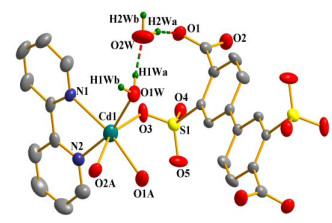
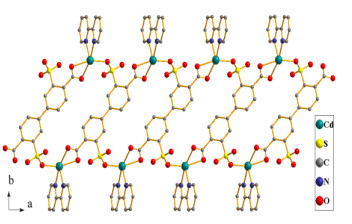
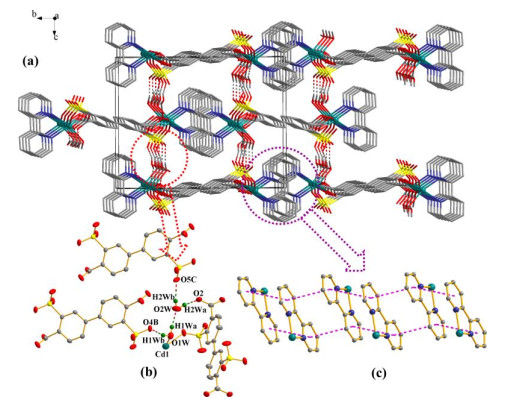
The asymmetric unit of 1 is composed of one Cd(II) ion, one half-occupied BPDSDC4– ligand, one 2, 2'-bpy, one coordinated water molecule, and one solvent water molecule. Cd(1) ion is coordinated to two carboxylate O and one sulfonate O atoms from two BPDSDC4– ligands, two N atoms of a 2, 2'-bpy ligand, and one coordinated water molecule (Fig. 1). The Cd‒O bond distances vary from 2.2740(19) to 2.359(2) Å and Cd‒N from 2.315(2) to 2.316(2) Å (Table 1). The BPDSDC4– ligand coordinates to four Cd(II) ions through its two chelating carboxylate groups and two unidentate sulfonate groups (Scheme 1a). One 2, 2'-bpy ligand chelates a Cd(II) ion to give a Cd(2, 2'-bpy) unit, which is linked by the tetradentate BPDSDC4– ligands to form a onedimensional (1D) ribbon structure running along the a axis (Fig. 2). The Cd(2, 2'-bpy) units are arranged at the edges of 1D ribbon, thus terminating the linkage of 1D ribbons to a high-dimensional structure through coordination bond. The O(1W)‒ H(1Wa)···O(2W), O(1W)‒H(1Wb)···O(4B), O(2W)‒ H(2Wa)···O(2), and O(2W)‒H(2Wb)···O(5C) hydrogen bonds (Table 2) with the O···O separations of 2.665(3), 2.798(3), 2.804(3) and 2.795(3) Å link the 1D ribbons to generate a 3D supramolecular structure (Fig. 3a). In addition, the π···π stacking interactions between the pyridine rings of neigh-boring 1D ribbons with the center-to-center distances of 3.8960(1) and 3.9532(2) Å and a dihedral angle of 3o are observed in the 3D packing (Fig. 3c). Thus, the present hydrogen bonds and π···π stacking interactions hold the 1D ribbons together and stabilize the whole 3D structure.
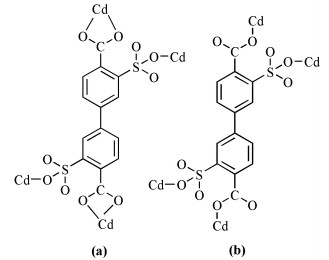
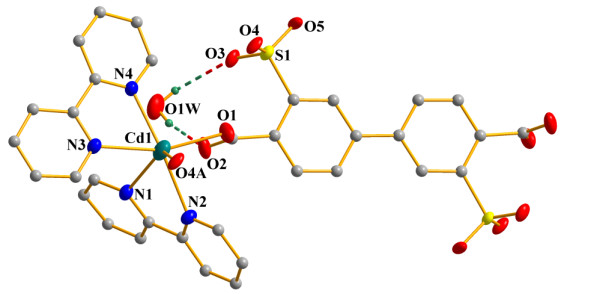
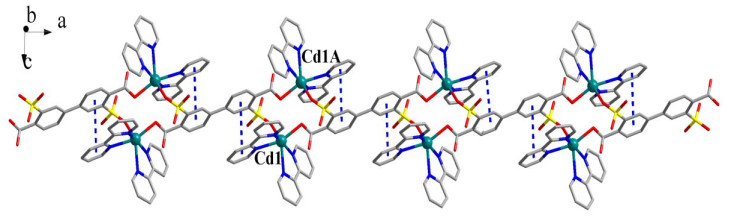
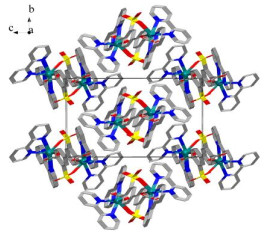
There are one Cd(II) ion, half a BPDSDC4– ligand, two 2, 2'-bpy and one solvent water molecule in the asymmetric unit of 2. The Cd(1) atom is six-coordinated to one carboxylate O and one sulfonate O atoms from two BPDSDC4– ligands and four N atoms of two 2, 2'-bpy ligands (Fig. 4). The Cd‒O bond distances are 2.2640(17) and 2.3350(16) Å and Cd‒N bond distances range from 2.3545(18) to 2.4787(19) Å (Table 1), which are comparable with those of compound 1. The BPDSDC4– ligand bridges four Cd(II) ions through two unidentate carboxylate O atoms and two unidentate sulfonate O atoms (Scheme 1b). Two 2, 2'-bpy ligands chelate one Cd(II) ion to form a Cd(2, 2'-bpy)2 unit. As shown in Fig. 5, two Cd(2, 2'-bpy)2 units are bridged by the BPDSDC4– ligands to give a dinuclear Cd2 unit with the Cd(1)···Cd(1A) separation of 4.84 Å. The dinuclear Cd2 units are further connected by BPDSDC4– ligands to form a 1D chain extending along the a axis (Fig. 5). The solvent water molecule is attached to the 1D chain through hydrogen bonds (Fig. 4 and Table 2). The 1D chain is further stabilized by π···π stacking interactions between the pyridine rings of 2, 2'-bpy ligands and benzene rings of BPDSDC4– ligands with a center-to-center distance of 3.9918(1) Å and a dihedral angle of 12o (Fig. 5). Such 1D chains are stacked into a 3D packing (Fig. 6). No interaction can be observed between the 1D chains in the 3D packing.
DownLoad:
CSV
| D–H···A | d(D–H) | d(H···A) | d(D···A) | ∠DHA | |
| Compound 1 | O(1W)–H(1Wa)···O(2W) | 0.85 | 1.82 | 2.665(3) | 174.1 |
| O(1W)–H(1Wb)···O(4B) | 0.85 | 1.99 | 2.798(3) | 158.1 | |
| O(2W)–H(1Wa)···O(2) | 0.85 | 2.02 | 2.804(3) | 152.3 | |
| O(2W)–H(1Wb)···O(5C) | 0.85 | 2.01 | 2.795(3) | 153.4 | |
| Compound 2 | O(1W)–H(1Wa)···O(3) | 0.85 | 2.43 | 3.149(3) | 142.5 |
| O(1W)–H(1Wb)···O(2) | 0.85 | 2.04 | 2.864(3) | 164.6 | |
| Symmetry codes: B: x – 1/2, –y + 1/2, z + 1/2; C: x + 1/2, –y + 1/2, z + 1/2 | |||||
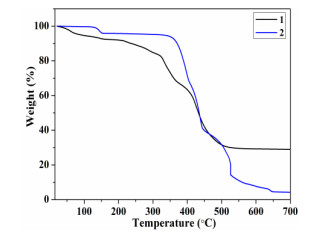
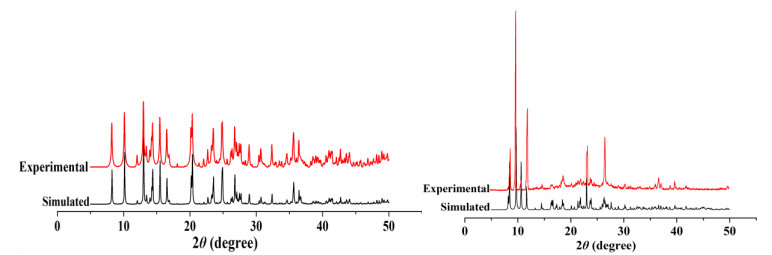
The absorption band centered at 3433 cm–1 in the IR spectrum of 1 is attributed to the O–H stretching vibration of water molecules. The strong peaks at 1601 and 1575 cm–1 can be assigned to the asymmetric stretching vibrations of carboxylate groups. The symmetric stretching vibrations of carboxylate groups are observed at 1465 and 1420 cm–1. The typical vibrations of sulfonate groups appeared at 1190, 1166, 1061, and 1025 cm–1. The asymmetric and symmetric stretching vibrations of carboxylate groups for compound 2 are observed at 1592 and 1576 cm–1, and 1475 and 1439 cm–1, respectively. The peaks at 1191, 1170, 1090, and 1025 cm–1 are the vibrations of sulfonate groups. The result of thermogravimetric analysis of 1 and 2 is shown in Fig. 7. The first weight loss between 30 and 150 ℃ can be attributed to the removal of water molecules (observed 7.35%, calculated 7.14%). The combustion of organic ligands occurs at 210 ℃. For compound 2, the loss of water molecule (observed 3.22%, calculated 2.86%) occurred from 100 to 150 ℃, and that of organic ligands started at 340 ℃. The measured PXRD patterns for compounds 1 and 2 match well with the corresponding simulated patterns generated from the single-crystal diffraction data (Fig. 8), which is indicative of pure products.
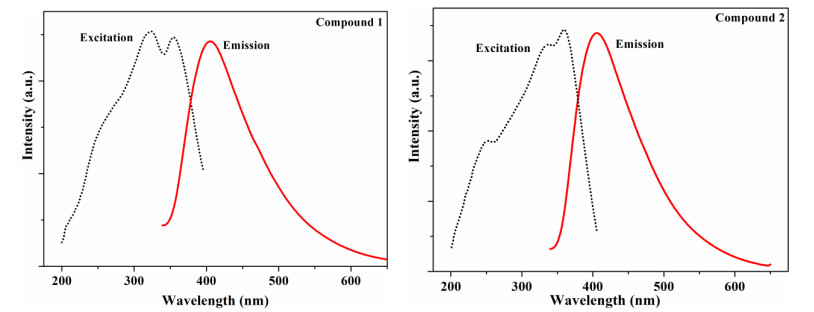
The luminescent properties of the two compounds were studied in the solid state under room temperature. It has been reported that the free H2-BPDSDC ligand displays a broad fluorescent emission centered at 390 nm upon 345 nm excitation[14]. The excitation spectrum of 1 displays a broad band from 200 to 400 nm with two peaks at 325 and 356 nm, which is mainly assigned to the π-π* transition of organic ligand. Upon excitation at 325 nm, the solid sample of 1 exhibits an emission centered at 406 nm (Fig. 9). Similar excitation and emission spectra were observed for 2. Therefore, the emissions for both compounds can be assigned to ligandcentered emissions.
In conclusion, two Cd(II) compounds based on the biphenyl-3, 3'-disulfonyl-4, 4'-dicarboxylate and 2, 2'-bipyridine mixed ligands have been reported. Both compounds have been characterized by FT-IR, single-crystal X-ray diffraction and TG analyses. Compound 1 is a 1D ribbon structure, while 2 has a 1D chain. Both these two compounds exhibit photoluminescent emission in the solid state.
Kitagawa, S.; Kitaura, R.; Noro, R. Functional porous coordination polymers. Angew. Chem., Int. Ed. 2004, 43, 2334–2375. doi: 10.1002/anie.200300610
He, Y.; Zhou, W.; Qian, G.; Chen, B. Methane storage in metal-organic frameworks. Chem. Soc. Rev. 2014, 43, 5657-5678. doi: 10.1039/C4CS00032C
Ma, H. F.; Xiong, L. N.; Chen, L.; Wang, Y. L.; Liu, Q. Y. Crystal structure and luminescent properties of a 3D Cd(II) compound constructed from succinate and 3, 6-di(4-pyridyl)pyridazine. Chin. J. Struct. Chem. 2017, 36, 485–490.
Yoon, M.; Srirambalaji, R.; Kim, K. Homochiral metal-organic frameworks for asymmetric heterogeneous catalysis. Chem. Rev. 2012, 112, 1196-1231. doi: 10.1021/cr2003147
Wang, Y. L.; Han, C. B.; Zhang, Y. Q.; Liu, Q. Y.; Liu, C. M.; Yin, S. G. Fine-tuning ligand to modulate the magnetic anisotropy in a carboxylate-bridged Dy2 single-molecule magnets system. Inorg. Chem. 2016, 55, 5578–5584. doi: 10.1021/acs.inorgchem.6b00653
Yang, F.; Xu, G.; Dou, Y.; Wang, B.; Zhang, H.; Wu, H.; Zhou, W.; Li, J. R.; Chen, B. A flexible metal-organic framework with a high density of sulfonic acid sites for proton conduction. Nat. Energy 2017, 2, 877-883. doi: 10.1038/s41560-017-0018-7
Kurc, T.; Janczak, J.; Hoffmann, J.; Videnova-Adrabinska, V. New heterometallic hybrid polymers constructed with aromatic sulfonate-carboxylate ligands: synthesis, layered structures, and properties. Cryst. Growth Des. 2012, 12, 2613–2624. doi: 10.1021/cg300199j
Li, R. P.; Wang, Y. L.; Liu, Q. Y. A Dinuclear dysprosium-2-quinolinecarboxylate-1, 10-phenanthroline compound: crystal structure and magnetism, Chin. J. Struct. Chem. 2018, 37, 407–413.
Li, P.; Vermeulen, N. A.; Gong, X.; Malliakas, C. D.; Stoddart, J. F.; Hupp, J. T.; Farha, O. K. Design and synthesis of a water-stable anionic uranium-based metal-organic framework (MOF) with ultra large pores. Angew. Chem. Int. Ed. 2016, 55, 10358–10362. doi: 10.1002/anie.201605547
Zhang, Y. B.; Furukawa, H.; Ko, N.; Nie, W.; Park, H. J.; Okajima, S.; Cordova, K. E.; Deng, H.; Kim, J.; Yaghi, O. M. Introduction of functionality, selection of topology, and enhancement of gas adsorption in multivariate metal-organic framework-177. J. Am. Chem. Soc. 2015, 137, 2641-2650. doi: 10.1021/ja512311a
Wang, B.; Lv, X. L.; Feng, D.; Xie, L. H.; Zhang, J.; Li, M.; Xie, Y.; Li, J.; Zhou, H. C. Highly stable Zr(IV)-based metal-organic frameworks for the detection and removal of antibiotics and organic explosives in water. J. Am. Chem. Soc. 2016, 138, 6204-6216. doi: 10.1021/jacs.6b01663
Shimizu, G. K. H.; Vaidhyanathan, R.; Taylor, J. M. Phosphonate and sulfonate metal organic frameworks. Chem. Soc. Rev. 2009, 38, 1430-1449. doi: 10.1039/b802423p
Sun, D. F.; Cao, R.; Sun, Y. Q.; Bi, W. H.; Yuan, D. Q.; Shi, Q.; Li, X. Syntheses and structures of two novel copper complexes constructed from unusual planar tetracopper(II) SBUs. Chem. Commun. 2003, 1528-1529.
Xiao, B.; Byrne, P. J.; Wheatley, P. S.; Wragg, D. S.; Zhao, X.; Fletcher, A. J.; Thomas, K. M.; Peters, L.; Evans, J. S. O.; Warren, J. E.; Zhou, W.; Morris, R. E. Chemically blockable transformation and ultraselective low-pressure gas adsorption in a non-porous metal organic framework. Nat. Chem. 2009, 1, 289-294. doi: 10.1038/nchem.254
Cao, H. Y.; Liu, Q. Y.; Li, L. Q.; Wang, Y. L.; Chen, L. L.; Yao, Y. Two cadmium coordination compounds with 5-sulfonyl-1, 2, 4-benzenetricarboxylate ligand: syntheses, structures, and photoluminescence. Z. Anorg. Allg. Chem. 2014, 640, 1420–1425. doi: 10.1002/zaac.201300681
Zhang, W. W.; Wang, Y. L.; Liu, Q.; Liu, Q. Y. Lanthanide-benzophenone-3, 3'-disulfonyl-4, 4'-dicarboxylate frameworks: temperature and 1-hydroxypyren luminescence sensing and proton conduction. Inorg. Chem. 2018, 57, 7805-7814. doi: 10.1021/acs.inorgchem.8b00865
Li, Z. T.; Zhang, W. W.; Liu, Q.; Liu, Q. Y.; Wang, Y. L. A noncentrosymmetric coordination polymer based on the benzophenone-3, 3'-disulfonyl-4, 4'-dicarboxylate ligand exhibiting second-harmonic-generation responses. Inorg. Chem. Commun. 2018, 95, 107-110. doi: 10.1016/j.inoche.2018.07.021
Zhou, L. J.; Deng, W. H.; Wang, Y. L.; Xu, G.; Yin, S. G.; Liu, Q. Y. Lanthanide-potassium-biphenyl-3, 3'-disulfonyl-4, 4'-dicarboxylate frameworks: gas sorption, proton conductivity, and luminescent sensing of metal ions. Inorg. Chem. 2016, 55, 6271–6277. doi: 10.1021/acs.inorgchem.6b00928
Wang, H. H.; Zhou, L. J.; Wang, Y. L.; Liu, Q. Y. Terbium-biphenyl-3, 3'-disulfonyl-4, 4'-dicarboxylate framework with sulfonate sites for luminescent sensing of Cr3+ ion. Inorg. Chem. Commun. 2016, 73, 94–97. doi: 10.1016/j.inoche.2016.10.006
CrysAlisPro. Rigaku Oxford Diffraction 2015.
Sheldrick, G. M. SHELXT-integrated space-group and crystal-structure determination. Acta Cryst. 2015, A71, 3–8.
Sheldrick, G. M. Crystal structure refinement with SHELXL. Acta Cryst. 2015, C71, 3–8.

Figure 3 View of the 3D supramolecular structure of 1 (a) and hydrogen bonds between 1D ribbons (b) and π···π interactions between the 1D ribbons in 1
Table 1. Selected Bond Lengths (Å) of 1 and 2
| Compound 1 | Compound 2 | |||
| Bond | Dist. | Bond | Dist. | |
| Cd(1)–O(3) | 2.2740(19) | Cd(1)–O(1) | 2.2640(17) | |
| Cd(1)–O(1W) | 2.289(2) | Cd(1)–O(4) | 2.3350(16) | |
| Cd(1)–O(1A) | 2.359(2) | Cd(1)–N(1) | 2.4787(19) | |
| Cd(1)–O(2A) | 2.3512(19) | Cd(1)–N(2) | 2.3969(18) | |
| Cd(1)–N(1) | 2.316(2) | Cd(1)–N(3) | 2.3913(18) | |
| Cd(1)–N(2) | 2.315(2) | Cd(1)–N(4) | 2.3545(18) | |
| Symmetry code for 1: A: x –1, y, z | ||||
 下载: 导出CSV
Table 2. Hydrogen Bonds of Compounds 1 and 2 (Å and °)
| D–H···A | d(D–H) | d(H···A) | d(D···A) | ∠DHA | |
| Compound 1 | O(1W)–H(1Wa)···O(2W) | 0.85 | 1.82 | 2.665(3) | 174.1 |
| O(1W)–H(1Wb)···O(4B) | 0.85 | 1.99 | 2.798(3) | 158.1 | |
| O(2W)–H(1Wa)···O(2) | 0.85 | 2.02 | 2.804(3) | 152.3 | |
| O(2W)–H(1Wb)···O(5C) | 0.85 | 2.01 | 2.795(3) | 153.4 | |
| Compound 2 | O(1W)–H(1Wa)···O(3) | 0.85 | 2.43 | 3.149(3) | 142.5 |
| O(1W)–H(1Wb)···O(2) | 0.85 | 2.04 | 2.864(3) | 164.6 | |
| Symmetry codes: B: x – 1/2, –y + 1/2, z + 1/2; C: x + 1/2, –y + 1/2, z + 1/2 | |||||
下载: 导出CSV

 扫一扫看文章


扫一扫关注我们


 下载:
下载: