

Table 1.
Selected Bond Lengths (Å) and Bond Angles (º)


Due to the excellent magnetic and photolumi-nescent behaviors, lanthanide materials have recently attracted more and more interest[1-4]. Up to date, researchers have completed a great deal of investigation on the lanthanide materials, trying to find out their practical applications for magnetic materials, light-emitting diodes (LEDs), luminescent probes, electrochemical displays, and so forth[5, 6]. To our knowledge, the amazing magnetic and photoluminescent behaviors of lanthanide materials are mainly originated from the rich f electrons of the lanthanide (LN) elements. In general, lanthanide materials can exhibit intensive photoluminescent emission, only when the electronic transition of the f electrons of the lanthanide ions could efficiently occur. Furthermore, a lot of lanthanide materials are famous of magnetic components because of their attractive magneto-optical and magnetic behaviors[7-10]. Therefore, a lot of scientists have devoted themselves into the investigation of the design, synthesis and characterization of novel lanthanide-containing magnetic materials. However, the semiconductive behaviors of the lanthanide materials are rarely studied yet in comparison with the investigations on the magnetic and photoluminescent behaviors of the lanthanide materials[11].
Group 12 (IIB) elements include zinc, cadmium and mercury and they have attracted increasing attention because of the following reasons: rich coordination motifs, photoluminescent and photo-electric behaviors, as well as the important role in the biosystem of zinc[12, 13]. IIB elements are also vital components in semiconductive materials and, nowadays, many semiconductive materials con-taining IIB elements have thus far been docu-mented[14-17]. For many years our group keeps studying magnetic, photoluminescent, and semi-conductive materials. Recently, we have mainly focused on the LN–IIB–VIIA (VIIA = halogen) materials in order to get new insights into their structures, photoluminescence, magnetism and semiconductive behaviors. We report in this work the preparation, structure, magnetism, photolumine-scence, and semiconductive behaviors of a 4f-5d material (La6Hg5Br26)[4(HgBr2)](2Br) (1) with a 2D layered structure. It should be pointed out that compound 1 is the first example of ternary LN-IIB-VIIA materials, although a lot of LN-IIB materials have thus far been documented[18-21].
The chemicals for the preparation of the title compound were purchased via commercial sources and directly used. Photoluminescence experiments were carried out on a F97XP photoluminescent spectrometer. The solid-state UV/vis diffuse reflec-tance spectrum was measured at room temperature on a computer-controlled TU1901 UV/vis spectro-meter equipped with an integrating sphere in the wavelength range of 190~900 nm. The barium sulfate powder was applied as a reference of 100% reflectance, on which the finely ground powder sample was daubed. Variable-temperature magnetic susceptibility and field dependence magnetization measurements of the title compound on polycry-stalline samples were carried out on a PPMS 9T Quantum Design SQUID magnetometer and the diamagnetism correction of the magnetic data was calculated from the Pascal's constants.
A mixture of La(NO3)3·6H2O (1 mmol, 433 mg), HgBr2 (1 mmol, 360 mg) and distilled water (10 mL) was sealed into a 23 mL Teflon-lined stainless-steel vessel which was heated to 433 K and kept there for one week under autogenous pressure. When the vessel was slowly cooled down to room temperature, colorless block-like crystals were obtained. The yield was 22% based on HgBr2.
A carefully selected single crystal (0.11mm × 0.10mm × 0.04mm) was adhered onto the tip of a glass fiber and then mounted to a SuperNova CCD diffractometer. The X-ray source is graphite-monochromatic Mo-Kα radiation with λ = 0.71073 Å. The intensity data were obtained at 293(2) K with the ω scan mode. For data reduction and empirical absorption correction, CrystalClear software was applied[22]. The crystal structure of the title compound was solved by direct methods. The final structure was refined on F2 by full-matrix least-squares using the Siemens SHELXTLTM V5 crystallographic software package[23]. All of the atoms were generated on difference Fourier maps and refined anisotropically. Reflections measured are 19516; the final R = 0.0671 for 1914 observed reflections with I > 2σ(I) and wR = 0.1761; S = 1.000, (Δρ)max = 1.297, (Δρ)min = –1.498 e/Å3 and (Δ/σ)max = 0. The selected bond lengths and bond angles are presented in Table 1.
 DownLoad:
CSV
DownLoad:
CSV
| Bond | Dist. | Bond | Dist. | Bond | Dist. | ||
| Hg(1)–Br(5) | 2.435(3) | Hg(2)–La(3)i | 3.444(2) | La(2)–Br(4) | 3.358(2) | ||
| Hg(1)–Br(6) | 2.742(3) | Hg(3)–Br(10) | 2.373(3) | La(2)–Br(4)iv | 3.358(2) | ||
| Hg(1)–Br(7) | 2.632(3) | Hg(3)–Br(11) | 2.410(3) | La(3)–Br(4) | 2.422(2) | ||
| Hg(1)–Br(8) | 2.736(4) | La(1)–Br(1)iv | 2.398(2) | La(3)–Br(5) | 3.290(3) | ||
| Hg(2)–La(2)i | 2.962(1) | La(1)–Br(1) | 2.398(2) | La(3)–Br(1)ii | 3.505(2) | ||
| Hg(2)–La(2) | 2.962(1) | La(1)–Br(2)vi | 3.416(3) | La(3)–Br(4)vii | 2.422(2) | ||
| Hg(2)–La(1)ii | 3.039(1) | La(1)–Br(3) | 3.307(3) | La(3)–Br(5)vii | 3.290(3) | ||
| Hg(2)–La(1)iii | 3.039(1) | La(2)–Br(2) | 2.415(3) | La(3)–Br(1) | 3.505(2) | ||
| Hg(2)–La(3) | 3.444(2) | La(2)–Br(3) | 2.407(3) | ||||
| Angle | (°) | Angle | (°) | Angle | (°) | ||
| Br(5)–Hg(1)–Br(7) | 123.2(1) | Br(1)iv–La(1)–Br(1) | 165.4(1) | Br(4)vii–La(3)–Br(4) | 173.8(1) | ||
| Br(5)–Hg(1)–Br(8) | 115.4(1) | Br(1)iv–La(1)–Hg(2)v | 97.18(5) | Br(4)vii–La(3)–Br(5) | 93.60(8) | ||
| Br(7)–Hg(1)–Br(8) | 102.9(1) | Br(1)–La(1)–Hg(2)v | 97.18(5) | Br(4)–La(3)–Br(5) | 90.89(9) | ||
| Br(5)–Hg(1)–Br(6) | 121.4(1) | Br(1)iv–La(1)–Br(3)v | 92.59(6) | Br(4)vii–La(3)–Br(5)vii | 90.89(9) | ||
| Br(7)–Hg(1)–Br(6) | 94.50(9) | Br(1)–La(1)–Br(3)v | 92.59(6) | Br(4)–La(3)–Br(5)vii | 93.60(8) | ||
| Br(8)–Hg(1)–Br(6) | 93.9(1) | Hg(2)v–La(1)–Br(3)v | 79.45(5) | Br(5)–La(3)–Br(5)vii | 87.17(10) | ||
| La(2)i–Hg(2)–La(2) | 180.0 | Br(1)iv–La(1)–Br(2)vi | 90.19(6) | Br(4)vii–La(3)–Hg(2) | 86.90(6) | ||
| La(2)i–Hg(2)–La(1)ii | 90.85(4) | Br(1)–La(1)–Br(2)vi | 90.19(6) | Br(4)–La(3)–Hg(2) | 86.90(6) | ||
| La(2)–Hg(2)–La(1)ii | 89.15(4) | Hg(2)v–La(1)–Br(2)vi | 78.20(6) | Br(5)–La(3)–Hg(2) | 136.42(5) | ||
| La(2)i–Hg(2)–La(1)iii | 89.15(4) | Br(3)v–La(1)–Br(2)vi | 157.65(8) | Br(5)vii–La(3)–Hg(2) | 136.42(5) | ||
| La(2)–Hg(2)–La(1)iii | 90.85(4) | Br(3)–La(2)–Br(2) | 164.0(1) | Br(4)vii–La(3)–Br(1)ii | 88.78(6) | ||
| La(1)ii–Hg(2)–La(1)iii | 180.0 | Br(3)–La(2)–Hg(2) | 97.75(8) | Br(4)–La(3)–Br(1)ii | 89.34(6) | ||
| La(2)i–Hg(2)–La(3) | 90.0 | Br(2)–La(2)–Hg(2) | 98.24(8) | Br(5)–La(3)–Br(1)ii | 64.15(6) | ||
| La(2)–Hg(2)–La(3) | 90.0 | Br(3)–La(2)–Br(4) | 91.40(5) | Br(5)vii–La(3)–Br(1)ii | 151.22(8) | ||
| La(1)ii–Hg(2)–La(3) | 90.0 | Br(2)–La(2)–Br(4) | 91.18(5) | Hg(2)–La(3)–Br(1)ii | 72.30(4) | ||
| La(2)–Hg(2)–La(3)i | 90.0 | Hg(2)–La(2)–Br(4) | 80.67(4) | Br(4)vii–La(3)–Br(1)viii | 89.34(6) | ||
| La(1)ii–Hg(2)–La(3)ii | 90.0 | Br(3)–La(2)–Br(4)iv | 91.40(5) | Br(4)–La(3)–Br(1)viii | 88.78(6) | ||
| La(1)iii–Hg(2)–La(3)i | 90.0 | Br(2)–La(2)–Br(4)iv | 91.18(5) | Br(5)–La(3)–Br(1)viii | 151.22(8) | ||
| La(3)–Hg(2)–La(3)i | 180.00(1) | Hg(2)–La(2)–Br(4)iv | 80.67(4) | Br(5)vii–La(3)–Br(1)viii | 64.15(6) | ||
| Br(10)–Hg(3)–Br(11) | 174.8(1) | Br(4)–La(2)–Br(4)iv | 161.35(8) | Br(1)ii–La(3)–Br(1)viii | 144.60(9) | ||
| Symmetry codes: (i) x, y, –z–1; (ii) –x+3½, y–½, –z–1; (iii) x+½, –y–2½, z; (iv) –x+3½, y+½, –z–1; (v) –x+3, –y–2, –z–1; (vi) x–½, –y–2½, z; (vii) –x+3, –y–2, z; (viii) x–½, –y–2½, –z–1 | |||||||
The title compound is crystallized in space group Pbam of the orthorhombic system with two formula units in one cell, as revealed by the single-crystal X-ray diffraction method. The asymmetric unit includes two and a quarter of mercury atoms, one and a half lanthanum atoms and nine bromine atoms. The molecular structure is comprised of one (La6Hg5Br26)2+ cation, four HgBr2 moieties and two bromide ions, as depicted in Fig. 1. Most of the crystallographically independent atoms are located in the general positions, but all lanthanum atoms, as well as Hg(2), Br(2), Br(3), Br(6) and Br(9) atoms, are resided in the special positions.

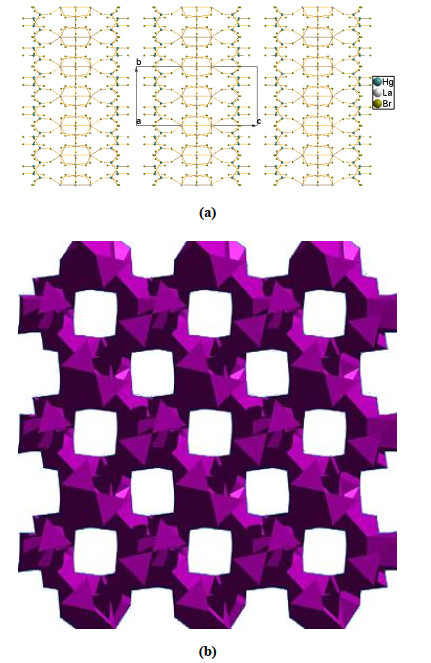
All the mercury ions are in a +2 oxidation state. Hg(1) ion is surrounded by four bromine atoms, forming a distorted tetrahedron with the Br–Hg1–Br bond angles in the range of 93.9(1)°~123.2(1)° and the Hg–Br bond lengths residing at the span of 2.435(3)~2.742(3) Å, which is comparable with those documented previously[24-26]. Hg(2) ion is surrounded by six La ions with the bond distances between 2.962(1) and 3.444(2) Å. Differently, Hg(3) ion is coordinated by two bromine atoms, yielding an almost linear geometry with the Br(10)–Hg(3)–Br(11) bond angle being 174.8(1) and the Hg–Br bonds of 2.373(3) and 2.410(3) Å, respectively. Both La(1) and La(2) are bound by four bromine atoms, while La(3) by six bromine atoms. The bond lengths of La–Br are between 2.398(2) and 3.505(2) Å. The bond angles of Br–La–Br are grouped into two kinds, namely, one is in the range of 64.15(6)°~93.60(8)° which is close to 90°, and the other falls in the 144.60(9)°~173.8(1)° the region similar to 180°. The mercury, lanthanum and bromide ions interconnect together to give a 2D layer running parallel to the ab plane, as presented in Fig. 2. These 2D layers stack along the c direction to form a crystal packing structure of compound 1 with the isolated bromide ions locating between the layers, as shown in Fig. 3. It is noteworthy to mention that compound 1 is the first example of ternary LN–IIB–VIIA compounds. Interestingly, compound 1 contains {La6} groups. Some compounds containing {La6} clusters have been documented previously[27, 28].

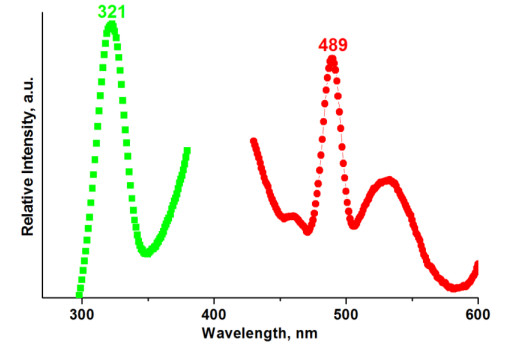
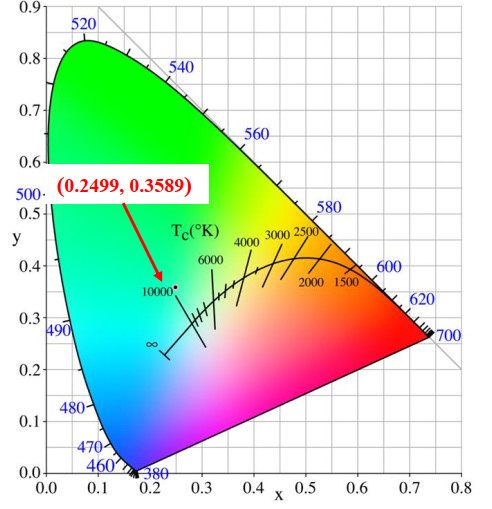
To the best of our knowledge, lanthanide materials can usually display photoluminescence and, up to date, a great number of lanthanide materials have been studied for their photoluminescent behavior and potential applications as photoluminescent emitting materials like electrochemical displays, chemical sensors, LEDs, and so forth[29-31]. Based on the above consideration, the title compound is supposed to exhibit interesting photoluminescence behavior. The photoluminescence behavior of the title compound in this work was investigated in the solid state under room temperature, with the result presented in Fig. 4 which obviously exhibits an effective energy absorption residing at the wavelength span of 300~350 nm. The photoluminescence excitation spectrum using the emission wavelength of 489 nm gives one sharp excitation peak at 321 nm. We further carried out the corresponding photoluminescence emission spectrum of the title compound under 321 nm irradiation. The photoluminescence emission spectrum is characteristic of one main peak locating at 489 nm, accompanied by two side ones at 461 and 533 nm, respectively. These emission peaks are attributed to the characteristic peaks of La3+ ions. The maximum peak locates at 489 nm of the green region of the light spectrum and, therefore, the title compound can be a candidate for potential green photoluminescence materials. It has remarkable CIE (Commission Internationale de I'Éclairage) chromaticity coordinates of (0.2499, 0.3589), as shown in Fig. 5.
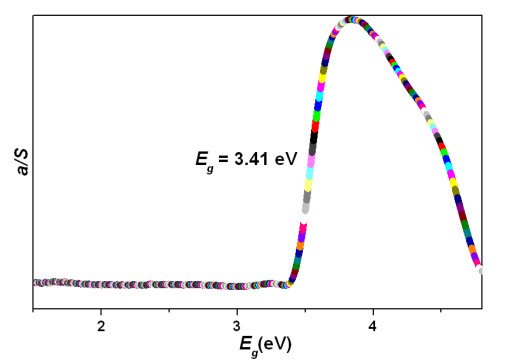
Zinc, cadmium and mercury are group 12 or IIB elements well-known as important components of semiconductive materials. The title compound contains mercury element and it is supposed to exhibit semiconductive behavior. Therefore, we measured the solid-state UV/vis diffuse reflectance spectrum with solid state sample at room temperature, and the data obtained were treated by using the Kubelka-Munk function, namely, α/S = (1 – R)2/2R. In this function, α means the absorption coefficient, S is the scattering coefficient that is practically wavelength independent when the particle size is larger than 5 μm, while R refers to the reflectance. The optical band gap value can be determined by extrapolating from the linear part of the absorption edges of the α/S vs. energy curve, as presented in Fig. 6. The solid-state diffuse reflectance spectrum uncovers that the title compound exhibits a wide optical band gap of 3.41 eV and, thereby, it can be a candidate for wide band gap semiconductive mate-rials. The solid-state diffuse reflectance spectrum shows a sharp slope of the optical absorption edge that indicates a direct transition[32]. The optical band gap value of 3.41 eV for the title compound is obviously smaller than 5.47 eV for diamond which is a famous third generation semiconductor, but it is clearly larger than that of CuInS2 (1.55 eV), GaAs (1.4 eV) and CdTe (1.5 eV) which are efficient photovoltaic materials[33, 34].
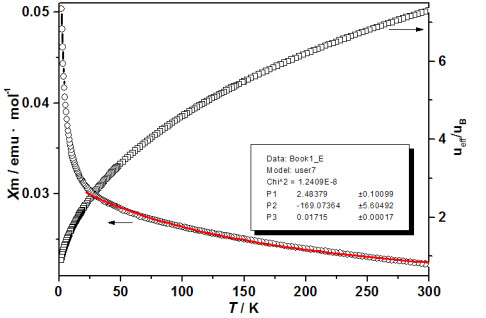
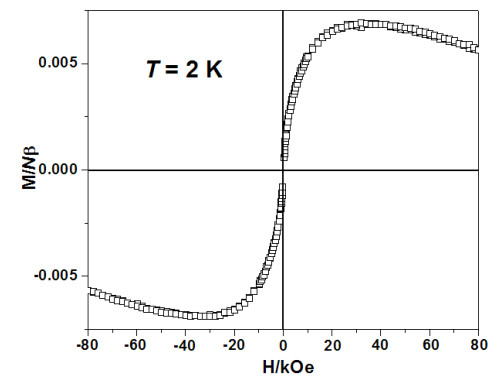
Compounds containing trivalent lanthanide ions can usually display magnetic behavior, so the title compound is supposed to possess magnetic pro-perties. The curves of χM vs. T and μeff vs. T for the title compound are depicted in Fig. 7. The χM refers to the magnetic susceptibility per La-containing molecule. When the temperature decreases, the χM vs. T curve continuously increases from 0.02 emu·mol–1 at 300 K to 0.03 emu·mol–1 at 25 K, then abruptly increases to 0.05 emu·mol–1 at 2 K. This χM vs. T curve exhibits an antiferromagnetic-like behavior. The nature of the antiferromagnetic-like behavior is not clear yet, but it is supposed to be due to the gradual thermal depopulation of the Stark components of lanthanide ions. The magnetic susceptibility curve accords with the Curie-Weiss law, i.e. χm = c/(T – θ). The data of the magnetic susceptibility are fitted from 300 to 25 K by using the Curie-Weiss law and it gives the value of C being 2.48 K and a negative Weiss constant θ = –169.07 K, as shown in Fig. 7. This negative Weiss constant proves the existence of antiferromagnetic-like interaction in compound 1, which is similar to the analog[35, 36]. When the temperature decreases, the μeff vs. T curve continuously decreases from 7.31 μB at 300 K to 0.89 μB at 2 K, which also validates the existence of antiferromagnetic-like interaction in compound 1, as given in Fig. 7. The field depen-dence of the magnetization of the title compound was measured at 2 K, as shown in Fig. 8. This curve exhibits a coercive field of around 122 Oe and a very small remnant magnetization of about 2.9 × 10⁻⁴ Nβ. The magnetization curve increases fast with the increased field from 0 to 3 T and reaches a saturation value of about 0.007 Nβ, then slowly decreases to 0.005 Nβ with the field decreased to 8 T.
The first ternary LN-IIB-VIIA compound (La6Hg5Br26)[4(HgBr2)](2Br) (1) has been synthesi-zed and structurally characterized by single-crystal X-ray diffraction technique. Compound 1 features a 2D layered structure. Interestingly, compound 1 contains {La6} groups. The solid-state photo-luminescence measurements reveal that compound 1 has a strong emission in the green region of the spectrum with CIE chromaticity coordinates of (0.2499, 0.3589). Solid-state UV/vis diffuse reflec-tance spectrum reveals that compound 1 shows a wide optical band gap of 3.41 eV. Compound 1 displays an antiferromagnetic interaction with C = 2.48 K and a negative Weiss constant θ = –169.07 K. Therefore, compound 1 is probably a candidate of photoluminescence, semiconductive or magnetic materials.
Han, S.; Deng, R.; Xie, X.; Liu, X. Enhancing luminescence in lanthanide-doped upconversion nanoparticles. Angew. Chem. Int. Edit. 2014, 53, 11702–11715. doi: 10.1002/anie.201403408
Zhou, B.; Tao, L.; Chai, Y.; Lau, S. P.; Zhang, Q.; Tsang, Y. H. Constructing interfacial energy transfer for photon up- and down-conversion from lanthanides in a core-shell nanostructure. Angew. Chem. Int. Edit. 2016, 55, 12356–12360. doi: 10.1002/anie.201604682
Mendes, R. F.; Ananias, D.; Carlos, L. D.; Rocha, J.; Paz, F. A. A. Photoluminescent lanthanide-organic framework based on a tetraphosphonic acid linker. Cryst. Growth Des. 2017, 17, 5191–5199. doi: 10.1021/acs.cgd.7b00667
Zhang, P.; Zhang, L.; Wang, C.; Xue, S.; Lin, S. Y.; Tang, J. Equatorially coordinated lanthanide single ion magnets. J. Am. Chem. Soc. 2014, 136, 4484–4487. doi: 10.1021/ja500793x
Pointillart, F.; Cador, O.; Le Guennic, B.; Ouahab, L. Uncommon lanthanide ions in purely 4f single molecule magnets. Coord. Chem. Rev. 2017, 346, 150–175. doi: 10.1016/j.ccr.2016.12.017
Kitchen, J. A. Lanthanide-based self-assemblies of 2, 6-pyridyldicarboxamide ligands: recent advances and applications as next-generation luminescent and magnetic materials. Coord. Chem. Rev. 2017, 340, 232–246. doi: 10.1016/j.ccr.2017.01.012
Shkrob, I. A.; Kaminski, M. D.; Mertz, C. J.; Rickert, P. G.; Derzon, M. S.; Rahimian, K. Sequestration, fluorometric detection, and mass spectroscopy analysis of lanthanide ions using surface modified magnetic microspheres for microfluidic manipulation. J. Am. Chem. Soc. 2009, 131, 15705–15710. doi: 10.1021/ja9035253
Abbas, G.; Lan, Y.; Kostakis, G.; Anson, C. E.; Powell, A. K. An investigation into lanthanide-lanthanide magnetic interactions in a series of [Ln2(mdeaH2)2(piv)6] dimers. Inorg. Chim. Acta 2008, 361, 3494–3499. doi: 10.1016/j.ica.2008.03.024
Kirste, A.; Kolmakova, N. P.; Hansel, S.; Mueller, H. U.; Von Ortenberg, M. Rare-earth zircons and intermetallic compounds in megagauss-fields. Investigation of new magnetic phenomena. Physica B 2004, 346-347, 191–195. doi: 10.1016/j.physb.2004.01.048
Ofer, O.; Sugiyama, J.; Brewer, J. H.; Ansaldo, E. J.; Mansson, M.; Chow, K. H.; Kamazawa, K.; Doi, Y.; Hinatsu, Y. Frustration and magnetism of the zigzag chain compounds EuL2O4 (L = Yb, Lu, Gd, Eu). Phys. Rev. B 2011, 84, 054428–5.
Ahmed, N.; Nisar, J.; Kouser, R.; Nabi, A. G.; Mukhtar, S.; Saeed, Y.; Nasim, M. H. Study of electronic, magnetic and optical properties of KMS (M = Nd, Ho, Er and Lu): first principle calculations. Mater. Res. Express 2017, 4, 065903–8. doi: 10.1088/2053-1591/aa75fc
Waters, J. B.; Turbervill, R. S. P.; Goicoechea, J. M. Group 12 metal complexes of N-heterocyclic ditopic carbanionic carbenes. Organometallics 2013, 32, 5190–5200. doi: 10.1021/om400728u
Mohapatra, B.; Verma, S. Crystal engineering with modified 2-aminopurine and group 12 metal ions. Cryst. Growth Des. 2013, 13, 2716–2721. doi: 10.1021/cg4006168
Yoshida, Y.; Ito, H.; Nakamura, Y.; Ishikawa, M.; Otsuka, A.; Hayama, H.; Maesato, M.; Yamochi, H.; Kishida, H.; Saito, G. BEDT-TTF salts formed with tetrahedrally coordinated zinc(II) complex anions. Cryst. Growth Des. 2016, 16, 6613–6630. doi: 10.1021/acs.cgd.6b01294
Zhang, L.; Lin, H.; Wu, Y.; Zhuo, S. Interfacial electron transfer of P3HT/PDI/ZnO nanocomposite and its application in visible-light detection. Chem. Phys. Lett. 2016, 661, 224–227. doi: 10.1016/j.cplett.2016.08.079
Zeng, Y.; Kelley, D. F. Excited hole photochemistry of CdSe/CdS quantum dots. J. Phys. Chem. C 2016, 120, 17853–17862. doi: 10.1021/acs.jpcc.6b06282
Uematsu, T.; Shimomura, E.; Torimoto, T.; Kuwabata, S. Evaluation of surface ligands on semiconductor nanoparticle surfaces using electron transfer to redox species. J. Phys. Chem. C 2016, 120, 16012–16023. doi: 10.1021/acs.jpcc.5b12698
Kazem, N.; Hurtado, A.; Sui, F.; Ohno, S.; Zevalkink, A.; Snyder, J. G.; Kauzlarich, S. M. High temperature thermoelectric properties of the solid-solution zintl phase Eu11Cd6–xZnxSb12. Chem. Mater. 2015, 27, 4413–4421. doi: 10.1021/acs.chemmater.5b01301
Suen, N. T.; Wang, Y.; Bobev, S. Synthesis, crystal structures, and physical properties of the new zintl phases A21Zn4Pn18 (A = Ca, Eu; Pn = As, Sb)—versatile arrangements of [ZnPn4] tetrahedra. J. Solid State Chem. 2015, 227, 204–211. doi: 10.1016/j.jssc.2015.03.031
Dymek, M.; Rozdzynska-Kielbik, B.; Pavlyuk, V. V.; Bala, H. Electrochemical hydrogenation properties of LaNi4.6Zn0.4−xSnx alloys. J. Alloy. Compd. 2015, 644, 916–922. doi: 10.1016/j.jallcom.2015.05.072
Ainsworth, C. M.; Wang, C. H.; Tucker, M. G.; Evans, J. S. O. Synthesis, structural characterization, and physical properties of the new transition metal oxyselenide Ce2O2ZnSe2. Inorg. Chem. 2015, 54, 1563–1571. doi: 10.1021/ic502551n
Rigaku, CrystalClear Version 1.35. Rigaku Corporation, Japan, Tokyo 2002.
Sheldrick, G. M. SHELXS-97, Program for X-ray Crystal Structure Solution. University of Göttingen, Germany 1997.
Sabounchei, S. J.; Ahmadianpoor, M.; Hashemi, A.; Mohsenzadeh, F.; Gable, R. W. Synthesis, spectroscopic and structural characterization and antibacterial activity of new dimeric and polymeric mercury(II) complexes of phosphonium ylide. Inorg. Chim. Acta 2017, 458, 77–83. doi: 10.1016/j.ica.2016.12.023
Vallejos, J.; Brito, I.; Cardenas, A.; Llanos, J.; Bolte, M.; Lopez-Rodriguez, M. Mercury coordination polymers with flexible ethane-1, 2-diyl-bis-(pyridyl-3-carboxylate): synthesis, structures, thermal and luminescent properties. J. Solid State Chem. 2015, 223, 17–22. doi: 10.1016/j.jssc.2014.03.022
Mahmoudi, G.; Khandar, A. A.; Zareba, J. K.; Bialek, M. J.; Gargari, M. S.; Abedi, M.; Barandika, G.; Van Derveer, D.; Mague, J.; Masoumi, A. The role of hydrogen bonding on supramolecular assembly of the mercury coordination compounds and final structure influenced by solvent effect. Inorg. Chim. Acta 2015, 429, 1–14. doi: 10.1016/j.ica.2014.12.027
Holynska, M.; Clerac, R.; Rouzieres, M. Lanthanide complexes with multidentate oxime ligands as single-molecule magnets and atmospheric carbon dioxide fixation systems. Chem. Eur. J. 2015, 21, 13321–13329. doi: 10.1002/chem.201501824
Colmont, M.; Leclercq, B.; Mentre, O.; Roussel, P. Complex tunnel structure of new La6(Mo2O7)(MoO4)8: crystal growth from flux and high structural complexity. Mendeleev Commun. 2017, 27, 592–594. doi: 10.1016/j.mencom.2017.11.018
Joos, J. J.; Poelman, D.; Smet, P. F. Energy level modeling of lanthanide materials: review and uncertainty analysis. Energy level modeling of lanthanide materials: review and uncertainty analysis. Phys. Chem. Chem. Phys. 2015, 17, 19058–19078. doi: 10.1039/C5CP02156A
Zhang, Y.; Wei, W.; Das, G. K.; Yang, T.; Timothy, T. Engineering lanthanide-based materials for nanomedicine. J. Photoch. Photobio. C 2014, 20, 71–96. doi: 10.1016/j.jphotochemrev.2014.06.001
van Sark, W. G. J. H. M.; de Wild, J.; Rath, J. K.; Meijerink, A.; El Schropp, R. Upconversion in solar cells. Nanoscale Res. Lett. 2013, 8, 81/1–81/10.
Huang, F. Q.; Mitchell, K.; Ibers, J. A. New layered materials: syntheses, structures, and optical and magnetic properties of CsGdZnSe3, CsZrCuSe3, CsUCuSe3, and BaGdCuSe3. Inorg. Chem. 2001, 40, 5123–5126. doi: 10.1021/ic0104353
Dürichen, P.; Bensch, W. Synthesis, crystal structures and optical properties of new quaternary chalcogenides of Va-metals: Rb2CuVS4, K2CuVSe4, Rb2CuNbSe4, Cs2CuNbSe4 and Rb2CuNbS4. Eur. J. Solid State Inorg. Chem. 1997, 34, 1187–1198.
Tillinski, R.; Rumpf, C.; Näther, C.; Duerichen, P.; Jess, I.; Schunk, S. A.; Bensch, W. Synthesis, crystal structures, and optical properties of new quaternary metal chalcogenides of group 5. Cs2AgVS4, K2AgVSe4, Rb2AgVSe4, Rb2AgNbS4, and Cs2AgNbSe4. Z. Anorg. Allg. Chem. 1998, 624, 1285–1290. doi: 10.1002/(SICI)1521-3749(199808)624:8<1285::AID-ZAAC1285>3.0.CO;2-5
Ali, S. S.; Li, W. J.; Javed, K.; Shi, D. W.; Riaz, S.; Liu, Y.; Zhao, Y. G.; Zhai, G. J.; Han, X. F. Utilizing the anti-ferromagnetic functionality of a multiferroic shell to study exchange bias in hybrid core-shell nanostructures. Nanoscale 2015, 7, 13398–13403. doi: 10.1039/C5NR02977E
Yoshida, K.; Okubo, R.; Tanida, H.; Matsumura, T.; Sera, M.; Nishioka, T.; Matsumura, M.; Moriyoshi, C.; Kuroiwa, Y. Pr- and La-doping effects on the magnetic anisotropy in the antiferromagnetic phase of Kondo semiconductor CeRu2Al10. Phys. Rev. B 2015, 91, 235124–13. doi: 10.1103/PhysRevB.91.235124

Figure 1 An ORTEP drawing of compound 1 with 25% thermal ellipsoids. Symmetry transformations used to generate the equivalent atoms: (ii) –x+3½, y–½, –z–1; (iv) –x+3½, y+½, –z–1; (vi) x–½, –y–2½, z; (vii) –x+3, –y–2, z

Figure 2 2D layer of compound 1 viewed along (a) b- and (b) c-axis, respectively. The figure (c) is the moiety in the circles of (a) and (b)

Figure 3 Packing diagram of compound 1 in (a) ball and stick representation viewed along the a-axis and (b) polyhedral representation viewed along the b-axis, respectively

Figure 4 Solid state photoluminescence spectra of compound 1. Green line: excitation; red line: emission

Figure 5 CIE chromaticity diagram and chromaticity coordinate of the photoluminescence emission spectrum of 1

Figure 7 Thermal dependence of χM and μeff for 1 with the red line representing the best fitting curve
Table 1. Selected Bond Lengths (Å) and Bond Angles (º)
| Bond | Dist. | Bond | Dist. | Bond | Dist. | ||
| Hg(1)–Br(5) | 2.435(3) | Hg(2)–La(3)i | 3.444(2) | La(2)–Br(4) | 3.358(2) | ||
| Hg(1)–Br(6) | 2.742(3) | Hg(3)–Br(10) | 2.373(3) | La(2)–Br(4)iv | 3.358(2) | ||
| Hg(1)–Br(7) | 2.632(3) | Hg(3)–Br(11) | 2.410(3) | La(3)–Br(4) | 2.422(2) | ||
| Hg(1)–Br(8) | 2.736(4) | La(1)–Br(1)iv | 2.398(2) | La(3)–Br(5) | 3.290(3) | ||
| Hg(2)–La(2)i | 2.962(1) | La(1)–Br(1) | 2.398(2) | La(3)–Br(1)ii | 3.505(2) | ||
| Hg(2)–La(2) | 2.962(1) | La(1)–Br(2)vi | 3.416(3) | La(3)–Br(4)vii | 2.422(2) | ||
| Hg(2)–La(1)ii | 3.039(1) | La(1)–Br(3) | 3.307(3) | La(3)–Br(5)vii | 3.290(3) | ||
| Hg(2)–La(1)iii | 3.039(1) | La(2)–Br(2) | 2.415(3) | La(3)–Br(1) | 3.505(2) | ||
| Hg(2)–La(3) | 3.444(2) | La(2)–Br(3) | 2.407(3) | ||||
| Angle | (°) | Angle | (°) | Angle | (°) | ||
| Br(5)–Hg(1)–Br(7) | 123.2(1) | Br(1)iv–La(1)–Br(1) | 165.4(1) | Br(4)vii–La(3)–Br(4) | 173.8(1) | ||
| Br(5)–Hg(1)–Br(8) | 115.4(1) | Br(1)iv–La(1)–Hg(2)v | 97.18(5) | Br(4)vii–La(3)–Br(5) | 93.60(8) | ||
| Br(7)–Hg(1)–Br(8) | 102.9(1) | Br(1)–La(1)–Hg(2)v | 97.18(5) | Br(4)–La(3)–Br(5) | 90.89(9) | ||
| Br(5)–Hg(1)–Br(6) | 121.4(1) | Br(1)iv–La(1)–Br(3)v | 92.59(6) | Br(4)vii–La(3)–Br(5)vii | 90.89(9) | ||
| Br(7)–Hg(1)–Br(6) | 94.50(9) | Br(1)–La(1)–Br(3)v | 92.59(6) | Br(4)–La(3)–Br(5)vii | 93.60(8) | ||
| Br(8)–Hg(1)–Br(6) | 93.9(1) | Hg(2)v–La(1)–Br(3)v | 79.45(5) | Br(5)–La(3)–Br(5)vii | 87.17(10) | ||
| La(2)i–Hg(2)–La(2) | 180.0 | Br(1)iv–La(1)–Br(2)vi | 90.19(6) | Br(4)vii–La(3)–Hg(2) | 86.90(6) | ||
| La(2)i–Hg(2)–La(1)ii | 90.85(4) | Br(1)–La(1)–Br(2)vi | 90.19(6) | Br(4)–La(3)–Hg(2) | 86.90(6) | ||
| La(2)–Hg(2)–La(1)ii | 89.15(4) | Hg(2)v–La(1)–Br(2)vi | 78.20(6) | Br(5)–La(3)–Hg(2) | 136.42(5) | ||
| La(2)i–Hg(2)–La(1)iii | 89.15(4) | Br(3)v–La(1)–Br(2)vi | 157.65(8) | Br(5)vii–La(3)–Hg(2) | 136.42(5) | ||
| La(2)–Hg(2)–La(1)iii | 90.85(4) | Br(3)–La(2)–Br(2) | 164.0(1) | Br(4)vii–La(3)–Br(1)ii | 88.78(6) | ||
| La(1)ii–Hg(2)–La(1)iii | 180.0 | Br(3)–La(2)–Hg(2) | 97.75(8) | Br(4)–La(3)–Br(1)ii | 89.34(6) | ||
| La(2)i–Hg(2)–La(3) | 90.0 | Br(2)–La(2)–Hg(2) | 98.24(8) | Br(5)–La(3)–Br(1)ii | 64.15(6) | ||
| La(2)–Hg(2)–La(3) | 90.0 | Br(3)–La(2)–Br(4) | 91.40(5) | Br(5)vii–La(3)–Br(1)ii | 151.22(8) | ||
| La(1)ii–Hg(2)–La(3) | 90.0 | Br(2)–La(2)–Br(4) | 91.18(5) | Hg(2)–La(3)–Br(1)ii | 72.30(4) | ||
| La(2)–Hg(2)–La(3)i | 90.0 | Hg(2)–La(2)–Br(4) | 80.67(4) | Br(4)vii–La(3)–Br(1)viii | 89.34(6) | ||
| La(1)ii–Hg(2)–La(3)ii | 90.0 | Br(3)–La(2)–Br(4)iv | 91.40(5) | Br(4)–La(3)–Br(1)viii | 88.78(6) | ||
| La(1)iii–Hg(2)–La(3)i | 90.0 | Br(2)–La(2)–Br(4)iv | 91.18(5) | Br(5)–La(3)–Br(1)viii | 151.22(8) | ||
| La(3)–Hg(2)–La(3)i | 180.00(1) | Hg(2)–La(2)–Br(4)iv | 80.67(4) | Br(5)vii–La(3)–Br(1)viii | 64.15(6) | ||
| Br(10)–Hg(3)–Br(11) | 174.8(1) | Br(4)–La(2)–Br(4)iv | 161.35(8) | Br(1)ii–La(3)–Br(1)viii | 144.60(9) | ||
| Symmetry codes: (i) x, y, –z–1; (ii) –x+3½, y–½, –z–1; (iii) x+½, –y–2½, z; (iv) –x+3½, y+½, –z–1; (v) –x+3, –y–2, –z–1; (vi) x–½, –y–2½, z; (vii) –x+3, –y–2, z; (viii) x–½, –y–2½, –z–1 | |||||||
 下载: 导出CSV

 扫一扫看文章


扫一扫关注我们


 下载:
下载: