
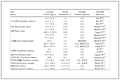
Table 1.
Selected Bond Lengths (Å) and Bond Angles (°)


N-heterocyclic carbene (NHC) transition metal and rare earth complexes have shown many advantageous effects in catalyzing cross-coupling, metathesis reaction, polymerization, etc., partially due to the strong metal-carbon bonds in NHC complexes[1, 2]. NHCs have unique electronic and steric properties that are easily tunable by modifying the N-substituents and backbone skeletons[3]. Research of this class of ligands is not only from laboratory curiosity but also from the industry field. So far, NHC complexes of Ru, Pd, Cu, Au, Ni and so on have realized commercialization[4]. The effective catalytic properties of NHC transition metal complexes prompted us to study the synthetic methods and structures of rare earth metal complexes.
Most reported NHCs are sterically bulky[5, 6]. Nolan[7, 8], Cavallo[9, 10] and their co-workers developed the concept of buried volume (%Vbur), which refers to the percentage of a sphere that is occupied by atoms of a ligand around the metal. It could reasonably calculate the steric effects of NHC ligands and provide a semi-quantitative comparison of the steric effects of NHC ligands. According to their theoretical calculations in quantum, the saturated SIMes (N, N΄-bis(2, 4, 6-trimethylphenyl)-imidazolidin-2-ylidene) (32.7%) has shown a greater %Vbur than the unsaturated IMes (N, N΄-bis-(2, 4, 6-trimethylphenyl)imidazol-2-ylidene) (31.6%) using the model [IrCl(CO)2(NHC)] complexes. The trend of bond dissociation energy was rationalized in [RuClCp*(NHC)] complexes and the authors found that the steric effect of NHC was of vital importance that could control the binding behavior in their systems[11].
The electronic and steric properties of NHCs are important factors to NHC-rare earth complexes[12]. Although electronic properties of imidazolidin- and imidazol-based NHCs have a small difference[13], SIMes- and IMes-based NHC transition metal complexes may show remarkably different catalytic behaviors[4]. Okuda[14, 15] and Lu[16] reported that IMes could successfully coordinate to rare earth metal centers (Y, Lu, Sc) using rare earth alkyls [Ln(CH2SiMe3)3(THF)2] as the starting material. IMes has been successfully applied in rare earth alkyl complexes and the SIMes-rare earth complexes may be worth expecting. Herein, we report the chemistry of stericallly demanding SIMes moiety with rare earth bis(trimethylsilyl)amides in THF solvent.
The syntheses of complexes 1 and 2 were carried out under purified argon using Schlenk techniques. Hexane and THF were distilled with sodium benzophenone ketyl as the indicator. All other reagents and solvents were commercially available and used without further purification. Elemental analysis was performed by direct combustion with a Flash EA-1112 instrument. 1H NMR spectra were recorded on a Bruker Avance DMX 400 spectrometer or an Agilent 600MHz Direct Drive 2. The sample of complex 2 for 1H NMR analysis was dissolved in dry and oxygen-free THF-d8 and sealed in a dry and oxygen-free NMR tube, and recorded on Agilent 600 MHz Direct Drive 2 spectrometer at room temperature.
The [SIMes-H]Br was prepared according to the literature[17]. 2, 4, 6-Trimethylaniline (4.4 mL, 31 mmol) and 1, 2-dibromoethane (1.18 mL, 13.5 mmol) were added to methanol (3.6 mL) at room temperature. The solution was stirred vigorously under reflux overnight. The precipitate was separated by filtration and washed 3 times with EtOAc to get the desired 1, 2-diamine in 44% yield. The preceding solid (1.02 g, 2.6 mmol) was suspended in 15.0 mL of trimethylorthoformate with catalytic amount of formic acid and the suspension was heated to reflux at 120 ℃ for 12 h. The white solid was filtrated and washed 3 times with cold hexane with the yield of 90%. 1H NMR (400 MHz, CDCl3, 25 ℃): δ 8.90 (1H, d, C2-H(imid)), 6.94 (4H, d, Ar-H), 4.63 (4H, d, CH2), 2.39 (12H, d, CH3), 2.28 (6H, d, CH3).
Treatment of a stirring solution of [SIMes-H]Br (0.10 g, 0.26 mmol) in THF with KN(SiMe3)2 (0.26 mmol) and Nd[N(SiMe3)2]3 (0.26 mmol). The reaction mixture was stirred at –30 ℃ for 2 h and at room temperature for another 5 h. Then the solvent was removed under vacuum. The hexane/THF solvent was added to extract complex 1. Blue block crystals were obtained at room temperature in a week with the yield of 58%. Anal. Calcd. (%) for C74H138N8Nd2O2Si8: C, 52.74; H, 8.25; N, 6.65. Found (%): C, 52.91; H, 8.13; N, 6.51.
The synthesis of complex 2 was carried out in the same way as described for complex 1, but Y[N(SiMe3)2]3 was used instead of Nd[N(SiMe3)2]3. The yield is 60%. Anal. Calcd. (%) for C74H138N8Y2O2Si8: C, 56.45; H, 8.83; N, 7.12. Found (%): C, 56.30; H, 8.87; N, 7.01. 1H NMR (600 MHz, THF-d8, 25 ℃): δ 6.87 (4H, d, Ar-H), 3.56 (2H, s, O-CH2), 3.08 (2H, s, CH2), 2.70 (2H, s, CH2), 2.49 (2H, t, CH), 2.32 (6H, s, CH3), 2.24 (12H, d, CH3), 1.28 (2H, q, CH2), 1.08 (2H, q, CH2), 0.04 (TMS).
A light violet single crystal of complex 1 with dimensions of 0.49mm × 0.43mm × 0.38mm was selected for single-crystal X-ray diffraction analysis. Data collections were performed with an ω scan mode at 170 K in the range of 3.05<θ<25.35° on a CrysAlisPro, Oxford Diffraction Ltd. using graphite-monochromatic MoKα radiation (λ = 0.71073 Å). The data sets were corrected by empirical absorption correction using spherical harmonics, implemented in SCALE3 ABSPACK scaling algorithm. A total of 58448 reflections were collected and 8100 were unique (Rint = 0.0446). The final refinement gave R = 0.0324 and wR = 0.0707 for 6929 observed reflections with I > 2σ(I) (w = 1/[σ2(Fo2) + (0.0230P)2 + 12.1892P], where P = (Fo2 + 2Fc2)/3), S = 1.157, (∆/σ)max = 0.003, (∆ρ)max = 0.848 and (∆ρ)min = –0.370 e/Å3. The structure was solved by direct methods with SHELXS-2008[18], and refined by full-matrix least-square methods based on |F|2, using SHELXL-2008 programs[18]. All non-hydrogen atoms were located successfully from Fourier maps and refined anisotropically. The hydrogen atoms were generated geometrically. Selected bond lengths and bond angles for complex 1 are listed in Table 1.
 DownLoad:
CSV
DownLoad:
CSV
| Bond | Dist. | Bond | Dist. | Bond | Dist. | ||
| Nd(1)–O(1) | 2.327(2) | N(3)–C(12) | 1.398(4) | C(23)–C(24) | 1.532(4) | ||
| Nd(1)–O(1A) | 2.321(2) | N(4)–C(12) | 1.385(4) | C(24)–C(25) | 1.500(4) | ||
| Nd(1)–N(1) | 2.324(2) | C(12)–C(22) | 1.346(4) | O(1)–C(25) | 1.432(4) | ||
| Nd(1)–N(2) | 2.310(3) | C(22)–C(23) | 1.489(5) | N(3)–C(10) | 1.435(4) | ||
| N(4)–C(11) | 1.458(4) | C(10)–C(11) | 1.477(6) | ||||
| Angle | (°) | Angle | (°) | Angle | (°) | ||
| Nd(1)–O(1)–Nd(1A) | 107.87(8) | O(1)–Nd(1)–N(2) | 106.23(8) | C(12)–C(22)–C(23) | 127.8(3) | ||
| O(1)–Nd(1)–O(1A) | 72.13(8) | N(1)–Nd(1)–N(2) | 119.68(10) | C(22)–C(23)–C(24) | 113.0(3) | ||
| O(1A)–Nd(1)–N(1) | 111.70(8) | N(3)–C(12)–N(4) | 105.9(3) | C(23)–C(24)–C(25) | 112.4(3) | ||
| O(1A)–Nd(1)–N(2) | 114.78(8) | N(3)–C(12)–C(22) | 124.8(3) | O(1)–C(25)–C(24) | 112.9(2) | ||
| O(1)–Nd(1)–N(1) | 123.31(8) | N(4)–C(12)–C(22) | 129.3(3) |
The symmetrical imidazolidinium salt [SIMes-H] Br[N, N΄-bis-(2, 4, 6-trimethylphenyl)imidazolidiniumbromide], precursor of N-heterocyclic carbene SIMes, was prepared according to the literature[17]. The [SIMes-H]Br is soluble in tetrahydrofuran and insoluble in toluene and hexane. Rare earth bis(trimethylsilyl)amides Ln[N(SiMe3)2]3 were prepared according to literature procedures[19].
Complexes 1 and 2 were synthesized by the route shown in Scheme 1. Reaction of [SIMes-H]Br with KN(SiMe3)2 (KHMDS) and Ln[N(SiMe3)2]3 was carried out in THF solvent. The function of potassium amide is to abstract proton on the imidazolidinium ring to form a carbene structure.
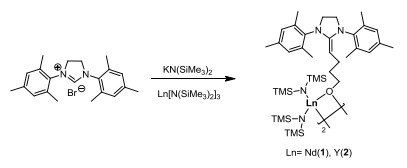
Complexes 1 and 2 were soluble in THF and insoluble in toluene or hexane. The single crystal for X-ray crystallography was grown from THF/hexane solvent mixture. The experiments were repeated for many times.
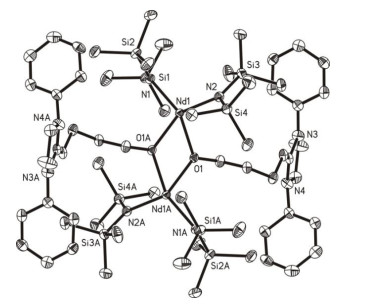
The solid structure is revealed by X-ray diffraction analysis and an ORTEP diagram of complex 1 is depicted in Fig. 1. The solid structure of complex 1 is centrosymmetric, showing a dimeric feature with two oxygen ions bridging two Nd ion cores. The solid structure is free of solvent. The Nd ions in complex 1 have a pseudo-tetrahedral coordination geometry with a coordination number of 4. The bridging oxygen ions and Nd ions are exactly coplanar as required by the crystallographic symmetry. The bridging oxygen ions derived from tetrafuran molecules from the rare earth amides in solvent state where THF is likely to be coordinated. The bridging Nd–O bond lengths (2.327(2) Å, 2.321(2) Å) are similar to those of other bridging Nd–O coplanar cores reported (2.267(2) Å, 2.379(2) Å)[20], and the bond lengths are shorter than those of Nd–O (2.502(2) Å, 2.595(2) Å) where Nd are coordinated by THF molecules[20]. The C–C bond length on N-heterocyclic olefin (C(12)–C(22)) is 1.346(4) Å, which is a typical C=C bond[21]. The nitrogen atoms on the N-heterocyclic ring and the carbon-carbon double bond form a p-π conjugated structure and the N–C bond lengths are 1.385(4) and 1.398(4) Å, shorter than those of the adjacent N–C bonds (1.435(4) and 1.458(4) Å).
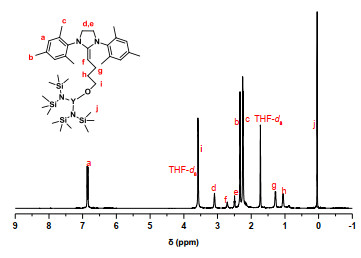
Attempts to obtain a suitable crystal of complex 2 for X-ray analysis were failed. The paramagnetism of the Nd complex precludes the 1H NMR spectroscopic identification, while the 1H NMR analysis of the Y complex gave insight into the structure, with the spectrum shown in Fig. 2. The crystals were dissolved in dry and moisture free THF-d8 solvent and the resonances of THF-d8 are at 1.72 and 3.58 ppm. The characteristics acidic proton resonance of [SIMes-H]Br according to 1H NMR spectrum in CDCl3 is at 8.90 ppm. However, the disappearance of the signal in the 1H NMR spectrum of complex 2 in THF-d8 indicates that deprotonation by potassium amide occurred. The hydrogen atoms on N-heterocyclic ring (N-CH2) are chemically non-equivalent due to the formation of a dangling, uncoordinated N-heterocyclic olefin moiety. The resonances of hydrogens appear at 3.08 and 2.49 ppm, and the chemically non-equivalency also appears at the NHC rare earth complexes (2.69, 2.91 ppm) we have previously synthesized[22]. The resonance of proton (O-CH2) occurs at 3.56 ppm and the resonance of proton on the carbon-carbon double bond is found at 2.70 ppm. The spectroscopy data are indicative of the formation of a NHO-rare earth complex. Elemental analysis was also performed and the results are in good agreement with the structure of the X-ray diffraction analysis.
One possible formation mechanism is proposed. THF molecules could be easily trapped by rare earth centers in THF solvent by the form of coordination. The acidic proton of [SIMes-H]Br is deprotonated by potassium amide, forming N-heterocyclic carbene SIMes. SIMes acts as a nucleophile attacking the α-carbon of the coordinated THF and forming an O-coordinated zwitterion (onium-(CH2)4-O). In this zwitterion, the onium-(CH2) bond is acidic enough to be deprotonated by the Ln-HMDS functionality. This deprotonation leads to the formation of N-heterocyclic olefin.
Rare earth complexes tend to aggregate in the form of oxygen-bridged dinuclear rare earth complexes, as needed by the high coordination number of rare earth centers and many researchers have reported the oxygen-bridged dinuclear structures detected by X-ray diffraction in solid state[23].
The reaction of the rare earth complexes with SIMes shows a different reaction route in comparison with those of the NHC-metal complexes[14-16, 24]. The reaction does not give the expected N-heterocyclic carbene rare earth metal complexes but formed NHO-rare earth complexes. The occurrence of NHO-rare earth complexes may be due to the following reasons. Rare earth bis(trimethylsilyl)amides, as important starting materials in preparing rare earth complexes, are sterically crowded[25]. Thus, the bulky amides hinder the bonding of sterically demanding SIMes moiety and the rare earth metal center. Rare earth alkyls, exhibiting high reaction active and owning enough space around rare earth metal center, could form NHC rare earth complexes[26]. IMes-rare earth complexes were synthesized by using rare earth alkyl complexes with coordinated THF molecules as the starting materials[14-16]. Similarly, the reactions were carried out in THF without side reaction such as the ring opening of THF.
Even though NHC as Lewis base and rare earth as Lewis acid can form hemilabile NHC-rare earth bond, dissociation may occur between NHC and rare earth without chelating effect provided by anion arms on the NHC ligands. In other words, the anionic NHC ligand may avoid the tendency for NHC ligand dissociation by chelating effects[27-29]. Presumably, the NHC-rare earth bond is not strong enough. We have previously reported that the initiation mechanism of lactide and n-hexyl isocynate polymerization was relevant to NHC-rare earth bond breakage[22, 30]. The N-substituents on the NHCs affect the electronic and steric properties. If NHCs have anionic arms, the amides may be pulled off from rare earth metal center, leaving enough room for the coordination of NHCs. We reported that NHC with two anionic phenolate arms could coordinate to rare earth metals in a bis(NHC) manner leaving no amides on the metal[22, 30]. However, bulky monophenolate NHC ligands reacted with KHMDS and Ln[N(SiMe3)2]3 to form a NHC-K structure with bulky Ln[N(SiMe3)2]3 hanging to the aryloxide on the margin, since it is too crowded for the rare earth center to reach the carbene[31]. All of the reactions were carried out in THF at room temperature, using Ln[N(SiMe3)2]3 as the starting materials and KHMDS as the strong base. The results may indicate that NHCs are sterically demanding, so rare earth metal center need to reserve enough space for the coordination of NHC.
The electronic and steric properties of NHCs and rare earth complexes are important in synthesizing rare earth metal complexes. NHC ligands need to be designed in consideration of steric and electronic properties to accommodate the metal center and to exert direct effect on the stability and reactivity of complexes.
This work studied the reaction of SIMes with rare earth bis(trimethylsilyl)amides in THF solvent. We reported the synthesis of oxygen-bridged dinuclear rare earth complexes and detected the structure features by X-ray diffraction analysis, 1H NMR spectroscopy and elemental analysis. The possible mechanism of the formation of NHO-rare earth complexes was discussed and the reasons for not forming NHC-rare earth complexes were presumed.
Herrmann, W. A. N-heterocyclic carbenes: a new concept in organometallic catalysis. Angew. Chem. 2010, 41, 1290–1309.
Arnold, P. L.; Casely, I. J. F-block N-heterocyclic carbene complexes. Chem. Rev. 2009, 109, 3599–3611. doi: 10.1021/cr8005203
Liu, J.; Huo, R.; Wei, Q.; Zhao, Z. X.; Liu, Q. X. Synthesis and structural study of a N-heterocyclic carbene trinuclear silver(I) complex. Chin. J. Struct. Chem. 2016, 35, 313–318.
Cazin, C. S. J. N-heterocyclic carbenes in transition metal catalysis and organocatalysis, catalysis by metal complexes 32, Springer: Dordrecht, The Netherlands 2011, 19–20.
Yuan, W. G.; Tang, W.; Zhang, H. L.; Zhao, B.; Xiong, F.; Jing, L. H.; Qin, D. B. Two amine-tethered imidazolium NHC Ni(II) complexes: synthesis, structure and catalytic activity. Chin. J. Struc. Chem. 2014, 33, 325–332.
Trampert, J.; Nagel, M.; Grimm, T.; Sun, Y.; Thiel, W. R. Phosphine functionalized NHC ligands and their cyclopentadienide nickel(II) complexes. Z. Anorg. Allg. Chem. 2018, 644, 963–972. doi: 10.1002/zaac.201800151
Clavier, H.; Nolan, S. P. Percent buried volume for phosphine and N-heterocyclic carbene ligands: steric properties in organometallic chemistry. Chem. Commun. 2010, 46, 841–861. doi: 10.1039/b922984a
Dorta, R.; Stevens, E. D.; Scott, N. M.; Costabile, C.; Cavallo, L.; Hoff, C. D.; Nolan, S. P. Steric and electronic properties of N-heterocyclic carbenes (NHC): a detailed study on their interaction with Ni(CO)4. J. Am. Chem. Soc. 2005, 127, 2485–2495. doi: 10.1021/ja0438821
Poater, A.; Cosenza, B.; Correa, A.; Giudice, S.; Ragone, F.; Scarano, V.; Cavallo, L. SambVca: a web application for the calculation of the buried volume of N-heterocyclic carbene ligands. Eur. J. Inorg. Chem. 2009, 2009, 1759–1766. doi: 10.1002/ejic.200801160
Cavallo, L.; Correa, A.; Costabile, C.; Jacobsen, H. Steric and electronic effects in the bonding of N-heterocyclic ligands to transition metals. J. Organomet. Chem. 2005, 690, 5407–5413. doi: 10.1016/j.jorganchem.2005.07.012
Hillier, A. C.; Sommer, W. J.; Yong, B. S.; Petersen, J. L.; Cavallo, L.; Nolan, S. P. A combined experimental and theoretical study examining the binding of N-heterocyclic carbenes (NHC) to the Cp*RuCl (Cp* = η5-C5Me5) moiety: insight into stereoelectronic differences between unsaturated and saturated NHC ligands. Organometallics 2003, 22, 4322–4326. doi: 10.1021/om034016k
Yuan, J.; Hu, H.; Cui, C. N-Heterocyclic carbene-ytterbium amide as a recyclable homogeneous precatalyst for hydrophosphination of alkenes and alkynes. Chem. Eur. J. 2016, 22, 5778–5785. doi: 10.1002/chem.201600512
Leuthäußer, S.; Schwarz, D.; Plenio, H. Tuning the electronic properties of N-heterocyclic carbenes. Chem. Eur. J. 2007, 13, 7195–7203. doi: 10.1002/chem.200700228
Fegler, W.; Spaniol, T. P.; Okuda, J. Trimethylsilylmethyl complexes of the rare-earth metals with sterically hindered N-heterocyclic carbene ligands: adduct formation and C–H bond activation. Dalton Trans. 2010, 39, 6774–6779. doi: 10.1039/c001699c
Fegler, W.; Saito, T.; Mashima, K.; Spaniol, T. P.; Okuda, J. C–H bond activation of N-heterocyclic carbene IMes by rare-earth metal alkyl complexes. J. Organomet. Chem. 2010, 695, 2794–2797. doi: 10.1016/j.jorganchem.2010.08.021
Pan, Y.; Xu, T.; Ge, Y. S.; Lu, X. B. N-heterocyclic carbene scandium complexes: synthesis, structure, and catalytic performance for α-olefin polymerization and copolymerization with 1, 5-hexadiene. Organometallics 2011, 30, 5687–5694. doi: 10.1021/om200550j
Roche, S. P.; Teyssot, M. L.; Gautier, A. Synthesis of 1, 2 diamines under environmentally benign conditions: application for the preparation of imidazolidiniums. Tetra. Lett. 2010, 51, 1265–1268. doi: 10.1016/j.tetlet.2009.12.072
Sheldrick, G. M. A short history of SHELX. Acta Cryst. 2008, A64, 112-122.
Bradley, D. C.; Ghotra, J. S.; Hart, F. A. Low coordination numbers in lanthanide and actinide compounds. Part I. The preparation and characterization of tris{bis(trimethylsilyl)-amido}lanthanides. J. Am. Chem. Soc., Dalton Trans. 1973, 1021–1023.
Zhang, M.; Liang, Z.; Ling, J.; Ni, X.; Shen, Z. Carbon bridged triphenolate lanthanide complexes: synthesis, characterization, DFT studies and catalytic activities for isoprene polymerization. Dalton Trans. 2015, 44, 11182–11190. doi: 10.1039/C5DT01241D
Mcmurry, J. Fundamentals of Organic Chemistry, 7th ed. Brooks/Cole, Belmont, CA 2010, 156.
Zhang, M.; Ni, X.; Shen, Z. Synthesis of bimetallic bis(phenolate) N-heterocyclic carbene lanthanide complexes and their applications in the ring-opening polymerization of l-lactide. Organometallics 2014, 33, 6861–6867. doi: 10.1021/om500930m
Panda, T. K.; Hrib, C. G.; Jones, P. G.; Tamm, M. Synthesis and characterization of homoleptic imidazolin-2-iminato rare earth metal complexes. J. Organomet. Chem. 2010, 695, 2768–2773. doi: 10.1016/j.jorganchem.2010.06.028
Li, Y. G.; Han, L.; Ma, G.; Zhu, C. F. Synthesis, structure and property of one bis(benzimidazolin-2-ylidene) arene-mercury(II) complex. Chin. J. Struc. Chem. 2014, 33, 1610–1616.
Zhou, L.; Yao, Y.; Shen, Q. Lanthanide(II) amide complexes: efficient initiators for the living polymerization of methyl methacrylate. J. Appl. Poly. Sci. 2009, 114, 2403–2409. doi: 10.1002/app.30656
Wang, B.; Cui, D.; Lv, K. Highly 3, 4-selective living polymerization of isoprene with rare earth metal fluorenyl N-heterocyclic carbene precursors. Macromolecules 2008, 41, 1983–1988. doi: 10.1021/ma702505n
Aihara, H.; Matsuo, T.; Kawaguchi, H. Titanium N-heterocyclic carbene complexes incorporating an imidazolium-linked bis(phenol). Chem. Commun. 2003, 2204–2205.
Zhang, D.; Aihara, H.; Watanabe, T.; Matsuo, T.; Kawaguchi, H. Zirconium complexes of the tridentate bis(aryloxide)-N-heterocyclic-carbene ligand: chloride and alkyl functionalized derivatives. J. Organomet. Chem. 2007, 692, 234–242. doi: 10.1016/j.jorganchem.2006.03.044
Romain, C.; Brelot, L.; Bellemin-Laponnaz, S.; Dagorne, S. Synthesis and structural characterization of a novel family of titanium complexes bearing a tridentate bis-phenolate-N-heterocyclic carbene dianionic ligand and their use in the controlled ROP of rac-lactide. Organometallics 2010, 29, 1191–1198. doi: 10.1021/om901084n
Zhang, M.; Zhang, J.; Ni, X.; Shen, Z. Bis(phenolate) N-heterocyclic carbene rare earth metal complexes: synthesis, characterization and applications in the polymerization of n-hexyl isocyanate. RSC Adv. 2015, 5, 83295–83303. doi: 10.1039/C5RA16447H
Zhang, J.; Zhang, M.; Bai, T.; Ni, X.; Shen, Z. Synthesis and characterization of heterobimetallic organo rare earth complexes bearing aryloxide-N-heterocyclic carbene ligands. J. Organomet. Chem. 2017, 843, 1–6. doi: 10.1016/j.jorganchem.2017.04.039

Figure 1 ORTEP diagram of complex 1 with 30% probability thermal ellipsoids. Hydrogen atoms and methyl groups on the aryl groups are omitted for clarity
Table 1. Selected Bond Lengths (Å) and Bond Angles (°)
| Bond | Dist. | Bond | Dist. | Bond | Dist. | ||
| Nd(1)–O(1) | 2.327(2) | N(3)–C(12) | 1.398(4) | C(23)–C(24) | 1.532(4) | ||
| Nd(1)–O(1A) | 2.321(2) | N(4)–C(12) | 1.385(4) | C(24)–C(25) | 1.500(4) | ||
| Nd(1)–N(1) | 2.324(2) | C(12)–C(22) | 1.346(4) | O(1)–C(25) | 1.432(4) | ||
| Nd(1)–N(2) | 2.310(3) | C(22)–C(23) | 1.489(5) | N(3)–C(10) | 1.435(4) | ||
| N(4)–C(11) | 1.458(4) | C(10)–C(11) | 1.477(6) | ||||
| Angle | (°) | Angle | (°) | Angle | (°) | ||
| Nd(1)–O(1)–Nd(1A) | 107.87(8) | O(1)–Nd(1)–N(2) | 106.23(8) | C(12)–C(22)–C(23) | 127.8(3) | ||
| O(1)–Nd(1)–O(1A) | 72.13(8) | N(1)–Nd(1)–N(2) | 119.68(10) | C(22)–C(23)–C(24) | 113.0(3) | ||
| O(1A)–Nd(1)–N(1) | 111.70(8) | N(3)–C(12)–N(4) | 105.9(3) | C(23)–C(24)–C(25) | 112.4(3) | ||
| O(1A)–Nd(1)–N(2) | 114.78(8) | N(3)–C(12)–C(22) | 124.8(3) | O(1)–C(25)–C(24) | 112.9(2) | ||
| O(1)–Nd(1)–N(1) | 123.31(8) | N(4)–C(12)–C(22) | 129.3(3) |
 下载: 导出CSV

 扫一扫看文章


扫一扫关注我们


 下载:
下载: