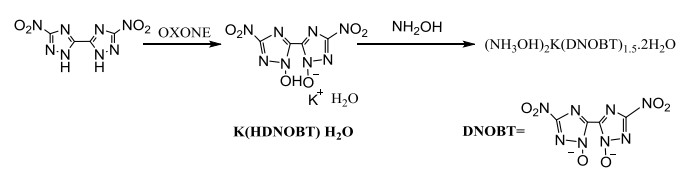
Scheme 1.
Synthetic route of the title compound

A Novel Energetic Ionic Salt: Hydroxylammonium Potassium 3, 3'-Dinitro-5, 5'-bis-1, 2, 4-triazole-1, 1'-diolate Dihydrate
Yi-Fen LUO , Lian-Jie ZHAI , Fu-Qiang BI , Huan HUO , Xiang-Zhi LI , Bo-Zhou WANG


Owing to the high positive heats of formation resulting from the large number of N-N and C-N bonds[1], and the high level of environmental compatibility, energetic azole-based compounds have been studied over the last couple of years with growing interest[2]. Especially, 1, 2, 4-triazoles show a perfect balance between thermal stability and high positive heats of formation, required for applications as prospective HEDMs. Many energetic compounds that combine the 1, 2, 4-triazole backbone with energetic moieties have been synthesized over the last decades. Bis-1, 2, 4-triazoles connected through a C–C bond are expected to show similar energetic properties[3-5]. Because ionic energetic materials often possess advantages of lower vapor pressures and higher stabilities over their molecular analogues[6-8], it has been reported that dihydroxylammonium 3, 3'-dinitro-5, 5'-bis-1, 2, 4-triazole-1, 1'-diolate(MAD-X1) has a high density (1.90 g·cm-3) and detonation velocity (9087 m·s-1)[9]. Meanwhile, we reported the synthesis of dipotassium 3, 3'-dinitro-5, 5'-bis-1, 2, 4-triazole-1, 1'-diolate[K2(DNOBT)][10], which could be used as flame suppressor in solid propellant. However, they often possess disadvantages. MAD-X1 can't be used as flame suppressor, and [K2(DNOBT)] has low energy compared with MAD-X1.
In this paper, using 3, 3'-dinitro-5, 5'-bis-1, 2, 4-triazole (DNBT) as a raw material, we report firstly the synthesis, crystal structure and thermal performance of hydroxylammonium potassium 3, 3'-dinitro-5, 5'-bis-1, 2, 4-triazole-1, 1'-diolatedihydrate [(NH3OH)2K(DNOBT)1.5∙2H2O], which could be used as a flame suppressor in solid propellant to substitute inorganic potassium salts (K2SO4, KNO3 and K3AlF6). Meanwhile, as a detonating explosive it can generate much more energy and clean gas[11-13] compared to K2(DNOBT).
1H NMR and 13C NMR were obtained in DMSO-d6 on a Bruker AV500 NMR spectrometer. Infrared spectra were obtained from KBr pellets on a Nicolet NEXUS870 Infrared spectrometer in the range of 4000~400 cm-1. Elemental analyses (C, H and N) were performed on a VARI-El-3 elementary analysis instrument. Differential scanning calorimetry (DSC) studies were carried out on a Q200 apparatus (TA, USA) at a heating rate of 5 K·min-1, using dry oxygen-free nitrogen as atmosphere with a flowing rate of 50 mL·min-1. The TG-DTG experiment was performed with a SDT-Q600 apparatus (TA, USA) operating at a heating rate of 5 K·min-1 in a flow of dry oxygen-free nitrogen at 100 mL·min-1.
3, 3'-Dinitro-5, 5'-bis-1, 2, 4-triazole was prepared according to the published procedures[14]. Other chemicals were obtained from commercial sources and used without further purification.
The title compound was synthesized by the method in Scheme 1.
3, 3'-Dinitro-5, 5'-bis-1, 2, 4-triazole (5.0 g, 19 mmol) was dissolved in a solution of water (125 mL) and potassium acetate (25.0 g, 0.25 mol) and heated to 40 ℃. Oxone (83.0 g, 0.27 mol) was added portionwise within 2 h, and the pH was meanwhile carefully adjusted to 4~5 by dropwise addition of potassium acetate (38.0 g, 0.38 mol) in 50 mL water. The mixture was subsequently stirred at 40 ℃ for 48 h. The solution was acidified with hydrochloric acid (180 mL, 36%). The resulting precipitate was filtrated and dried on air to yield 2.9 g K(HDNOBT)∙H2O in the yield of 48.4% as a yellowish solid.
1H NMR (DMSO-d6, 500 MHz): δ = 13.117 (br, 1H, OH) ppm; 13C NMR (DMSO-d6, 125 MHz): δ = 154.896 (C–NO2), 134.321 (C–C) ppm; IR(KBr, cm-1): ν = 3440(m), 2858(w), 2538(w), 1557(vs), 1472(s), 1458(m), 1413(vs), 1391(m), 1358(m), 1314(vs), 1222(w), 1047(s), 1024(s), 841(s), 735(m), 670(m), 598(w). EA (C4HN8O6K∙H2O, %): calcd.: C, 15.29; H, 0.955; N, 35.67. Found (%): C, 15.81; H, 0.635; N, 35.93.
K(HDNOBT)∙H2O (0.2 g, 0.637 × 10⁻³ mol) was dissolved in ethanol (40 mL) and treated with NH2OH (0.063 g, 50%) in ethanol (10 mL) at room temperature. The precipitate was filtered off, and the crude product was recrystallized from boiling water to give orange specular-shaped crystals 0.2 g with a yield of 82.6%.
13C NMR (DMSO-d6, 125 MHz): δ = 151.348(C–NO2), 133.137(C–C) ppm. 1H NMR (500 MHz, DMSO-d6, δ): 8.131(br, alive H) ppm; IR(KBr, cm-1): v = 3497(s), 3155(s), 2922(w), 2712(w), 1638(m), 1530(vs), 1464(vs), 1391(vs), 1364(vs), 1302(vs), 1176(s), 1035(s), 1027(s), 1011(w), 990(w), 836(m), 747(m), 681(w), 647(w). EA (C6H8N14O11K∙2H2O, %): calcd.: C, 12.63; H, 2.367; N, 36.84. Found (%): C, 12.73; H, 2.753; N, 36.78.
The crystal of (NH3OH)2K(DNOBT)1.5∙2H2O was obtained as an orange block by slow evaporation of its aqueous solution at room temperature. The crystal with approximate dimensions of 0.31mm × 0.25mm × 0.13mm was mounted on the top of a glass fiber in a random orientation. The unit cell determination and data collection were performed on a Bruker Smart APE Ⅱ X-ray diffractometer equipped with a MoΚα radiation (λ = 0.71073 Å) using the φ-ω scan mode at 296(2) K. A total of 4769 reflections were collected in the range of 1.52 < θ < 25.10°, of which 3330 were independent (Rint = 0.0144) and 3107 were observed with I > 2σ(I). The data collection and procession were performed with programs SMART and SAINT. The structure was solved by direct methods and refined by full-matrix least-squares/difference Fourier techniques with SHELXS-97 and SHELXL-97 programs[15, 16]. All non-hydrogen atoms were refined with anisotropic displacement parameters. After that, all hydrogen atoms were located theoretically and refined with riding model position parameters and fixed isotropic thermal parameters. The final full-matrix least-squares refinement gave R = 0.0525, wR = 0.1593 (w = 1/[σ2(Fo)2 + 1.0355P], where P = (Fo2 + 2Fc2)/3), (Δ/σ)max < 0.001, S = 1.070, (Δρ)max = 0.415 and (Δρ)min = –1.014 e·Å-3. All calculations were performed on a BRUKER SMATR by using SHELXTL.
Using oxone as oxidation regent, 3, 3'-dinitro-5, 5'-bis-1, 2, 4-triazole is oxidized in a solution of potassium acetate to dipotassium 3, 3'-dinitro-5, 5'-bis-1, 2, 4-triazole-1, 1'-diolate, which can be acidified particularly by HCl to give potassium 1'-hydroxy-3, 3'-dinitro-5, 5'-bis-1, 2, 4-triazole-1-olate monohydrate. And finally hydroxylammonium potassium of 3, 3'-dinitro-5, 5'-bis-1, 2, 4-triazole-1, 1'-diolate is synthesized by means of proton transfer process with a total yield of 39.98%. The elemental analysis, IR and NMR of the product are all in good agreement with the assumed structure.
(NH3OH)2K(DNOBT)1.5∙2H2O crystallizes with higher density (1.855 g·cm-3) observed in this work in the triclinic space group P
 DownLoad:
CSV
DownLoad:
CSV
| Bond | Dist. | Bond | Dist. | Bond | Dist. | ||
| O(4)–K(1)#1 | 2.963(2) | K(1)–N(2)#2 | 2.998(3) | N(12)–C(6) | 1.341(4) | ||
| N(2)–K(1)#2 | 2.998(3) | K(1)–O(1)#2 | 3.210(3) | O(3)–N(3) | 1.303(3) | ||
| O(1)–K(1)#2 | 3.210(3) | K(1)–O(5) | 3.321(3) | O(13)–H(13E) | 0.807(19) | ||
| O(12)–K(1) | 2.842(3) | K(1)–O(7) | 3.324(3) | O(13)–H(13D) | 0.80(2) | ||
| O(11)–K(1) | 2.915(3) | K(1)–H(11A) | 3.04(2) | O(8)–N(9) | 1.226(4) | ||
| K(1)–O(3) | 2.801(2) | O(9)–N(11) | 1.307(3) | N(5)–C(4) | 1.321(4) | ||
| K(1)–N(5) | 2.895(3) | N(11)–N(10) | 1.341(3) | N(8)–O(6) | 1.224(4) | ||
| K(1)–O(4)#3 | 2.963(2) | N(11)–C(6) | 1.358(4) | N(8)–O(5) | 1.224(4) | ||
| K(1)–O(10) | 2.973(3) | N(12)–C(5) | 1.325(4) | N(8)–C(4) | 1.444(4) | ||
| Dihedral angle | (°) | Dihedral angle | (°) | Dihedral angle | (°) | ||
| O(4)–N(6)–N(7)–C(4) | 179.7(2) | C(5)–N(12)–C(6)–C(6)#4 | –179.1(3) | N(6)–N(7)–C(4)–N(5) | 0.2(3) | ||
| C(3)–N(6)–N(7)–C(4) | 0.2(3) | O(9)–N(11)–C(6)–N(12) | 179.6(3) | N(6)–N(7)–C(4)–N(8) | 179.3(3) | ||
| N(3)–N(2)–C(1)–N(4) | 0.4(3) | N(10)–N(11)–C(6)–N(12) | –0.4(3) | C(3)–N(5)–C(4)–N(7) | –0.5(3) | ||
| O(4)–N(6)–C(3)–N(5) | –179.9(3) | O(9)–N(11)–N(10)–C(5) | –179.6(2) | C(3)–N(5)–C(4)–N(8) | –179.5(3) | ||
| N(7)–N(6)–C(3)–N(5) | –0.5(3) | C(6)–N(11)–N(10)–C(5) | 0.5(3) | O(11)–K(1)–O(3)–N(3) | –31.0(2) | ||
| N(2)–C(1)–N(4)–C(2) | –0.3(3) | C(6)–N(12)–C(5)–N(10) | 0.2(3) | K(1)#2–N(2)–N(3)–O(3) | –31.1(4) | ||
| N(6)–C(3)–N(5)–C(4) | 0.5(3) | N(11)–N(10)–C(5)–N(12) | –0.4(3) | N(6)–C(3)–C(2)–N(4) | 31.4(5) | ||
| C(1)–N(2)–N(3)–C(2) | –0.4(3) | C(1)–N(4)–C(2)–N(3) | 0.0(3) | N(5)–C(3)–C(2)–N(3) | 31.6(5) | ||
| C(5)–N(12)–C(6)–N(11) | 0.2(3) | N(2)–N(3)–C(2)–N(4) | 0.3(3) | ||||
| Symmetry codes: #1: x–1, y, z; #2: –x+1, –y+2, –z+1; #3: x+1, y, z; #4: –x, –y+2, –z | |||||||
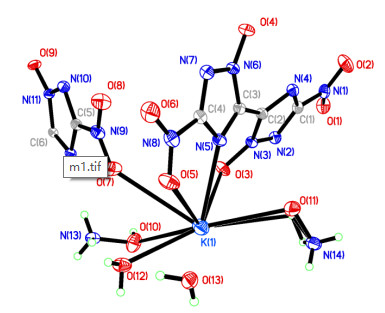
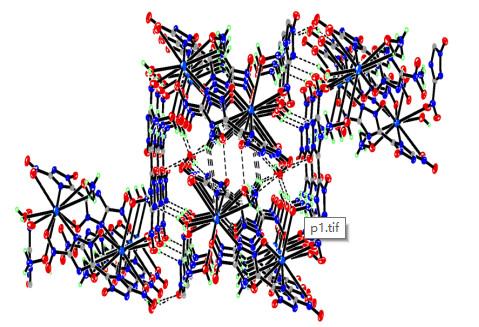
As seen in Table 1, the bond lengths of triazole ring in the molecular structure of (NH3OH)2-K(DNOBT)1.5∙2H2O lie between the lengths of formal C–N and N–N single and double bonds (C–N: 1.47, 1.22 Å; N–N: 1.48, 1.20 Å). Because of the p-π conjugative effect of O atom in N-oxide with triazole ring, the average bond length of N-oxide (1.307(2) Å) is much longer than those in the nitro group (O(3)–N(4): 1.224(2) Å, O(4)–N(4): 1.233(2) Å), and slightly shorter than the normal N–O single bond (O–N 1.349(2) Å). It is interesting to find that there are two crystallographic independent DNOBT anions in the unit. These two independent DNOBT anions have different conformations, in which the torsion angles show significant difference. One of the DNOBT anions shows a complete planar assembly with a torsion angle between the triazole rings of 0°, indicating conjugation effect in the DNOBT anion. Differently, the C–C bonded triazole rings are distinctly twisted with the dihedral angle of 31.9° in the other conjugation. Furthermore, each DNOBT anion within the crystal structure is surrounded by two water molecules linked by hydrogen bonds to the nitrogen N(2) of the triazole ring and the oxygen O(2) of N-oxide. The DNOBT anion is linked with hydroxylamine ions by nine hydrogen bonds, and with water via five hydrogen bonds. Hydrogen bond lengths and bond angles are given in Table 2. Finally, it expands into a three-dimensional network structure through coordination bonds, electrostatic forces, and hydrogen bonds (Fig. 2).
DownLoad:
CSV
| D–H⋅⋅⋅A | d(D–H) (Å) | d(H⋅⋅⋅A) (Å) | D–H⋅⋅⋅A (°) | d(D⋅⋅⋅A) (Å) |
| N(13)–H(13B)⋅⋅⋅O(9) #3 | 0.83 | 1.95 | 176 | 2.784(3) |
| N(13)–H(13B)⋅⋅⋅N(11) #3 | 0.83 | 2.57 | 148 | 3.301(2) |
| N(13)–H(13B)⋅⋅⋅N(10) #3 | 0.83 | 2.69 | 120 | 3.188(2) |
| N(13)–H(13C)⋅⋅⋅N(12) | 0.82 | 2.10 | 173 | 2.920(2) |
| N(14)–H(14C)⋅⋅⋅O(4) #6 | 0.86 | 2.18 | 137 | 2.873(4) |
| N(14)–H(14C)⋅⋅⋅N(4) #6 | 0.86 | 2.34 | 130 | 2.967(3) |
| O(12)–H(12A)⋅⋅⋅N(10) #7 | 0.81 | 2.20 | 159 | 2.973(2) |
| O(12)–H(12B)⋅⋅⋅O(8) #3 | 0.81 | 2.25 | 166 | 3.039(3) |
| O(12)–H(12B)⋅⋅⋅O(1) #2 | 0.81 | 2.65 | 112 | 3.041(5) |
| O(12)–H(12B)⋅⋅⋅N(10) #3 | 0.81 | 2.67 | 124 | 3.193(2) |
| O(13)–H(13D)⋅⋅⋅N(7) #3 | 0.81 | 2.00 | 166 | 2.787(3) |
| N(14)–H(14A)⋅⋅⋅O(3) #2 | 0.85 | 1.93 | 172 | 2.767(2) |
| N(14)–H(14A)⋅⋅⋅N(3) #2 | 0.85 | 2.65 | 149 | 3.400(2) |
| O(11)–H(11A)⋅⋅⋅O(3) #2 | 0.88 | 2.55 | 168 | 3.414(4) |
| Symmetry codes: #3: x+1, y, z; #6: x+1, y, z; #7: –x, –y+1, –z; #2: –x+1, –y+2, –z+1 | ||||
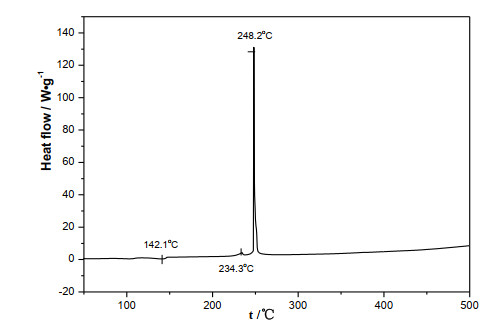
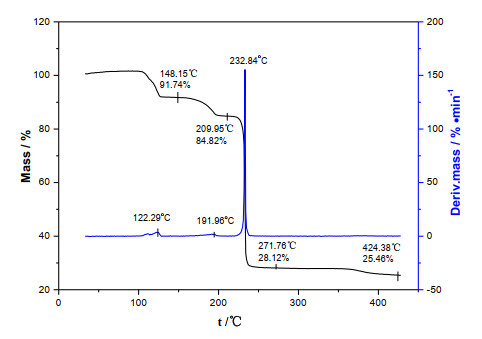
Typical DSC and TG-DTG experiments were carried out in order to investigate the thermal decomposition of K(HDNOBT)∙H2O and (NH3OH)2-K(DNOBT)1.5∙2H2O. First, the samples were heated up to 500 ℃ with a linear heating rate of 5 ℃·min-1, and the curves (Figs. 3, 4, 5 and 6) exhibit good thermal stability as evidence.
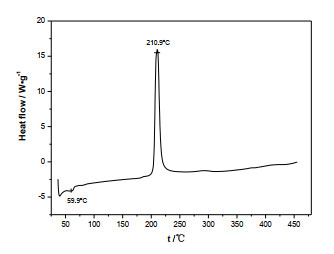
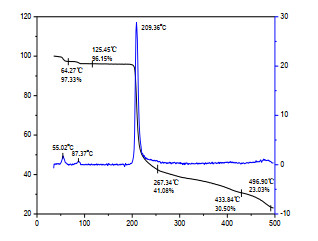
The thermal decomposition of K(HDNOBT)∙H2O can be divided into two obvious stages, and the first step corresponds to the release of water with the peak temperature of 59.9 ℃, as the sample losses ca. 3.85% of its mass (calculated value of 5.73%). A weak endothermic effect can be noticed in a temperature range of 25~100 ℃. The exothermic process in a sharp temperature peak is an intense decomposition process that ends at 245 ℃ with the peak temperature located at 210.9 ℃, and this exothermic process corresponds to the second mass loss stage that starts at 200 ℃ and ends at 267.34 ℃, which reaches the largest rate at 209.36 ℃ with a mass loss percentage of 55.07%. The final residue at 496.90 ℃ is about 23.03%.
The (NH3OH)2K(DNOBT)1.5∙2H2O thermally decomposes in three obvious stages, and the first step corresponds to the release of two water solvent molecules at around 142.1 ℃, as the sample losses ca. 8.26% of its weight (calculated 6.83%). The second step results from the release of one hydroxylamine molecule near 234.3 ℃ due to the removal of ca. 6.92% of its mass (calculated 6.26%). It may be that during the decomposition of (NH3OH)2K(DNOBT)1.5, proton transfer occurs and one molecule of hydroxylamine is removed. The exothermic process occurs in a sharp temperature peak and is an intense decomposition process ends at 260 ℃ with the peak temperature to be 248.2 ℃, and this exothermic process corresponds to the third mass loss stage that starts at 209.95 ℃ and finished at 271.76 ℃, which reaches the largest rate at 232.84 ℃ with a mass loss percentage of 56.7%. The final residue at 424.38 ℃ is about 25.46%.
A novel energetic ionic salt (NH3OH)2K(DNOBT)1.5∙ 2H2O was synthesized and characterized thoroughly. (NH3OH)2K(DNOBT)1.5∙2H2O crystallizes in the triclinic system with space group P
Klapötke, T. M. In Structure and Bonding (Ed. : D. M. P. Mingos), Springer, Berlin 2007.
(a) Fischer, N.; Karaghiosoff, K.; Klapötke T. M.; Stierstorfer, J. New energetic materials featuring tetrazoles and nitramines – synthesis, characterization and properties. Z. Anorg. Allg. Chem. 2010, 636, 735–749. (b) Holl, G.; Klapötke T. M.; Polborn, K.; Rienacker, C. Structure and bonding in 2-diazo-4, 6-dinitrophenol (DDNP). Propellants, Explos. , Pyrotech. 2003, 28, 153–156. (c) Karaghiosoff, K.; Klapötke T. M.; Michailovski, A.; Nöth, H.; Suter, M. 1, 4-Diformyl-2, 3, 5, 6-tetranitratopiperazine: a new primary explosive based on glyoxal. Propellants, Explos. , Pyrotech. 2003, 28, 1–6.
Wang, R.; Xu, H.; Guo, Y.; Sa, R.; Shreeve, J. M. Bis[3-(5-nitroimino-1, 2, 4-triazolate)]-based energetic salts: synthesis and promising properties of a new family of high-density insensitive materials. J. Am. Chem. Soc. 2010, 132, 11904–11905. doi: 10.1021/ja1055033
Dippold, A. A.; Feller, M.; Klapötke T. M. 5, 5'-Dinitrimino-3, 3'-methylene-1H-1, 2, 4-bistriazole – a metal free primary explosive combining excellent thermal stability and high performance. Cent. Eur. J. Energ. Mater. 2011, 8, 261-278.
Dippold, A. A.; Klapötke, T. M. Synthesis and characterization of 3, 3'-bis(dinitromethyl)-5, 5'-azo-1H-1, 2, 4-triazole. Z. Anorg. Allg. Chem. 2011, 637, 1453-1457. doi: 10.1002/zaac.201100196
Li, Z. M.; Zhang, J. G.; Yang, W.; Sun, M.; Zhang, T. L. Synthesis and structural characterization of a new 1D polymeric energetic complex [Hg(DAT)Cl2]n. Chin. J. Struct. Chem. 2013, 32, 653-658.
Brand, H.; Mayer, P.; Polborn, K.; Schulz, A.; Weigand, J. J. Blue alkali dinitrosomethanides: synthesis, structure, and bonding. J. Am. Chem. Soc. 2005, 127, 1360-1361. doi: 10.1021/ja042877u
Xu, C.; Bi, F. Q.; Zhang, M.; Liu, Q.; Ding, K. W.; Ge, Z. X. Synthesis, structural characterization and properties of bis(1, 5-diamino-1H-tetrazolium) 3, 3'-bis(nitramino)-4, 4'-azofurazan. Chin. J. Struct. Chem. 2015, 34, 1341-1346.
Dippold, A. A.; Klapötke, T. M. A study of dinitro-bis-1, 2, 4-triazole-1, 1'-diol and derivatives: design of high-performance insensitive energetic materials by the introduction of N-oxides. J. Am. Chem. Soc. 2013, 135, 9931-9938. doi: 10.1021/ja404164j
Luo, Y. F.; Bi, F. Q.; Zhai, L. J.; Wang, X. J.; Lian, P.; Wang, B. Z. Synthesis, crystal structure and thermal decomposition of a new energetic dipotassium 3, 3'-dinitro-5, 5'-bis-1, 2, 4-triazole-1, 1'-diolate. Chin. J. Struct. Chem. 2017, 36, 211-216.
Xu, K. Z.; Zuo, X. G.; Zhang, H.; Yan, B.; Huang, J.; Ma, H. X.; Wang, B. Z.; Zhao, F. Q. Synthesis and thermal behavior of a new high-energy organic potassium salt. J. Therm. Anal. Calorim. 2012, 110, 585–591. doi: 10.1007/s10973-011-1894-x
Chen, H. Y.; Zhang, T. L.; Zhang, J. G.; Yang, L.; Qiao, X. J. Synthesis, characterization and properties of tri-substitute potassium salt of trinitrophloroglucinol. Chin. J. Chem. 2007, 25, 59-65. doi: 10.1002/cjoc.200790017
Zhai, L. J.; Wang, B. Z.; Fan, X. Z.; Li, X. Z. Synthesis, crystal structure and thermal decomposition of a new energetic potassium salt bis(dinitromethyl)ether. Chin. J. Struct. Chem. 2014, 33, 1353-1359.
Luo, Y. F.; Wang, Z. J.; Bi, F. Q.; Wang, B. Z.; Zhou, C.; Ge, Z. X. Synthesis and properties of insensitive energetic material MAD-X1. Chin. J. Expl. Propell. 2015, 38, 13-17.
Sheldrick, G. M. SHELXS-97. Program for Crystal Structure Solution. University of Göttingen, Germany 1997.
Sheldrick, G. M. SHELXL-97. Program for Crystal Structure Refinement. University of Göttingen, Germany 1997.
Table 1. Selected Bond Lengths (Å) and Dihedral Angles (°)
| Bond | Dist. | Bond | Dist. | Bond | Dist. | ||
| O(4)–K(1)#1 | 2.963(2) | K(1)–N(2)#2 | 2.998(3) | N(12)–C(6) | 1.341(4) | ||
| N(2)–K(1)#2 | 2.998(3) | K(1)–O(1)#2 | 3.210(3) | O(3)–N(3) | 1.303(3) | ||
| O(1)–K(1)#2 | 3.210(3) | K(1)–O(5) | 3.321(3) | O(13)–H(13E) | 0.807(19) | ||
| O(12)–K(1) | 2.842(3) | K(1)–O(7) | 3.324(3) | O(13)–H(13D) | 0.80(2) | ||
| O(11)–K(1) | 2.915(3) | K(1)–H(11A) | 3.04(2) | O(8)–N(9) | 1.226(4) | ||
| K(1)–O(3) | 2.801(2) | O(9)–N(11) | 1.307(3) | N(5)–C(4) | 1.321(4) | ||
| K(1)–N(5) | 2.895(3) | N(11)–N(10) | 1.341(3) | N(8)–O(6) | 1.224(4) | ||
| K(1)–O(4)#3 | 2.963(2) | N(11)–C(6) | 1.358(4) | N(8)–O(5) | 1.224(4) | ||
| K(1)–O(10) | 2.973(3) | N(12)–C(5) | 1.325(4) | N(8)–C(4) | 1.444(4) | ||
| Dihedral angle | (°) | Dihedral angle | (°) | Dihedral angle | (°) | ||
| O(4)–N(6)–N(7)–C(4) | 179.7(2) | C(5)–N(12)–C(6)–C(6)#4 | –179.1(3) | N(6)–N(7)–C(4)–N(5) | 0.2(3) | ||
| C(3)–N(6)–N(7)–C(4) | 0.2(3) | O(9)–N(11)–C(6)–N(12) | 179.6(3) | N(6)–N(7)–C(4)–N(8) | 179.3(3) | ||
| N(3)–N(2)–C(1)–N(4) | 0.4(3) | N(10)–N(11)–C(6)–N(12) | –0.4(3) | C(3)–N(5)–C(4)–N(7) | –0.5(3) | ||
| O(4)–N(6)–C(3)–N(5) | –179.9(3) | O(9)–N(11)–N(10)–C(5) | –179.6(2) | C(3)–N(5)–C(4)–N(8) | –179.5(3) | ||
| N(7)–N(6)–C(3)–N(5) | –0.5(3) | C(6)–N(11)–N(10)–C(5) | 0.5(3) | O(11)–K(1)–O(3)–N(3) | –31.0(2) | ||
| N(2)–C(1)–N(4)–C(2) | –0.3(3) | C(6)–N(12)–C(5)–N(10) | 0.2(3) | K(1)#2–N(2)–N(3)–O(3) | –31.1(4) | ||
| N(6)–C(3)–N(5)–C(4) | 0.5(3) | N(11)–N(10)–C(5)–N(12) | –0.4(3) | N(6)–C(3)–C(2)–N(4) | 31.4(5) | ||
| C(1)–N(2)–N(3)–C(2) | –0.4(3) | C(1)–N(4)–C(2)–N(3) | 0.0(3) | N(5)–C(3)–C(2)–N(3) | 31.6(5) | ||
| C(5)–N(12)–C(6)–N(11) | 0.2(3) | N(2)–N(3)–C(2)–N(4) | 0.3(3) | ||||
| Symmetry codes: #1: x–1, y, z; #2: –x+1, –y+2, –z+1; #3: x+1, y, z; #4: –x, –y+2, –z | |||||||
 下载: 导出CSV
Table 2. Selected Hydrogen Bond Lengths (Å) and Bond Angles (°)
| D–H⋅⋅⋅A | d(D–H) (Å) | d(H⋅⋅⋅A) (Å) | D–H⋅⋅⋅A (°) | d(D⋅⋅⋅A) (Å) |
| N(13)–H(13B)⋅⋅⋅O(9) #3 | 0.83 | 1.95 | 176 | 2.784(3) |
| N(13)–H(13B)⋅⋅⋅N(11) #3 | 0.83 | 2.57 | 148 | 3.301(2) |
| N(13)–H(13B)⋅⋅⋅N(10) #3 | 0.83 | 2.69 | 120 | 3.188(2) |
| N(13)–H(13C)⋅⋅⋅N(12) | 0.82 | 2.10 | 173 | 2.920(2) |
| N(14)–H(14C)⋅⋅⋅O(4) #6 | 0.86 | 2.18 | 137 | 2.873(4) |
| N(14)–H(14C)⋅⋅⋅N(4) #6 | 0.86 | 2.34 | 130 | 2.967(3) |
| O(12)–H(12A)⋅⋅⋅N(10) #7 | 0.81 | 2.20 | 159 | 2.973(2) |
| O(12)–H(12B)⋅⋅⋅O(8) #3 | 0.81 | 2.25 | 166 | 3.039(3) |
| O(12)–H(12B)⋅⋅⋅O(1) #2 | 0.81 | 2.65 | 112 | 3.041(5) |
| O(12)–H(12B)⋅⋅⋅N(10) #3 | 0.81 | 2.67 | 124 | 3.193(2) |
| O(13)–H(13D)⋅⋅⋅N(7) #3 | 0.81 | 2.00 | 166 | 2.787(3) |
| N(14)–H(14A)⋅⋅⋅O(3) #2 | 0.85 | 1.93 | 172 | 2.767(2) |
| N(14)–H(14A)⋅⋅⋅N(3) #2 | 0.85 | 2.65 | 149 | 3.400(2) |
| O(11)–H(11A)⋅⋅⋅O(3) #2 | 0.88 | 2.55 | 168 | 3.414(4) |
| Symmetry codes: #3: x+1, y, z; #6: x+1, y, z; #7: –x, –y+1, –z; #2: –x+1, –y+2, –z+1 | ||||
下载: 导出CSV

 扫一扫看文章


扫一扫关注我们


 下载:
下载: