
Scheme 1.
Synthetic route of PPC

Synthesis, Characterization and Catalytic Activity of SalenCo(III)Cl in Alternating Copolymerization of CO2 and Propylene Oxide
Jin-Fa YU , Min-Jie MAO , Hui-Ping LI , Xian-Bo ZHOU , Dan-Dan ZHANG , Jian-Xin CHEN , Zhi-Chun ZHANG


Over the past decade carbon dioxide capture and storage technologies have experienced important advancements. Chemical transformation of carbon dioxide as the feedstock into usefu1 organic compounds has attracted much attention in recent years[1], because carbon dioxide is an easily available, inexpensive, innoxious, and nonflammable raw material[2, 3]. In recent years lots of transition metal Schiff base catalysts, including cobalt, zinc, chromium and aluminium complexes, for the copolymerization of propylene oxide (PO) and carbon dioxide (CO2) have been reported[4, 5]. Metal-Salen complexes exhibited good catalytic activity[6, 7] in the reaction of PO/CO2, including Salen-AlX[8], Salen-CrX[9], Salen-CoX[10, 11]. The alternating copolymerization of poly(propylene carbonate) (PPC) from carbon dioxide and propylene oxide (PO) has received great interest, because poly(propylenecarbonate) utilized in such large-scale processes, such as numerous catalyst systems have been developed to promote this transformation[12].
The present paper describes the catalytic production of ploy(propylene carbonate) (PPC) from carbon dioxide/propylene oxide mixture using SalenCoCl/n-Bu4NBr as catalyst (Scheme 1). A type of ligand (Scheme 2) based on cyclohexane-1,2-diamine and 3,5-di-tert-butyl-2-hydroxybenzaldehyde and cobalt(III) complex (SalenCo(III)Cl) (Scheme 3) were synthetized. Then the catalytic activity of Schiff-base cobalt(III) complex was analyzed. Meanwhile, n-Bu4NBr was used as the co-catalyst in the catalytic reaction.
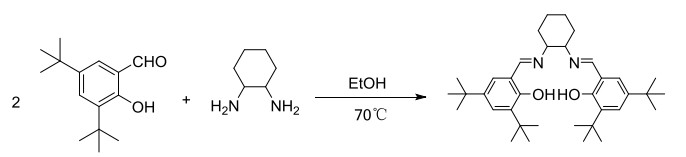

The reagents of 3, 5-di-tert-butyl-2-hydroxybenzaldehyde, cyclohexane-1, 2-diamine, cobalt(II) acetate tetrahydrate and lithium chloride were obtained as commercial sources without further purification. The solvents, ethanol, dichloromethane and methanol were obtained with further purification. Fourier transform infrared (FT-IR) spectra were determined on a Nicolet-5700 spectrometer with KBr pellets in the range of 4000~400 cm-1. 1H and 13C NMR spectra were recorded on Bruker ARX-400 spectrometers. The UV-visible absorption spectra were recorded on a UV1902 ultraviolet-visible spectrophotometer. Mass spectra were performed on DE-CAX-30000 LCQ Deca XP ESI-MS. Elemental analyses were obtained with an Elementar Vario EL (III) analyzer. Thermogravimetric analysis (TG) data were obtained under N2 atmosphere in the temperature from 30 to 600 ℃ at a heating rate of 10 ℃·min-1 on a METTLER TGA/SDTA851 apparatus.
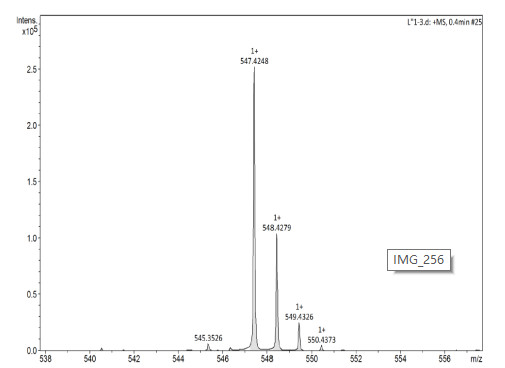
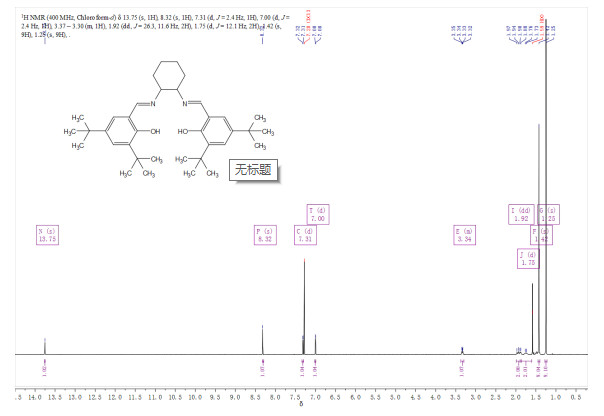
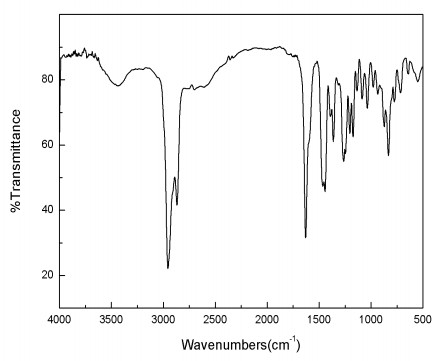
The solution of cyclohexane-1, 2-diamine (1 mmol, 11.62 mg) in ethanol (10 mL) was dropped into a solution of 3, 5-di-tert-butyl-2-hydroxybenzaldehyde (2 mmol, 47.01 mg) in ethanol (20 mL) with magnetic stirring, and then the mixture was heated to reflux under N2 atmosphere at 70 ℃ for 6 h. After that, the mixture was cooled to 0 ℃ and con-centrated by evaporating the solvent under reduced pressure in a rotary evaporator. Then, the compound was collected, washed thoroughly with ethanol and dried under vacuum. Yellow solid; yield 89%. m.p.: 157~160 ℃. Anal. Calcd. for C36H54N2O2: C, 79.07; H, 9.95; N, 5.12%. Found: C, 79.17; H, 9.91; N, 5.01%. IR (KBr, cm-1): 3441 (w), 2949 (s), 2876 (s), 2593 (w), 1627 (s), 1454 (s), 1372 (m), 1262 (s), 1180 (m), 1089 (w), 1035 (w), 834 (m), 779 (w), 725 (w). 1H NMR (400 MHz, CDCl3) TM 13.75 (s, 1H, OH), 8.32 (s, 1H, HC=N), 7.31 (d, J = 2.4 Hz, 1H, Ph–H), 7.00 (d, J = 2.4 Hz, 1H, Ph–H), 3.37~3.30 (m, 1H, C=N–CH), 1.92 (dd, J = 26.3, 11.6 Hz, 2H, CH2), 1.75 (d, J = 12.1 Hz, 2H, CH2), 1.42 (s, 9H, t-Bu), 1.25 (s, 9H, t-Bu). ESI-MS m/z: [M+H]+ Calcd. for C36H54N2O2 546.4258. Found: 547.4248.
The salen ligand (1 mmol) and sodium methoxide (1.5 mmol) were dissolved in methanol (10 mL) with magnetic stirring. Then, the solution was added to Co(AcO)2·4H2O (2 mmol) in methanol (10 mL), which was heated to reflux under N2 atmosphere for 5 h. The mixture was cooled to room temperature and added to LiCl (2.5 mmol) in methanol (10 mL) with stirring for 8 h under air. After filtration and crystallizing the complex with methanol, the product was obtained at 60 ℃ in vacuum. Dark red solid; yield 91%. Anal. Calcd. for C36H52ClCoN2O2: C, 67.65; H, 8.20; N, 4.38. Found (%): C, 67.69; H, 8.23; N, 4.40. IR (KBr, cm-1): 3450 (m), 2958 (s), 2867 (m), 1991 (w), 1599 (m), 1527 (m), 1445 (w), 1381 (w), 1335 (w), 1255 (m), 1180 (w), 1053 (w), 925 (w), 779 (w), 561 (w).
The catalyst (0.2 mmol) and TBAB (0.2 mmol) as cocatalyst with propylene oxide (PO) were dissolved in a Schlenk tube with magnetic stirring for 10 min under N2 atmosphere. Then the solution reacted under carbon dioxide atmosphere in a 100 mL stainless-steel autoclave equipped with a magnetic stirring bar. After required time, the residue was dissolved in CH2Cl2 and removed to a round-bottom flask to evaporate the solvent. The copolymerization was characterized by IR, 1H NMR and 13C NMR.
As shown in Fig. 1, molecular ion peak of the ligand was detected at m/z 547.4248, which is basically equal to the reported literature value of C36H54N2O2 to be 546.4258. The 1H NMR spectra in Fig. 2 exhibits the structure of the ligand is symmetrical. The peaks at 13.75, 8.32, 7.00, 3.34, 1.75, 1.42 and 1.25 ppm can be ascribed to the protons of hydroxyl group, HC=N bond, benzene ring, C=N–CH bond, cyclohexane, tertiary butyl group and tertiary butyl group, respectively. The number of protons of the chemical shift in 1H NMR spectrum of the ligand basically confirmed the synthesis of the ligand. However, in 1H NMR, the peaks at 8.32, 7.00, 3.74, 1.75, 1.44 and 1.26 ppm can be assigned to the protons of HC=N group, benzene ring, C=N–CH group, cyclohexane, tertiary butyl group and tertiary butyl group of the catalyst, respectively. Based on the above results, the number of protons of the chemical shift in 1H NMR spectrum of the complex accords with the desired catalyst, and the absence of hydroxyl group appears at 13.5 ppm, which confirms one metal is coordinated and the desired compound is formed.
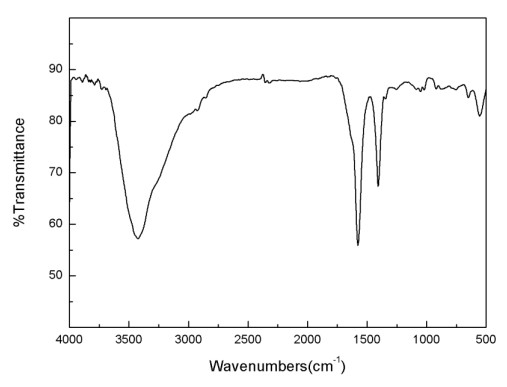
The IR spectra of Salen in Fig. 3 show a band at 1627 cm-1 belonging to the imine (vC=N) band in the Schiff base ligand, which reveals that the desired ligand has been successfully synthetized. And the IR spectra in Figs. 3 and 4 show that characteristic absorption peaks at 1627 and 1599 cm-1 are from the C=N of the ligand and catalyst, respectively. The above results revealed that the C=N stretching frequency of the catalyst was moved to lower frequency against the ligand, indicating the occurrence of red shift because of an electron absorption inductive effect of metal of the coordinate bond of the metal with the salen ligand. Under the same influence, the characteristic absorption peaks (from 1454 to 1445 cm-1 and 1262 to 1255 cm-1) were from the C=C bond, the C=O bond of the ligand and the catalyst, respectively.
To study the optimal reactivity of this catalyst system, we explored the influence of reaction temperature, CO2 pressure, reaction time and complex concentration on the copolymerization. Herein we summarize some representative results in Tables 1, 2, 3 and 4.
 DownLoad:
CSV
DownLoad:
CSV
| Run | Temperature (℃) | PO conversion (%)b | TOFPPC (h-1)c | TOFPC (h-1)c | Selectivity (%)d |
| 1 | 40 | 34.7 | 6.13×10³ | 2.32×10³ | 72.6 |
| 2 | 50 | 42.6 | 9.68×10³ | 0.69×10³ | 93.3 |
| 3 | 60 | 38.7 | 6.14×10³ | 3.27×10³ | 65.3 |
| 4 | 70 | 41.1 | 2.78×10³ | 7.22×10³ | 27.8 |
| 5 | 80 | 47.3 | -- | 11.5×10³ | -- |
| a polymerization condition: PO: cat: TBAB, 1500:1:1; Time, 6 h; pressure 3MPa. b fractional conversion of PO to PPC(PC) c TOF = mass of product (PPC or PC)/mole of catalyst/per hour d ratio of PPC in mixture |
|||||
DownLoad:
CSV
| Run | Pressure (MPa) | PO conversion (%)b | TOFPPC (h-1)c | TOFPC (h-1)c | Selectivity (%)d |
| 1 | 1 | 39.5 | 2.48×10³ | 7.13×10³ | 25.8 |
| 2 | 2 | 45.9 | 4.72×10³ | 6.46×10³ | 42.2 |
| 3 | 3 | 42.6 | 9.68×10³ | 0.69×10³ | 93.3 |
| 4 | 4 | 42.1 | 8.83×10³ | 1.41×10³ | 86.2 |
| a polymerization condition: PO: cat: TBAB, 1500:1:1; Time, 6 h; temperature 50 ºC. b fractional conversion of PO to PPC(PC) c TOF = mass of product(PPC or PC)/mole of catalyst/per hour d ratio of PPC in mixture |
|||||
DownLoad:
CSV
| Run | Time (h) | PO conversion (%)b | TOFPPC (h-1)c | TOFPC (h-1)c | Selectivity (%)d |
| 1 | 6 | 42.6 | 9.68×10³ | 0.69×10³ | 93.3 |
| 2 | 10 | 68.2 | 9.42×10³ | 0.54×10³ | 94.0 |
| 3 | 14 | 93.5 | 9.60×10³ | 0.51×10³ | 93.9 |
| 4 | 18 | 98.4 | 7.49×10³ | 0.50×10³ | 93.7 |
| a polymerization condition: PO: cat: TBAB, 1500:1:1; temperature 50 ℃; pressure 3 MPa. b fractional conversion of PO to PPC(PC) c TOF = mass of product(PPC or PC)/mole of catalyst/per hour d ratio of PPC in mixture |
|||||
DownLoad:
CSV
| Run | nPO/ncat | PO conversion (%)b | TOFPPC (h-1)c | TOFPC (h-1)c | Selectivity (%)d |
| 1 | 500 | 38.8 | 6.23×10³ | 3.21×10³ | 66.0 |
| 2 | 1000 | 44.2 | 7.22×10³ | 3.54×10³ | 67.1 |
| 3 | 1500 | 42.6 | 9.68×10³ | 0.69×10³ | 93.3 |
| 4 | 2000 | 42.3 | 8.98×10³ | 1.31×10³ | 87.3 |
| a polymerization condition: cat: TBAB, 1:1; temperature 50 ºC; pressure 3 MPa; time 6 h b fractional conversion of PO to PPC (PC) c TOF = mass of product (PPC or PC)/mole of catalyst/per hour d ratio of PPC in mixture |
|||||
The reaction temperature was a significant factor for the copolymerization. As shown in Table 1, by the complex/TBAB catalyst system, the copolymerization of PO and CO2 selectively resulted in the alternating copolymer at 40 ℃ in 6 h (PPC = 6.13 × 10³ g·mol-1·h-1, PC = 2.32 × 10³ g·mol-1·h-1; Run 1 in Table 1), although the reaction proceeded relatively slowly (TOFPPC + PC = 8.45 × 10³ g·mol-1·h-1). When up to 50 ℃, the TOFPPC + PC of the copolymer was slightly increased to 10.37 × 10³ g·mol-1·h-1 under otherwise similar conditions, with slightly increasing the selectivity (PPC = 9.68 × 10³ g·mol-1·h-1, PC = 0.69 × 10³ g·mol-1·h-1; Run 2 in Table 1). When the temperature rose again, the TOFPPC + PC values of the copolymer showed a downward trend. However, once the reaction temperature was increased to 80 ℃, the product was propylene carbonate (PC) instead of PPC. The decrease of TOFPPC for polycarbonate with the temperature increased may be caused by the high stability of PC and backbiting reaction of copolymer[13]. Therefore, the optimum reaction temperature is around 50 ℃ to get more PPC.
The effect of carbon dioxide pressure was a significant factor for the copolymerization. As is shown in Table 2, an increase of CO2 pressure from 1 to 3 MPa showed that selectivity for PPC over PC increased with increasing pressure. However, CO2 was pressurized to 4 MPa that gave rise to a slightly lowering selectivity might be mainly attributed to the volume of the solvent expanded and the solubility of the copolymerization decreased with the increase of CO2 pressure[14]. In summary, the optimum reaction pressure is around 3 MPa.
The effect of reaction time was a significant factor for copolymerization. As shown in Table 3, increasing the reaction time from 6 to 14 h resulted in a nearly two-fold enhancement in the PO conversion (Run 1, 2 and 3, Table 3). However, the increase of reaction time to 18 h resulted in a slight drop-off PO conversion. Above 14 h, the selectivity and TOFPPC decreased with the increasing reaction time, which might be caused by the concentration of monomer of PO decreased with reaction and the reduction of monomer of PO contacted with the catalytic center. In addition, with the copolymerization production increasing, viscosity in the system gradually increased, the catalyst was encapsulated and the activation centers gradually decreased[15]. Based on the above results, the optimum reaction time is 14 h.
The effect of monomer concentration of propylene oxide was a significant factor for copolymerization. As shown in Table 4, an increase of mole ratio of PO/catalyst form 500 to 1500 resulted in an enhancement in TOFPPC (Run 1, 2, 3, Table 4). However, the mole ratio of PO/catalyst increased to 2000. The fact that the TOFPPC decreased with the increasing concentration of PO might be caused by the following factors. More catalytic active centers and TOF increased when the monomer concentration of PO increased. However, as the monomer concentration of PO increased to a certain extent, the active centers of metal in the system were too enough to conduce to the formation of ploy(propylene carbonate). Therefore, the optimum molar ratio of PO/catalyst is 1500:1.
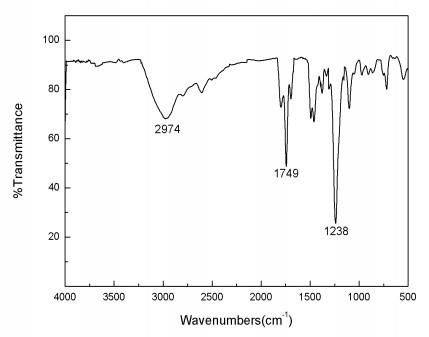
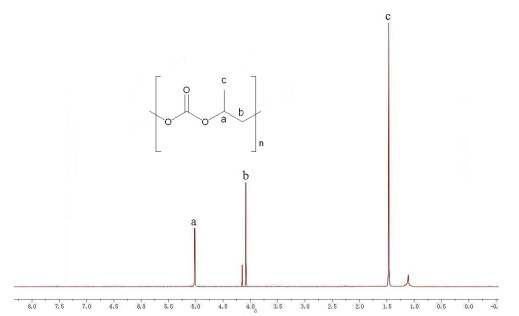
The IR spectra in Fig. 5 is similar to the general IR spectrum of ploy(propylene carbonate) (PPC). The absorption peaks are at 1238, 1749 and 2974 cm-1 from the C–O–C, C=O and CH3 of PPC, respectively. And the 1H NMR spectra of PPC is shown in Fig. 6, in which the peaks at TM = 1.48, 4.2 and 5.0 ppm were assigned to the protons of these groups, respectively. In the spectrum, we can not find the chemical shift in the range from 3.4 to 3.9 ppm. The above results reveal that PPC has been synthesized.
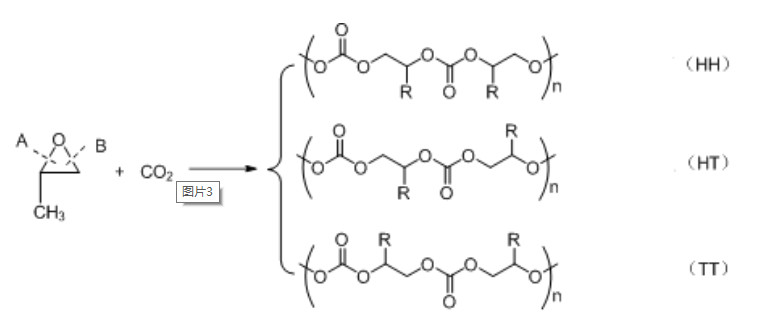
13C NMR spectra of PPC are shown in Fig. 7. The chemical shifts in the range from 153.6 to 154.8 ppm are assigned to the carbon of the OCOO of PPC. And the peaks (73.5, 69, 16.4 ppm) were assigned to the carbon of CH2, CH and CH3 of PPC, respectively. The triple peaks in the range between 153.6 and 154.8 ppm belonged to three regional chemical structures: Head to head (HH) (TM = 153.6 ppm), Head to tail (HT) (TM = 154.2 ppm), and Tail to tail (TT) (TM = 154.6 ppm), respectively in Fig. 8. The head-and-tail junction unit content was available from the following formula.
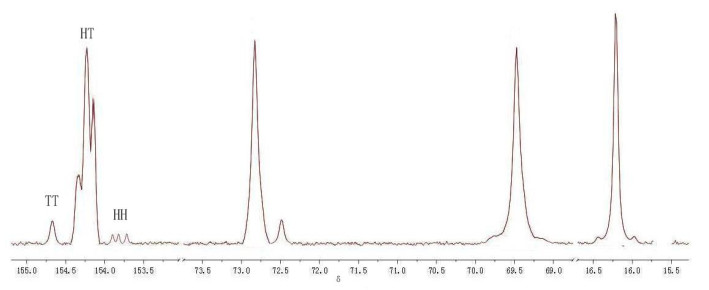
(Head-and-tail junction unit content) HT% = A154.2/(A154.6 + A154.2 + A153.6) = 80%
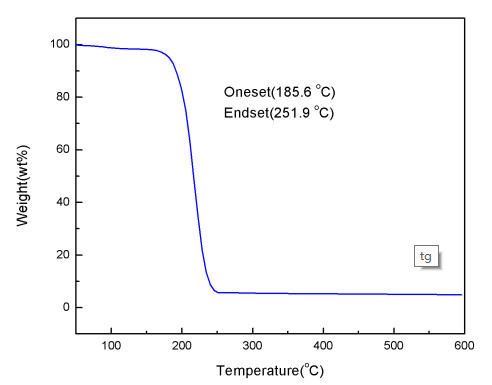
The above results showed that the catalyst was more inclined to open the ring on carbon atom of the methylene with lower steric resistance in Fig. 8, which also showed the ring-opening process mainly followed the nucleophilic ring-opening mechanism of SN2[16], and the catalytic selectivity was relatively good. In order to obtain the thermal stability of PPC, the thermogravimetric analysis has been put into effect from 100 to 600 ℃ under N2 atmosphere. As shown in Fig. 9, the beginning of weight loss indicated the decomposition of the complex. After that, the decomposition of PPC was completed over 251.9 ℃. The result demonstrates good thermal properties for the produced PPC.
In summary, a SalenCo(III)Cl was synthesized and characterized by IR, elemental analysis, 1H NMR and UV-Vis. The effect of catalyst in alternating copolymerization of CO2 and propylene oxide under different conditions of reaction time, reaction temperature, carbon dioxide pressure, and monomer concentration were investigated. In this process, the optimum molar ratio of PO/catalyst was 1500:1, the optimum reaction time was 14 h, the optimum reaction temperature was around 50 ℃ and the optimum reaction pressure was around 3 MPa. Moreover, the optimum catalytic activity of this complex was reached up to 9.68
Firouz, A. Q.; Torabi, F. Utilization of carbon dioxide and methane in huff- and -puff injection scheme to improve heavy oil recovery. Fuel 2014, 117, 966-973. doi: 10.1016/j.fuel.2013.10.040
Perathoner, S.; Centi, G. CO2 recycling: a key strategy to introduce green energy in the chemical production chain. ChemSusChem. 2014, 7, 1274-1282. doi: 10.1002/cssc.201300926
Chen, Q.; Lv, M.; Tang, Z. Y.; Wang, H.; Wei, W.; Sun, Y. H. Opportunities of integrated systems with CO2, utilization technologies for green fuel & chemicals production in a carbon-constrained society. J. CO2. Util. 2016, 14, 1-9. doi: 10.1016/j.jcou.2016.01.004
Darensbourg, D. J.; Mackiewicz, R. M.; Phelps, A. L.; Damon, R. B. Copolymerization of CO2 and epoxides catalyzed by metal salen complexes. Acc. Chem. Res. 2004, 37, 836-844. doi: 10.1021/ar030240u
Eberhardt, R.; Allmendinger, M.; Rieger, B. DMAP/Cr(III) catalyst ratio: the decisive factor for poly(propylene carbonate) formation in the coupling of CO2 and propylene oxide. Macromol. Rapid. Commun. 2010, 24, 194-196.
Rulev, Y. A.; Gugkaeva, Z.; Maleev, V. I.; Belokon, Y. N.; North, M. Robust bifunctional aluminium-salen catalysts for the preparation of cyclic carbonates from carbon dioxide and epoxides. Beilstein. J. Org. Chem. 2015, 11, 1614-1623. doi: 10.3762/bjoc.11.176
Niu, Y. S.; Li, H. C. Silica supported Schiff-base cobalt(III) complex-Lewis base system: a highly selective catalyst for alternating copolymerization of CO2 and propylene oxide. E-Polymers 2011, 11, 55-62. http://www.degruyter.com/view/j/epoly.2011.11.issue-1/epoly.2011.11.1.55/epoly.2011.11.1.55.xml
Darensbourg, D. J.; Yeung, A. D. Kinetics of the (salen)Cr(III) and (salen)Co(III) catalyzed copolymerization of epoxides with CO2, and of the accompanying degradation reactions. Poly. Chem. -UK. 2015, 6, 1103-1117. doi: 10.1039/C4PY01322K
Jacobsen, E. N. Asymmetric catalysis of epoxide ring-opening reactions. Acc. Chem. Res. 2000, 33, 421-431. doi: 10.1021/ar960061v
Liu, T. T.; Liang, J.; Xu, R.; Huang, Y. B.; Cao, R. Salen-Co(III) insertion in multivariate cationic metal-organic frameworks for the enhanced cycloaddition reaction of carbon dioxide. Chem. Commun. 2019, DOI: 10.1039/c8cc10268f.
Qin, Z.; Thomas, C. M.; Lee, S.; Coates, G. W. Cobalt-based complexes for the copolymerization of propylene oxide and CO2: active and selective catalysts for polycarbonate synthesis. Angew. Chem. Int. Ed. 2003, 42, 5484-5487. doi: 10.1002/anie.200352605
Darensbourg, D. J. Making plastics from carbon dioxide: salen metal complexes as catalysts for the production of polycarbonates from epoxides and CO2. Chem. Rev. 2007, 38, 2388-2410.
Lednor, P. W.; Rol, N. C. Copolymerization of propene oxide with carbon dioxide: a selective incorporation of propene oxide into the polycarbonate chains, determined by 100 MHz 13C NMR spectroscopy. J. Chem. Soc. Chem. Commun. 1985, 9, 598-599.
Lu, B. Y.; Gao, Y. H.; Zhao, X.; Yan, W. D.; Wang, X. H. Alternating copolymerization of carbon dioxide and propylene oxide under bifunctional cobalt salen complexes: role of Lewis base substituent covalent bonded on salen ligand. J. Polym. Sci. Pol. Chem. 2010, 48, 359-365. doi: 10.1002/pola.23792
Decortes, A.; Haak, R. M.; Martin, C.; Martin, E.; Belmonte, M. M.; Kleij, A. Copolymerization of CO2 and cyclohexene oxide mediated by Yb(salen)-based complexes. Macromolecules 2015, 48, 8197-8207. doi: 10.1021/acs.macromol.5b01880
Kember, M. R.; Buchard, A.; Williams, C. K. Catalysts for CO2/epoxide copolymerisation. Chem. Commun. 2011, 47, 141-163. doi: 10.1039/C0CC02207A
Table 1. Effect of Reaction Temperature on the PO/CO2 Copolymerizationa
| Run | Temperature (℃) | PO conversion (%)b | TOFPPC (h-1)c | TOFPC (h-1)c | Selectivity (%)d |
| 1 | 40 | 34.7 | 6.13×10³ | 2.32×10³ | 72.6 |
| 2 | 50 | 42.6 | 9.68×10³ | 0.69×10³ | 93.3 |
| 3 | 60 | 38.7 | 6.14×10³ | 3.27×10³ | 65.3 |
| 4 | 70 | 41.1 | 2.78×10³ | 7.22×10³ | 27.8 |
| 5 | 80 | 47.3 | -- | 11.5×10³ | -- |
| a polymerization condition: PO: cat: TBAB, 1500:1:1; Time, 6 h; pressure 3MPa. b fractional conversion of PO to PPC(PC) c TOF = mass of product (PPC or PC)/mole of catalyst/per hour d ratio of PPC in mixture |
|||||
 下载: 导出CSV
Table 2. Effect of CO2 Pressure on PO/CO2 Copolymerizationa
| Run | Pressure (MPa) | PO conversion (%)b | TOFPPC (h-1)c | TOFPC (h-1)c | Selectivity (%)d |
| 1 | 1 | 39.5 | 2.48×10³ | 7.13×10³ | 25.8 |
| 2 | 2 | 45.9 | 4.72×10³ | 6.46×10³ | 42.2 |
| 3 | 3 | 42.6 | 9.68×10³ | 0.69×10³ | 93.3 |
| 4 | 4 | 42.1 | 8.83×10³ | 1.41×10³ | 86.2 |
| a polymerization condition: PO: cat: TBAB, 1500:1:1; Time, 6 h; temperature 50 ºC. b fractional conversion of PO to PPC(PC) c TOF = mass of product(PPC or PC)/mole of catalyst/per hour d ratio of PPC in mixture |
|||||
下载: 导出CSV
Table 3. Effects of Reaction Time on the PO/CO2 Copolymerizationa
| Run | Time (h) | PO conversion (%)b | TOFPPC (h-1)c | TOFPC (h-1)c | Selectivity (%)d |
| 1 | 6 | 42.6 | 9.68×10³ | 0.69×10³ | 93.3 |
| 2 | 10 | 68.2 | 9.42×10³ | 0.54×10³ | 94.0 |
| 3 | 14 | 93.5 | 9.60×10³ | 0.51×10³ | 93.9 |
| 4 | 18 | 98.4 | 7.49×10³ | 0.50×10³ | 93.7 |
| a polymerization condition: PO: cat: TBAB, 1500:1:1; temperature 50 ℃; pressure 3 MPa. b fractional conversion of PO to PPC(PC) c TOF = mass of product(PPC or PC)/mole of catalyst/per hour d ratio of PPC in mixture |
|||||
下载: 导出CSV
Table 4. Effect of Complex Concentration on PO/CO2 Copolymerizationa
| Run | nPO/ncat | PO conversion (%)b | TOFPPC (h-1)c | TOFPC (h-1)c | Selectivity (%)d |
| 1 | 500 | 38.8 | 6.23×10³ | 3.21×10³ | 66.0 |
| 2 | 1000 | 44.2 | 7.22×10³ | 3.54×10³ | 67.1 |
| 3 | 1500 | 42.6 | 9.68×10³ | 0.69×10³ | 93.3 |
| 4 | 2000 | 42.3 | 8.98×10³ | 1.31×10³ | 87.3 |
| a polymerization condition: cat: TBAB, 1:1; temperature 50 ºC; pressure 3 MPa; time 6 h b fractional conversion of PO to PPC (PC) c TOF = mass of product (PPC or PC)/mole of catalyst/per hour d ratio of PPC in mixture |
|||||
下载: 导出CSV

 扫一扫看文章


扫一扫关注我们


 下载:
下载: